


 Скачать презентацию Emergency Management Education A Snapshot of the Community
00fd1cb0b0a136bab9b079f2e40f6c1e.ppt
- Количество слайдов: 44
 Emergency Management Education: A Snapshot of the Community 2009 FEMA Emergency Management Higher Education Program Report Carol L. Cwiak North Dakota State University
 Thank you! Thank you high ed community for your participation! Many thanks to Dr. Blanchard and Barbara Johnson for all they do for our community on a day-to-day basis!
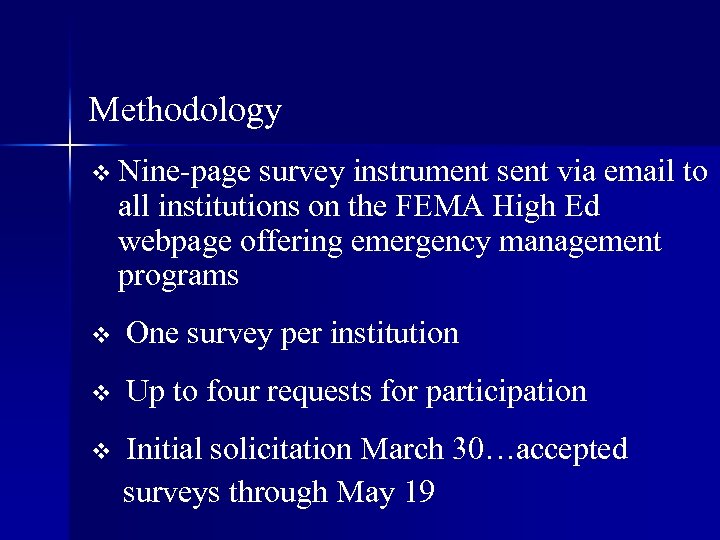 Methodology v Nine-page survey instrument sent via email to all institutions on the FEMA High Ed webpage offering emergency management programs v One survey per institution v Up to four requests for participation v Initial solicitation March 30…accepted surveys through May 19
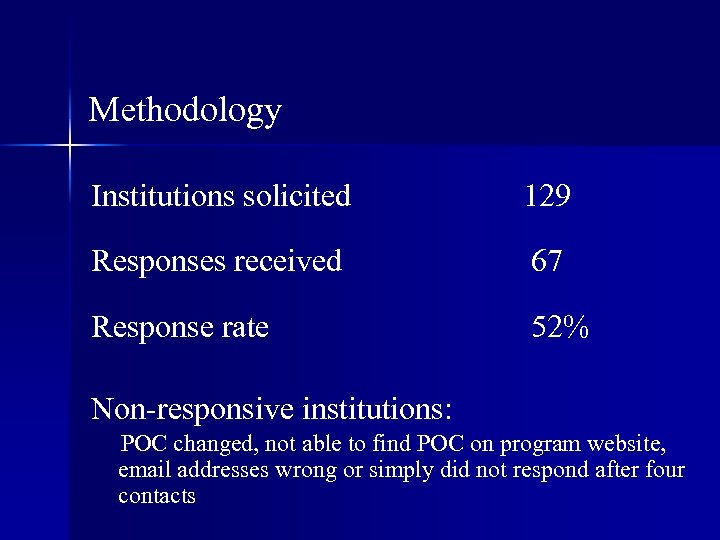 Methodology Institutions solicited 129 Responses received 67 Response rate 52% Non-responsive institutions: POC changed, not able to find POC on program website, email addresses wrong or simply did not respond after four contacts
 Methodology - Limitations v Hindsight is 20 -20 v This presentation is merely a brief summary of this year’s data collection v The full report will be posted on the High Ed website in the Surveys section: http: //www. training. fema. gov/EMIWeb/edu/surveys. asp
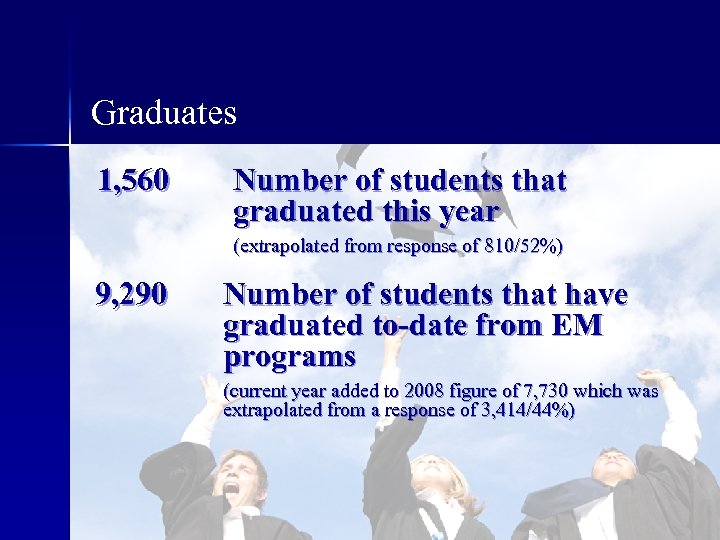 Graduates 7, 730 1, 560 Number ofof students that Number students that graduated this year (extrapolated from response of 3, 414/44%) (extrapolated from response of 810/52%) 9, 290 Number of students that have graduated to-date from EM programs (current year added to 2008 figure of 7, 730 which was extrapolated from a response of 3, 414/44%)
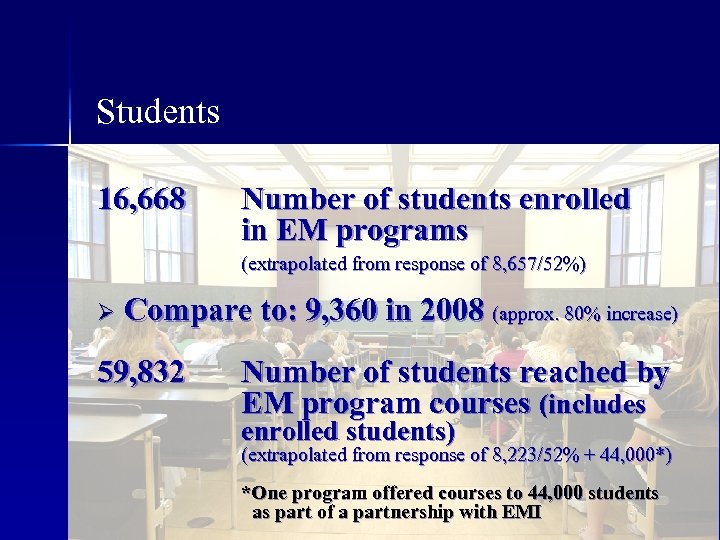 Students 16, 668 Number of students enrolled in EM programs (extrapolated from response of 8, 657/52%) Ø Compare to: 9, 360 in 2008 (approx. 80% increase) 59, 832 Number of students reached by EM program courses (includes enrolled students) (extrapolated from response of 8, 223/52% + 44, 000*) *One program offered courses to 44, 000 students as part of a partnership with EMI
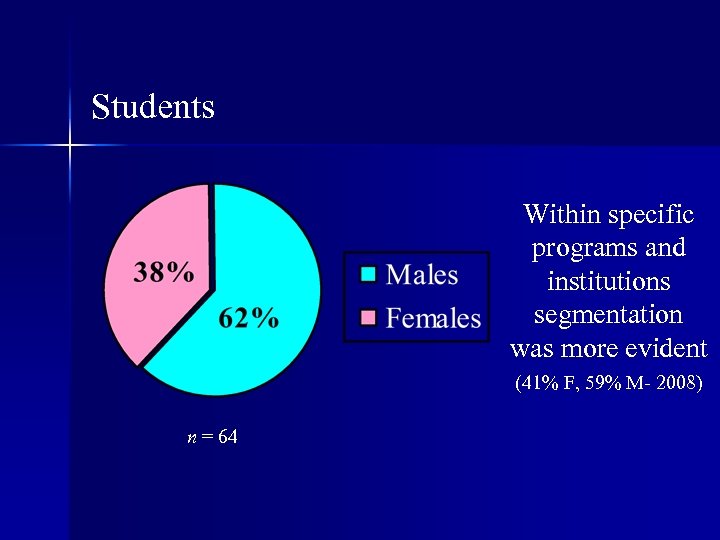 Students Within specific programs and institutions segmentation was more evident (41% F, 59% M- 2008) n = 64
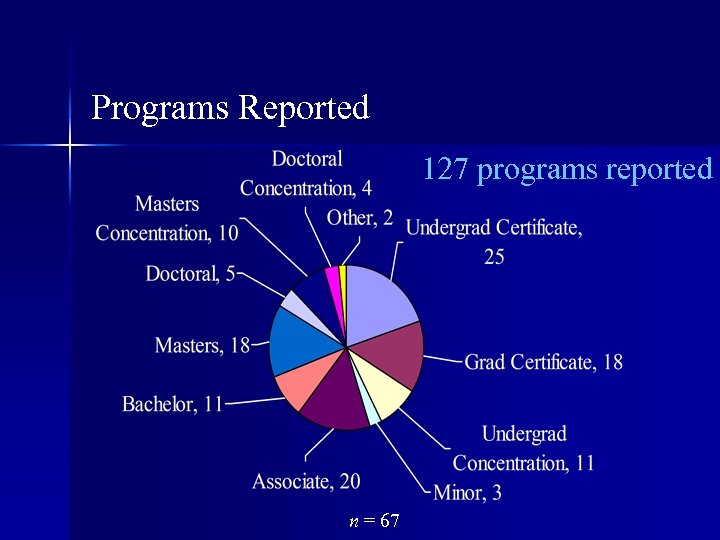 Programs Reported 127 programs reported n = 67
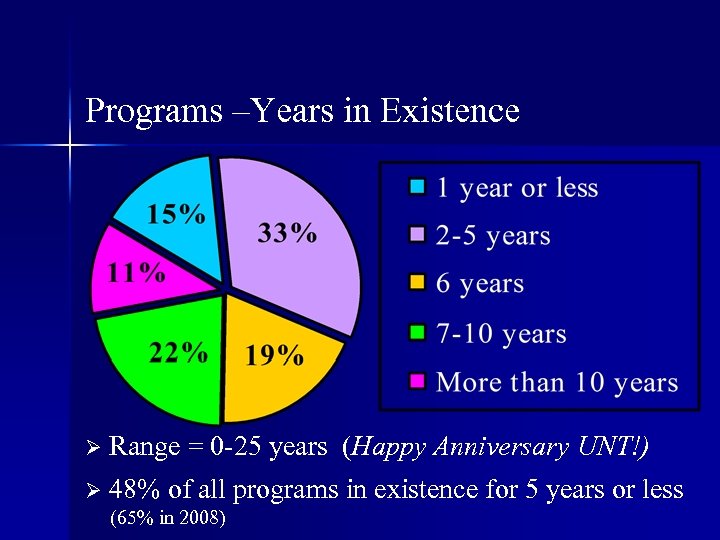 Programs –Years in Existence Ø Range = 0 -25 years (Happy Anniversary UNT!) Ø 48% of all programs in existence for 5 years or less (65% in 2008)
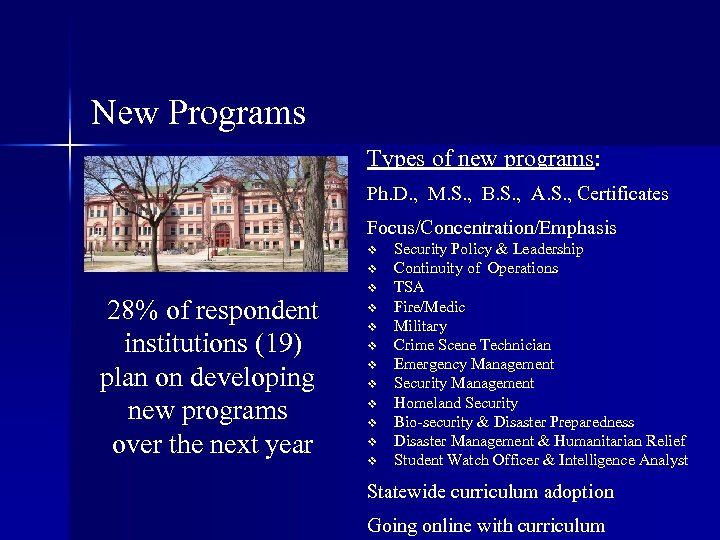 New Programs Types of new programs: Ph. D. , M. S. , B. S. , A. S. , Certificates Focus/Concentration/Emphasis v v 28% of respondent institutions (19) plan on developing new programs over the next year v v v v v Security Policy & Leadership Continuity of Operations TSA Fire/Medic Military Crime Scene Technician Emergency Management Security Management Homeland Security Bio-security & Disaster Preparedness Disaster Management & Humanitarian Relief Student Watch Officer & Intelligence Analyst Statewide curriculum adoption Going online with curriculum
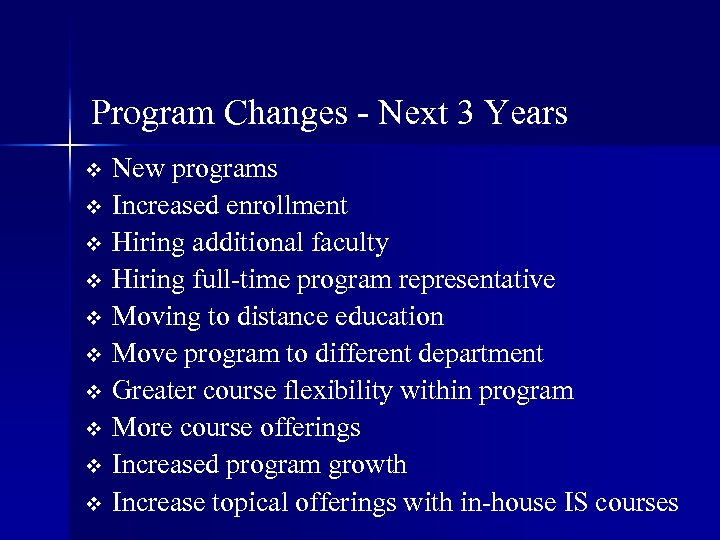 Program Changes - Next 3 Years New programs v Increased enrollment v Hiring additional faculty v Hiring full-time program representative v Moving to distance education v Move program to different department v Greater course flexibility within program v More course offerings v Increased program growth v Increase topical offerings with in-house IS courses v
 Program Changes - Next 3 Years Greater competition for students v Decreases related to economic downturn v Greater involvement in the LEPC v Refine/fine-tune course offerings/program v More digital video streaming v Offer program internationally via partnerships v More technical courses v Greater focus on grants and research with students v More support resources expected – financial & course material v
 Program Changes - Next 3 Years Changing demographic at two year technical colleges v Integrating both HS and EM student markets v Restructuring to include FEMA High Ed courses v Dealing with employment perceptions in the field v Increase practical exercises and hands-on experiences v
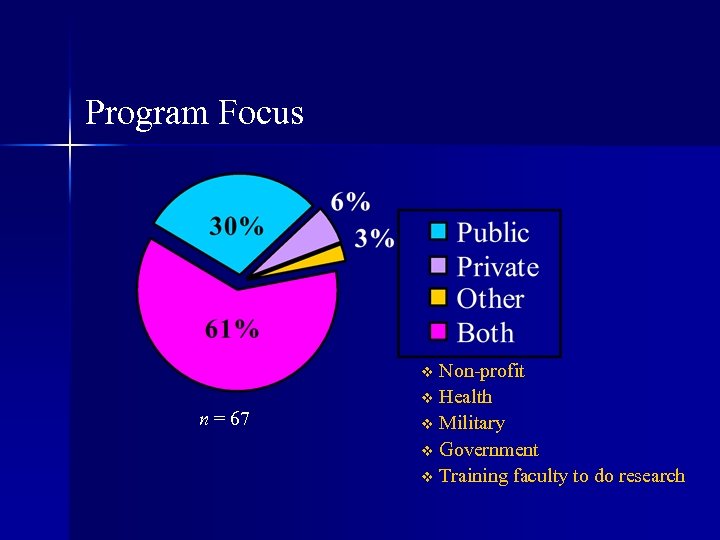 Program Focus Non-profit v Health v Military v Government v Training faculty to do research v n = 67
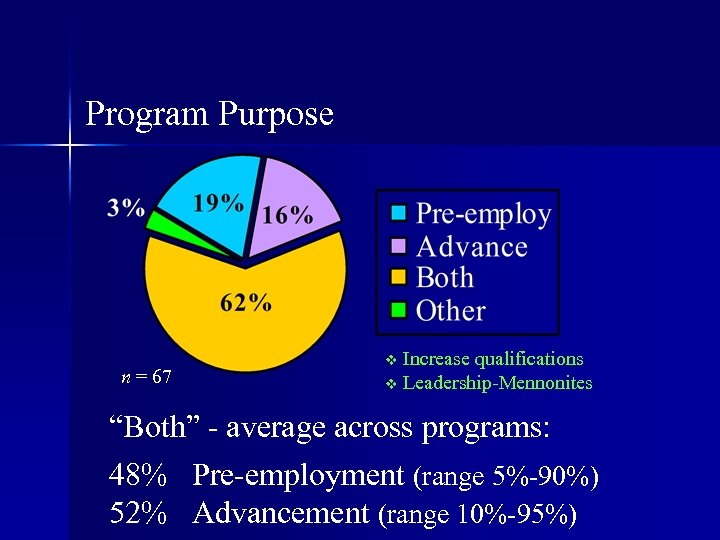 Program Purpose n = 67 Increase qualifications v Leadership-Mennonites v “Both” - average across programs: 48% Pre-employment (range 5%-90%) 52% Advancement (range 10%-95%)
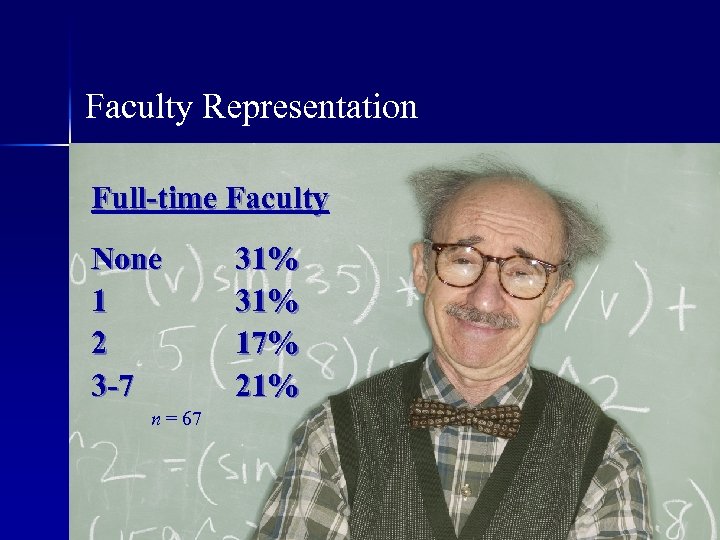 Faculty Representation Full-time Faculty None 1 2 3 -7 n = 67 31% 17% 21%
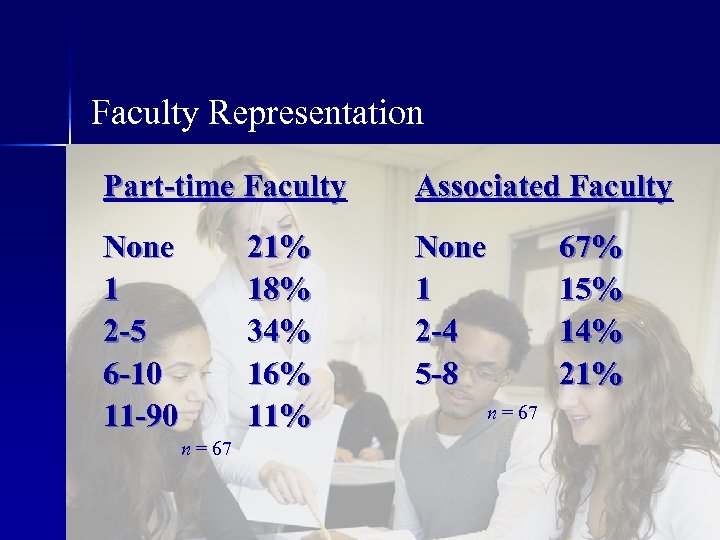 Faculty Representation Part-time Faculty Associated Faculty None 1 2 -5 6 -10 11 -90 None 1 2 -4 5 -8 21% 18% 34% 16% 11% n = 67 67% 15% 14% 21%
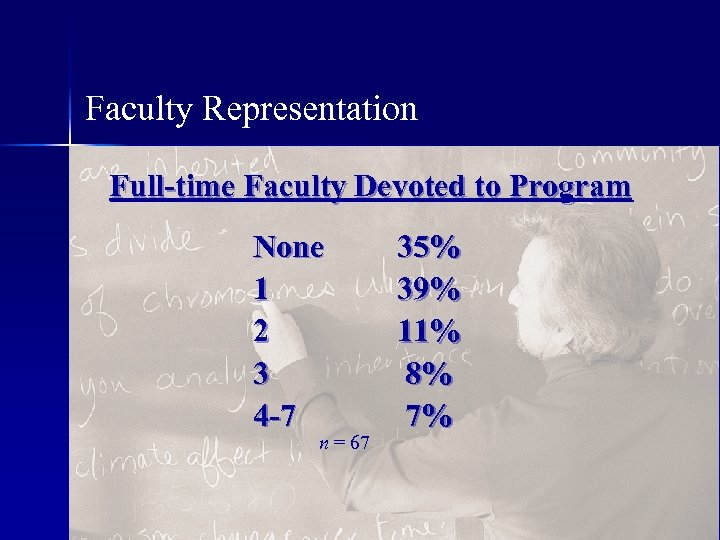 Faculty Representation Full-time Faculty Devoted to Program None 1 2 3 4 -7 n = 67 35% 39% 11% 8% 7%
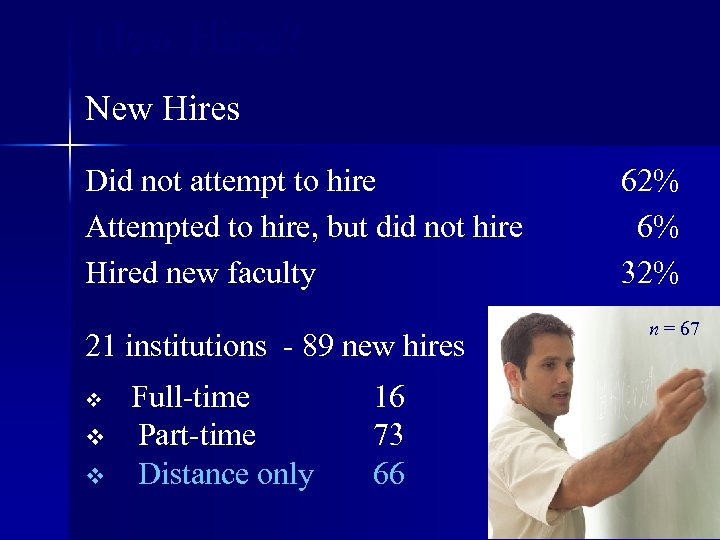 New Hires? New Hires Did not attempt to hire Attempted to hire, but did not hire Hired new faculty 21 institutions - 89 new hires v v v Full-time Part-time Distance only 16 73 66 62% 6% 32% n = 67
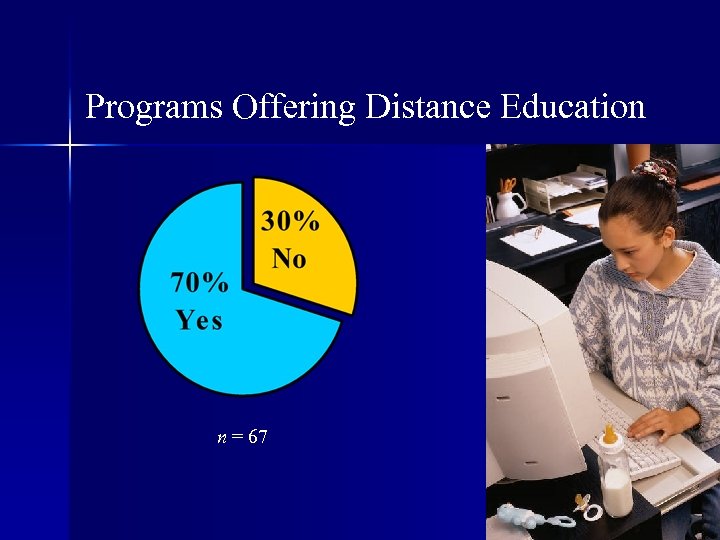 Programs Offering Distance Education n = 67
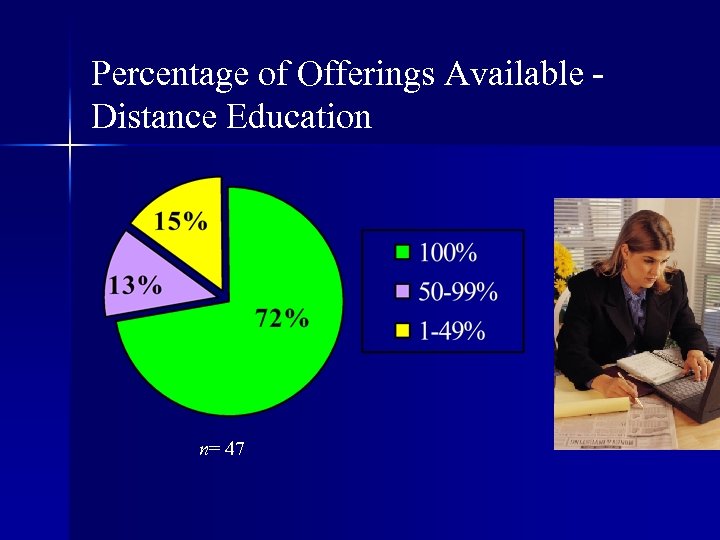 Percentage of Offerings Available Distance Education n= 47
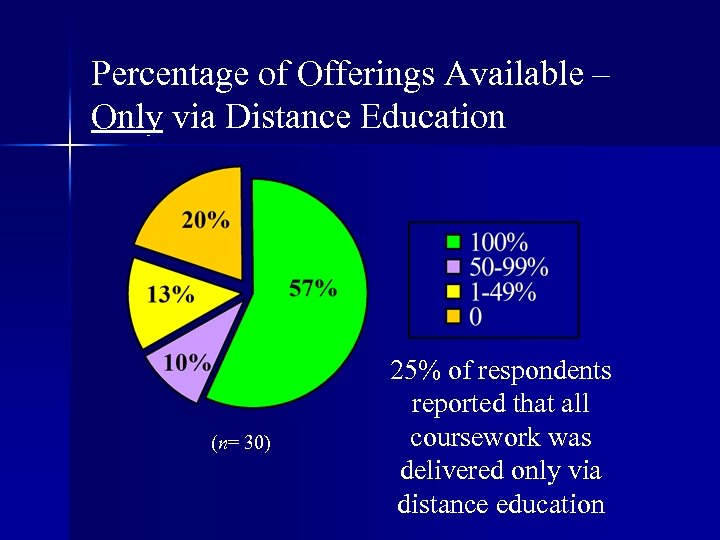 Percentage of Offerings Available – Only via Distance Education (n= 30) 25% of respondents reported that all coursework was delivered only via distance education
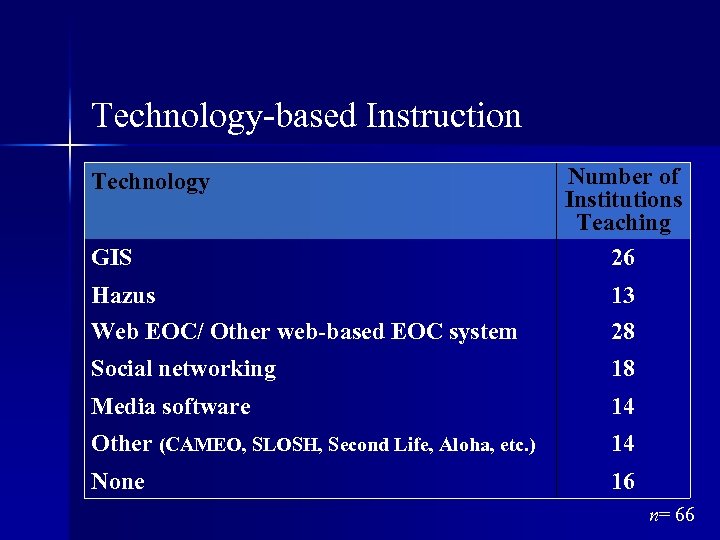 Technology-based Instruction Technology GIS Number of Institutions Teaching 26 Hazus Web EOC/ Other web-based EOC system 13 28 Social networking 18 Media software 14 Other (CAMEO, SLOSH, Second Life, Aloha, etc. ) 14 None 16 n= 66
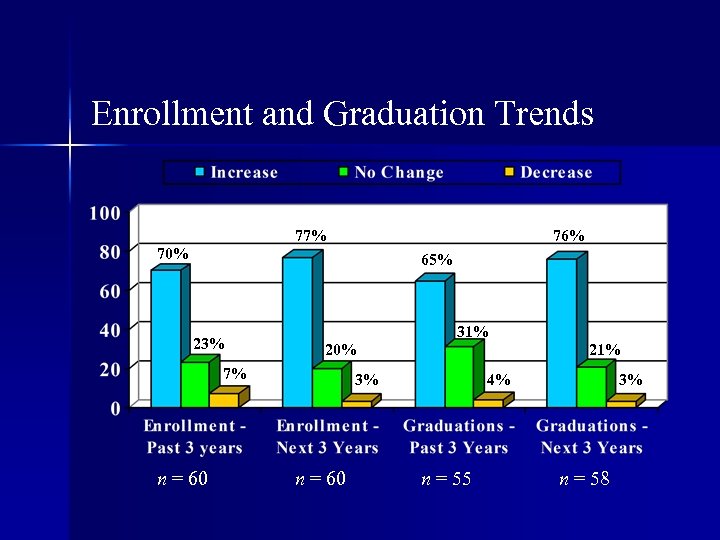 Enrollment and Graduation Trends 77% 76% 70% 65% 23% 31% 20% 7% n = 60 21% 3% n = 60 4% n = 55 3% n = 58
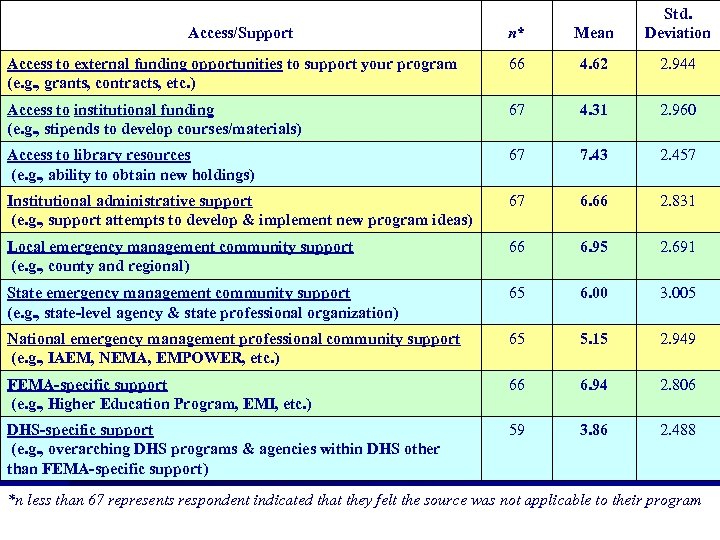 n* Mean Std. Deviation Access to external funding opportunities to support your program (e. g. , grants, contracts, etc. ) 66 4. 62 2. 944 Access to institutional funding (e. g. , stipends to develop courses/materials) 67 4. 31 2. 960 Access to library resources (e. g. , ability to obtain new holdings) 67 7. 43 2. 457 Institutional administrative support (e. g. , support attempts to develop & implement new program ideas) 67 6. 66 2. 831 Local emergency management community support (e. g. , county and regional) 66 6. 95 2. 691 State emergency management community support (e. g. , state-level agency & state professional organization) 65 6. 00 3. 005 National emergency management professional community support (e. g. , IAEM, NEMA, EMPOWER, etc. ) 65 5. 15 2. 949 FEMA-specific support (e. g. , Higher Education Program, EMI, etc. ) 66 6. 94 2. 806 DHS-specific support (e. g. , overarching DHS programs & agencies within DHS other than FEMA-specific support) 59 3. 86 2. 488 Access/Support Table 2 - Representation Across Program Level *n less than 67 represents respondent indicated that they felt the source was not applicable to their program.
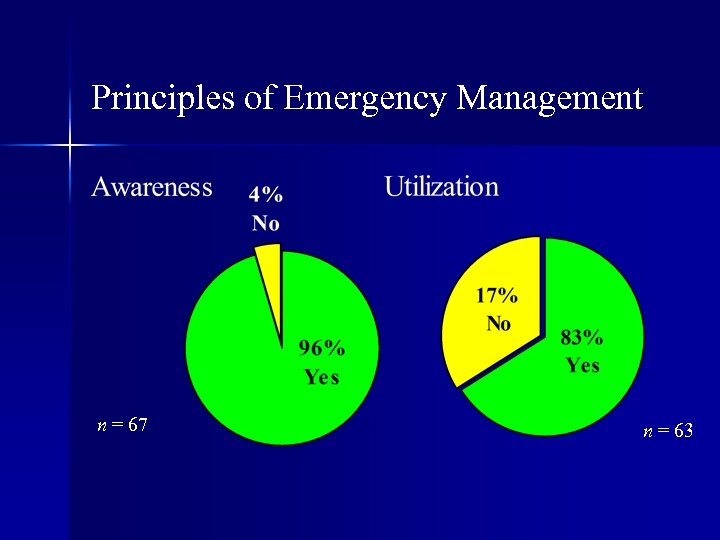 Principles of Emergency Management n = 67 n = 63
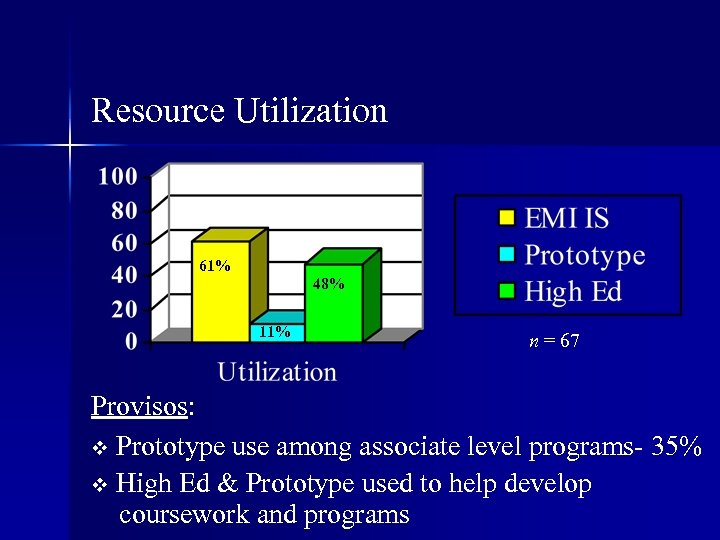 Resource Utilization 61% 48% 11% n = 67 Provisos: v Prototype use among associate level programs- 35% v High Ed & Prototype used to help develop coursework and programs
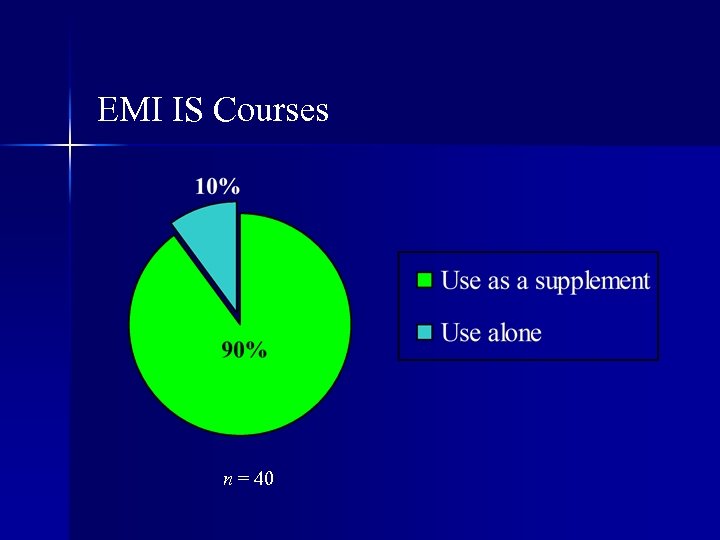 EMI IS Courses n = 40
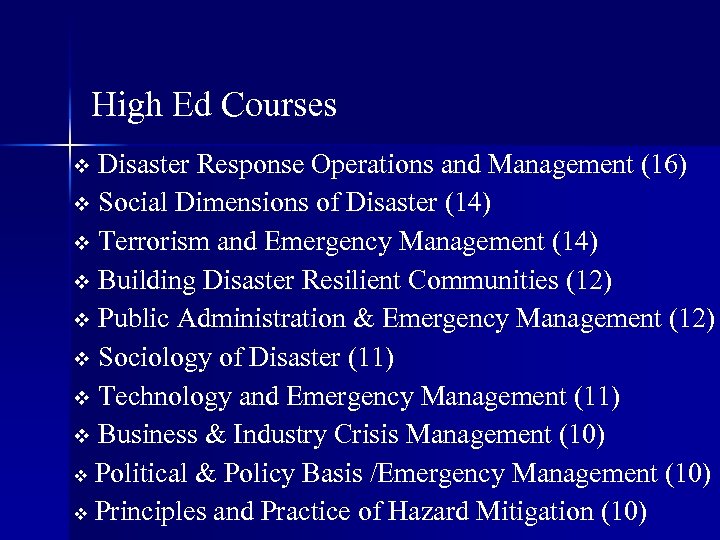 High Ed Courses Disaster Response Operations and Management (16) v Social Dimensions of Disaster (14) v Terrorism and Emergency Management (14) v Building Disaster Resilient Communities (12) v Public Administration & Emergency Management (12) v Sociology of Disaster (11) v Technology and Emergency Management (11) v Business & Industry Crisis Management (10) v Political & Policy Basis /Emergency Management (10) v Principles and Practice of Hazard Mitigation (10) v
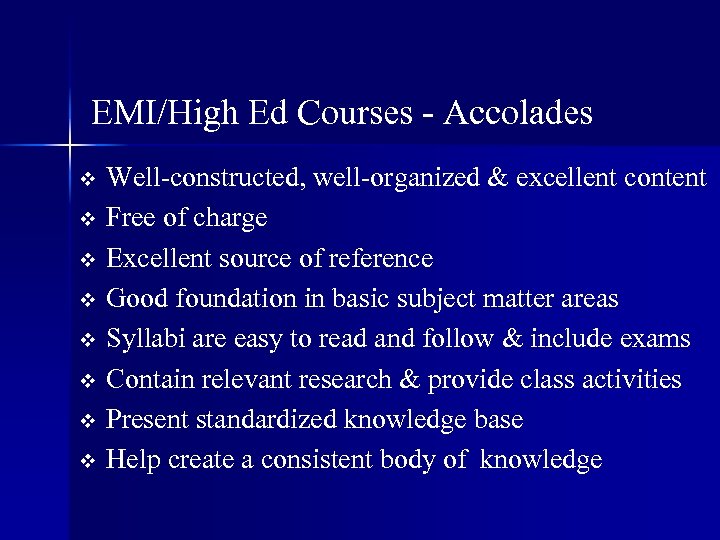 EMI/High Ed Courses - Accolades Well-constructed, well-organized & excellent content v Free of charge v Excellent source of reference v Good foundation in basic subject matter areas v Syllabi are easy to read and follow & include exams v Contain relevant research & provide class activities v Present standardized knowledge base v Help create a consistent body of knowledge v
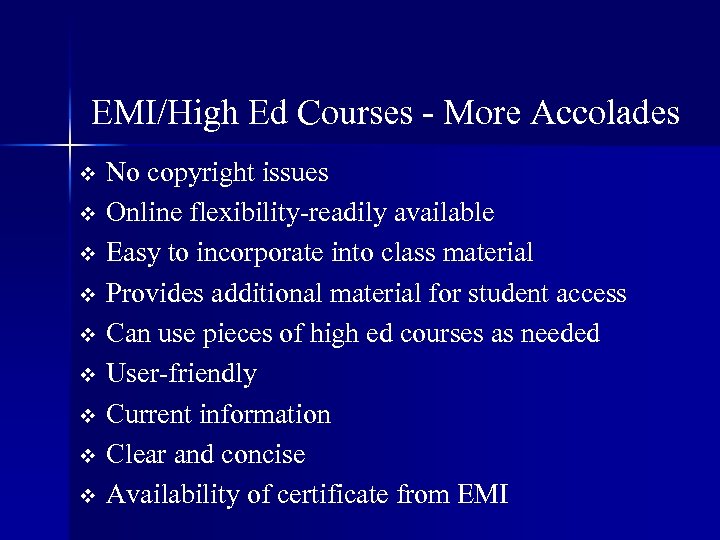 EMI/High Ed Courses - More Accolades No copyright issues v Online flexibility-readily available v Easy to incorporate into class material v Provides additional material for student access v Can use pieces of high ed courses as needed v User-friendly v Current information v Clear and concise v Availability of certificate from EMI v
 EMI/High Ed Courses - Requests v v v More advertising and awareness for programs Online forums/discussion boards Crossover between EMI courses and high ed courses Structured curriculum recommendations Open courses for additional input Short books on EM topics More collaborative opportunities for high ed community Regional high ed meetings More advertising for honor society – Epsilon Pi Phi Textbook reviews Downloadable instructional modules and multimedia files for Blackboard/LMS
 EMI/High Ed Courses - Requests v v v More courses Continued course updates Recommended readings by topic area More interactive cases and simulations online Actual photos that relate to the material being discussed (EMI courses) Instructor Power. Point presentations for EMI courses Improve timing in testing/grading area (EMI courses) Public/private partnering course Increase depth of materials Course development by faculty with real world experience More research-focused courses
 EMI/High Ed Courses - Requests v v v v v Posters, fact sheets, visual aids Database of syllabi Activities and classroom exercises that emphasize material/theory More videos, DVDs and online clips Webinars and videoconferences International Disasters course Incorporate content/media options to support distance ed More courses at entry-level Update videos and training materials
 EMI/High Ed Courses - Improvements v v Live exercise for students E-books More challenging associate degree level courses More sophisticated technology to keep younger students’ attention
 High Ed Program - aka Dr. Blanchard & Barbara “We have been exceptionally pleased with the support and networking offered by the Higher Education Program. ” “Doing a great job!” “Thank you for all you do for the higher education community!” “Running the Higher Education Program is a Herculean task…when is someone from FEMA going to snap out of it and get Wayne and Barbara some help? !”
 Competencies v Most important areas of competency in emergency management v 2008 - surveyed KSAs v Are competencies and KSAs different?
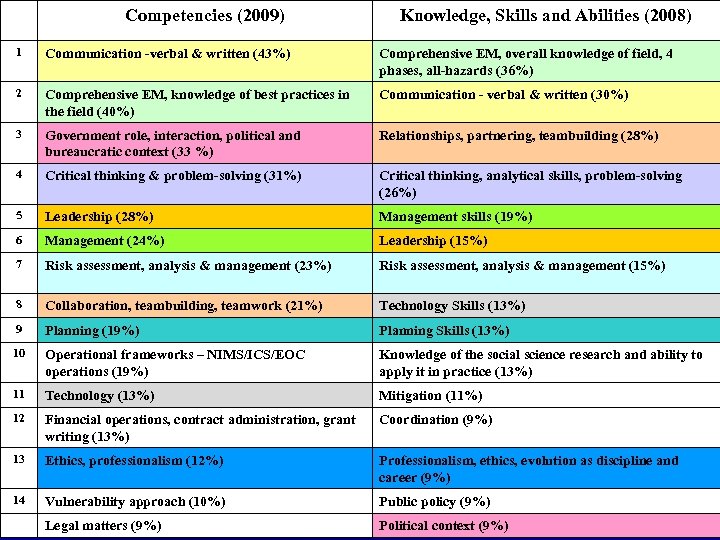 Competencies (2009) Knowledge, Skills and Abilities (2008) 1 Communication -verbal & written (43%) Comprehensive EM, overall knowledge of field, 4 phases, all-hazards (36%) 2 Comprehensive EM, knowledge of best practices in the field (40%) Communication - verbal & written (30%) 3 Government role, interaction, political and bureaucratic context (33 %) Relationships, partnering, teambuilding (28%) 4 Critical thinking & problem-solving (31%) Critical thinking, analytical skills, problem-solving (26%) 5 Leadership (28%) Management skills (19%) 6 Management (24%) Leadership (15%) 7 Risk assessment, analysis & management (23%) Risk assessment, analysis & management (15%) 8 Collaboration, teambuilding, teamwork (21%) Technology Skills (13%) 9 Planning (19%) Planning Skills (13%) 10 Operational frameworks – NIMS/ICS/EOC operations (19%) Knowledge of the social science research and ability to apply it in practice (13%) 11 Technology (13%) Mitigation (11%) 12 Financial operations, contract administration, grant writing (13%) Coordination (9%) 13 Ethics, professionalism (12%) Professionalism, ethics, evolution as discipline and career (9%) 14 Vulnerability approach (10%) Public policy (9%) 15 Legal matters (9%) Political context (9%) Competencies
 The Top Challenges Facing Emergency Management Programs 1. Funding (31%) Programs, faculty, research, students 2. Faculty (20%) Ph. D. , experience, research ability, quality candidates 3. Student recruitment (16%) Higher quality students, better marketing, increased competition
 The Top Challenges Facing Emergency Management Programs 4. Lack of political understanding/support (15%) Political appointees who do not understand the importance of EM or EM high ed 5. DHS/FEMA (15%) DHS influence disruptive, oversight over FEMA causes problems, no balance 6. Academic legitimacy (15%) Fighting for recognition within the larger academic community
 The Top Challenges Facing Emergency Management Programs 7. Jobs/careers (12%) Lack of jobs, career path options not apparent 8. Books/journal articles (10%) Quality material needed, should be written by qualified folks 9. Connection between the field and academia (9%)
 An invitation… v Created to represent the interests and concerns of the EM high ed community Board Members and Executive Director Kay Goss, CEM John Mc. Kay, M. A. Ellis Stanley, CEM Practitioner Community All EM high ed programs are invited to join the Consortium Greg Shaw, D. Sc. , CBCP Doctoral Programs v Each member institution has a vote Jane Kushma, Ph. D. , ACSW Master Programs v There is no cost to join v v All member institutions will be listed on the Consortium’s web page and can display the logo on their program page David Mc. Entire, Ph. D. Bachelor Programs J. D. Richardson, MA. Ed Associate Programs Rick Bissell, Ph. D. Certificate Programs Carol Cwiak, J. D. Executive Director
 Calls, letters, emails, visits, gifts… Carol L. Cwiak Department of Sociology, Anthropology, and Emergency Management North Dakota State University Dept. 2350 P. O. Box 6050 Fargo, ND 58108 -6050 (701) 231 -5847 carol. cwiak@ndsu. edu www. ndsu. edu/ndsu/em