


 Скачать презентацию Emergency Exit Detector Team Kelly MDR Presentation Team
5ff7fab2d954f9231780e8d9933c269b.ppt
- Количество слайдов: 22
 Emergency Exit Detector Team Kelly MDR Presentation Team Members Leonardo Mascarenhas Ernald Nicolas Krystina Pysz David Vega 1
 Motivation September 11, 2001 South Tower • four civilians escaped on Stairwell A from 80 th floor or above • one specific evacuee switched from one impassable staircase to a clear one North Tower • one group below the fire repeatedly called 911 asking for the fire’s location • this group is presumed dead because 911 advised them to remain on the 83 rd floor 2
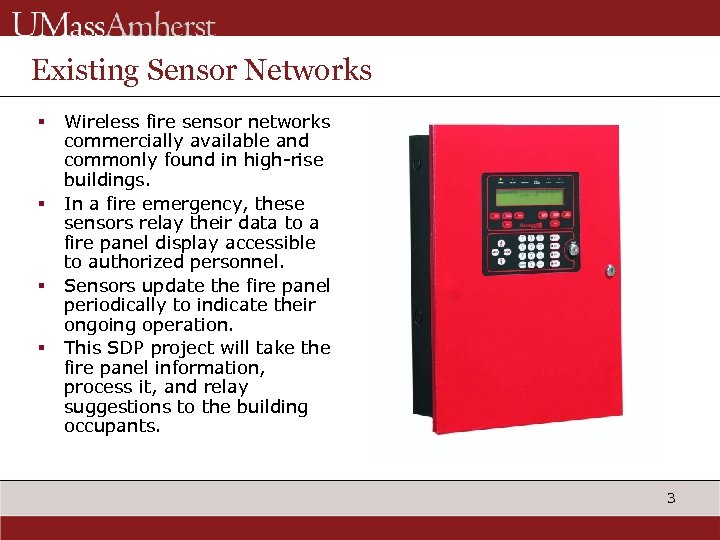 Existing Sensor Networks § § Wireless fire sensor networks commercially available and commonly found in high-rise buildings. In a fire emergency, these sensors relay their data to a fire panel display accessible to authorized personnel. Sensors update the fire panel periodically to indicate their ongoing operation. This SDP project will take the fire panel information, process it, and relay suggestions to the building occupants. 3
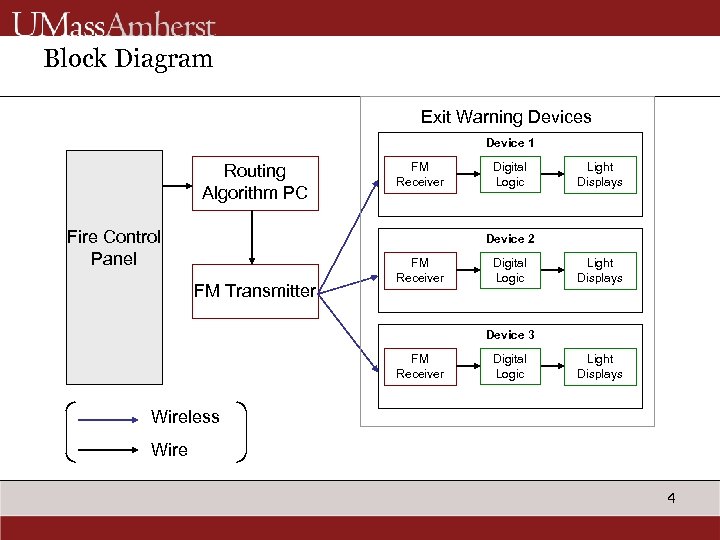 Block Diagram Exit Warning Devices Device 1 Routing Algorithm PC Fire Control Panel FM Receiver FSM Digital (A/D) Logic Light Displays Device 2 FM Transmitter FM Receiver Digital FSM Logic (A/D) Light Displays Device 3 FM Receiver Digital Logic Light Displays Wireless Wire 4
 MDR Specifications § Detailed block diagram of routing algorithm design. § One wireless transmitter capable of sweeping through four different frequencies. • Transmitter sweep will consist of sine waves without modulation. • Transmitter will reach receiver at a distance of at least 10 meters. § One wireless receiver unit attuned only to one particular broadcast frequency. • Receiver will be able to switch its light display off, green, and red. • Receiver will not respond to frequencies outside of its pass-band. 5
 Algorithm 1. Flowchart of Algorithm 2. Example Scenario 3. Algorithm and Transmission
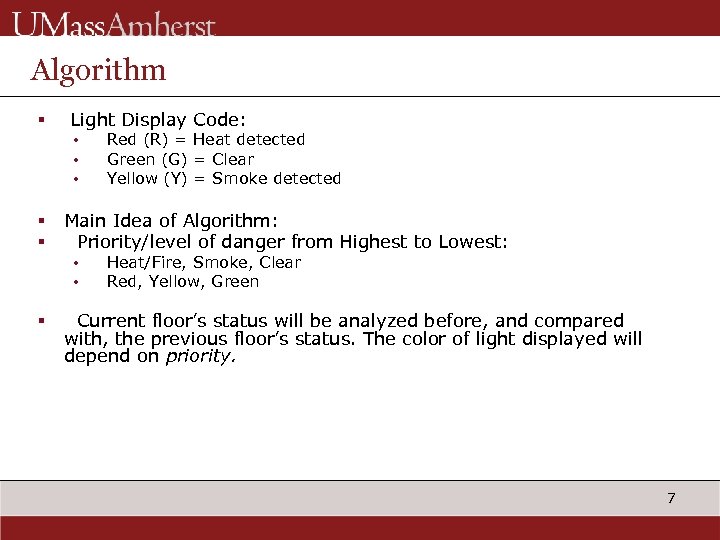 Algorithm § Light Display Code: • • • § § Main Idea of Algorithm: Priority/level of danger from Highest to Lowest: • • § Red (R) = Heat detected Green (G) = Clear Yellow (Y) = Smoke detected Heat/Fire, Smoke, Clear Red, Yellow, Green Current floor’s status will be analyzed before, and compared with, the previous floor’s status. The color of light displayed will depend on priority. 7
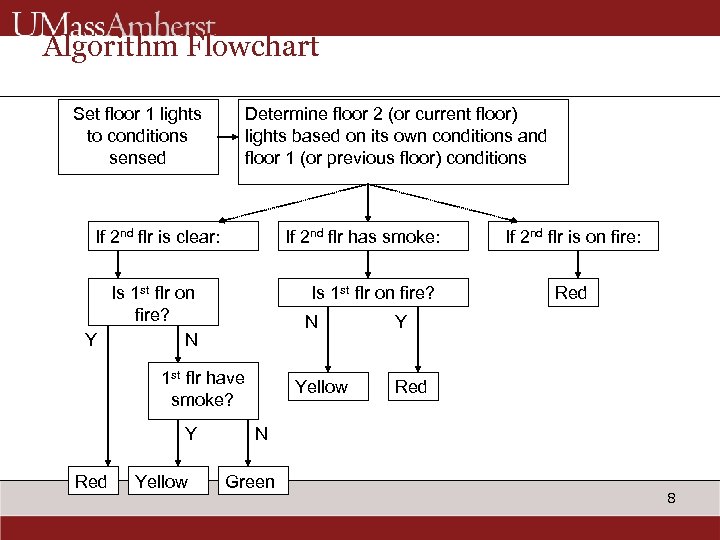 Algorithm Flowchart Determine floor 2 (or current floor) lights based on its own conditions and floor 1 (or previous floor) conditions Set floor 1 lights to conditions sensed If 2 nd flr has smoke: If 2 nd flr is clear: Is 1 st flr on fire? Y N Is 1 st flr on fire? N 1 st flr have smoke? Y Red Yellow If 2 nd flr is on fire: Red Y Red N Green 8
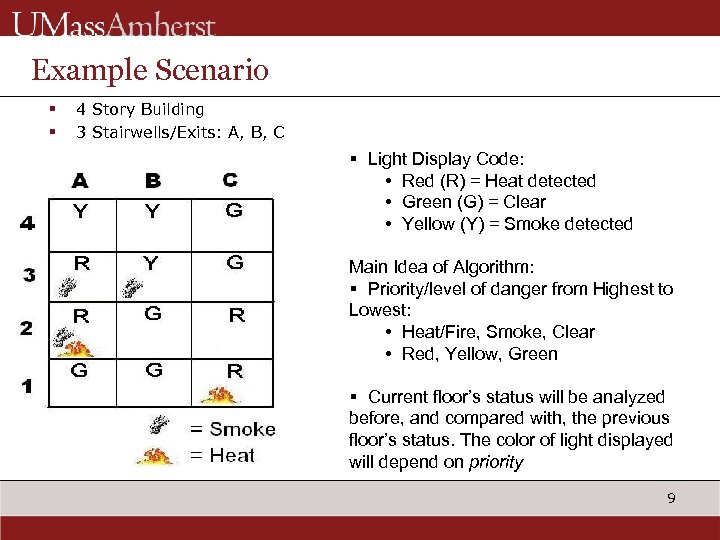 Example Scenario § § 4 Story Building 3 Stairwells/Exits: A, B, C § Light Display Code: • Red (R) = Heat detected • Green (G) = Clear • Yellow (Y) = Smoke detected Main Idea of Algorithm: § Priority/level of danger from Highest to Lowest: • Heat/Fire, Smoke, Clear • Red, Yellow, Green § Current floor’s status will be analyzed before, and compared with, the previous floor’s status. The color of light displayed will depend on priority 9
 Algorithm and Transmission § Transmission to change light color will occur only if status of sensor has changed from previous check. § Plan: Save matrix of previous sensor data and compare with new matrix to see which have changed. 10
 FM Transmitter § What is new from PDR design? • Changed from FSK chip to FM chip. • FM fits our needs better. • We are transmitting simple data. • Input will be a sum of sinusoidal waves. • It will transmit different messages at the same fc. • Addition of microcontroller to generate desired message. § § What is the Chip we are using? • The Motorola MC 2833 (Low Power FM Transmitter). • Has an output power in the range of 5 d. Bm to 10 d. Bm. What the design look like? 11
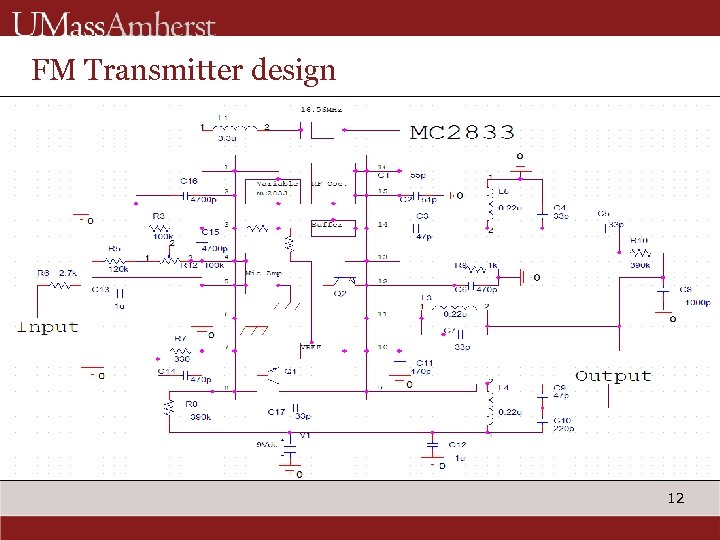 FM Transmitter design 12
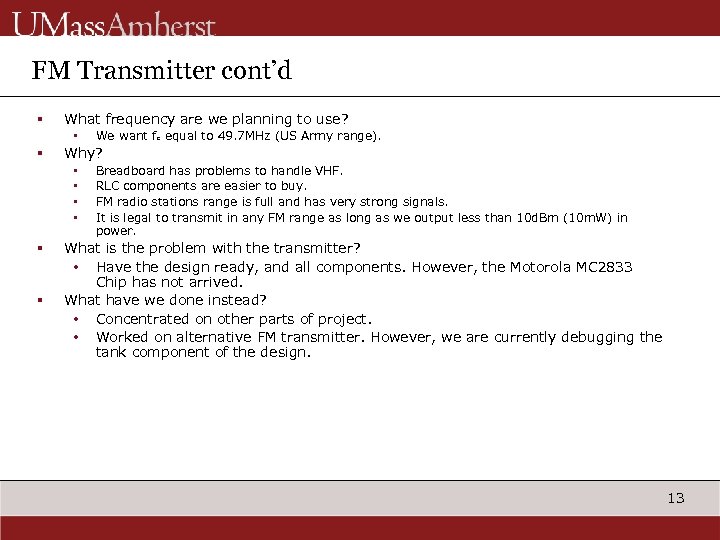 FM Transmitter cont’d § What frequency are we planning to use? • § Why? • • § § We want fc equal to 49. 7 MHz (US Army range). Breadboard has problems to handle VHF. RLC components are easier to buy. FM radio stations range is full and has very strong signals. It is legal to transmit in any FM range as long as we output less than 10 d. Bm (10 m. W) in power. What is the problem with the transmitter? • Have the design ready, and all components. However, the Motorola MC 2833 Chip has not arrived. What have we done instead? • Concentrated on other parts of project. • Worked on alternative FM transmitter. However, we are currently debugging the tank component of the design. 13
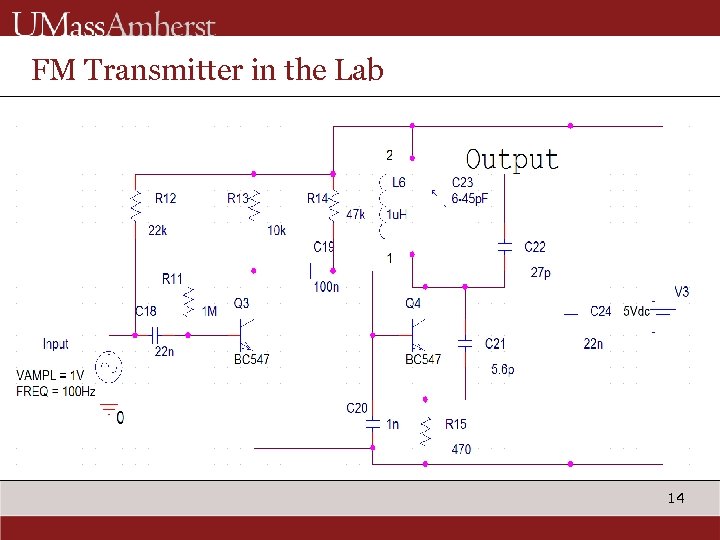 FM Transmitter in the Lab 14
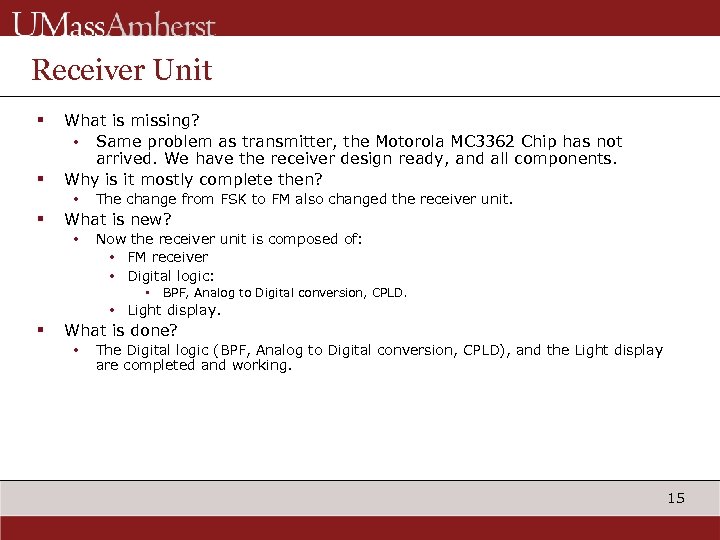 Receiver Unit § § What is missing? • Same problem as transmitter, the Motorola MC 3362 Chip has not arrived. We have the receiver design ready, and all components. Why is it mostly complete then? • § The change from FSK to FM also changed the receiver unit. What is new? • Now the receiver unit is composed of: • FM receiver • Digital logic: • BPF, Analog to Digital conversion, CPLD. • Light display. § What is done? • The Digital logic (BPF, Analog to Digital conversion, CPLD), and the Light display are completed and working. 15
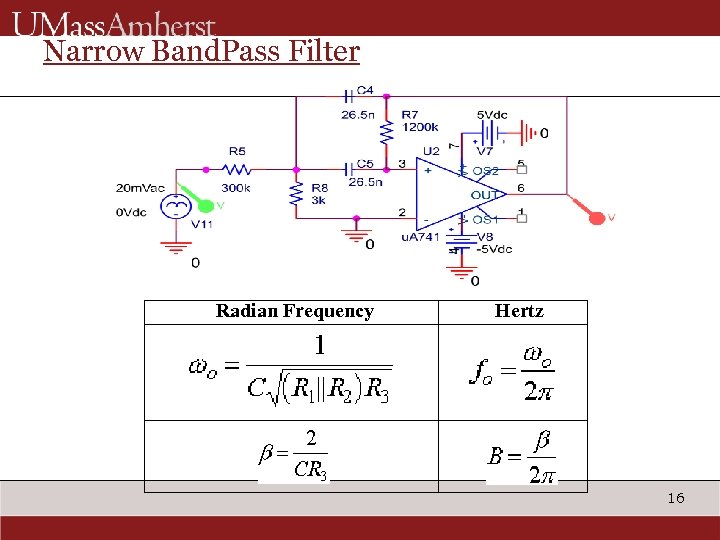 Narrow Band. Pass Filter Radian Frequency Hertz 16
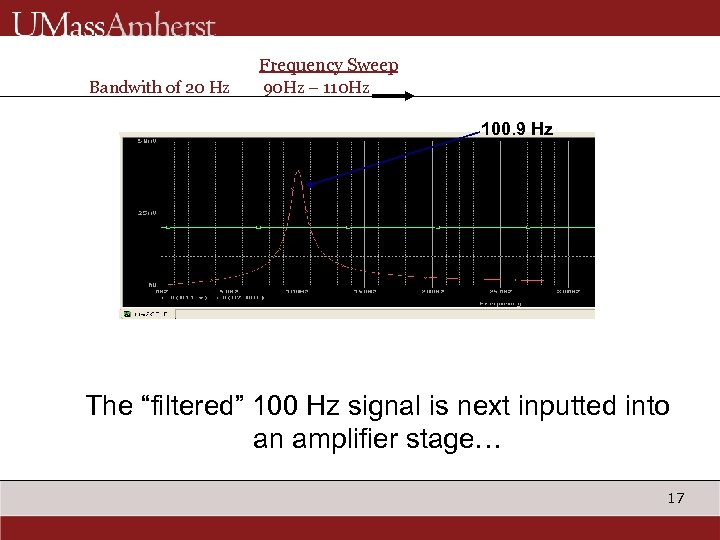 Frequency Sweep Bandwith of 20 Hz 90 Hz – 110 Hz 100. 9 Hz The “filtered” 100 Hz signal is next inputted into an amplifier stage… 17
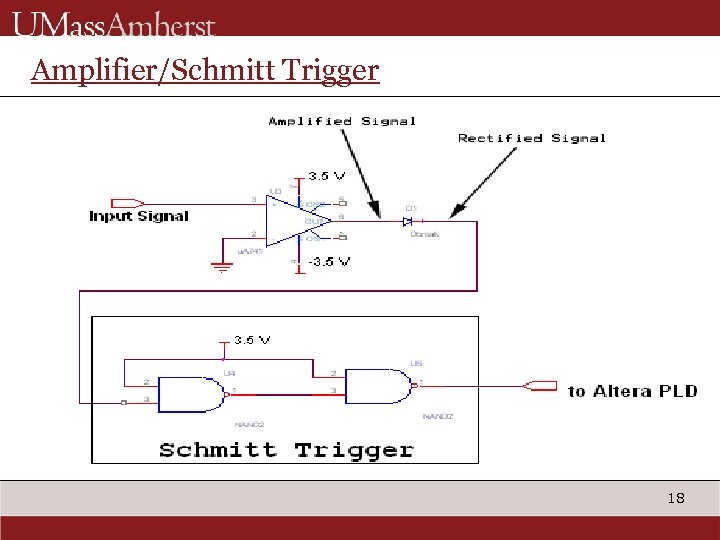 Amplifier/Schmitt Trigger 18
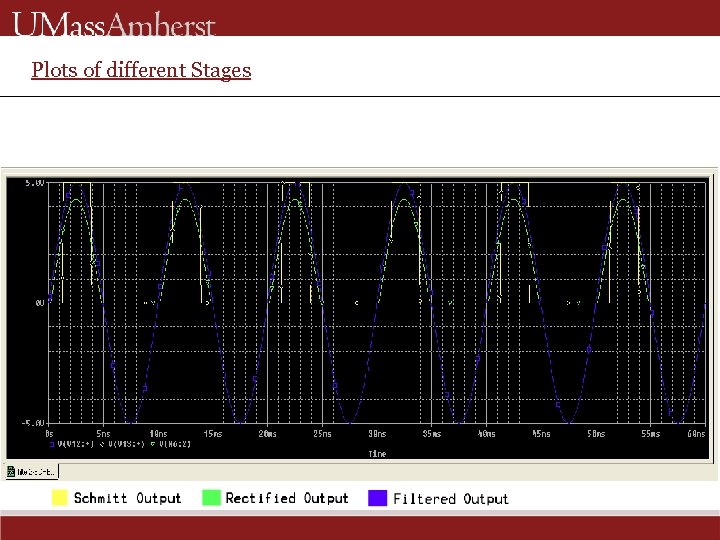 Plots of different Stages 19
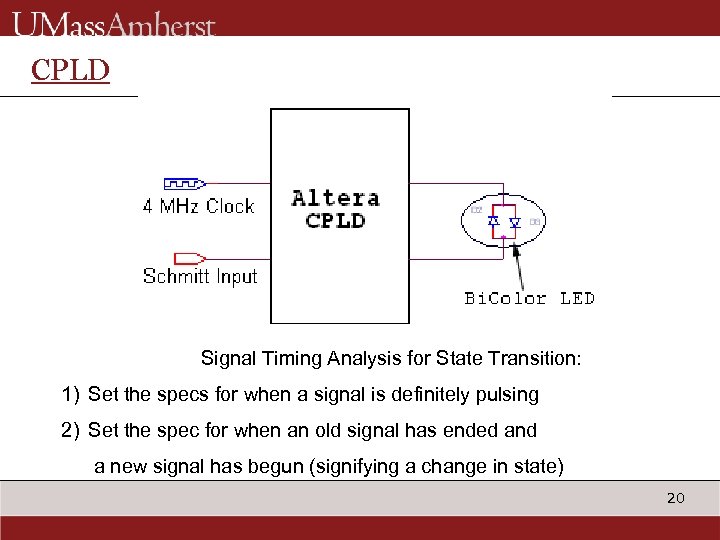 CPLD Signal Timing Analysis for State Transition: 1) Set the specs for when a signal is definitely pulsing 2) Set the spec for when an old signal has ended and a new signal has begun (signifying a change in state) 20
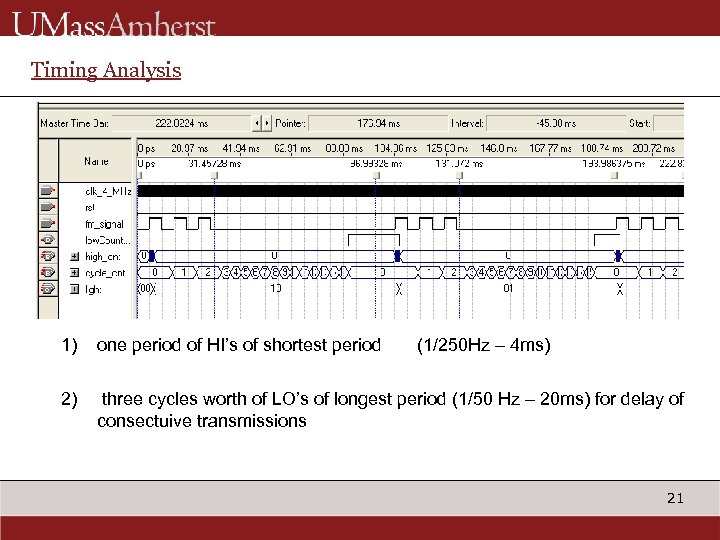 Timing Analysis 1) one period of HI’s of shortest period 2) three cycles worth of LO’s of longest period (1/50 Hz – 20 ms) for delay of consectuive transmissions (1/250 Hz – 4 ms) 21
 Summary § § Routing algorithm logic completed, actual code needs to be written. Preliminary transmitter and receiver designs completed, awaiting component ICs. Receiver logic completed, and component LED for light display chosen. Less than $100 has been spent, and thus the project is well under budget. 22