 Скачать презентацию Emergency Department Orientation Part I Developed by Lori
4df1b310aa821d82bc5eef2fc81c7ea1.ppt
- Количество слайдов: 66



Emergency Department Orientation Part I Developed by: Lori Baker, RN, BSN 3/16/2018 1
Mission and Goals See Orientation Notebook 3/16/2018 2
Your Orientation Notebook • Most of your orientation material will be found on Quia (pronounced key’-ah) in an effort to do our part in saving the environment • Some copies have been made of the material you will use more often so it will be close at hand during your orientation • We will review both electronic material and hard-copy material during orientation so always bring your notebook with you 3/16/2018 3
Beyond Orientation – Any Questions? • • Employee Health Infection Control Restraints Wound and Pressure Ulcer Management • VTE and SCD • Hyper/Hypothermia Systems • Telemetry/Cardiology 3/16/2018 • Body Safety and Patient Transfers • Codes • Life. Net • IV Therapy • Pain Management • Informed Consent • Blood Administration • Swallow Screening 4
Become Familiar with Your Department • • 3/16/2018 Acute, MEC, and Triage POCT Breakroom, Locker room Utility rooms Patient rooms Core Storage rooms Ancillary departments 5
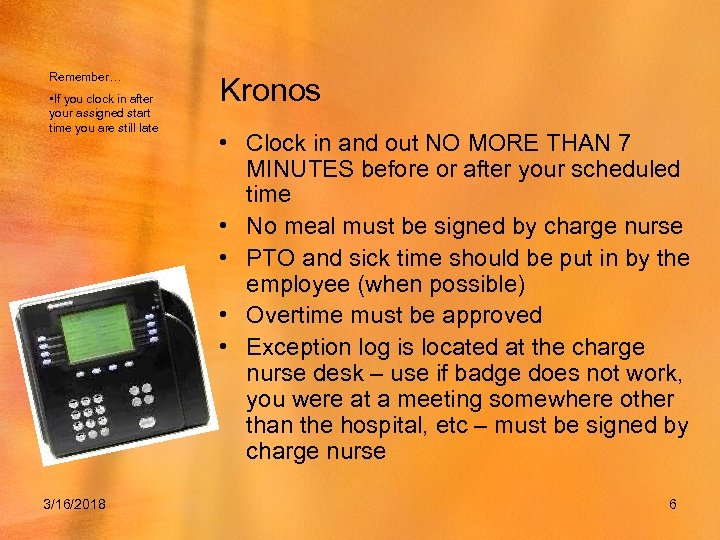
Remember… • If you clock in after your assigned start time you are still late 3/16/2018 Kronos • Clock in and out NO MORE THAN 7 MINUTES before or after your scheduled time • No meal must be signed by charge nurse • PTO and sick time should be put in by the employee (when possible) • Overtime must be approved • Exception log is located at the charge nurse desk – use if badge does not work, you were at a meeting somewhere other than the hospital, etc – must be signed by charge nurse 6
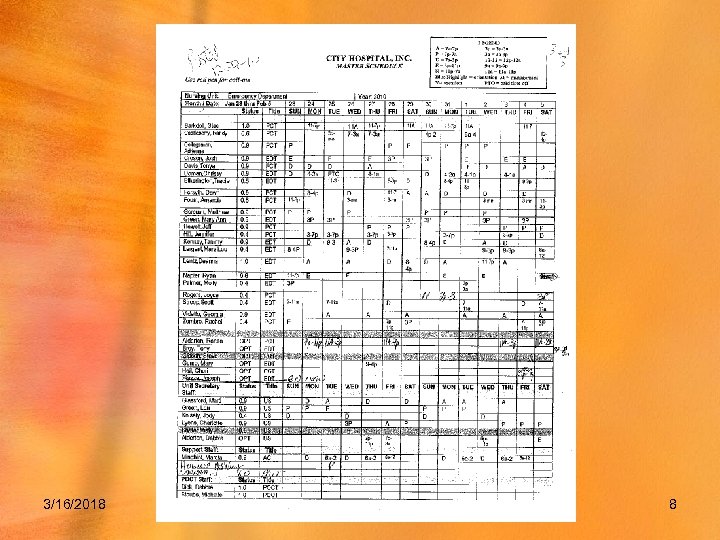
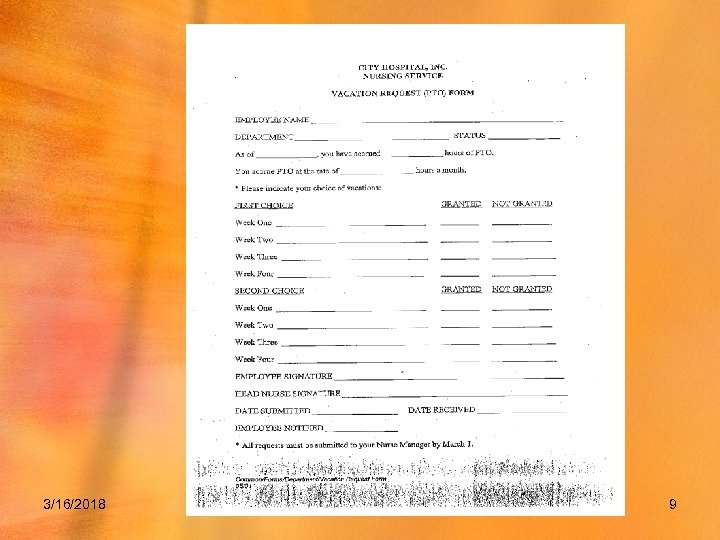
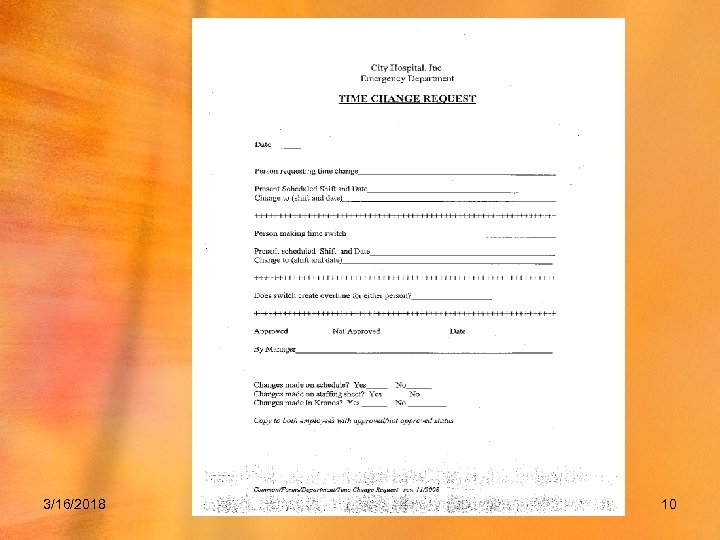
Scheduling • “Wish list” in breakroom • NOT guaranteed • Sign up for your weekend or holiday • May use an “R” one time per 2 weeks • May not be actual schedule when it comes out – check it!!! See tip sheet • Masters, daily's, and sign-ups are in the schedule book at the charge nurse desk on Quia During your orientation, you are to work your preceptor’s schedule unless other arrangements are made. For consistency, please make every effort to adhere to this arrangement unless absolutely necessary. 3/16/2018 7
3/16/2018 8
3/16/2018 9
3/16/2018 10
Holiday Rotations • Full-time and part-time – one major and two minor, alternate with two major and one minor • OPT – one major and one minor per year • Work your usual shift • You will be assigned to group “A” or group “B” • NSER-215 scheduling of Weekends. Holidays is the policy listing what is considered major and minor holidays See tip sheet on Quia 3/16/2018 11
Call in procedure See tip sheet on Quia • For sick calls, call Nursing Administration at 304 -2641000 ext 1782 • Call-ins are considered unexcused • Put in your own sick time in Kronos • Please refer to… NSER-216 Sick Call-Ins for details 3/16/2018 12
Education • General Hospital Education • Net. Learning • ED Specific Education • Quia • Instructions in orientation notebook • You will be given a specific username and password for this 3/16/2018 13
Mandatory Education • Intranet>Departments>Education • Accu-Chek • Blood administration • Braun IV pumps • Blood culture collection • Fill out and send to hospital education department via email • Mandatory every 2 years: BLS, CPI, ACLS, PALS • Mandatory every 4 years: TNCC • TNCC is done through the ED, not the hospital education department • This is counted as hours worked – don’t forget to clock in for these 3/16/2018 14

One day per month See tip sheet on Quia 0715 and 1400 in dept. • Must sign off on 100% or staff meeting minutes • Minutes are in a book at the charge nurse desk 3/16/2018 15
Huddles • To be done every 12 hours by clinical coordinators at the beginning of the shift • It is your responsibility to to be at the charge nurse desk on time • The object is to disperse up-to-date ED pertinent information • Changes weekly • Huddle book at charge nurse desk See tip sheet on Quia 3/16/2018 16
Dress Code • • 3/16/2018 Colors • Primary-navy, white and gold for nurses • Any combination • Prints acceptable, only in these colors • Techs – burgundy with gray accent color NO thermal or denim fabric NO T-shirts • A thin T-shirt of department colors may be worn under the scrub top • NO logos or pictures visible • May NOT hang below the scrub top If a cover-up is needed it MUST be a uniform scrub jacket • NO sweatshirts, hoodies, sweaters, etc. 17
Dress Code • Holiday Scrubs • Appropriately themed holiday scrubs may be worn for the following holidays ON the holiday • Christmas – may wear the week before through New Years Day • Thanksgiving • Valentines • Easter • 4 th of July • St. Patrick’s • Memorial 3/16/2018 18
Dress Code • “Free Friday” • Alternate colors/patterns of scrubs may be worn on Fridays • Still NO denim, flannel, or thermal material • Must be professional and of uniform style (i. e. no fatigue patterns, etc. ) • With all uniforms • Tight fitting clothing is inappropriate • Underwear should never be visible (even when bending or stooping) • Tattoos must be fully covered • Hair should be up off collar and out of face • Beards and mustaches should be neatly trimmed 3/16/2018 19
Dress Code • Shoes • No open toed shoes allowed • Shoes should be able to be washed or autoclaved • Athletic-style shoes may be worn • Keep in mind all the fluids you may be exposed to • NO body piercings other than 2 earrings per ear should be visible • No artificial nails, tips, wraps or other type of extension • No perfume or cologne • Make-up should be minimal and in good taste 3/16/2018 20
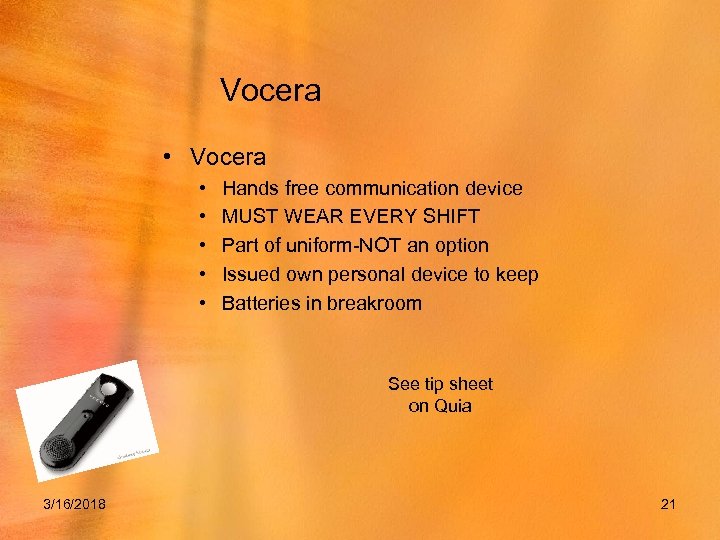
Vocera • • • Hands free communication device MUST WEAR EVERY SHIFT Part of uniform-NOT an option Issued own personal device to keep Batteries in breakroom See tip sheet on Quia 3/16/2018 21
HIPAA 3/16/2018 22
Confidentiality • Electronic information • Minimize screens • Only use EMR for appropriate use • Do not look up any patient you are not directly taking care of (including relatives and friends) • Verbal • Clinical information for patient care • Be careful who, what and where • Be very cautious using the Vocera (DO NOT use it in or near a patient care area) 3/16/2018 23
Other Access • EPIC • Meditech • Omnicel 3/16/2018 24

REVIEW TIME!!! 3/16/2018 25
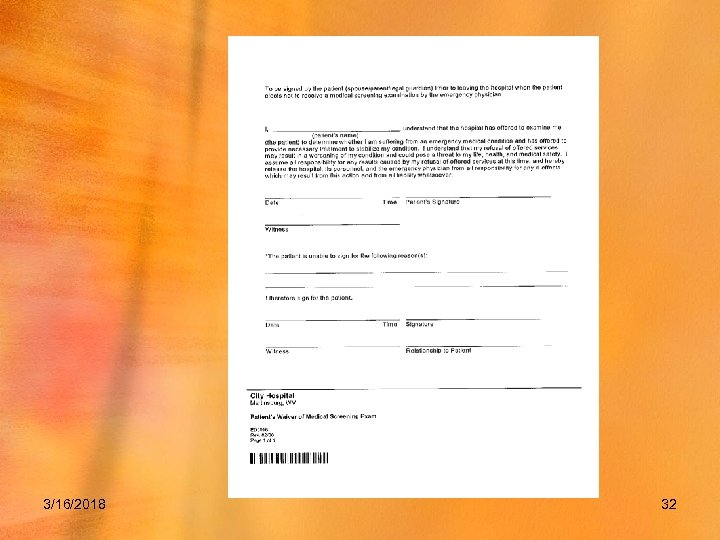
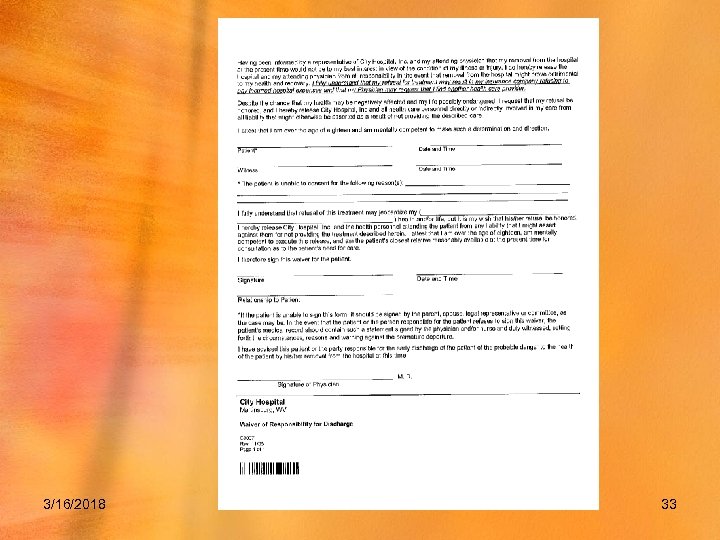
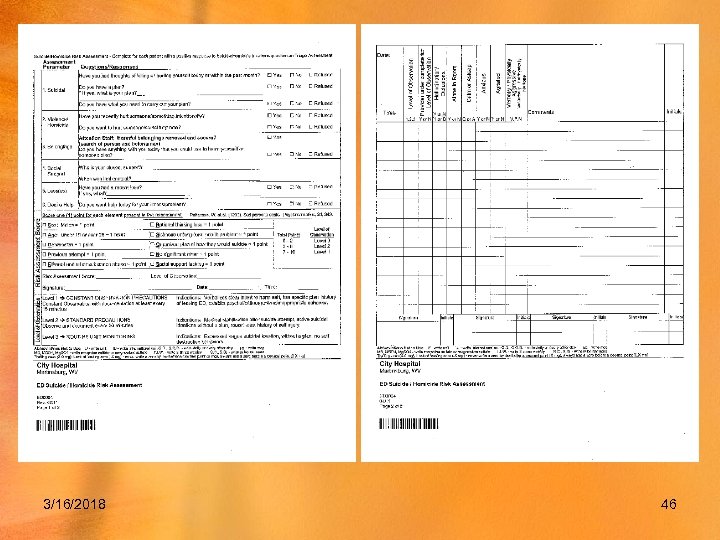
ED Documentation See tip sheet on Quia 3/16/2018 • Most documentation is done through EPIC on the computer • Exceptions are the following, which will be done on paper forms: • Traumas • Codes • Suicide risk assessments • Disposition of Body Form • Waiver of medical screening • AMA/Refusal to Treat 26
Computer Downtime • Appendix F in downtime procedure manual (link is on Quia ED Orientation page) See tip sheet on Quia 3/16/2018 27
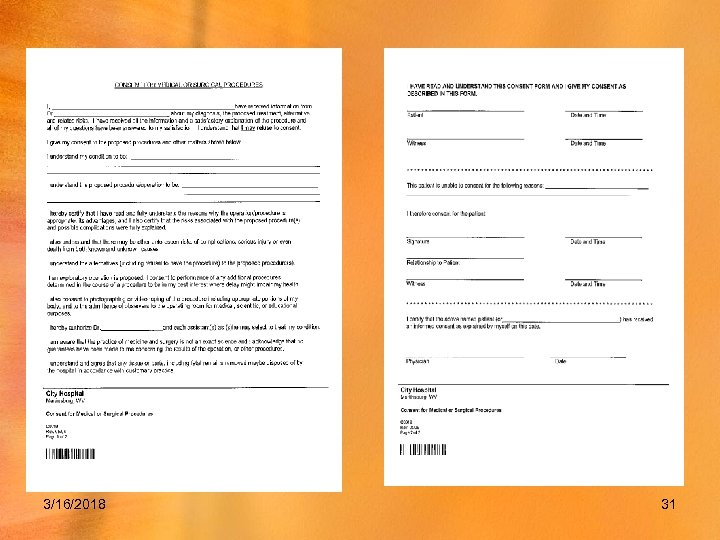
Consents • Types • Informed – fully explained – sign • Implied – ex. Cardiac arrest • Phone consent – document reason and 2 witnesses • No mind altering drugs before getting consent See policies on Quia 3/16/2018 28
Telephone Consent See policy 3/16/2018 • If parent, MPOA unable to give written consent, can consent over phone • Documentation: • MPOA ( write name of representative) is unavailable to sign an informed consent because (write the reason), but has consented over the telephone for (write the procedure) • Two witnesses to sign, date, time • Please refer to the following policy for all consents: • CH ADM-301 -Consent Policy 29
Consent of Minors See policy 3/16/2018 • Minor – under age 18 • Emancipated minor - <16; court declared or married • Mature minor - >16; deemed mature by physician • Minor consent must be given by parent otherwise • Exceptions: pregnancy, birth control, STD, substance abuse • Minor can give consent for own child 30
3/16/2018 31
3/16/2018 32
3/16/2018 33
EMTALA • Emergency Medical Treatment and Active Labor Act • Require medical screening • Stabilize and transfer if appropriate • Need receiving MD name and a bed • Consents to treat signed • Medical chart sent with patient • Nurse-to-nurse report • DOCUMENT Policy on Quia 3/16/2018 34
![Triage • • QUALIFICATIONS: Licensed in West Virginia ACLS, PALS, [TNCC and CEN preferred]](https://present5.com/presentation/4df1b310aa821d82bc5eef2fc81c7ea1/image-35.jpg "Triage • • QUALIFICATIONS: Licensed in West Virginia ACLS, PALS, [TNCC and CEN preferred]")
Triage • • QUALIFICATIONS: Licensed in West Virginia ACLS, PALS, [TNCC and CEN preferred] Demonstrated competence evidenced by completion of a triage checklist and preceptor evaluation. A formal class will be provided. Effective 1/1/03, nurses that have worked 6 month in ED with prior experience can Triage OR 1 year without prior ED experience. However, all nurses must attend the class prior to being assigned to triage. Effective interpersonal and communication skills and the ability to work collaboratively and effectively interact with public Flexibility/adaptability to rapidly changing situations Ability to use decision-making skills • Excerpt from ED Operational Guidelines/Triage Nurse 3/16/2018 35
Triage • ESI V Level Triage • Emergency Severity Index • Separate class will be scheduled once you meet the qualifications 3/16/2018 36
Immediate Bedding • Trial began June 3, 2013 (still ongoing) • Patient presents to front desk • Pivot nurse directs patient to a bed by chief complaint and general rapid assessment • Bedside nurse performs “triage” assessment 3/16/2018 37
Advanced Triage Protocols (ATPs) See separate Quia page for ATPs 3/16/2018 • Pre-set procedures to follow for patients presenting with the following: • Abdominal pain • Flank pain Please refer to the • Sore throat specific protocols on Quia • Pyrexia/Pain • Orthopedic • Chest pain • Psych complaint • Suture removal • Chest pain 38
Code STEMI See orientation notebook • EMS or walk-in • 12 lead EKG to be transmitted from EMS, otherwise, EKG within 5 minutes • Physician calls Code STEMI • Unit secretary calls 1 -911 to page the Code STEMI • Cath lab nurse and Hospitalist transport patient to cath lab • Door to cath goal 90 minutes (or less) • Document time accurately!!! • Please refer to the handouts in your orientation notebook 3/16/2018 39
Ten-minute EKG • For all chest pains of patients >16 y/o • If they present to triage, place them on a stretcher and do the EKG BEFORE bringing them back to a room • As soon as the EKG is done, show it to a provider immediately (and document that this was done. • Place ALL chest pain patients in a wheelchair as opposed to walking them to a room 3/16/2018 40
Code Stroke See orientation notebook 3/16/2018 • • Notification from EMS (or walk-in) Page for Code Stroke initiated by physician Draw labs if not done by EMS Send to CT Vitals and repeat fingerstick glucose NIH stroke scale Contraindications to thrombolytics Please refer to the handouts in your orientation notebook 41

REVIEW TIME!!! 3/16/2018 42
Admissions Process • • • Admitting physician enters orders in EPIC Nurse views admission orders Nurse enters a bed request Page or call for bed Call report Transport patient to assigned bed • Discharge from ED • See policy on Quia 3/16/2018 43
Gateway Admissions (Psych) • • See tip sheet on Quia Crisis worker evaluates patient in ED ED medically clears Same admission process When admitted, patient is escorted to Gateway with crisis worker and security guard Policy also on Quia 3/16/2018 44
Suicidal/Homicidal Risk Assessment • Suicidal/homicidal pts should change into paper scrubs. Belongings out of room. • Ensure room clear of IV tubing, wires, etc. • Notify security only if needed Policy found on Quia ED Orientation Page 3/16/2018 45
3/16/2018 46
Commitment • • • Involuntary Clear and present danger to self or others Deprives patient of rights and freedoms Petition filed at county clerks office Patient to ED for evaluation by psychologist • Hearing takes place • Decision by mental hygiene commissioner • Patients pending a commitment hearing will have PD at bedside at all times for duration of hold order 3/16/2018 47
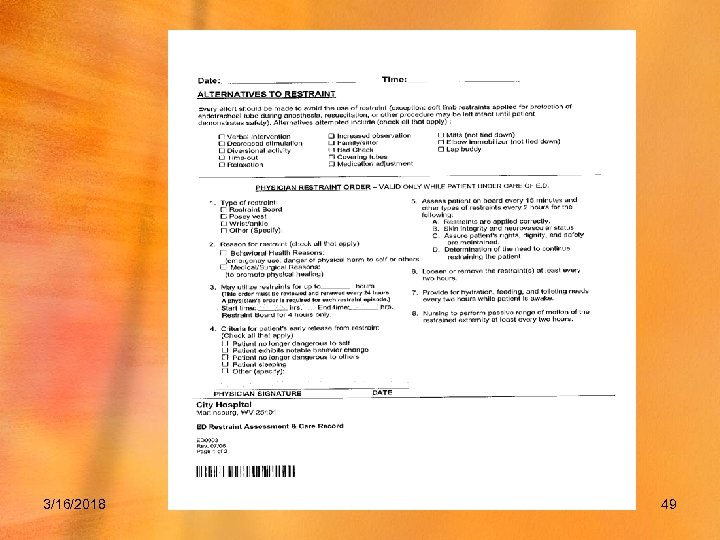
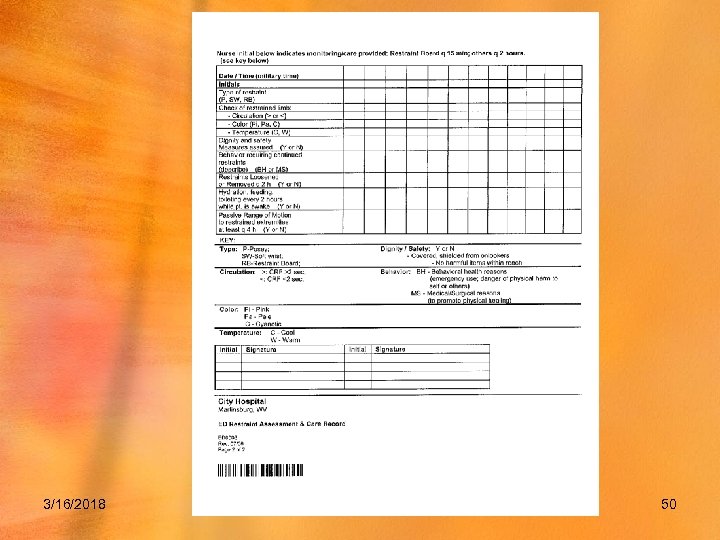
Restraints • RN may initiate but physician order must follow • Identify alternatives to physical restraints first • Monitor circulation, measure dignity, behavior, loosen every 2 hours, provide hydration, elimination, passive ROM every 4 hours • Document on restraint documentation 3/16/2018 48
3/16/2018 49
3/16/2018 50
Abuse - Reporting • Mandatory reporting of child and incapacitated adult abuse is to be made to the DHHR • Domestic violence is not mandatory reporting in WV • Provide community resource information Policy on Quia 3/16/2018 51
Blood Alcohol • If it is to be used as legal evidence • Law enforcement requests level to be done • Consent is to be signed by officer and patient • Individual kits • Lab may draw the specimen See guideline 3/16/2018 • Please refer to ED Operational Guidelines/Blood Alcohol Testing WV Code 52
POCT (Point Of Care Testing) • Located next to triage • Become familiar with their policies • Intranet>MCN Policy Manager>Lab>Point of Care Testing 3/16/2018 53
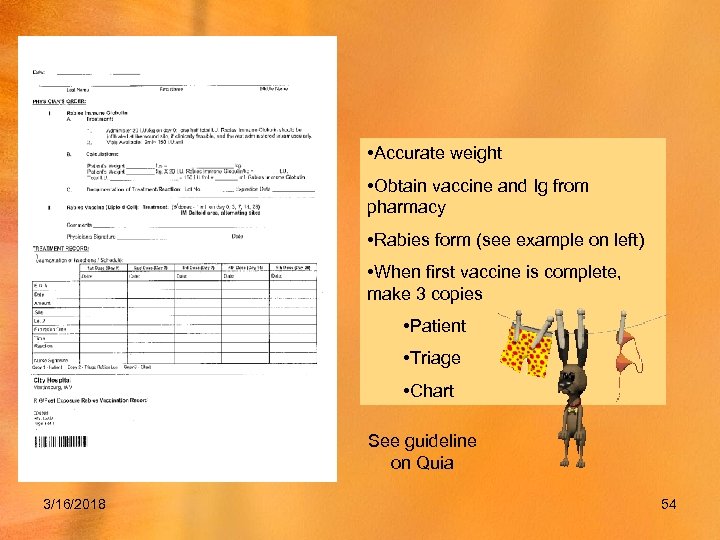
• Accurate weight • Obtain vaccine and Ig from pharmacy • Rabies form (see example on left) • When first vaccine is complete, make 3 copies • Patient • Triage • Chart See guideline on Quia 3/16/2018 54
Interpreter Service • Hearing Impaired • DT Video Interpreting Services • (housed in care management department on 3 rd floor) • DEAFNET(301) 791 -9025 or • Policy: CH ADM-320 Obtaining Interpreter See policy 3/16/2018 and Other Services. . . 55

Interpreters • INTERPRETER’S FOR NON-ENGLISH SPEAKING… See CM Policy for same which lists the following: • LANGUAGE LINE, LLC • Telephone # - 1 -866 -237 -0173 • Language ID Code - 25401 3/16/2018 56
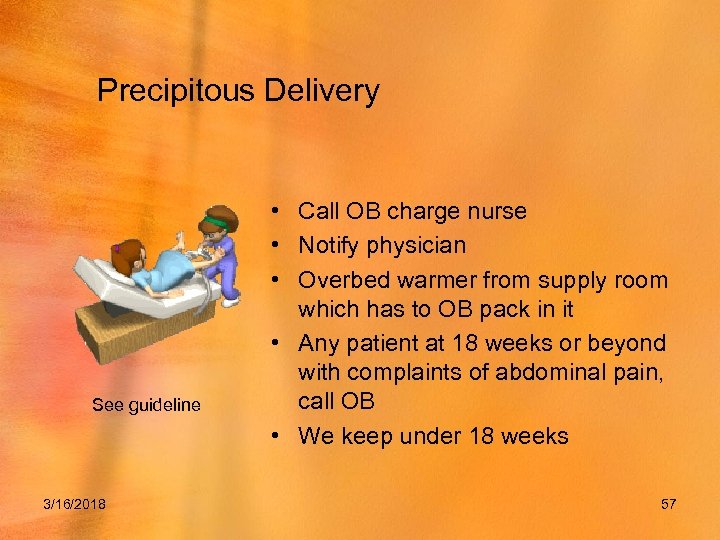
Precipitous Delivery See guideline 3/16/2018 • Call OB charge nurse • Notify physician • Overbed warmer from supply room which has to OB pack in it • Any patient at 18 weeks or beyond with complaints of abdominal pain, call OB • We keep under 18 weeks 57
Workplace Violence • • Zero tolerance Verbal or physical Incident report Patient or staff involvement See policy 3/16/2018 58
Valuables Policy See policy 3/16/2018 • To secure patient valuables call control center (3 -1430) • Security officer and patient sign (or witness if patient unable) • One copy to chart • Admissions need “Patient Valuables Record” completed 59
Safety and Security • Become familiar with the hospital policies pertaining to safety and security • Intranet>MCN Policy Manager>Safety and Security • Be aware there is a silent alarm at triage, MEC, and Acute care areas that go directly to the control center • Call ext 3 -1430(control center) for security • If PD is deemed necessary, the control center will notify them 3/16/2018 60
Forensics • Evidence collection/preservation • GSW, stab wounds • Sexual assault • SANE • Chain of custody See policy on Quia 3/16/2018 61
Law Enforcement Issues • Patients under arrest • Law enforcement stays with patient at all times (prefer 2) • Restriction of rights up to the officer (i. e. visitors) • Notify security of patients arrival • Forensic restraints to remain on (i. e. handcuffs) • Unarmed officer at bedside, armed outside the room 3/16/2018 62
Law Enforcement Issues • Scenario • An officer asks you to call PD when a patient is discharged, so that an arrest can be made • What to do… • Such a notification poses a violation of patient confidentiality. Therefore, the officer must explain options to the patient • If patient consents, document with patients signature, officer signature, and hospital staff witness 3/16/2018 63
Reporting Deaths See several policies 3/16/2018 • Organ/Tissue donation • 1 -866 -LIFENET • ALL deaths are reported • Potential imminent death, such as severe brain trauma, call for possible organ donation • Documentation • Coroner Notification • County medical examiner • Sudden, unexpected death (i. e. suicide, homicide) • Leave all tubes in place • Disposition of body form 64
Post-Mortem Care • • Secure valuables Death certificate Notify Life. Net Eye care Notify medical examiner (see policy on Quia) Notify funeral home Do not remove any drains, IV’s, catheters if this is a coroner’s case Wash body if needed • Shroud and tags • Removal of body See policy • Disposition of body form 3/16/2018 65

3/16/2018 66
Скачать презентацию Emergency Department Orientation Part I Developed by Lori
4df1b310aa821d82bc5eef2fc81c7ea1.ppt