


 Скачать презентацию Emergency Care THIRTEENTH EDITION CHAPTER 18 Cardiac Emergencies
412af0d9b438b2bcfea831ffc09fa321.ppt
- Количество слайдов: 119
 Emergency Care THIRTEENTH EDITION CHAPTER 18 Cardiac Emergencies Emergency Care, 13 e Daniel Limmer | Michael F. O'Keefe Copyright © 2016, 2012, 2009 by Pearson Education, Inc. All Rights Reserved
 Multimedia Directory Slide 102 Slide 103 Slide 104 Slide 105 Ventricular Fibrillation and AED Video Cardiac Arrest Animation AED Video Coronary Heart Disease Video Emergency Care, 13 e Daniel Limmer | Michael F. O'Keefe Copyright © 2016, 2012, 2009 by Pearson Education, Inc. All Rights Reserved
 Topics • • Cardiac Anatomy and Physiology Acute Coronary Syndrome Causes of Cardiac Conditions Cardiac Arrest Emergency Care, 13 e Daniel Limmer | Michael F. O'Keefe Copyright © 2016, 2012, 2009 by Pearson Education, Inc. All Rights Reserved
 Cardiac Anatomy and Physiology Emergency Care, 13 e Daniel Limmer | Michael F. O'Keefe Copyright © 2016, 2012, 2009 by Pearson Education, Inc. All Rights Reserved
 Cardiac Anatomy and Physiology • Review of the cardiovascular system: § Flow of blood through the chambers of the heart § Cardiac conductive system § Composition of the blood § Flow of blood through arteries, veins, arterioles, venules, and capillaries continued on next slide Emergency Care, 13 e Daniel Limmer | Michael F. O'Keefe Copyright © 2016, 2012, 2009 by Pearson Education, Inc. All Rights Reserved
 Cardiac Anatomy and Physiology • Review of the cardiovascular system: § Circulation of blood between heart and lungs, and between heart and the rest of body § How heart function and circulation of blood relate to pulse and blood pressure § Shock (hypoperfusion) Emergency Care, 13 e Daniel Limmer | Michael F. O'Keefe Copyright © 2016, 2012, 2009 by Pearson Education, Inc. All Rights Reserved
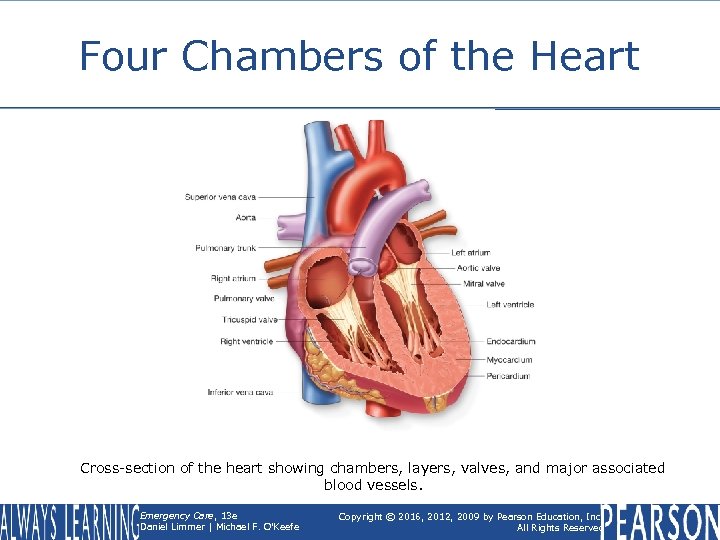 Four Chambers of the Heart Cross-section of the heart showing chambers, layers, valves, and major associated blood vessels. Emergency Care, 13 e Daniel Limmer | Michael F. O'Keefe Copyright © 2016, 2012, 2009 by Pearson Education, Inc. All Rights Reserved
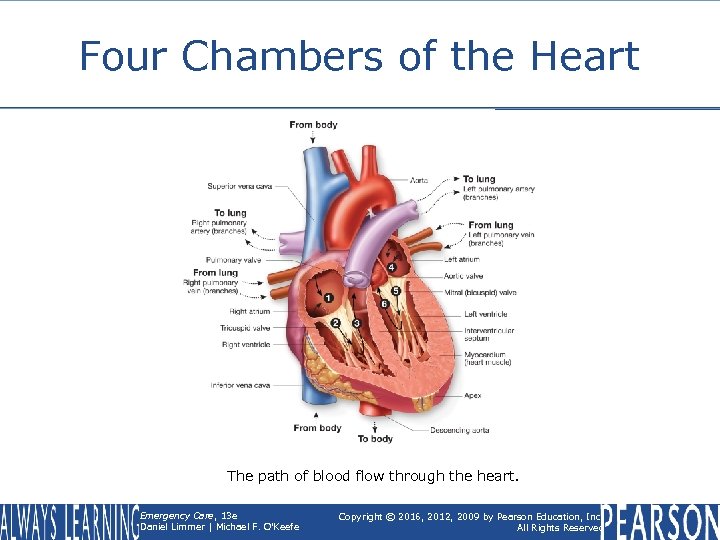 Four Chambers of the Heart The path of blood flow through the heart. Emergency Care, 13 e Daniel Limmer | Michael F. O'Keefe Copyright © 2016, 2012, 2009 by Pearson Education, Inc. All Rights Reserved
 Think About It • How does the normal function of the heart and blood vessels relate to blood pressure and distal pulses? • How is shock related to the function of the heart and blood vessels? Emergency Care, 13 e Daniel Limmer | Michael F. O'Keefe Copyright © 2016, 2012, 2009 by Pearson Education, Inc. All Rights Reserved
 Acute Coronary Syndrome Emergency Care, 13 e Daniel Limmer | Michael F. O'Keefe Copyright © 2016, 2012, 2009 by Pearson Education, Inc. All Rights Reserved
 Acute Coronary Syndrome • Sometimes called cardiac compromise • Refers to any time the heart may not be getting enough oxygen • Many different kinds of problems under the ACS heading continued on next slide Emergency Care, 13 e Daniel Limmer | Michael F. O'Keefe Copyright © 2016, 2012, 2009 by Pearson Education, Inc. All Rights Reserved
 Acute Coronary Syndrome • Symptoms often mimic non-cardiac conditions. • Treat all patients with ACS-like signs and symptoms as though they are having a heart problem. continued on next slide Emergency Care, 13 e Daniel Limmer | Michael F. O'Keefe Copyright © 2016, 2012, 2009 by Pearson Education, Inc. All Rights Reserved
 Acute Coronary Syndrome • Chest pain is best-known symptom. § Can be described as crushing, dull, heavy, or squeezing • Sometimes described only as pressure or discomfort • Radiates along arms, down to upper abdomen, or up to jaw continued on next slide Emergency Care, 13 e Daniel Limmer | Michael F. O'Keefe Copyright © 2016, 2012, 2009 by Pearson Education, Inc. All Rights Reserved
 Acute Coronary Syndrome • Dyspnea also found in ACS § May be the only finding in some patients Emergency Care, 13 e Daniel Limmer | Michael F. O'Keefe Copyright © 2016, 2012, 2009 by Pearson Education, Inc. All Rights Reserved
 Acute Coronary Syndrome • Other symptoms § Anxiety, feeling of impending doom § Nausea and pain or discomfort in upper abdomen (epigastric pain) § Sudden onset of sweating § Abnormal pulse (tachycardia/bradycardia) § Abnormal blood pressure Emergency Care, 13 e Daniel Limmer | Michael F. O'Keefe Copyright © 2016, 2012, 2009 by Pearson Education, Inc. All Rights Reserved
 Management of Acute Coronary Syndrome • Patient assessment § Perform primary assessment. § Obtain history and physical exam. § Use OPQRST to get history of present illness. § Obtain past medical history. § Take baseline vital signs. continued on next slide Emergency Care, 13 e Daniel Limmer | Michael F. O'Keefe Copyright © 2016, 2012, 2009 by Pearson Education, Inc. All Rights Reserved
 Management of Acute Coronary Syndrome • Patient care § Place patient in position of comfort (typically sitting up). § Determine if oxygen should be administered. § Transport. Emergency Care, 13 e Daniel Limmer | Michael F. O'Keefe Copyright © 2016, 2012, 2009 by Pearson Education, Inc. All Rights Reserved
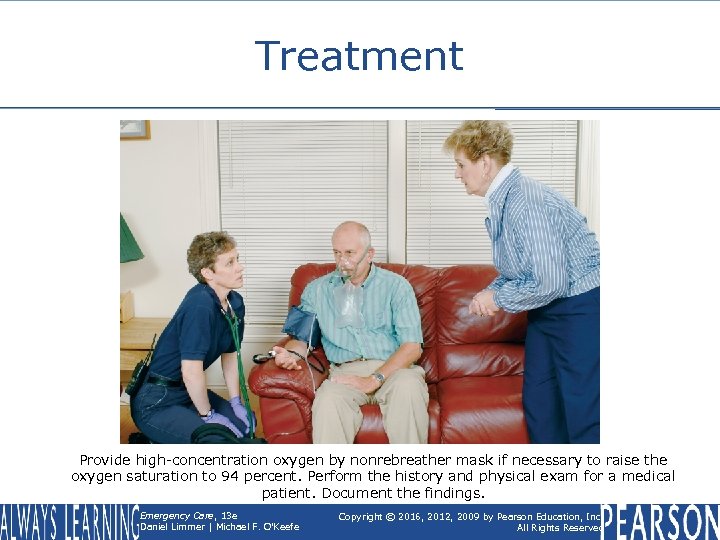 Treatment Provide high-concentration oxygen by nonrebreather mask if necessary to raise the oxygen saturation to 94 percent. Perform the history and physical exam for a medical patient. Document the findings. Emergency Care, 13 e Daniel Limmer | Michael F. O'Keefe Copyright © 2016, 2012, 2009 by Pearson Education, Inc. All Rights Reserved
 Management of Acute Coronary Syndrome • Patient care § If trained, equipped, and authorized to do so, obtain a 12 -lead electrocardiogram (ECG). § Follow local protocol as to whether to transmit it to hospital for interpretation. continued on next slide Emergency Care, 13 e Daniel Limmer | Michael F. O'Keefe Copyright © 2016, 2012, 2009 by Pearson Education, Inc. All Rights Reserved
 Management of Acute Coronary Syndrome • Patient care § Indications for administering nitroglycerin • Chest pain • History of cardiac problems and prescribed nitroglycerin • Physician has prescribed nitroglycerin to patient. • Patient has nitroglycerin with him. Emergency Care, 13 e Daniel Limmer | Michael F. O'Keefe Copyright © 2016, 2012, 2009 by Pearson Education, Inc. All Rights Reserved
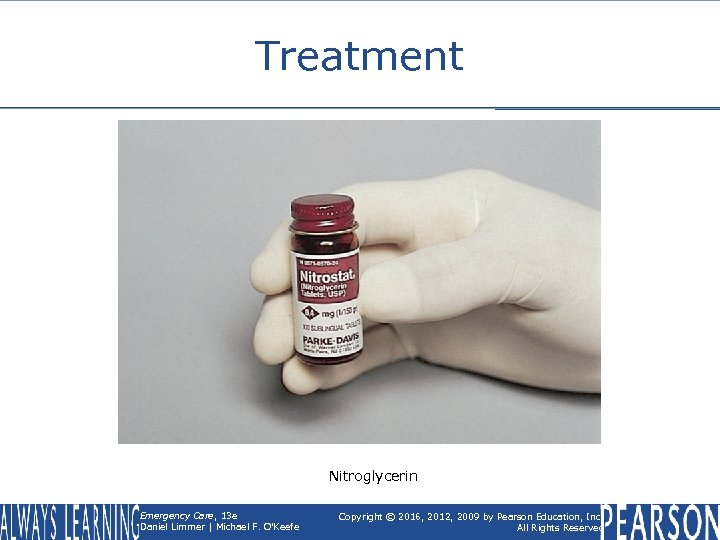 Treatment Nitroglycerin Emergency Care, 13 e Daniel Limmer | Michael F. O'Keefe Copyright © 2016, 2012, 2009 by Pearson Education, Inc. All Rights Reserved
 Management of Acute Coronary Syndrome • Patient care § Indications for administering nitroglycerin • Systolic blood pressure meets protocol criteria. • Patient has not had Viagra or similar drug for erectile dysfunction within forty-eight to seventy-two hours. • Medical direction authorizes administration of the medication. continued on next slide Emergency Care, 13 e Daniel Limmer | Michael F. O'Keefe Copyright © 2016, 2012, 2009 by Pearson Education, Inc. All Rights Reserved
 Management of Acute Coronary Syndrome • Patient care § After giving one dose of nitroglycerin, repeat dose in 5 minutes if: • Patient experiences no relief or only partial relief. • Systolic blood pressure remains greater than 90 to 100 systolic. • Medical direction authorizes another dose of medication. continued on next slide Emergency Care, 13 e Daniel Limmer | Michael F. O'Keefe Copyright © 2016, 2012, 2009 by Pearson Education, Inc. All Rights Reserved
 Management of Acute Coronary Syndrome • Patient care § Indications for administering aspirin • • Chest pain Patient not allergic to aspirin No history of asthma Patient not taking medications to prevent clotting continued on next slide Emergency Care, 13 e Daniel Limmer | Michael F. O'Keefe Copyright © 2016, 2012, 2009 by Pearson Education, Inc. All Rights Reserved
 Management of Acute Coronary Syndrome • Patient care § Indications for administering aspirin • No other contraindications to aspirin • Ability to safely swallow • Medical direction authorization Emergency Care, 13 e Daniel Limmer | Michael F. O'Keefe Copyright © 2016, 2012, 2009 by Pearson Education, Inc. All Rights Reserved
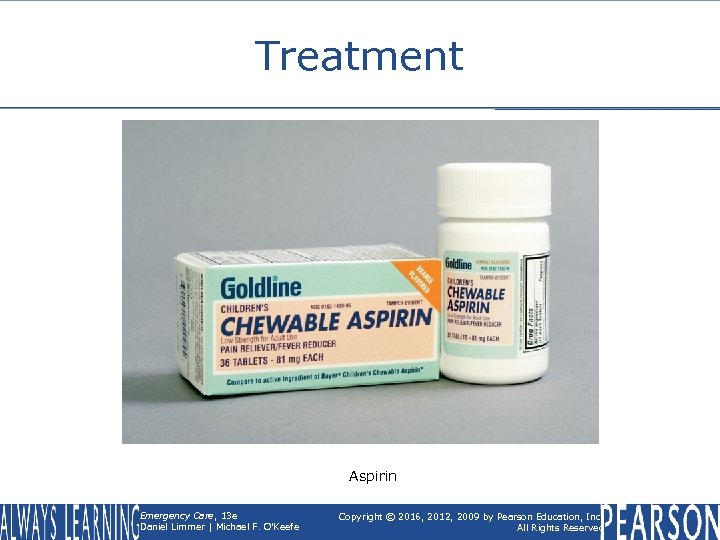 Treatment Aspirin Emergency Care, 13 e Daniel Limmer | Michael F. O'Keefe Copyright © 2016, 2012, 2009 by Pearson Education, Inc. All Rights Reserved
 Causes of Cardiac Conditions Emergency Care, 13 e Daniel Limmer | Michael F. O'Keefe Copyright © 2016, 2012, 2009 by Pearson Education, Inc. All Rights Reserved
 Causes of Cardiac Conditions • Heart problems caused by a number of disorders affecting condition and function of blood vessels and heart Emergency Care, 13 e Daniel Limmer | Michael F. O'Keefe Copyright © 2016, 2012, 2009 by Pearson Education, Inc. All Rights Reserved
 Coronary Artery Disease • Conditions that narrow or block arteries of heart • Often result from fatty deposit buildup on inner walls of arteries • Buildup narrows inner vessel diameter, restricting flow of blood. continued on next slide Emergency Care, 13 e Daniel Limmer | Michael F. O'Keefe Copyright © 2016, 2012, 2009 by Pearson Education, Inc. All Rights Reserved
 Coronary Artery Disease • Thrombus § Occlusion of blood flow caused by formation of a clot on rough inner surface of diseased artery § Can break loose and form an embolism • Emboli can move to occlude flow of blood downstream in a smaller artery. continued on next slide Emergency Care, 13 e Daniel Limmer | Michael F. O'Keefe Copyright © 2016, 2012, 2009 by Pearson Education, Inc. All Rights Reserved
 Coronary Artery Disease • Reduced blood supply to myocardium causes emergency in majority of cardiac-related medical emergencies • Chest pain is most common symptom of reduced blood supply. Emergency Care, 13 e Daniel Limmer | Michael F. O'Keefe Copyright © 2016, 2012, 2009 by Pearson Education, Inc. All Rights Reserved
 Aneurysm • Weakened sections of arterial walls begin to dilate (balloon). • Bursting can cause rapid, lifethreatening internal bleeding. Emergency Care, 13 e Daniel Limmer | Michael F. O'Keefe Copyright © 2016, 2012, 2009 by Pearson Education, Inc. All Rights Reserved
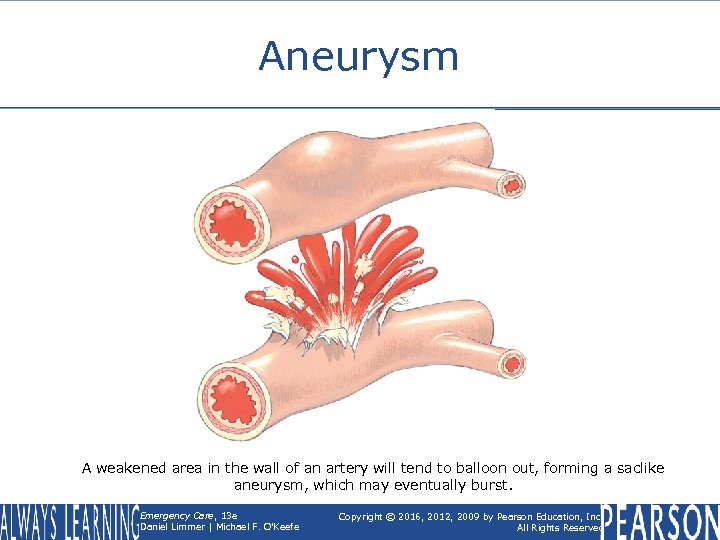 Aneurysm A weakened area in the wall of an artery will tend to balloon out, forming a saclike aneurysm, which may eventually burst. Emergency Care, 13 e Daniel Limmer | Michael F. O'Keefe Copyright © 2016, 2012, 2009 by Pearson Education, Inc. All Rights Reserved
 Electrical Malfunction of the Heart • Malfunction of heart's electrical system generally results in dysrhythmia. • Dysrhythmias include bradycardia, tachycardia, and rhythms that may be present when there is no pulse. Emergency Care, 13 e Daniel Limmer | Michael F. O'Keefe Copyright © 2016, 2012, 2009 by Pearson Education, Inc. All Rights Reserved
 Mechanical Malfunctions of the Heart • Angina pectoris • Acute myocardial infarction (AMI) • Congestive Heart Failure (CHF) Emergency Care, 13 e Daniel Limmer | Michael F. O'Keefe Copyright © 2016, 2012, 2009 by Pearson Education, Inc. All Rights Reserved
 Angina Pectoris • Chest pain caused by insufficient blood flow to the myocardium • Typically due to narrowed arteries secondary to coronary artery disease • Pain usually during times of increased myocardial oxygen demand, such as exertion or stress Emergency Care, 13 e Daniel Limmer | Michael F. O'Keefe Copyright © 2016, 2012, 2009 by Pearson Education, Inc. All Rights Reserved
 Acute Myocardial Infarction (AMI) • Death of a portion of the myocardium due to lack of oxygen • Coronary artery disease is usually the underlying reason. Emergency Care, 13 e Daniel Limmer | Michael F. O'Keefe Copyright © 2016, 2012, 2009 by Pearson Education, Inc. All Rights Reserved
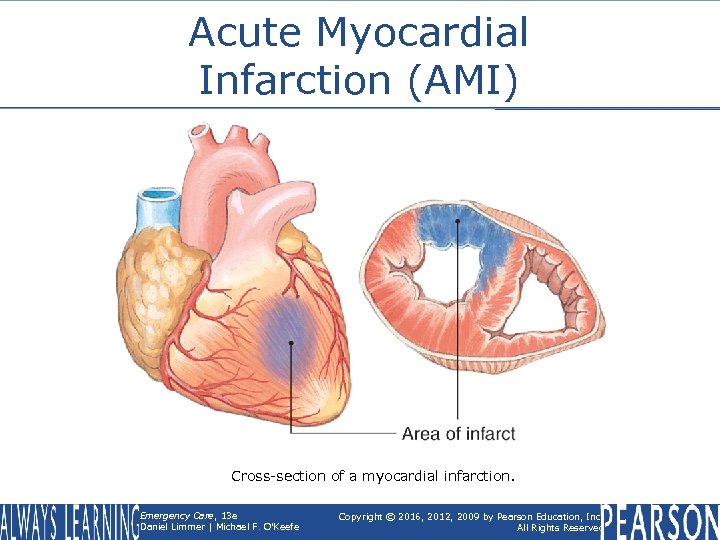 Acute Myocardial Infarction (AMI) Cross-section of a myocardial infarction. Emergency Care, 13 e Daniel Limmer | Michael F. O'Keefe Copyright © 2016, 2012, 2009 by Pearson Education, Inc. All Rights Reserved
 Congestive Heart Failure • Inadequate pumping of the heart • Often leads to excessive fluid buildup in lungs and/or body • May be brought on by diseased heart valves, hypertension, obstructive pulmonary disease • Often a complication of AMI continued on next slide Emergency Care, 13 e Daniel Limmer | Michael F. O'Keefe Copyright © 2016, 2012, 2009 by Pearson Education, Inc. All Rights Reserved
 Congestive Heart Failure • Progression § Patient sustains AMI • Myocardium of left ventricle dies § Because of damage to left ventricle, blood backs up into pulmonary circulation and lungs § If untreated, left heart failure commonly causes right heart failure continued on next slide Emergency Care, 13 e Daniel Limmer | Michael F. O'Keefe Copyright © 2016, 2012, 2009 by Pearson Education, Inc. All Rights Reserved
 Congestive Heart Failure • Signs and symptoms § § § Tachycardia Dyspnea Cyanosis Normal or elevated blood pressure Diaphoresis Pulmonary edema continued on next slide Emergency Care, 13 e Daniel Limmer | Michael F. O'Keefe Copyright © 2016, 2012, 2009 by Pearson Education, Inc. All Rights Reserved
 Congestive Heart Failure • Signs and symptoms § Anxiety or confusion due to hypoxia § Pedal edema § Engorged, pulsating neck veins (late sign) § Enlarged liver and spleen with abdominal distention (late sign) Emergency Care, 13 e Daniel Limmer | Michael F. O'Keefe Copyright © 2016, 2012, 2009 by Pearson Education, Inc. All Rights Reserved
 Cardiac Arrest Emergency Care, 13 e Daniel Limmer | Michael F. O'Keefe Copyright © 2016, 2012, 2009 by Pearson Education, Inc. All Rights Reserved
 Chain of Survival • Five elements 1. 2. 3. 4. 5. Immediate recognition and activation Early CPR Rapid defibrillation Effective advanced life support Integrated post-cardiac arrest care • Teamwork • Coordination Emergency Care, 13 e Daniel Limmer | Michael F. O'Keefe Copyright © 2016, 2012, 2009 by Pearson Education, Inc. All Rights Reserved
 Immediate Recognition and Activation • Requires prompt notification of EMS system • Most likely a bystander responsibility Emergency Care, 13 e Daniel Limmer | Michael F. O'Keefe Copyright © 2016, 2012, 2009 by Pearson Education, Inc. All Rights Reserved
 Early CPR • Increases survival chances significantly • Three ways CPR can be delivered earlier § Get CPR-trained professionals to patient faster. § Train laypeople in CPR. § Train dispatchers to instruct callers how to perform CPR. continued on next slide Emergency Care, 13 e Daniel Limmer | Michael F. O'Keefe Copyright © 2016, 2012, 2009 by Pearson Education, Inc. All Rights Reserved
 Early CPR • High-Performance CPR § Changes implemented in resuscitation efforts § Compressing the chest at least 2 inches in adults § Allowing for full relaxation on the upstroke of compressions § Spending half of each compression on the downstroke and half on the upstroke continued on next slide Emergency Care, 13 e Daniel Limmer | Michael F. O'Keefe Copyright © 2016, 2012, 2009 by Pearson Education, Inc. All Rights Reserved
 Early CPR • High-Performance CPR § Using correct hand position § Compressing the chest at least 100 times per minute § Spending no more than one second on each ventilation § Minimizing interruptions of CPR to no more than 10 seconds each continued on next slide Emergency Care, 13 e Daniel Limmer | Michael F. O'Keefe Copyright © 2016, 2012, 2009 by Pearson Education, Inc. All Rights Reserved
 Early CPR • High-Performance CPR § Key is increasing cardiac output. § Since most cardiac arrests in adults are the result of cardiac problems, not respiratory problems, there is enough oxygen in the bloodstream to maintain metabolic processes for several minutes. Emergency Care, 13 e Daniel Limmer | Michael F. O'Keefe Copyright © 2016, 2012, 2009 by Pearson Education, Inc. All Rights Reserved
 Rapid Defibrillation • The sooner defibrillator arrives, the more likely the patient will survive cardiac arrest. Emergency Care, 13 e Daniel Limmer | Michael F. O'Keefe Copyright © 2016, 2012, 2009 by Pearson Education, Inc. All Rights Reserved
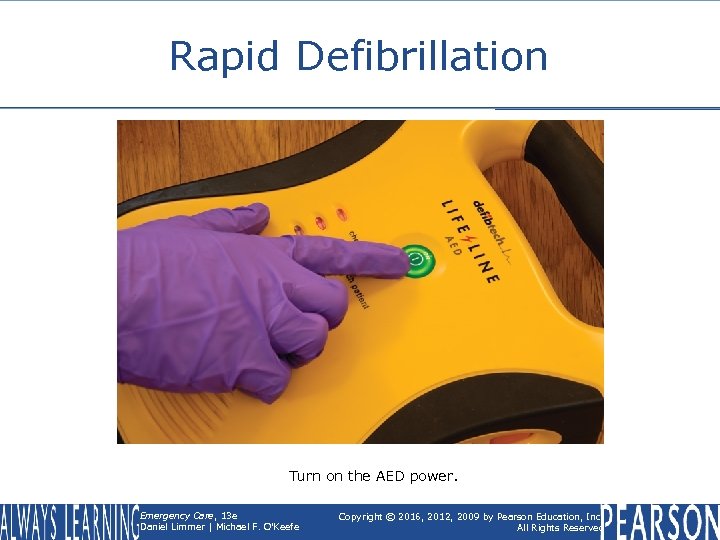 Rapid Defibrillation Turn on the AED power. Emergency Care, 13 e Daniel Limmer | Michael F. O'Keefe Copyright © 2016, 2012, 2009 by Pearson Education, Inc. All Rights Reserved
 Effective Advanced Life Support • Generally provided by EMT-Paramedics who respond to scene or rendezvous with BLS unit en route to hospital. • Rapid transport to hospital may be the most time-efficient means of obtaining ALS. Emergency Care, 13 e Daniel Limmer | Michael F. O'Keefe Copyright © 2016, 2012, 2009 by Pearson Education, Inc. All Rights Reserved
 Integrated Post-Cardiac Arrest Care • Coordinating numerous means of assessment and interventions that, together, maximize the chance of neurologically intact survival continued on next slide Emergency Care, 13 e Daniel Limmer | Michael F. O'Keefe Copyright © 2016, 2012, 2009 by Pearson Education, Inc. All Rights Reserved
 Integrated Post-Cardiac Arrest Care Maintaining adequate oxygenation Avoiding hyperventilation Performing 12 -lead ECG Finding and managing treatable causes of arrest • Determining appropriate destination for patient • Possibly inducing hypothermia • • Emergency Care, 13 e Daniel Limmer | Michael F. O'Keefe Copyright © 2016, 2012, 2009 by Pearson Education, Inc. All Rights Reserved
 Management of Cardiac Arrest • EMT provides two links in the chain of survival. § Early CPR § Rapid defibrillation Emergency Care, 13 e Daniel Limmer | Michael F. O'Keefe Copyright © 2016, 2012, 2009 by Pearson Education, Inc. All Rights Reserved
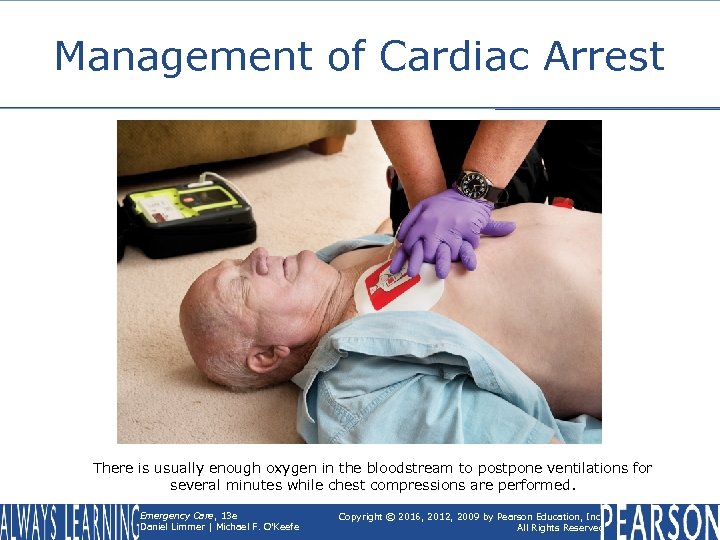 Management of Cardiac Arrest There is usually enough oxygen in the bloodstream to postpone ventilations for several minutes while chest compressions are performed. Emergency Care, 13 e Daniel Limmer | Michael F. O'Keefe Copyright © 2016, 2012, 2009 by Pearson Education, Inc. All Rights Reserved
 Management of Cardiac Arrest Perform one- and two-rescuer CPR. Take Standard Precautions. Use an automated external defibrillator. Request ALS (when available) to continue the chain of survival. • Use a bag-valve mask device with oxygen. • • continued on next slide Emergency Care, 13 e Daniel Limmer | Michael F. O'Keefe Copyright © 2016, 2012, 2009 by Pearson Education, Inc. All Rights Reserved
 Management of Cardiac Arrest • Use flow-restricted, oxygen-powered ventilation device. • Lift and move patients. • Suction patient's airway. • Use airway adjuncts. • Interview bystanders and family members. Emergency Care, 13 e Daniel Limmer | Michael F. O'Keefe Copyright © 2016, 2012, 2009 by Pearson Education, Inc. All Rights Reserved
 Automated External Defibrillator (AED) • Types of AEDs § Semi-automatic • Advises EMT to press button that causes machine to deliver shock through pads § Fully automatic • Does not advise EMT to take any action • Delivers shock automatically continued on next slide Emergency Care, 13 e Daniel Limmer | Michael F. O'Keefe Copyright © 2016, 2012, 2009 by Pearson Education, Inc. All Rights Reserved
 Automated External Defibrillator (AED) • Types of AEDs § Classified by type of shock delivered • Monophasic • Sends single shock from negative pad to positive pad • Biphasic • Sends shock in one direction and then the other continued on next slide Emergency Care, 13 e Daniel Limmer | Michael F. O'Keefe Copyright © 2016, 2012, 2009 by Pearson Education, Inc. All Rights Reserved
 Automated External Defibrillator (AED) • How AEDs Work § Analyzes cardiac rhythm to determine whether shock is indicated continued Emergency Care, 13 e Daniel Limmer | Michael F. O'Keefe Copyright © 2016, 2012, 2009 by Pearson Education, Inc. All Rights Reserved
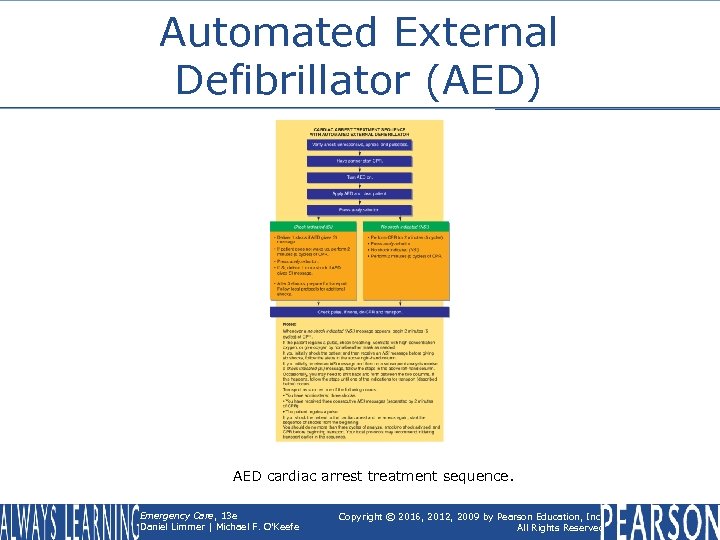 Automated External Defibrillator (AED) AED cardiac arrest treatment sequence. Emergency Care, 13 e Daniel Limmer | Michael F. O'Keefe Copyright © 2016, 2012, 2009 by Pearson Education, Inc. All Rights Reserved continued
 Automated External Defibrillator (AED) • How AEDs Work § Most common conditions resulting in cardiac arrest are shockable rhythms. • Ventricular fibrillation • Ventricular tachycardia Emergency Care, 13 e Daniel Limmer | Michael F. O'Keefe Copyright © 2016, 2012, 2009 by Pearson Education, Inc. All Rights Reserved
 Coordinating CPR and AED for a Patient in Cardiac Arrest • Interrupt CPR only when absolutely necessary and for as short a period as possible. • CPR must be paused for rhythm analysis and defibrillation. Emergency Care, 13 e Daniel Limmer | Michael F. O'Keefe Copyright © 2016, 2012, 2009 by Pearson Education, Inc. All Rights Reserved
 Patient Assessment • Perform primary assessment. § If bystanders are doing CPR when you arrive, have them stop. § Verify pulselessness, apnea, absence of other signs of life no longer than 10 seconds. Emergency Care, 13 e Daniel Limmer | Michael F. O'Keefe Copyright © 2016, 2012, 2009 by Pearson Education, Inc. All Rights Reserved
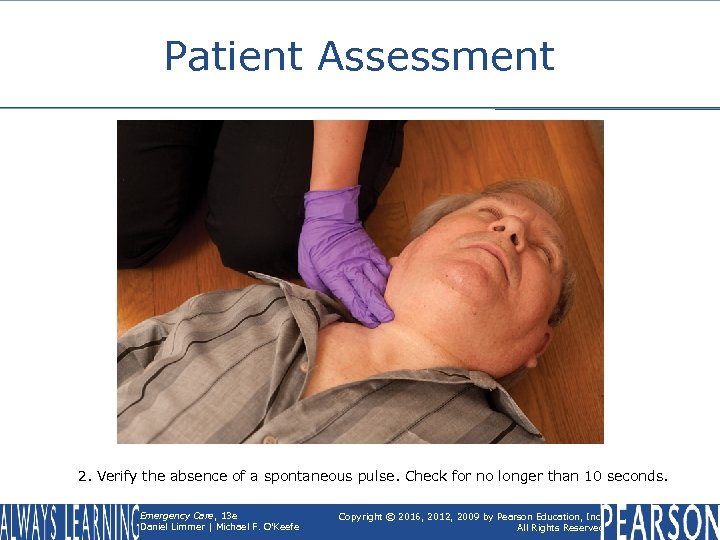 Patient Assessment 2. Verify the absence of a spontaneous pulse. Check for no longer than 10 seconds. Emergency Care, 13 e Daniel Limmer | Michael F. O'Keefe Copyright © 2016, 2012, 2009 by Pearson Education, Inc. All Rights Reserved
 Patient Care • Apply AED § Bare patient's chest. • Quickly shave area where pads will be placed if necessary. § If available, use pediatric AED pads. § If using adult pads, do not overlap. Emergency Care, 13 e Daniel Limmer | Michael F. O'Keefe Copyright © 2016, 2012, 2009 by Pearson Education, Inc. All Rights Reserved
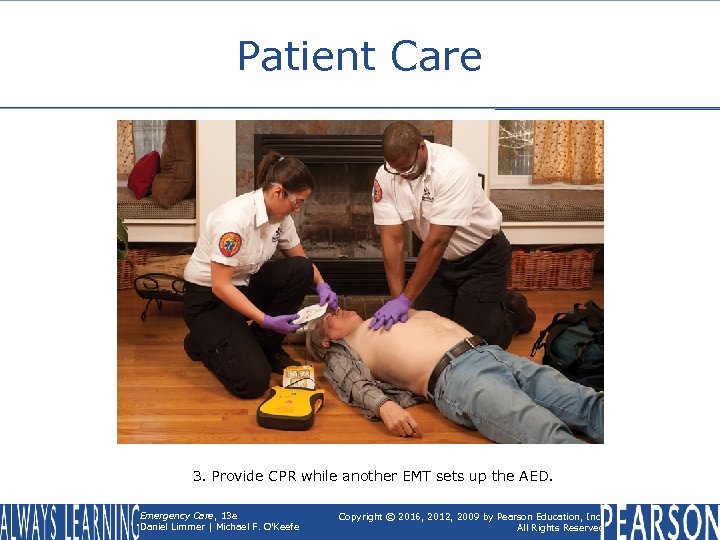 Patient Care 3. Provide CPR while another EMT sets up the AED. Emergency Care, 13 e Daniel Limmer | Michael F. O'Keefe Copyright © 2016, 2012, 2009 by Pearson Education, Inc. All Rights Reserved
 Patient Care • Use AED. § Turn on AED. § Attach pads to cables and then to patient. § Stop CPR and analyze. § Clear patient and shock if indicated. Emergency Care, 13 e Daniel Limmer | Michael F. O'Keefe Copyright © 2016, 2012, 2009 by Pearson Education, Inc. All Rights Reserved
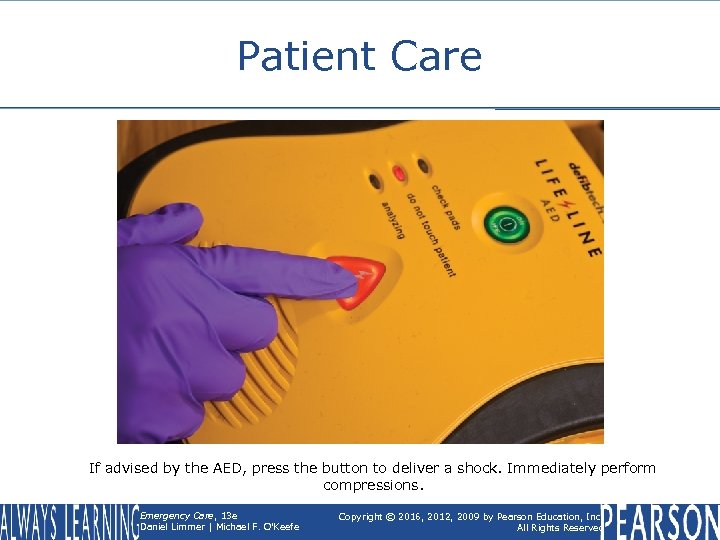 Patient Care If advised by the AED, press the button to deliver a shock. Immediately perform compressions. Emergency Care, 13 e Daniel Limmer | Michael F. O'Keefe Copyright © 2016, 2012, 2009 by Pearson Education, Inc. All Rights Reserved
 Patient Care • Immediately begin CPR after delivering a shock. • Reassess patient after providing 2 minutes or 5 cycles of CPR. Emergency Care, 13 e Daniel Limmer | Michael F. O'Keefe Copyright © 2016, 2012, 2009 by Pearson Education, Inc. All Rights Reserved
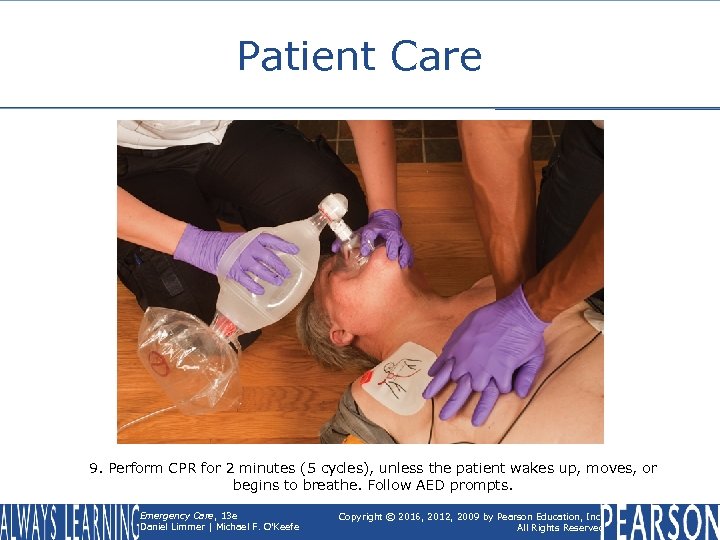 Patient Care 9. Perform CPR for 2 minutes (5 cycles), unless the patient wakes up, moves, or begins to breathe. Follow AED prompts. Emergency Care, 13 e Daniel Limmer | Michael F. O'Keefe Copyright © 2016, 2012, 2009 by Pearson Education, Inc. All Rights Reserved
 Patient Care • If AED finds no shockable ECG rhythm, will advise that no shock is indicated. § Pulseless electrical activity § Asystole • Resume CPR immediately. continued on next slide Emergency Care, 13 e Daniel Limmer | Michael F. O'Keefe Copyright © 2016, 2012, 2009 by Pearson Education, Inc. All Rights Reserved
 Patient Care • When providing CPR § Compressions must not be interrupted for any longer than 10 seconds § Compressions at least 2 inches deep for adult and at least one-third depth of chest for infants and children with full chest recoil continued on next slide Emergency Care, 13 e Daniel Limmer | Michael F. O'Keefe Copyright © 2016, 2012, 2009 by Pearson Education, Inc. All Rights Reserved
 Patient Care • When providing CPR § Rate should be at least 100 per minute § Rotate personnel through compressor position to prevent fatigue continued on next slide Emergency Care, 13 e Daniel Limmer | Michael F. O'Keefe Copyright © 2016, 2012, 2009 by Pearson Education, Inc. All Rights Reserved
 Patient Care • If patient wakes or begins to move: § Obtain baseline vital signs. § Administer high-concentration oxygen. § Transport. continued Emergency Care, 13 e Daniel Limmer | Michael F. O'Keefe Copyright © 2016, 2012, 2009 by Pearson Education, Inc. All Rights Reserved
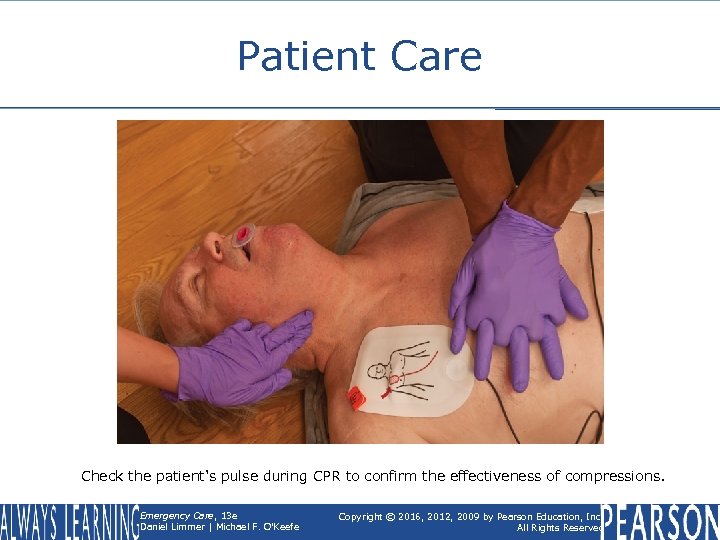 Patient Care Check the patient's pulse during CPR to confirm the effectiveness of compressions. continued Emergency Care, 13 e Daniel Limmer | Michael F. O'Keefe Copyright © 2016, 2012, 2009 by Pearson Education, Inc. All Rights Reserved
 Special Considerations for AED Use • General Principles § One EMT operates the defibrillator while another does CPR. § CPR must include high-quality compressions. § Defibrillation comes first. § You must be familiar with the model of AED used in your area. continued on next slide Emergency Care, 13 e Daniel Limmer | Michael F. O'Keefe Copyright © 2016, 2012, 2009 by Pearson Education, Inc. All Rights Reserved
 Special Considerations for AED Use • General Principles § All contact with the patient must be avoided during rhythm analysis. • Pulse checks should not occur during rhythm analysis. § State, "Clear!" and be sure everyone is clear of the patient before delivering every shock. continued on next slide Emergency Care, 13 e Daniel Limmer | Michael F. O'Keefe Copyright © 2016, 2012, 2009 by Pearson Education, Inc. All Rights Reserved
 Special Considerations for AED Use • General Principles § Check the batteries at the beginning of your shift, and carry a spare. § If you have delivered three shocks and are without backup, prepare patient for transport. § An AED is often not able to analyze a rhythm accurately in a moving emergency vehicle. Emergency Care, 13 e Daniel Limmer | Michael F. O'Keefe Copyright © 2016, 2012, 2009 by Pearson Education, Inc. All Rights Reserved
 Special Considerations for AED Use • Coordination with ALS Personnel § Notify as soon as possible to greater the patient's chance of survival. § If the team arrives before you have finished the first shock, they should allow you to complete the shock. § Your actions may depend on location of the arrest and estimated time of arrival of the ALS team. Emergency Care, 13 e Daniel Limmer | Michael F. O'Keefe Copyright © 2016, 2012, 2009 by Pearson Education, Inc. All Rights Reserved
 Special Considerations for AED Use • Coordination with Others Who Defibrillate before You Arrive § Let the operator of the AED complete the shock before you take over care of the patient. § You may need to take the first AED to the hospital with the patient so data can be retrieved from the machine. § Your protocols will dictate transfer of care. Emergency Care, 13 e Daniel Limmer | Michael F. O'Keefe Copyright © 2016, 2012, 2009 by Pearson Education, Inc. All Rights Reserved
 Post-Resuscitation Care • If patient has a pulse § Manage airway. • Avoid hyperventilation. § Keep defibrillator on patient during transport in case patient goes back into arrest. § Reassess frequently (every 5 minutes). § Consider hypothermia protocols. continued on next slide Emergency Care, 13 e Daniel Limmer | Michael F. O'Keefe Copyright © 2016, 2012, 2009 by Pearson Education, Inc. All Rights Reserved
 Post-Resuscitation Care • If patient has no pulse § You will need to resume CPR. • AED will have given you a "No shock indicated" message. • AED may be prompting you to analyze the rhythm because it "thinks" there is a shockable rhythm. continued on next slide Emergency Care, 13 e Daniel Limmer | Michael F. O'Keefe Copyright © 2016, 2012, 2009 by Pearson Education, Inc. All Rights Reserved
 Post-Resuscitation Care • Ensure adequate ventilation and oxygenation § Adjust amount to no more than what is necessary to achieve oxygen saturation of 94 percent • Protocol may require you to place the patient in therapeutic hypothermia. • Use techniques of lifting and moving. Emergency Care, 13 e Daniel Limmer | Michael F. O'Keefe Copyright © 2016, 2012, 2009 by Pearson Education, Inc. All Rights Reserved
 Patients Who Go Back into Cardiac Arrest • Stop the vehicle and resume CPR. • Have someone else start CPR if the AED is not immediately ready. • Analyze rhythm as soon as possible. • Deliver shock if indicated. • Continue with 2 shocks separated by 2 minutes (5 cycles). Emergency Care, 13 e Daniel Limmer | Michael F. O'Keefe Copyright © 2016, 2012, 2009 by Pearson Education, Inc. All Rights Reserved
 Witnessed Arrests in the Ambulance • No guarantees, but very good chance of reviving patient because you can defibrillate very shortly after patient goes into shockable rhythm • Stop the vehicle and treat this patient like any other patient in cardiac arrest. Emergency Care, 13 e Daniel Limmer | Michael F. O'Keefe Copyright © 2016, 2012, 2009 by Pearson Education, Inc. All Rights Reserved
 Single Rescuer with an AED • Apply the AED and defibrillate immediately • Once shock delivered or received "No shock indicated, " begin chest compressions. • After about 2 minutes, check rhythm again and shock as needed. Emergency Care, 13 e Daniel Limmer | Michael F. O'Keefe Copyright © 2016, 2012, 2009 by Pearson Education, Inc. All Rights Reserved
 Contraindications • Pads won't fit on patient without touching each other. • Trauma with severe blood loss or damage to one or more vital organs • Hypothermia continued on next slide Emergency Care, 13 e Daniel Limmer | Michael F. O'Keefe Copyright © 2016, 2012, 2009 by Pearson Education, Inc. All Rights Reserved
 Contraindications • Do not defibrillate soaking-wet patient. • Do not defibrillate if patient is touching anything metallic that other people are touching. • Remove nitroglycerin patches before defibrillating. • Verbally and visually "CLEAR!" patient before defibrillating. Emergency Care, 13 e Daniel Limmer | Michael F. O'Keefe Copyright © 2016, 2012, 2009 by Pearson Education, Inc. All Rights Reserved
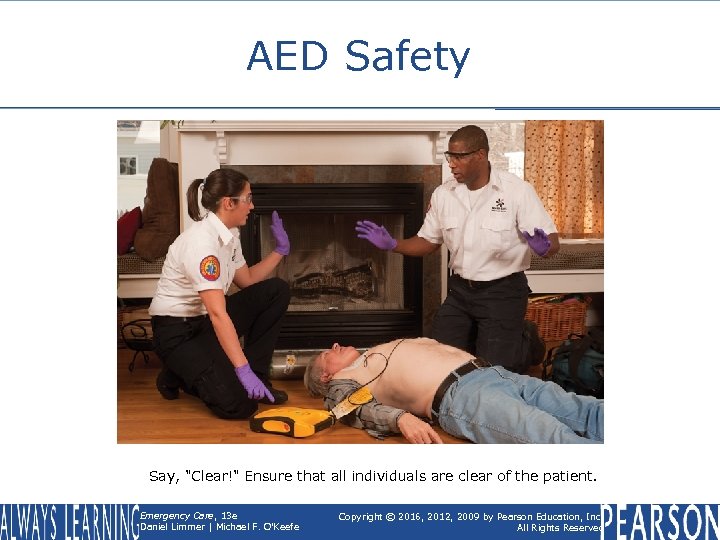 AED Safety Say, "Clear!" Ensure that all individuals are clear of the patient. Emergency Care, 13 e Daniel Limmer | Michael F. O'Keefe Copyright © 2016, 2012, 2009 by Pearson Education, Inc. All Rights Reserved
 Implants and Surgeries • Defibrillation can be performed on patient with an implanted device. • Position defibrillation pads on patient's chest to avoid contact with the device. continued on next slide Emergency Care, 13 e Daniel Limmer | Michael F. O'Keefe Copyright © 2016, 2012, 2009 by Pearson Education, Inc. All Rights Reserved
 Implants and Surgeries • Some devices and surgeries you may observe in the field include: § § Cardiac pacemaker Implanted defibrillator Ventricular assist device Cardiac bypass surgery Emergency Care, 13 e Daniel Limmer | Michael F. O'Keefe Copyright © 2016, 2012, 2009 by Pearson Education, Inc. All Rights Reserved
 Quality Improvement • Involves multiple functions § § § Medical direction Initial training Maintenance of skills Case review Trend analysis Strengthening links in chain of survival continued on next slide Emergency Care, 13 e Daniel Limmer | Michael F. O'Keefe Copyright © 2016, 2012, 2009 by Pearson Education, Inc. All Rights Reserved
 Quality Improvement • Maintenance § Use checklist at beginning of every shift to ensure you have all supplies and AED is functioning properly. § Make sure battery is charged and you have a spare with defibrillator. Emergency Care, 13 e Daniel Limmer | Michael F. O'Keefe Copyright © 2016, 2012, 2009 by Pearson Education, Inc. All Rights Reserved
 Mechanical CPR Devices • Mechanical devices assist EMTs to provide high-quality compressions. • Using the LUCAS CPR device § Stop CPR just long enough to put the LUCAS base plate under the patient. § Apply stabilization strap before moving the patient. § Upon termination of arrest or return of spontaneous circulation, power down. continued on next slide Emergency Care, 13 e Daniel Limmer | Michael F. O'Keefe Copyright © 2016, 2012, 2009 by Pearson Education, Inc. All Rights Reserved
 Mechanical CPR Devices • Using the Auto-Pulse § Align the patient on the Auto-Pulse platform. § Provide bag-mask ventilation at a rate of two ventilations for every 30 compressions. § After 2 minutes of CPR, reassess for pulse and/or shockable rhythm. Emergency Care, 13 e Daniel Limmer | Michael F. O'Keefe Copyright © 2016, 2012, 2009 by Pearson Education, Inc. All Rights Reserved
 Terminating Resuscitation • Once you start resuscitation, you must continue until: § Spontaneous circulation occurs. • Then provide rescue breathing as needed. § Spontaneous circulation and breathing occur. § Another trained rescuer can take over for you. continued on next slide Emergency Care, 13 e Daniel Limmer | Michael F. O'Keefe Copyright © 2016, 2012, 2009 by Pearson Education, Inc. All Rights Reserved
 Terminating Resuscitation • Once you start resuscitation, you must continue until: § You turn care of patient over to a person with higher level of training. § You are too exhausted to continue. § You receive a "no resuscitation" order from a physician or other authority per local protocols. continued on next slide Emergency Care, 13 e Daniel Limmer | Michael F. O'Keefe Copyright © 2016, 2012, 2009 by Pearson Education, Inc. All Rights Reserved
 Terminating Resuscitation • Once you start resuscitation, you must continue until: § Criteria to determine when it is reasonable to stop without missing anyone who has a chance of survival • Arrest not witnessed by EMS personnel or first responders • No return of spontaneous circulation after three rounds of CPR and rhythm checks with an AED continued on next slide Emergency Care, 13 e Daniel Limmer | Michael F. O'Keefe Copyright © 2016, 2012, 2009 by Pearson Education, Inc. All Rights Reserved
 Terminating Resuscitation • Once you start resuscitation, you must continue until: § Criteria to determine when it is reasonable to stop without missing anyone who has a chance of survival • AED did not detect a shockable rhythm and did not deliver any shocks. Emergency Care, 13 e Daniel Limmer | Michael F. O'Keefe Copyright © 2016, 2012, 2009 by Pearson Education, Inc. All Rights Reserved
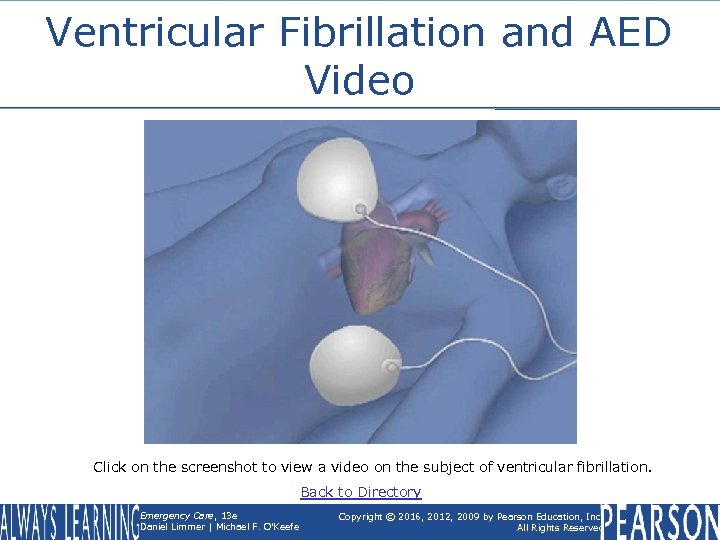 Ventricular Fibrillation and AED Video Click on the screenshot to view a video on the subject of ventricular fibrillation. Back to Directory Emergency Care, 13 e Daniel Limmer | Michael F. O'Keefe Copyright © 2016, 2012, 2009 by Pearson Education, Inc. All Rights Reserved
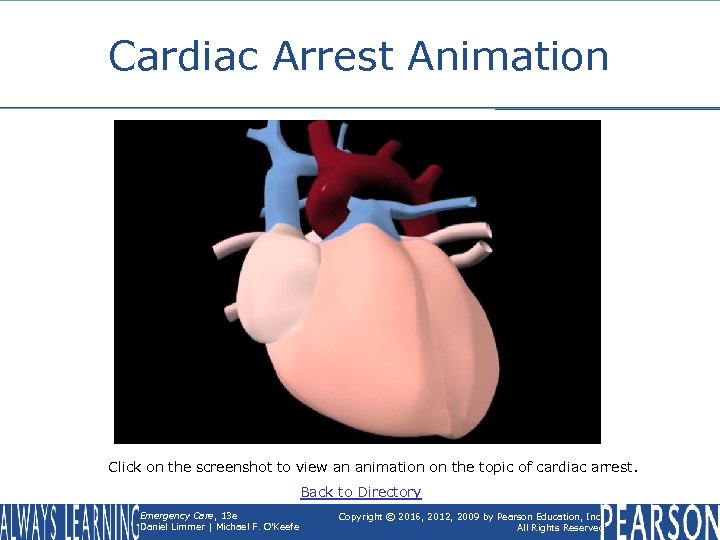 Cardiac Arrest Animation Click on the screenshot to view an animation on the topic of cardiac arrest. Back to Directory Emergency Care, 13 e Daniel Limmer | Michael F. O'Keefe Copyright © 2016, 2012, 2009 by Pearson Education, Inc. All Rights Reserved
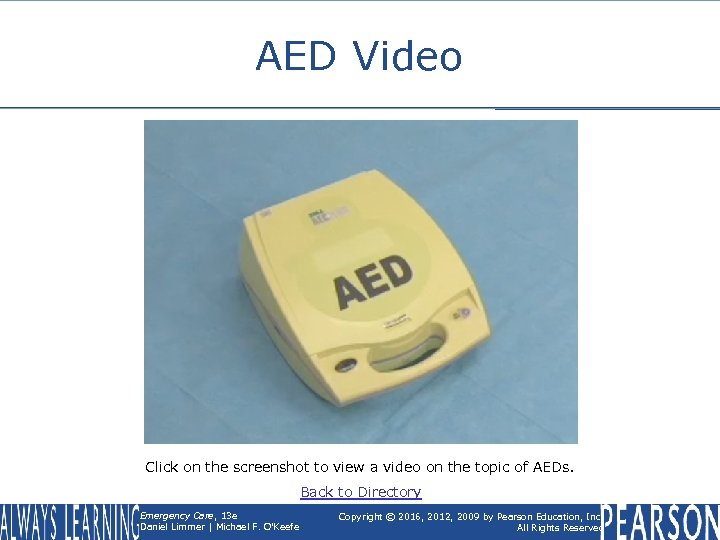 AED Video Click on the screenshot to view a video on the topic of AEDs. Back to Directory Emergency Care, 13 e Daniel Limmer | Michael F. O'Keefe Copyright © 2016, 2012, 2009 by Pearson Education, Inc. All Rights Reserved
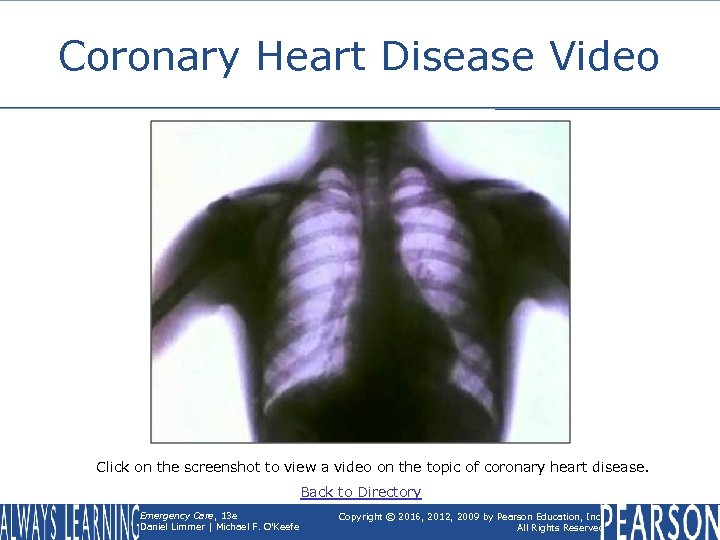 Coronary Heart Disease Video Click on the screenshot to view a video on the topic of coronary heart disease. Back to Directory Emergency Care, 13 e Daniel Limmer | Michael F. O'Keefe Copyright © 2016, 2012, 2009 by Pearson Education, Inc. All Rights Reserved
 Chapter Review Emergency Care, 13 e Daniel Limmer | Michael F. O'Keefe Copyright © 2016, 2012, 2009 by Pearson Education, Inc. All Rights Reserved
 Chapter Review • Patients with cardiac compromise or ACS can have many different presentations. Some complain of pressure or pain in the chest with difficulty breathing. Others may have just mild discomfort that they ignore or that goes away and returns. Between 10 and 20 percent of heart attack patients have no chest discomfort. continued on next slide Emergency Care, 13 e Daniel Limmer | Michael F. O'Keefe Copyright © 2016, 2012, 2009 by Pearson Education, Inc. All Rights Reserved
 Chapter Review • Because of these possibilities and the severe complications of heart problems, it is important to have a high suspicion and treat patients with these symptoms for ACS. The treatment will not hurt them and may help them. continued on next slide Emergency Care, 13 e Daniel Limmer | Michael F. O'Keefe Copyright © 2016, 2012, 2009 by Pearson Education, Inc. All Rights Reserved
 Chapter Review • Patients with suspected ACS who are hypoxic or short of breath need oxygen and prompt, safe transportation to definitive care. You may be able to assist patients who have their own nitroglycerin in taking it, thereby relieving pain and anxiety. continued on next slide Emergency Care, 13 e Daniel Limmer | Michael F. O'Keefe Copyright © 2016, 2012, 2009 by Pearson Education, Inc. All Rights Reserved
 Chapter Review • To provide maximum chance of survival for patients in cardiac arrest, EMS agencies must strengthen their performance of the chain of survival: § § § Immediate recognition and activation Early CPR Rapid defibrillation Effective ALS Integrated post-cardiac arrest care Emergency Care, 13 e Daniel Limmer | Michael F. O'Keefe Copyright © 2016, 2012, 2009 by Pearson Education, Inc. All Rights Reserved
 Remember • The heart is a simple pump that moves deoxygenated blood to the lungs and oxygenated blood to the body. Pressure within the cardiovascular system is critical to the moving of blood. continued on next slide Emergency Care, 13 e Daniel Limmer | Michael F. O'Keefe Copyright © 2016, 2012, 2009 by Pearson Education, Inc. All Rights Reserved
 Remember • Acute coronary syndrome (ACS) is a blanket term that refers to a number of situations in which perfusion of the heart is inadequate. • Although there are common symptoms of ACS, EMTs must recognize atypical findings and err on the side of caution. continued on next slide Emergency Care, 13 e Daniel Limmer | Michael F. O'Keefe Copyright © 2016, 2012, 2009 by Pearson Education, Inc. All Rights Reserved
 Remember • Oxygen, nitroglycerine, and aspirin are key medications indicated to treat ACS. However, the definitive treatment is transportation of the patient to a facility that can open the blocked artery. continued on next slide Emergency Care, 13 e Daniel Limmer | Michael F. O'Keefe Copyright © 2016, 2012, 2009 by Pearson Education, Inc. All Rights Reserved
 Remember • Most cardiac conditions are caused by arterial problems. Angina pectoris and acute myocardial infarction are caused by inadequate perfusion of the heart. • Heart failure can be caused by either electrical or mechanical problems. continued on next slide Emergency Care, 13 e Daniel Limmer | Michael F. O'Keefe Copyright © 2016, 2012, 2009 by Pearson Education, Inc. All Rights Reserved
 Remember • The most important element of cardiac arrest care is the administration of high -quality chest compressions. • The American Heart Association's chain of survival describes the key elements necessary to maximize the cardiac arrest patient's chance of survival. continued on next slide Emergency Care, 13 e Daniel Limmer | Michael F. O'Keefe Copyright © 2016, 2012, 2009 by Pearson Education, Inc. All Rights Reserved
 Remember • AED provides early defibrillation in cardiac arrest patients with ventricular tachycardia and ventricular fibrillation. • Post-cardiac arrest care is an essential element of cardiac arrest care. • Mechanical CPR devices provide automated chest compressions in cardiac arrest settings. Emergency Care, 13 e Daniel Limmer | Michael F. O'Keefe Copyright © 2016, 2012, 2009 by Pearson Education, Inc. All Rights Reserved
 Questions to Consider • What position is best for a patient with: § Difficulty breathing and a blood pressure of 100/70? § Chest pain and a blood pressure of 180/90? • Describe how to "clear" a patient before administering a shock. continued on next slide Emergency Care, 13 e Daniel Limmer | Michael F. O'Keefe Copyright © 2016, 2012, 2009 by Pearson Education, Inc. All Rights Reserved
 Questions to Consider • List three safety measures to keep in mind when using an AED. • List the steps in the application of an AED. Emergency Care, 13 e Daniel Limmer | Michael F. O'Keefe Copyright © 2016, 2012, 2009 by Pearson Education, Inc. All Rights Reserved
 Critical Thinking • A 78 -year-old male has been complaining of severe shortness of breath for 20 minutes prior to your arrival. When you arrive, you find the patient unconscious and not moving. What are your immediate priorities? Emergency Care, 13 e Daniel Limmer | Michael F. O'Keefe Copyright © 2016, 2012, 2009 by Pearson Education, Inc. All Rights Reserved