 Скачать презентацию Emerald Deposits of Brazil References http www
34f6590cfdea1aca8d6f937771377b24.ppt
- Количество слайдов: 61



Emerald Deposits of Brazil References • http: //www. cigem. ca/brazil. html • Dietmar Schwarz, 2542. เอกสารประกอบการอบรมเชงปฏบตการเรอง “ มรกต และพลอยตระกลคอรน ดม “. ภาควชาธรณวทยา มหาวทยาลยเชยงใหม • Delaney, J. V. Patrick, 1996. Gemstones of Brazil-Geology and Occurrences. REM-revista Escola de Minas, Brazil
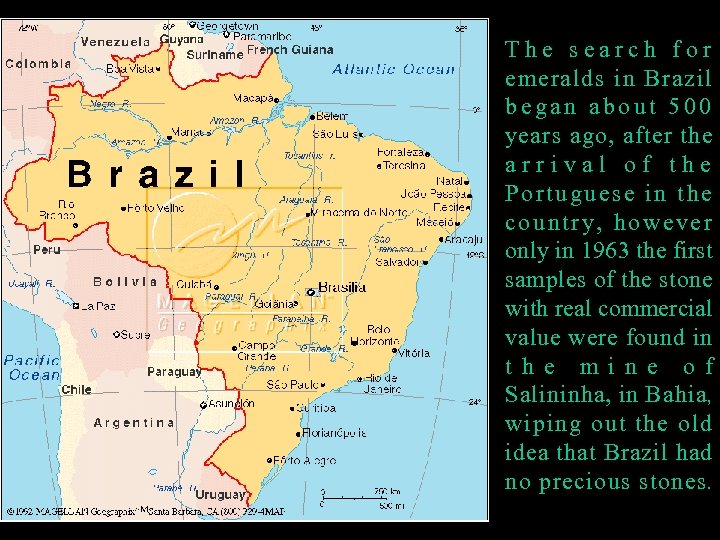
The search for emeralds in Brazil began about 500 years ago, after the arrival of the Portuguese in the country, however only in 1963 the first samples of the stone with real commercial value were found in t h e m i n e o f Salininha, in Bahia, wiping out the old idea that Brazil had no precious stones.
History • 16 -17 th centuries : in search of the legendar “Serra das Esmeraldas” • beginning of 20 th century : discovered some small deposits in Bahia state • 1963 first important find of emeralds in Salininha mine, Bahia • 1978 accidentally discovery of emerald deposit (Blemont Mine) in Minas Gerais • 1981 emerald mining (Blemont Mine) started • 1981 discovery of Santa Terezinha emerald deposits in Goias State
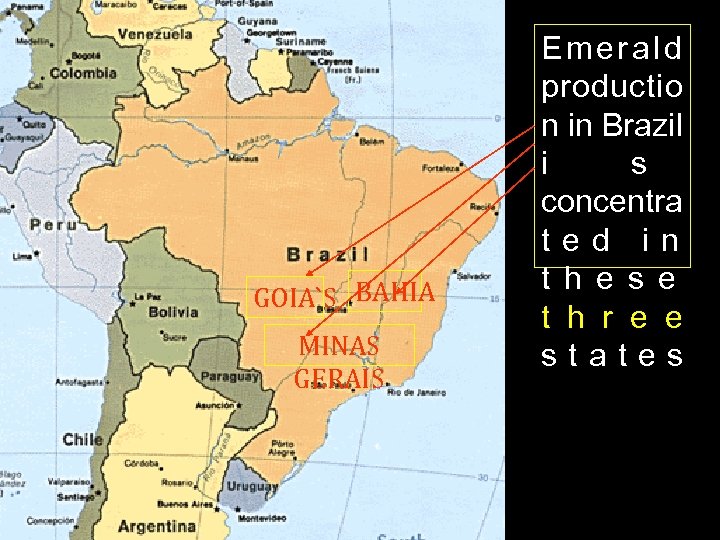
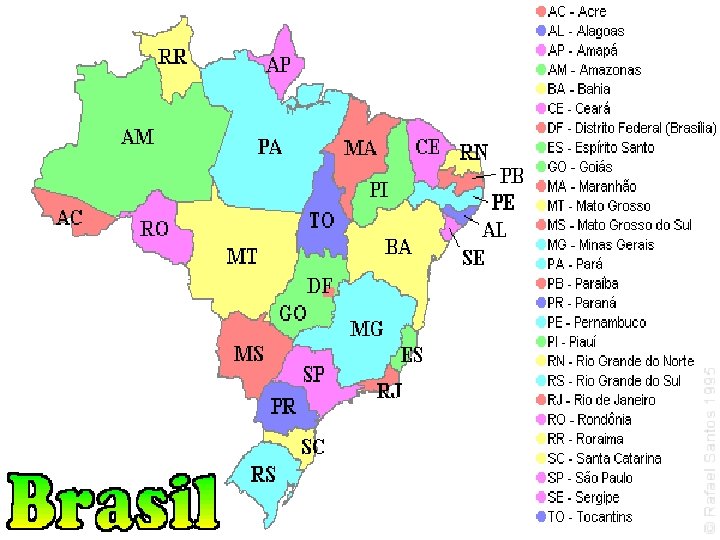
GOIA`S BAHIA MINAS GERAIS Emerald productio n in Brazil i s concentra ted in t h e s e t h r e e states
Geology Basement of Archean Gneiss Complex (> 2. 5 Ga(. Overlies by Proterozoic mafic-ultramafic and meta -sedimentary/volcanic rocks Classification of Emerald Deposits • Granitic Pegmatite-Hydrothermal Type I/A In mafic-ultramafic rocks : Carnaiba. Socoto (2. 0 Ga. ), Belmont Mine-Capoeirana (508 Ma(.
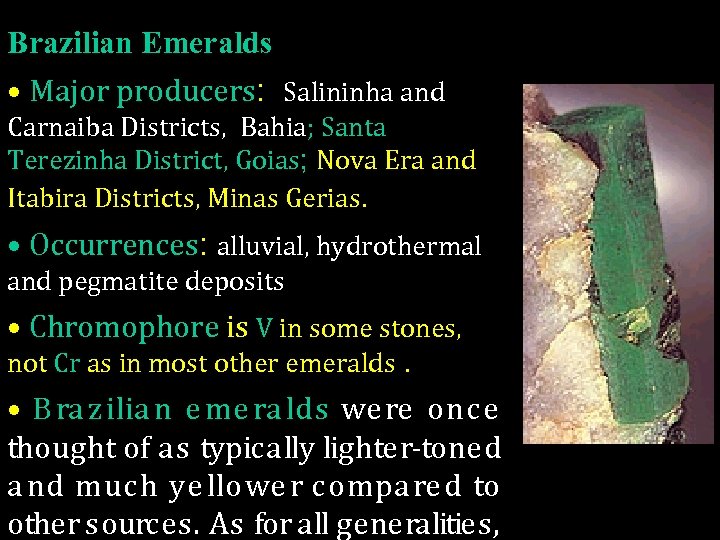
Brazilian Emeralds • Major producers: Salininha and Carnaiba Districts, Bahia; Santa Terezinha District, Goias; Nova Era and Itabira Districts, Minas Gerias. • Occurrences: alluvial, hydrothermal and pegmatite deposits • Chromophore is V in some stones, not Cr as in most other emeralds. • B ra z ilia n e me ra lds we re onc e thought of as typically lighter-toned a nd muc h ye llowe r c ompa re d to other sources. As for all generalities,
Mining & Production • Supervised by Federal Mining Department ( DNPM( • Mining claim (5 years) = US$ 2 million • Mining cost per 1 kg rough = US$ 5000 • 1 m advance of shaft and tunnel = US$ 600 - 1000 • Annual production = US$ 50 million Santa Terezinha, Goia’s State = 60%
G oia’s: The "g a rimpo" is located in the municipality of C ampos Verdes. Nowadays few companies explore there a s the known mine s a re ve ry de e p (up to 600 me te rs d e e p ), th u s n o t p e rm ittin g th e ir e x p lo ra tio n b y "ga rimpe iros" (g a rimpo workers). The gems are of very small sizes but with good crystallization. At present the production is small in volume and of lower commercial q u a l i t y. B a h ia: T h is "g a rim p o" pre s e nts a ve ry irre g ula r production owing to its geological characteristics, but it provide s with a re a s ona ble qua ntity of rough ma te ria l adequate for cutting, reaching competitive prices in the market. The production varies from lower, commercial to e xtra g oods in a ll s ize s. At pre s e nt this "g a rimpo" is producing a reasonable amount of rough and tending to
Nova Era Mine, Minas Gerais Nova Era, is a region close to Itabira. It is a more recent "garimpo" and its goods began to be accepted in the international market at the beginning of 1990. They are clearer crystals of bigger sizes with a bright shine. At present its production is small and irregular, what has reduced the market for t h i s k i n d o f p r o d u c t.
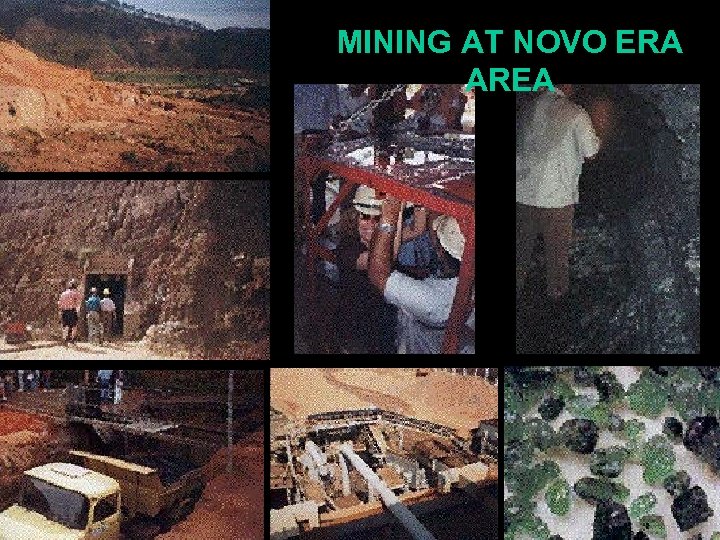
MINING AT NOVO ERA AREA
Salininha Mine, Bahia The discovery of the mine of S a l i n h a and the international acceptance of its gems changed the characteristics of the search for emeralds in Brazil, increasing the mining activity in the country, what brought about the discovery of new mines raising the country to one of the first positions in the world production of colored gems, besides being an important source of emeralds with very good quality.
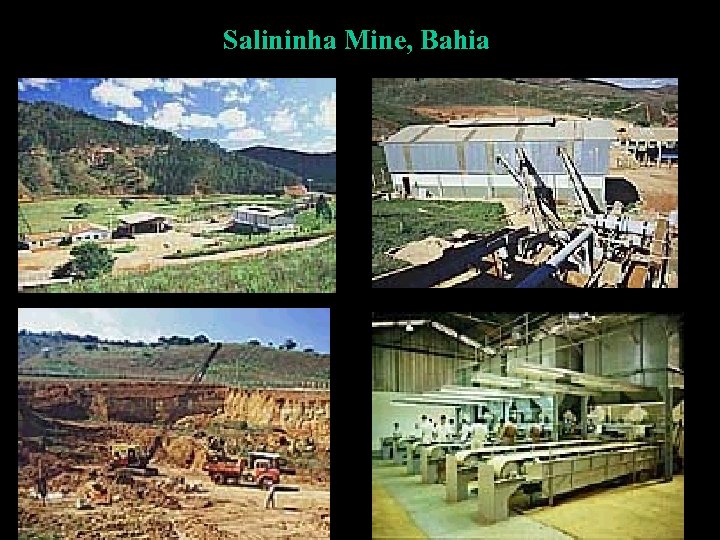
Salininha Mine, Bahia
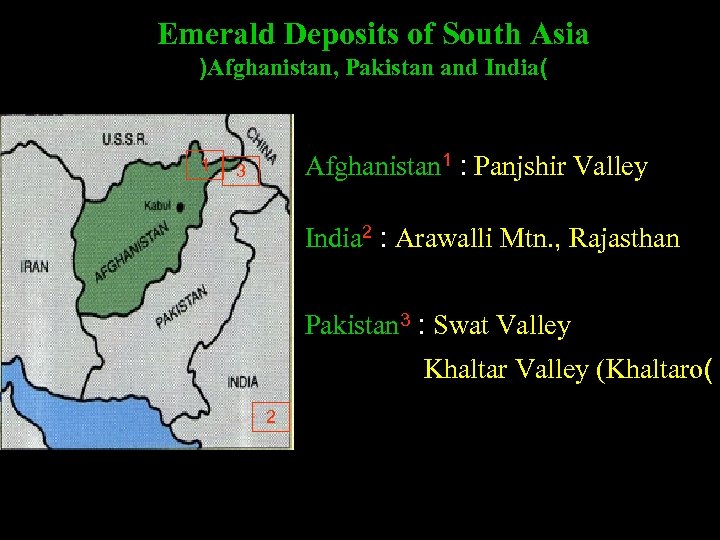
Emerald Deposits of South Asia )Afghanistan, Pakistan and India( 1 Afghanistan 1 : Panjshir Valley 3 India 2 : Arawalli Mtn. , Rajasthan Pakistan 3 : Swat Valley Khaltar Valley (Khaltaro( 2
AFGHANISTAN • Tectonic hydrothermal of type II/A 2 ) Hydrothermal veins cutting ophiolites( • Panjshir Valley 130 km N. of Kabul • discovered early 1970 s • peak production of 1990 s (US$ 10 mil. for rough( • source of revenue for Mujahideen! • difficult terrain, lacks of infrastucture • mining activities depend on political and military situations! Ref. • Emeralds of the Panjshir Valley, Afghanistan in GEMS & GEMOLOGY, Spring, 1991 • http: //www. gems-afghan. com/articles/emeralds. htm
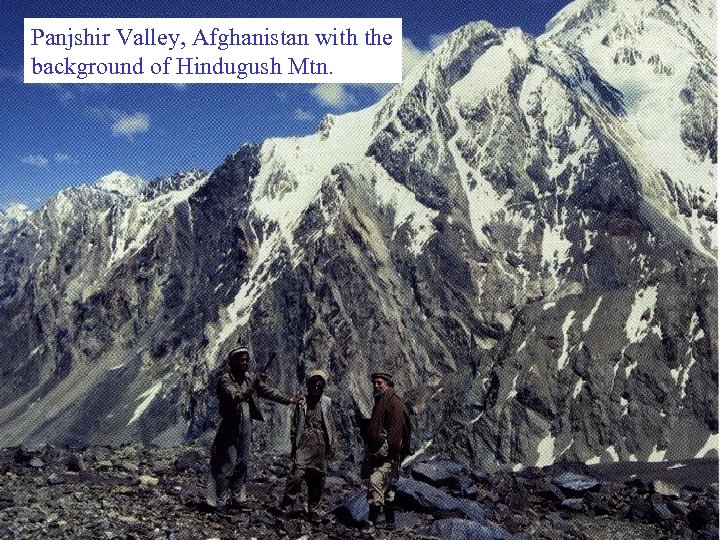
Panjshir Valley, Afghanistan with the background of Hindugush Mtn.
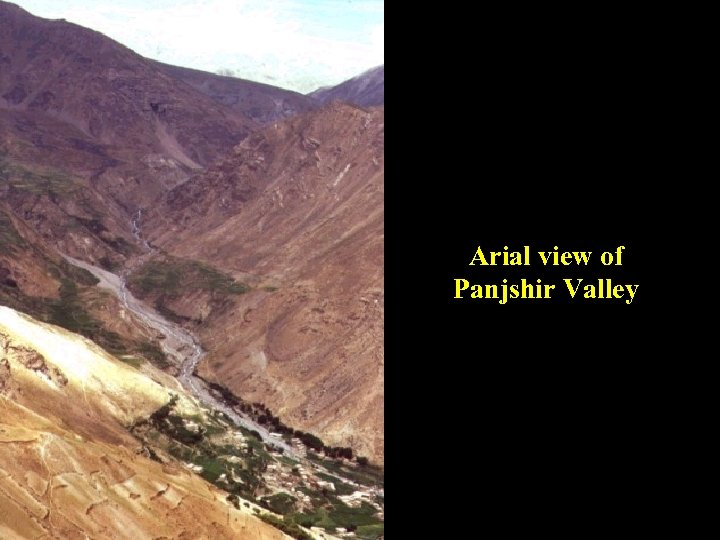
Arial view of Panjshir Valley
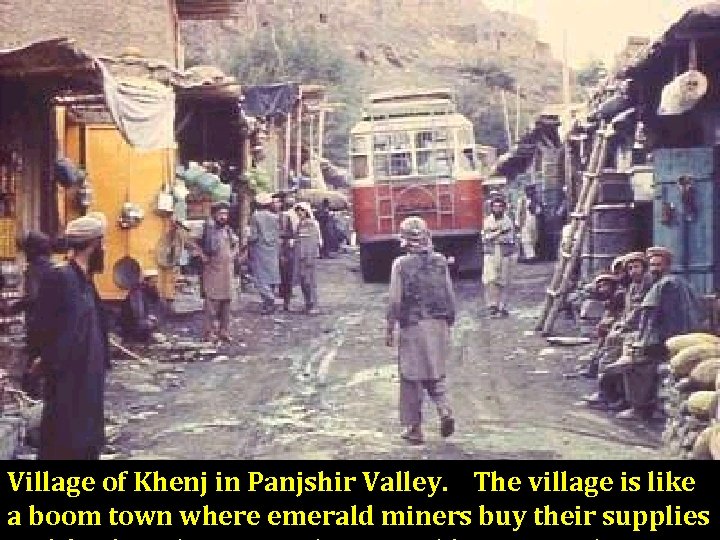
Village of Khenj in Panjshir Valley. The village is like a boom town where emerald miners buy their supplies
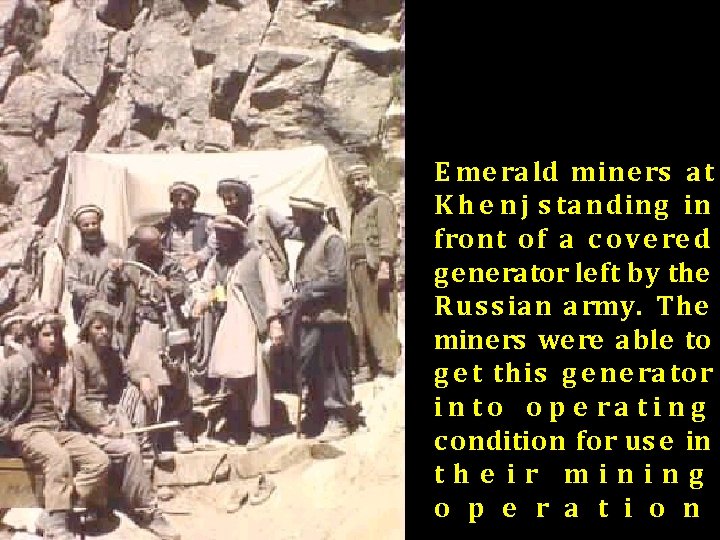
E me ra ld mine rs a t K h e n j s ta nding in fro nt o f a c o ve re d generator left by the R us s ia n a rmy. The miners were able to g e t this g e ne ra to r in to o p e ra tin g c ondition for us e in the ir mining o p e r a t i o n
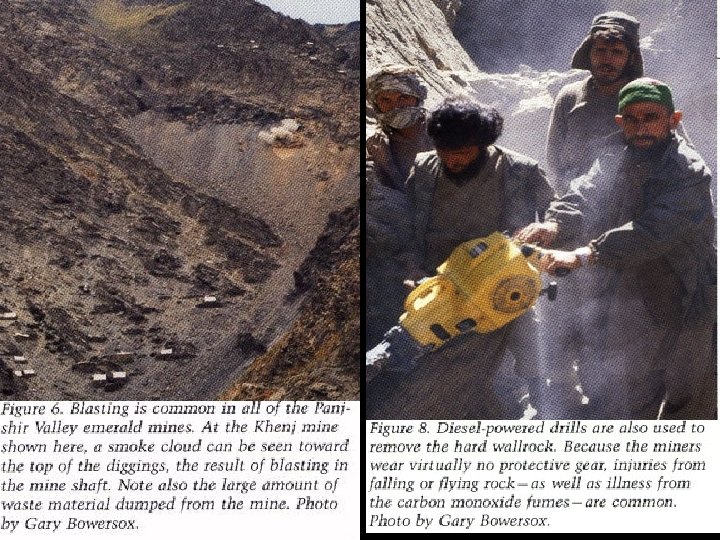
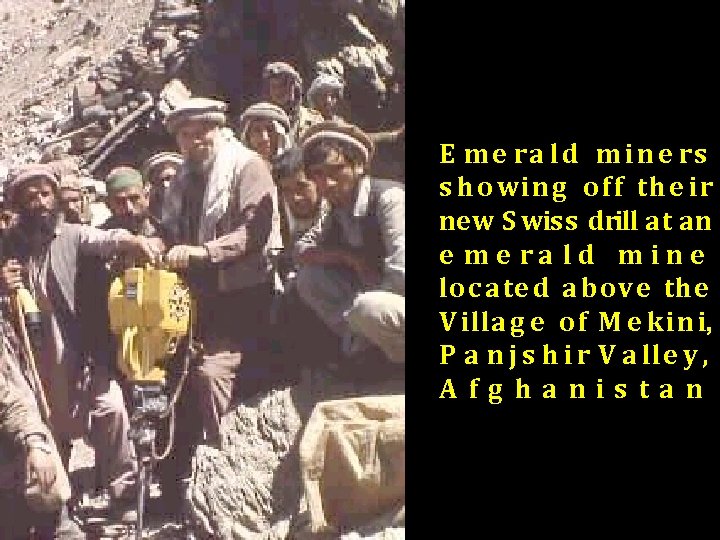
E m e ra l d m i n e rs s h o win g o f f th e ir new S wiss drill at an e m e ra ld m in e lo c a te d a bo ve the V illa g e o f M e kin i, P a n j s h i r V a lle y , A fg ha nis ta n
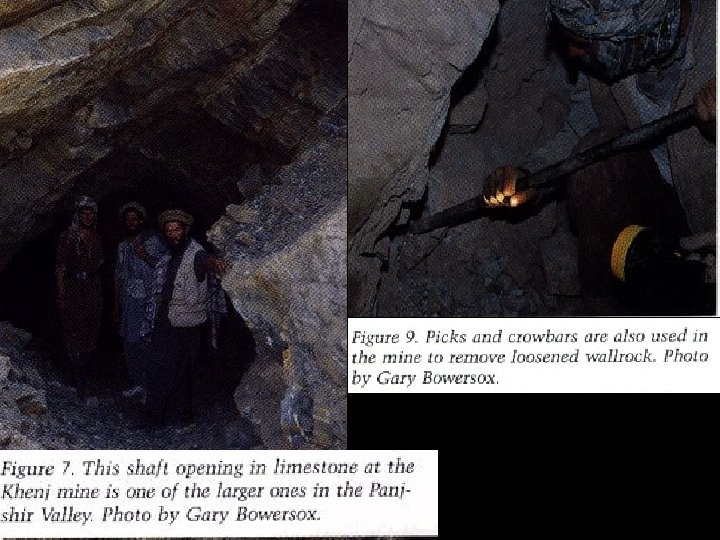
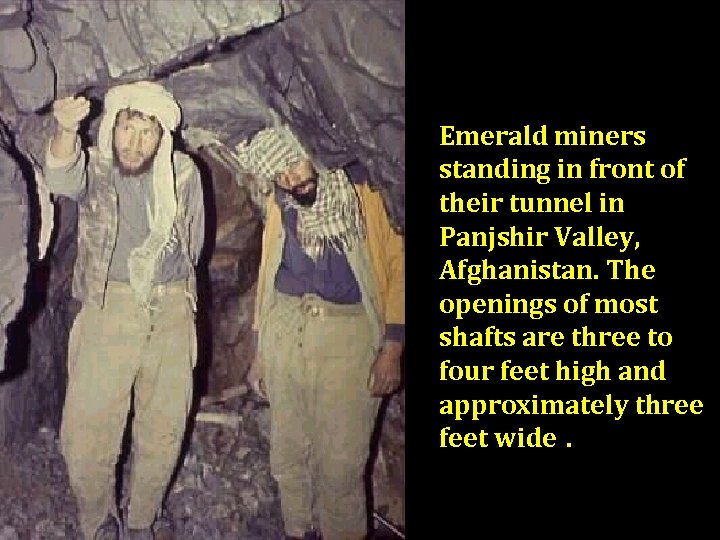
Emerald miners standing in front of their tunnel in Panjshir Valley, Afghanistan. The openings of most shafts are three to four feet high and approximately three feet wide.
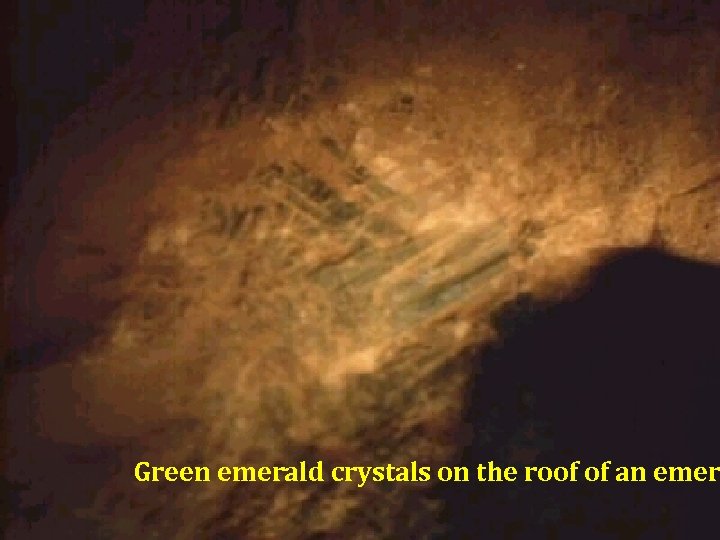
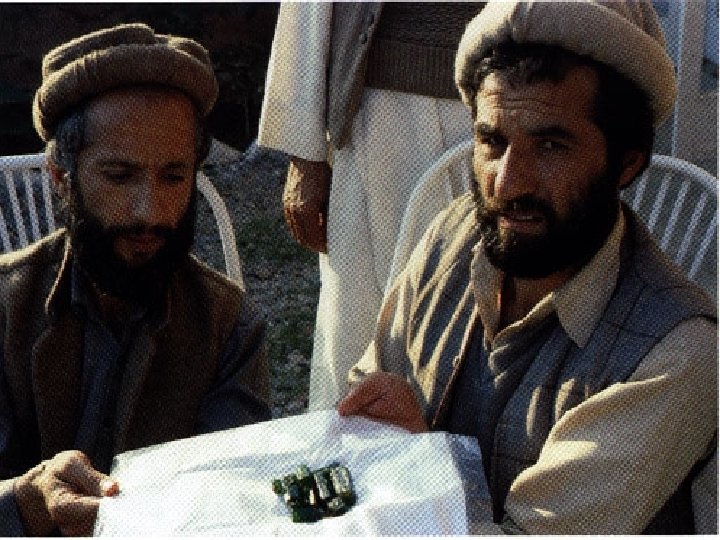
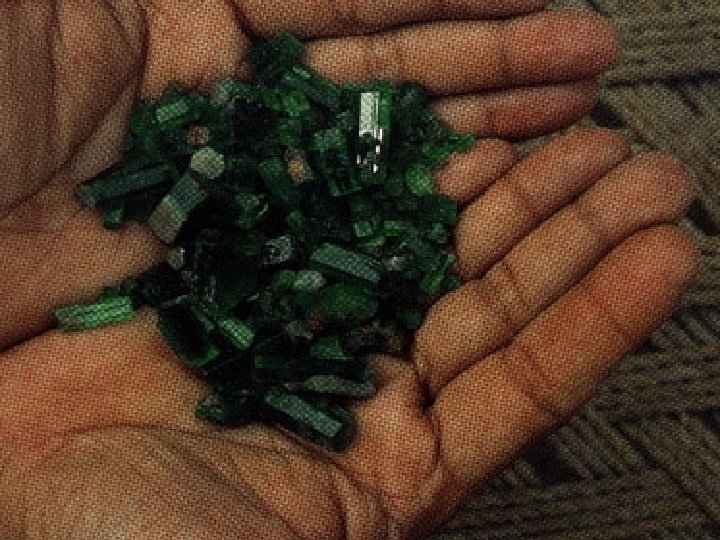
Green emerald crystals on the roof of an emer
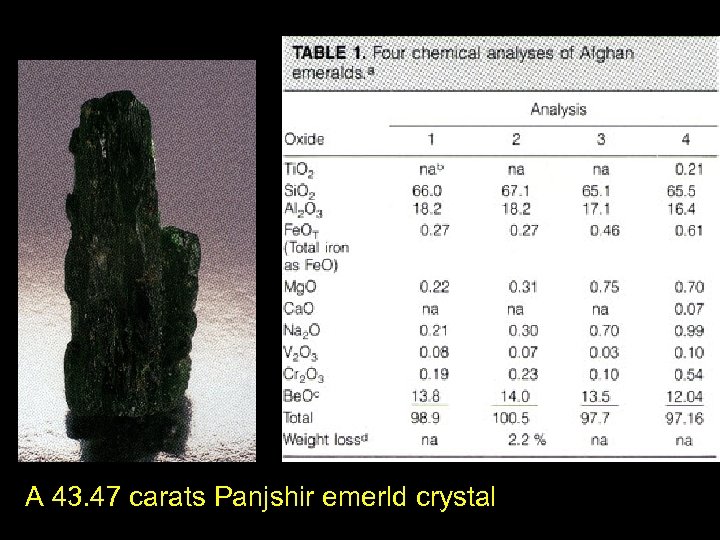
A 43. 47 carats Panjshir emerld crystal
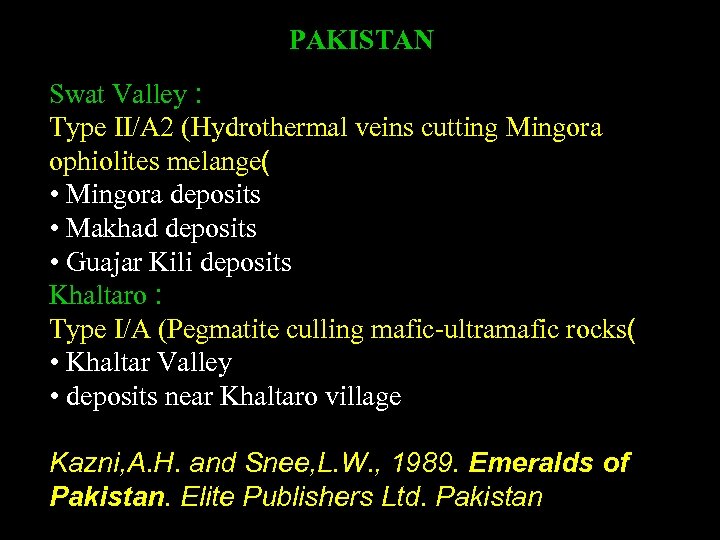
PAKISTAN Swat Valley : Type II/A 2 (Hydrothermal veins cutting Mingora ophiolites melange( • Mingora deposits • Makhad deposits • Guajar Kili deposits Khaltaro : Type I/A (Pegmatite culling mafic-ultramafic rocks( • Khaltar Valley • deposits near Khaltaro village Kazni, A. H. and Snee, L. W. , 1989. Emeralds of Pakistan. Elite Publishers Ltd. Pakistan
MINGORA (Swat Valley( • found in 1958 near Mingora City, Swat District • fine emeralds comparable to Muzo’s • known as “Pakistan or Swat Emeralds” • Mining done by GEMCP (Gemstone Corp. of Pakistan. ( • Mineralization in shear planes, fractures, stockworks and tension gashes. • 15 -30 cm emerald-bearing zone around quartz lenses • Commonly up to 30 carats crystals of good green colour and clarity.
MAKHAD (Swat Valley( • near Makhad Village, 19 Km NE of Mingora • intermittenly mined (Local and GEMCP( • Emerald crystals (10 carats or greater) in talc-carbonate schist host rocks • very dark green, opaque to translucent, full of inclusions (talc, carbonate minerals etc. (. • low gemmological value. • now abandoned
GUJAR KILI (Swat Valley( • 24 Km ENE of Mingora • discovered in 1981 by GEMCP • 3 acres outcrop of Mingora ophiolite melange • faulted and fractured talc-carbonate host rocks • limonitization is the dominant wall-rock alteration • emeralds in limonitzed fault and joint planes • large crystals are 100 -200 carats weight • deep blue green, transp. -transl. , few inclusions • since 1982 annual production > 10, 000 carats
KHALTARO • the deposit is at 4, 500 m MSL, rugged terrain • emeralds in peg. intruded mafic-ultramafic rks. • 3 months mining periods (July-September( • mostly 1 -3 cm. euhedral crystals • inclusions and cracks are common • known production only 600 carats by GEMCP
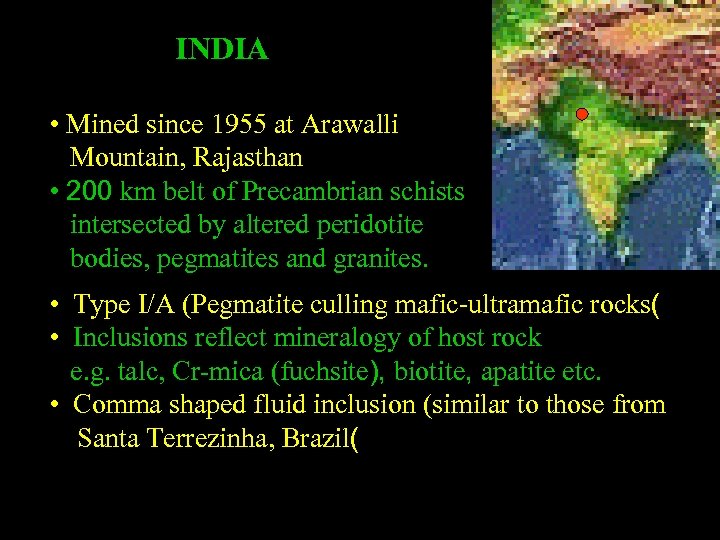
INDIA • Mined since 1955 at Arawalli Mountain, Rajasthan • 200 km belt of Precambrian schists intersected by altered peridotite bodies, pegmatites and granites. • Type I/A (Pegmatite culling mafic-ultramafic rocks( • Inclusions reflect mineralogy of host rock e. g. talc, Cr-mica (fuchsite), biotite, apatite etc. • Comma shaped fluid inclusion (similar to those from Santa Terrezinha, Brazil(
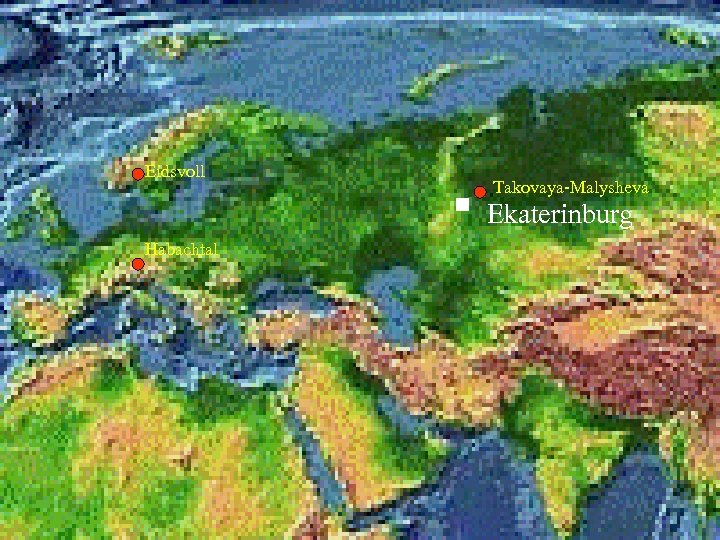
Emerald Deposits of Europe AUSTRIA • Habachtal deposit mined during Roman Empire RUSSIA • Takovaya-Malysheva deposits NORWAY • Eidsvoll deposits NORWAY
Eidsvoll Takovaya-Malysheva Ekaterinburg Habachtal
RUSSIA • deposits in Ural area, 90 Km NE of Ekaterinburg • discovered by Maxim Kojevenikov near Takovaya river in ) 1830 mine opened in 1831( • during WW II was the main source for Be • 3 -4 mil. carats of emerald and green beryl per year in 1950 s • underground mining at Takovaya-Malysheva since 1970 s • non-profitable mining and marketting problems by ends of 1990 s
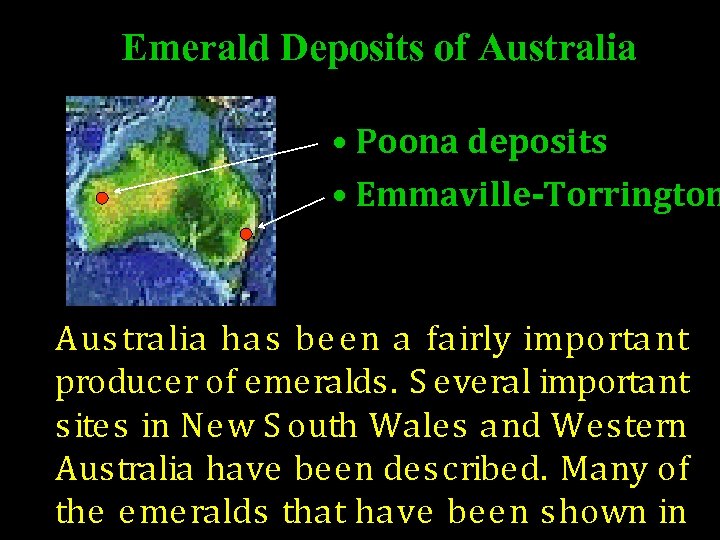
Emerald Deposits of Australia • Poona deposits • Emmaville-Torrington Aus tra lia ha s be e n a fa irly importa nt producer of emeralds. S everal important sites in New S outh Wales and Western Australia have been described. Many of the emeralds that have been shown in
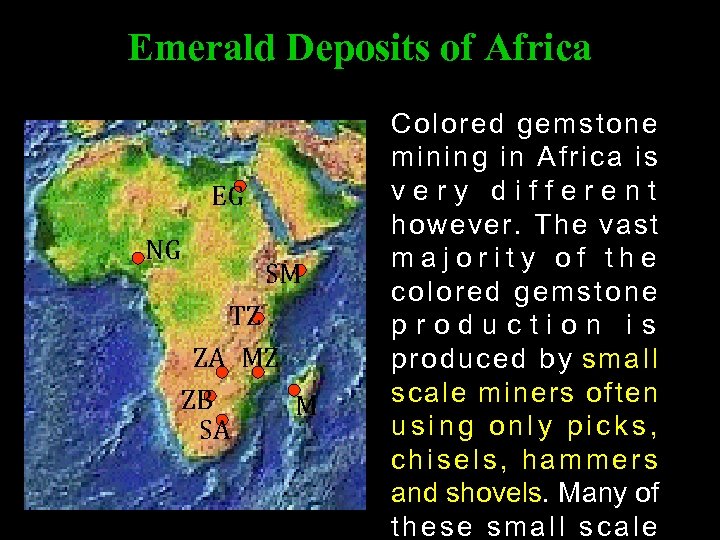
Emerald Deposits of Africa EG NG SM TZ ZA MZ ZB M SA Colored gemstone mi ni ng i n Afri ca i s very different however. The vast majority of the colored gemstone production is produced by small scale miners often using only picks, chisels, hammers and shovels. Many of these small scale
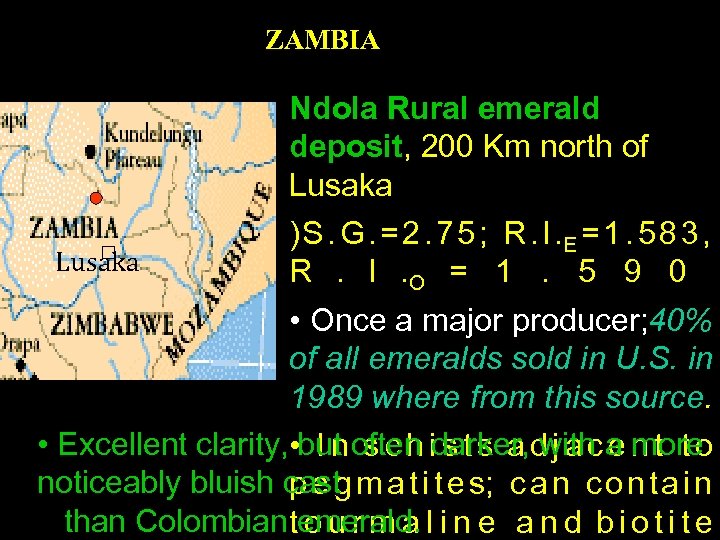
ZAMBIA Ndola Rural emerald deposit, 200 Km north of Lusaka )S. G. = 2. 7 5 ; R. I. E = 1. 5 8 3 , R. I. O = 1. 5 9 0 • Once a major producer; 40% of all emeralds sold in U. S. in 1989 where from this source. • Excellent clarity, • but often idarker, d j a c a n t t o I n s c h s t s a with e more noticeably bluish cast m a t i t e s; c a n c o n t a i n peg than Colombian temerald. l i n e a n d b i o t i t e ourma
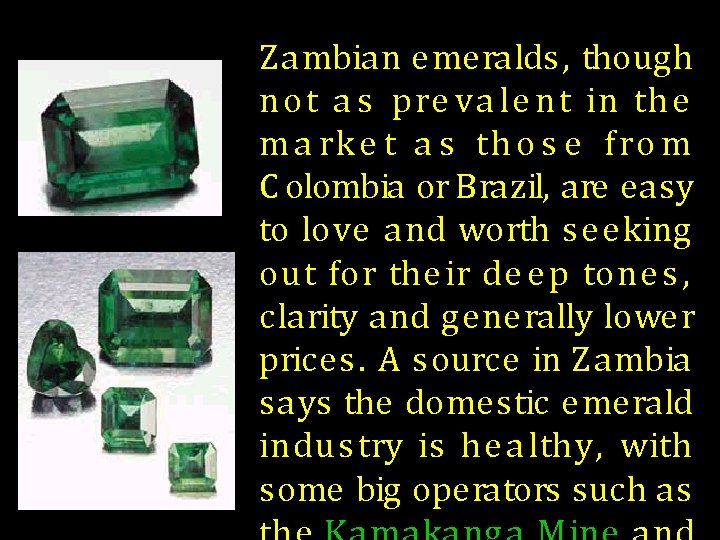
Zambian emeralds, though no t a s p re va le nt in th e m a rk e t a s th o s e f ro m C olombia or Brazil, are easy to love and worth s e e king out for the ir de e p tone s , clarity and generally lower prices. A source in Zambia says the domestic emerald indus try is he a lthy, with some big operators such as
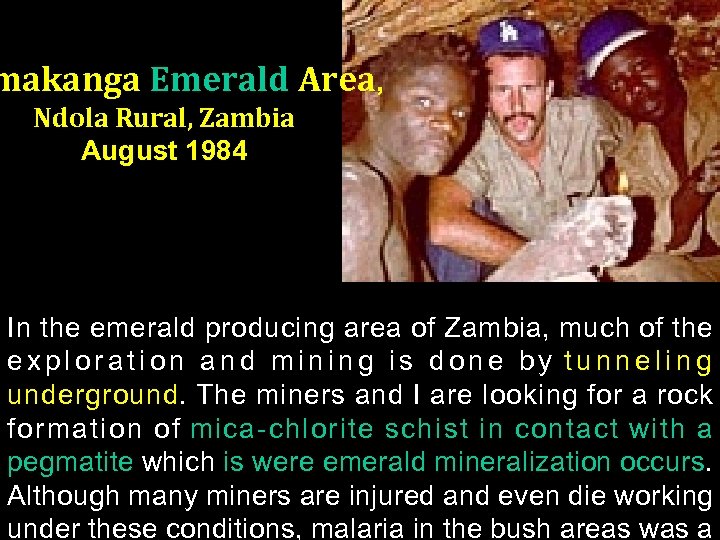
makanga Emerald Area, Ndola Rural, Zambia August 1984 In the emerald producing area of Zambia, much of the exploration and mining is done by tunneling underground. The miners and I are looking for a rock formation of mica-chlorite schist in contact with a pegmatite which is were emerald mineralization occurs. Although many miners are injured and even die working under these conditions, malaria in the bush areas was a
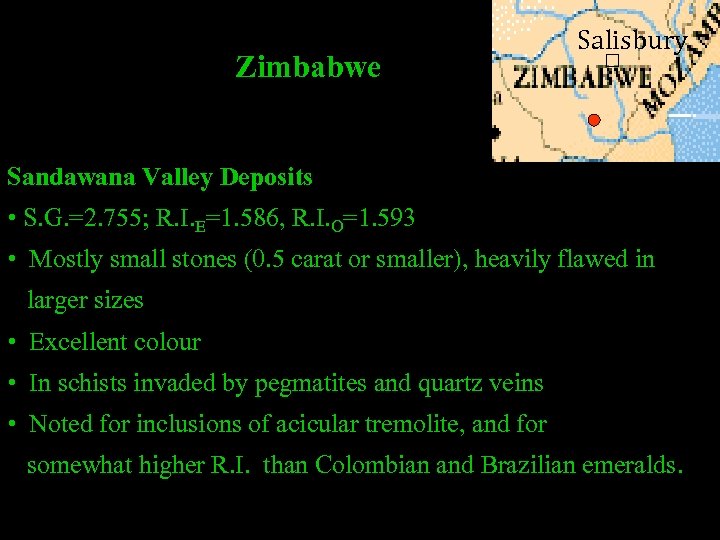
Zimbabwe Salisbury Sandawana Valley Deposits • S. G. =2. 755; R. I. E=1. 586, R. I. O=1. 593 • Mostly small stones (0. 5 carat or smaller), heavily flawed in larger sizes • Excellent colour • In schists invaded by pegmatites and quartz veins • Noted for inclusions of acicular tremolite, and for somewhat higher R. I. than Colombian and Brazilian emeralds.
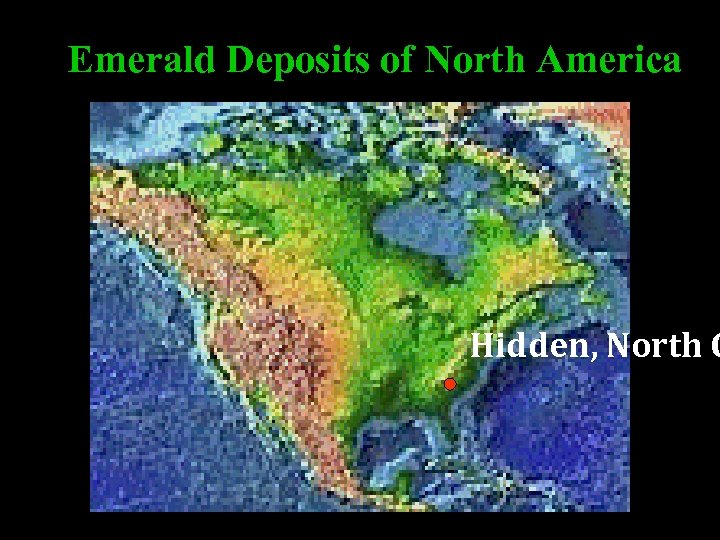
Emerald Deposits of North America Hidden, North C
USA In the United S tates, few emeralds have been found and most have been recovered from near Hidden, North C arolina. A very large emerald that became the subject of a bitte r la w s uit wa s mine d the re in the 1980's. The tragicomic outcome was that one of the miners involved sawed the very fine 14 inc h c rys ta l (va lue d a t s e ve ra l millions of dollars) in half and destroyed muc h of the va lue of this e s s e ntia lly
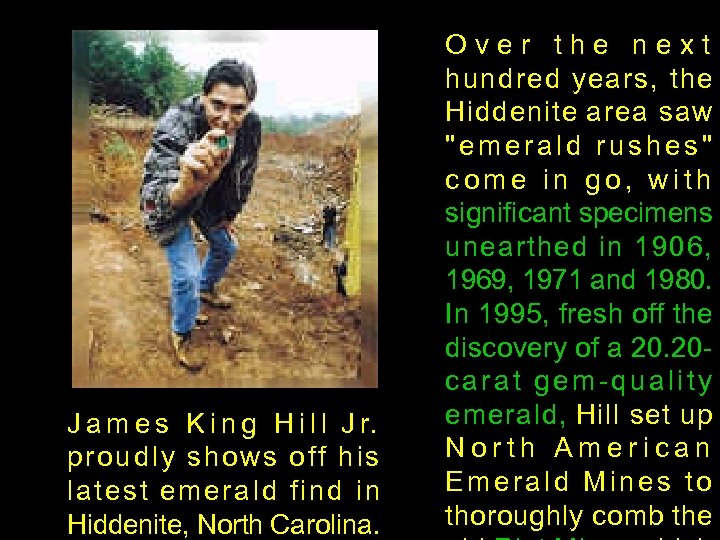
J a m e s K i n g H i l l J r. proudly shows off his latest emerald find in Hiddenite, North Carolina. Over the next hundred years, the Hiddenite area saw "emerald rushes" come in go, with significant specimens unearthed in 1906, 1969, 1971 and 1980. In 1995, fresh off the discovery of a 20. 20 carat gem-quality emerald, Hill set up North American Emerald Mines to thoroughly comb the
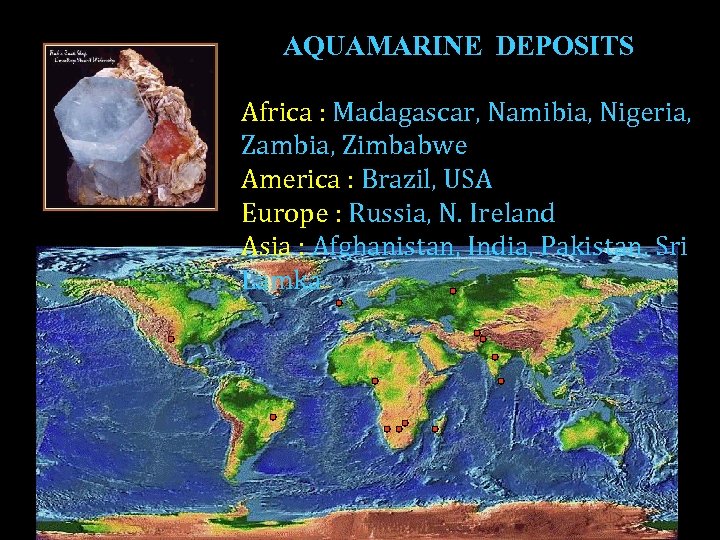
AQUAMARINE DEPOSITS Africa : Madagascar, Namibia, Nigeria, Zambia, Zimbabwe America : Brazil, USA Europe : Russia, N. Ireland Asia : Afghanistan, India, Pakistan, Sri Lamka Aquamarine Deposits
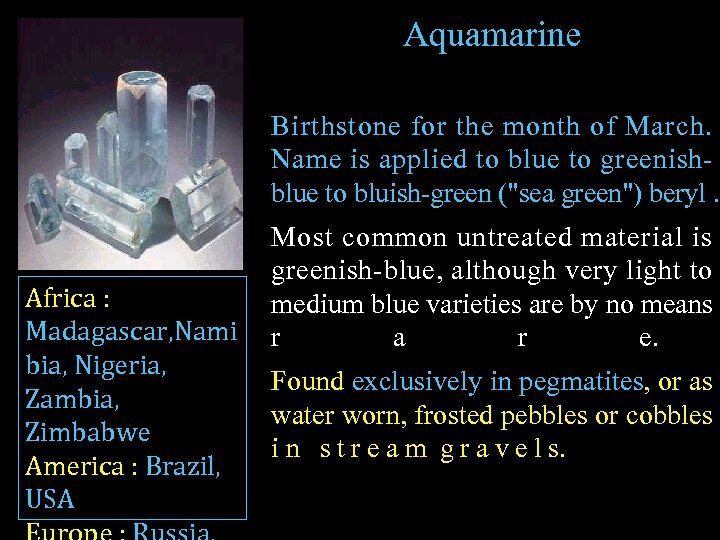
Aquamarine Birthstone for the month of March. Name is applied to blue to greenishblue to bluish-green ("sea green") beryl. Africa : Madagascar, Nami bia, Nigeria, Zambia, Zimbabwe America : Brazil, USA Most common untreated material is greenish-blue, although very light to medium blue varieties are by no means r a r e. Found exclusively in pegmatites, or as water worn, frosted pebbles or cobbles i n s t r e a m g r a v e l s. k n o w n.
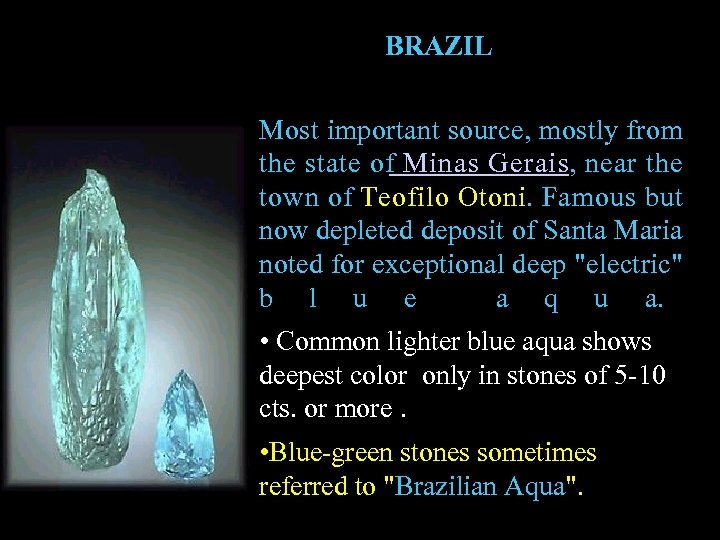
BRAZIL Most important source, mostly from the state of Minas Gerais, near the town of Teofilo Otoni. Famous but now depleted deposit of Santa Maria noted for exceptional deep "electric" b l u e a q u a. • Common lighter blue aqua shows deepest color only in stones of 5 -10 cts. or more. • Blue-green stones sometimes referred to "Brazilian Aqua".
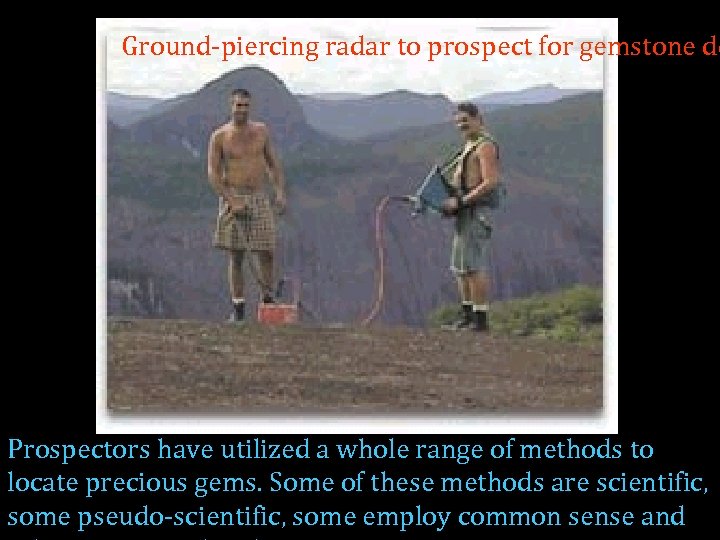
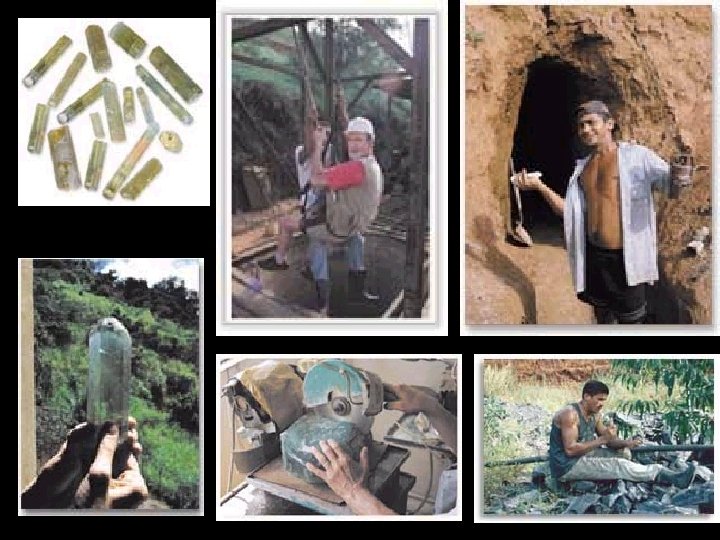
Ground-piercing radar to prospect for gemstone de Prospectors have utilized a whole range of methods to locate precious gems. Some of these methods are scientific, some pseudo-scientific, some employ common sense and
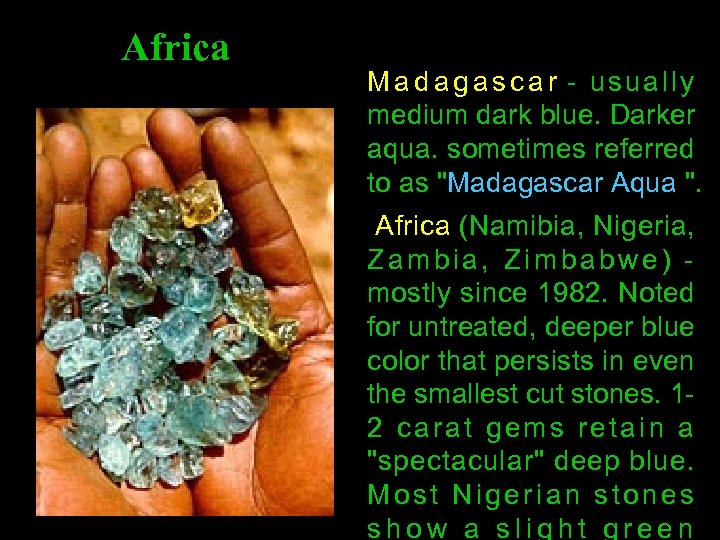
Africa M a d a g a s c a r - usually medium dark blue. Darker aqua. sometimes referred to as "Madagascar Aqua ". Africa (Namibia, Nigeria, Zambia, Zimbabwe) mostly since 1982. Noted for untreated, deeper blue color that persists in even the smallest cut stones. 12 carat gems retain a "spectacular" deep blue. Most Nigerian stones show a slight green
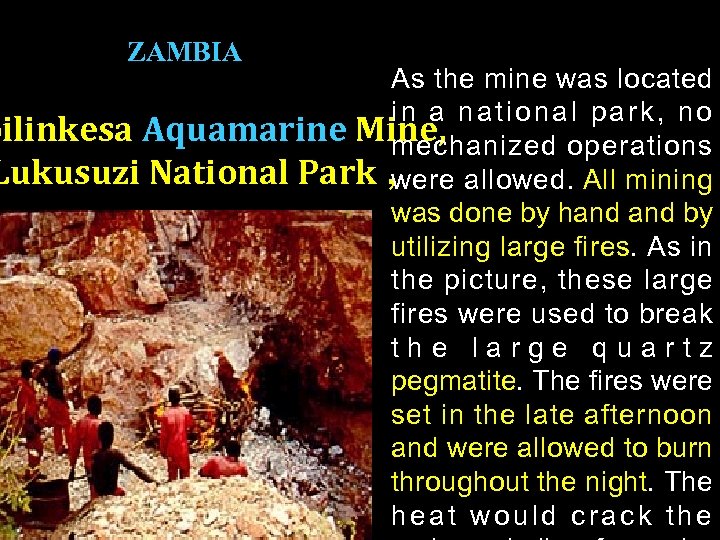
ZAMBIA As the mine was located in a national park, no pilinkesa Aquamarine Mine, mechanized operations Lukusuzi National Park , were allowed. All mining was done by hand by utilizing large fires. As in the picture, these large fires were used to break the large quartz pegmatite. The fires were set in the late afternoon and were allowed to burn throughout the night. The heat would crack the
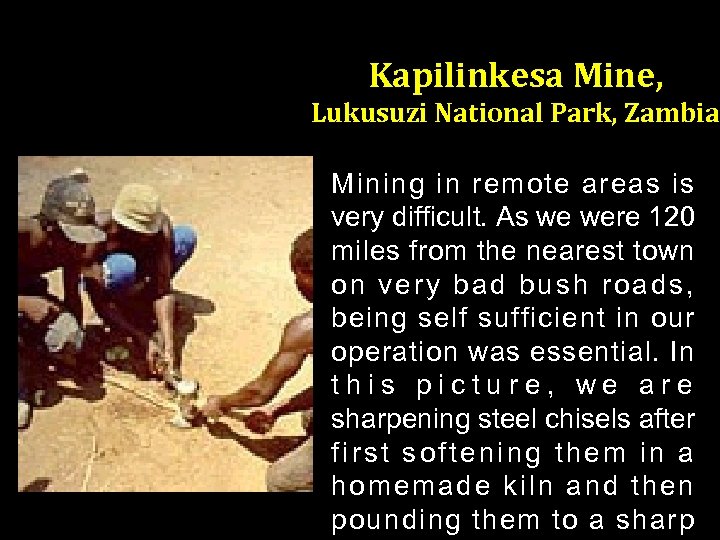
Kapilinkesa Mine, Lukusuzi National Park, Zambia Mining in remote areas is very difficult. As we were 120 miles from the nearest town on very bad bush roads, being self sufficient in our operation was essential. In this picture, we are sharpening steel chisels after first softening them in a homemade ki l n and then pounding them to a sharp
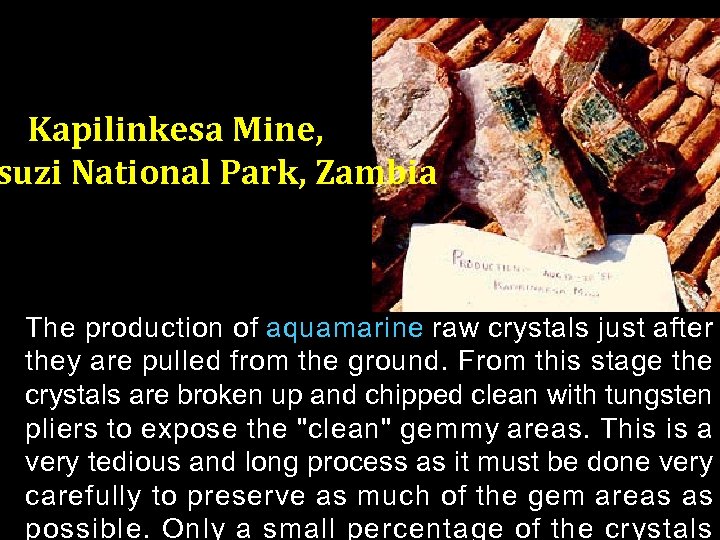
Kapilinkesa Mine, suzi National Park, Zambia The production of aquamarine raw crystals just after they are pulled from the ground. From this stage the crystals are broken up and chipped clean with tungsten pliers to expose the "clean" gemmy areas. This is a very tedious and long process as it must be done very carefully to preserve as much of the gem areas as possible. Only a small percentage of the crystals
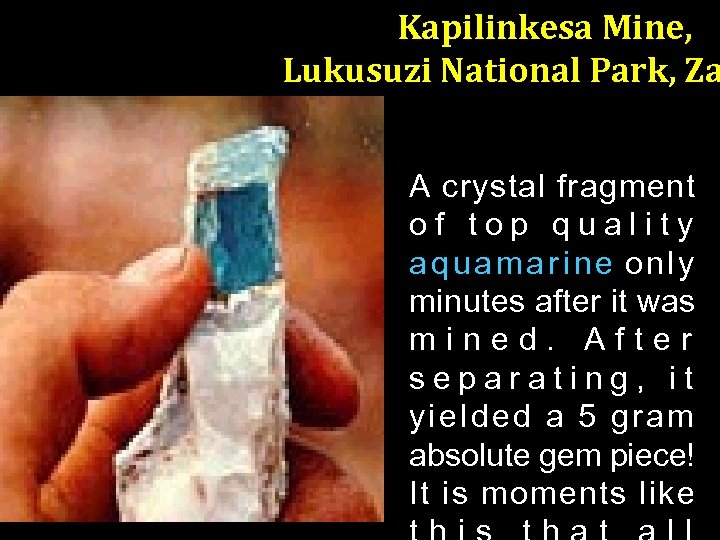
Kapilinkesa Mine, Lukusuzi National Park, Za A crystal fragment of top quality aquamarine only minutes after it was mined. After separating, it yielded a 5 gram absolute gem piece! It is moments like
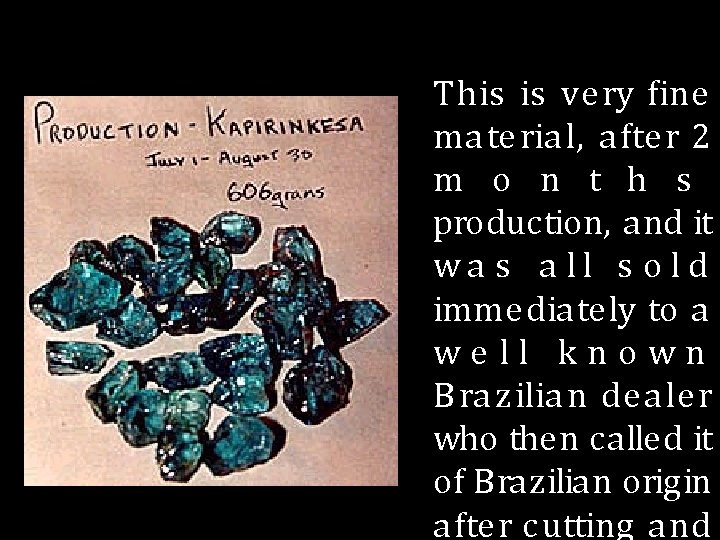
This is ve ry fine ma te ria l, a fte r 2 m o n t h s production, and it wa s a ll s o ld immediately to a we ll kno wn B ra zilia n de a le r who then called it of Brazilian origin a fte r cutting a nd
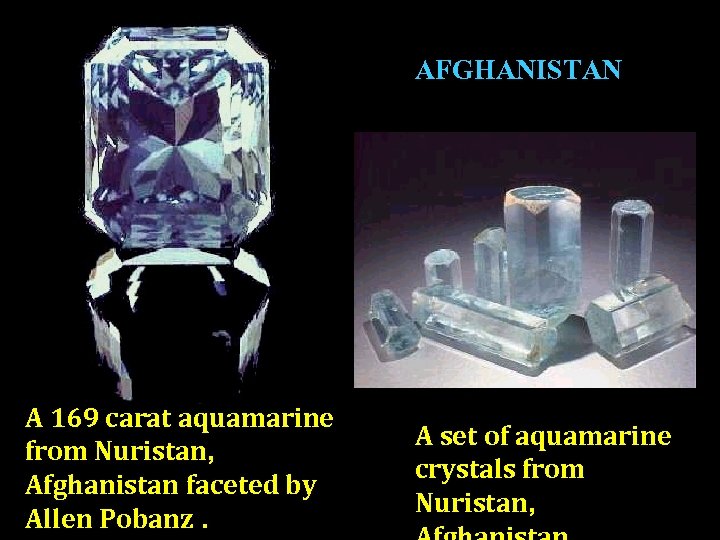
AFGHANISTAN A 169 carat aquamarine from Nuristan, Afghanistan faceted by Allen Pobanz. A set of aquamarine crystals from Nuristan,
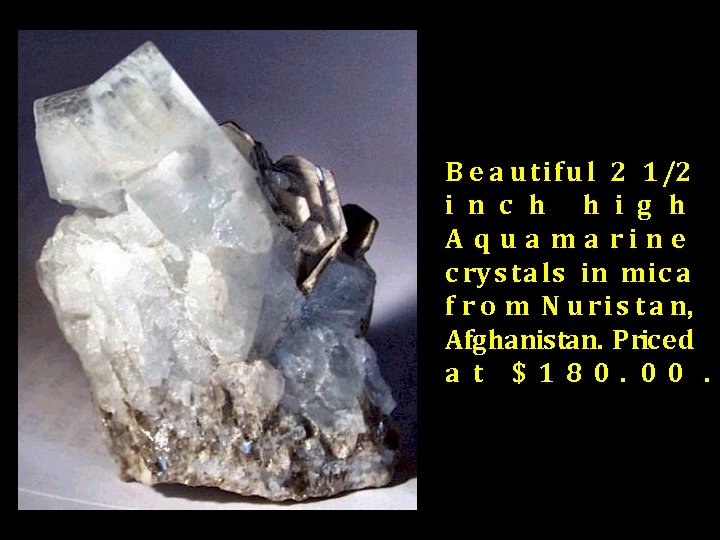
B e a u tif u l 2 1 /2 i n c h h i g h A q u a m a rin e c ry s ta ls in mic a f r o m N u ri s t a n, Afghanistan. Priced a t $ 180. 00.
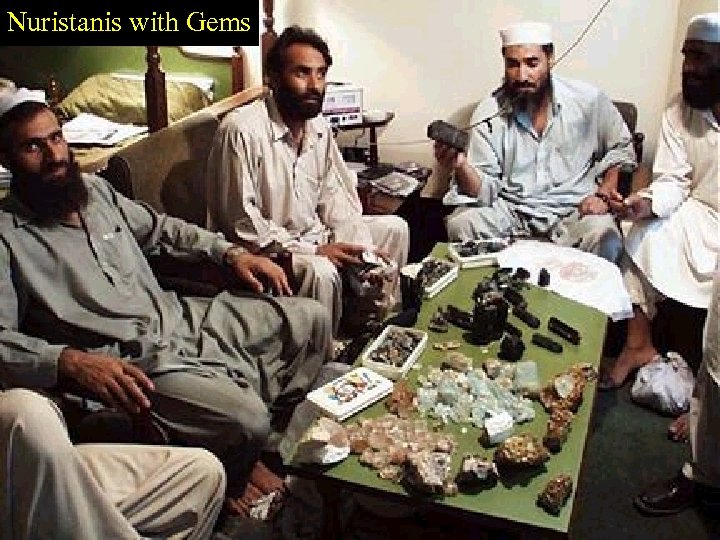
Nuristanis with Gems from Pech Nuristan
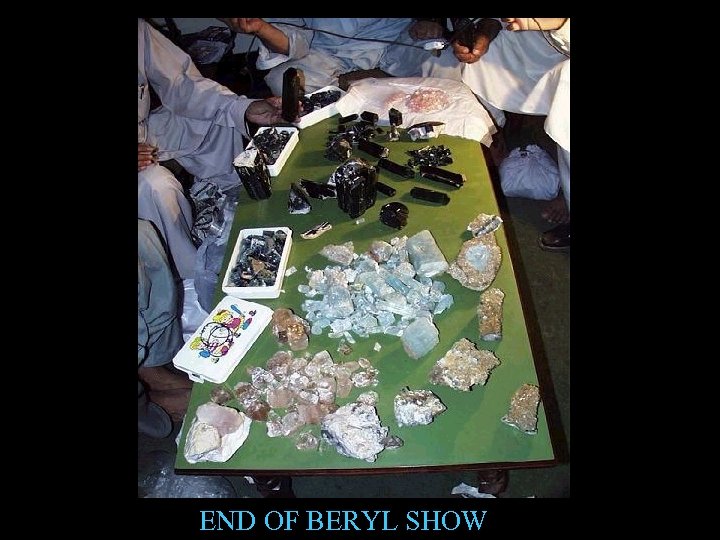
END OF BERYL SHOW
Suggested Reading A STATUS REPORT ON GEMSTONES FROM AFGHANISTAN By Gary W. Bowersox 1986 ©Gemological Institute of America First published in GEMS & GEMOLOGY, Winter, 1985 http: //gems-afghan. com/articles/status. htm
Скачать презентацию Emerald Deposits of Brazil References http www
34f6590cfdea1aca8d6f937771377b24.ppt