 Скачать презентацию Embedded System Hardware Embedded system hardware is frequently
240a6b01c71c6913ea7a0207866ba440.ppt
- Количество слайдов: 23



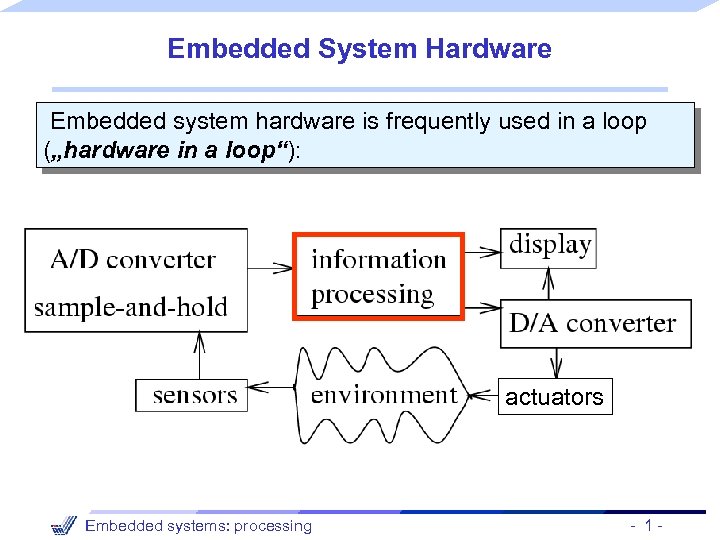
Embedded System Hardware Embedded system hardware is frequently used in a loop („hardware in a loop“): actuators Embedded systems: processing - 1 -
Summary: Information processing 1. ASICs 2. Processors • Energy efficient • Code-size efficient • Run-time efficient • Special features of DSP processors • Multimedia instructions • Very long instruction word machines 3. Reconfigurable hardware 4. Memory Embedded systems: processing - 2 -
Reconfigurable Logic Full custom chips may be too expensive, software may be too slow. Use of configurable hardware; most common form: field programmable gate arrays (FPGAs) Considered e. g. for configuring mobile phone according to local standards; Fast “object recognition”. Example: Xilinx Virtex II FPGAs, Altera Stratix Embedded systems: processing - 3 -
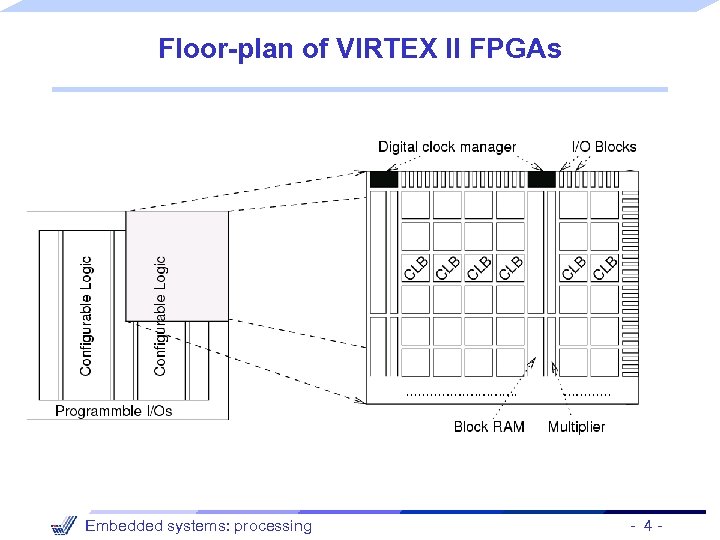
Floor-plan of VIRTEX II FPGAs Embedded systems: processing - 4 -

Virtex II Configurable Logic Block (CLB) Embedded systems: processing - 5 -
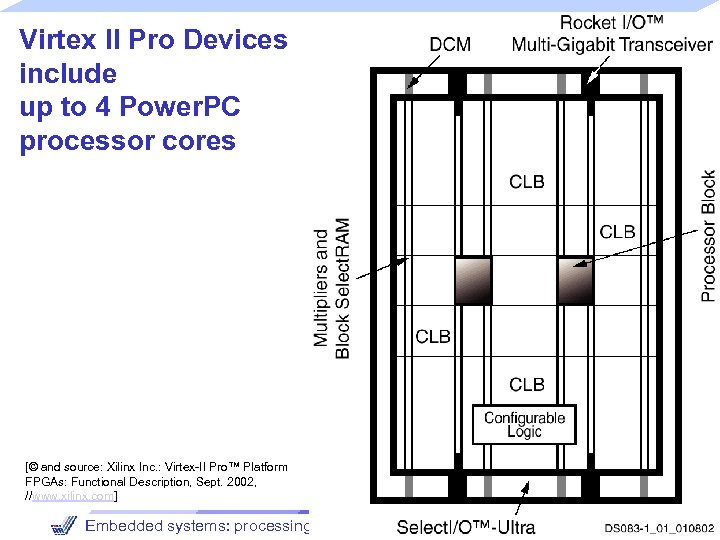
Virtex II Pro Devices include up to 4 Power. PC processor cores [© and source: Xilinx Inc. : Virtex-II Pro™ Platform FPGAs: Functional Description, Sept. 2002, //www. xilinx. com] Embedded systems: processing - 6 -
Memory For the memory, efficiency is again a concern: • fast (latency and throughput); predictable timing • energy efficiency • size • cost • other attributes (volatile vs. persistent, etc) Embedded systems: processing - 7 -
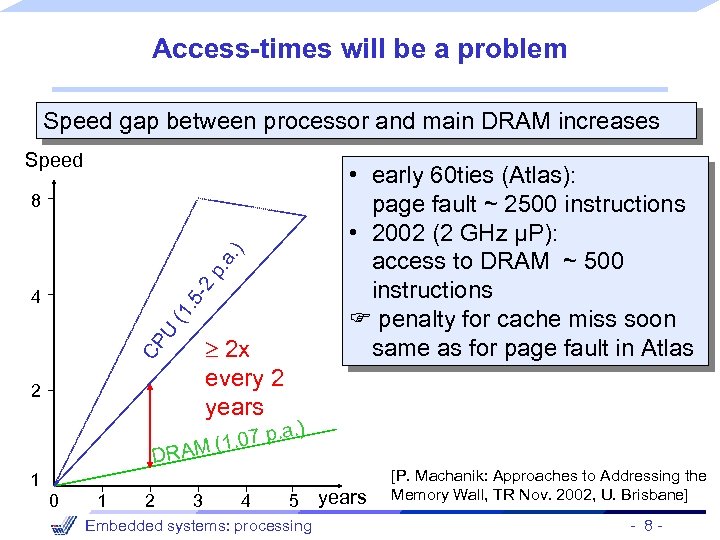
Access-times will be a problem Speed gap between processor and main DRAM increases Speed • early 60 ties (Atlas): page fault ~ 2500 instructions • 2002 (2 GHz µP): access to DRAM ~ 500 instructions penalty for cache miss soon same as for page fault in Atlas (1. 5 -2 p. a. ) 8 U 4 CP 2 x every 2 years 2 . ). 07 p. a (1 DRAM 1 0 1 2 3 4 5 Embedded systems: processing years [P. Machanik: Approaches to Addressing the Memory Wall, TR Nov. 2002, U. Brisbane] - 8 -
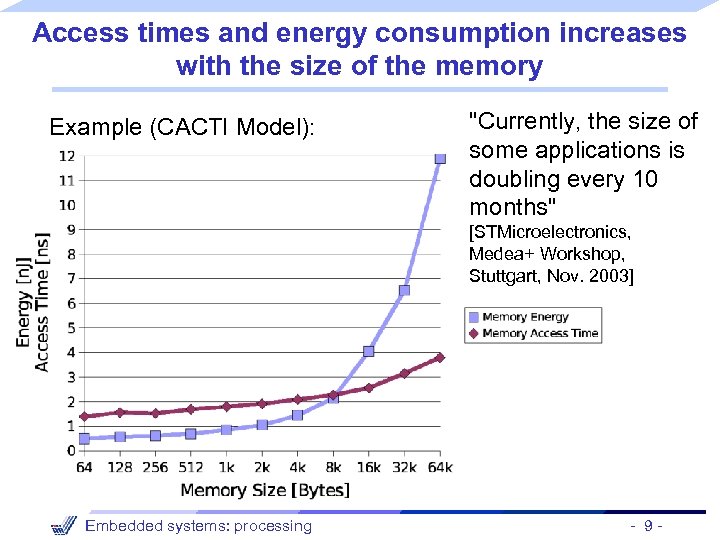
Access times and energy consumption increases with the size of the memory Example (CACTI Model): "Currently, the size of some applications is doubling every 10 months" [STMicroelectronics, Medea+ Workshop, Stuttgart, Nov. 2003] Embedded systems: processing - 9 -
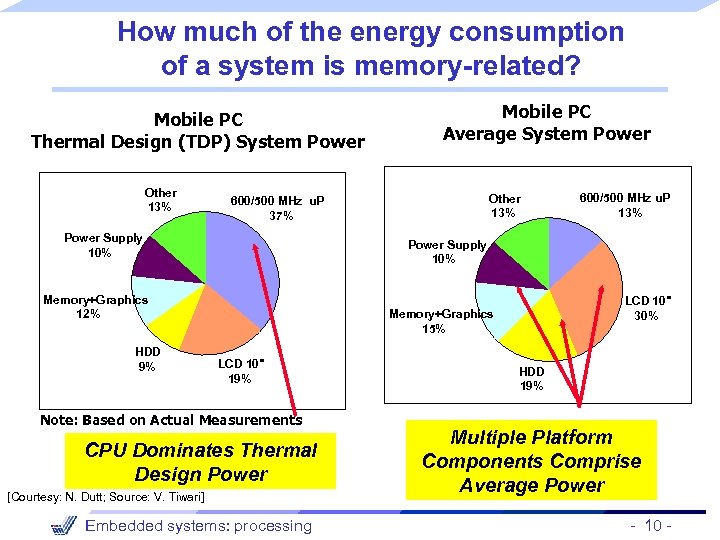
How much of the energy consumption of a system is memory-related? Mobile PC Thermal Design (TDP) System Power Other 13% 600/500 MHz u. P 37% Power Supply 10% 600/500 MHz u. P 13% Power Supply 10% Memory+Graphics 12% HDD 9% Mobile PC Average System Power LCD 10" 30% Memory+Graphics 15% LCD 10" 19% Note: Based on Actual Measurements CPU Dominates Thermal Design Power [Courtesy: N. Dutt; Source: V. Tiwari] Embedded systems: processing HDD 19% Multiple Platform Components Comprise Average Power - 10 -
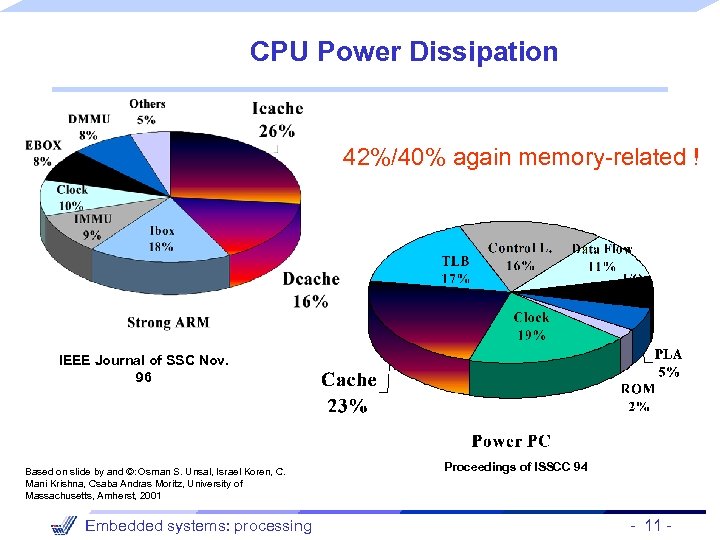
CPU Power Dissipation 42%/40% again memory-related ! IEEE Journal of SSC Nov. 96 Based on slide by and ©: Osman S. Unsal, Israel Koren, C. Mani Krishna, Csaba Andras Moritz, University of Massachusetts, Amherst, 2001 Embedded systems: processing Proceedings of ISSCC 94 - 11 -
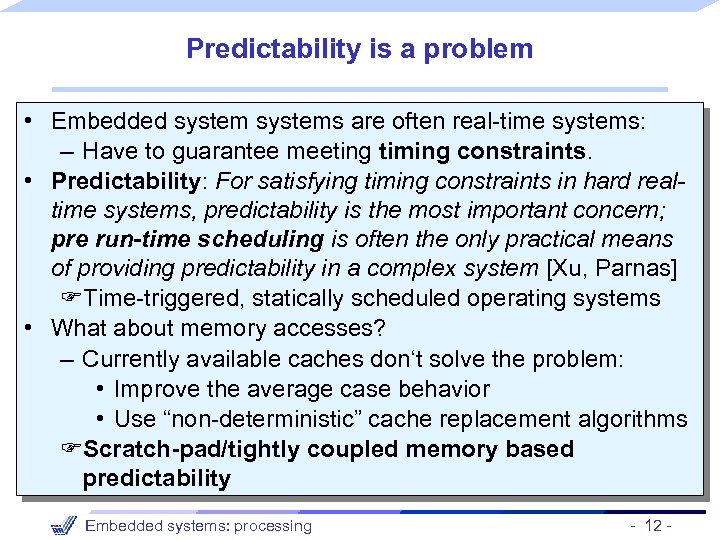
Predictability is a problem • Embedded systems are often real-time systems: – Have to guarantee meeting timing constraints. • Predictability: For satisfying timing constraints in hard realtime systems, predictability is the most important concern; pre run-time scheduling is often the only practical means of providing predictability in a complex system [Xu, Parnas] Time-triggered, statically scheduled operating systems • What about memory accesses? – Currently available caches don‘t solve the problem: • Improve the average case behavior • Use “non-deterministic” cache replacement algorithms Scratch-pad/tightly coupled memory based predictability Embedded systems: processing - 12 -
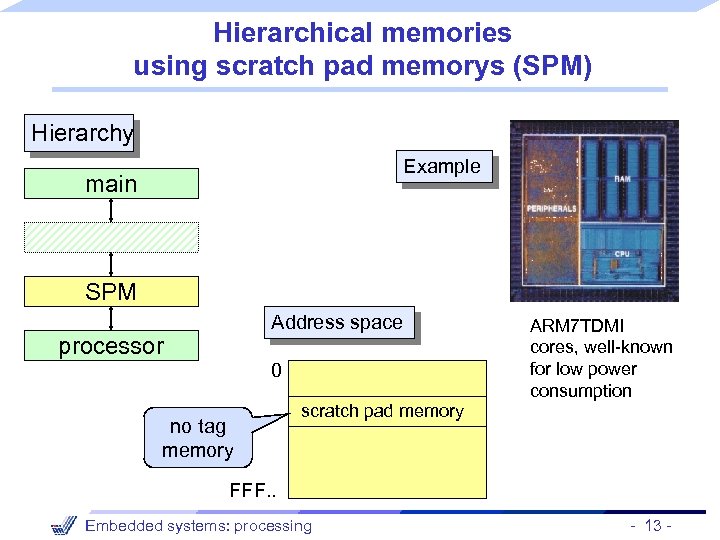
Hierarchical memories using scratch pad memorys (SPM) Hierarchy Example main SPM Address space processor 0 no tag memory ARM 7 TDMI cores, well-known for low power consumption scratch pad memory FFF. . Embedded systems: processing - 13 -
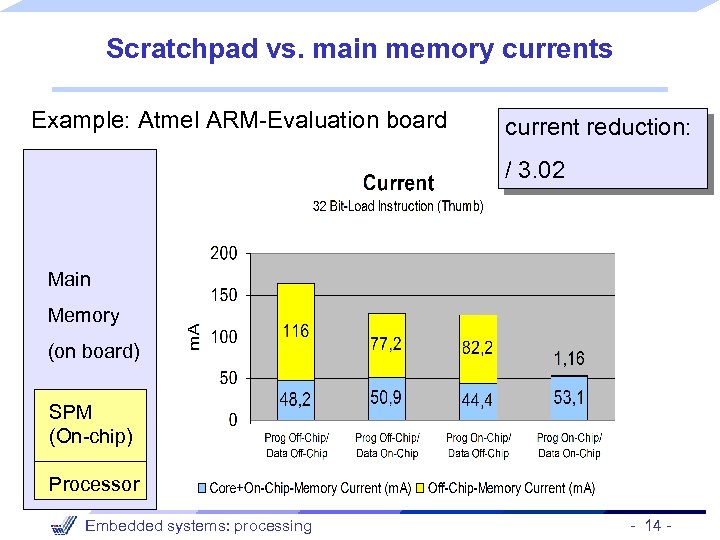
Scratchpad vs. main memory currents Example: Atmel ARM-Evaluation board current reduction: / 3. 02 Main Memory (on board) SPM (On-chip) Processor Embedded systems: processing - 14 -
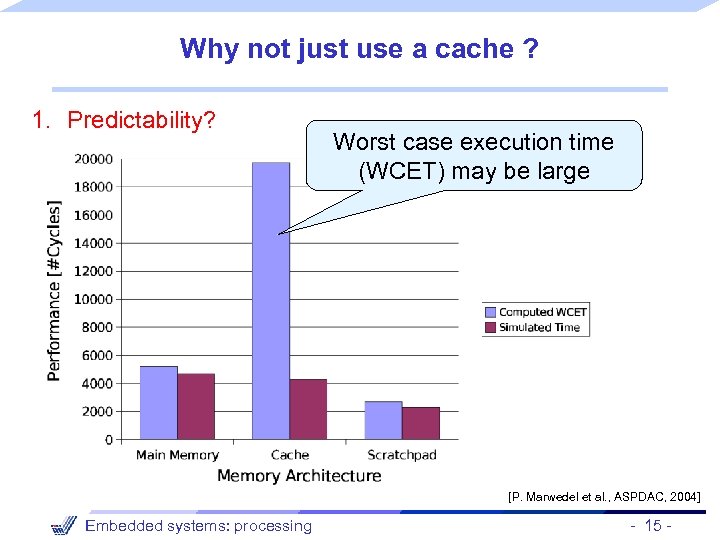
Why not just use a cache ? 1. Predictability? Worst case execution time (WCET) may be large [P. Marwedel et al. , ASPDAC, 2004] Embedded systems: processing - 15 -
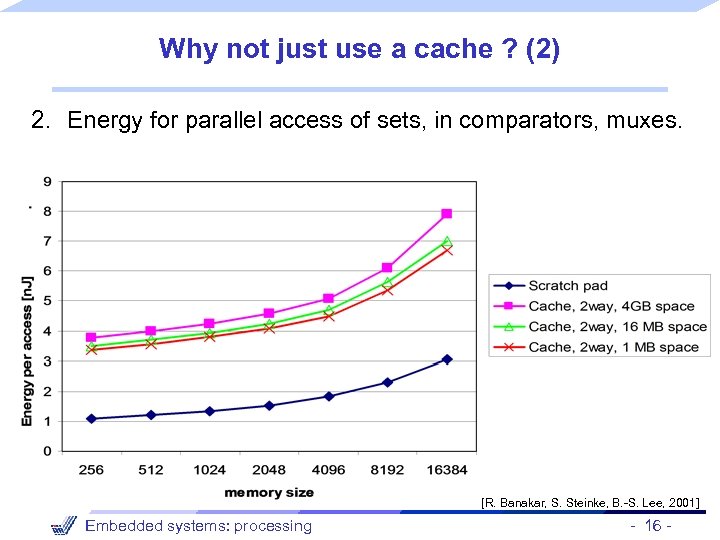
Why not just use a cache ? (2) 2. Energy for parallel access of sets, in comparators, muxes. [R. Banakar, S. Steinke, B. -S. Lee, 2001] Embedded systems: processing - 16 -
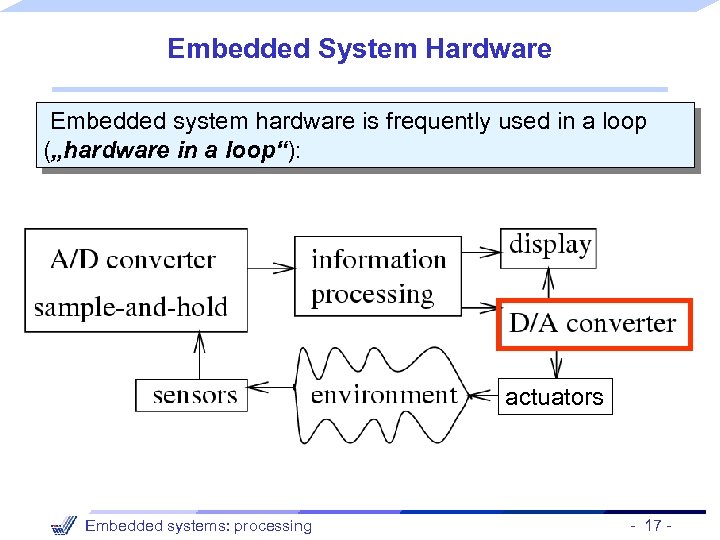
Embedded System Hardware Embedded system hardware is frequently used in a loop („hardware in a loop“): actuators Embedded systems: processing - 17 -
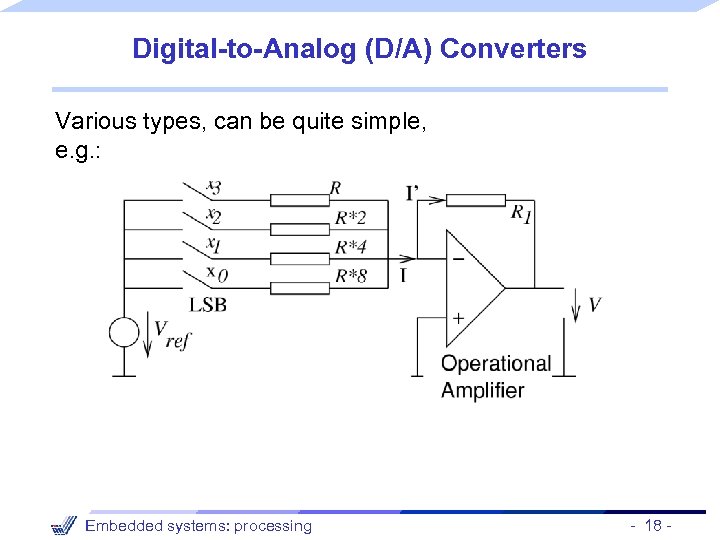
Digital-to-Analog (D/A) Converters Various types, can be quite simple, e. g. : Embedded systems: processing - 18 -
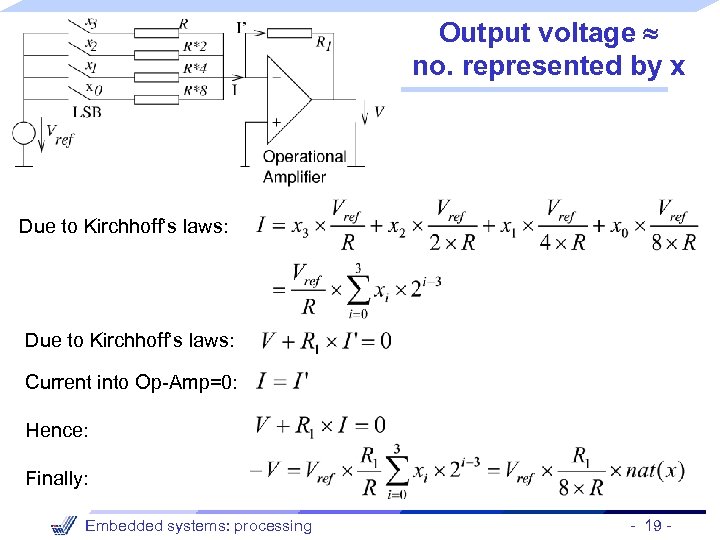
Output voltage no. represented by x Due to Kirchhoff‘s laws: Current into Op-Amp=0: Hence: Finally: Embedded systems: processing - 19 -
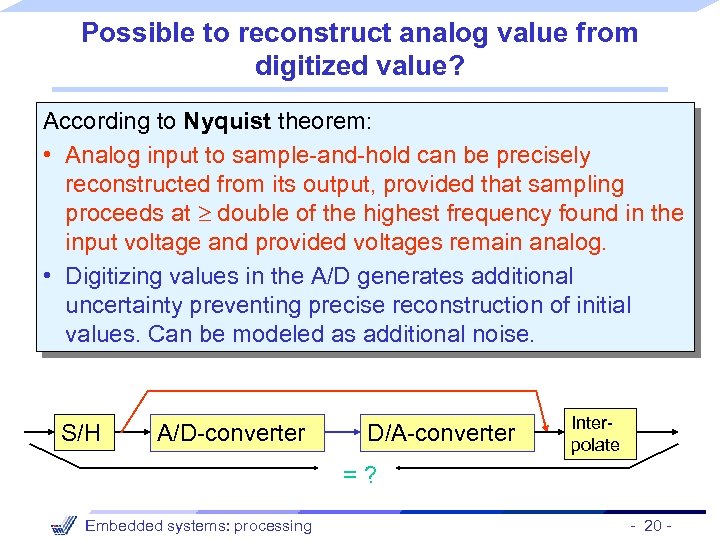
Possible to reconstruct analog value from digitized value? According to Nyquist theorem: • Analog input to sample-and-hold can be precisely reconstructed from its output, provided that sampling proceeds at double of the highest frequency found in the input voltage and provided voltages remain analog. • Digitizing values in the A/D generates additional uncertainty preventing precise reconstruction of initial values. Can be modeled as additional noise. S/H A/D-converter D/A-converter Interpolate =? Embedded systems: processing - 20 -
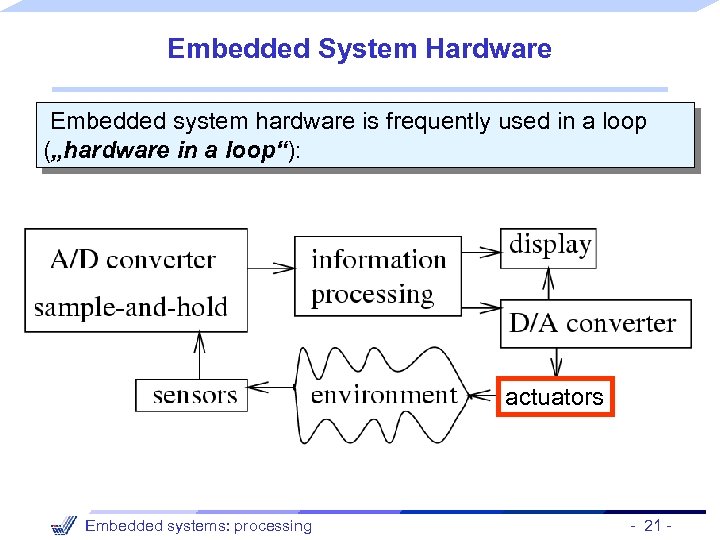
Embedded System Hardware Embedded system hardware is frequently used in a loop („hardware in a loop“): actuators Embedded systems: processing - 21 -
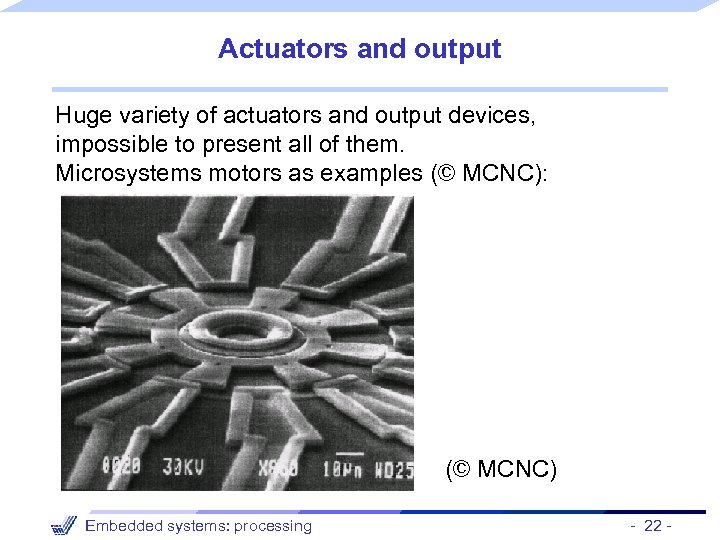
Actuators and output Huge variety of actuators and output devices, impossible to present all of them. Microsystems motors as examples (© MCNC): (© MCNC) Embedded systems: processing - 22 -
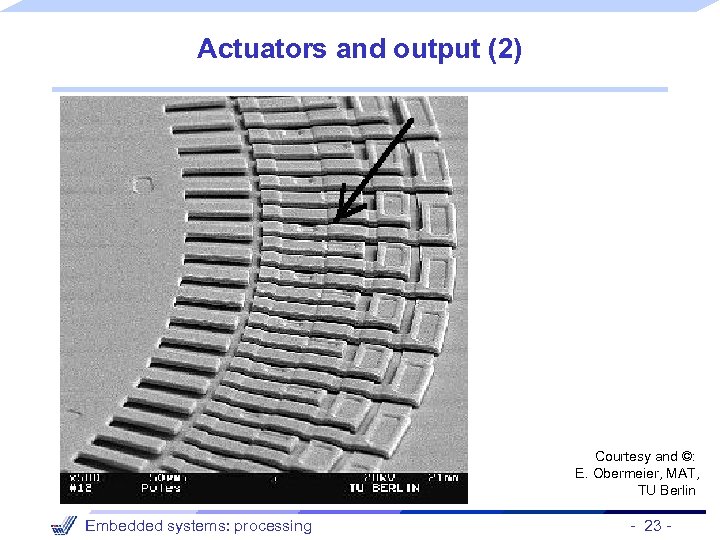
Actuators and output (2) Courtesy and ©: E. Obermeier, MAT, TU Berlin Embedded systems: processing - 23 -
Скачать презентацию Embedded System Hardware Embedded system hardware is frequently
240a6b01c71c6913ea7a0207866ba440.ppt