


 Скачать презентацию Elements 4 5 Evaluation Professional Growth
6a8207b63ef40f2fdae69c2bafd3f1e3.ppt
- Количество слайдов: 19
 Elements 4 & 5 Evaluation & Professional Growth Cycle and Aligned Professional Learning
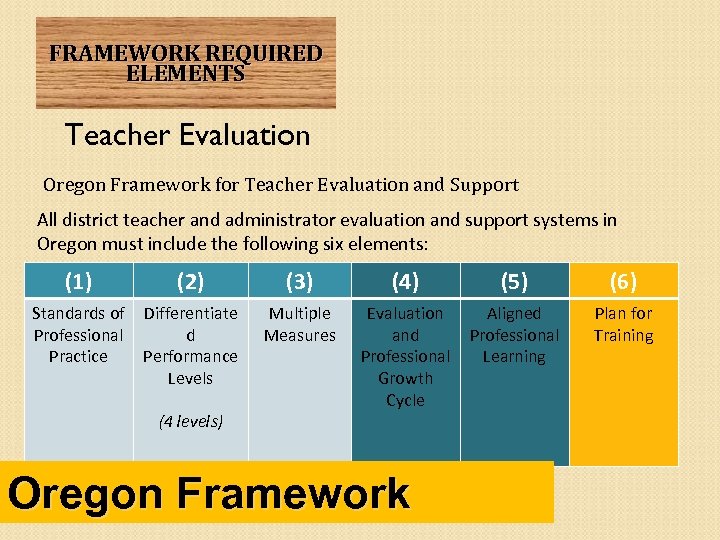 FRAMEWORK REQUIRED ELEMENTS Teacher Evaluation Oregon Framework for Teacher Evaluation and Support All district teacher and administrator evaluation and support systems in Oregon must include the following six elements: (1) (2) (3) (4) (5) (6) Standards of Professional Practice Differentiate d Performance Levels Multiple Measures Evaluation and Professional Growth Cycle Aligned Professional Learning Plan for Training (4 levels) Oregon Framework
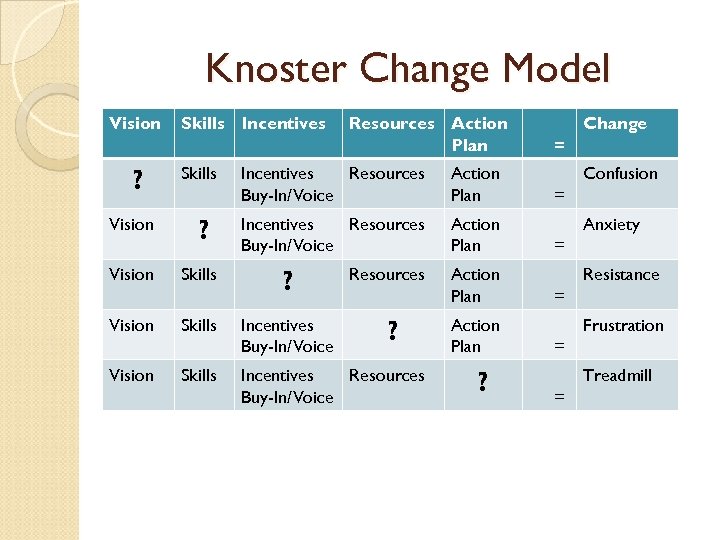 Knoster Change Model Vision ? Vision Skills Incentives Skills ? Skills Resources Action Plan Incentives Resources Buy-In/Voice Action Plan Resources Action Plan ? Incentives Buy-In/Voice ? Incentives Resources Buy-In/Voice Action Plan ? Change = Confusion = Anxiety = Resistance = Frustration = Treadmill =
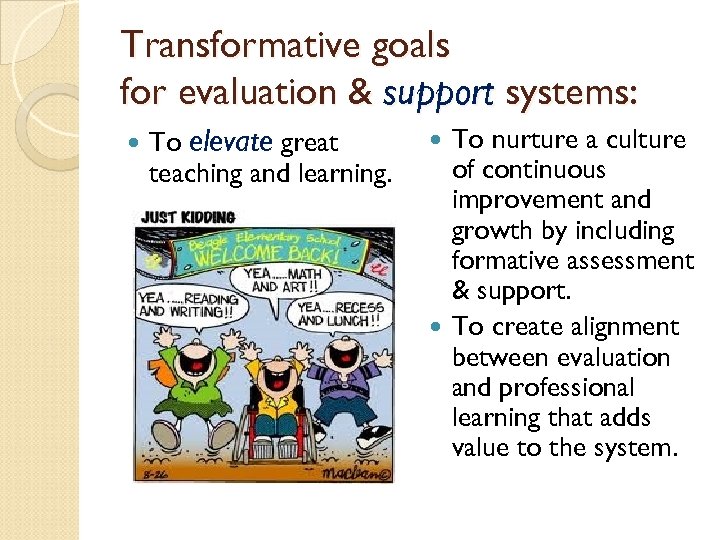 Transformative goals for evaluation & support systems: To elevate great teaching and learning. To nurture a culture of continuous improvement and growth by including formative assessment & support. To create alignment between evaluation and professional learning that adds value to the system.
 Table Talk Questions: How is your system that you are designing different in implementation from the hire/fire systems of the past? What are you currently doing in professional learning that is worth building on? How can you grow it? How is your system meeting these broader goals? : To elevate great teaching and learning. To nurture a culture of continuous improvement and growth by including formative assessment & support. To create alignment between evaluation and professional learning that adds value to the system.
 Share Out Questions: How is your system that you are designing different in implementation from the hire/fire systems of the past? What are you currently doing in professional learning that is worth building on? How can you grow it? How is your system meeting these broader goals? : To elevate great teaching and learning. To nurture a culture of continuous improvement and growth by including formative assessment & support. To create alignment between evaluation and professional learning that adds value to the system.
 Best Practice of Cycle Self-reflection: Reflects on practice under standards framework and analyzes student learning. Goal setting: Identifies goals aligned with standards of professional practice and impact on learning. Observation & artifact collection: Educator & evaluator collect and analyze multiple measures of practice, responsibilities and student learning. Formative assessment: Review of progress towards goals using: (1) analysis of measures, (2)professional conversations & (3) professional growth. Make adjustments & engage in targeted professional learning. Summative assessment: Culmination of multiple formative observations, conversations, & analysis of artifacts. Educator is assessed against the standards of professional practice, attainment of student learning goals, and attainment of professional practice goals.
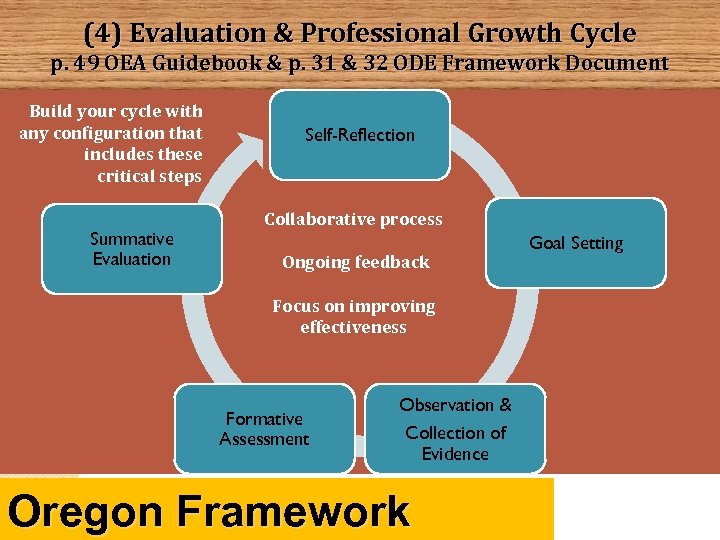 (4) Evaluation & Professional Growth Cycle p. 49 OEA Guidebook & p. 31 & 32 ODE Framework Document Build your cycle with any configuration that includes these critical steps Summative Evaluation Self-Reflection Collaborative process Ongoing feedback Focus on improving effectiveness Formative Assessment Observation & Collection of Evidence Oregon Framework Goal Setting
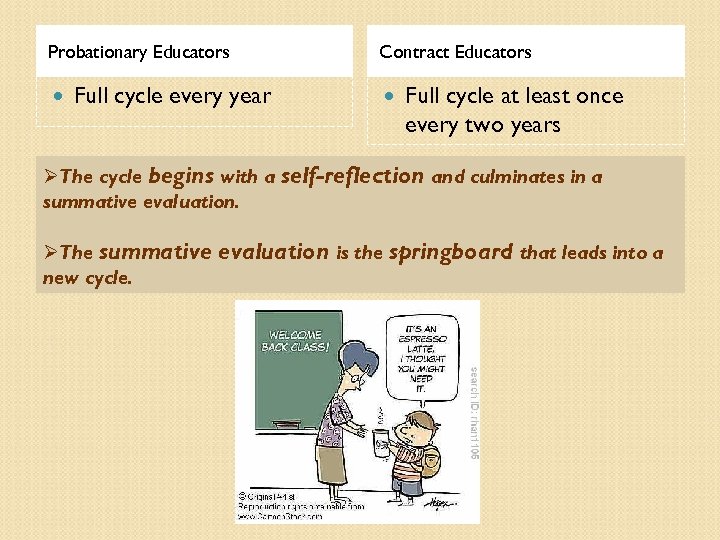 Probationary Educators Full cycle every year Contract Educators Full cycle at least once every two years ØThe cycle begins with a self-reflection and culminates in a summative evaluation. ØThe summative evaluation is the springboard that leads into a new cycle.
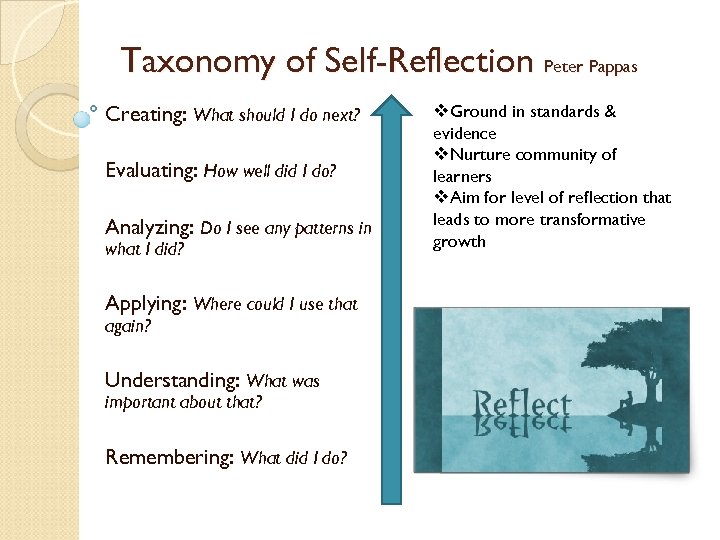 Taxonomy of Self-Reflection Peter Pappas Creating: What should I do next? Evaluating: How well did I do? Analyzing: Do I see any patterns in what I did? Applying: Where could I use that again? Understanding: What was important about that? Remembering: What did I do? v. Ground in standards & evidence v. Nurture community of learners v. Aim for level of reflection that leads to more transformative growth
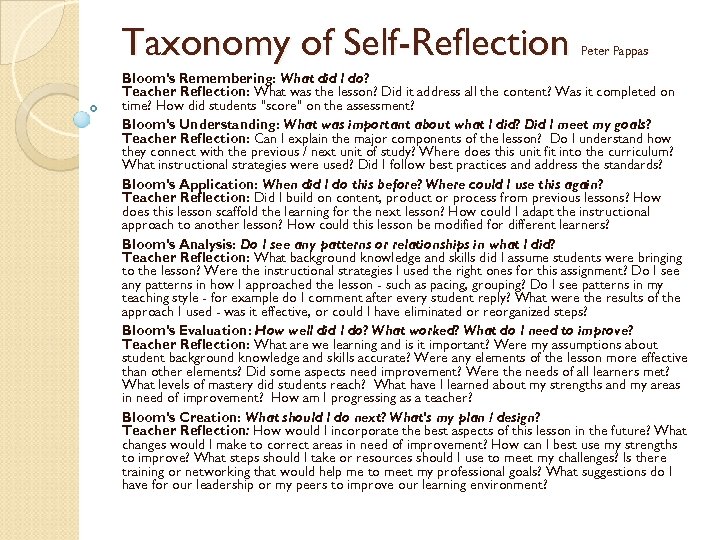 Taxonomy of Self-Reflection Peter Pappas Bloom's Remembering: What did I do? Teacher Reflection: What was the lesson? Did it address all the content? Was it completed on time? How did students "score" on the assessment? Bloom's Understanding: What was important about what I did? Did I meet my goals? Teacher Reflection: Can I explain the major components of the lesson? Do I understand how they connect with the previous / next unit of study? Where does this unit fit into the curriculum? What instructional strategies were used? Did I follow best practices and address the standards? Bloom's Application: When did I do this before? Where could I use this again? Teacher Reflection: Did I build on content, product or process from previous lessons? How does this lesson scaffold the learning for the next lesson? How could I adapt the instructional approach to another lesson? How could this lesson be modified for different learners? Bloom's Analysis: Do I see any patterns or relationships in what I did? Teacher Reflection: What background knowledge and skills did I assume students were bringing to the lesson? Were the instructional strategies I used the right ones for this assignment? Do I see any patterns in how I approached the lesson - such as pacing, grouping? Do I see patterns in my teaching style - for example do I comment after every student reply? What were the results of the approach I used - was it effective, or could I have eliminated or reorganized steps? Bloom's Evaluation: How well did I do? What worked? What do I need to improve? Teacher Reflection: What are we learning and is it important? Were my assumptions about student background knowledge and skills accurate? Were any elements of the lesson more effective than other elements? Did some aspects need improvement? Were the needs of all learners met? What levels of mastery did students reach? What have I learned about my strengths and my areas in need of improvement? How am I progressing as a teacher? Bloom's Creation: What should I do next? What's my plan / design? Teacher Reflection: How would I incorporate the best aspects of this lesson in the future? What changes would I make to correct areas in need of improvement? How can I best use my strengths to improve? What steps should I take or resources should I use to meet my challenges? Is there training or networking that would help me to meet my professional goals? What suggestions do I have for our leadership or my peers to improve our learning environment?
 Possible ways an evaluation cycle that is aligned to professional learning can look? Individual/collective alignment? How can the reflective goal process help connect teachers to learning that elevates their formative and summative results? • How is that scaffolded across the system to drive collective professional learning opportunities? •
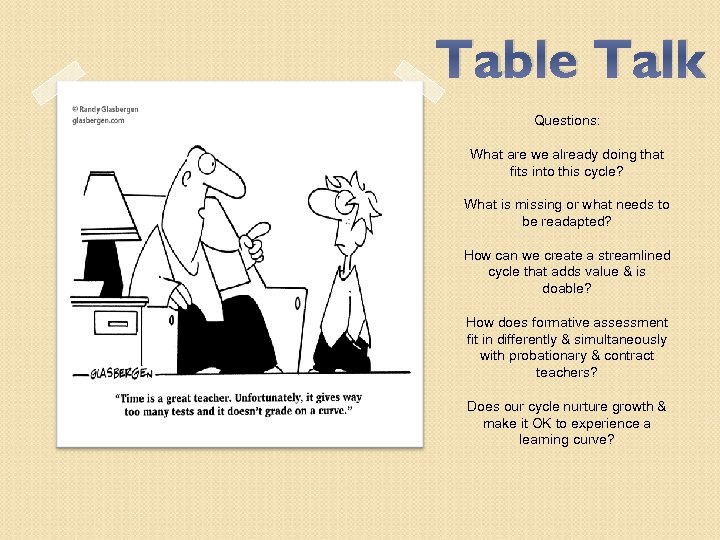 Table Talk Questions: What are we already doing that fits into this cycle? What is missing or what needs to be readapted? How can we create a streamlined cycle that adds value & is doable? How does formative assessment fit in differently & simultaneously with probationary & contract teachers? Does our cycle nurture growth & make it OK to experience a learning curve?
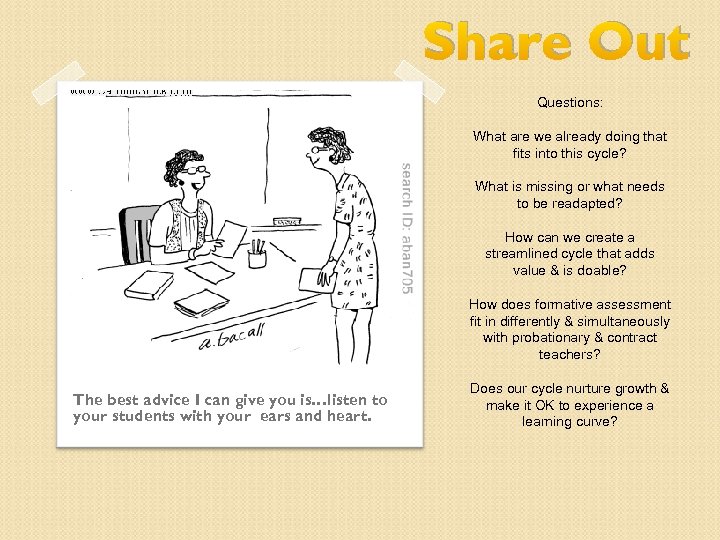 Share Out Questions: What are we already doing that fits into this cycle? What is missing or what needs to be readapted? How can we create a streamlined cycle that adds value & is doable? How does formative assessment fit in differently & simultaneously with probationary & contract teachers? The best advice I can give you is…listen to your students with your ears and heart. Does our cycle nurture growth & make it OK to experience a learning curve?
 High quality professional development aligned to evaluation system Aligned to performance standards and connected to impact on learning Present and supported in the evaluation cycle Sustained, focused and relevant to the individual educator’s goals & needs
 LEARNING FORWARD “The best systems create time for teachers to work and learn together during the school day, as is common in high-achieving nations in Europe and Asia, where teachers typically have 15 -25 hours a week to plan and work together. Over time, this collective investment reaps greater gains for student learning than the efforts of any one teacher alone. ” LINDA DARLING HAMMOND Occurs within learning communities Continuous improvement Aligned to goals/standards Student focused & evidence based Job-embedded Comprehensive Sustained, supported, intensive approach Contains elements of coaching, modeling, observation & feedback Several times a week Focused on specific curriculum content Teacher buy-in, teacher valued
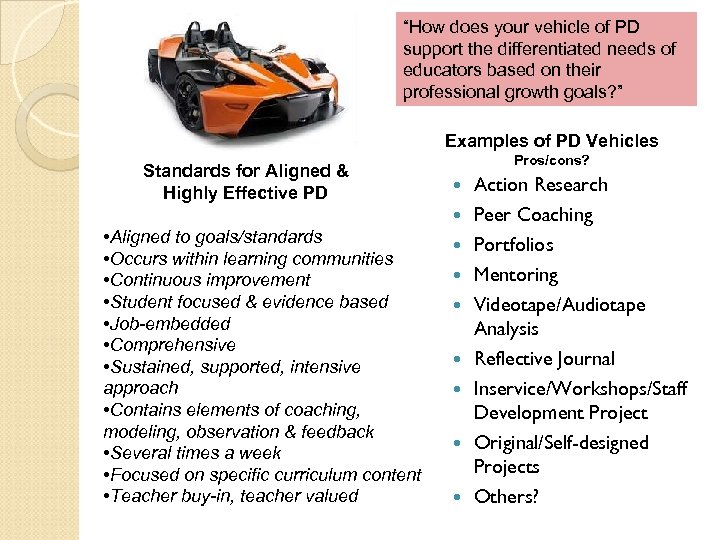 “How does your vehicle of PD support the differentiated needs of educators based on their professional growth goals? ” Examples of PD Vehicles Standards for Aligned & Highly Effective PD Pros/cons? • Aligned to goals/standards • Occurs within learning communities • Continuous improvement • Student focused & evidence based • Job-embedded • Comprehensive • Sustained, supported, intensive approach • Contains elements of coaching, modeling, observation & feedback • Several times a week • Focused on specific curriculum content • Teacher buy-in, teacher valued Action Research Peer Coaching Portfolios Mentoring Videotape/Audiotape Analysis Reflective Journal Inservice/Workshops/Staff Development Project Original/Self-designed Projects Others?
 TABLE TALK Questions: How do we create relevant learning opportunities targeted to individuals and the collective staff? Given no additional resources, what adjustments need to be made to include professional learning? How can we connect professional learning more intuitively to the standards and evaluation system? How can we nurture and grow collegial learning and classroom visits/forums?
 Share Out Questions: How do we create relevant learning opportunities targeted to individuals and the collective staff? Given no additional resources, what adjustments need to be made to include professional learning? How can we connect professional learning more intuitively to the standards and evaluation system? How can we nurture and grow collegial learning and classroom visits/forums?