 Скачать презентацию Electronic Web Sign-out As an Interactive Tool to
b065c0eef37c1023354dbd0bc1dd5db7.ppt
- Количество слайдов: 18



Electronic Web Sign-out As an Interactive Tool to Improve Patient Safety Hobart Lee, M. D. Joel Heidelbaugh, M. D. Denise Campbell-Scherer, M. D. Ph. D
Signout (or Handoffs) • Background • Resident survey • Computerized signout • Future steps
Introduction • Joint Commission on Accreditation of Healthcare Organizations (JCAHO) National Patient Safety Goals 1 – “[Implementation] of a standardized approach to ‘hand off’ communications, including an opportunity to ask and respond to questions. ” • New Institute of Medicine (IOM) work hour restrictions 2 1. National Patient Safety Goals 2006. http: //www. jointcommission. org/Patient. Safety/National. Patient. Safety. Goals/ 2. IOM resident duty hour brief. http: //www. iom. edu/CMS/3809/48553/60449. aspx
80 hour work week • • Hospital complications 3 Patient safety or mortality 4, 5 Preventable errors 6 Resident’s perspectives: – Improved signout reduces adverse events 7 – Poor signout contributes greatly to mistakes 8 3. Laine C et al. The Impact of a Regulation Restricting Medical House Staff Working Hours on the Quality of Patient Care. JAMA 1993; 269(3): 374 -378 4. Fletcher KE et al. Systematic Review: Effects of Resident Work Hours on Patient Safety. Ann Intern Med 2004; 141(11): 851 -7 5. Howard D. Do Regulations Limiting Resident’s Work Hours Affect Patient Mortality? J Gen Intern Med 2004; 19: 1 -7 6. Peterson LA. Does Housestaff Discontinuity of Care Increase the Risk for Preventable Adverse Events? Ann Intern Med 1994; 121(11): 866 -72 7. Sorkin, R et al. Attitudes About Patient Safety: A Survey of Physicians-In-Training. Amer J Medical Quality 2005; 20: 707 8. Jagsi R et al. Residents Report on Adverse Events and Their Causes. Arch Intern Med 2005; 165: 2607 -13
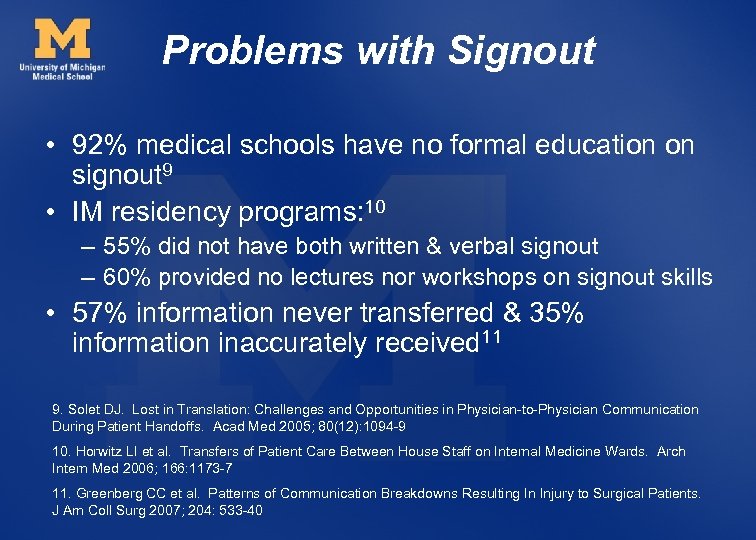
Problems with Signout • 92% medical schools have no formal education on signout 9 • IM residency programs: 10 – 55% did not have both written & verbal signout – 60% provided no lectures nor workshops on signout skills • 57% information never transferred & 35% information inaccurately received 11 9. Solet DJ. Lost in Translation: Challenges and Opportunities in Physician-to-Physician Communication During Patient Handoffs. Acad Med 2005; 80(12): 1094 -9 10. Horwitz LI et al. Transfers of Patient Care Between House Staff on Internal Medicine Wards. Arch Intern Med 2006; 166: 1173 -7 11. Greenberg CC et al. Patterns of Communication Breakdowns Resulting In Injury to Surgical Patients. J Am Coll Surg 2007; 204: 533 -40
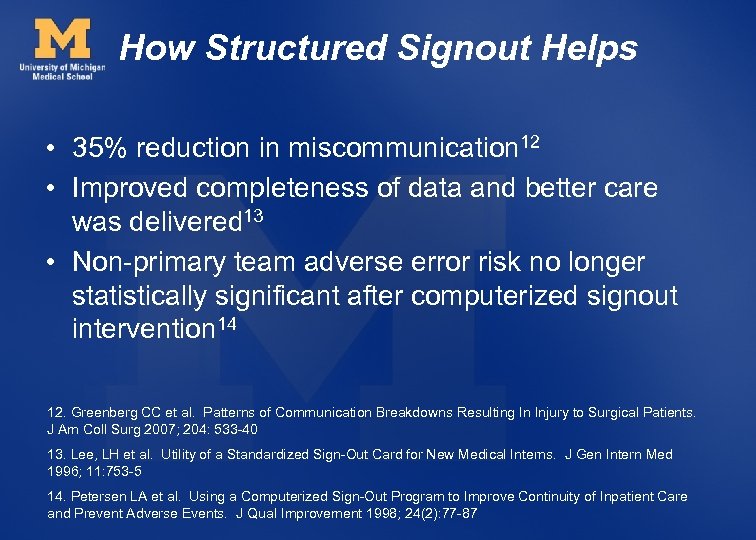
How Structured Signout Helps • 35% reduction in miscommunication 12 • Improved completeness of data and better care was delivered 13 • Non-primary team adverse error risk no longer statistically significant after computerized signout intervention 14 12. Greenberg CC et al. Patterns of Communication Breakdowns Resulting In Injury to Surgical Patients. J Am Coll Surg 2007; 204: 533 -40 13. Lee, LH et al. Utility of a Standardized Sign-Out Card for New Medical Interns. J Gen Intern Med 1996; 11: 753 -5 14. Petersen LA et al. Using a Computerized Sign-Out Program to Improve Continuity of Inpatient Care and Prevent Adverse Events. J Qual Improvement 1998; 24(2): 77 -87
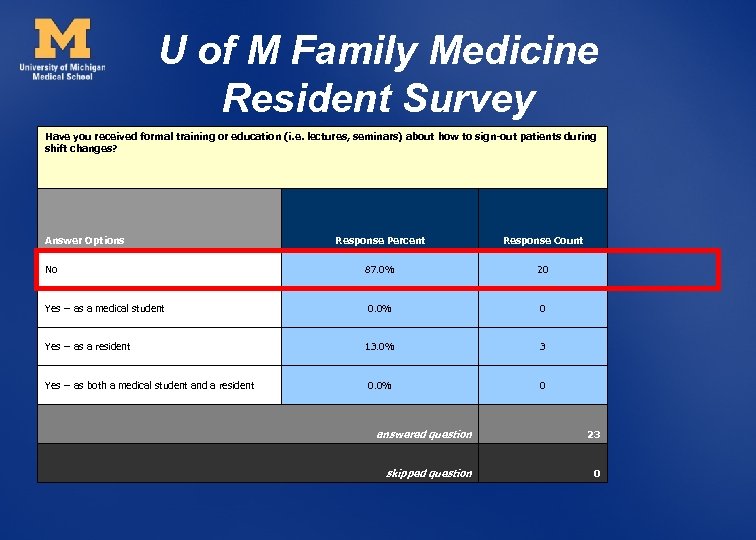
U of M Family Medicine Resident Survey Have you received formal training or education (i. e. lectures, seminars) about how to sign-out patients during shift changes? Answer Options Response Percent Response Count No 87. 0% 20 Yes -- as a medical student 0. 0% 0 Yes -- as a resident 13. 0% 3 Yes -- as both a medical student and a resident 0. 0% 0 answered question 23 skipped question 0
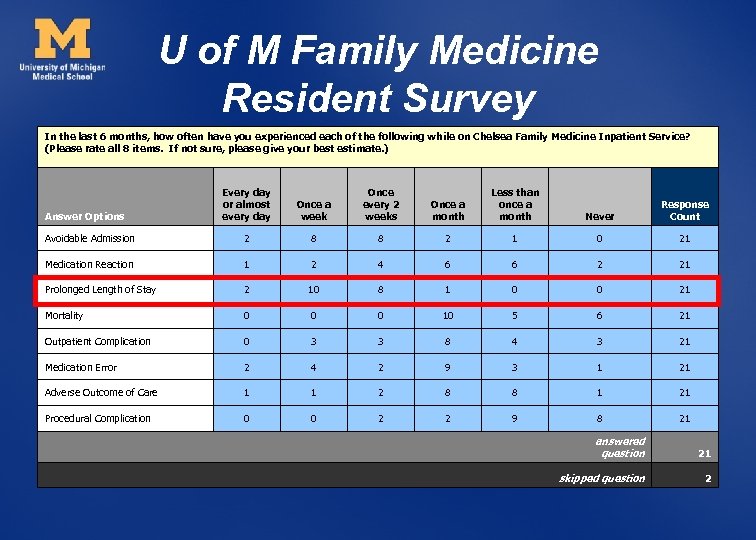
U of M Family Medicine Resident Survey In the last 6 months, how often have you experienced each of the following while on Chelsea Family Medicine Inpatient Service? (Please rate all 8 items. If not sure, please give your best estimate. ) Every day or almost every day Once a week Once every 2 weeks Once a month Less than once a month Never Response Count Avoidable Admission 2 8 8 2 1 0 21 Medication Reaction 1 2 4 6 6 2 21 Prolonged Length of Stay 2 10 8 1 0 0 21 Mortality 0 0 0 10 5 6 21 Outpatient Complication 0 3 3 8 4 3 21 Medication Error 2 4 2 9 3 1 21 Adverse Outcome of Care 1 1 2 8 8 1 21 Procedural Complication 0 0 2 2 9 8 21 Answer Options answered question 21 skipped question 2
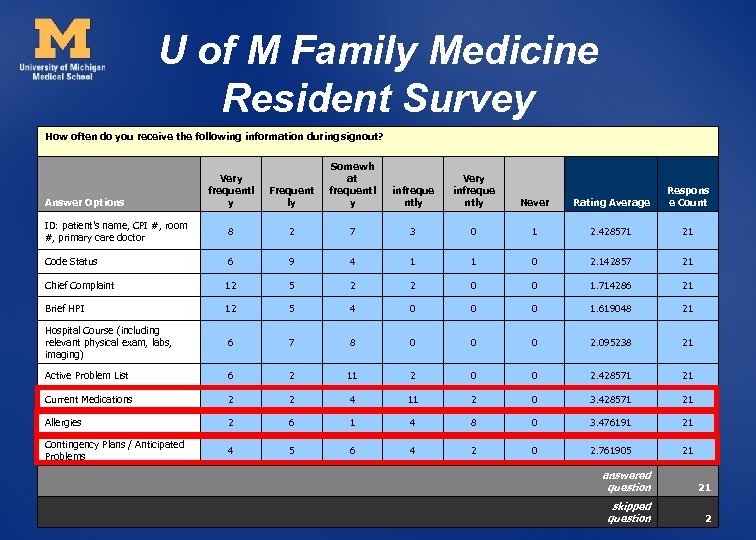
U of M Family Medicine Resident Survey How often do you receive the following information during signout? Frequent ly Somewh at frequentl y infreque ntly Very infreque ntly Never Rating Average Respons e Count 8 2 7 3 0 1 2. 428571 21 Code Status 6 9 4 1 1 0 2. 142857 21 Chief Complaint 12 5 2 2 0 0 1. 714286 21 Brief HPI 12 5 4 0 0 0 1. 619048 21 Hospital Course (including relevant physical exam, labs, imaging) 6 7 8 0 0 0 2. 095238 21 Active Problem List 6 2 11 2 0 0 2. 428571 21 Current Medications 2 2 4 11 2 0 3. 428571 21 Allergies 2 6 1 4 8 0 3. 476191 21 Contingency Plans / Anticipated Problems 4 5 6 4 2 0 2. 761905 21 Very frequentl y ID: patient's name, CPI #, room #, primary care doctor Answer Options answered question 21 skipped question 2
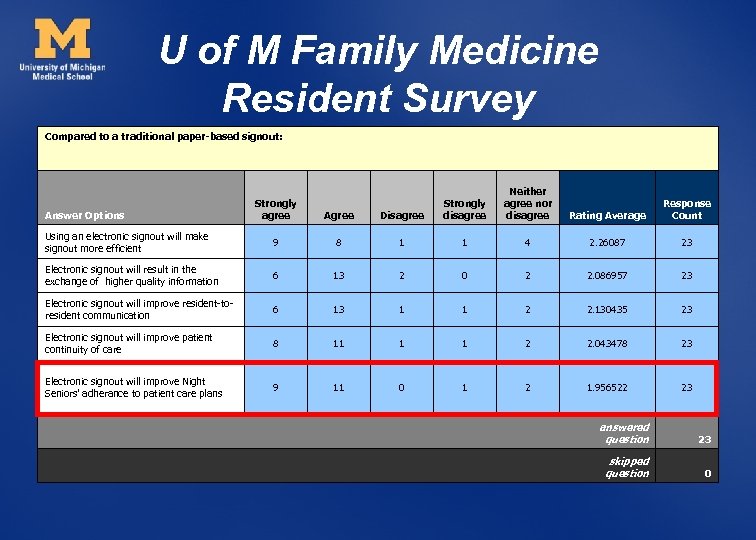
U of M Family Medicine Resident Survey Compared to a traditional paper-based signout: Disagree Strongly disagree Neither agree nor disagree Rating Average Response Count 8 1 1 4 2. 26087 23 6 13 2 0 2 2. 086957 23 Electronic signout will improve resident-toresident communication 6 13 1 1 2 2. 130435 23 Electronic signout will improve patient continuity of care 8 11 1 1 2 2. 043478 23 Electronic signout will improve Night Seniors' adherance to patient care plans 9 11 0 1 2 1. 956522 23 Strongly agree Agree Using an electronic signout will make signout more efficient 9 Electronic signout will result in the exchange of higher quality information Answer Options answered question 23 skipped question 0
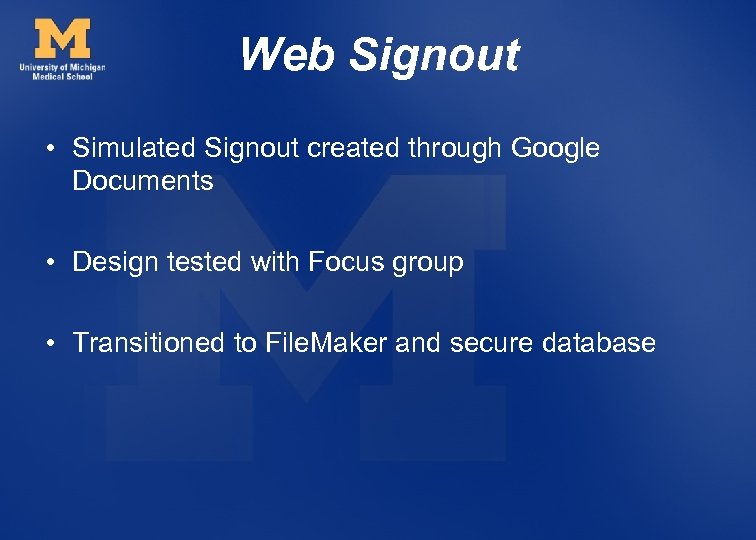
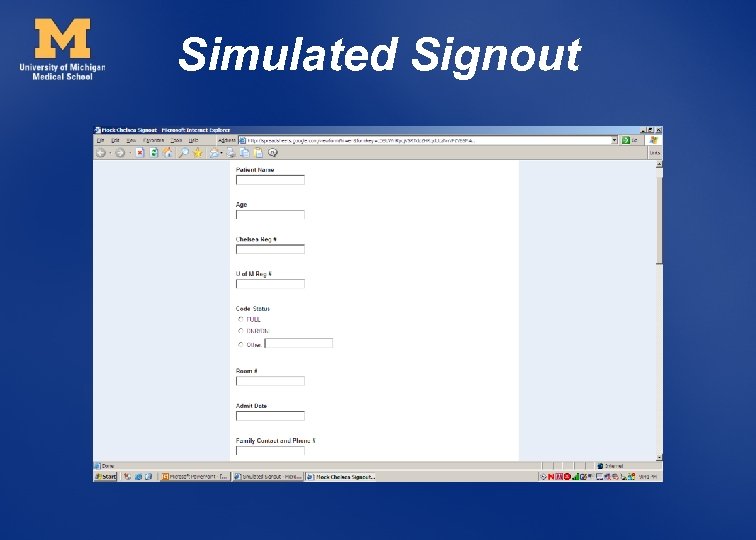
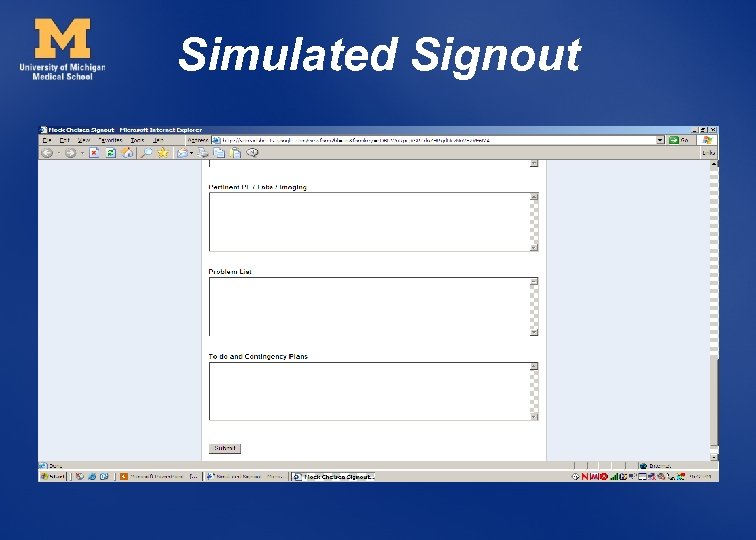
Web Signout • Simulated Signout created through Google Documents • Design tested with Focus group • Transitioned to File. Maker and secure database
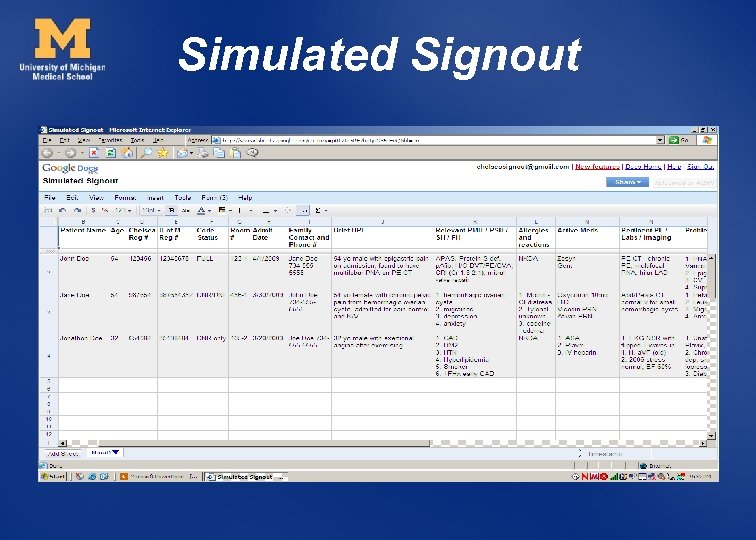
Simulated Signout
Simulated Signout
Simulated Signout
Focus Group Data • Four residents (3 PGY-1 and 1 PGY-2) • • General Impressions Content Usability Potential Difficulties
Limitations & Future Steps • Web publishing vs. HIPAA compliance • Pilot test at community hospital • Repeat survey for post-intervention data
Thank You Dr. Joel Heidelbaugh Dr. Denise Campbell-Scherer Department of Family Medicine, University of Michigan

Questions?
Скачать презентацию Electronic Web Sign-out As an Interactive Tool to
b065c0eef37c1023354dbd0bc1dd5db7.ppt