 Скачать презентацию Electronic Public Procurement in the UK PEPPOL Reference
b6b06a2f6c16c76ea9081ce02c249b8d.ppt
- Количество слайдов: 14



Electronic Public Procurement in the UK PEPPOL Reference Group By Martin Leverington Office of Government Commerce UK
Office of Government Commerce – Who we are, what we do … www. ogc. gov. uk OGC is an office of HM Treasury. Our main functions are: § § § Delivering value from third-party spend § OGCbuying. solutions – OGC’s trading arm, one of the largest public sector professional buying organisations § 2 Improving delivery of Government projects Getting the best from the Government estate Delivering sustainable procurement and operations Guidance and advice to support delivery of government policy Improving central Government capability Offers e-procurement solutions to the public sector
e. PP in the United Kingdom Electronic procurement is recognised as having an important role in enhancing public procurement • • 3 Improve information about government procurement expenditure Enables purchasing trends to be identified Improves link between purchasing and financial data Speeds the procurement process Modernisation Efficiency improvements (the way people work) Improved commercial relationships with suppliers
e. PP benefits cont’d • • • Reduce costs for suppliers dealing with government Opens up the government marketplace Improve departments' ability to manage their supply chain more efficiently § There is no single national UK e. PP solution § Public bodies choose to use solutions depending on their situation 4
OGC Role in e. PP § Responsible for implementing public procurement Directives (2004/18/EC, 2004/17/EC, 2007/66/EC) § § § Attendance at EU and international fora (eg DG Markt ACPC, e. PWG, IDABC) § § § Fed into UBL 5 Advice and Guidance on use of e. PP Responsible for the development of the OGC Interoperability Requirements model and development of proof of concept schemas Liaison with contracting authorities and devolved administrations Leads other topics with potential relevance to e. PP, eg collection of statistical data, SME access to public contracts
Legal situation and challenges § § § UK has implemented relevant legislation, for example: § § § 2006/112/EC on the common system of VAT § Advanced and qualified digital signatures allowed under UK law, but not generally required (but there is some use, eg IDe. A Marketplace) § 6 2004/18/EC (transposed in Jan 2006) 1999/93/EC on a Community framework for electronic signatures (transposed in 2002) Legal issues are not seen as a major impediment to adoption of e-procurement Need to ensure that e-procurement solutions meet the requirements of Articles 42 and 54 of 2004/18/EC – typically a contractual requirement (note English and Scots law differ, but implementation substantially similar)
Approach to e-procurement services § Public bodies do not typically develop e-procurement solutions or services themselves § Usual approach is to implement an e. PP solution supplied by a software or services company, perhaps as a managed service § § § May be part of or added to existing ERP / finance solution § “Zanzibar” is also provided by an external services provider (“Proc. Serve”), IDe. A marketplace by “EGS” 7 Eg: OGCbuying. solutions has put in place frameworks with service providers for eauction and e-sourcing services, which can be accessed by OGCbuying. solutions customers
Key stakeholders in UK e. PP No single solution § OGC § Central government departments and agencies § Local government (over 400 bodies) § National Health Service bodies § Central purchasing bodies (over 40) • • 8 OGCbuying. solutions NHS PASA Local Authority consortia etc
Key stakeholders in UK e. PP (cont’d) § e. PP marketplaces, eg • • • § § § 9 IDe. A Zanzibar Devolved administrations (eg e. Procurement Scotland) E-procurement solution providers Suppliers Complex landscape No simple “one size fits all” solution or mandated approach Allows flexibility, solutions for specific needs Potential duplication and fragmentation, reduces central data
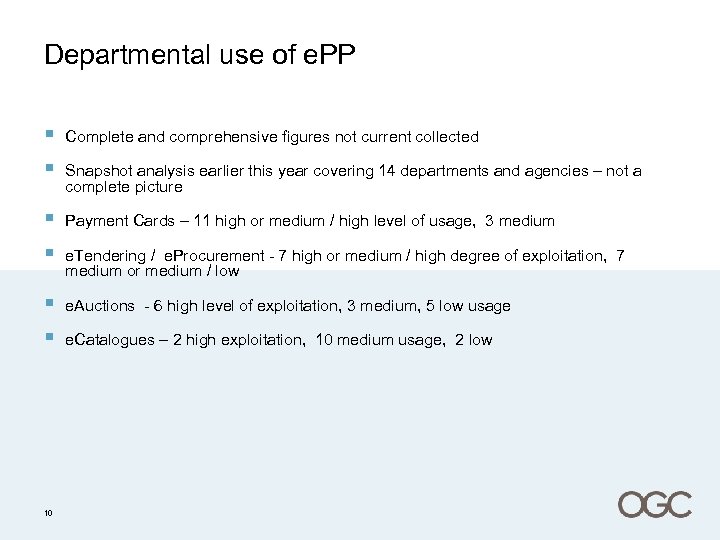
Departmental use of e. PP § § Complete and comprehensive figures not current collected § § Payment Cards – 11 high or medium / high level of usage, 3 medium § § e. Auctions - 6 high level of exploitation, 3 medium, 5 low usage 10 Snapshot analysis earlier this year covering 14 departments and agencies – not a complete picture e. Tendering / e. Procurement - 7 high or medium / high degree of exploitation, 7 medium or medium / low e. Catalogues – 2 high exploitation, 10 medium usage, 2 low
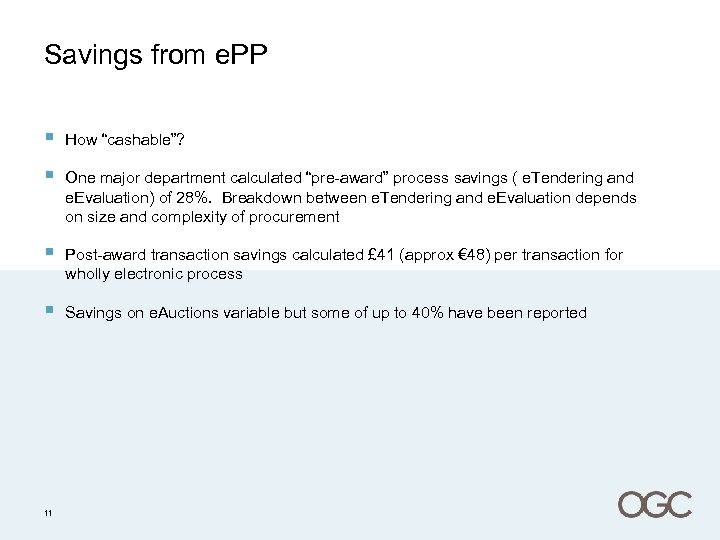
Savings from e. PP § How “cashable”? § One major department calculated “pre-award” process savings ( e. Tendering and e. Evaluation) of 28%. Breakdown between e. Tendering and e. Evaluation depends on size and complexity of procurement § Post-award transaction savings calculated £ 41 (approx € 48) per transaction for wholly electronic process § Savings on e. Auctions variable but some of up to 40% have been reported 11
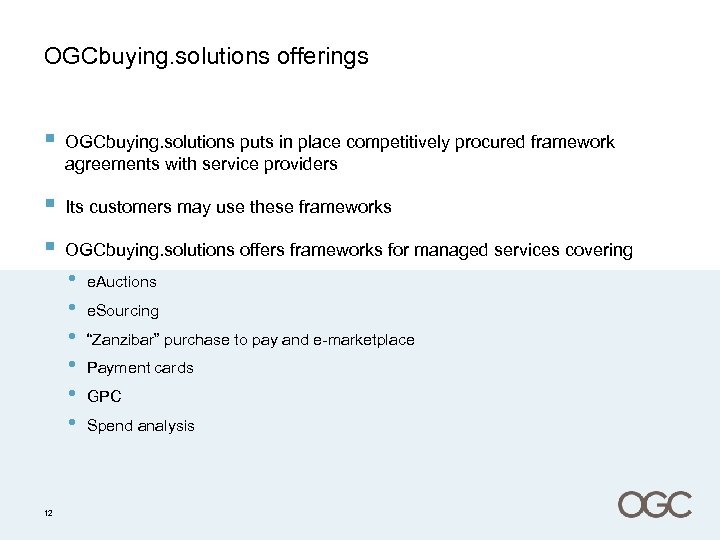
OGCbuying. solutions offerings § OGCbuying. solutions puts in place competitively procured framework agreements with service providers § Its customers may use these frameworks § OGCbuying. solutions offers frameworks for managed services covering • • • 12 e. Auctions e. Sourcing “Zanzibar” purchase to pay and e-marketplace Payment cards GPC Spend analysis
NHS Procurement e. Enablement Programme § Recognises that e-procurement has potential for significant benefits § But benefits have not been fully realised yet § Programme aims to put in place “enablers” to assist use and benefits from eprocurement in the health sector § Programme includes understanding existing landscape of e-procurement in NHS, and engagement with stakeholders § Helping procurement practitioners identify, understand, and measure potential benefits § Identify and promote appropriate procurement data and messaging standards 13
NHS Procurement e. Enablement Programme cont’d § Interoperability standards (data and messaging) § NHS Datapool § Pre-qualification data (VCD equivalence? ) 14
Скачать презентацию Electronic Public Procurement in the UK PEPPOL Reference
b6b06a2f6c16c76ea9081ce02c249b8d.ppt