


 Скачать презентацию Electronic Death Registration Systems in the United States
a5ab54dff2ae94cee8f30b4bd6111aa8.ppt
- Количество слайдов: 23
 Electronic Death Registration Systems in the United States Electronic Death Registration Systems And Mortality Surveillance for Pandemic Influenza Conference Call November 14, 2007 Rose Trasatti Project Manager National Association for Public Health Statistics and Information Systems
 NAPHSIS National Association for Public Health Statistics and Information Systems Represents all 57 health statistics and vital registration jurisdictions Funded by SSA since 1999 to support development of EDR systems throughout the U. S. SSA has provided funding to 31 jurisdictions for the development and implementation of EDR systems www. naphsis. org
 Certificate of Death Permanent legal record of fact and cause of death Identifies deceased individual Includes demographic information of the deceased Specifies final disposition of the body Specifies the cause of death of the deceased Provides information about the funeral director and medical certifier completing the record
 Certificate of Death usages Used for both administrative and public health analytical needs Necessary for the family to handle the business matters of the decedent Source of mortality statistics at national and jurisdictional level Data used to: n n n Allocate research and development funding Establish goals related to public health Measure health status
 What is EDR? Electronic filing of death certificates On-line collaboration among multiple death registration system users User-friendly death record data entry screens n n Fact-of-Death data entry Cause-of-Death data entry Built-in instructions and on-line help Internet accessibility Electronic authentication n User IDs/passwords Personal Identification Numbers (PINs) Biometrics
 Who benefits from an EDRS? Physicians, medical examiners and coroners Institutions n n n Hospitals Nursing Homes Hospice Funeral directors Local and state registrars Federal, state and local agencies Public health researchers Families
 Benefits of an EDRS Greater efficiency- participants interact electronically Improved timeliness of death registration Higher quality data via real-time edits n n Reduces errors in and rejection of death certificates Promotes uniformity in demographic and cause-ofdeath statistics Increased security and fraud prevention Supports partial electronic/paper death registration 7
 Benefits of an EDRS Capability to report fact-of-death to SSA with increased accuracy and timeliness n Verified Social Security numbers Capability to report cause-of-death with increased accuracy and timeliness n n n Integral part of patient care Uniformity in cause-of-death statistics Improves the cause-of-death data for electronic disease surveillance systems
 Benefits of an EDRS Electronic referrals to Medical Examiners/Coroners by n Physicians n Funeral directors n Health departments n Key terms (fall, laceration, hypothermia…) Electronic submission of supplemental cause-of-death information for pending investigations Electronic cremation approvals Printing of the Burial Permit at the Funeral Home Electronic trade calls between Funeral Homes Ordering of certified copies
 EDRS implementation challenges An EDRS is a complex system n n n Numerous data items with extensive edit checks Detailed business rules and workflow Multiple users working on the same death record Many users accessing the system from many points Internet application with a need for high-levels of security
 EDRS implementation challenges An EDRS is a complex system n n Costly to develop Takes time to configure/customize system to meet requirements Numerous participants w Need to be trained w Need to be provided access to the EDR system w Help desk Requires the availability of Department of Health resources
 EDRS implementation challenges EDRS funding is needed for n Hardware costs w Servers w Biometric devices n System development costs w Vendor w In-house n n n Staff resources throughout project life cycle Training Ongoing maintenance w Help desk w Hardware/software w Training new users
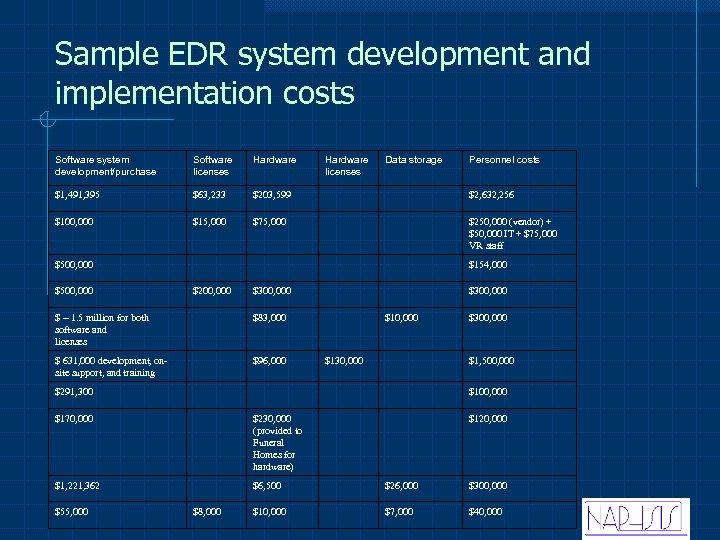 Sample EDR system development and implementation costs Software system development/purchase Software licenses Hardware licenses Data storage $1, 491, 395 $63, 233 $203, 599 $2, 632, 256 $100, 000 $15, 000 $75, 000 $250, 000 (vendor) + $50, 000 IT + $75, 000 VR staff $500, 000 Personnel costs $154, 000 $200, 000 $300, 000 $ ~ 1. 5 million for both software and licenses $83, 000 $ 631, 000 development, onsite support, and training $96, 000 $300, 000 $130, 000 $300, 000 $1, 500, 000 $291, 300 $100, 000 $170, 000 $230, 000 (provided to Funeral Homes for hardware) $1, 221, 362 $6, 500 $26, 000 $300, 000 $10, 000 $7, 000 $40, 000 $55, 000 $8, 000 $120, 000
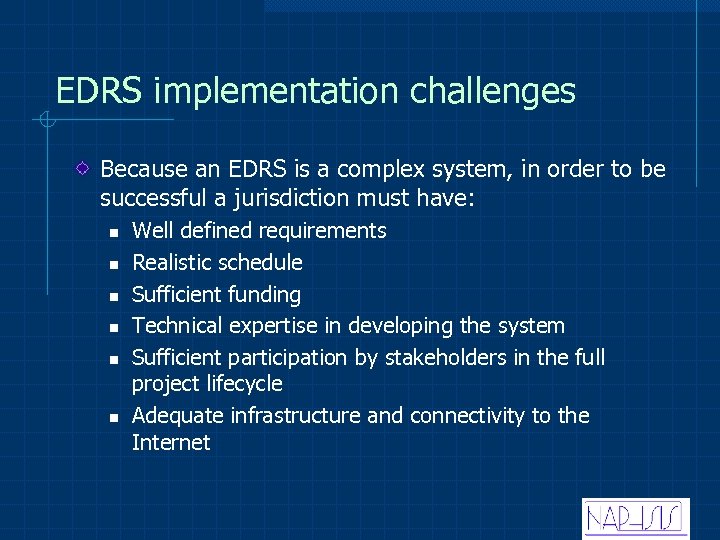 EDRS implementation challenges Because an EDRS is a complex system, in order to be successful a jurisdiction must have: n n n Well defined requirements Realistic schedule Sufficient funding Technical expertise in developing the system Sufficient participation by stakeholders in the full project lifecycle Adequate infrastructure and connectivity to the Internet
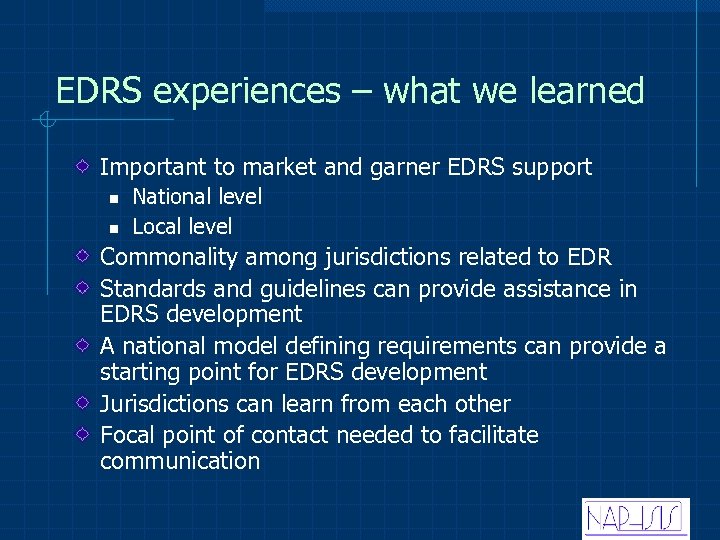 EDRS experiences – what we learned Important to market and garner EDRS support n n National level Local level Commonality among jurisdictions related to EDR Standards and guidelines can provide assistance in EDRS development A national model defining requirements can provide a starting point for EDRS development Jurisdictions can learn from each other Focal point of contact needed to facilitate communication
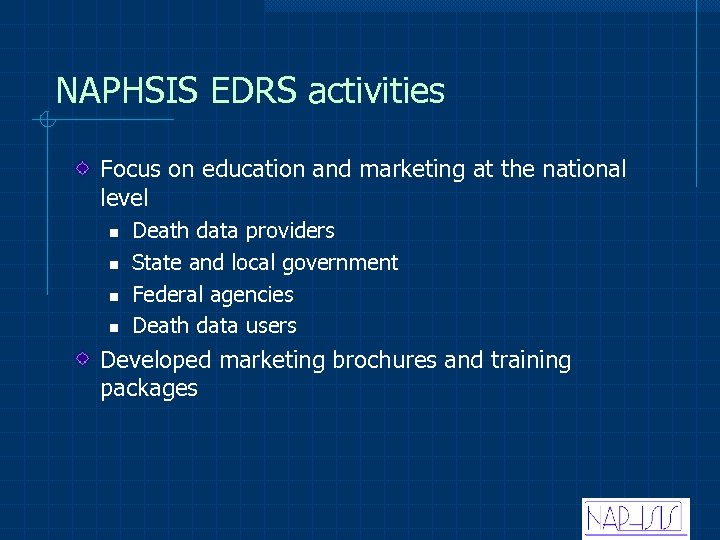 NAPHSIS EDRS activities Focus on education and marketing at the national level n n Death data providers State and local government Federal agencies Death data users Developed marketing brochures and training packages
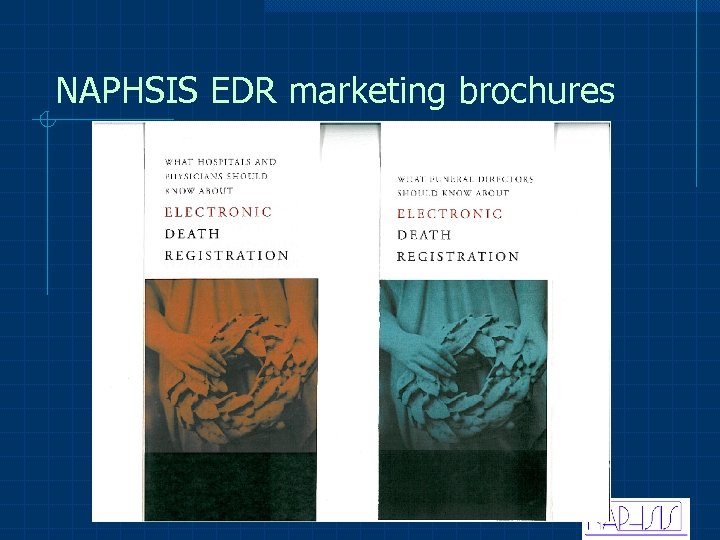 NAPHSIS EDR marketing brochures
 NAPHSIS EDRS activities Exhibited EDR booth and spoken at national level conferences n n n National Funeral Director Association National Association of Medical Examiners Alliance for Continuing Medical Education Association for Hospital Medical Education American Medical Association Continuing Medical Education Director’s Taskforce
 NAPHSIS EDRS activities Provide consulting services to jurisdictions for implementing EDR systems n n n Meet with vital records agencies/vital records staff Meet with EDR participants Help review EDRS materials developed in-house or by a vendor Facilitate communication with other jurisdictions Established an EDR Documentation Library w EDRS Standards & Guidelines w EDRS RFP Template and Proposal Evaluation Guide w EDRS Best Practices and Lessons Learned Assist jurisdictions with the tailoring of the EDRS National Model to meet their needs
 EDRS National Model meets 80 -85% of any jurisdiction’s electronic death registration requirements Addressed the needs of the death data providers Included participation from multiple jurisdictions Re-engineering artifacts developed n n Components are modular Use cases and activity diagrams Recommended reports, files, outputs EDR system requirements and business rules
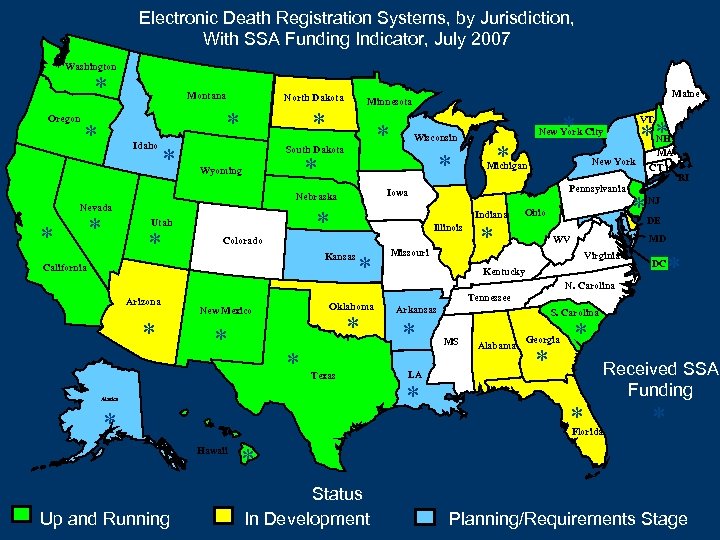 Electronic Death Registration Systems, by Jurisdiction, With SSA Funding Indicator, July 2007 Washington * Oregon Montana North Dakota * * Idaho * * * South Dakota * Utah * Colorado Arizona * Indiana * * Oklahoma New Mexico * * Texas Alaska * Missouri ** New York Ohio * * NH MA CT RI NJ DE MD WV Virginia Kentucky DC N. Carolina * Tennessee Arkansas * LA * S. Carolina MS Alabama Georgia * * Received SSA Funding * Florida Hawaii Up and Running * Pennsylvania Illinois Kansas California VT Michigan Iowa Nebraska * * * New York City Wisconsin * Wyoming Nevada * Maine Minnesota * * Status In Development Planning/Requirements Stage
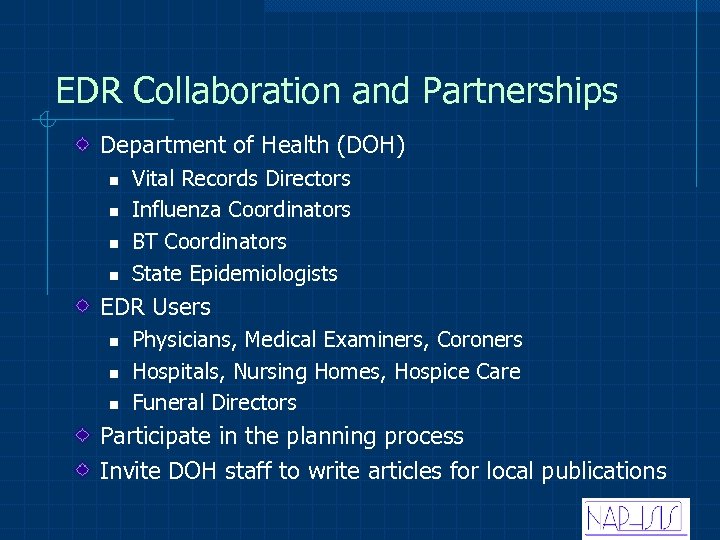 EDR Collaboration and Partnerships Department of Health (DOH) n n Vital Records Directors Influenza Coordinators BT Coordinators State Epidemiologists EDR Users n n n Physicians, Medical Examiners, Coroners Hospitals, Nursing Homes, Hospice Care Funeral Directors Participate in the planning process Invite DOH staff to write articles for local publications
 NAPHSIS contact information Rose Trasatti Project Manager National Association for Public Health Statistics and Information Systems (NAPHSIS) 801 Roeder Road Suite 650 Silver Spring, Maryland 20910 (301) 563 -6001 (phone) (301) 563 -6012 (fax) www. naphsis. org rtrasatti@naphsis. org