 Скачать презентацию Electronic data interchange Sabitova Elza 2014 DEM-402
Electronic data interchange.pptx
- Количество слайдов: 18



Electronic data interchange Sabitova Elza 2014 DEM-402
Electronic data interchange (EDI) is an electronic communication system that provides standards for exchanging data via any electronic means. By adhering to the same standard, two different companies, even in two different countries, can electronically exchange documents (such as purchase orders, invoices, shipping notices, and many others).
EDI has existed for more than 30 years, and there are many EDI standards (including X 12, EDIFACT, ODETTE, etc. ), some of which address the needs of specific industries or regions. It also refers specifically to a family of standards.
In 1996, the National Institute of Standards and Technology defined electronic data interchange as "the computer-to-computer interchange of strictly formatted messages that represent documents other than monetary instruments. EDI implies a sequence of messages between two parties, either of whom may serve as originator or recipient.
It distinguishes mere electronic communication or data exchange, specifying that "in EDI, the usual processing of received messages is by computer only. Human intervention in the processing of a received message is typically intended only for error conditions, for quality review, and for special situations. For example, the transmission of binary or textual data is not EDI as defined here unless the data are treated as one or more data elements of an EDI message and are not normally intended for human interpretation as part of online data processing. "
EDI provides a technical basis for commercial "conversations" between two entities, either internal or external. EDI constitutes the entire electronic data interchange paradigm, including the transmission, message flow, document format, and software used to interpret the documents. EDI standards describe the rigorous format of electronic documents.
EDI documents generally contain the same information that would normally be found in a paper document used for the same organizational function. For example an EDI 940 ship-from-warehouse order is used by a manufacturer to tell a warehouse to ship product to a retailer. It typically has a 'ship-to' address, a 'bill-to' address, and a list of product numbers (usually a UPC) and quantities. Another example is the set of messages between sellers and buyers, such as request for quotation (RFQ), bid in response to RFQ, purchase order acknowledgment, shipping notice, receiving advice, invoice, and payment advice.
EDI is not confined to just business data related to trade but encompasses all fields such as medicine (e. g. , patient records and laboratory results), transport (e. g. , container and modal information), engineering and construction, etc. In some cases, EDI will be used to create a new business information flow (that was not a paper flow before).
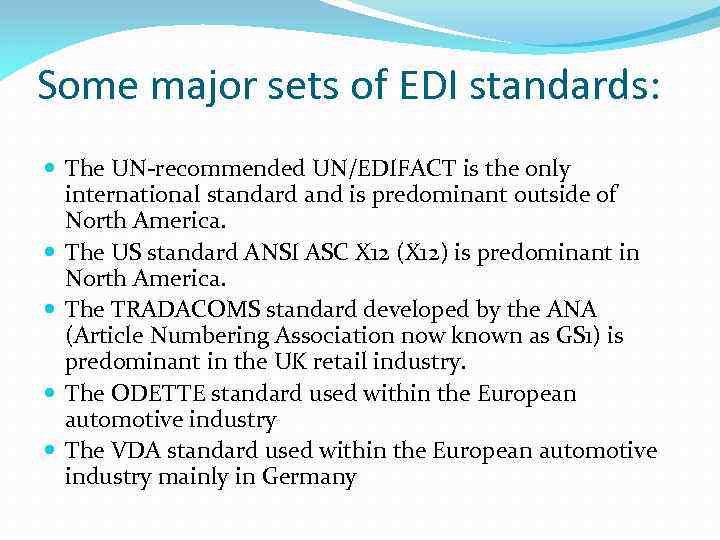
Some major sets of EDI standards: The UN-recommended UN/EDIFACT is the only international standard and is predominant outside of North America. The US standard ANSI ASC X 12 (X 12) is predominant in North America. The TRADACOMS standard developed by the ANA (Article Numbering Association now known as GS 1) is predominant in the UK retail industry. The ODETTE standard used within the European automotive industry The VDA standard used within the European automotive industry mainly in Germany
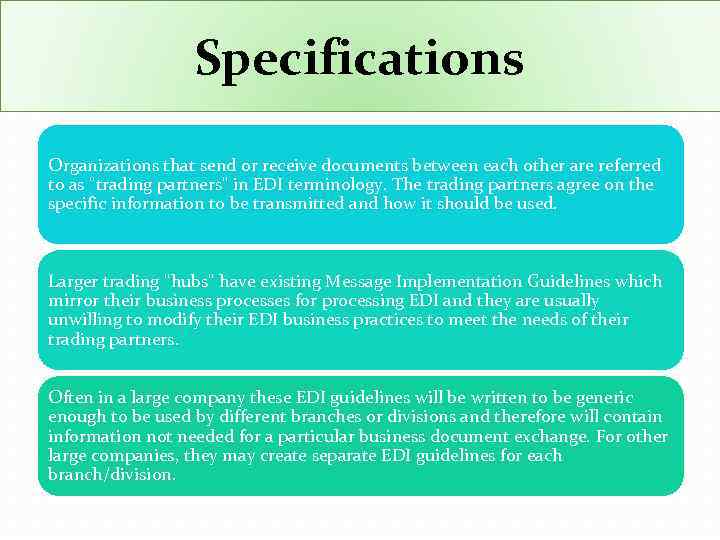
Specifications Organizations that send or receive documents between each other are referred to as "trading partners" in EDI terminology. The trading partners agree on the specific information to be transmitted and how it should be used. Larger trading "hubs" have existing Message Implementation Guidelines which mirror their business processes for processing EDI and they are usually unwilling to modify their EDI business practices to meet the needs of their trading partners. Often in a large company these EDI guidelines will be written to be generic enough to be used by different branches or divisions and therefore will contain information not needed for a particular business document exchange. For other large companies, they may create separate EDI guidelines for each branch/division.
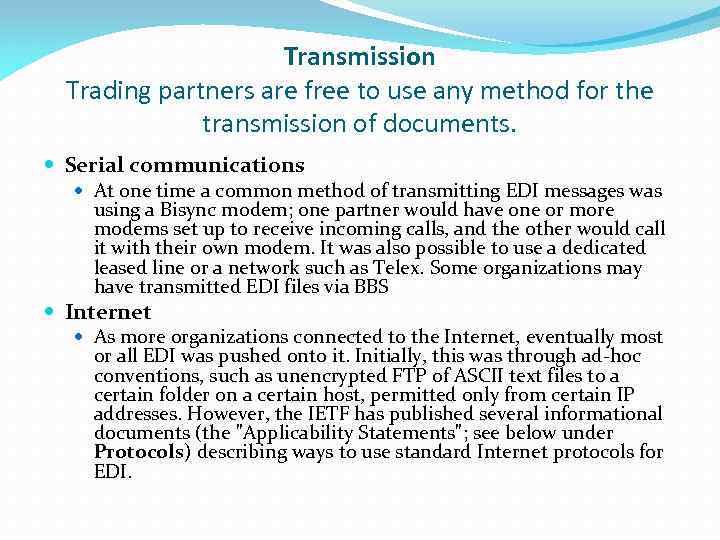
Transmission Trading partners are free to use any method for the transmission of documents. Serial communications At one time a common method of transmitting EDI messages was using a Bisync modem; one partner would have one or more modems set up to receive incoming calls, and the other would call it with their own modem. It was also possible to use a dedicated leased line or a network such as Telex. Some organizations may have transmitted EDI files via BBS Internet As more organizations connected to the Internet, eventually most or all EDI was pushed onto it. Initially, this was through ad-hoc conventions, such as unencrypted FTP of ASCII text files to a certain folder on a certain host, permitted only from certain IP addresses. However, the IETF has published several informational documents (the "Applicability Statements"; see below under Protocols) describing ways to use standard Internet protocols for EDI.
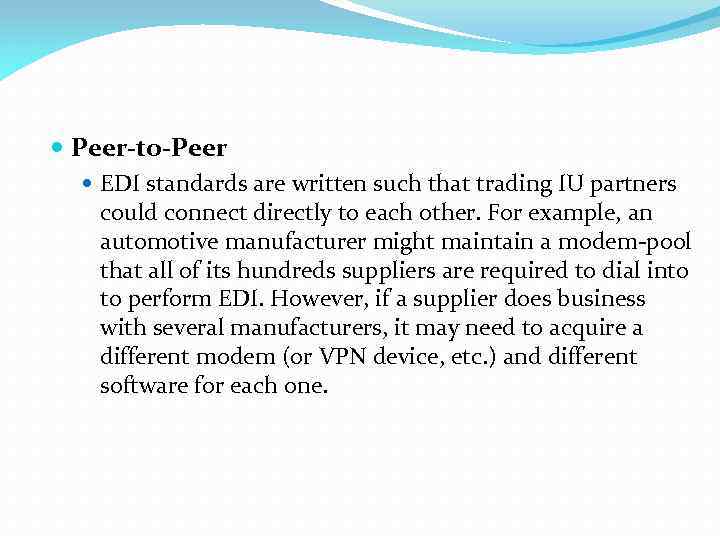
Peer-to-Peer EDI standards are written such that trading IU partners could connect directly to each other. For example, an automotive manufacturer might maintain a modem-pool that all of its hundreds suppliers are required to dial into to perform EDI. However, if a supplier does business with several manufacturers, it may need to acquire a different modem (or VPN device, etc. ) and different software for each one.
Value-added networks To address the limitations in peer-to-peer adoption of EDI, VANs (value-added networks) were established. A VAN acts as a regional post office. It receives transactions, examines the 'from' and the 'to' information, and routes the transaction to the final recipient. VANs may provide a number of additional services, e. g. retransmitting documents, providing third party audit information, acting as a gateway for different transmission methods, and handling telecommunications support. Because of these and other services VANs provide, businesses frequently use a VAN even when both trading partners are using Internetbased protocols. Healthcare clearinghouses perform many of the same functions as a VAN, but have additional legal restrictions VANs may be operated by various entities: telecommunication companies; industry group consortia; a large company interacting with its suppliers/vendors.
Advantages over paper systems EDI and other similar technologies save a company money by providing an alternative to, or replacing, information flows that require a great deal of human interaction and paper documents. Even when paper documents are maintained in parallel with EDI exchange, e. g. printed shipping manifests, electronic exchange and the use of data from that exchange reduces the handling costs of sorting, distributing, organizing, and searching paper documents.
EDI and similar technologies allow a company to take advantage of the benefits of storing and manipulating data electronically without the cost of manual entry. Another advantage of EDI is the opportunity to reduce or eliminate manual data entry errors, such as shipping and billing errors, because EDI eliminates the need to rekey documents on the destination side. One very important advantage of EDI over paper documents is the speed in which the trading partner receives and incorporates the information into their system thus greatly reducing cycle times. For this reason, EDI can be an important component of just-in -time production systems.
According to the 2008 Aberdeen report "A Comparison of Supplier Enablement around the World", only 34% of purchase orders are transmitted electronically in North America. In EMEA, 36% of orders are transmitted electronically and in APAC, 41% of orders are transmitted electronically. They also report that the average paper requisition to order costs a company $37. 45 in North America, $42. 90 in EMEA and $23. 90 in APAC. With an EDI requisition to order costs are reduced to $23. 83 in North America, $34. 05 in EMEA and $14. 78 in APAC.
Barriers to implementation is the accompanying business process change. Existing business processes built around paper handling may not be suited for EDI and would require changes to accommodate automated processing of business documents. is the cost in time and money in the initial set-up. The preliminary expenses and time that arise from the implementation, customization and training can be costly. It is important to select the correct level of integration to match the business requirement.

Thanks for attention
Скачать презентацию Electronic data interchange Sabitova Elza 2014 DEM-402
Electronic data interchange.pptx