 Скачать презентацию Electronic Commerce Transactions Week 11 Objectives
29dd10231b162b2cb0f52596657af4de.ppt
- Количество слайдов: 24



Electronic Commerce Transactions Week 11
Objectives • • • What is e-commerce Implementing transactions over the internet Managing security risk Tools for implementing e-commerce Consumer and business markets for ecommerce
What is e-commerce • The sharing of business information, maintaining business relationships, and conducting business transactions by means of telecommunication networks • E-business denotes a broad holistic concept encompassing internet related technologies on business functions, from human resource management to marketing to corporate strategy
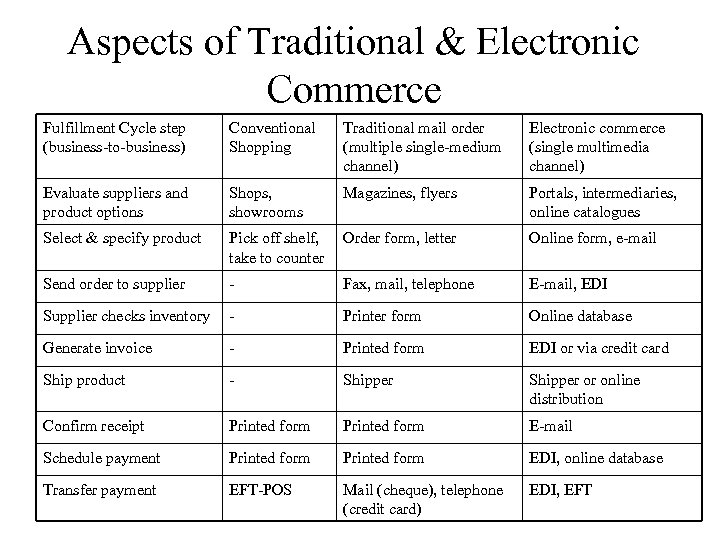
Aspects of Traditional & Electronic Commerce Fulfillment Cycle step (business-to-business) Conventional Shopping Traditional mail order (multiple single-medium channel) Electronic commerce (single multimedia channel) Evaluate suppliers and product options Shops, showrooms Magazines, flyers Portals, intermediaries, online catalogues Select & specify product Pick off shelf, take to counter Order form, letter Online form, e-mail Send order to supplier - Fax, mail, telephone E-mail, EDI Supplier checks inventory - Printer form Online database Generate invoice - Printed form EDI or via credit card Ship product - Shipper or online distribution Confirm receipt Printed form E-mail Schedule payment Printed form EDI, online database Transfer payment EFT-POS Mail (cheque), telephone (credit card) EDI, EFT
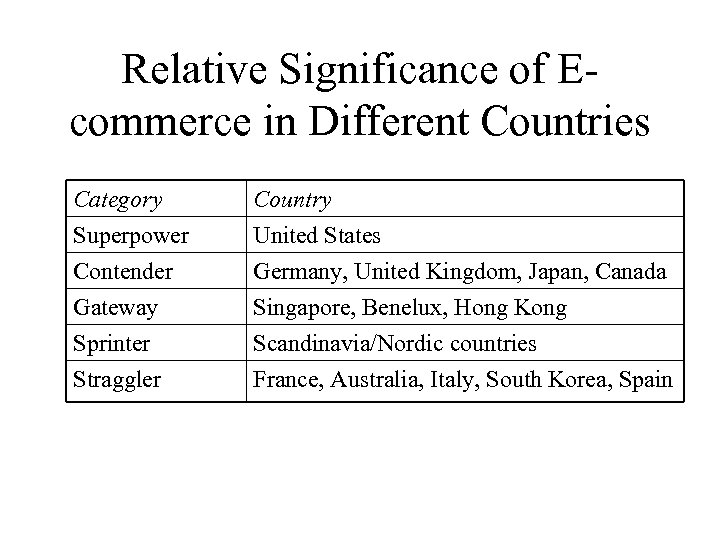
Relative Significance of Ecommerce in Different Countries Category Superpower Contender Gateway Country United States Germany, United Kingdom, Japan, Canada Singapore, Benelux, Hong Kong Sprinter Straggler Scandinavia/Nordic countries France, Australia, Italy, South Korea, Spain
A History of E-commerce • Electronic Data Interchange – the exchange, using digital media, of standardized business documents such as purchase orders and invoices between buyers and sellers • Financial EDI – an aspect of the electronic payment mechanism involving transfer of funds from the bank of a buyer to a seller
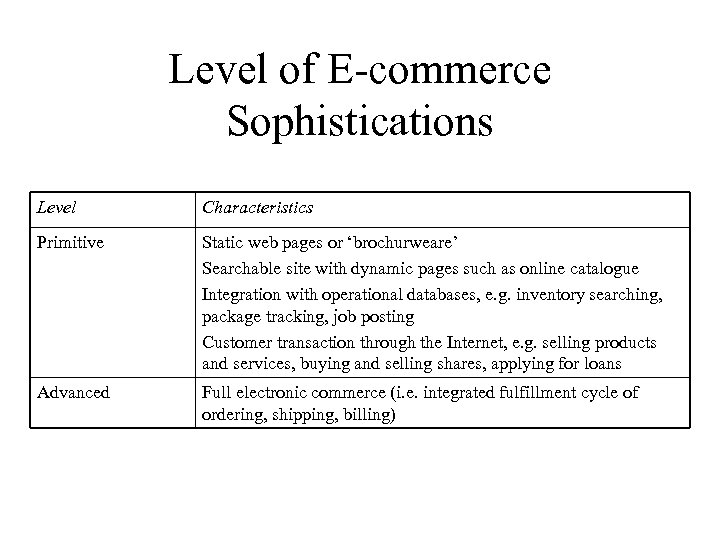
Level of E-commerce Sophistications Level Characteristics Primitive Static web pages or ‘brochurweare’ Searchable site with dynamic pages such as online catalogue Integration with operational databases, e. g. inventory searching, package tracking, job posting Customer transaction through the Internet, e. g. selling products and services, buying and selling shares, applying for loans Advanced Full electronic commerce (i. e. integrated fulfillment cycle of ordering, shipping, billing)
Reasons for the Growth in Ecommerce • Increase in demand for choice (product depth, global reach, price choices) • Demand for information (detailed product information, inventory, order status) • Demand for interactive, online support • Avoidance of travel and parking difficulties for consumer e-commerce • Elimination of time constraints (that is, opening hours or delays between placing an order and delivery)
Benefits of E-commerce • Lower purchasing overhead – especially for small value and repeat orders • Greater choice (greater product depth and global reach) • Faster fulfilling cycle time (ordering, shipping, billing) • Greater ability to supply information (inventory, order status, etc. ) • Lower cost than EDI • Ease of swapping between suppliers greater than with EDI
Benefits for suppliers • A global reach, leading to more orders • Reduced administration overhead (paperwork automation leading to a lower cost for each order made) • Reduced asset requirement (physical properties for companies with a retail network) • Integration between back office and online ‘shopping’ activities • Integration of online ‘shopping’ activities with database marketing • Less need for distribution via channel (disinter mediation) • Reduced working capital (inventory)
E-commerce Enablers • • Internet standards Bandwidth development World Wide Web Diversification and proliferation of internet access • Development of ‘off the shelf’ e-commerce products
Inhibitors to E-commerce • • • Technophobia Security fears Technology not user friendly Poor performance leading to slow download Inertia of habitual conventional shopping and purchasing • Internet access still limited • Entrenched interests (for example, distributors who may be bypassed)
Payment system requirements • Be secure • Be easy for buyer and seller to use and understand • Be straight forward for banks to administer • Be scalable across different currencies and to different denominations • Have a low costs for implementing transactions
Consumer Payment Systems • Purchasers • Merchants • Certified Authority (CA)- body that issues digital certificates that confirm the identity of purchasers and merchants • Banks • Electronic token issuer – dependent on digital certificates for security
Non-credit of Pre-paid Systems • Digital, virtual or electronic cash • Microtransactions or micropayments such as Millicent • Debit cards • Smartcards
Post-paid or Credit-based Systems • Digital/electronic cheques • Credit cards such as Visa or Master. Card
Requirements for Security Systems • • • Authentication Privacy and confidentiality Integrity Non-repudiability Availability
Methods of Increasing Security • Encryption – Secret-key (symmetric) encryption – Public-key (asymmetric) encryption • Digital signatures – Identifies individuals using public key encryption – Certificate and certificate authorities (CA) – Secure Electronic Transaction
Constraints on Selecting an Ecommerce Solution • Cost • Quality of service – Performance of service – Downtime – Security – Cards supported – Currencies supported – Time taken to set up an account
Constraints on Selecting an Ecommerce Solution • Transaction method – Traditional (phone/fax/mail) – E-mail – Online transaction • Number of products required • Volume of sales – Shopcreator Stall supports up to 10 products – IBM Home page creator supports 15 -500 items – BT Store. Front supports a small to medium number of products
Constraints on Selecting an Ecommerce Solution • • Cost of product Configurability Personalization facilities Integration with back-end systems – Integration with stock control system to determine availability is vital – Integration with stock control system will allow price and product information changes to be updated rapidly – Integration with adequate fulfillment services – Integration with e-mail to conform order to customer
Consumer & Business Markets for E-commerce • Business-to-business – Familiarity with the technology – Account selling • Consumer markets – Acceptable Internet access mechanisms – Payment mechanisms perceived as convenient and secure – An attractive and usable media interface
The Commercial Environment for E-commerce • Legal status of banks – Non banks are subject to less scrutiny and regulation – Non-banks are at a competitive advantage as they do not carry the costs of the high level of registration – Non-banks do not report to central bank which leads to uncertainty and instability in the money supply • Tariffs and taxation – Value added Tax charged depending on location of supplier and consumer – Export and import tax implications – Services attract VAT according to where the supplier is located
Contracts – consumer protection • Location and identity of supplier and in case of contracts requiring payment in advance his address • The main characteristics of the goods or services • The price of goods or services • Delivery costs • The arrangement of payments, delivery or performance • The existence of right of withdrawal • The cost of using the means of distance communication, where it is calculated other than the basic rates • The period for which the offer or price remains valid • The minimum duration of the contract and whether the contracts for the supply of goods are to be permanent or recurrent
Скачать презентацию Electronic Commerce Transactions Week 11 Objectives
29dd10231b162b2cb0f52596657af4de.ppt