


 Скачать презентацию Electronic Commerce Eighth Edition Chapter 9 Electronic Commerce
48c18050739dd22cefc3587fe031c0b4.ppt
- Количество слайдов: 88
 Electronic Commerce Eighth Edition Chapter 9 Electronic Commerce Software
 Learning Objectives In this chapter, you will learn about: • Finding and evaluating Web-hosting services • Basic functions of electronic commerce software • Advanced functions of electronic commerce software Electronic Commerce, Eighth Edition 2
 Learning Objectives (cont’d. ) • Electronic commerce software for small and midsize businesses • Electronic commerce software for midsize to large businesses • Electronic commerce software for large businesses that have an existing information technology infrastructure Electronic Commerce, Eighth Edition 3
 Web Hosting Alternatives • Self-hosting – Run servers in-house – Often used by large companies • Third-party Web-hosting service providers – Offer Web services, electronic commerce functions – Often used by midsize, smaller companies • Commerce service providers (CSPs) – Provide Internet access, Web-hosting services – Offer hosting services • Help companies conduct electronic commerce Electronic Commerce, Eighth Edition 4
 Web Hosting Alternatives (cont’d. ) • Commerce service providers (CSPs) (cont’d. ) – Offer Web server management, rent application software – Also called: • Managed service providers (MSPs) • Application service providers (ASPs) • Service provider hosting arrangements – Shared hosting • Client's Web site on server hosting other Web sites simultaneously • Operated by service provider at its location Electronic Commerce, Eighth Edition 5
 Web Hosting Alternatives (cont’d. ) • Service provider hosting arrangements (cont’d. ) – Dedicated hosting • Client Web server available • Server not shared with other clients – Service provider responsibilities (shared and dedicated hosting) • Owns server hardware, leased to client • Maintains Web server hardware, software • Provides Internet connection through its routers, other network hardware Electronic Commerce, Eighth Edition 6
 Web Hosting Alternatives (cont’d. ) • Service provider hosting arrangements (cont’d. ) – Co-location service • Service provider rents physical space to client • Provides reliable power supply, Internet connection • Clients install own server hardware, software; maintain server • Finding service providers – Local telephone directory – Web directories • The List • Google Directory of Web Host Directories Electronic Commerce, Eighth Edition 7
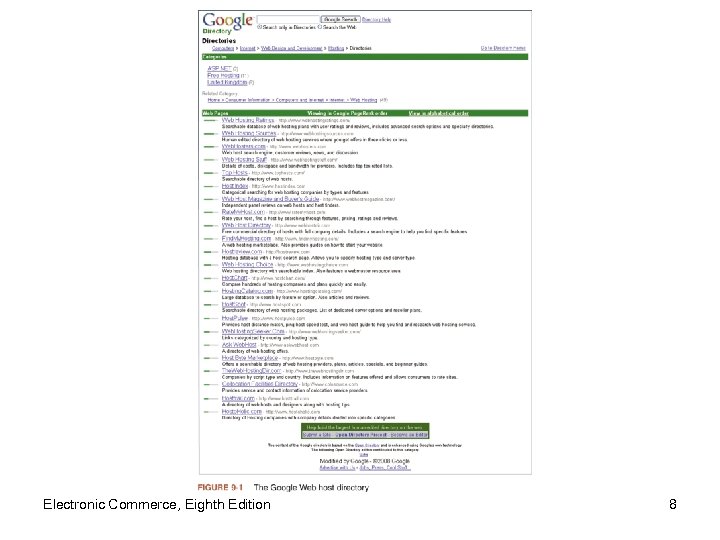 Electronic Commerce, Eighth Edition 8
 Web Hosting Alternatives (cont’d. ) • Comparing Web hosts – Host. Index site • Web-hosting alternatives and services – Top. Hosts. com and Host. Search sites • Major Web directories – Google Directory of Web Host Directories • Web server-hosting decision: main factor – Scalable • Web server hardware, software combinations adaptable to meet changing requirements when needs of clients grow Electronic Commerce, Eighth Edition 9
 Basic Functions of Electronic Commerce Software • Software and hardware products to build sites – Inexpensive hosted stores with software tools – Expensive sophisticated electronic commerce software suites • Electronic commerce software needs determined by: – Expected enterprise size, projected traffic, sales – Budget • Online store creation is less expensive than building retail store chain • External or in-house host considerations Electronic Commerce, Eighth Edition 10
 Basic Functions of Electronic Commerce Software (cont’d. ) • All electronic commerce solutions must provide: – Catalog display – Shopping cart capabilities – Transaction processing • Larger complex sites may include: – Software • Adding features, capabilities to basic commerce tools Electronic Commerce, Eighth Edition 11
 Catalog Display • Catalog organizes goods and services being sold – Organizes offerings into departments – Web store advantage • Single product in multiple categories • Catalog: listing of goods and services • Static catalog: simple list written in HTML – On Web page or series of Web pages • Dynamic catalog: item information stored in database – Separate computer accessible to server running Web site itself (usually) Electronic Commerce, Eighth Edition 12
 Catalog Display (cont’d. ) • Large, well-known electronic commerce sites – Include many features; are professional looking • Small electronic commerce site – Simple, inexpensive electronic commerce software – Few features, clean look – Small Web stores (sell fewer than 100 items) • Use simple list of products or categories (static) • Item organization not particularly important • Can provide item photo • Good sites provide alternative ways to find products – Search engine Electronic Commerce, Eighth Edition 13
 Electronic Commerce, Eighth Edition 14
 Shopping Cart • Early days of electronic commerce – Used forms-based shopping • Shoppers selected items for purchase by filling out online forms • Awkward if ordering more than one or two items – Problems • Need to write down product codes, unit prices, other information before ordering • Customers forgot whether submit button clicked – Confusing and error prone Electronic Commerce, Eighth Edition 15
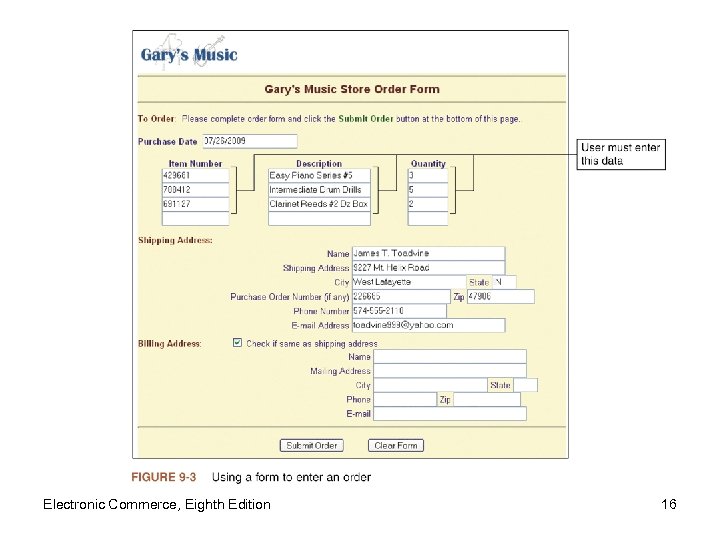 Electronic Commerce, Eighth Edition 16
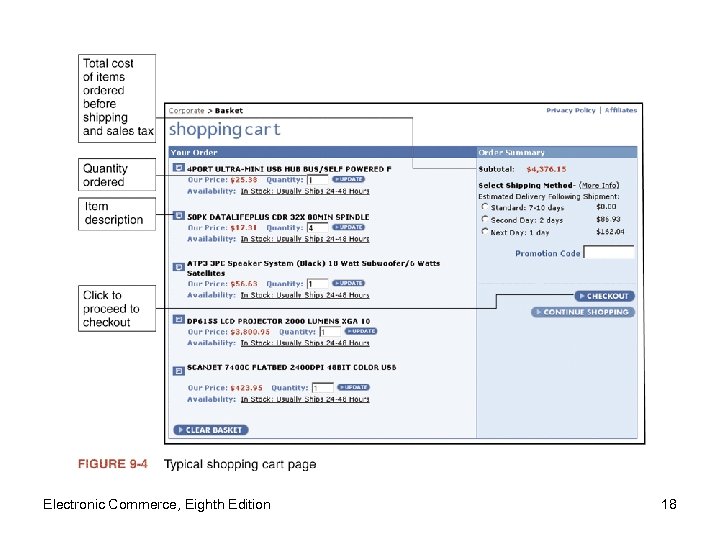
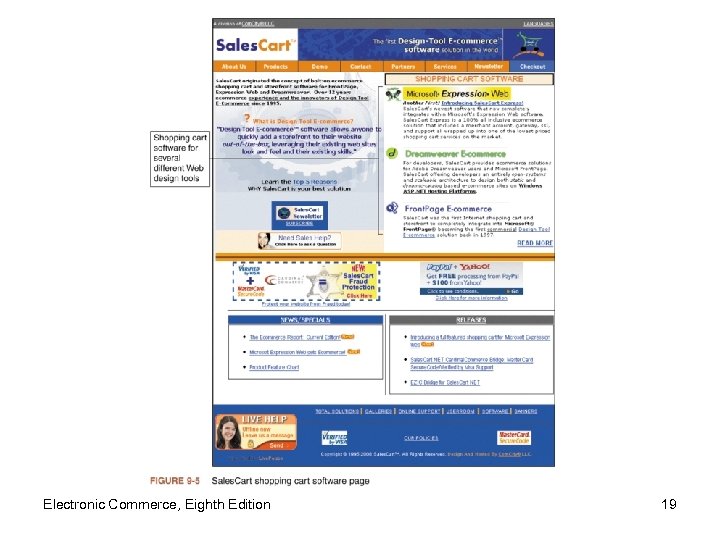
 Shopping Cart (cont’d. ) • Electronic shopping carts – Today: electronic commerce standard – Keep track of items customer selected – Customer may view cart contents, add items, remove items – Figure 9 -4 • Shopping cart software – BIZNET Internet Services, Sales. Cart, Web. Genie Software – Figure 9 -5 Electronic Commerce, Eighth Edition 17
 Electronic Commerce, Eighth Edition 18
 Electronic Commerce, Eighth Edition 19
 Shopping Cart (cont’d. ) • Web is stateless – Unable to remember anything from one session to another – To retrieve shopping cart information later • Information must be stored explicitly • Use cookies – If shopper’s browser does not allow cookie storage • Electronic commerce software automatically assigns temporary number • Example: Shop. Site Electronic Commerce, Eighth Edition 20
 Transaction Processing • Occurs when shopper proceeds to virtual checkout counter – Click checkout button • Electronic commerce software performs necessary calculations • Web browser software and seller’s Web server software switch into secure communication state • Most complex part of online sale – Web server software must communicate with other software running on seller’s other computers Electronic Commerce, Eighth Edition 21
 Transaction Processing (cont’d. ) • Most companies use accounting software package – Record sales and inventory movements • Must compute sales taxes and shipping costs – Software: update tax rates automatically – Fed. Ex and UPS • Offer software integrating with electronic commerce software • Other calculation complications – Coupons, special promotions, time-sensitive offers Electronic Commerce, Eighth Edition 22
 Advanced Functions of Electronic Commerce Software • Large company e-commerce operations – May have substantial business activity • Not related to electronic commerce – Exceptions: Amazon. com and Buy. com • Important – Integrate electronic commerce activities into other operations Electronic Commerce, Eighth Edition 23
 Middleware • Middleware software – Takes sales and inventory shipments information from electronic commerce software – Transmits to accounting and inventory management software (format systems can read) • Sources – Companies can write own middleware – Purchase customized middleware • Interoperability – Making information systems work together – Important goal when installing middleware Electronic Commerce, Eighth Edition 24
 Middleware (cont’d. ) • Middleware costs – Primarily consulting fees to make software work – Range: $50, 000 to several million dollars • Depending on complexity • Major middleware vendors – BEA Systems, Broadvision, Digital River, IBM Tivoli Systems Electronic Commerce, Eighth Edition 25
 Enterprise Application Integration and Databases • Application program (application software, application) – Program performing specific function • Application server (computer) – Takes request messages received by Web server • Runs application program performing action based on request message’s contents • Actions determined by business logic • Business logic – Rules used in the business Electronic Commerce, Eighth Edition 26
 Enterprise Application Integration and Databases (cont’d. ) • Application integration (enterprise application integration) – Creation of links among scattered applications – Interconnects organization’s business logic – Accomplished by programs transferring information • From one application to another – Various program data formats differ • Must edit and reformat data • Increasingly using XML data feeds Electronic Commerce, Eighth Edition 27
 Enterprise Application Integration and Databases (cont’d. ) • Types of application servers – Page-based and component-based systems • Page-based application systems – Return pages generated by scripts containing rules • Present data on Web page with the business logic – Work well for small, midsize Web sites – Examples • • Adobe Cold. Fusion Java. Server Pages (JSP) Microsoft Active Server Pages (ASP) Hypertext Preprocessor (PHP) Electronic Commerce, Eighth Edition 28
 Enterprise Application Integration and Databases (cont’d. ) • Component-based application systems – Separate presentation logic from business logic – Preferred by larger businesses – Logic component created in its own module • Updating, changing system elements much easier – Common Web component-based systems • Enterprise Java. Beans (EJBs) • Microsoft: Component Object Model (COM) • Object Management Group: Common Object Request Broker Architecture (CORBA) Electronic Commerce, Eighth Edition 29
 Enterprise Application Integration and Databases (cont’d. ) • Databases contain business logic information that application servers use • Database manager (software) – Stores information in highly structured way – Database structure allows database manager software to retrieve database information – Smaller electronic commerce sites • Low-cost database (Microsoft Access) – Larger electronic commerce sites • Need power (IBM DB 2, Microsoft SQL Server, Oracle) Electronic Commerce, Eighth Edition 30
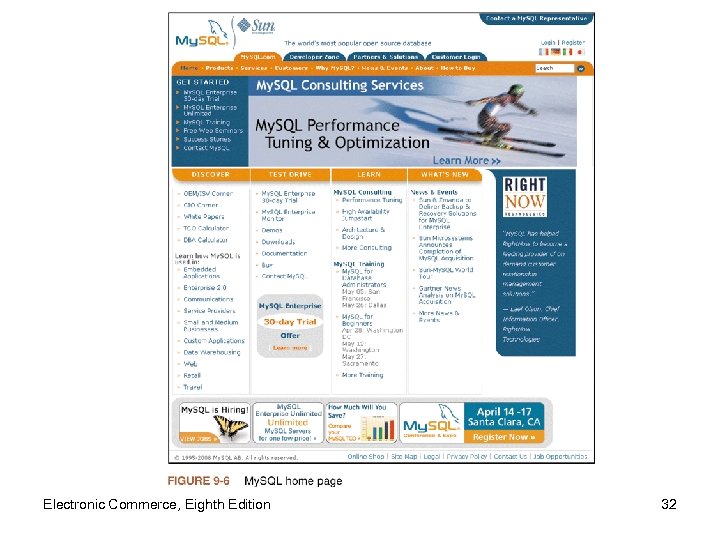
 Enterprise Application Integration and Databases (cont’d. ) • Distributed information systems – Large information systems storing data in many different physical locations • Distributed database systems – Databases within distributed information systems • Complexity leads to high cost • My. SQL database software – Maintained by community of programmers – Open source software: downloadable (free) • Software source code freely available (“open”) – Owned by Sun since 2008 Electronic Commerce, Eighth Edition 31
 Electronic Commerce, Eighth Edition 32
 Web Services • Web services (software tools) – Application software in one organization communicates with other applications • Over a network using specific set of standard protocols (SOAP, UDDI, WSDL) • Web services (another definition) – Self-contained, modular unit of application logic – Provides business functionality to other applications – Through Internet connection Electronic Commerce, Eighth Edition 33
 Web Services (cont’d. ) • What Web services can do – Offer improved customer service, reduced costs – Provide XML data feeds • Flow from one application to another – Provide data feeds between two different companies • Examples – Information portal (J. P. Morgan Chase & Co. ) – Automating communications (Nationwide Building Society) – Generating Web pages (CUNA Mutual Group) Electronic Commerce, Eighth Edition 34
 Web Services (cont’d. ) • How Web services work – Key element • Programmers write software accessing business application logic units without knowing details – Machine-to-machine communication • Allows programs written in different languages on different platforms to communicate, accomplish transaction processing, and perform other business tasks • Originally accomplished with HTML • Implemented with XML today Electronic Commerce, Eighth Edition 35
 Web Services (cont’d. ) • How Web services work (cont’d. ) – First Web services • Information sources • Allowed programmers to incorporate information sources into software applications – More advanced example • Company uses Web services purchasing software to obtain vendor price information • Purchasing agent authorizes purchase using software to submit order, track until shipment received • Vendor's Web services software checks buyer’s credit, contracts with freight company Electronic Commerce, Eighth Edition 36
 Web Services (cont’d. ) • SOAP, WSDL, and UDDI specifications – Simple Object Access Protocol (SOAP) • Message-passing protocol defining how to send marked up data from one software application to another across a network – Full SOAP specification • W 3 C SOAP Page Electronic Commerce, Eighth Edition 37
 Web Services (cont’d. ) • SOAP, WSDL, and UDDI specifications (cont’d. ) – Web Services Description Language (WSDL) • Describes logical units characteristics making up specific Web services – More information • W 3 CWeb Services Activity pages – Universal Description, Discovery, and Integration (UDDI) specification • Set of protocols identifying Web services locations’ associated WSDL descriptions – More information • UDDI Web site Electronic Commerce, Eighth Edition 38
 Web Services (cont’d. ) • SOAP, WSDL, and UDDI specifications (cont’d. ) – Software vendors embracing Web services idea in new technology initiatives • Microsoft. NET • Sun Java 2 Platform, Enterprise Edition – Advantage • Less expensive to implement than older approaches Electronic Commerce, Eighth Edition 39
 Web Services (cont’d. ) • The future of Web services – Web services present a major change in business computing – Historically: • IT industry resisted standards; used programming languages unable to communicate with each other • Large businesses hired armies of programmers – Today: • Web services gaining momentum • Web services are in 25 percent of current data integration projects Electronic Commerce, Eighth Edition 40
 Web Services (cont’d. ) • The future of Web services (cont’d. ) – Potential pitfalls • Many variations of XML; data partners must agree • Software applications becoming dependent on Web services; must include reliable quality of service, service-level agreements • Still developing management standards; subscriber needs detailed agreement – Successful implementation: MSN Money • Com. Stock Web services acknowledgment on page Electronic Commerce, Eighth Edition 41
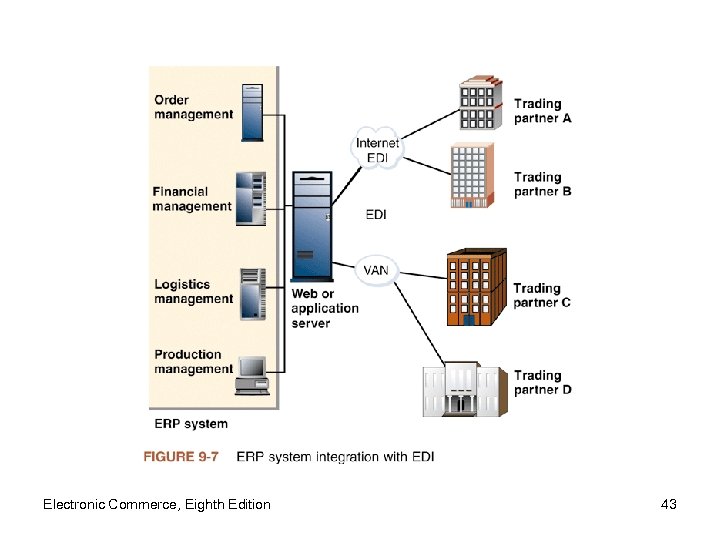
 Integration with ERP Systems • B 2 B interactions occur within large firms – Complex systems require security tools • Encryption and authentication • Enterprise resource planning (ERP) software packages – Business systems integrating all business facets • Accounting, logistics, manufacturing, marketing, planning, project management, treasury functions • Two major ERP vendors – Oracle and SAP – Costs: between $2 million and $25 million Electronic Commerce, Eighth Edition 42
 Electronic Commerce, Eighth Edition 43
 Electronic Commerce Software for Small and Midsize Companies • Small and medium-sized businesses – Software to implement online business Web sites • Web site – Stands alone in its business activities – Does not coordinate completely with business’ other activities Electronic Commerce, Eighth Edition 44
 Basic Commerce Service Providers • Service provider’s shared or dedicated hosting services – Staffing burden shifts from company to Web host • CSPs hosting services – Same advantages as ISPs – Large Web site cost spread over several “renters” – Low cost • Host provider purchased and configured the server • Host provider keeps server working through storms and power outages Electronic Commerce, Eighth Edition 45
 Basic Commerce Service Providers (cont’d. ) • CSPs offer free or low-cost e-commerce software – – Electronic commerce sites kept on CSP’s server Software built into CSP’s site Cost: $20 per month Designed for small online businesses • Selling few items (no more than 50) • Relatively low transaction volumes (fewer than 20 transactions per day) Electronic Commerce, Eighth Edition 46
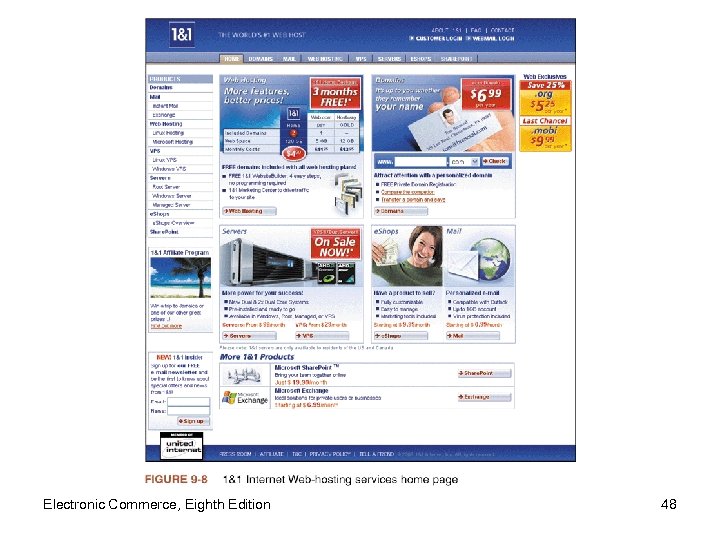
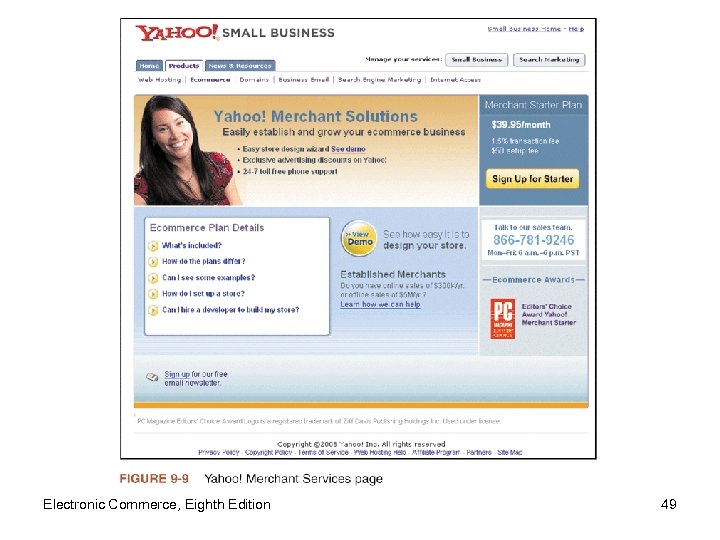
 Basic Commerce Service Providers (cont’d. ) • CSP example: Value. Web – Offers comprehensive e-commerce hosting services • Shared hosting, dedicated hosting, co-location services • CSP example: Pro. Hosting. com and 1&1 Internet – Serving small, midsize company market – Figure 9 -8 • CSP example: Yahoo! Merchant Solutions – Figure 9 -9 Electronic Commerce, Eighth Edition 47
 Electronic Commerce, Eighth Edition 48
 Electronic Commerce, Eighth Edition 49
 Mall-Style Commerce Service Providers • Mall-style CSPs services – – Internet connection Web site creation tools Little or no banner advertising clutter Costs • Low monthly fee • One-time setup fees • Percentage of (or fixed) amount for each transaction – Online store design tools, storefront templates, easyto-use interface, Web page-generation capabilities, page maintenance Electronic Commerce, Eighth Edition 50
 Mall-Style Commerce Service Providers (cont’d. ) • Mall-style CSPs services (cont’d. ) – Shopping cart software (or ability to use another vendor’s shopping cart software) – Payment processing services • Allows online store to accept credit cards • Main mall-style CSP: e. Bay stores – Cost: less than $20 per month – Small merchant has its own store Electronic Commerce, Eighth Edition 51
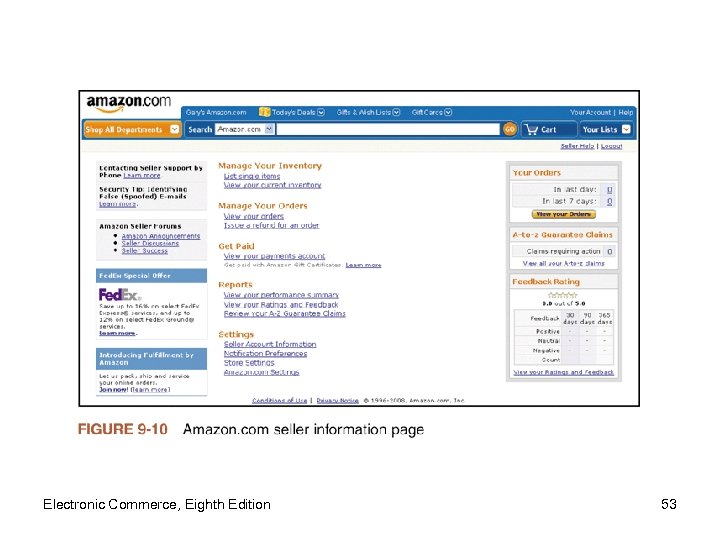
 Mall-Style Commerce Service Providers (cont’d. ) • Another example – Online merchant selling through Amazon. com – Sells used items on same page that Amazon. com lists new products – Merchants display offerings product by product – Amazon offers a Pro Merchant program – Figure 9 -10 Electronic Commerce, Eighth Edition 52
 Electronic Commerce, Eighth Edition 53
 Mall-Style Commerce Service Providers (cont’d. ) • Basic and mall-style CSPs – Provide data-mining capabilities – Search through site data collected in log files – Data mining • Looks for hidden patterns in data • Businesses find customers with common interests • Discover previously unknown relationships among data – Reports indicate: • Problematic pages in store’s design • Number of pages average customer must load and display before locating desired merchandise Electronic Commerce, Eighth Edition 54
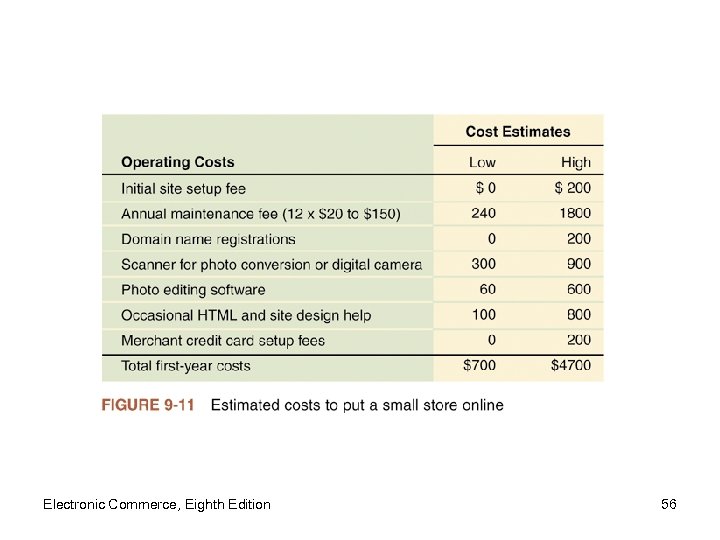
 Estimated Operating Expenses for a Small Web Business • Small business owner Web store – Use either basic CSP or mall-style CSP – First-year expenses estimate • See Figure 9 -11 • Total omits payment processing charge • Actual costs: somewhat lower or considerably higher Electronic Commerce, Eighth Edition 55
 Electronic Commerce, Eighth Edition 56
 Estimated Operating Expenses for a Small Web Business (cont’d. ) • Self-hosting a Web site – Comparable first year estimated costs • Setup and Web site maintenance ($3000 to $20, 000, one time) • High-bandwidth Internet connection ($1200 to $12, 000 per year) • Secure a small server room ($5000 a year) • Technicians to monitor and maintain equipment ($50, 000 to $100, 000 annually) • Total costs ($60, 000 to $100, 000) • Subsequent years: costs about the same Electronic Commerce, Eighth Edition 57
 Estimated Operating Expenses for a Small Web Business (cont’d. ) • Costs of larger sites: more difficult to estimate – Largest element • Integrating Web site with existing systems – Midsize businesses: start-up costs • $100, 000 to $500, 000 • Recurring annual costs of about half that amount – Large businesses: start-up costs • Recurring yearly costs: another 50 percent of the launch (operate, maintain, improve site) Electronic Commerce, Eighth Edition 58
 Electronic Commerce Software for Midsize to Large Businesses • Midrange electronic commerce software products – Provide merchant control • Merchandising choices, site layout, internal architecture, remote and local management options – Differences • Price, capability, database connectivity, software portability, software customization tools, computer expertise required Electronic Commerce, Eighth Edition 59
 Web Site Development Tools • Adobe Dreamweaver – Includes integrated development environment – Creates elements of dynamic Web pages as easily as static Web pages • Microsoft Expression Web – Builds framework of functional midrange electronic commerce site • After Web site creation – Add purchased software elements • Shopping carts, content management software Electronic Commerce, Eighth Edition 60
 Web Site Development Tools (cont’d. ) • Intershop Enfinity provides: – – – – Search and catalog capabilities Electronic shopping carts Online credit card transaction processing Ability to connect to existing back-end business systems and databases Setup wizards Good catalog and data management tools Built-in storefront templates Management and editing of a storefront • Through Web browser (local or remote) Electronic Commerce, Eighth Edition 61
 Web Site Development Tools (cont’d. ) • Intershop Enfinity provides: (cont’d. ) – Product inventory management module • Tracks inventory levels, shows available item quantity • Creates inventory transactions lists • Enters new products into inventory – Discount rules easy to enter – Database management system bundled • Alternative databases: IBM DB 2 or Oracle databases – Includes automated e-mail facility – Support for secure transactions – Site and customer reports available Electronic Commerce, Eighth Edition 62
 Web Site Development Tools (cont’d. ) • IBM Web. Sphere Commerce Professional Edition – Set of software components • Suitable for midsize to large businesses • Selling goods and services on the Internet – Includes: • Catalog templates, setup wizards, advanced catalog tools to create attractive and efficient sites – Useful for B 2 B and B 2 C applications – Smooth connection to existing corporate systems • Inventory databases, procurement Electronic Commerce, Eighth Edition 63
 Web Site Development Tools (cont’d. ) • IBM Web. Sphere Commerce Professional Edition (cont’d. ) – Runs on many different operating systems – Wizard used to create starter store • Can add more functionality – Large collection of functions, utility programs, commands • Create customized online store experience • Java. Script, Java, C++ expertise required – Connects to existing databases, other legacy systems – Administer several stores through one interface Electronic Commerce, Eighth Edition 64
 Web Site Development Tools (cont’d. ) • IBM Web. Sphere Commerce Professional Edition (cont’d. ) – Standard electronic commerce features • • Tools for a shopping cart E-mail notifications upon sale completion Secure transaction support Promotions and discounting Shipment tracking Links to legacy accounting systems Browser-based local and remote administration – Costs ($20, 000 to $200, 000) Electronic Commerce, Eighth Edition 65
 Web Site Development Tools (cont’d. ) • Microsoft Commerce Server 2007 – Tools included for: • • User profiling and management Transaction processing Product and service management Target audience marketing – Wizards help users build site in several steps – Not an out-of-the box solution • Program code must be written for specific user needs – Microsoft Visual Studio. NET tools bundled • Allows site customization Electronic Commerce, Eighth Edition 66
 Web Site Development Tools (cont’d. ) • Microsoft Commerce Server 2007 (cont’d. ) – Customer-oriented tools help: • Engage customer (marketing and advertising) • Complete order • Analyze sales information (after the sale) – Includes: • Predefined reports: analyzing site activities, product sales data • Storefront templates • Wizards for setting up, initializing store • Ability for database connections • Shopping cart Electronic Commerce, Eighth Edition 67
 Web Site Development Tools (cont’d. ) • Microsoft Commerce Server 2007 (cont’d. ) – Includes: (cont’d. ) • • E-mail confirmation for completed sales transactions Ability to support secure transactions Ability to connect to existing accounting systems Site administration through Web browser – Runs on Windows Server operating system and SQL Server database system – Costs: ($7000 to $20, 000 per processor) • Usually between $20, 000 and $150, 000 Electronic Commerce, Eighth Edition 68
 Electronic Commerce Software for Large Businesses • Larger businesses need: – Same advanced capabilities as midsize firms – To handle higher transaction loads – Dedicated software applications • To handle specific elements of their online business • Distinction between midrange and large-scale electronic commerce software – Price – Extensive support for business-to-business commerce Electronic Commerce, Eighth Edition 69
 Electronic Commerce Software for Large Businesses (cont’d. ) • Enterprise-class software – Commerce software for large systems • Enterprise – Describes system serving multiple locations of one company – Encompasses all areas of the business • Software provides tools for B 2 B and B 2 C commerce • Interacts with wide variety of existing systems – Database, accounting, ERP • Costs: $100, 000 to $10 million Electronic Commerce, Eighth Edition 70
 Enterprise-Class Electronic Commerce Software • Requires several dedicated computers, Web server system, and firewalls • Enterprise-class products – IBM Web. Sphere Commerce Enterprise, Oracle EBusiness Suite, products from Broadvision • Provides tools for linking to and supporting supply, purchasing activities Electronic Commerce, Eighth Edition 71
 Enterprise-Class Electronic Commerce Software (cont’d. ) • Provides standard electronic commerce activities – – – Secure transaction processing and fulfillment Interaction with firm’s inventory system Making proper stock adjustment Issuing purchase orders for needed supplies Generating other accounting entries Placing orders explicitly Electronic Commerce, Eighth Edition 72
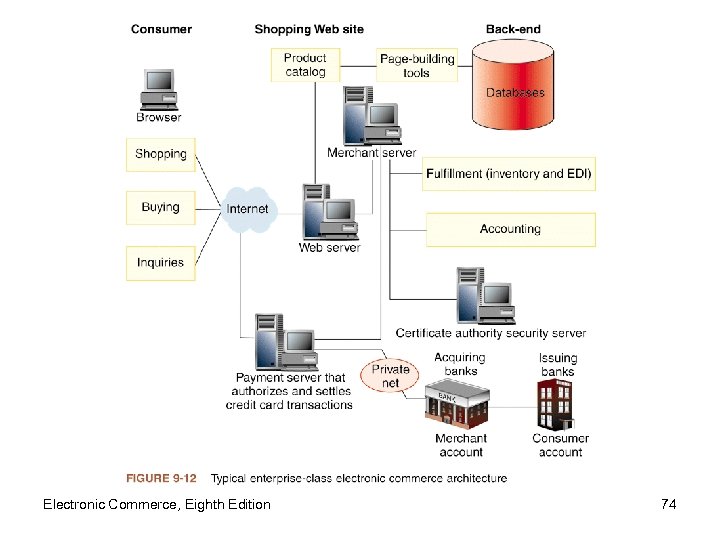
 Enterprise-Class Electronic Commerce Software (cont’d. ) • Enterprise-class electronic commerce architecture – Customers use Web browsers • Locate and browse company’s catalog – Electronic goods: download directly or complete order forms – Web server linked to back-end systems • Database management system, merchant server, application server • Purchasing history: way to provide customer recommendations – Merchant server houses e-business system, key back -end software Electronic Commerce, Eighth Edition 73
 Electronic Commerce, Eighth Edition 74
 Enterprise-Class Electronic Commerce Software (cont’d. ) • Additional specialized software – Accomplishes particular objectives – Example: deliver entertainment (music or videos) directly to consumers’ mobile devices • Use Open. Market software product – Customer relationship management software – Supply chain management software – Software automatically managing and rotating Web Site content – Knowledge management software Electronic Commerce, Eighth Edition 75
 Customer Relationship Management Software • Goal – Understand each customer’s specific needs – Customize product or service to meet those needs • Idea – Customer whose needs met exactly • Willing to pay more for goods or services • Customer relationship management (CRM) software – Obtains data from operations software – Gathers data about customer activities – Uses data to conduct analytical activities Electronic Commerce, Eighth Edition 76
 Customer Relationship Management Software (cont’d. ) • Basic CRM – Uses customer information to sell more goods or services • Advanced CRM – Delivers extremely attractive, positive customer experiences • CRM business importance – Maintaining customer loyalty – Maintaining positive, consistent contacts at the purchasing company Electronic Commerce, Eighth Edition 77
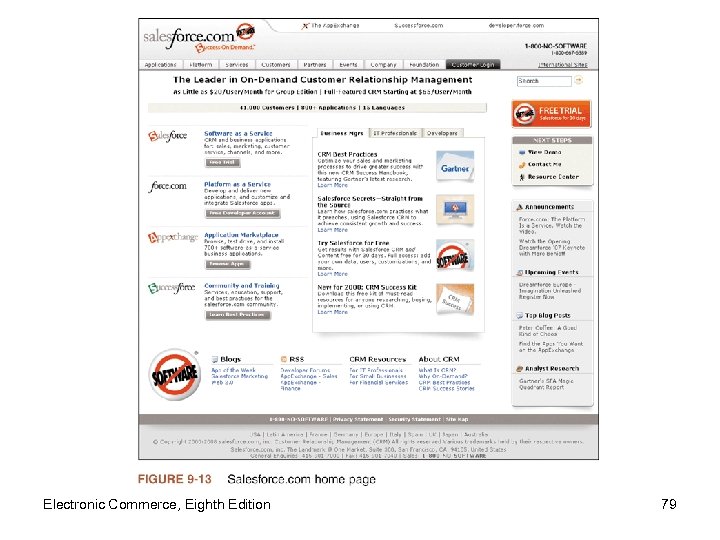
 Customer Relationship Management Software (cont’d. ) • CRM software source – Companies create their own • May use outside consultants and own IT staffs – Most companies likely to buy CRM software package – Oracle Siebel CRM Applications • Leading CRM software provider – SAP CRM: another vendor – Costs: $25, 000 to millions of dollars • New developments in CRM software market – Companies offering software for use on their Web site – Example: Salesforce. com Electronic Commerce, Eighth Edition 78
 Electronic Commerce, Eighth Edition 79
 Customer Relationship Management Software (cont’d. ) • 1996 to 2000 – Early days of CRM software implementation – Tool for changing overall customer strategy – Millions of dollars; bad experience • 2000 through 2003 – CRM software sales dropped • Since 2003 – CRM software sales resuming upward trend – CRM used to solve smaller, more specific problems – Popular target: call center operations Electronic Commerce, Eighth Edition 80
 Supply Chain Management Software • Companies coordinate planning and operations: – With industry supply chains partners • Two general function types: planning and execution • SCM planning software – Develops coordinated demand forecasts • Information from each participant in supply chain • SCM execution software – Tasks: warehouse and transportation management Electronic Commerce, Eighth Edition 81
 Supply Chain Management Software (cont’d. ) • Two major firms offering SCM software – i 2 Technologies and JDA Software • i 2 Technologies product: RHYTHM – Components managing demand planning, supply planning, demand fulfillment • Most supply chain management software – Developed for manufacturing firms • Manage inventory purchases, manufacturing processes • JDA Software – Successful line of software products for managing retail order entry and sales side of inventory control Electronic Commerce, Eighth Edition 82
 Supply Chain Management Software (cont’d. ) • JDA Software (cont’d. ) – 2006: JDA Software purchased Manugistics – Now JDA Software • Manages every operation in the supply chain • Cost of SCM software implementations – Varies tremendously • Depends on number of locations in the supply chain – Example: retailer with 500 stores • Pay between $3 million and $10 million Electronic Commerce, Eighth Edition 83
 Content Management Software • Content management software – Controls large amounts of text, graphics, media files • Rise of wireless devices – Content management even more important • Businesses customize Web pages • Content management software – Test before committing • Ensure straightforward software procedures for performing regular maintenance • Software should facilitate typical content creation tasks Electronic Commerce, Eighth Edition 84
 Content Management Software (cont’d. ) • Companies providing content management software – As components in other enterprise software packages • IBM and Oracle • Companies providing stand-alone content management software – EMC and Open Text Corporation • Software costs – Between $100, 000 and $500, 000 • Customization, configuration, implementation costs – Three or four times the cost of software Electronic Commerce, Eighth Edition 85
 Knowledge Management Software • Systems that help manage knowledge itself – Rather than documentary representations of that knowledge • Four main things – – Collect and organize information Share information among users Enhance ability of users to collaborate Preserve knowledge gained through information use • For future users benefit Electronic Commerce, Eighth Edition 86
 Knowledge Management Software (cont’d. ) • Includes tools to read: – Electronic documents, scanned paper documents, email messages, Web pages • Includes powerful search tools – Use proprietary semantic, statistical algorithms • Collects knowledge elements by extracting them from normal interactions users have with information • Major software vendors: IBM, Microsoft Share. Point, BMC Software, Customer. Vision • Costs: $10, 000 to $1 million or more Electronic Commerce, Eighth Edition 87
 Summary • Small, midsize, large businesses – Electronic commerce • Software functions, selection decisions • Host provider considerations • Key elements of electronic commerce software • Web services implementation – Basic CSP and mall-style hosting services – Electronic commerce software packages • Special needs of midsize and larger business Electronic Commerce, Eighth Edition 88