 Скачать презентацию Electronic Commerce Eighth Edition Chapter 5 Business-To-Business Online
f6a646aadb1a5beee90fccd0766134e6.ppt
- Количество слайдов: 66



Electronic Commerce Eighth Edition Chapter 5 Business-To-Business Online Strategies
Learning Objectives In this chapter, you will learn about: • Strategies that businesses use to improve purchasing, logistics, and other support activities • Electronic data interchange and how it works • How businesses have moved some of their electronic data interchange operations to the Internet Electronic Commerce, Eighth Edition 2
Learning Objectives (cont’d. ) • Supply chain management and how businesses are using Internet technologies to improve it • Electronic marketplaces and portals that make purchase-sale negotiations easier and more efficient Electronic Commerce, Eighth Edition 3
Purchasing, Logistics, and Support Activities • Electronic commerce – Improves primary and support activities – Tremendous potential for: • Cost reductions, business process improvements • e-government – Collective set of electronic commerce activities • Improving government support activities • Supporting activities and serving stakeholders better • Potential for synergies increase with Internet technologies use • Necessary characteristic: flexibility Electronic Commerce, Eighth Edition 4
Purchasing Activities • Supply chain – Part of industry value chain preceding a particular strategic business unit – Includes all activities undertaken by every predecessor in the value chain to: • Design, produce, promote, market, deliver, support each individual component of a product or service • Traditionally – Purchasing Department charged with buying components at lowest price possible – Process focused excessively on individual components’ cost: ignored total supply chain costs Electronic Commerce, Eighth Edition 5
Purchasing Activities (cont’d. ) • Procurement includes: – All purchasing activities – Monitoring all elements in purchase transactions • Supply management – Describes procurement activities • Procurement staff – Require product knowledge • Identify and evaluate appropriate suppliers • Sourcing – Procurement activity • Identifying suppliers, determining qualifications Electronic Commerce, Eighth Edition 6
Purchasing Activities (cont’d. ) • e-sourcing – Use of Internet technologies in sourcing activities • Specialized Web-purchasing sites • Figure 5 -1 – Typical business purchasing process steps • Many steps and people involved – Spend • Total goods and services dollar amount company buys during a year • Institute for Supply Management (ISM) – Main organization for procurement professionals Electronic Commerce, Eighth Edition 7
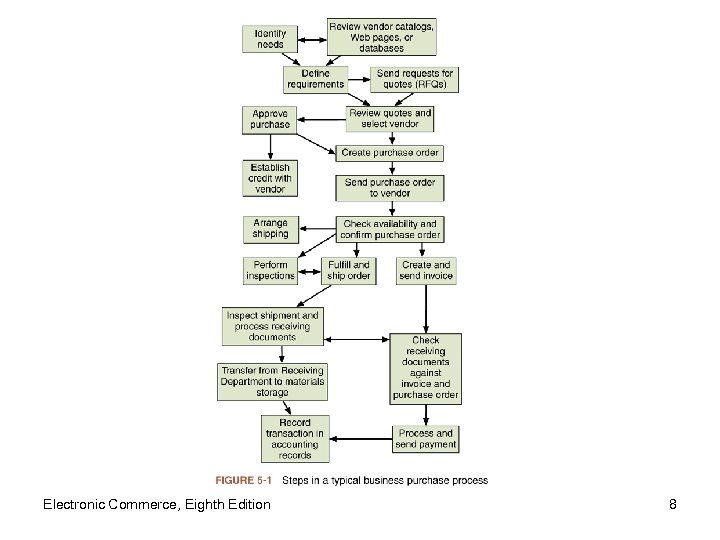
Electronic Commerce, Eighth Edition 8
Direct vs. Indirect Materials Purchasing • Direct materials – Materials that become part of finished product • Direct materials purchasing: two types – Replenishment purchasing (contract purchasing) • Company negotiates long-term material contracts – Spot purchasing • Purchases made in loosely organized market (spot market) • Indirect materials – All other materials company purchases Electronic Commerce, Eighth Edition 9
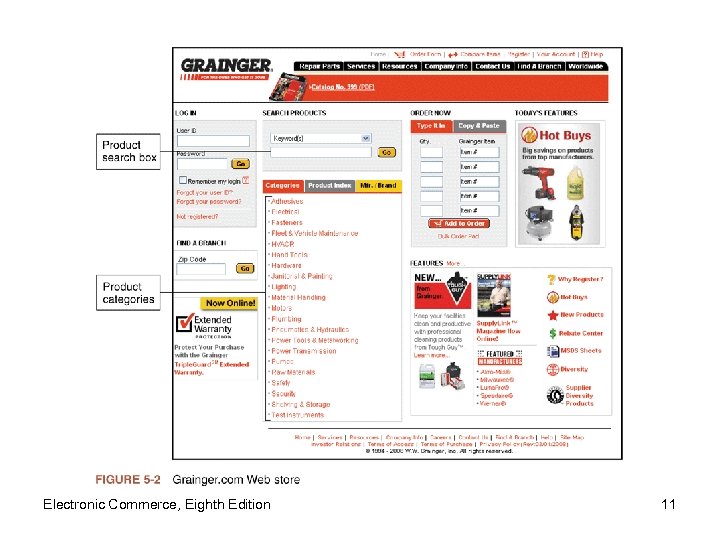
Direct vs. Indirect Materials Purchasing (cont’d. ) • Maintenance, repair, and operating (MRO) supplies – Indirect material products purchased on a recurring basis – Standard items (commodities) buyers usually select • Price: main criterion • Purchasing cards (p-cards) – Give individual managers ability to make multiple small purchases at their discretion – Provide cost-tracking information to procurement • MRO suppliers: Mc. Master-Carr, W. W. Grainger Electronic Commerce, Eighth Edition 10
Electronic Commerce, Eighth Edition 11
Logistics Activities • Provide the right goods in the right quantities in the right place at the right time • Important support activity for sales and purchasing – Inbound materials and supplies movements – Outbound finished goods and services movements • Example: Schneider Track and Trace system – Real-time shipment information: customers’ browsers • Third-party logistics (3 PL) provider – Operates all (large portion) of customer’s materials movement activities • Examples: Ryder and Whirlpool, Fed. Ex, UPS Electronic Commerce, Eighth Edition 12
Support Activities • General categories – Finance and administration, human resources, technology development – Example: Allegiance and A. D. A. M. Web site • Training – Common support activity • Underlies multiple primary activities – Advantages: training materials on company intranet • Distribute materials to many different sales offices • Coordinate use of materials in corporate headquarters Electronic Commerce, Eighth Edition 13
Support Activities (cont’d. ) • Examples: Ericson, Broad. Vision’s K-Net • Knowledge management – Intentional collection, classification, dissemination of information • About a company, its products, and its processes Electronic Commerce, Eighth Edition 14
E-Government • e-government – Use of electronic commerce by governments and government agencies • Perform functions for stakeholders • Operate businesslike activities • Examples in U. S. government – Financial Management Service (FMS) • Pay. gov Web site – Department of Homeland Security (DHS) • Internet technology use initiatives Electronic Commerce, Eighth Edition 15
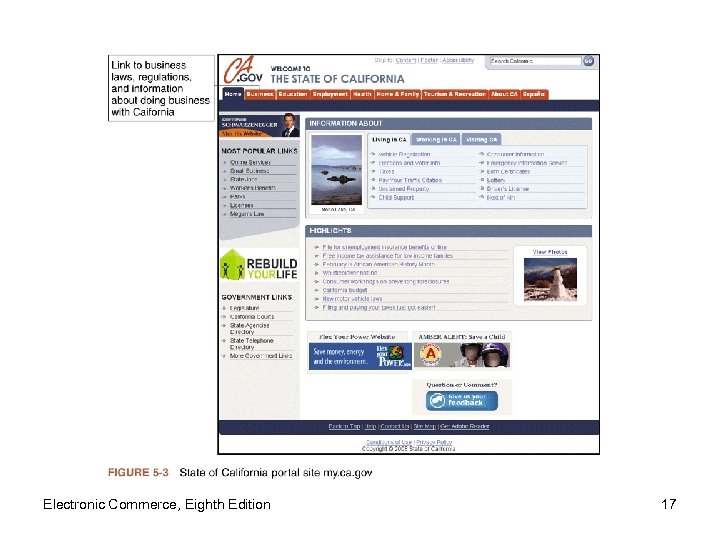
E-Government (cont’d. ) • Examples in other countries – United Kingdom • Department for Work and Pensions Web site – Singapore’s SINGOV site • Examples in state government – California’s one-stop portal site (my. ca. gov) – New York State Citizen Guide site • Examples in local government – Large cities: Minneapolis, New Orleans – New York City (My. NYC. gov) Electronic Commerce, Eighth Edition 16
Electronic Commerce, Eighth Edition 17
Network Model of Economic Organization • Trend in purchasing, logistics, and support activities – Shift from hierarchical structures • Toward network structures – Procurement Departments’ new tools (technology) • To negotiate with suppliers • Including possibility of forming strategic alliances • Network model of economic organization – Other firms perform various support activities • Manage payroll, administer employee benefits plans, handle document storage needs – Web: enabling shift from hierarchical to network Electronic Commerce, Eighth Edition 18
Electronic Data Interchange • Trading partners – Two businesses exchanging information • EDI compatible – Firms that exchange data in specific standard formats • EDI importance – Most B 2 B electronic commerce • An adaptation of EDI or based on EDI principles – Still the method used for most electronic B 2 B transactions Electronic Commerce, Eighth Edition 19
Early Business Information Interchange Efforts • 1800 s and early 1900 s – Need to create formal business transactions records • 1950 s – Computers store, process internal transaction records – Information flows printed on paper • 1960 s: large volume transactions – Exchanged on punched cards or magnetic tape • 1960 s and 1970 s – Transferred data over telephone lines • All efforts increased efficiency and reduced errors Electronic Commerce, Eighth Edition 20
Early Business Information Interchange Efforts (cont’d. ) • These information transfer agreements were not the ideal solution – Data translation programs incompatible • 1968: freight, shipping companies joined together – Transportation Data Coordinating Committee (TDCC) • Created standardized information set • Allowed electronic computer file transmission to any freight company adopting TDCC format • Benefits limited to members of industries that created standard-setting groups – Full realization of EDI • Required standards used by companies in all industries Electronic Commerce, Eighth Edition 21
Emergence of Broader EDI Standards • The American National Standards Institute (ANSI) – United States coordinating body for standards • 1979 – Accredited Standards Committee X 12 (ASC X 12) • Develop and maintain EDI standards – Data Interchange Standards Association (DISA) • Administrative body coordinating ASC X 12 activities • 1987: International standards – Administration, Commerce, and Transport (EDIFACT, UN/EDIFACT) Electronic Commerce, Eighth Edition 22
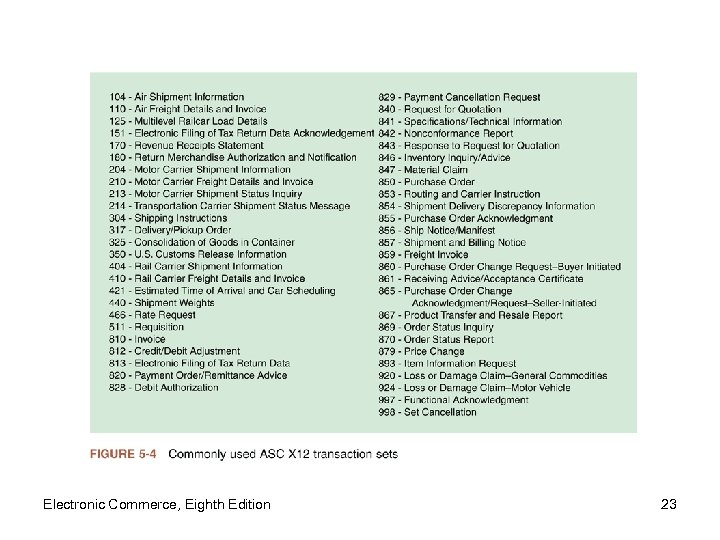
Electronic Commerce, Eighth Edition 23
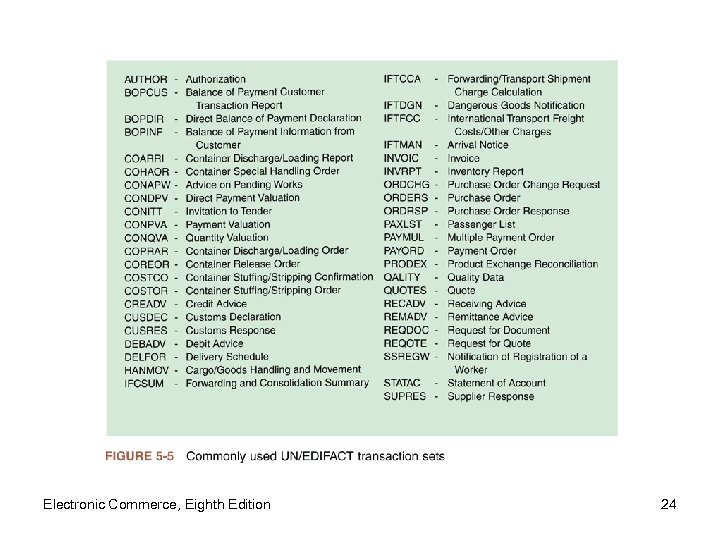
Electronic Commerce, Eighth Edition 24
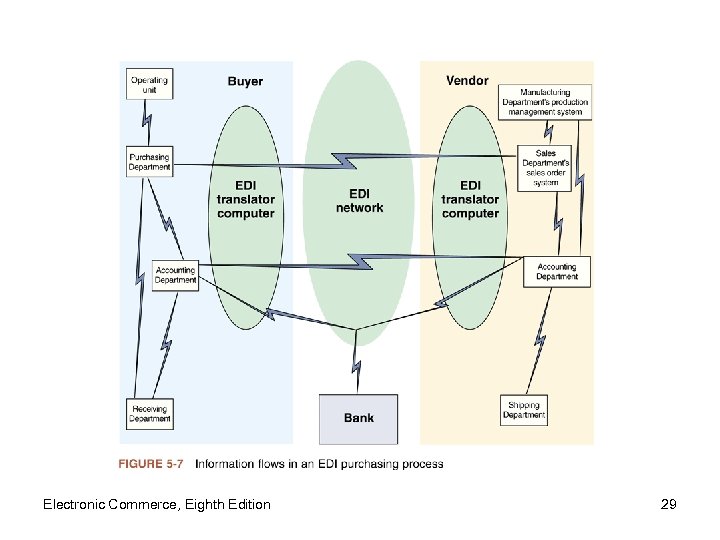
How EDI Works • Basic idea: straightforward • Implementation: complicated • Example: company to replace metal-cutting machine – Assume vendor uses its own vehicles instead to deliver purchased machine – Steps to purchase using paper-based system • Figure 5 -6 – Steps to purchase using EDI • Figure 5 -7 Electronic Commerce, Eighth Edition 25
How EDI Works (cont’d. ) • Paper-based purchasing process – Buyer and vendor • Not using integrated software for business processes – Each information processing step results in paper document • Must be delivered to department handling next step – Paper-based information transfer • Mail, courier, or fax – Figure 5 -6 • Information flows Electronic Commerce, Eighth Edition 26
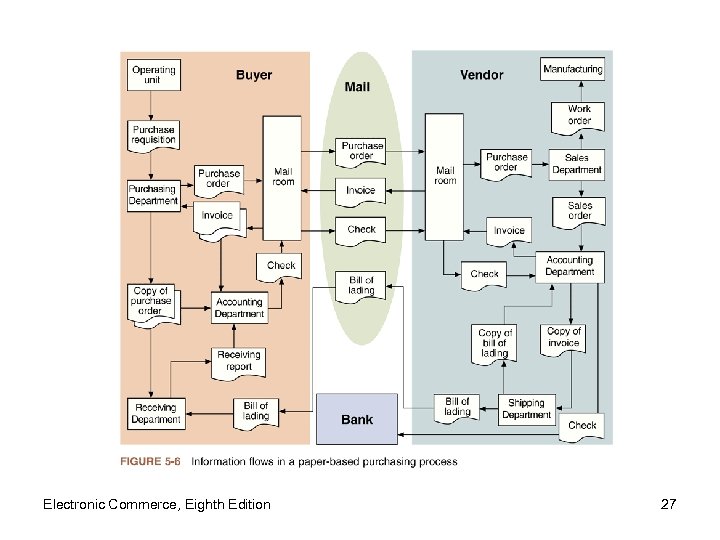
Electronic Commerce, Eighth Edition 27
How EDI Works (cont’d. ) • EDI purchasing process – Mail service replaced with EDI network data communications – Flows of paper within the buyer’s and vendor’s organizations replaced with computers • Running EDI translation software – Figure 5 -7 • Information flows Electronic Commerce, Eighth Edition 28
Electronic Commerce, Eighth Edition 29
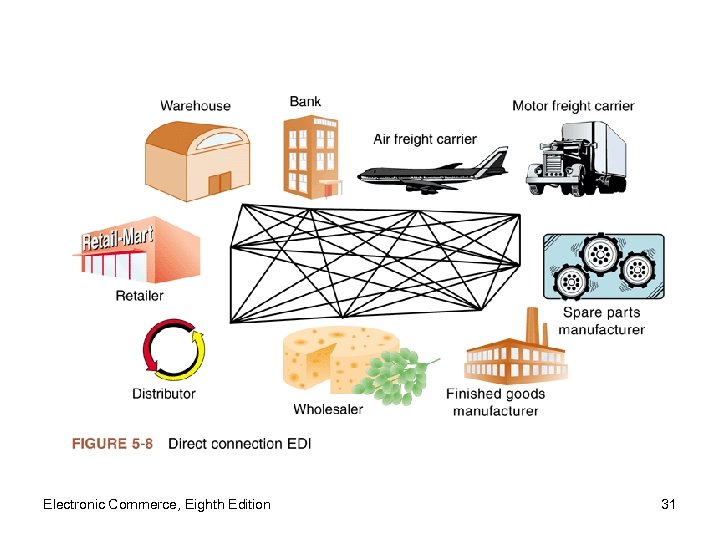
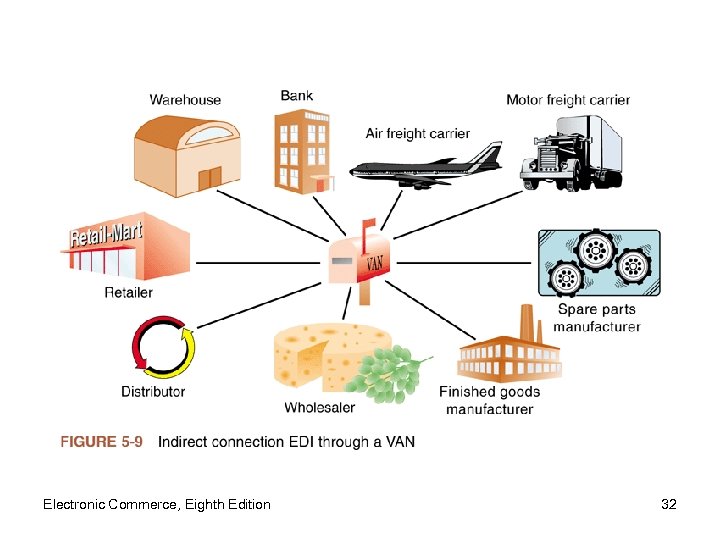
Value-Added Networks • EDI network key elements – EDI network, two EDI translator computers • Direct connection EDI – Each business operates an on-site EDI translator computer • Value-added network (VAN) – Receives, stores, forwards electronic messages containing EDI transaction sets • Indirect connection EDI – Trading partners use VAN to retrieve EDI-formatted messages Electronic Commerce, Eighth Edition 30
Electronic Commerce, Eighth Edition 31
Electronic Commerce, Eighth Edition 32
Value-Added Networks (cont’d. ) • Advantages – Support one communications protocol (VAN) – VAN records message activity in audit log (independent record of transactions) – VAN provides translation between different transaction sets – VAN performs automatic compliance checking • Disadvantages – Cost (fees) – Cumbersome, expensive (if using different VANs) Electronic Commerce, Eighth Edition 33
EDI Payments • Transaction sets provide instructions to trading partner’s bank – Negotiable instruments • Electronic equivalent of checks • Electronic funds transfers (EFTs) – Movement of money from one bank account to another • Automated clearing house (ACH) system – Service banks use to manage accounts • Operated by U. S. Federal Reserve Banks or private ACHs Electronic Commerce, Eighth Edition 34
EDI on the Internet • Potential replacement of: – Expensive leased lines, dial-up connections • Required to support direct and VAN-aided EDI • Initial roadblock concerns – Security – Internet’s inability to provide audit logs and third-party verification of message transmission and delivery • TCP/IP structure was enhanced with secure protocols and encryption schemes • Lack of third-party verification concerns continued Electronic Commerce, Eighth Edition 35
EDI on the Internet (cont’d. ) • Nonrepudiation – Ability to establish that a particular transaction actually occurred – Prevents either party from repudiating (denying) the transaction’s validity or existence – Previously provided by: • VAN’s audit logs (indirect connection EDI) • Comparison of trading partners’ message logs (direct connection EDI) Electronic Commerce, Eighth Edition 36
Open Architecture of the Internet • Internet EDI (Web EDI) – EDI on the Internet – Also called open EDI • Internet is an open architecture network – EDI offerings go beyond traditional EDI • Allow more complex information interchanges – Growing rapidly • Not replacing traditional EDI – Large companies have significant investments in traditional EDI computing infrastructure – Most VANs offer Internet EDI services, traditional EDI Electronic Commerce, Eighth Edition 37
Open Architecture of the Internet (cont’d. ) • More flexible exchange of information – Accomplished with new tools (XML) – ASC X 12 task group • Convert ASC X 12 EDI data elements and transaction set structures to XML • Context Inspired Component Architecture (CICA) – – Set of standards for assembling business messages Provides predictable structure for message content Provides more flexibility than EDI transaction sets Basis for future development of electronic business message standards using XML Electronic Commerce, Eighth Edition 38
Open Architecture of the Internet (cont’d. ) • Firms extending internal networks (intranets) to trading partners – Turns intranets into extranets – Virtual private networks (VPNs) provide security – Example: Nintendo USA • EDI-based product registration system to prevent fraudulent returns • Huge investment in EDI systems, trained personnel – Reluctant to change business processes, move to Internet EDI, approaches based on XML technologies • Move away from EDI will gradually occur Electronic Commerce, Eighth Edition 39
Supply Chain Management Using Internet Technologies • Supply chain management – Job of managing integration of company supply management and logistics activities • Across multiple participants in a particular product’s supply chain – Ultimate goal • Achieve higher-quality or lower-cost product at the end of the chain Electronic Commerce, Eighth Edition 40
Value Creation in the Supply Chain • Firms engaging in supply chain management – Reaching beyond limits of their own organization’s hierarchical structure – Creating new network • Form of organization among members of supply chain • Originally a way to reduce costs • Today, value added in the form of benefits to the ultimate consumer – Requires more holistic view of the entire supply chain Electronic Commerce, Eighth Edition 41
Value Creation in the Supply Chain (cont’d. ) • Tier-one suppliers – Very capable suppliers, a small number of which a firm establishes long-term relationships with • Tier-two suppliers – Larger number of suppliers that tier-one suppliers develop long-term relationships with • Provide components and raw materials • Tier-three suppliers – Next level of suppliers • Trust is a key element Electronic Commerce, Eighth Edition 42
Value Creation in the Supply Chain (cont’d. ) • Supply alliances – Long-term relationships among participants in the supply chain – Major barrier • Level of information sharing • Example: Dell Computer – Reduced supply chain costs by sharing information with suppliers • Buyers expect annual price reductions, quality improvements Electronic Commerce, Eighth Edition 43
Value Creation in the Supply Chain (cont’d. ) • Marshall Fisher 1997 Harvard Business Review article – Two types of organization goals • Efficient process goals • Market-responsive flexibility goals • Successful supply chain management key elements – Clear communications – Quick responses to those communications • Internet and Web technologies – Effective communications enhancers Electronic Commerce, Eighth Edition 44
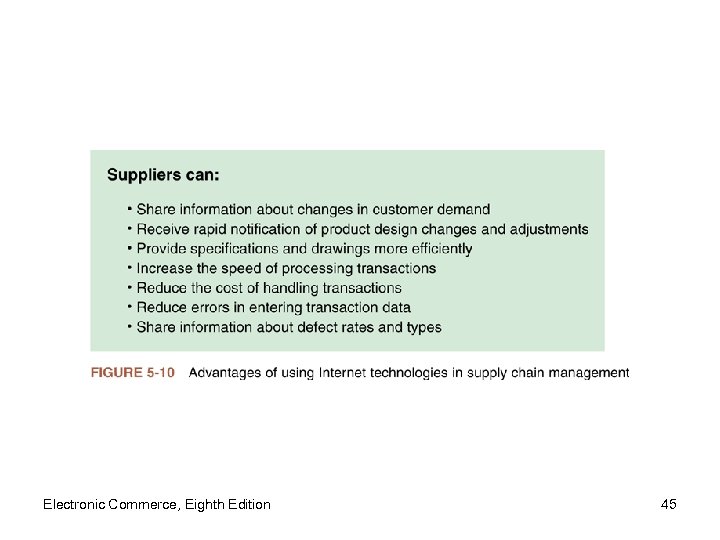
Electronic Commerce, Eighth Edition 45
Increasing Supply Chain Efficiencies • Internet and Web technologies used to manage supply chains – Yield increases in efficiency throughout the chain – Increase process speed, reduce costs, increase manufacturing flexibility • Respond to changes in quantity and nature of ultimate consumer demand • Example: Boeing – Invested in new information systems • Increase production efficiency – Launched spare parts Web site Electronic Commerce, Eighth Edition 46
Increasing Supply Chain Efficiencies (cont’d. ) • Example: Dell Computer – Famous for use of Web to sell custom-configured computers – Also used technology-enabled supply chain management • Give customers exactly what they want • Reduced inventory amount (three weeks to two hours) – Top suppliers have access to secure Web site • Know Dell’s customers and what they are buying • Tier-one suppliers better plan their production Electronic Commerce, Eighth Edition 47
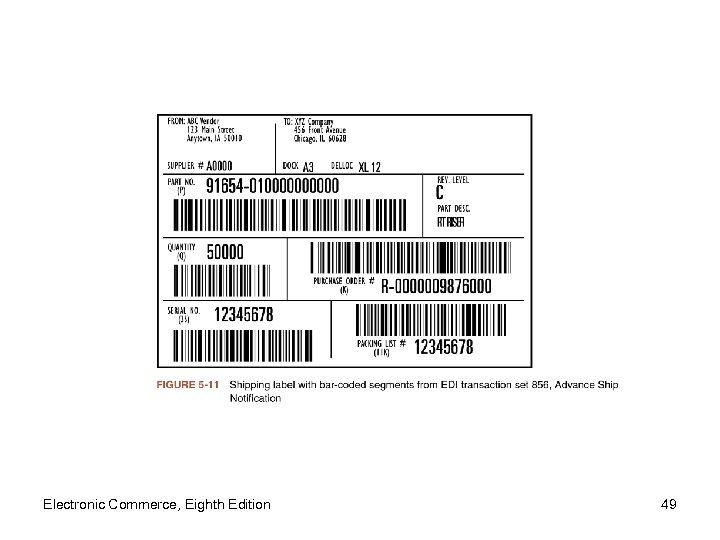
Using Materials-Tracking Technologies with EDI and Electronic Commerce • Troublesome task – Tracking materials as they move from one company to another • Use optical scanners and bar codes – Integration of bar coding and EDI is prevalent – Figure 5 -11 • Electronic commerce second wave – Integrating new types of tracking into Internet-based materials-tracking systems Electronic Commerce, Eighth Edition 48
Electronic Commerce, Eighth Edition 49
Using Materials-Tracking Technologies with EDI and Electronic Commerce (cont’d. ) • Radio Frequency Identification Devices (RFIDs) – Small chips – Use radio transmissions to track inventory – Older RFID technology • Each RFID required its own power supply – Important development: passive RFID tag • Made cheaply and in very small sizes • No power supply required • RFIDs – Read much more quickly, with higher degree of accuracy Electronic Commerce, Eighth Edition 50

Electronic Commerce, Eighth Edition 51
Using Materials-Tracking Technologies with EDI and Electronic Commerce (cont’d. ) • 2003 (Wal-Mart) – Tested use of RFID tags on merchandise for inventory tracking and control – Initiated plan to have all suppliers install RFID tags in goods they shipped – Reduced incidence of stockouts • Retailer loses sales because it does not have specific goods on its shelves – Suppliers found RFID tags, readers, computer systems to be quite expensive • Pushed for slowdown in Wal-Mart’s RFID initiative Electronic Commerce, Eighth Edition 52
Creating an Ultimate Consumer Orientation in the Supply Chain • Ultimate consumer orientation – Customer focus • Difficult to maintain • Michelin North America – Pioneered use of Internet technology • To go beyond next step in its value chain – 1995: launched electronic commerce initiative • BIB NET extranet – Allowed dealer access to tire specifications, inventory status, and promotional information • Through simple-to-use Web browser interface Electronic Commerce, Eighth Edition 53
Building and Maintaining Trust in the Supply Chain • Major issue in forming supply chain alliances – Developing trust – Key elements • Continual communication and information sharing • Internet and the Web – Provide excellent ways to communicate and share information – Provide opportunity to stay in contact with customers • More easily and less expensively – Instant access to sales representatives, vendors • Comprehensive information at a moment’s notice Electronic Commerce, Eighth Edition 54
Electronic Market Places and Portals • Vertical portals (vortal) – Information hubs for each major industry • Offer news, research reports, trend analyses, in-depth reports on companies, marketplaces, and auctions • Doorway (or portal) to the Internet for industry members • Vertically integrated • Predicted to change business forever – Not exactly correct Electronic Commerce, Eighth Edition 55
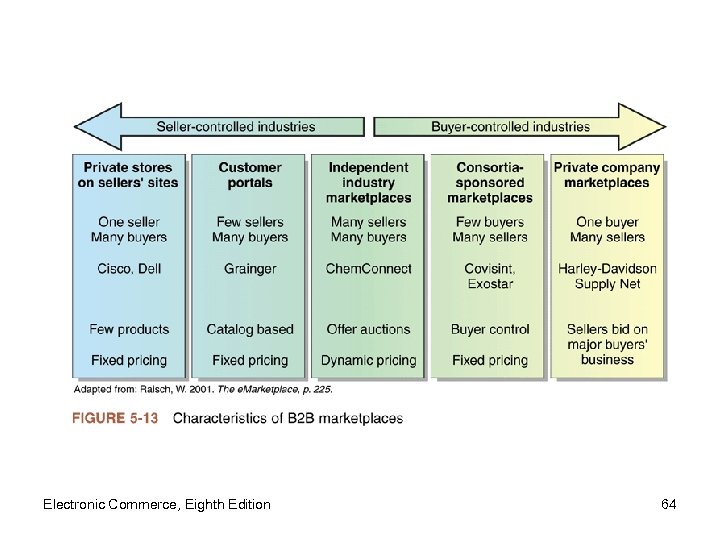
Independent Industry Marketplaces • First industry hubs following vertical portal model – Trading exchanges focused on a particular industry • Independent industry marketplaces – Industry marketplaces • Focused on a single industry – Independent exchanges • Not controlled by established buyer or seller in the industry – Public marketplaces • Open to new buyers and sellers just entering the industry Electronic Commerce, Eighth Edition 56
Independent Industry Marketplaces (cont’d. ) • Example: Ventro – 1997: opened industry marketplace Chemdex • Trade in bulk chemicals • By mid-2000 – More than 2200 independent exchanges • By 2008 – Fewer than 80 industry marketplaces still operating • Other B 2 B marketplace models arose – Took business away from the independent marketplaces Electronic Commerce, Eighth Edition 57
Private Stores and Customer Portals • Large seller concern – Independent operators would take control of transactions in supply chains – Industry marketplaces would dilute power – Customer portal sites • Cisco and Dell: private store with password-protected entrance • Grainger: provide additional services for customers – Needlessly duplicated if sellers participated in industry marketplace Electronic Commerce, Eighth Edition 58
Private Company Marketplaces • Large companies purchasing from relatively small vendors – Exert power in purchasing negotiations • e-procurement software – Company manages purchasing function through Web – Procurement software companies • Ariba, Commerce. One – Automates authorizations, other steps – Marketplace functions Electronic Commerce, Eighth Edition 59
Private Company Marketplaces (cont’d. ) • Companies implementing e-procurement software – Require suppliers bid on business • Private company marketplace – Marketplace providing auctions, request for quote postings, other features • For companies who want to operate their own marketplaces • Example: United Technologies – Sells $35 billion of high-technology products, services Electronic Commerce, Eighth Edition 60
Industry Consortia-Sponsored Marketplaces • Companies with strong negotiating positions in their industry supply chains – Not enough power to force suppliers to deal with them • Through a private company marketplace • Industry consortia-sponsored marketplace – Marketplace formed several large buyers in a particular industry • Example: Covisint (2000) – Consortium of Daimler. Chrysler, Ford, General Motors Electronic Commerce, Eighth Edition 61
Industry Consortia-Sponsored Marketplaces (cont’d. ) • Example: Agenda marketplace – Consortium formed by Marriott, Hyatt, three other major hotel chains • Example: Exostar marketplace – Boeing led group of aerospace industry companies • Example: Transora marketplace – Procter & Gamble joined with Sara Lee, Coca Cola, several other companies • Consortiums have taken large part of market from the industry marketplaces Electronic Commerce, Eighth Edition 62
Industry Consortia-Sponsored Marketplaces (cont’d. ) • Supplier concern – Ownership structure • Independent operators for fair bargaining (Covisint) • Including industry participants may be helpful (Chem. Connect) Electronic Commerce, Eighth Edition 63
Electronic Commerce, Eighth Edition 64
Summary • Using Internet and Web technologies improves purchasing and logistics primary activities • Emerging network model of organization • Governments extending reach of enterprise planning and control activities – Beyond legal definitions • History of EDI and how it works – Conducting EDI: better than processing mountains of paper transactions – Internet providing inexpensive communications channel EDI lacked Electronic Commerce, Eighth Edition 65
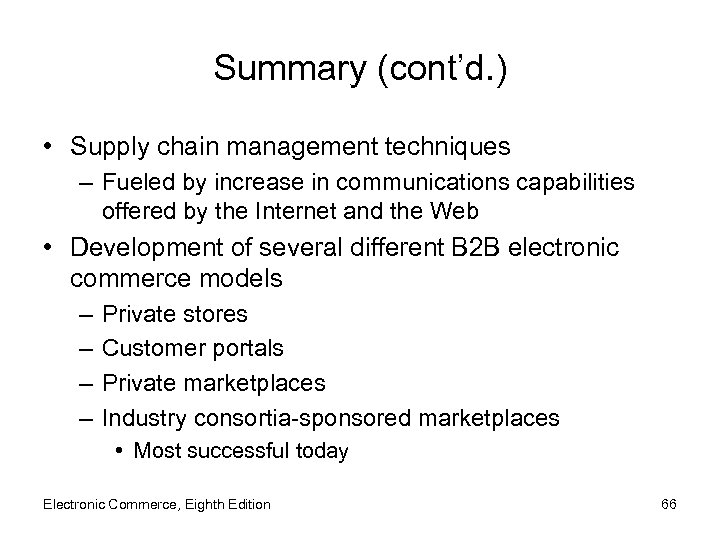
Summary (cont’d. ) • Supply chain management techniques – Fueled by increase in communications capabilities offered by the Internet and the Web • Development of several different B 2 B electronic commerce models – – Private stores Customer portals Private marketplaces Industry consortia-sponsored marketplaces • Most successful today Electronic Commerce, Eighth Edition 66
Скачать презентацию Electronic Commerce Eighth Edition Chapter 5 Business-To-Business Online
f6a646aadb1a5beee90fccd0766134e6.ppt