


 Скачать презентацию Electromagnetic shower reconstruction with emulsion films in the
b9444288e6c194f1340b67e12789b48d.ppt
- Количество слайдов: 32
 Electromagnetic shower reconstruction with emulsion films in the OPERA experiment F. Juget IPH Université de Neuchâtel On behalf of the OPERA collaboration CALOR 08 – Pavia – May 28 th 2008
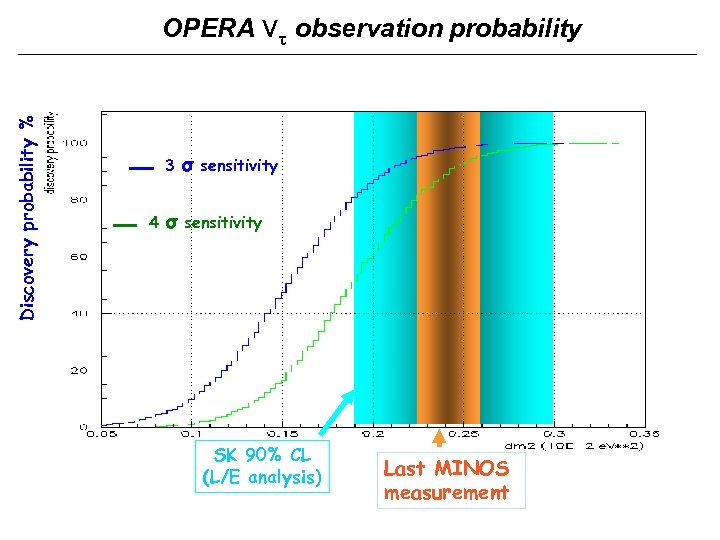
 Physics motivation • Appareance search of <-> oscillations in the parameter region indicated by S-K for the atmospheric neutrino deficit. Recent results (SK, MINOS): best fit: m 2 = 2. 4 10 -3 e. V 2 and sin 22 q 23 = 1. 00 Search for appearance in the CNGS beam Search for < > e : put new constraints on q 13 Actual result: (CHOOZ): sin 22 q 13 < 0. 1
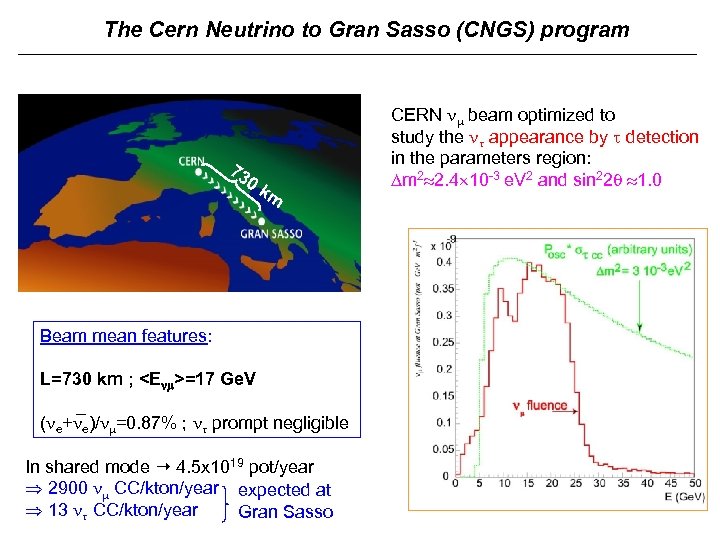 The Cern Neutrino to Gran Sasso (CNGS) program 73 0 k m Beam mean features: L=730 km ;
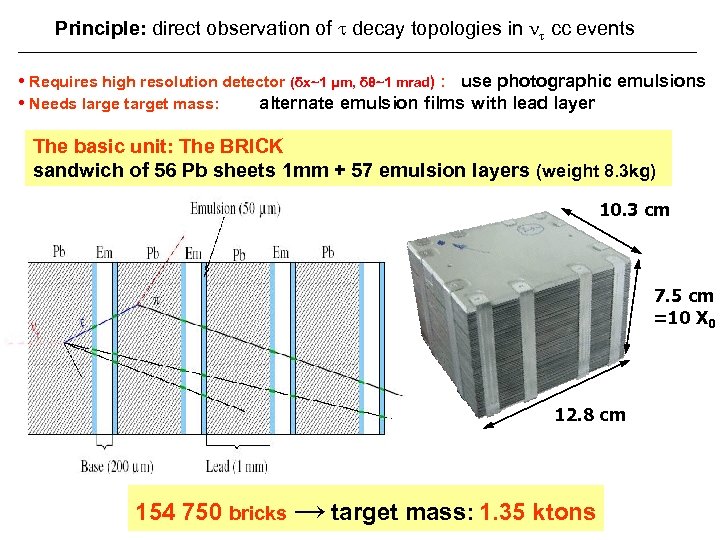 Principle: direct observation of decay topologies in cc events • Requires high resolution detector (δx~1 μm, δθ~1 mrad) : use photographic emulsions • Needs large target mass: alternate emulsion films with lead layer The basic unit: The BRICK sandwich of 56 Pb sheets 1 mm + 57 emulsion layers (weight 8. 3 kg) 10. 3 cm 7. 5 cm =10 X 0 12. 8 cm 154 750 bricks → target mass: 1. 35 ktons
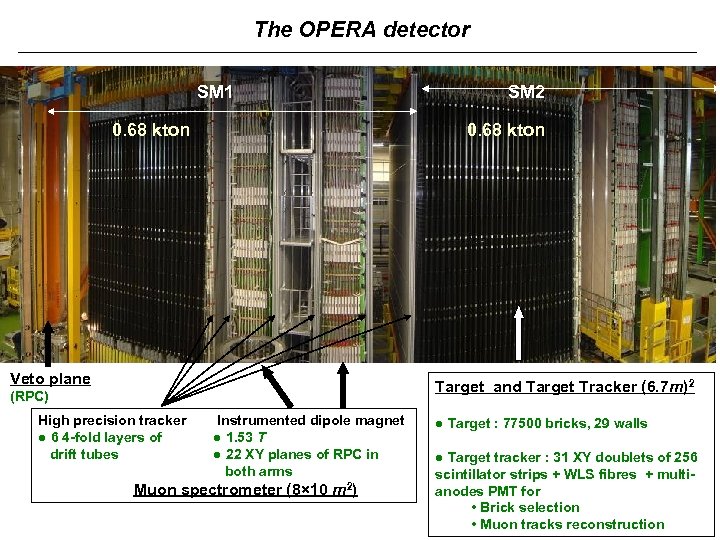 The OPERA detector SM 1 0. 68 kton SM 2 0. 68 kton Veto plane Target and Target Tracker (6. 7 m)2 (RPC) High precision tracker ● 6 4 -fold layers of drift tubes Instrumented dipole magnet ● 1. 53 T ● 22 XY planes of RPC in both arms Muon spectrometer (8× 10 m 2) ● Target : 77500 bricks, 29 walls ● Target tracker : 31 XY doublets of 256 scintillator strips + WLS fibres + multianodes PMT for • Brick selection • Muon tracks reconstruction
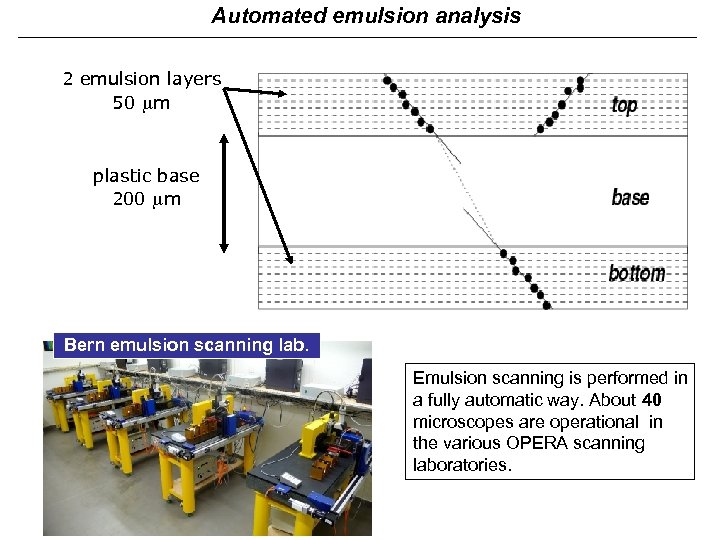 Automated emulsion analysis 2 emulsion layers 50 m plastic base 200 m 2 mm Bern emulsion scanning lab. Emulsion scanning is performed in a fully automatic way. About 40 microscopes are operational in the various OPERA scanning laboratories.
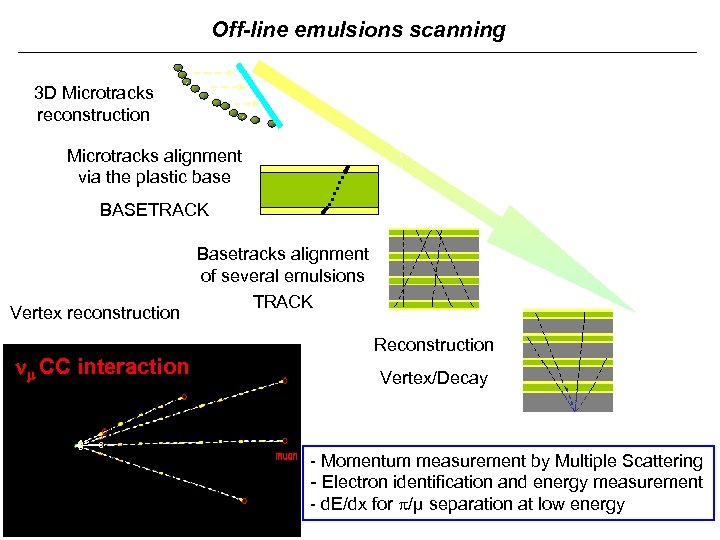 Off-line emulsions scanning 3 D Microtracks reconstruction Microtracks alignment via the plastic base BASETRACK Vertex reconstruction CC interaction Basetracks alignment of several emulsions TRACK Reconstruction Vertex/Decay - Momentum measurement by Multiple Scattering - Electron identification and energy measurement - d. E/dx for /µ separation at low energy
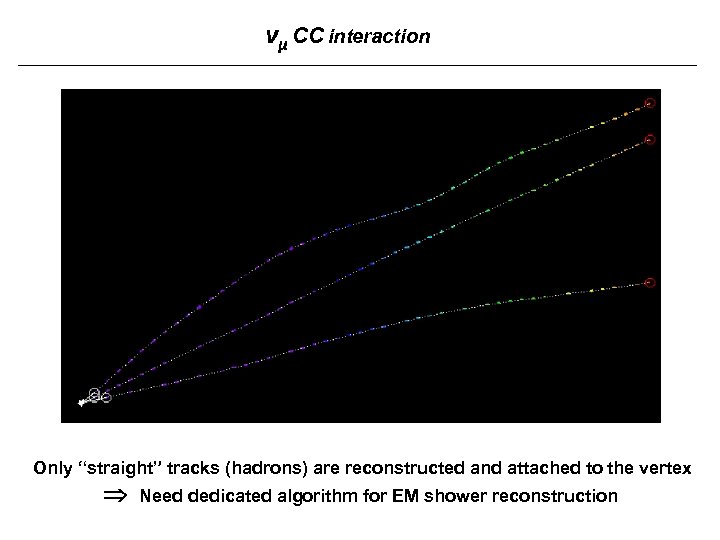 νμ CC interaction Only “straight” tracks (hadrons) are reconstructed and attached to the vertex Need dedicated algorithm for EM shower reconstruction
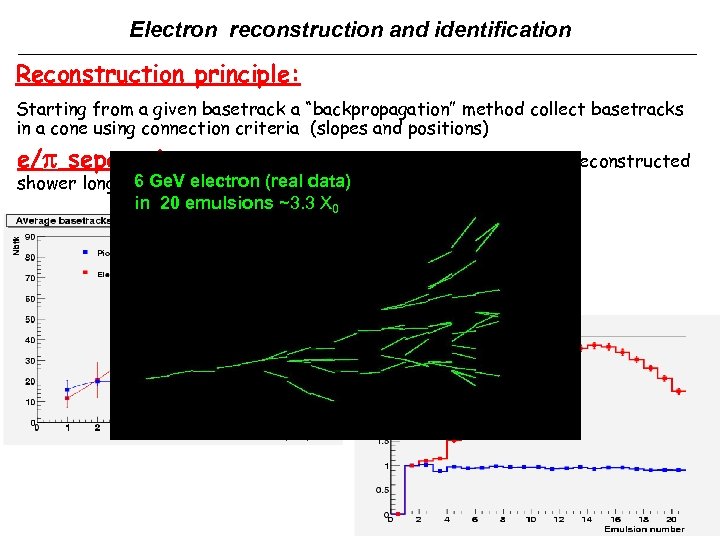 Electron reconstruction and identification Reconstruction principle: Starting from a given basetrack a “backpropagation” method collect basetracks in a cone using connection criteria (slopes and positions) e/p separation: Method use a neural network based on the reconstructed 6 Ge. V electron (real number of collected basetracks shower longitudinal profile and the data) in 20 emulsions ~3. 3 X 0
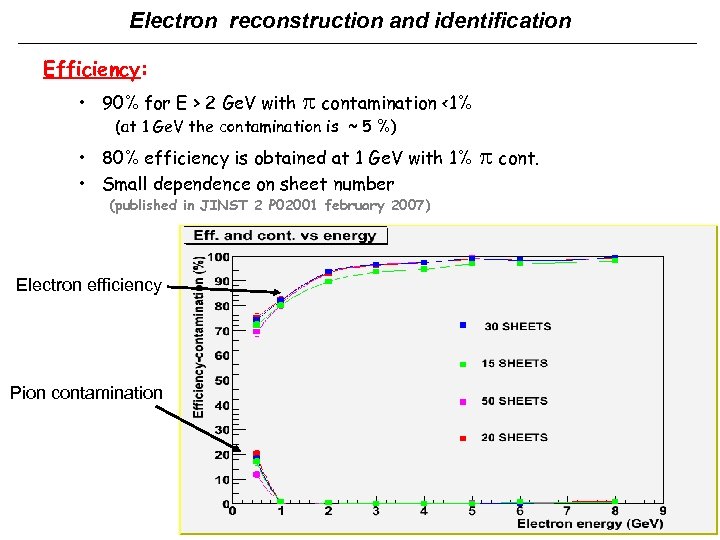 Electron reconstruction and identification Efficiency: • 90% for E > 2 Ge. V with contamination <1% (at 1 Ge. V the contamination is ~ 5 %) • 80% efficiency is obtained at 1 Ge. V with 1% • Small dependence on sheet number (published in JINST 2 P 02001 february 2007) Electron efficiency Pion contamination cont.
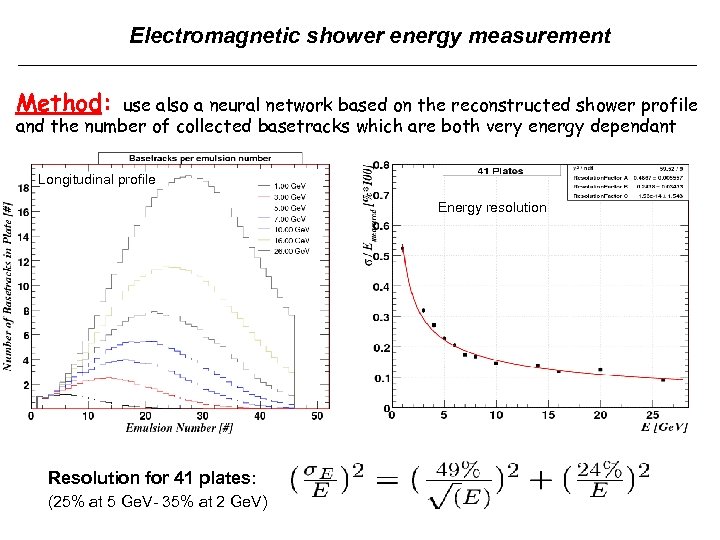 Electromagnetic shower energy measurement Method: use also a neural network based on the reconstructed shower profile and the number of collected basetracks which are both very energy dependant Longitudinal profile Energy resolution Resolution for 41 plates: (25% at 5 Ge. V- 35% at 2 Ge. V)
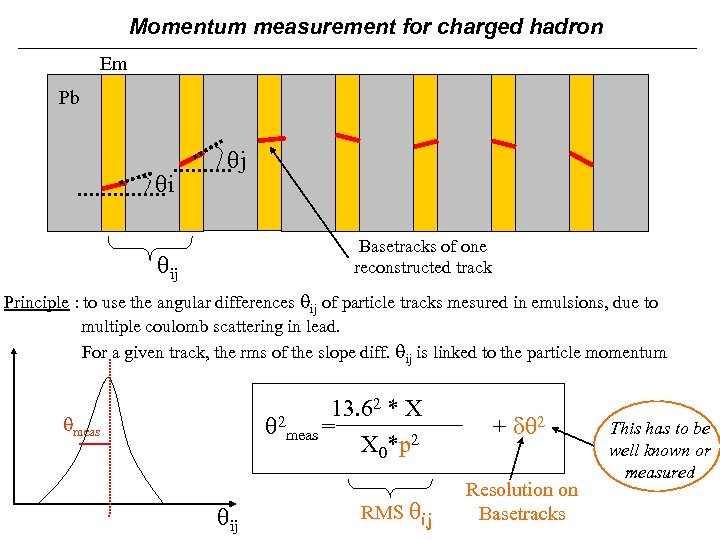 Momentum measurement for charged hadron Em Pb i j Basetracks of one reconstructed track ij Principle : to use the angular differences ij of particle tracks mesured in emulsions, due to multiple coulomb scattering in lead. For a given track, the rms of the slope diff. ij is linked to the particle momentum 13. 62 * X 2 meas = X 0*p 2 meas ij RMS ij + d 2 Resolution on Basetracks This has to be well known or measured
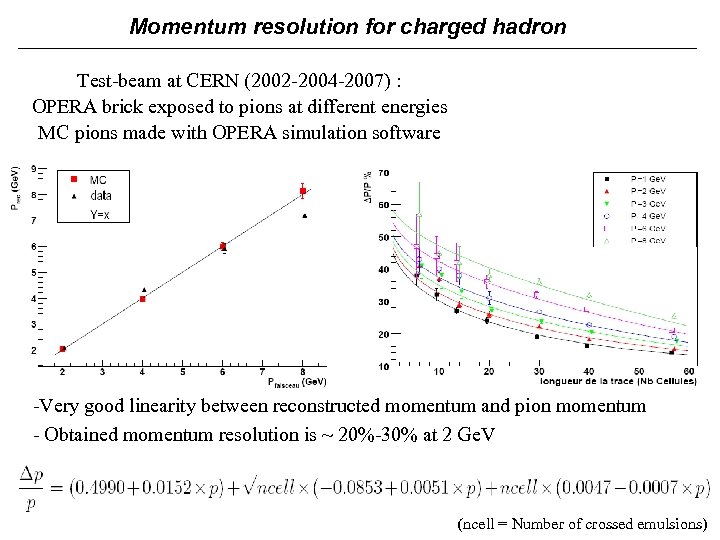 Momentum resolution for charged hadron Test-beam at CERN (2002 -2004 -2007) : OPERA brick exposed to pions at different energies MC pions made with OPERA simulation software -Very good linearity between reconstructed momentum and pion momentum - Obtained momentum resolution is ~ 20%-30% at 2 Ge. V (ncell = Number of crossed emulsions)
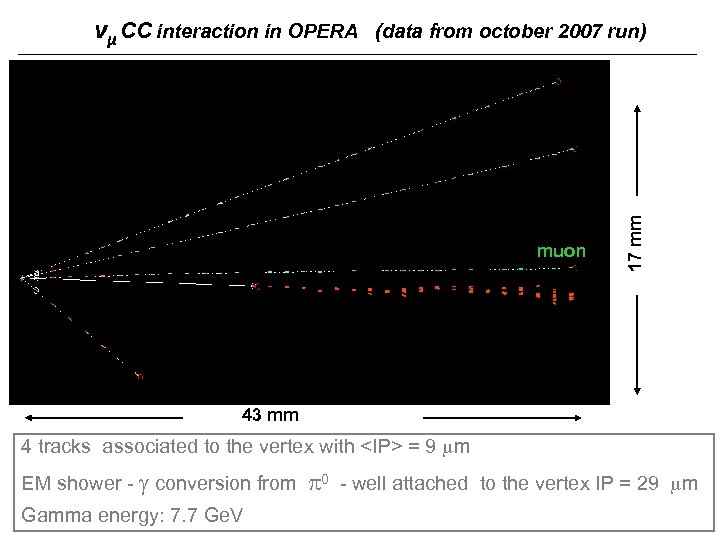 (data from october 2007 run) muon 17 mm νμ CC interaction in OPERA 43 mm 4 tracks associated to the vertex with
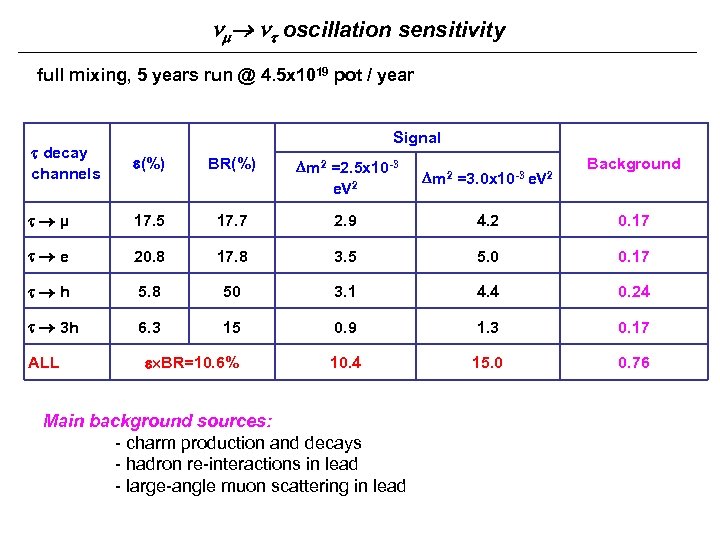
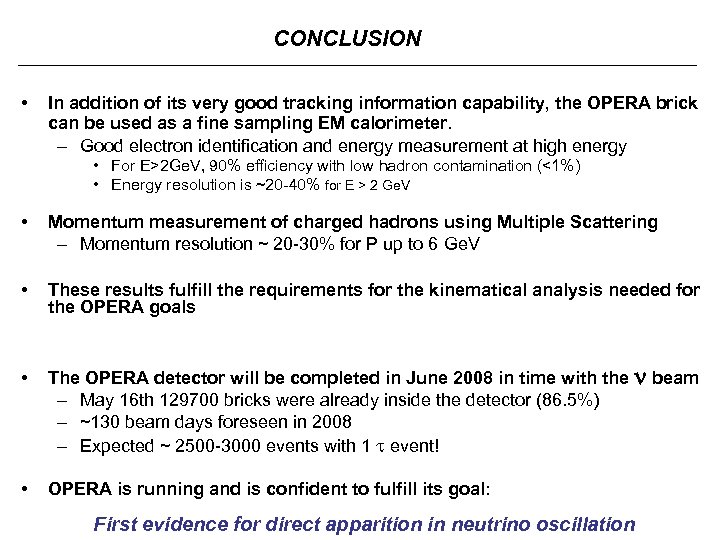 CONCLUSION • In addition of its very good tracking information capability, the OPERA brick can be used as a fine sampling EM calorimeter. – Good electron identification and energy measurement at high energy • For E>2 Ge. V, 90% efficiency with low hadron contamination (<1%) • Energy resolution is ~20 -40% for E > 2 Ge. V • Momentum measurement of charged hadrons using Multiple Scattering – Momentum resolution ~ 20 -30% for P up to 6 Ge. V • These results fulfill the requirements for the kinematical analysis needed for the OPERA goals • The OPERA detector will be completed in June 2008 in time with the – May 16 th 129700 bricks were already inside the detector (86. 5%) – ~130 beam days foreseen in 2008 – Expected ~ 2500 -3000 events with 1 event! • OPERA is running and is confident to fulfill its goal: beam First evidence for direct apparition in neutrino oscillation


 BACKUP
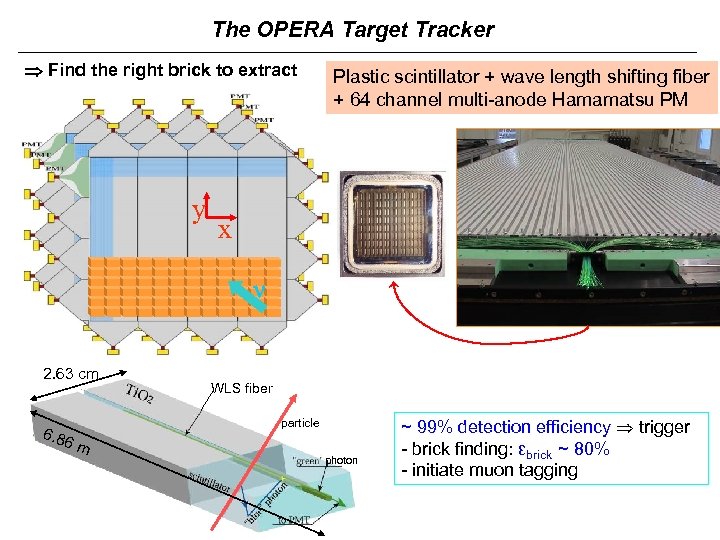 The OPERA Target Tracker Find the right brick to extract y Plastic scintillator + wave length shifting fiber + 64 channel multi-anode Hamamatsu PM x 2. 63 cm 6. 86 WLS fiber particle m photon ~ 99% detection efficiency trigger - brick finding: εbrick ~ 80% - initiate muon tagging
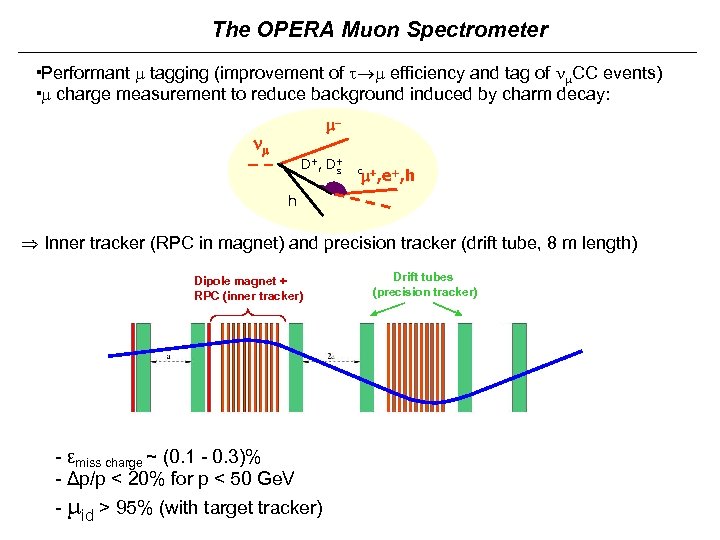 The OPERA Muon Spectrometer Performant tagging (improvement of efficiency and tag of CC events) charge measurement to reduce background induced by charm decay: D+ , D + s c , e+, h h Inner tracker (RPC in magnet) and precision tracker (drift tube, 8 m length) Dipole magnet + RPC (inner tracker) - εmiss charge ~ (0. 1 - 0. 3)% - Δp/p < 20% for p < 50 Ge. V - id > 95% (with target tracker) Drift tubes (precision tracker)
 Bricks filling with the BMS
 oscillation sensitivity full mixing, 5 years run @ 4. 5 x 10¹⁹ pot / year Signal decay channels (%) BR(%) m 2 =2. 5 x 10 -3 e. V 2 m 2 =3. 0 x 10 -3 e. V 2 µ 17. 5 17. 7 2. 9 4. 2 0. 17 e 20. 8 17. 8 3. 5 5. 0 0. 17 h 5. 8 50 3. 1 4. 4 0. 24 3 h 6. 3 15 0. 9 1. 3 0. 17 BR=10. 6% 10. 4 15. 0 0. 76 ALL Main background sources: - charm production and decays - hadron re-interactions in lead - large-angle muon scattering in lead Background
 Discovery probability % OPERA ντ observation probability 3 4 σ σ sensitivity SK 90% CL (L/E analysis) Last MINOS measurement
 1 st CNGS run: August 2006 No brick in the detector Used for electronic detectors, DAQ, GPS commissioning and tests of CNGS-OPERA information exchange 1 21 hours of real beam operation (70% of nominal intensity 1. 7 1013 pot/extraction) Integrated intensity: 7. 6 1017 pot Time selection of beam events: TOPERA - (TCERN+Tflight) < Tgate Tflight = 2. 44 ms GPS Time Stamp resolution ~ 100 ns Tgate ~ 10. 5 s Cosmic ray events The events time distribution is peaked around the 2 extractions peak times within negligible cosmic-ray background
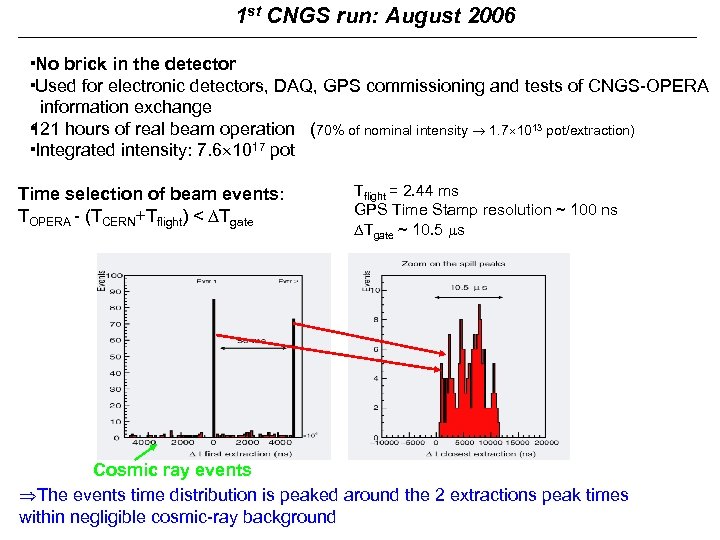
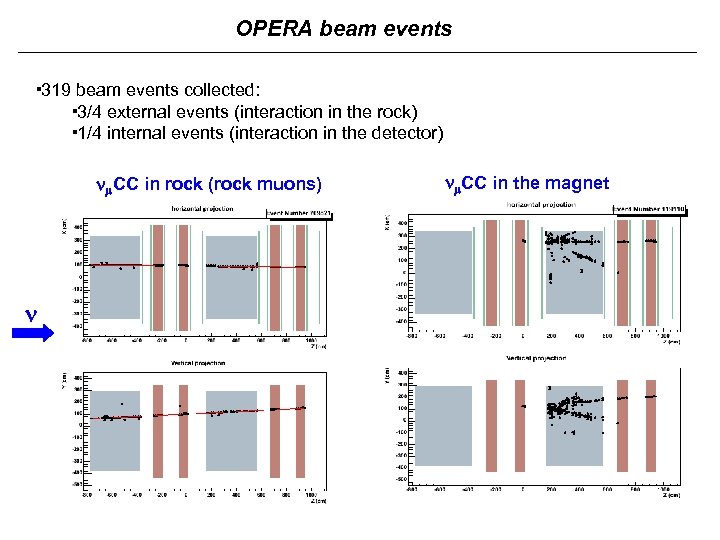 OPERA beam events 319 beam events collected: 3/4 external events (interaction in the rock) 1/4 internal events (interaction in the detector) CC in rock (rock muons) CC in the magnet
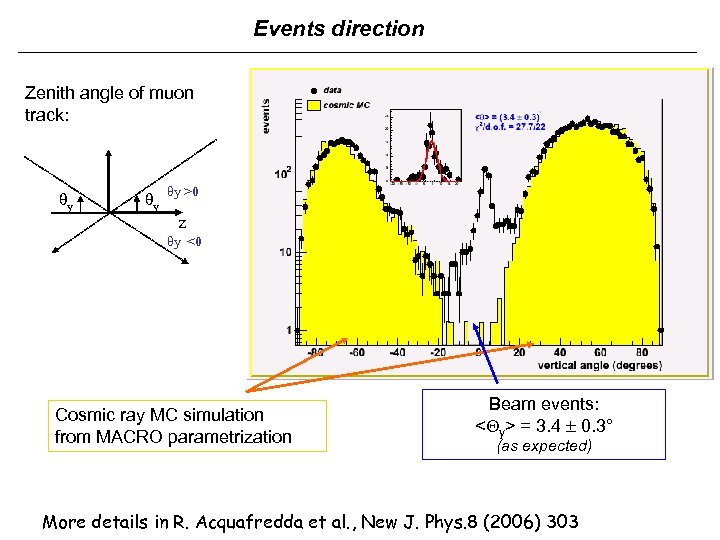 Events direction Zenith angle of muon track: θy θy θy >0 z θy <0 Cosmic ray MC simulation from MACRO parametrization Beam events: < y> = 3. 4 0. 3° (as expected) More details in R. Acquafredda et al. , New J. Phys. 8 (2006) 303
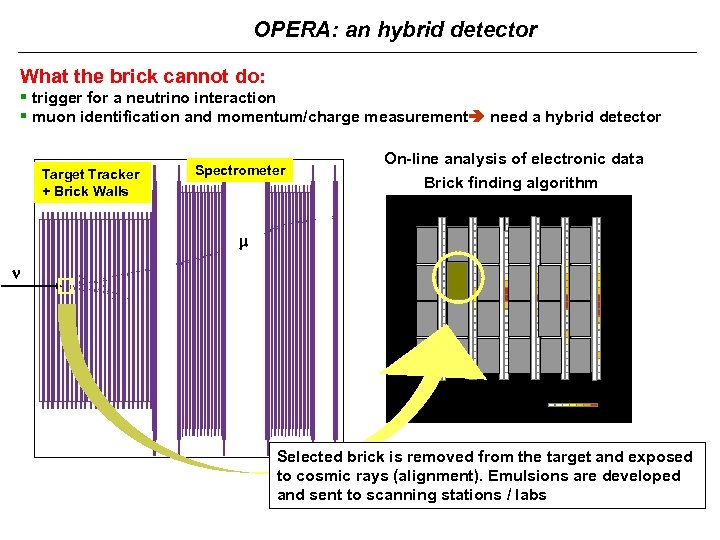 OPERA: an hybrid detector What the brick cannot do: § trigger for a neutrino interaction § muon identification and momentum/charge measurement need a hybrid detector Target Tracker + Brick Walls Spectrometer On-line analysis of electronic data Brick finding algorithm p. h. 0 max Selected brick is removed from the target and exposed to cosmic rays (alignment). Emulsions are developed and sent to scanning stations / labs
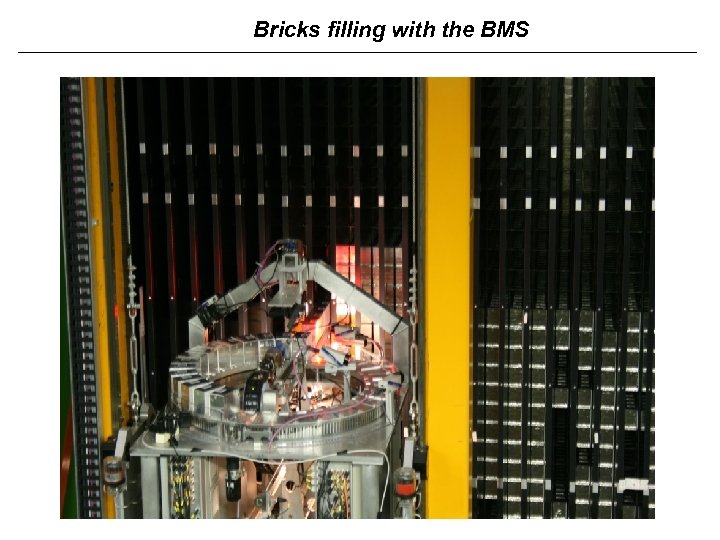
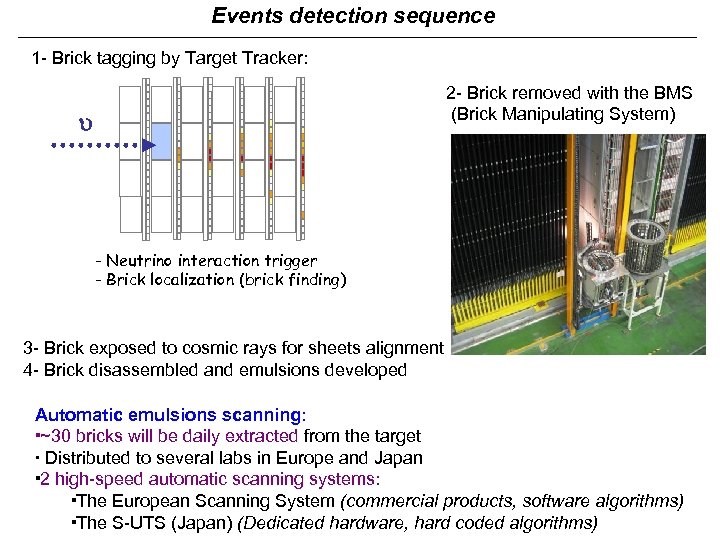 Events detection sequence 1 - Brick tagging by Target Tracker: 2 - Brick removed with the BMS (Brick Manipulating System) - Neutrino interaction trigger - Brick localization (brick finding) 3 - Brick exposed to cosmic rays for sheets alignment 4 - Brick disassembled and emulsions developed Automatic emulsions scanning: ~30 bricks will be daily extracted from the target Distributed to several labs in Europe and Japan 2 high-speed automatic scanning systems: The European Scanning System (commercial products, software algorithms) The S-UTS (Japan) (Dedicated hardware, hard coded algorithms)
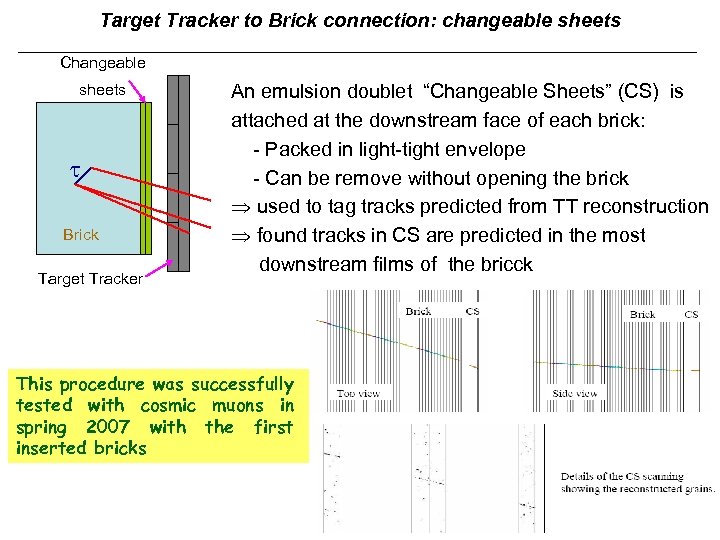 Target Tracker to Brick connection: changeable sheets Changeable sheets Brick Target Tracker An emulsion doublet “Changeable Sheets” (CS) is attached at the downstream face of each brick: - Packed in light-tight envelope - Can be remove without opening the brick used to tag tracks predicted from TT reconstruction found tracks in CS are predicted in the most downstream films of the bricck This procedure was successfully tested with cosmic muons in spring 2007 with the first inserted bricks
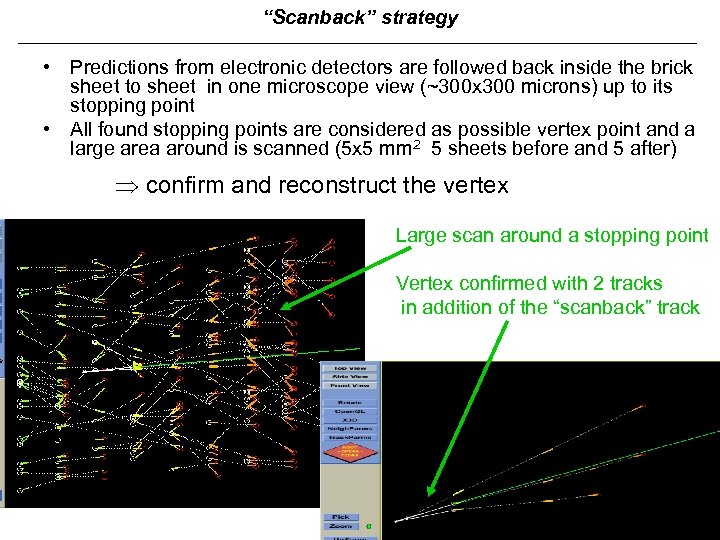 “Scanback” strategy • Predictions from electronic detectors are followed back inside the brick sheet to sheet in one microscope view (~300 x 300 microns) up to its stopping point • All found stopping points are considered as possible vertex point and a large area around is scanned (5 x 5 mm 2 5 sheets before and 5 after) confirm and reconstruct the vertex Large scan around a stopping point Vertex confirmed with 2 tracks in addition of the “scanback” track
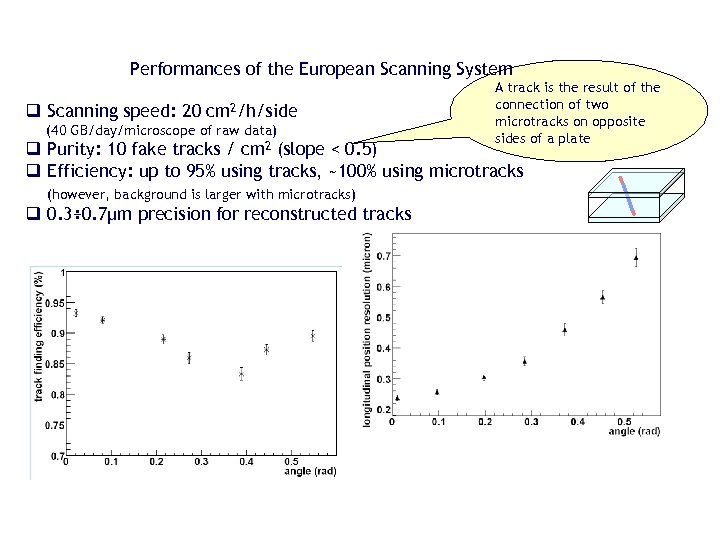 The European Scanning System Performances of the European Scanning System q Scanning speed: 20 cm 2/h/side (40 GB/day/microscope of raw data) A track is the result of the connection of two microtracks on opposite sides of a plate q Purity: 10 fake tracks / cm 2 (slope < 0. 5) q Efficiency: up to 95% using tracks, ~100% using microtracks (however, background is larger with microtracks) q 0. 3÷ 0. 7μm precision for reconstructed tracks
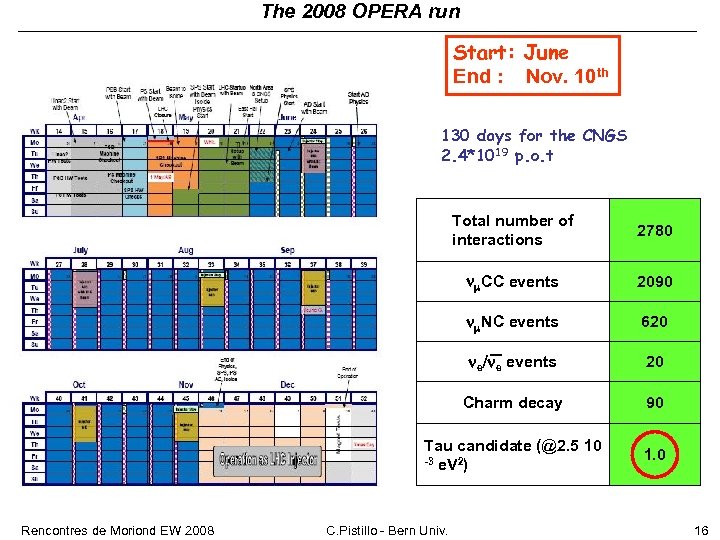 The 2008 OPERA run Start: June End : Nov. 10 th 130 days for the CNGS 2. 4*1019 p. o. t Total number of interactions CC events 2090 NC events 620 e/ e events 20 Charm decay 90 Tau candidate (@2. 5 10 -3 e. V 2) Rencontres de Moriond EW 2008 2780 1. 0 C. Pistillo - Bern Univ. 16