


 Скачать презентацию Electricity for All Ten Ideas towards Turning Rhetoric
c12c67d14f4c440590442f0c8c093545.ppt
- Количество слайдов: 25
 Electricity for All: Ten Ideas towards Turning Rhetoric into Reality Meeting of the Coordination Forum Vadodara, April 02, 2011 Prayas Energy Group, Pune www. prayaspune. org/peg energy@prayaspune. org
 www. amulya-reddy. org. in Prayas … ‘Prayas’ means ‘Focused Effort’ Based at Pune, India Research based, policy advocacy Voluntary Org. Focus on protection of “Public Interest” in electricity sector Activities: • Research & intervention (regulatory, policy) • Civil Society training, awareness, and support Prayas, Guj Coord-Forum, 2011 2
 Gujarat Electricity Sector • Highly rated (eg. CRISIL survey) • Has met most of the ‘conventional’ challenges, unlike many States – – – Financially viable Utilities Low peak and energy shortages Feeder separation for better rural power supply High village and household electrification Healthy Government-Utility-Regulator relationship Prayas, Guj Coord-Forum, 2011 3
 Next steps • • Sustaining gains Improving quality of supply & service Reducing losses and tariff Take good practices from Gujarat to other States • Presentation will help generate new ideas Prayas, Guj Coord-Forum, 2011 4
 Presentation Plan • Great expectations from the ‘happening sector’ • Uncomfortable truths before us • Change of mindset needed • Ten Action Ideas Prayas, Guj Coord-Forum, 2011 5
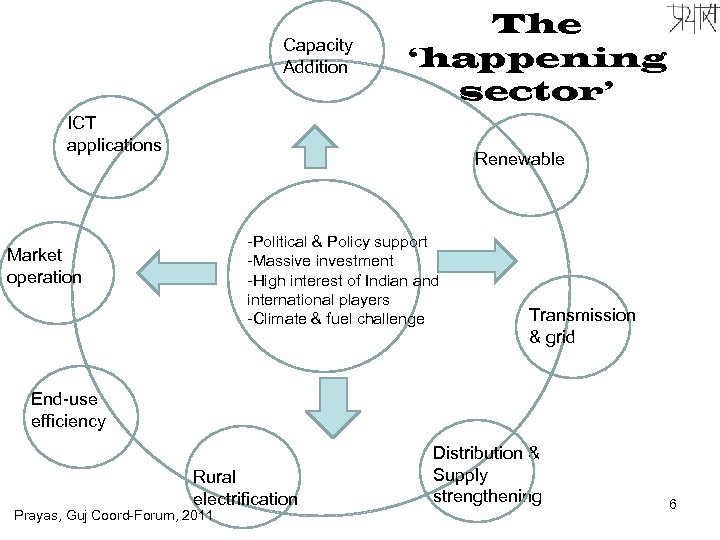 Capacity Addition The ‘happening sector’ ICT applications Renewable -Political & Policy support -Massive investment -High interest of Indian and international players -Climate & fuel challenge Market operation Transmission & grid End-use efficiency Rural electrification Prayas, Guj Coord-Forum, 2011 Distribution & Supply strengthening 6
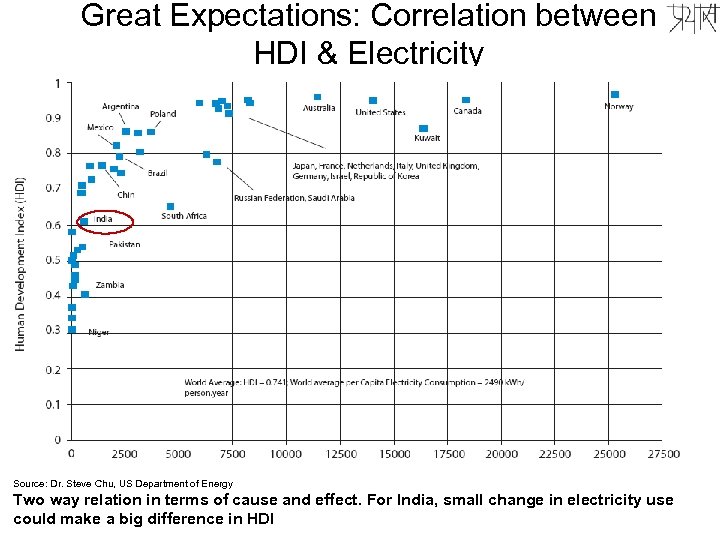 Great Expectations: Correlation between HDI & Electricity Source: Dr. Steve Chu, US Department of Energy Two way relation in terms of cause and Guj Coord-Forum, 2011 Prayas, effect. For India, small change in electricity use 7 could make a big difference in HDI 7
 Great expectations: National Commitments “Electricity is an essential requirement for all facets of our life. It has been recognized as a basic human need. It is a critical infrastructure on which the socio-economic development of the country depends. Supply of electricity at a reasonable rate to rural India is essential for its overall development. ” (National Electricity Policy) • National commitments – Electricity for all by 2012 (RGGVY continuation order -2008) – Per capita availability of electricity to be increased to over 1000 units by 2012 (National Electricity Policy) – Minimum lifeline consumption of 1 unit/household/day as a merit good by year 2012 (National Electricity Policy) • Massive ongoing investments – To the tune of Rs. 50, 000 Cr/year Prayas, Guj Coord-Forum, 2011 8
 Great expectations: Markets & Commercial orientation will deliver • High attention on market issues, commercial viability – Promotion of captive (Electricity Act, Electricity Rules-2006, Amendment -2007 removing the need for license) – Measures to encourage open access, trading, markets, exchanges – Promotion of merchant power (Electricity Policy, Hydro Policy, State Policies) – Increase in revenue is the major performance index for DISCOMs Prayas, Guj Coord-Forum, 2011 9
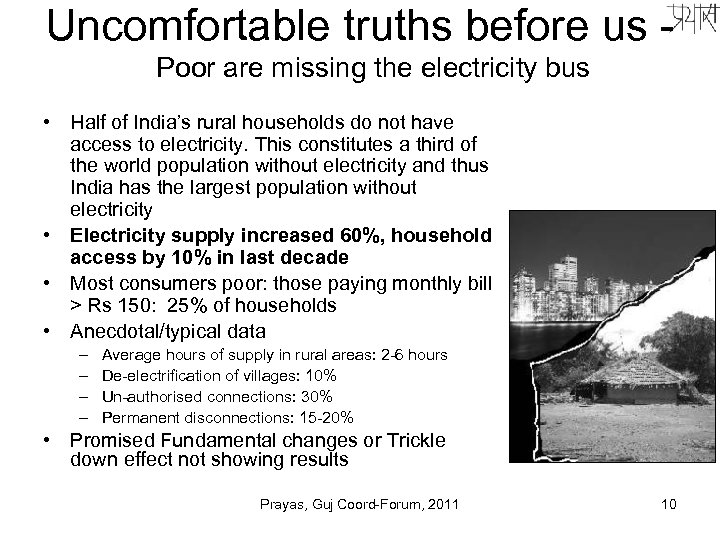 Uncomfortable truths before us Poor are missing the electricity bus • Half of India’s rural households do not have access to electricity. This constitutes a third of the world population without electricity and thus India has the largest population without electricity • Electricity supply increased 60%, household access by 10% in last decade • Most consumers poor: those paying monthly bill > Rs 150: 25% of households • Anecdotal/typical data – – Average hours of supply in rural areas: 2 -6 hours De-electrification of villages: 10% Un-authorised connections: 30% Permanent disconnections: 15 -20% • Promised Fundamental changes or Trickle down effect not showing results Prayas, Guj Coord-Forum, 2011 10
 Change of mindset needed to address the issue • Different kind of steps needed to correct this shameful state of affairs • Bits and pieces approach will not do • Pro-active, comprehensive initiatives, urgent & essential • Prayas has some ideas on this, which are to be improved through discussion & debate Prayas, Guj Coord-Forum, 2011 11
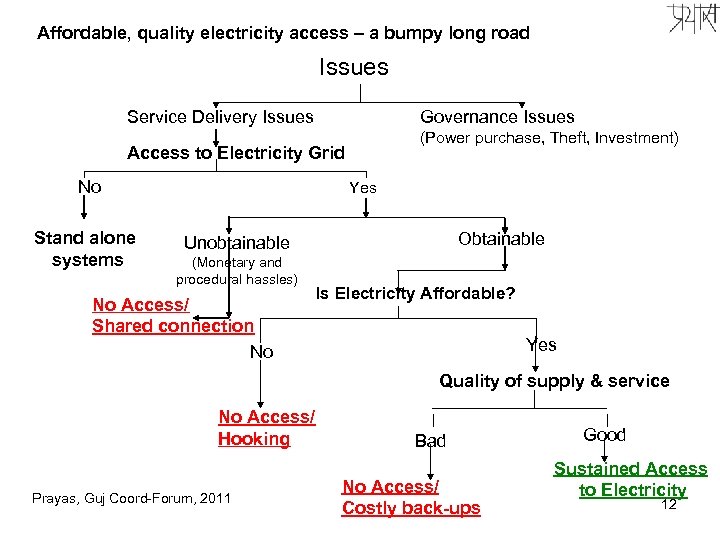 Affordable, quality electricity access – a bumpy long road Issues Service Delivery Issues Governance Issues (Power purchase, Theft, Investment) Access to Electricity Grid No Stand alone systems Yes Obtainable Unobtainable (Monetary and procedural hassles) No Access/ Shared connection No Is Electricity Affordable? Yes Quality of supply & service No Access/ Hooking Prayas, Guj Coord-Forum, 2011 Bad No Access/ Costly back-ups Good Sustained Access to Electricity 12
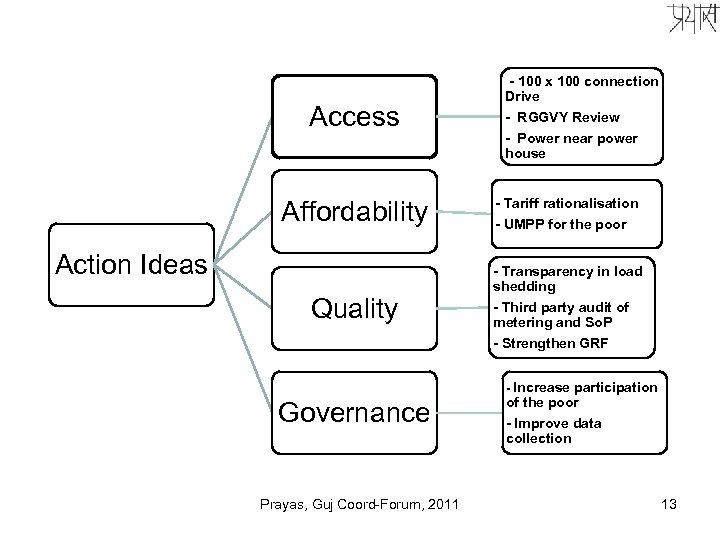 Access Affordability Action Ideas Quality - 100 x 100 connection Drive - RGGVY Review - Power near power house - Tariff rationalisation - UMPP for the poor - Transparency in load shedding - Third party audit of metering and So. P - Strengthen GRF - Increase participation Governance Prayas, Guj Coord-Forum, 2011 of the poor - Improve data collection 13
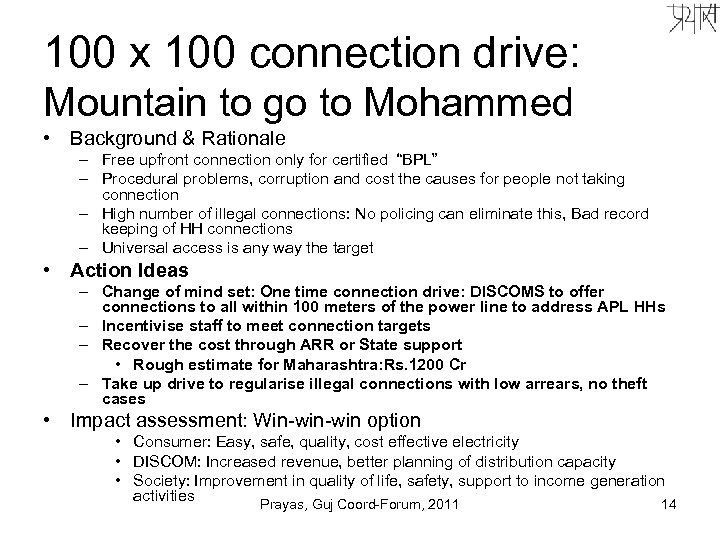 100 x 100 connection drive: Mountain to go to Mohammed • Background & Rationale – Free upfront connection only for certified “BPL” – Procedural problems, corruption and cost the causes for people not taking connection – High number of illegal connections: No policing can eliminate this, Bad record keeping of HH connections – Universal access is any way the target • Action Ideas – Change of mind set: One time connection drive: DISCOMS to offer connections to all within 100 meters of the power line to address APL HHs – Incentivise staff to meet connection targets – Recover the cost through ARR or State support • Rough estimate for Maharashtra: Rs. 1200 Cr – Take up drive to regularise illegal connections with low arrears, no theft cases • Impact assessment: Win-win option • Consumer: Easy, safe, quality, cost effective electricity • DISCOM: Increased revenue, better planning of distribution capacity • Society: Improvement in quality of life, safety, support to income generation activities Prayas, Guj Coord-Forum, 2011 14
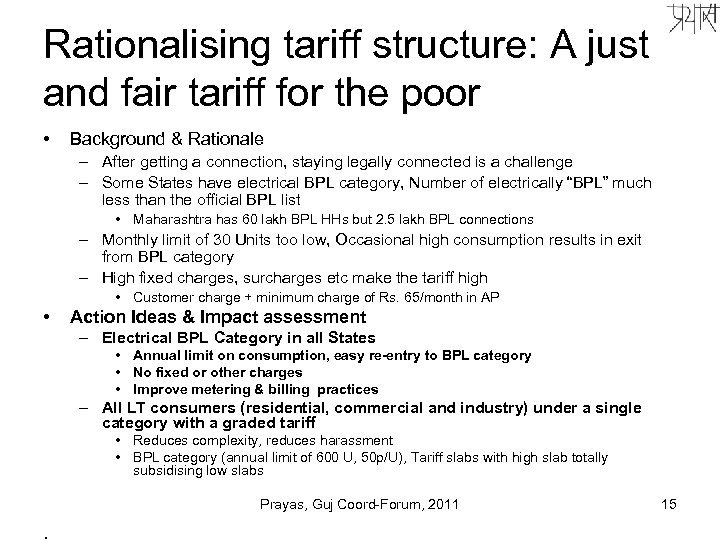 Rationalising tariff structure: A just and fair tariff for the poor • Background & Rationale – After getting a connection, staying legally connected is a challenge – Some States have electrical BPL category, Number of electrically “BPL” much less than the official BPL list • Maharashtra has 60 lakh BPL HHs but 2. 5 lakh BPL connections – Monthly limit of 30 Units too low, Occasional high consumption results in exit from BPL category – High fixed charges, surcharges etc make the tariff high • Customer charge + minimum charge of Rs. 65/month in AP • Action Ideas & Impact assessment – Electrical BPL Category in all States • Annual limit on consumption, easy re-entry to BPL category • No fixed or other charges • Improve metering & billing practices – All LT consumers (residential, commercial and industry) under a single category with a graded tariff • Reduces complexity, reduces harassment • BPL category (annual limit of 600 U, 50 p/U), Tariff slabs with high slab totally subsidising low slabs Prayas, Guj Coord-Forum, 2011 . 15
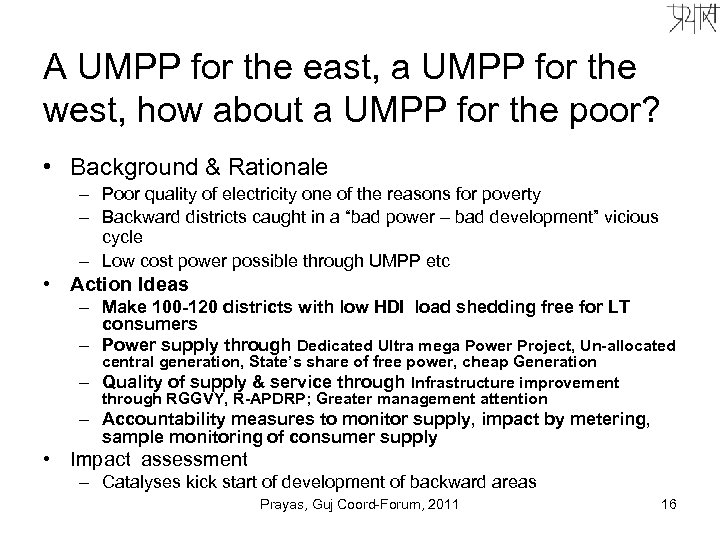 A UMPP for the east, a UMPP for the west, how about a UMPP for the poor? • Background & Rationale – Poor quality of electricity one of the reasons for poverty – Backward districts caught in a “bad power – bad development” vicious cycle – Low cost power possible through UMPP etc • Action Ideas – Make 100 -120 districts with low HDI load shedding free for LT consumers – Power supply through Dedicated Ultra mega Power Project, Un-allocated central generation, State’s share of free power, cheap Generation – Quality of supply & service through Infrastructure improvement through RGGVY, R-APDRP; Greater management attention – Accountability measures to monitor supply, impact by metering, sample monitoring of consumer supply • Impact assessment – Catalyses kick start of development of backward areas Prayas, Guj Coord-Forum, 2011 16
 Power power everywhere, where is the light for homes near the power house? • Background & Rationale – Homes in the vicinity of power plants do not have electricity – Limitations of existing schemes • National Hydro Policy -2008 • Mo. P Scheme of power supply within 5 km of central power house -2010 – Need better and mandatory provisions for all power plants • Action Ideas – All within 5 km of the power house to be given load shedding free power supply – To be done by all projects with 100 MW or more capacity – government or private, hydro, coal, nuclear or renewable – Power supply to support social and economic needs • Impact assessment – Reduce opposition to siting of power plants Prayas, Guj Coord-Forum, 2011 17
 Transparency and equity in load shedding: Share the shortage • Background & Rationale – No Fairness, Transparency and Predictability – Problem for all, but small consumers most effected • Not consulted, longest duration, no predictability • Cannot afford costly back-ups • Action Ideas – Consultative process by SERCs to decide load shedding protocol – Link load shedding duration to AT&C loss – Mechanism to oversee implementation of load shedding protocol • Representative committees • Publication of hourly HT feeder data on DISCOM website • Sample monitoring at consumer locations – Maharashtra, Uttarakhand, Orissa examples • Impact assessment – Consumer satisfaction due to predictability – Equitable use of electricity Prayas, Guj Coord-Forum, 2011 18
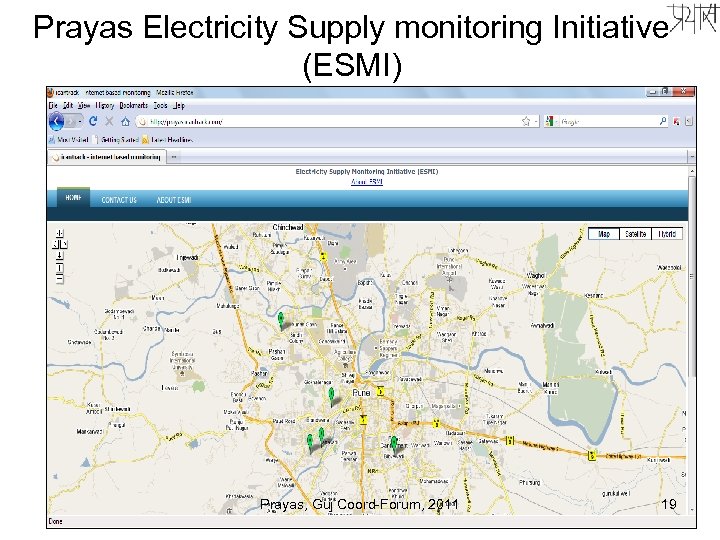 Prayas Electricity Supply monitoring Initiative (ESMI) Prayas, Guj Coord-Forum, 2011 19
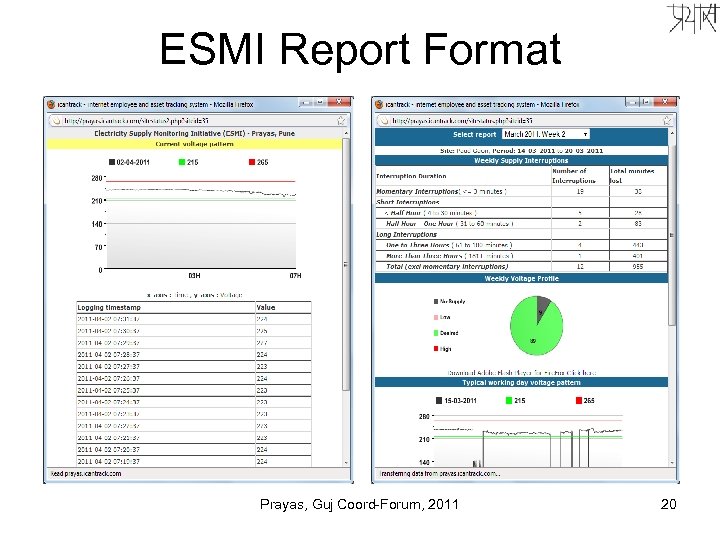 ESMI Report Format Prayas, Guj Coord-Forum, 2011 20
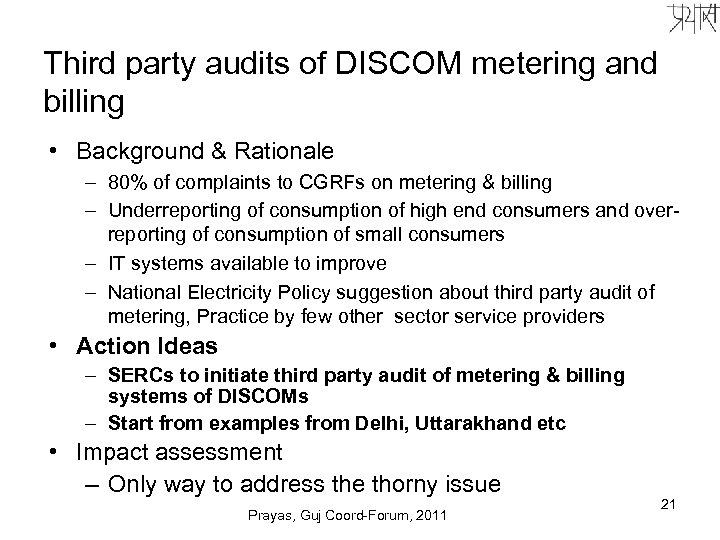 Third party audits of DISCOM metering and billing • Background & Rationale – 80% of complaints to CGRFs on metering & billing – Underreporting of consumption of high end consumers and overreporting of consumption of small consumers – IT systems available to improve – National Electricity Policy suggestion about third party audit of metering, Practice by few other sector service providers • Action Ideas – SERCs to initiate third party audit of metering & billing systems of DISCOMs – Start from examples from Delhi, Uttarakhand etc • Impact assessment – Only way to address the thorny issue Prayas, Guj Coord-Forum, 2011 21
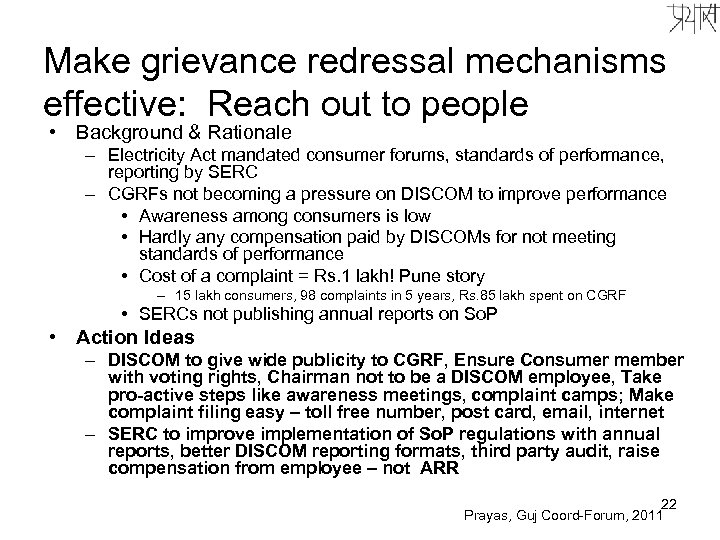 Make grievance redressal mechanisms effective: Reach out to people • Background & Rationale – Electricity Act mandated consumer forums, standards of performance, reporting by SERC – CGRFs not becoming a pressure on DISCOM to improve performance • Awareness among consumers is low • Hardly any compensation paid by DISCOMs for not meeting standards of performance • Cost of a complaint = Rs. 1 lakh! Pune story – 15 lakh consumers, 98 complaints in 5 years, Rs. 85 lakh spent on CGRF • SERCs not publishing annual reports on So. P • Action Ideas – DISCOM to give wide publicity to CGRF, Ensure Consumer member with voting rights, Chairman not to be a DISCOM employee, Take pro-active steps like awareness meetings, complaint camps; Make complaint filing easy – toll free number, post card, email, internet – SERC to improve implementation of So. P regulations with annual reports, better DISCOM reporting formats, third party audit, raise compensation from employee – not ARR 22 Prayas, Guj Coord-Forum, 2011
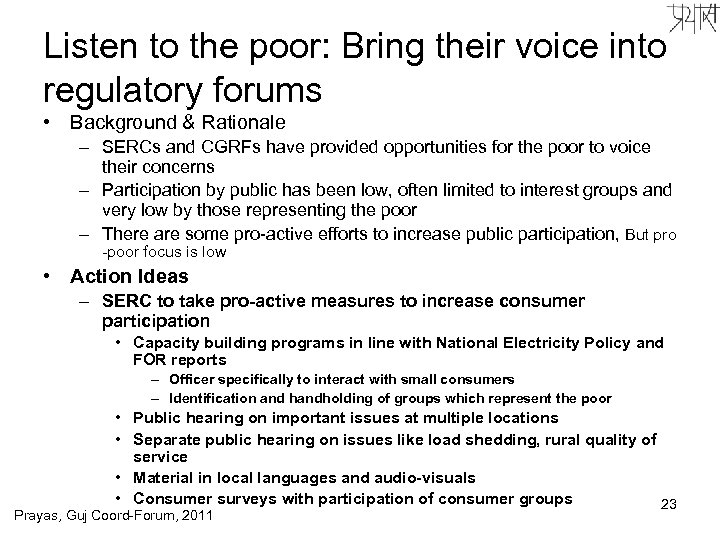 Listen to the poor: Bring their voice into regulatory forums • Background & Rationale – SERCs and CGRFs have provided opportunities for the poor to voice their concerns – Participation by public has been low, often limited to interest groups and very low by those representing the poor – There are some pro-active efforts to increase public participation, But pro -poor focus is low • Action Ideas – SERC to take pro-active measures to increase consumer participation • Capacity building programs in line with National Electricity Policy and FOR reports – Officer specifically to interact with small consumers – Identification and handholding of groups which represent the poor • Public hearing on important issues at multiple locations • Separate public hearing on issues like load shedding, rural quality of service • Material in local languages and audio-visuals • Consumer surveys with participation of consumer groups 23 Prayas, Guj Coord-Forum, 2011
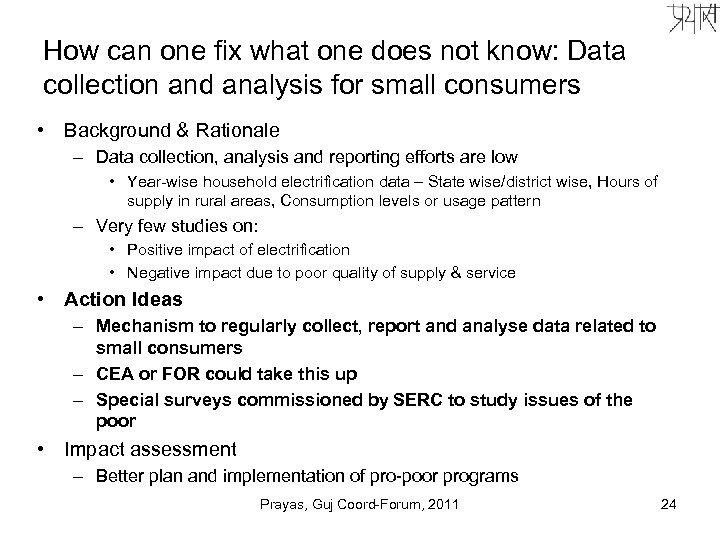 How can one fix what one does not know: Data collection and analysis for small consumers • Background & Rationale – Data collection, analysis and reporting efforts are low • Year-wise household electrification data – State wise/district wise, Hours of supply in rural areas, Consumption levels or usage pattern – Very few studies on: • Positive impact of electrification • Negative impact due to poor quality of supply & service • Action Ideas – Mechanism to regularly collect, report and analyse data related to small consumers – CEA or FOR could take this up – Special surveys commissioned by SERC to study issues of the poor • Impact assessment – Better plan and implementation of pro-poor programs Prayas, Guj Coord-Forum, 2011 24
 What to do next? • These ideas will not solve all problems, but will surely be a good first step • DISCOMs, SERCs, FOR, Governments and Government agencies have roles • Detail and prioritise based on the local context • Start by replicating ideas already implemented in some States • Relevant issues to be simultaneously taken up Prayas, Guj Coord-Forum, 2011 25