


 Скачать презентацию Electrical engineering the meaning of the word
Electrical engineering.pptx
- Количество слайдов: 10
 Electrical engineering
 the meaning of the word Electrical engineering - the branch of science and technology related to the use of electrical and magnetic phenomena for energy conversion, receive, and changes in the composition of chemicals, manufacturing and materials processing; industry, covering the obtaining (production), distribution, conversion and use of electricity.
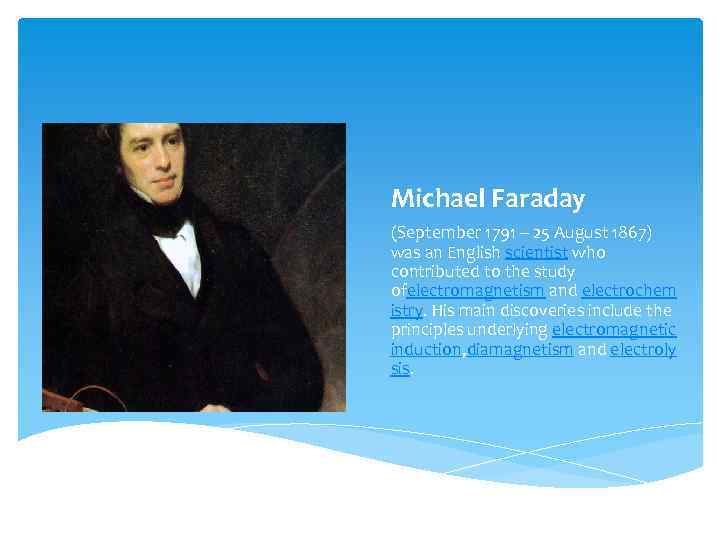 Michael Faraday (September 1791 – 25 August 1867) was an English scientist who contributed to the study ofelectromagnetism and electrochem istry. His main discoveries include the principles underlying electromagnetic induction, diamagnetism and electroly sis.
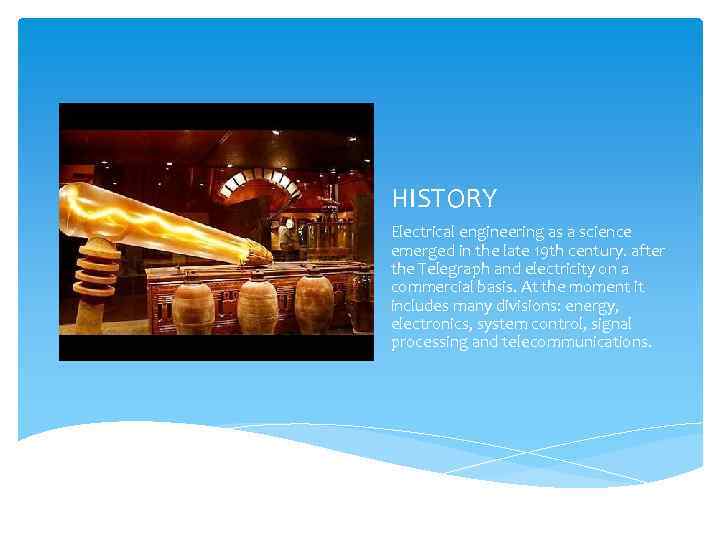 HISTORY Electrical engineering as a science emerged in the late 19 th century. after the Telegraph and electricity on a commercial basis. At the moment it includes many divisions: energy, electronics, system control, signal processing and telecommunications.
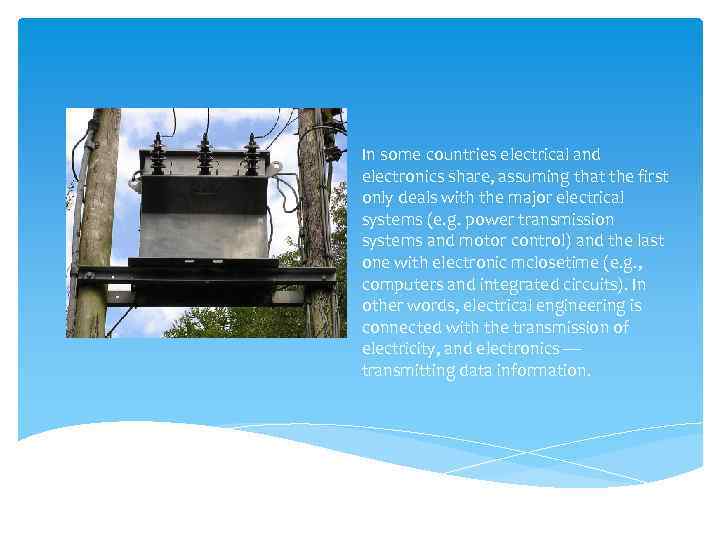 In some countries electrical and electronics share, assuming that the first only deals with the major electrical systems (e. g. power transmission systems and motor control) and the last one with electronic mclosetime (e. g. , computers and integrated circuits). In other words, electrical engineering is connected with the transmission of electricity, and electronics — transmitting data information.
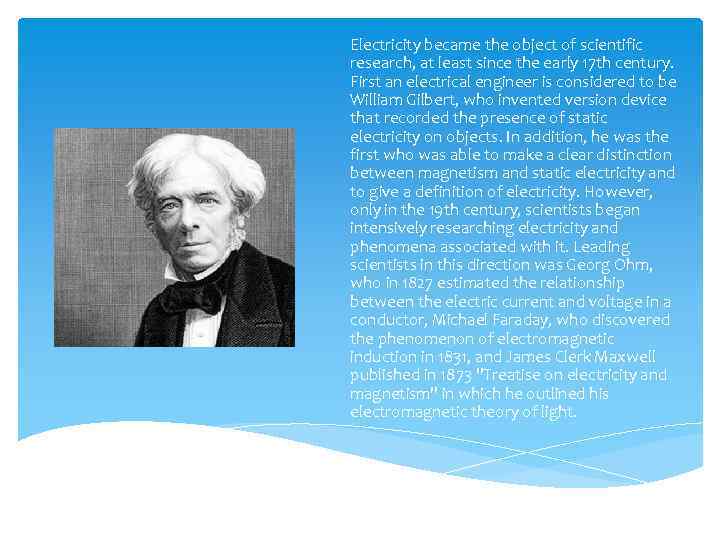 Electricity became the object of scientific research, at least since the early 17 th century. First an electrical engineer is considered to be William Gilbert, who invented version device that recorded the presence of static electricity on objects. In addition, he was the first who was able to make a clear distinction between magnetism and static electricity and to give a definition of electricity. However, only in the 19 th century, scientists began intensively researching electricity and phenomena associated with it. Leading scientists in this direction was Georg Ohm, who in 1827 estimated the relationship between the electric current and voltage in a conductor, Michael Faraday, who discovered the phenomenon of electromagnetic induction in 1831, and James Clerk Maxwell published in 1873 "Treatise on electricity and magnetism" in which he outlined his electromagnetic theory of light.
 Electricity became the object of scientific research, at least since the early 17 th century. First an electrical engineer is considered to be William Gilbert, who invented version device that recorded the presence of static electricity on objects. In addition, he was the first who was able to make a clear distinction between magnetism and static electricity and to give a definition of electricity. However, only in the 19 th century, scientists began intensively researching electricity and phenomena associated with it. Leading scientists in this direction was Georg Ohm, who in 1827 estimated the relationship between the electric current and voltage in a conductor, Michael Faraday, who discovered the phenomenon of electromagnetic induction in 1831, and James Clerk Maxwell published in 1873 "Treatise on electricity and magnetism" in which he outlined his electromagnetic theory of light.
 At that time, the science of electricity and electrical phenomena was considered as a subsection of physics. Only in the late 19 th century, universities began to grant diplomas in the field of electrical engineering. First, the Department and the faculty of electrical engineering was opened at the Darmstadt University of Technology in 1882. In 1883, this University, together with Kornelsky University for the first time in the world introduced a course in electrical engineering. And in 1885 the College of London University opened the first Department of electrical engineering in the UK. Then in 1886 at the University of Missouri and was the first in the United States Department of electrical engineering.
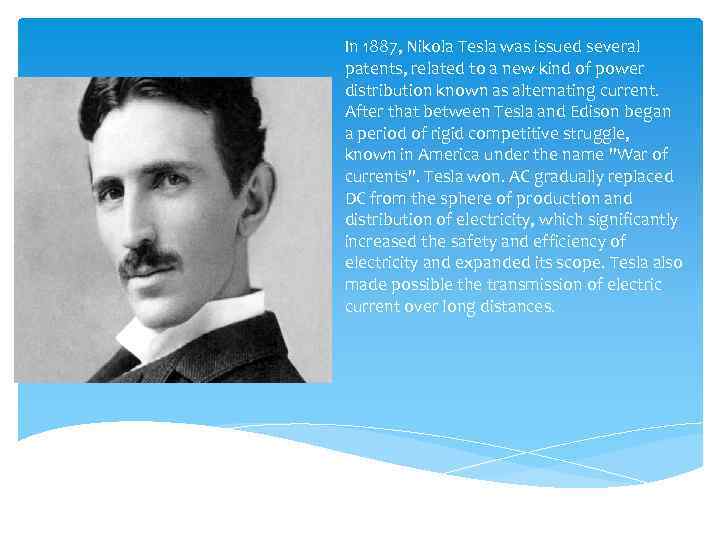 In 1887, Nikola Tesla was issued several patents, related to a new kind of power distribution known as alternating current. After that between Tesla and Edison began a period of rigid competitive struggle, known in America under the name "War of currents". Tesla won. AC gradually replaced DC from the sphere of production and distribution of electricity, which significantly increased the safety and efficiency of electricity and expanded its scope. Tesla also made possible the transmission of electric current over long distances.
 The invention of radio and electronics has contributed many outstanding scientists and inventors. Doing in-depth study of ultra-high frequencies, Heinrich Hertz in 1888 discovered experimentally using electrical equipment the existence of electromagnetic radio waves. In 1895, Nikola Tesla was able to fix the radio signal transferred from his new York lab at a military school West point (a distance of approximately 80. 5 km). Karl Ferdinand Braun in 1897, proposed the use of cathoderay tube in oscilloscope that marked the beginning of the development of television technology. John Ambrose Fleming invented the first vacuum tube or vacuum diode, in 1904. Two years later, Robert von Len (Germany) and Lee de forest (USA) independently from each other invented the amplifier tube, or vacuum triode. In 1920 albert Hull opened the magnetron, which in turn led to the invention of Percy Spencer in 1946, the microwave oven. In 1934 the British military scientists under the direction of Dr. Umpires began the successful development of the first radar (which also uses the magnetron). The work was completed in August 1936 construction Bouds first radar station.