


 Скачать презентацию Electrical Engineering E 6761 Computer Communication Networks Lecture
7bc7fedbd4159d620a030dd1a1560670.ppt
- Количество слайдов: 63
 Electrical Engineering E 6761 Computer Communication Networks Lecture 11 Security Professor Dan Rubenstein Tues 4: 10 -6: 40, Mudd 1127 Course URL: http: //www. cs. columbia. edu/~danr/EE 6761 1
 Reminders r Fill out course evaluation (http: //oracle. seas. columbia. edu) m chance to win a Palm Pilot r Course project m 50% of grade! m Due 12/15 m Include: • • ~10 pg report list of individual contributions include source code written preferred method of delivery: e-mail 2
 Overview Foundations: r what is security? r cryptography r authentication r message integrity r key distribution and certification Security in practice: r application layer: secure e-mail r transport layer: Internet commerce, SSL, SET r network layer: IP security Denial of Service Attacks: r Common attacks r solutions 3
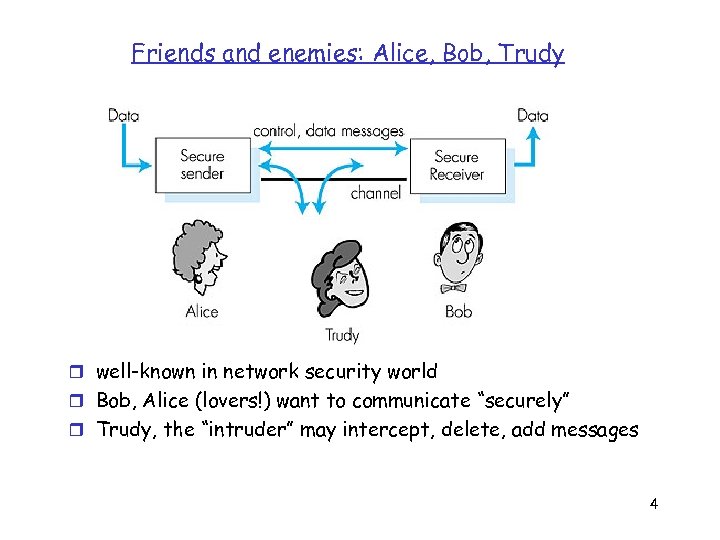 Friends and enemies: Alice, Bob, Trudy Figure 7. 1 goes here r well-known in network security world r Bob, Alice (lovers!) want to communicate “securely” r Trudy, the “intruder” may intercept, delete, add messages 4
 What is network security? Secrecy: only sender, intended receiver should “understand” msg contents m m sender encrypts msg receiver decrypts msg Authentication: sender, receiver want to confirm identity of each other Message Integrity: sender, receiver want to ensure message not altered (in transit, or afterwards) 5
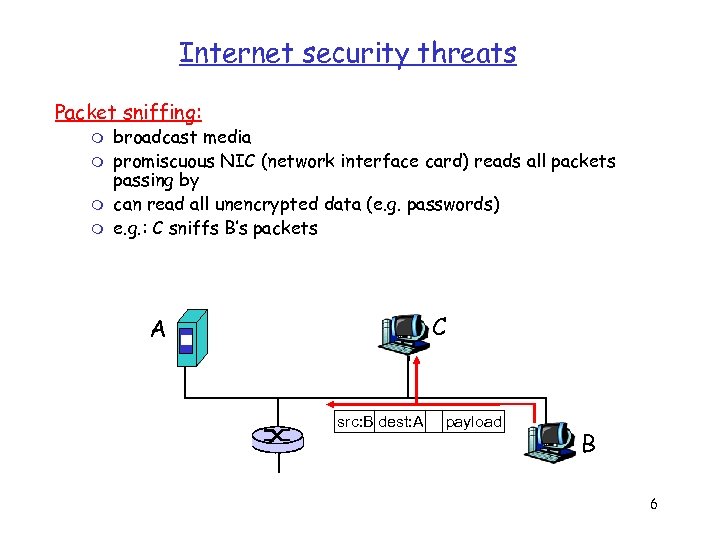 Internet security threats Packet sniffing: m m broadcast media promiscuous NIC (network interface card) reads all packets passing by can read all unencrypted data (e. g. passwords) e. g. : C sniffs B’s packets C A src: B dest: A payload B 6
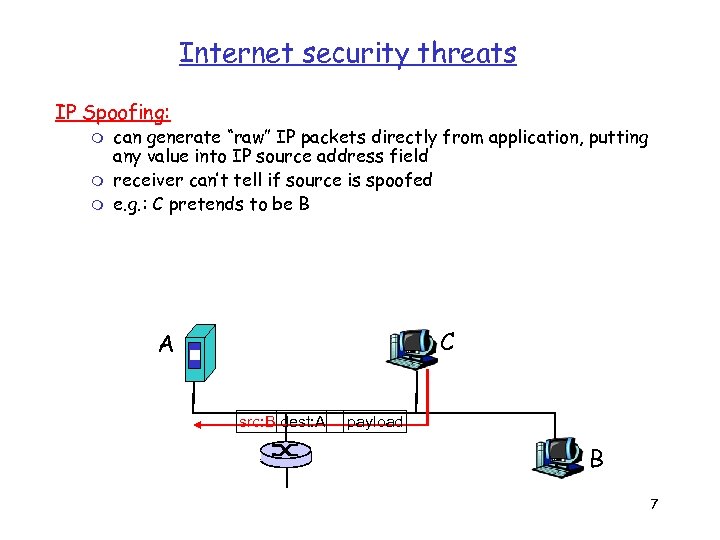 Internet security threats IP Spoofing: m m m can generate “raw” IP packets directly from application, putting any value into IP source address field receiver can’t tell if source is spoofed e. g. : C pretends to be B C A src: B dest: A payload B 7
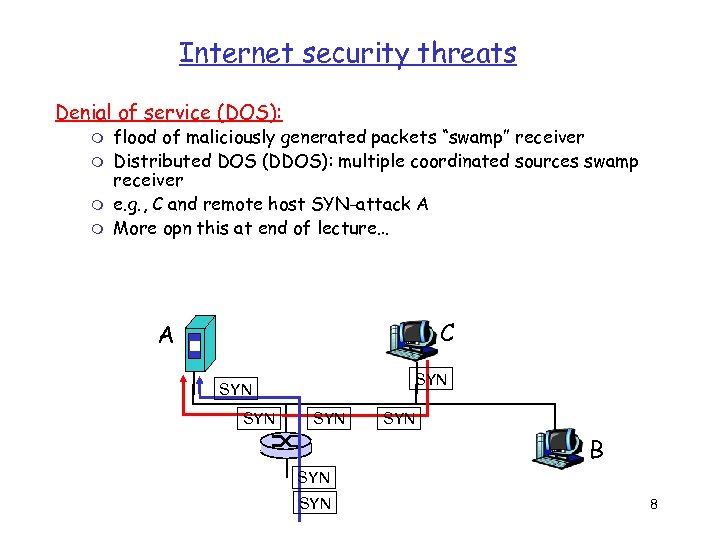 Internet security threats Denial of service (DOS): m m flood of maliciously generated packets “swamp” receiver Distributed DOS (DDOS): multiple coordinated sources swamp receiver e. g. , C and remote host SYN-attack A More opn this at end of lecture… C A SYN SYN SYN B SYN 8
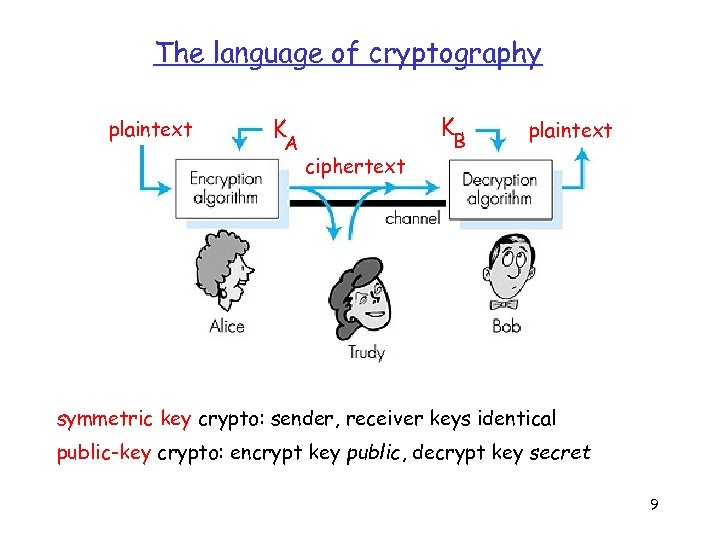 The language of cryptography plaintext K K A ciphertext B plaintext Figure 7. 3 goes here symmetric key crypto: sender, receiver keys identical public-key crypto: encrypt key public, decrypt key secret 9
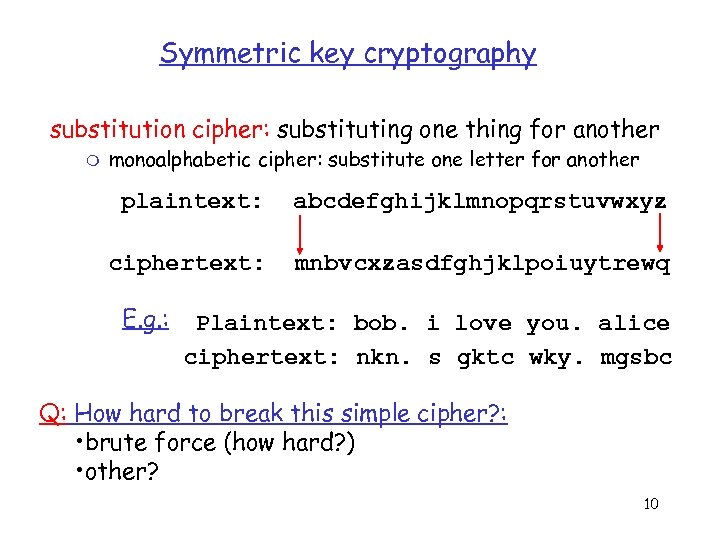 Symmetric key cryptography substitution cipher: substituting one thing for another m monoalphabetic cipher: substitute one letter for another plaintext: abcdefghijklmnopqrstuvwxyz ciphertext: mnbvcxzasdfghjklpoiuytrewq E. g. : Plaintext: bob. i love you. alice ciphertext: nkn. s gktc wky. mgsbc Q: How hard to break this simple cipher? : • brute force (how hard? ) • other? 10
![Symmetric key crypto: DES: Data Encryption Standard r US encryption standard [NIST 1993] r](https://present5.com/presentation/7bc7fedbd4159d620a030dd1a1560670/image-11.jpg "Symmetric key crypto: DES: Data Encryption Standard r US encryption standard [NIST 1993] r") Symmetric key crypto: DES: Data Encryption Standard r US encryption standard [NIST 1993] r 56 -bit symmetric key, 64 bit plaintext input r How secure is DES? m m DES Challenge: 56 -bit-key-encrypted phrase (“Strong cryptography makes the world a safer place”) decrypted (brute force) in 4 months no known “backdoor” decryption approach r making DES more secure m use three keys sequentially (3 -DES) on each datum m use cipher-block chaining 11
Symmetric key crypto: DES: Data Encryption Standard r US encryption standard [NIST 1993] r 56 -bit symmetric key, 64 bit plaintext input r How secure is DES? m m DES Challenge: 56 -bit-key-encrypted phrase (“Strong cryptography makes the world a safer place”) decrypted (brute force) in 4 months no known “backdoor” decryption approach r making DES more secure m use three keys sequentially (3 -DES) on each datum m use cipher-block chaining 11
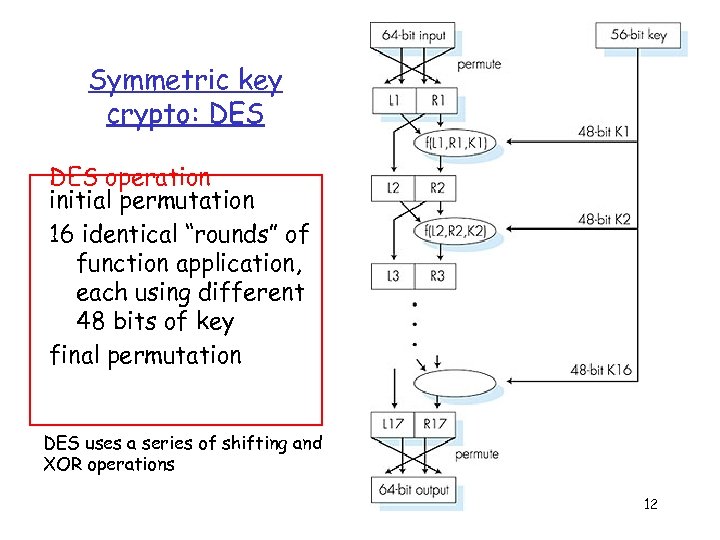 Symmetric key crypto: DES operation initial permutation 16 identical “rounds” of function application, each using different 48 bits of key final permutation DES uses a series of shifting and XOR operations 12
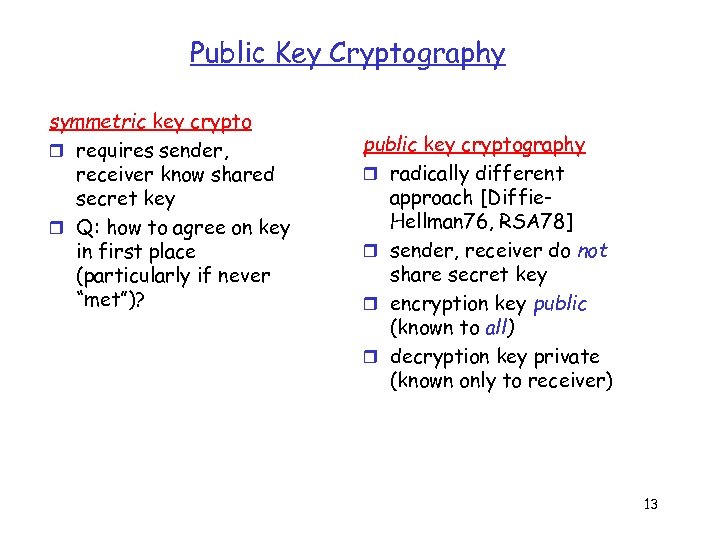 Public Key Cryptography symmetric key crypto r requires sender, receiver know shared secret key r Q: how to agree on key in first place (particularly if never “met”)? public key cryptography r radically different approach [Diffie. Hellman 76, RSA 78] r sender, receiver do not share secret key r encryption key public (known to all) r decryption key private (known only to receiver) 13
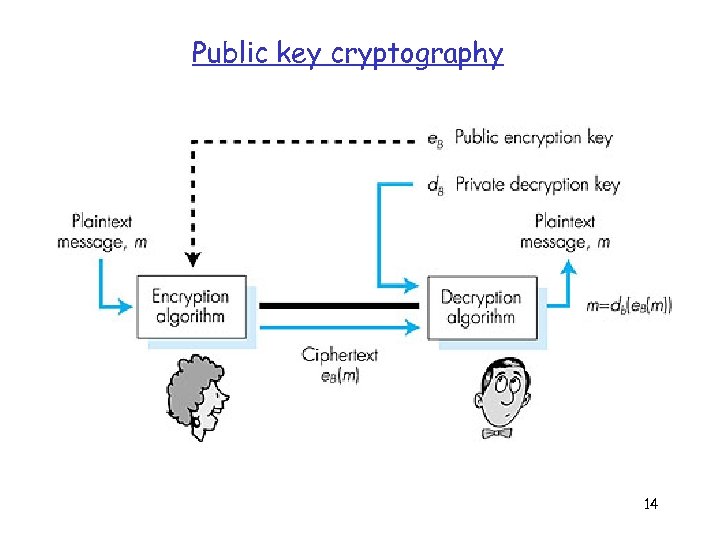 Public key cryptography Figure 7. 7 goes here 14
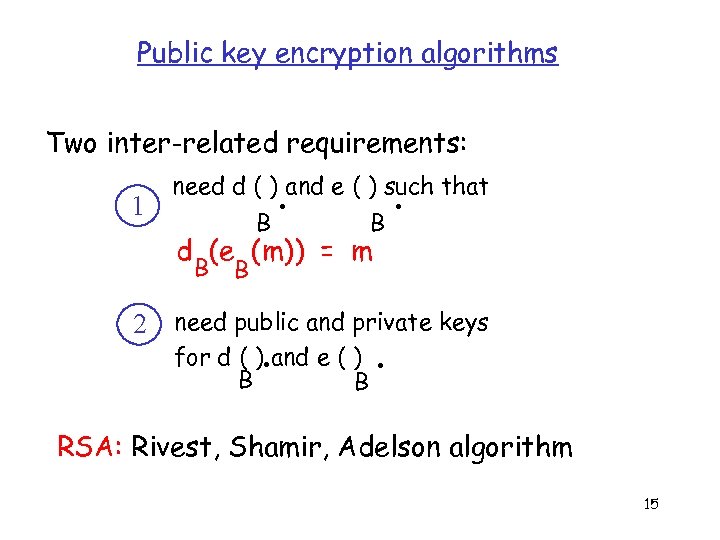 Public key encryption algorithms Two inter-related requirements: 1 . B need d ( ) and e ( ) such that d (e (m)) = m B B 2 need public and private keys . for d ( ) and e ( ) B B . RSA: Rivest, Shamir, Adelson algorithm 15
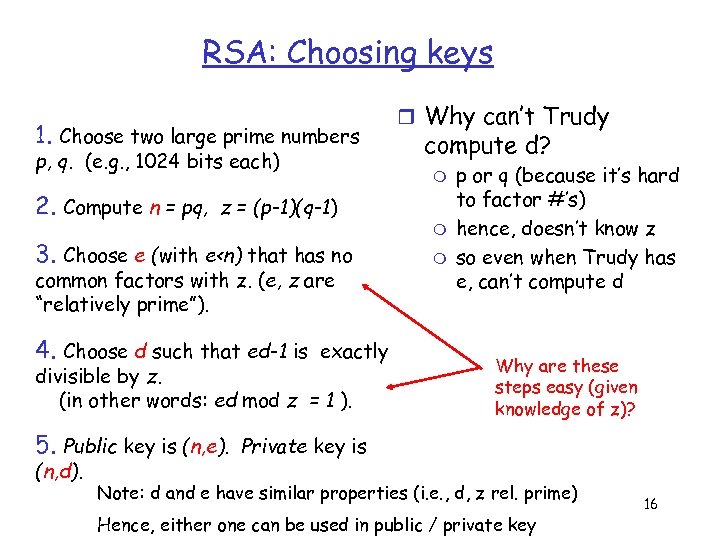 RSA: Choosing keys 1. Choose two large prime numbers p, q. (e. g. , 1024 bits each) r Why can’t Trudy compute d? m 2. Compute n = pq, z = (p-1)(q-1) 3. Choose e (with e
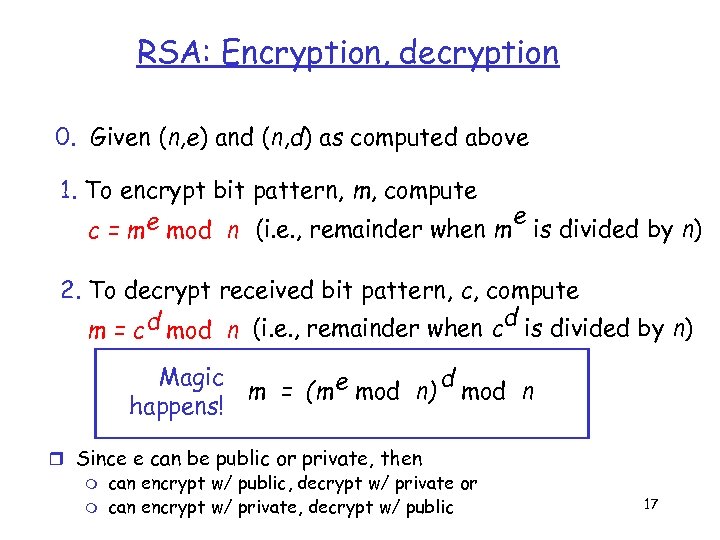 RSA: Encryption, decryption 0. Given (n, e) and (n, d) as computed above 1. To encrypt bit pattern, m, compute e mod n (i. e. , remainder when m e is divided by n) c=m 2. To decrypt received bit pattern, c, compute d m = c d mod n (i. e. , remainder when c is divided by n) Magic d m = (m e mod n) mod n happens! r Since e can be public or private, then m can encrypt w/ public, decrypt w/ private or m can encrypt w/ private, decrypt w/ public 17
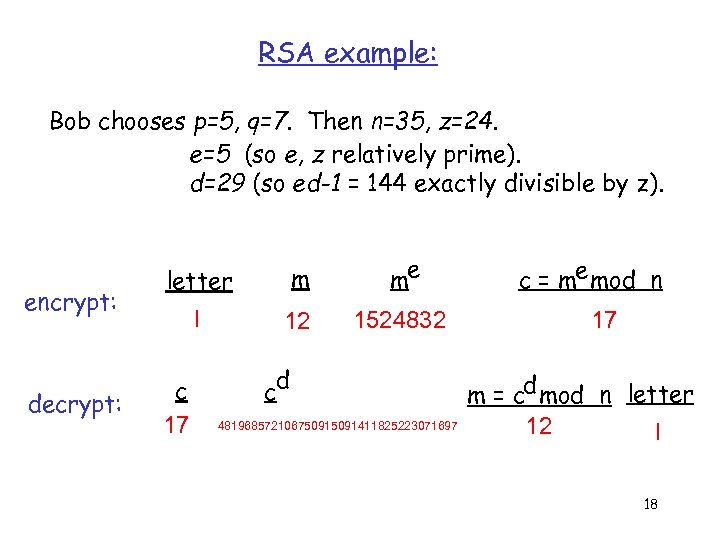 RSA example: Bob chooses p=5, q=7. Then n=35, z=24. e=5 (so e, z relatively prime). d=29 (so ed-1 = 144 exactly divisible by z). encrypt: decrypt: letter m me l 12 1524832 c 17 d c 48196857210675091411825223071697 c = me mod n 17 m = cd mod n letter 12 l 18
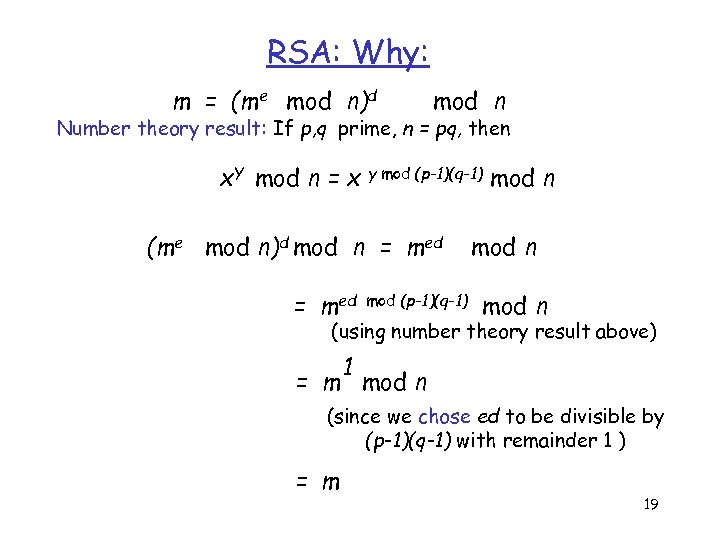 RSA: Why: m = (me mod n)d mod n Number theory result: If p, q prime, n = pq, then x. Y mod n = x y mod (p-1)(q-1) (me mod n)d mod n = med mod (p-1)(q-1) mod n (using number theory result above) 1 = m mod n (since we chose ed to be divisible by (p-1)(q-1) with remainder 1 ) = m 19
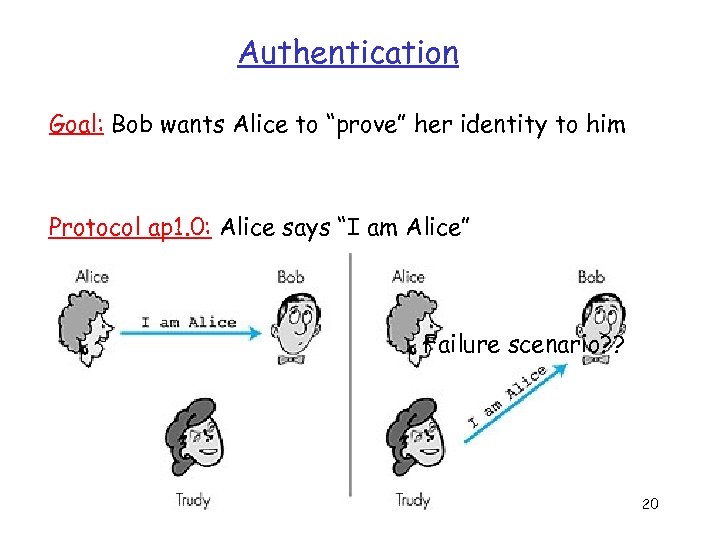 Authentication Goal: Bob wants Alice to “prove” her identity to him Protocol ap 1. 0: Alice says “I am Alice” Failure scenario? ? 20
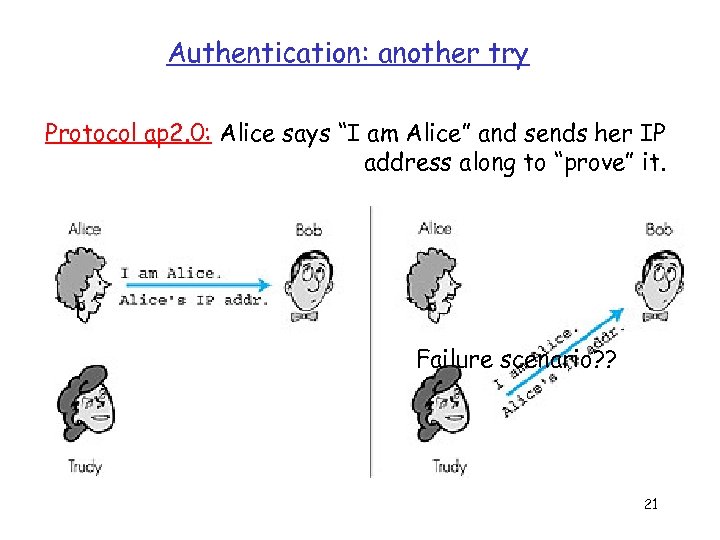 Authentication: another try Protocol ap 2. 0: Alice says “I am Alice” and sends her IP address along to “prove” it. Failure scenario? ? 21
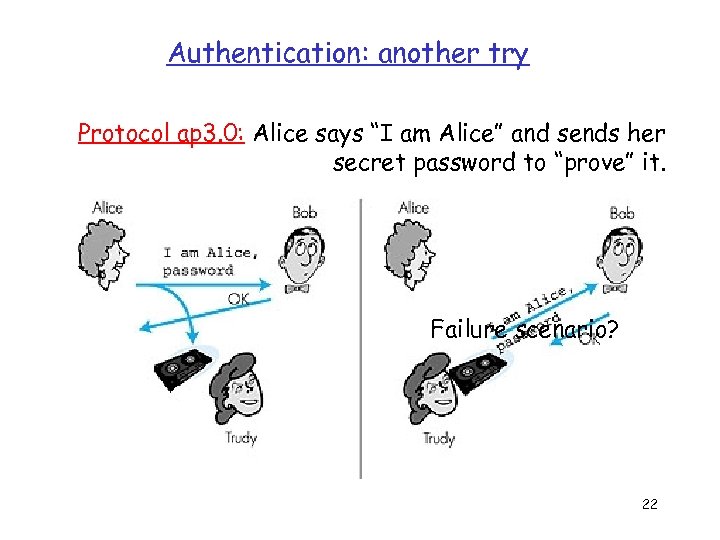 Authentication: another try Protocol ap 3. 0: Alice says “I am Alice” and sends her secret password to “prove” it. Failure scenario? 22
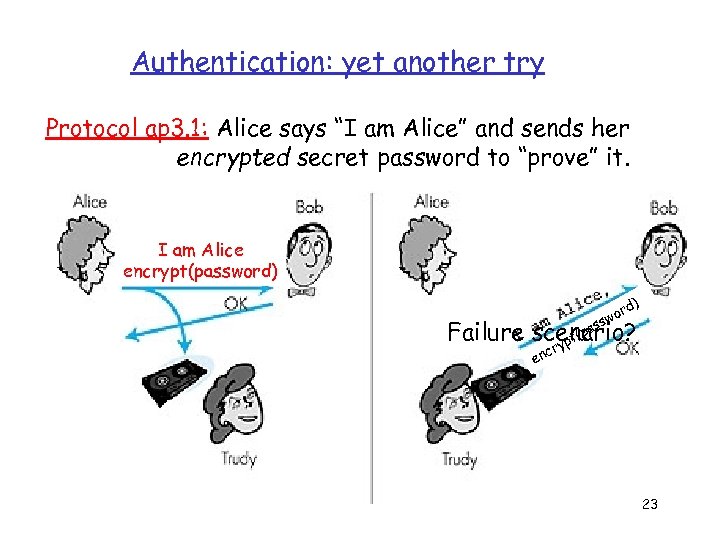 Authentication: yet another try Protocol ap 3. 1: Alice says “I am Alice” and sends her encrypted secret password to “prove” it. I am Alice encrypt(password) ) rd o ssw pa Failure scenario? pt( y cr en 23
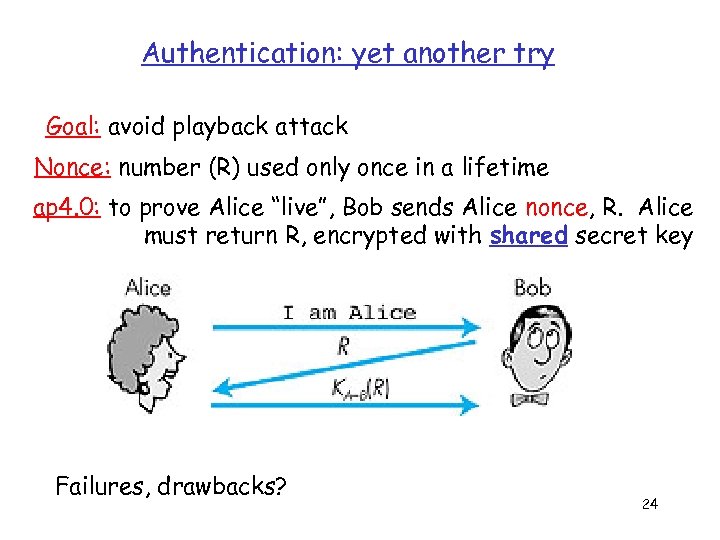 Authentication: yet another try Goal: avoid playback attack Nonce: number (R) used only once in a lifetime ap 4. 0: to prove Alice “live”, Bob sends Alice nonce, R. Alice must return R, encrypted with shared secret key Figure 7. 11 goes here Failures, drawbacks? 24
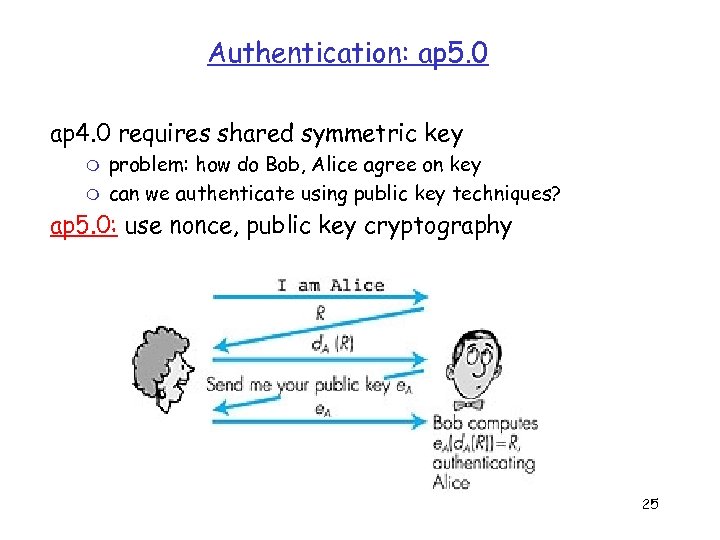 Authentication: ap 5. 0 ap 4. 0 requires shared symmetric key m m problem: how do Bob, Alice agree on key can we authenticate using public key techniques? ap 5. 0: use nonce, public key cryptography Figure 7. 12 goes here 25
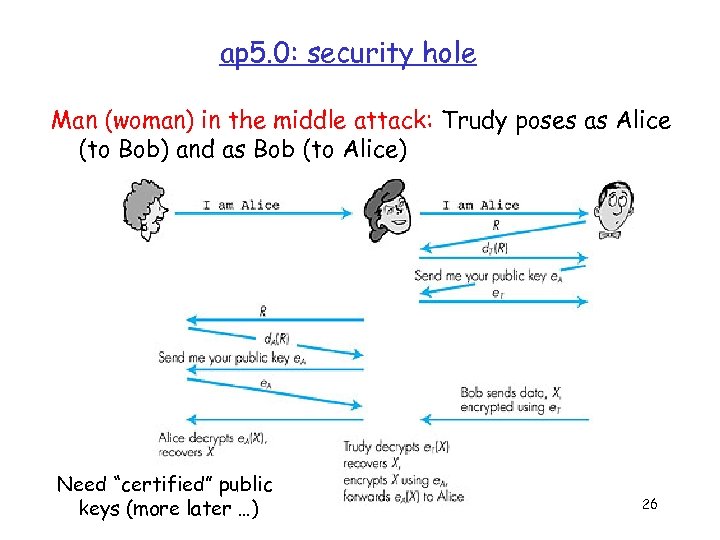 ap 5. 0: security hole Man (woman) in the middle attack: Trudy poses as Alice (to Bob) and as Bob (to Alice) Figure 7. 14 goes here Need “certified” public keys (more later …) 26
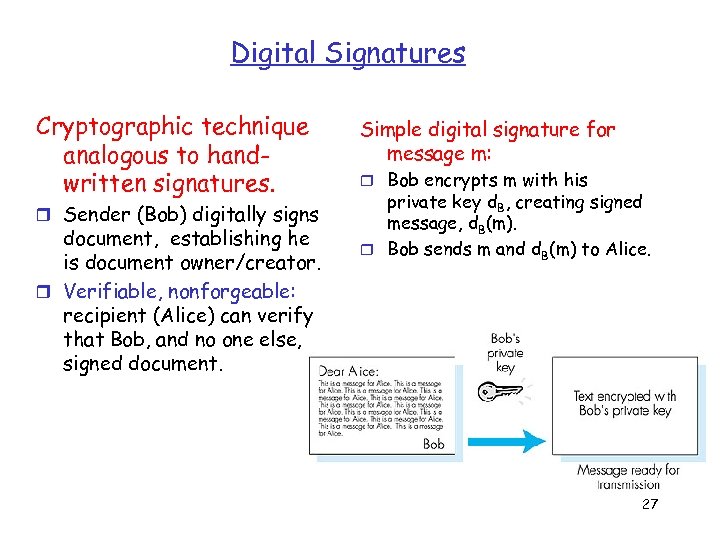 Digital Signatures Cryptographic technique analogous to handwritten signatures. r Sender (Bob) digitally signs document, establishing he is document owner/creator. r Verifiable, nonforgeable: recipient (Alice) can verify that Bob, and no one else, signed document. Simple digital signature for message m: r Bob encrypts m with his private key d. B, creating signed message, d. B(m). r Bob sends m and d. B(m) to Alice. 27
 Digital Signatures (more) r Suppose Alice receives msg Alice thus verifies that: m, and digital signature m Bob signed m. d. B(m) m No one else signed m. r Alice verifies m signed by m Bob signed m and not m’. Bob by applying Bob’s public key e. B to d. B(m) then checks Non-repudiation: m Alice can take m, and e. B(d. B(m) ) = m. signature d. B(m) to court and r If e. B(d. B(m) ) = m, whoever prove that Bob signed m must have used Bob’s private key. 28
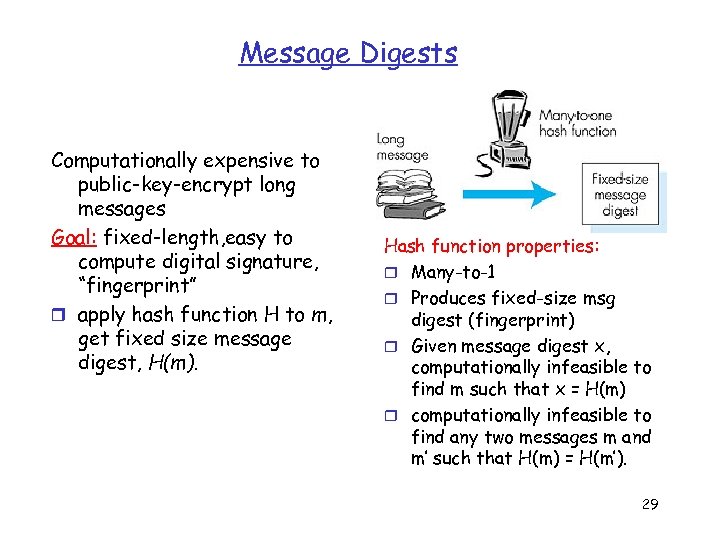 Message Digests Computationally expensive to public-key-encrypt long messages Goal: fixed-length, easy to compute digital signature, “fingerprint” r apply hash function H to m, get fixed size message digest, H(m). Hash function properties: r Many-to-1 r Produces fixed-size msg digest (fingerprint) r Given message digest x, computationally infeasible to find m such that x = H(m) r computationally infeasible to find any two messages m and m’ such that H(m) = H(m’). 29
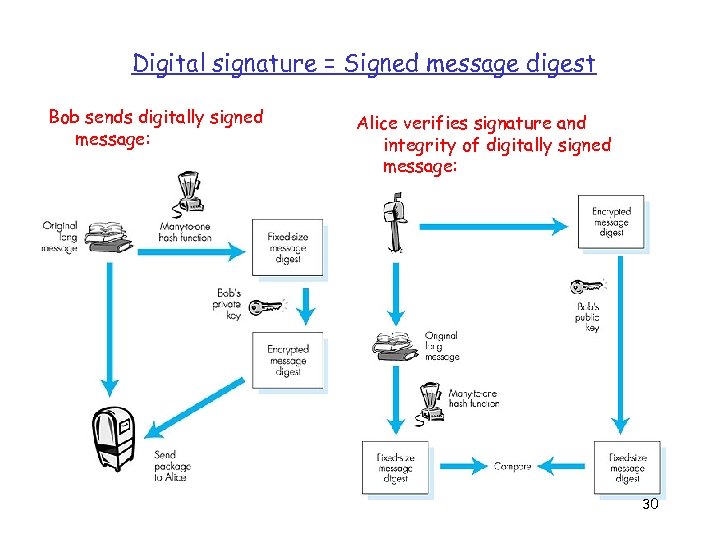 Digital signature = Signed message digest Bob sends digitally signed message: Alice verifies signature and integrity of digitally signed message: 30
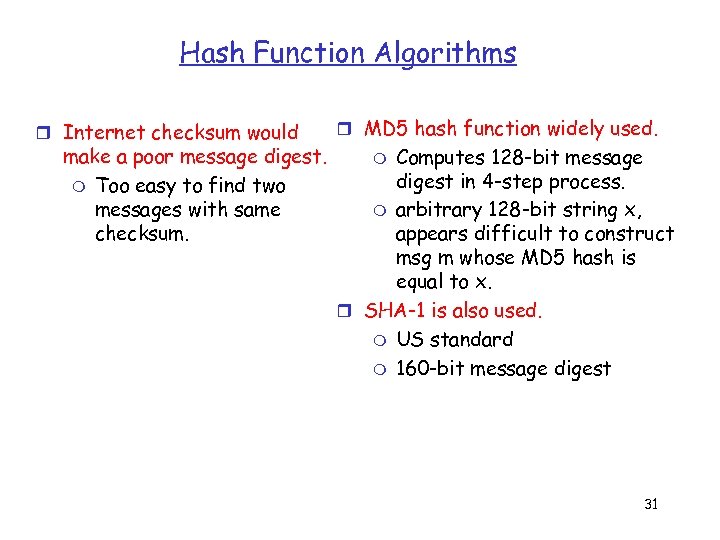 Hash Function Algorithms r Internet checksum would make a poor message digest. m Too easy to find two messages with same checksum. r MD 5 hash function widely used. Computes 128 -bit message digest in 4 -step process. m arbitrary 128 -bit string x, appears difficult to construct msg m whose MD 5 hash is equal to x. r SHA-1 is also used. m US standard m 160 -bit message digest m 31
 Encrypting long-lived sessions r Session may be transmitted using numerous packets r Problem: Public/Private key encryption/decryption a slow expensive process, DES encryption takes much less time r Q: How can a session be encrypted efficiently (e. g. , via DES) without forcing participants to find trusted medium to exchange a shared session key? 32
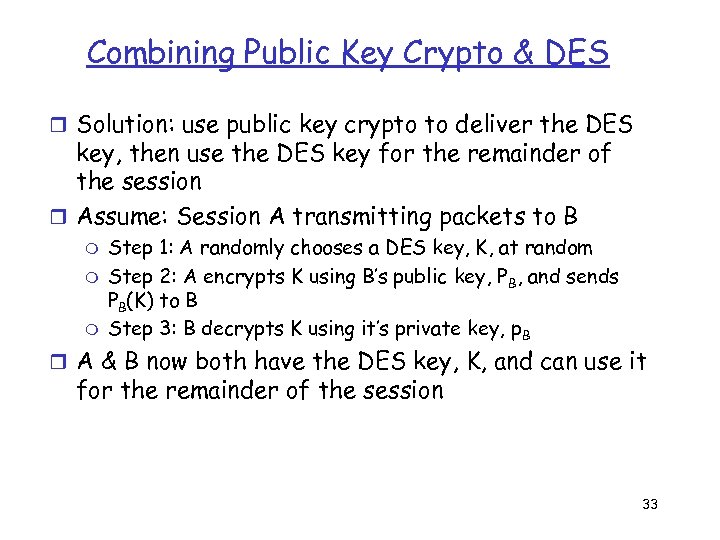 Combining Public Key Crypto & DES r Solution: use public key crypto to deliver the DES key, then use the DES key for the remainder of the session r Assume: Session A transmitting packets to B m m m Step 1: A randomly chooses a DES key, K, at random Step 2: A encrypts K using B’s public key, PB, and sends PB(K) to B Step 3: B decrypts K using it’s private key, p. B r A & B now both have the DES key, K, and can use it for the remainder of the session 33
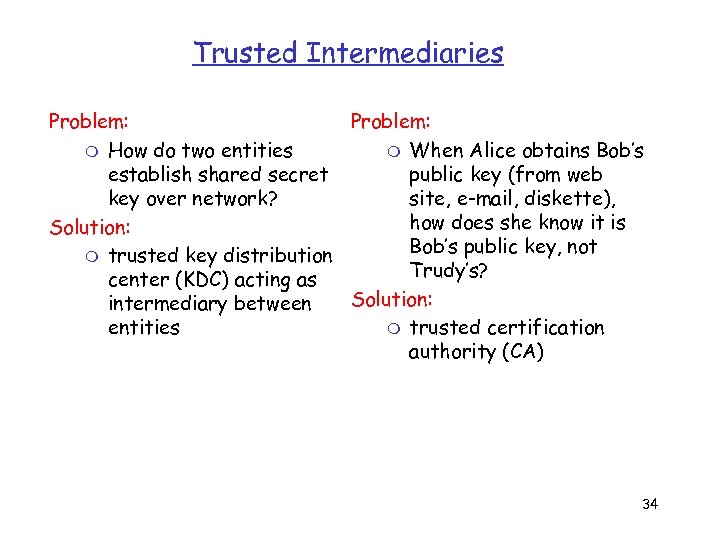 Trusted Intermediaries Problem: m How do two entities m When Alice obtains Bob’s establish shared secret public key (from web key over network? site, e-mail, diskette), how does she know it is Solution: Bob’s public key, not m trusted key distribution Trudy’s? center (KDC) acting as Solution: intermediary between entities m trusted certification authority (CA) 34
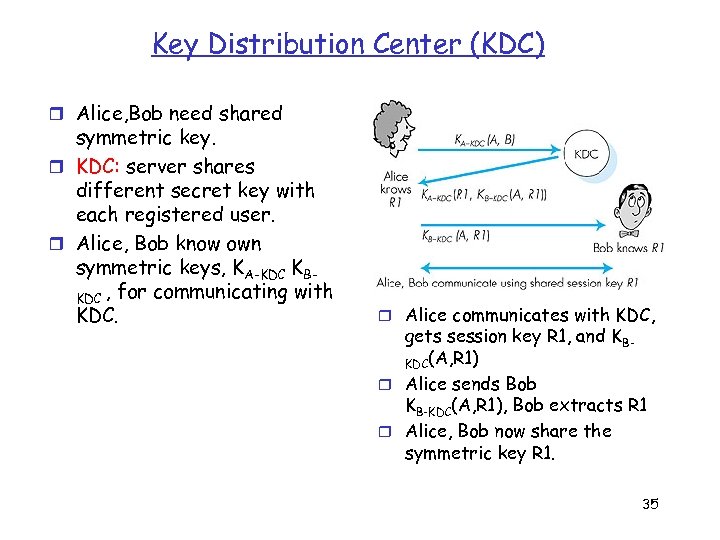 Key Distribution Center (KDC) r Alice, Bob need shared symmetric key. r KDC: server shares different secret key with each registered user. r Alice, Bob know own symmetric keys, KA-KDC KBKDC , for communicating with KDC. r Alice communicates with KDC, gets session key R 1, and KBKDC(A, R 1) r Alice sends Bob KB-KDC(A, R 1), Bob extracts R 1 r Alice, Bob now share the symmetric key R 1. 35
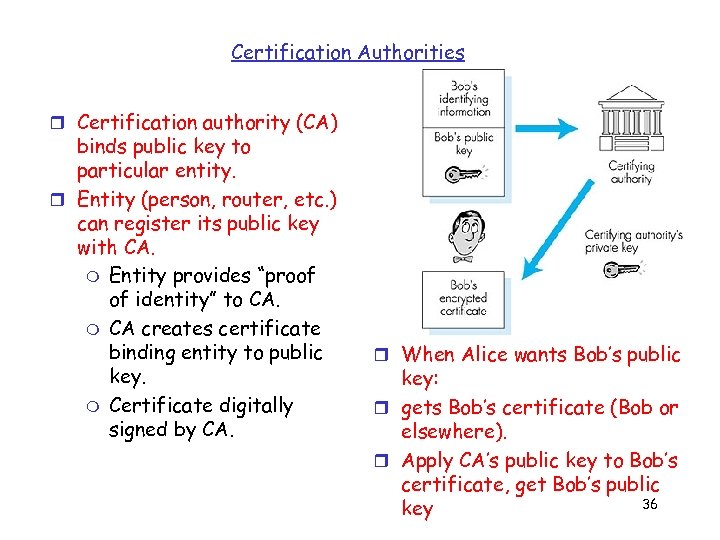 Certification Authorities r Certification authority (CA) binds public key to particular entity. r Entity (person, router, etc. ) can register its public key with CA. m Entity provides “proof of identity” to CA. m CA creates certificate binding entity to public key. m Certificate digitally signed by CA. r When Alice wants Bob’s public key: r gets Bob’s certificate (Bob or elsewhere). r Apply CA’s public key to Bob’s certificate, get Bob’s public 36 key
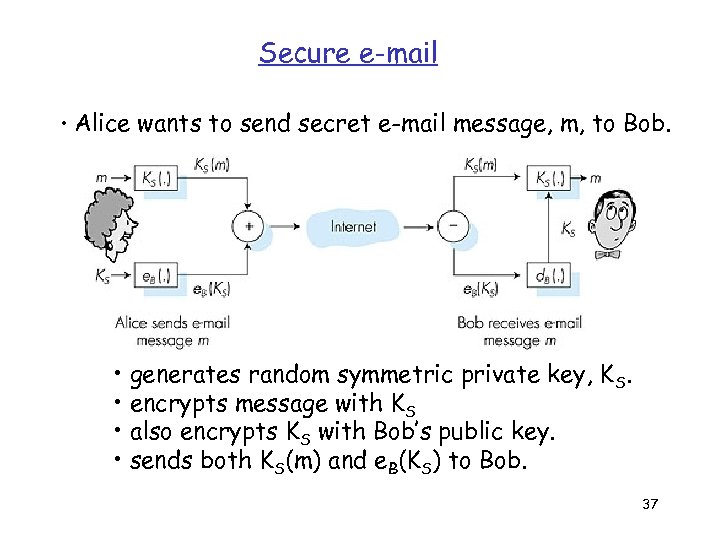 Secure e-mail • Alice wants to send secret e-mail message, m, to Bob. • generates random symmetric private key, KS. • encrypts message with KS • also encrypts KS with Bob’s public key. • sends both KS(m) and e. B(KS) to Bob. 37
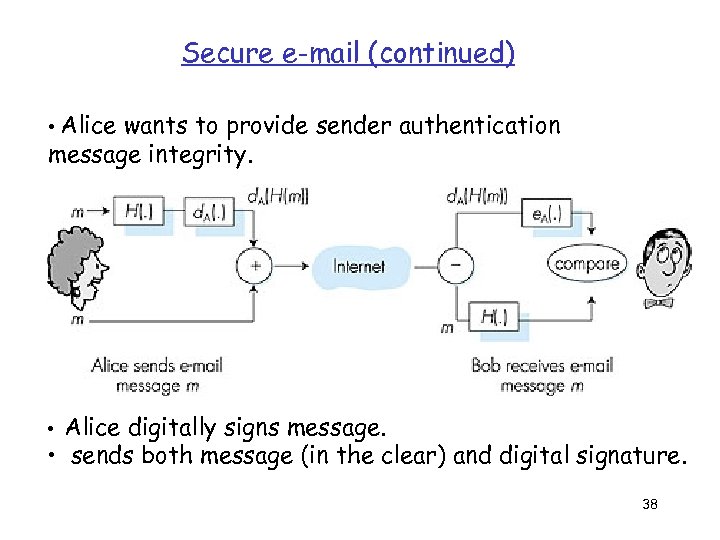 Secure e-mail (continued) • Alice wants to provide sender authentication message integrity. • Alice digitally signs message. • sends both message (in the clear) and digital signature. 38
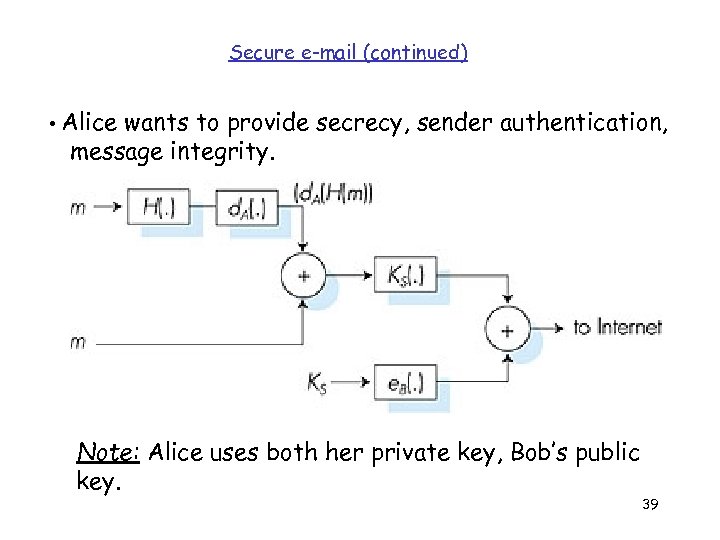 Secure e-mail (continued) • Alice wants to provide secrecy, sender authentication, message integrity. Note: Alice uses both her private key, Bob’s public key. 39
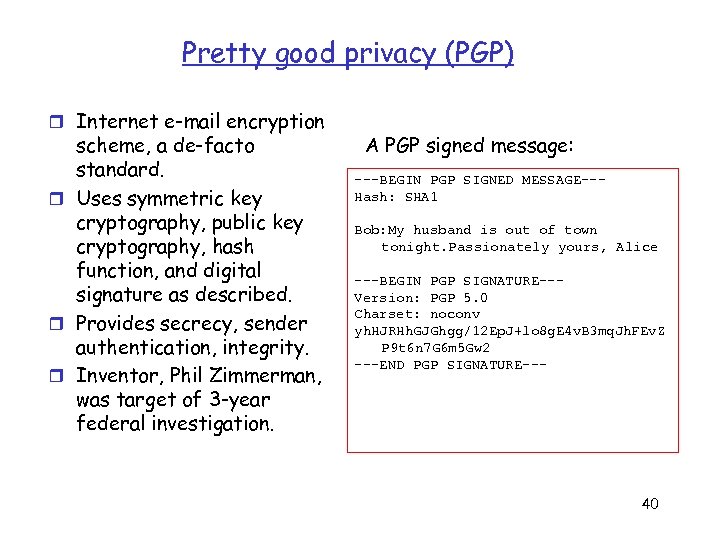 Pretty good privacy (PGP) r Internet e-mail encryption scheme, a de-facto standard. r Uses symmetric key cryptography, public key cryptography, hash function, and digital signature as described. r Provides secrecy, sender authentication, integrity. r Inventor, Phil Zimmerman, was target of 3 -year federal investigation. A PGP signed message: ---BEGIN PGP SIGNED MESSAGE--Hash: SHA 1 Bob: My husband is out of town tonight. Passionately yours, Alice ---BEGIN PGP SIGNATURE--Version: PGP 5. 0 Charset: noconv yh. HJRHh. GJGhgg/12 Ep. J+lo 8 g. E 4 v. B 3 mq. Jh. FEv. Z P 9 t 6 n 7 G 6 m 5 Gw 2 ---END PGP SIGNATURE--- 40
 Secure sockets layer (SSL) r PGP provides security for a specific network app. r SSL works at transport layer. Provides security to any TCP-based app using SSL services. r SSL: used between WWW browsers, servers for Icommerce (https). r SSL security services: m m m r Server authentication: m SSL-enabled browser includes public keys for trusted CAs. m Browser requests server certificate, issued by trusted CA. m Browser uses CA’s public key to extract server’s public key from certificate. r Visit your browser’s security menu to see its trusted CAs. server authentication data encryption client authentication (optional) 41
 SSL (continued) Encrypted SSL session: r Browser generates symmetric session key, encrypts it with server’s public key, sends encrypted key to server. r Using its private key, server decrypts session key. r Browser, server agree that future msgs will be encrypted. r All data sent into TCP socket (by client or server) is encrypted with session key. r SSL: basis of IETF Transport Layer Security (TLS). r SSL can be used for non-Web applications, e. g. , IMAP. r Client authentication can be done with client certificates. 42
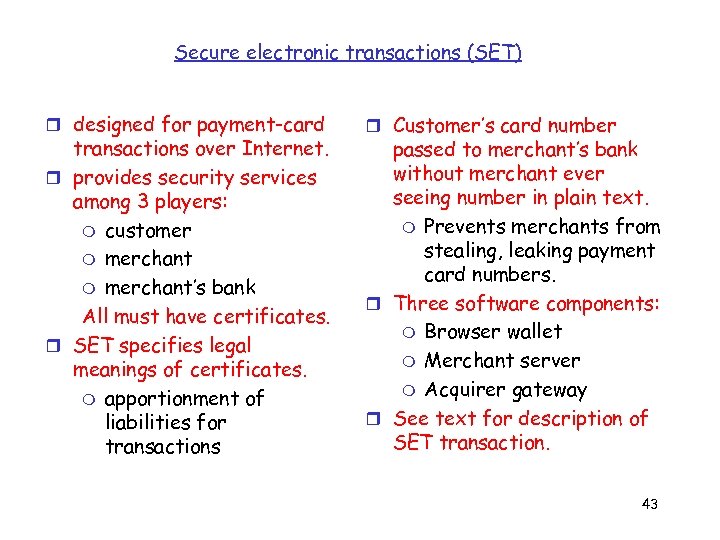 Secure electronic transactions (SET) r designed for payment-card transactions over Internet. r provides security services among 3 players: m customer m merchant’s bank All must have certificates. r SET specifies legal meanings of certificates. m apportionment of liabilities for transactions r Customer’s card number passed to merchant’s bank without merchant ever seeing number in plain text. m Prevents merchants from stealing, leaking payment card numbers. r Three software components: m Browser wallet m Merchant server m Acquirer gateway r See text for description of SET transaction. 43
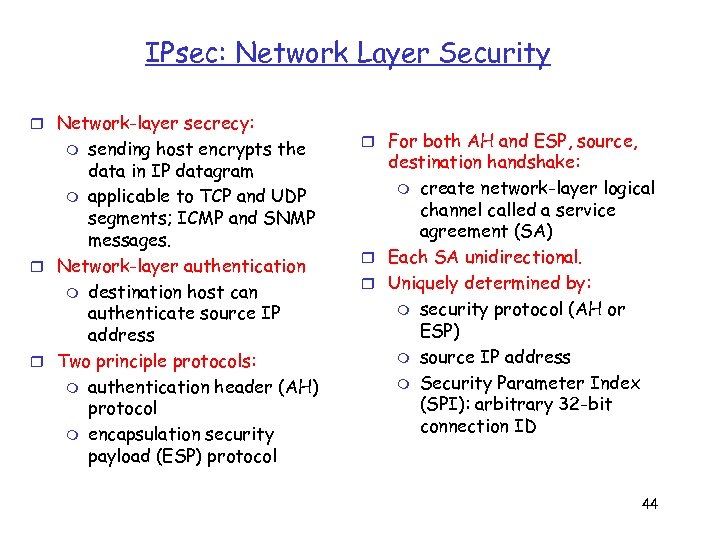 IPsec: Network Layer Security r Network-layer secrecy: sending host encrypts the data in IP datagram m applicable to TCP and UDP segments; ICMP and SNMP messages. r Network-layer authentication m destination host can authenticate source IP address r Two principle protocols: m authentication header (AH) protocol m encapsulation security payload (ESP) protocol m r For both AH and ESP, source, destination handshake: m create network-layer logical channel called a service agreement (SA) r Each SA unidirectional. r Uniquely determined by: m security protocol (AH or ESP) m source IP address m Security Parameter Index (SPI): arbitrary 32 -bit connection ID 44
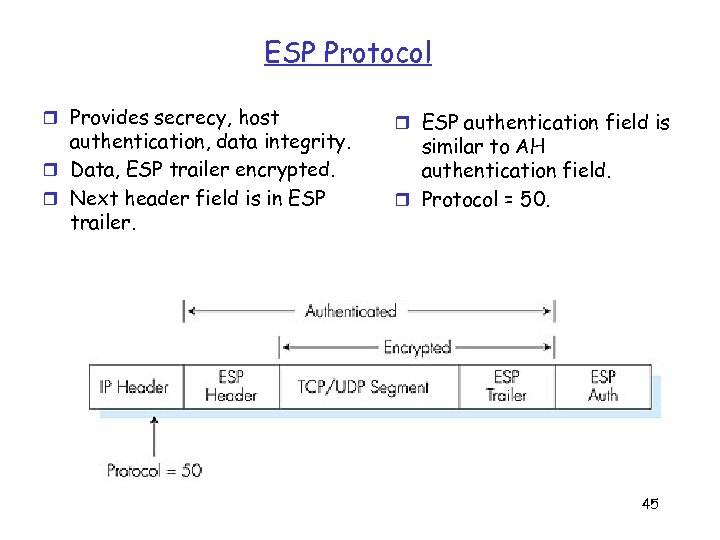 ESP Protocol r Provides secrecy, host authentication, data integrity. r Data, ESP trailer encrypted. r Next header field is in ESP trailer. r ESP authentication field is similar to AH authentication field. r Protocol = 50. 45
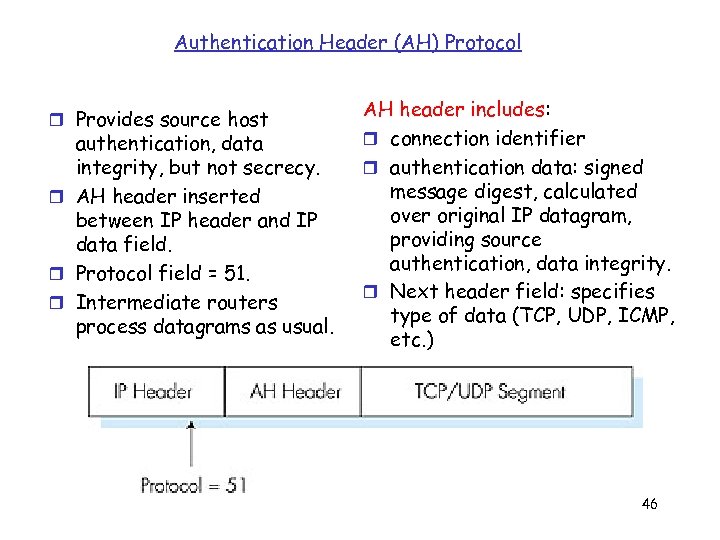 Authentication Header (AH) Protocol r Provides source host authentication, data integrity, but not secrecy. r AH header inserted between IP header and IP data field. r Protocol field = 51. r Intermediate routers process datagrams as usual. AH header includes: r connection identifier r authentication data: signed message digest, calculated over original IP datagram, providing source authentication, data integrity. r Next header field: specifies type of data (TCP, UDP, ICMP, etc. ) 46
 Attacks and Attack Prevention r Problem: there exist users who want to compromise security of a system m monetary gain (theft) political gain fun / prestige in the hacker community r If legitimate users can access a system, so can illegitimate users m m luck (guess a password) find flaws in system security and crack through r Fact: As systems become more complex, more loopholes are created that permit break-ins m e. g. , anonymous ftp to a system w/ relaxed file permission settings 47
 Denial of Service Attacks r Def: Do. S is prevention of use of a service by legitimate users, e. g. , by m m m flooding of traffic on the network, “drowning” legitimate traffic disrupting a connection between 2 machines preventing an individual from accessing a service r Compared to other attacks: m less damaging: user does not try to steal or erase info m harder to stop: simply involves sending lots of traffic 48
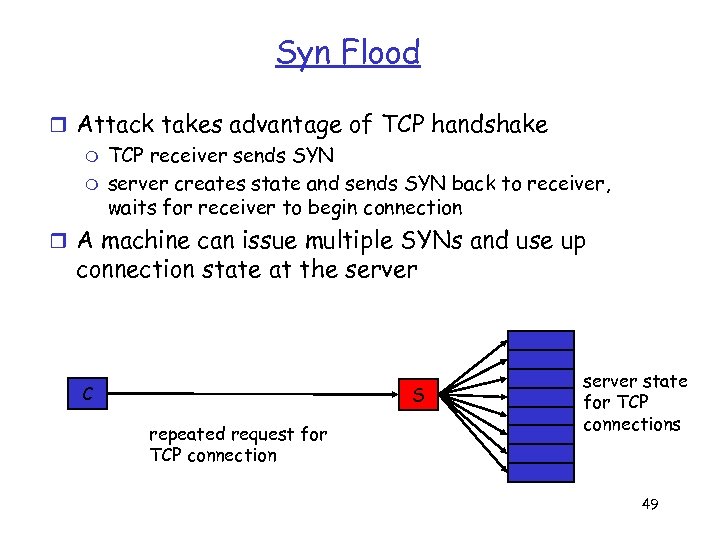 Syn Flood r Attack takes advantage of TCP handshake m TCP receiver sends SYN m server creates state and sends SYN back to receiver, waits for receiver to begin connection r A machine can issue multiple SYNs and use up connection state at the server C S repeated request for TCP connection server state for TCP connections 49
 Preventing Syn Floods r Limit rate of connections from given address m Problem: receivers can perform IP spoofing: use fake source address m no confirmation of source address provided m Q: why doesn’t IPsec solve the problem? r Use nonces, e. g. , : m step 1: rcvr sends SYN m step 2: sender chooses random # n and sends to rcvr m step 3: rcvr sends SYN w/ n m Problem: sender must keep nonce state – not much help over keeping SYN state r What may help: Prevent spoofing or identify actual location of spoofers 50
 Preventing Spoofing r Goal: if a packet has a fake source address, it should be dropped r CISCO routers provide “Verify Reverse Path” m m m a packet P with source address S should only be accepted on interface i if a packet P with destination address P is forwarded out on interface i Recall: reverse-path forwarding is what is used by multicast routing protocols Problem: • Verify Reverse Path assumes that routing is symmetric • Otherwise, likely to block legitimate traffic 51
 Tracking Do. S attacks that use spoofing r Goal: identify location where the Do. S attack is coming from r Observation: Do. S attacks transmit lots of packets r Assumptions m m attack mounted from single point (note: in practice, attacks often consist of coordinated transmission from distributed set of hosts) attack packets can be distinguished from regular traffic 52
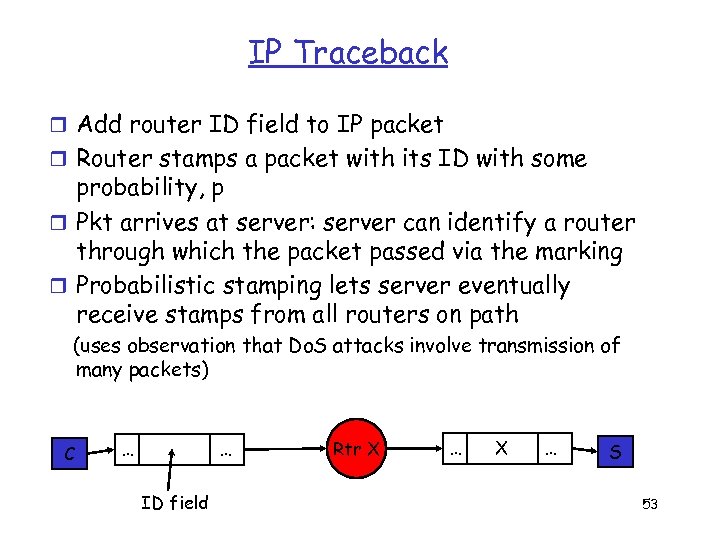 IP Traceback r Add router ID field to IP packet r Router stamps a packet with its ID with some probability, p r Pkt arrives at server: server can identify a router through which the packet passed via the marking r Probabilistic stamping lets server eventually receive stamps from all routers on path (uses observation that Do. S attacks involve transmission of many packets) C … … ID field Rtr X … S 53
 Problems with IP traceback r Have router ID’s but don’t know the path (i. e. , the order in which routers are traversed from client to server) r Also, what if m m routers are involved in Do. S attack? client sticks in fake router ID? r Is there still a way to make use of this probabilistic stamping approach? 54
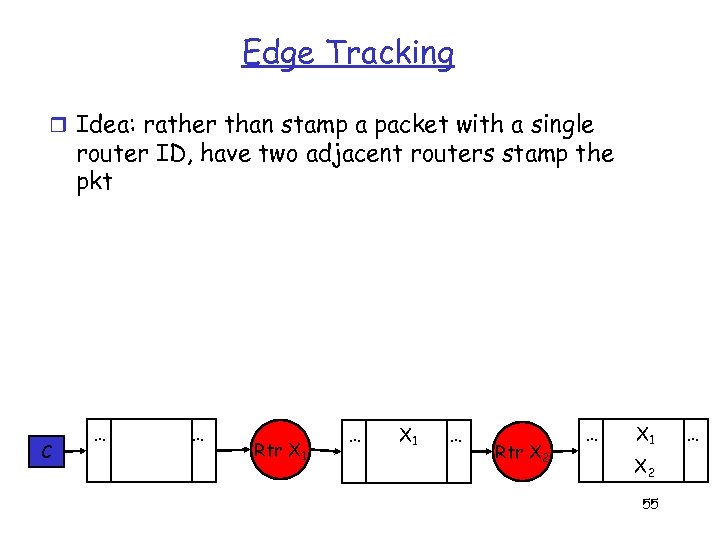 Edge Tracking r Idea: rather than stamp a packet with a single router ID, have two adjacent routers stamp the pkt C … … Rtr X 1 … Rtr X 2 … X 1 X 2 55 …
 Edge Tracking r Add additional bit and additional router tag field r initially set bit to 0 r At packet arrival to router: m Router probabilistically marks packet in first tag field, if marks then sets bit to 1 m If doesn’t mark but bit set to 1, router marks packet in second tag field, sets bit to 0 r packet marked with edge (i. e. , 2 routers attached to one another) r Using edges, server can piece together the order in which routers appear on path r Q: What about valid vs. invalid markings 56
 Trusted Suffix r Given: we deduce a set of edges m (R 1, R 2), (R 2, R 3), …, (Rn-1, Rn) m which are valid? r Some suffix (Ri, Ri+1), (Ri+1, Ri+2), …, (Rn-1, Rn) is valid m an intruder can make changes at some router on the path, but cannot change the marks downstream 57
 Network Security (summary) Basic techniques… r cryptography (symmetric and public) r authentication r message integrity … used in many different security scenarios r secure email r secure transport (SSL) r IP sec Denial of Service Attacks… r Prevention r Detection See also: firewalls , in network management 58
 Course Summary What you should now know: r Protocol Stack (App, Transport, NW, Link, Phys) r Basic hardware m m m repeaters hubs switches / bridges routers ethernet, LAN r Addressing m MAC (ARP) m IP (CIDR, class-based) m DNS 59
 Course Summary (cont’d) r Transport Layer m E 2 E argument m Connection Setup/Teardown m Reliability (sel-rpt, Go-back-N) m Flow control m Congestion Control m Case studies: TCP, UDP, RTP m Multicast group paradigm r Network Theory m Queueing models (M/M/1/K) m Fluid models r Network Layer m Router switching (crossbar, fast lookups via tries) m Queueing disciplines (FIFO, Round Robin, WFQ, Priority) 60
 Course Summary (cont’d) r Network Layer (cont’d) m Policing (leaky-bucket) m Routing (Link-state, distance vector) m Multicast routing (Reverse-path flooding, Core-based trees) r Link Layer m MAC protocols • CDMA • TDMA: Aloha, Slotted Aloha, CSMA m Error correction and detection • 1 D, 2 D parity, 1’s complement, CRC 61
 Course Summary (cont’d) r Transport Layer Multimedia Networking m Coping with Jitter & Delay • buffering • interleaving • FEC m m RTP & RTCP, congestion control Multi-rate multicast • destination set splitting • layering r Network Layer Multimedia Networking m Reservations: Int-Serv, RSVP, MBAC m Priority services: Diff. Serv, Dynamic Packet State m MPLS 62
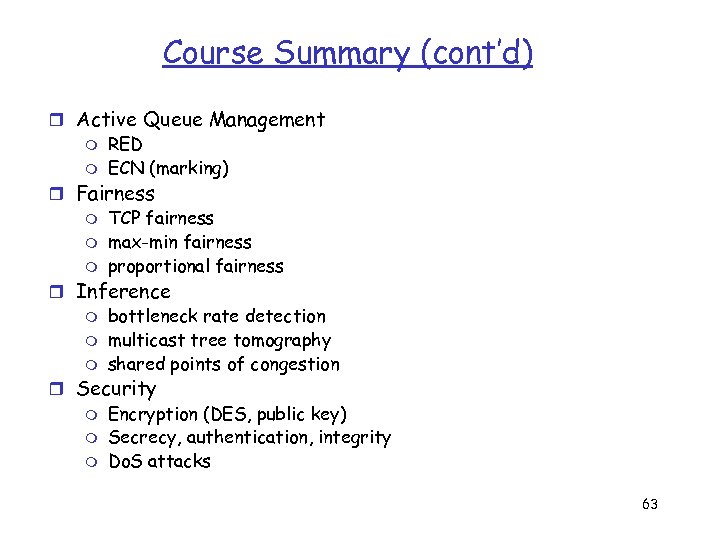 Course Summary (cont’d) r Active Queue Management m RED m ECN (marking) r Fairness m TCP fairness m max-min fairness m proportional fairness r Inference m bottleneck rate detection m multicast tree tomography m shared points of congestion r Security m Encryption (DES, public key) m Secrecy, authentication, integrity m Do. S attacks 63