


 Скачать презентацию Electric Vehicles outlook and policy actions needed Jacques
4aaf65421132980b380465eab2a1f1f0.ppt
- Количество слайдов: 11
 Electric Vehicles: outlook and policy actions needed Jacques de Selliers, Ir Managing Director Going-Electric, Association for Electric Vehicles in Europe www. going-electric. org, jsm 08@going-electric. org, tel: +32 475 55 20 26 Former importer of REVA electric cars in Belgium. Going-Electric Printed on 3/19/2018 EV outlook and policy actions needed Page 1
 Electric Vehicles: Key considerations EVs = 3 technologies of electrically powered vehicle: 1. Battery Electric Vehicles (BEVs) (= pure electric vehicles), 2. Extended Range Electric Vehicles (EREVs) (= Series Plug-in Hybrids), 3. Fuel Cell Vehicles (FCVs, fuelled by hydrogen). By far, they are the most sustainable car technologies: Nearly petrol-free, no urban pollution, 30% less primary energy, less CO 2… 80% of cars mileage = short trips, slow speed, 1 occupant: Small/ultra-small BEVs are ideal for this usage… EREVs are fine for long trips – and FCVs even better! BEV & EREV technologies are mature enough to fill all car markets. But they are temporarily expensive. What is missing for EVs to spread is: 1. The right initial incentives from public authorities (first priority = non-financial), 2. The right charging infrastructure (first priority is where EV drivers live), 3. Attractive EV models (which will only arrive after 1. & 2. ). Going-Electric Printed on 3/19/2018 EV outlook and policy actions needed Page 2
 EV Sustainability versus ICV EVs (BEVs, EREVs & FCVs) are MUCH cleaner than ICVs. Compared to ICVs of same power and weight: 1. EVs use about 30% less primary energy – 2. 3. An electric car charged with petrol/biofuel-generated electricity uses about 30% less petrol/biofuel than an ICV. . . EVs cause 25% less CO 2 with the Chinese electricity mix – Even less CO 2 as electricity generation gets cleaner (which is happening). – 70% less CO 2 in the EU – Nearly zero CO 2 in Norway, Sweden, France. . . – Same CO 2 in the worse case (coal fired power plants). EVs are silent and cause zero urban pollution – – 4. EVs reduce energy dependency – – 5. It is easier to reduce pollution from a few power plants than from millions of cars. Reducing urban pollution saves health and building cleaning costs. Over 50% of world’s petrol is used in road transport. Electricity generation uses a variety of energies (including renewable) and little petrol. EVs have a sustainable life cycle – – Vehicle environmental impact: 25% = manufacturing + recycling, 75% = usage EVs, batteries and fuel cells are very recyclable. Going-Electric Printed on 3/19/2018 EV outlook and policy actions needed Page 3
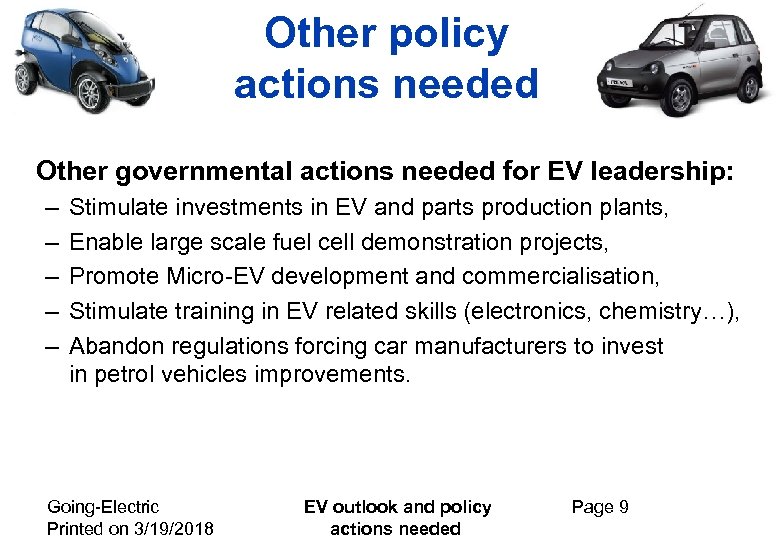
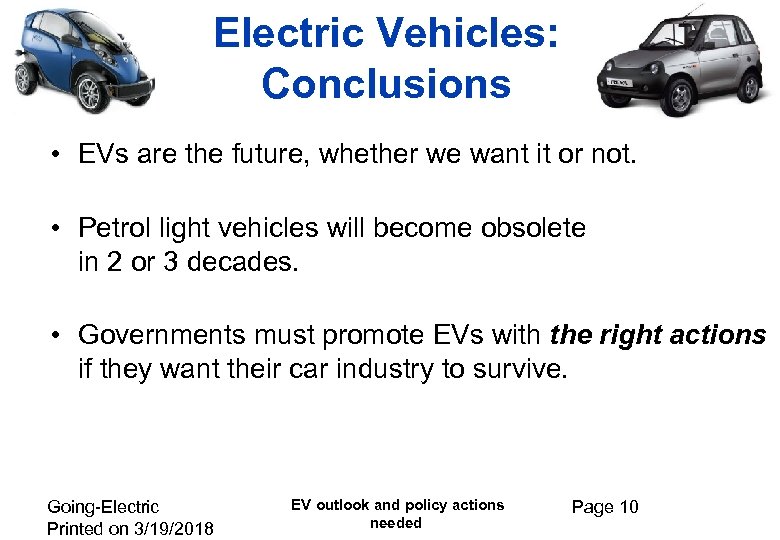
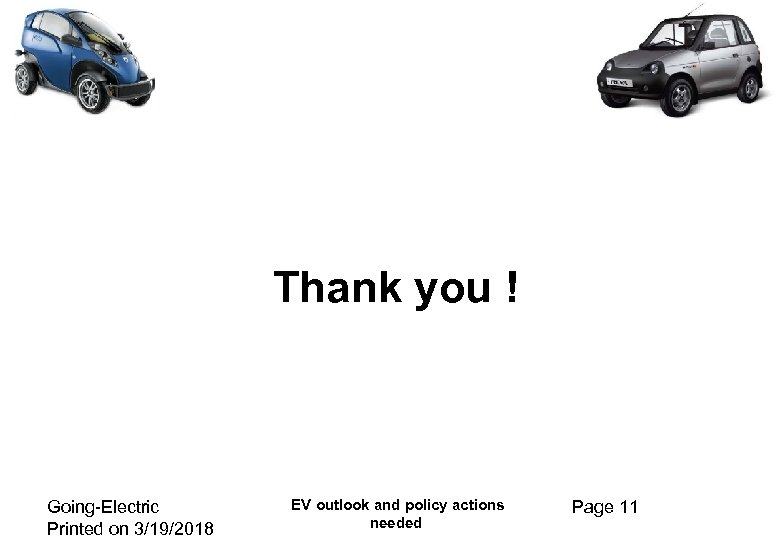
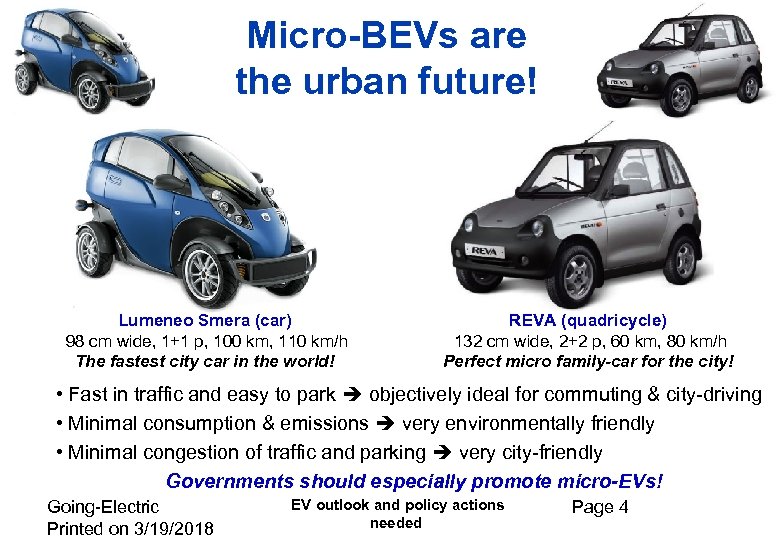 Micro-BEVs are the urban future! Lumeneo Smera (car) 98 cm wide, 1+1 p, 100 km, 110 km/h The fastest city car in the world! REVA (quadricycle) 132 cm wide, 2+2 p, 60 km, 80 km/h Perfect micro family-car for the city! • Fast in traffic and easy to park objectively ideal for commuting & city-driving • Minimal consumption & emissions very environmentally friendly • Minimal congestion of traffic and parking very city-friendly Governments should especially promote micro-EVs! Going-Electric Printed on 3/19/2018 EV outlook and policy actions needed Page 4
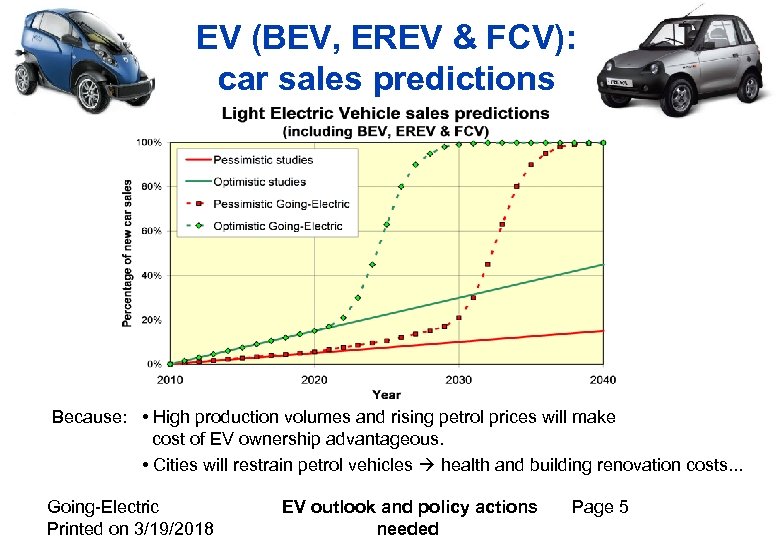 EV (BEV, EREV & FCV): car sales predictions Because: • High production volumes and rising petrol prices will make cost of EV ownership advantageous. • Cities will restrain petrol vehicles health and building renovation costs. . . Going-Electric Printed on 3/19/2018 EV outlook and policy actions needed Page 5
 The two key policy actions needed 1. EVs are temporarily more expensive than ICVs Purchase incentives are initially needed 1. Financial incentives: expensive to states 2. Non-financial incentives: most effective! 2. EVs need to charge – two different needs: 1. At or near home: daily low power charging at night. 2. In transit places: occasional high power recharging. Going-Electric Printed on 3/19/2018 EV outlook and policy actions needed Page 6
 Norway’s most effective incentives Saving time & hassles is invaluable to drivers! In congested cities: – EV access to priority lanes – Free unlimited parking for EVs – Parking spots reserved for EVs – No odd/even plate restrictions – Free freeway tolls & congestion charge Successful EV introduction at no cost! Going-Electric Printed on 3/19/2018 EV outlook and policy actions needed Page 7
 Two different charging needs Key considerations: – – No one will buy an EV if he can’t charge it at/near home 80% daily trips < 60 km need << 15 k. Wh/day BEVs are NOT for very long trips ( EREVs and/or FCVs) Charging at night is better for the electrical network. Implications on charging needs – Night charging at/near home is essential 2 -3 k. W charging is usually enough domestic plug – Public charging in transit places is needed: • Against range anxiety: low/medium power is enough • For exceptional longer trips: high power charging (motorways). Going-Electric Printed on 3/19/2018 EV outlook and policy actions needed Page 8
 Other policy actions needed Other governmental actions needed for EV leadership: – – – Stimulate investments in EV and parts production plants, Enable large scale fuel cell demonstration projects, Promote Micro-EV development and commercialisation, Stimulate training in EV related skills (electronics, chemistry…), Abandon regulations forcing car manufacturers to invest in petrol vehicles improvements. Going-Electric Printed on 3/19/2018 EV outlook and policy actions needed Page 9
 Electric Vehicles: Conclusions • EVs are the future, whether we want it or not. • Petrol light vehicles will become obsolete in 2 or 3 decades. • Governments must promote EVs with the right actions if they want their car industry to survive. Going-Electric Printed on 3/19/2018 EV outlook and policy actions needed Page 10
 Thank you ! Going-Electric Printed on 3/19/2018 EV outlook and policy actions needed Page 11