 Скачать презентацию Electric Vehicles 101 An Introduction By Dan Lauber
2dfab6fff9d9a05b62236e3acfc7dc2f.ppt
- Количество слайдов: 57



Electric Vehicles 101 An Introduction By Dan Lauber Nov 13, 2009 EVs 101
Electric Vehicles 101 o o o A Brief History Advantages Challenges Meeting the Challenge EV’s Today EV’s at MIT EVs 101
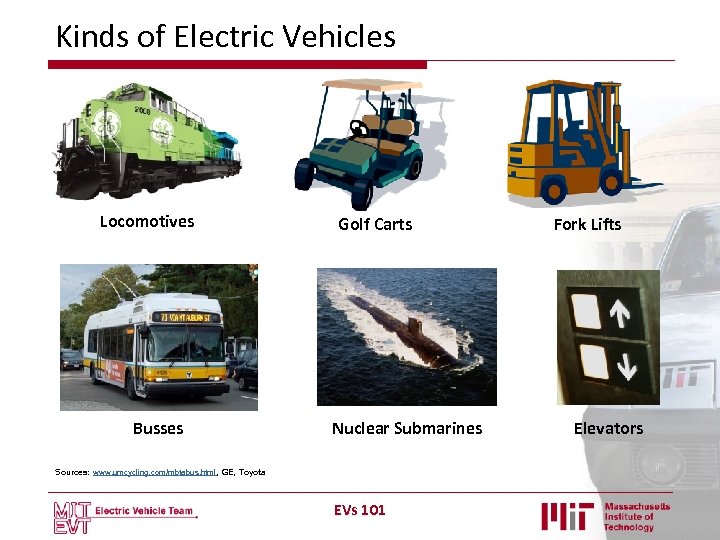
Kinds of Electric Vehicles Locomotives Busses Golf Carts Nuclear Submarines Sources: www. umcycling. com/mbtabus. html, GE, Toyota EVs 101 Fork Lifts Elevators
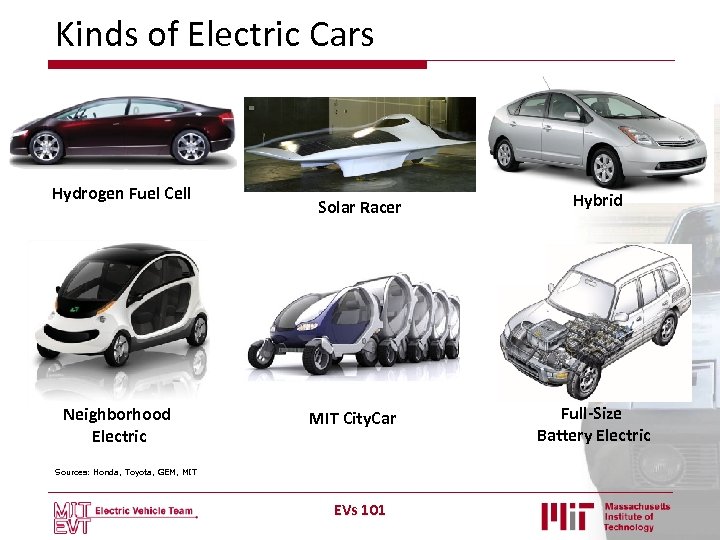
Kinds of Electric Cars Hydrogen Fuel Cell Neighborhood Electric Solar Racer MIT City. Car Sources: Honda, Toyota, GEM, MIT EVs 101 Hybrid Full-Size Battery Electric
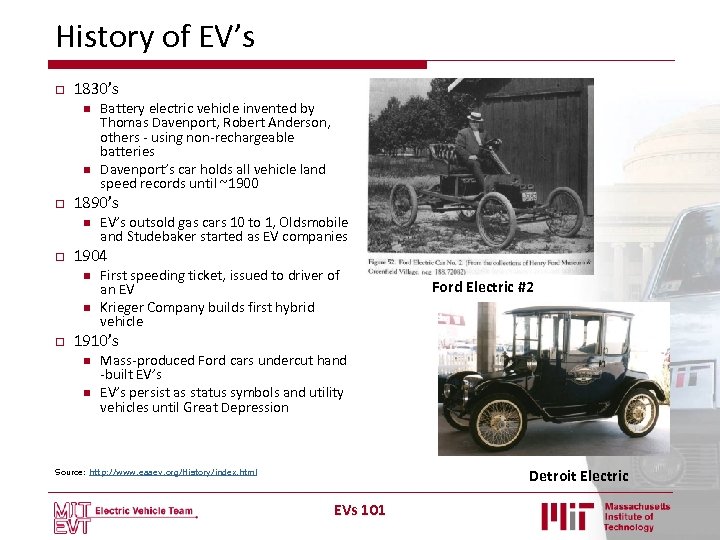
History of EV’s o 1830’s n n o 1890’s n o EV’s outsold gas cars 10 to 1, Oldsmobile and Studebaker started as EV companies 1904 n n o Battery electric vehicle invented by Thomas Davenport, Robert Anderson, others - using non-rechargeable batteries Davenport’s car holds all vehicle land speed records until ~1900 First speeding ticket, issued to driver of an EV Krieger Company builds first hybrid vehicle Ford Electric #2 1910’s n n Mass-produced Ford cars undercut hand -built EV’s persist as status symbols and utility vehicles until Great Depression Detroit Electric Source: http: //www. eaaev. org/History/index. html EVs 101
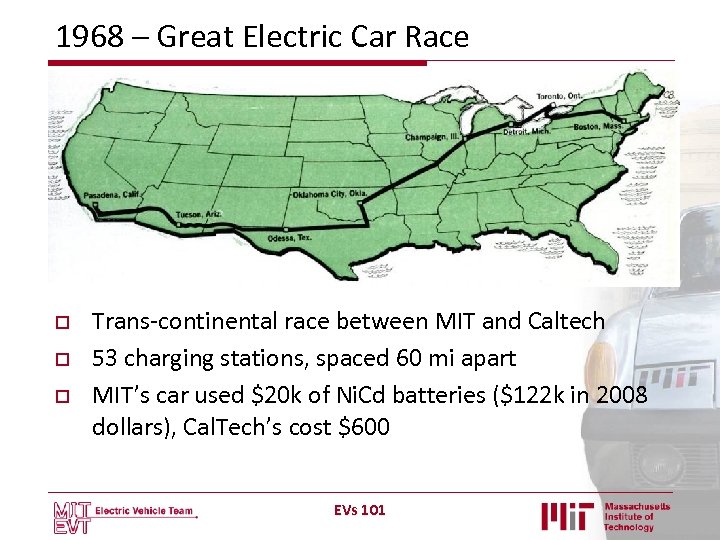
1968 – Great Electric Car Race o o o Trans-continental race between MIT and Caltech 53 charging stations, spaced 60 mi apart MIT’s car used $20 k of Ni. Cd batteries ($122 k in 2008 dollars), Cal. Tech’s cost $600 EVs 101
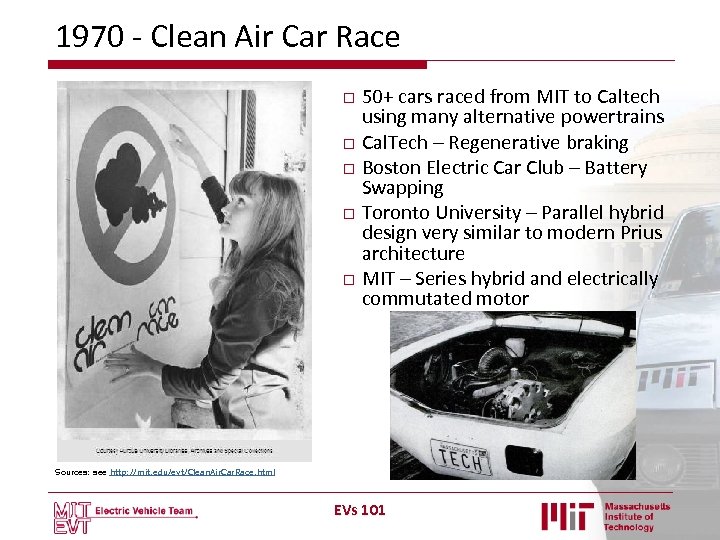
1970 - Clean Air Car Race 50+ cars raced from MIT to Caltech using many alternative powertrains o Cal. Tech – Regenerative braking o Boston Electric Car Club – Battery Swapping o Toronto University – Parallel hybrid design very similar to modern Prius architecture o MIT – Series hybrid and electrically commutated motor o Sources: see http: //mit. edu/evt/Clean. Air. Car. Race. html EVs 101
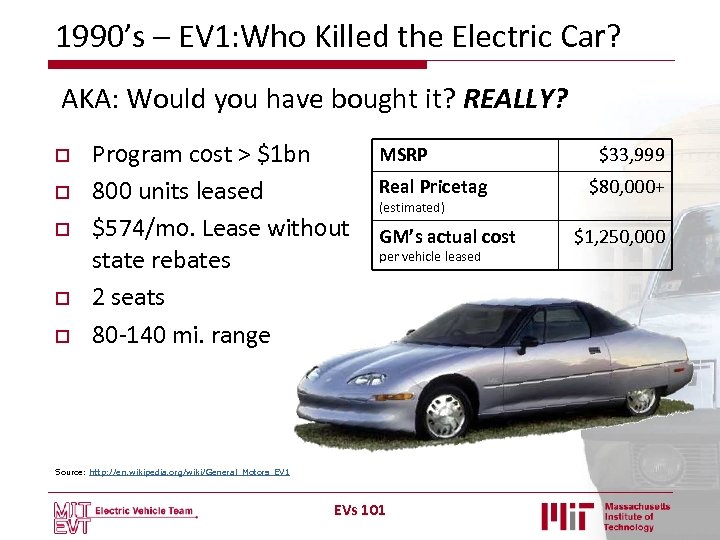
1990’s – EV 1: Who Killed the Electric Car? AKA: Would you have bought it? REALLY? o o o Program cost > $1 bn 800 units leased $574/mo. Lease without state rebates 2 seats 80 -140 mi. range MSRP Real Pricetag (estimated) GM’s actual cost per vehicle leased Source: http: //en. wikipedia. org/wiki/General_Motors_EV 1 EVs 101 $33, 999 $80, 000+ $1, 250, 000
What is an EV? And how does it work? EVs 101
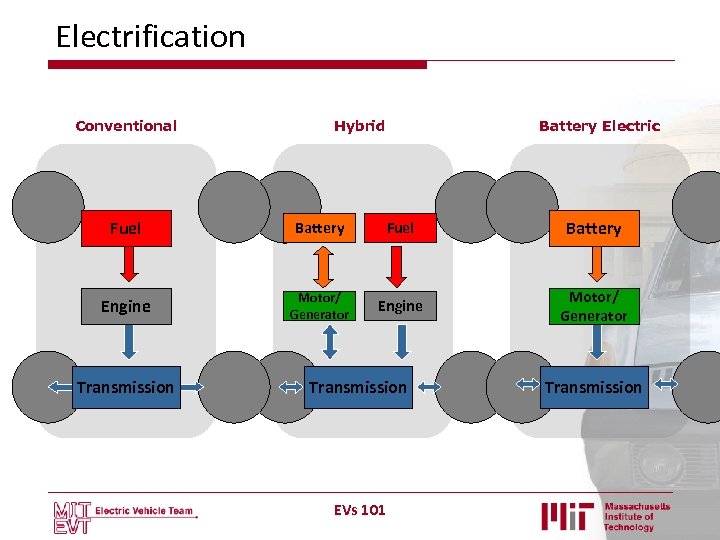
Electrification Conventional Hybrid Battery Electric Fuel Battery Engine Motor/ Generator Transmission EVs 101 Transmission
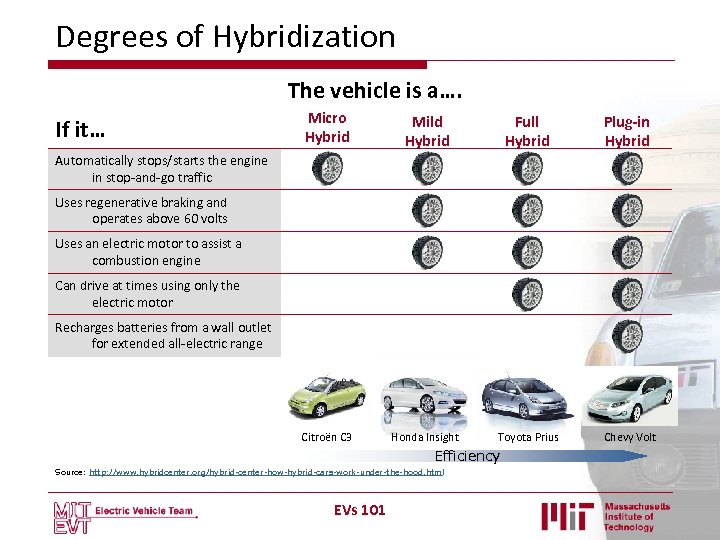
Degrees of Hybridization The vehicle is a…. Mild Hybrid Full Hybrid Plug-in Hybrid Citroën C 3 If it… Micro Hybrid Honda Insight Toyota Prius Chevy Volt Automatically stops/starts the engine in stop-and-go traffic Uses regenerative braking and operates above 60 volts Uses an electric motor to assist a combustion engine Can drive at times using only the electric motor Recharges batteries from a wall outlet for extended all-electric range Efficiency Source: http: //www. hybridcenter. org/hybrid-center-how-hybrid-cars-work-under-the-hood. html EVs 101
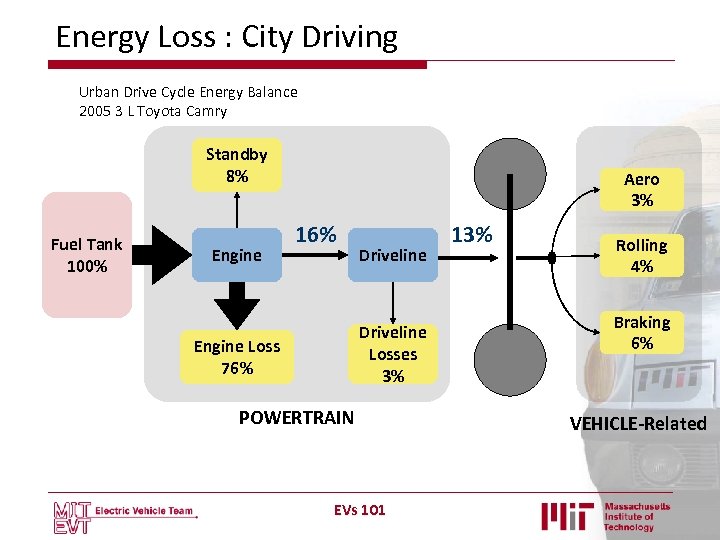
Energy Loss : City Driving Urban Drive Cycle Energy Balance 2005 3 L Toyota Camry Standby 8% Fuel Tank 100% Engine Aero 3% 16% Driveline Losses 3% Engine Loss 76% POWERTRAIN EVs 101 13% Rolling 4% Braking 6% VEHICLE-Related
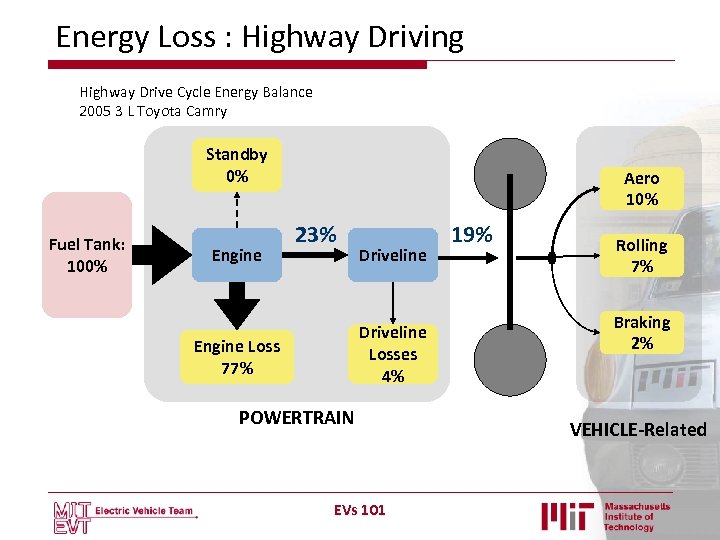
Energy Loss : Highway Driving Highway Drive Cycle Energy Balance 2005 3 L Toyota Camry Standby 0% Fuel Tank: 100% Engine Aero 10% 23% Driveline Losses 4% Engine Loss 77% POWERTRAIN EVs 101 19% Rolling 7% Braking 2% VEHICLE-Related
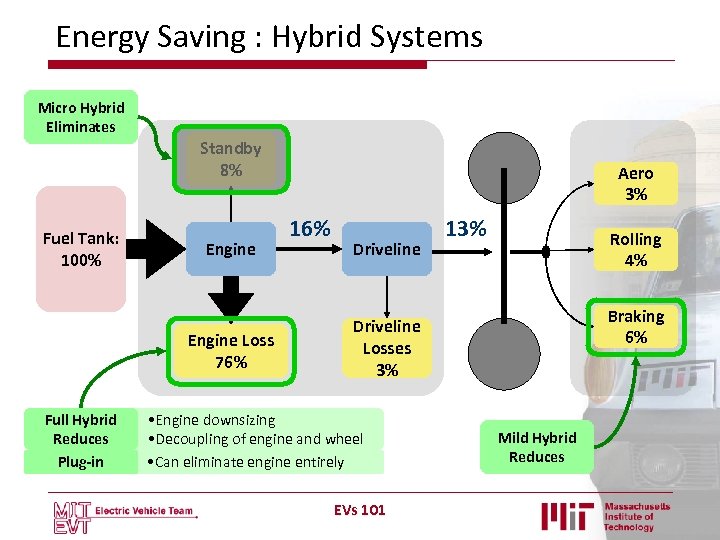
Energy Saving : Hybrid Systems Micro Hybrid Eliminates Standby 8% Fuel Tank: 100% Engine Loss 76% Full Hybrid Reduces Plug-in Aero 3% 16% Driveline 13% Rolling 4% Braking 6% Driveline Losses 3% • Engine downsizing • Decoupling of engine and wheel • Can eliminate engine entirely EVs 101 Mild Hybrid Reduces
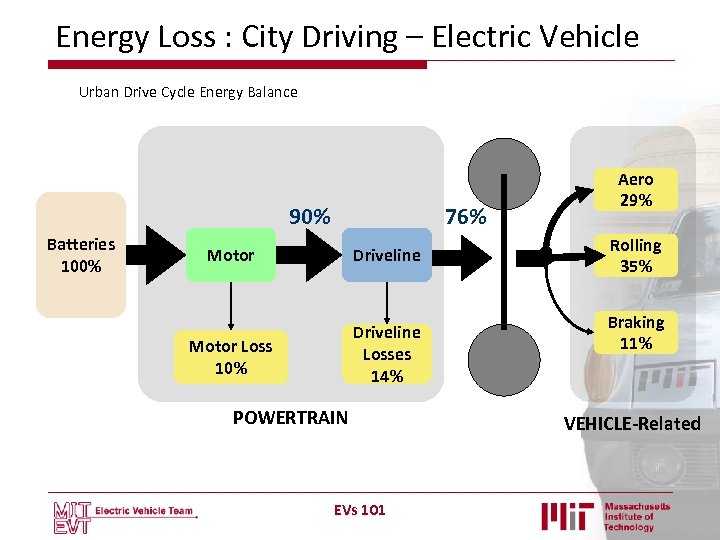
Energy Loss : City Driving – Electric Vehicle Urban Drive Cycle Energy Balance 90% Batteries 100% 76% Motor Driveline Motor Loss 10% Driveline Losses 14% POWERTRAIN EVs 101 Aero 29% Rolling 35% Braking 11% VEHICLE-Related
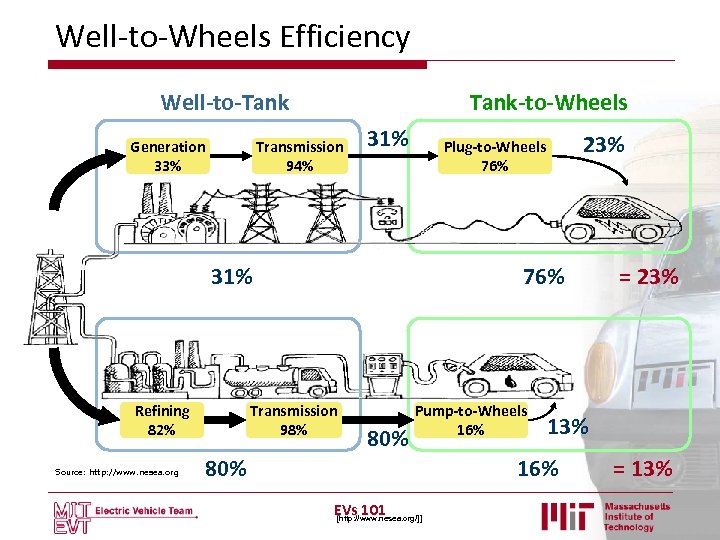
Well-to-Wheels Efficiency Well-to-Tank Generation 33% Tank-to-Wheels Transmission 94% 31% Refining 82% Source: http: //www. nesea. org 23% Plug-to-Wheels 76% Transmission 98% 80% Pump-to-Wheels 16% 80% 13% 16% EVs 101 [http: //www. nesea. org/]] = 23% = 13%
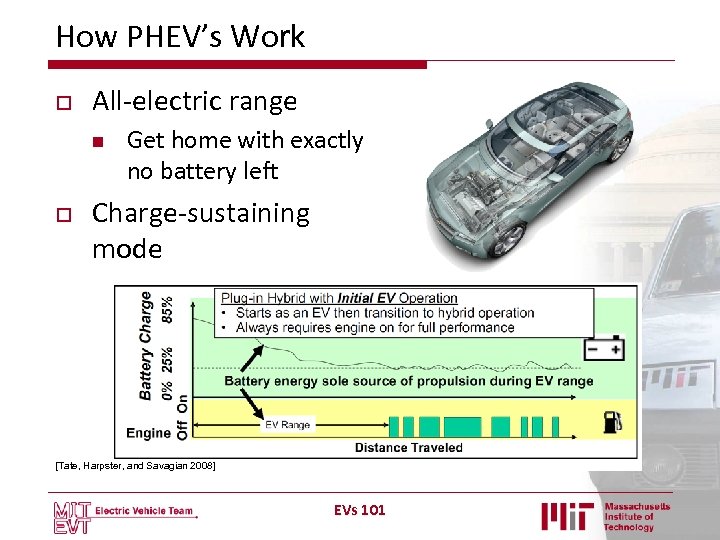
How PHEV’s Work o All-electric range n o Get home with exactly no battery left Charge-sustaining mode [Tate, Harpster, and Savagian 2008] EVs 101
Technical EVs 101
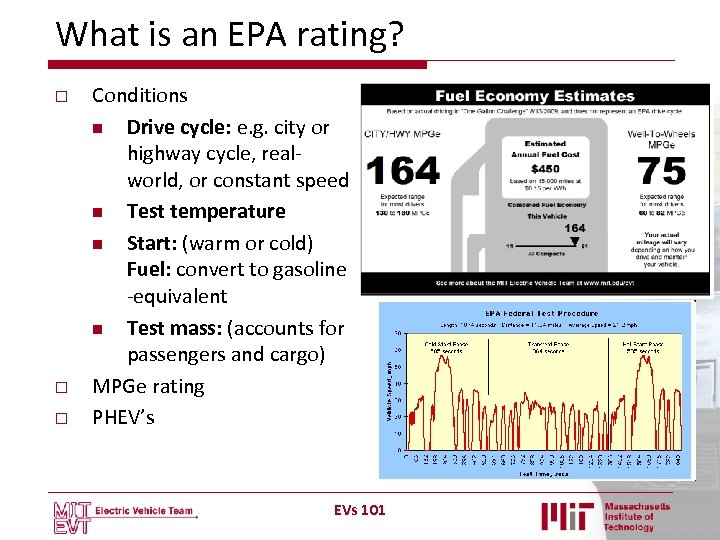
What is an EPA rating? o o o Conditions n Drive cycle: e. g. city or highway cycle, realworld, or constant speed n Test temperature n Start: (warm or cold) Fuel: convert to gasoline -equivalent n Test mass: (accounts for passengers and cargo) MPGe rating PHEV’s EVs 101
Terminology o o o State of charge (SOC) n Battery capacity, expressed as a percentage of maximum capacity Depth of Discharge (DOD) n The percentage of battery capacity that has been discharged Capacity n The total Amp-hours (Amp-hr) available when the battery is discharged at a specific current (specified as a C-rate) from 100% SOC Energy n The total Watt-hours (Wh) available when the battery is discharged at a specific current (specified as a C-rate) from 100% SOC Specific Energy (Wh/kg) n The total Watt-hours (Wh) per unit mass Specific Power n Maximum power (Watts) that the battery can provide per unit mass, function of internal resistance of battery EVs 101

Benefits EVs 101
Benefits of EVs and PHEVs o o o More efficient, lower fuel costs, lower emissions Simpler transmission, fewer moving parts Fuel Choice Oil/energy independence Emissions improve with time Emissions at few large locations is easier to control than millions of tailpipes EVs 101
V 2 G (Vehicle to Grid) Technology o o Allows communication between utility and vehicle Allow integration of more renewables like wind Used EV batteries could be used as stationary batteries for utilities With so much focus on energy efficiency reducing electricity sales and expensive renewable energy generation mandated, EVs could be a welcome new segment for utilities n o They could still be a nightmare Batteries could provide ancillary services Source: Mc. Kinsey EVs 101
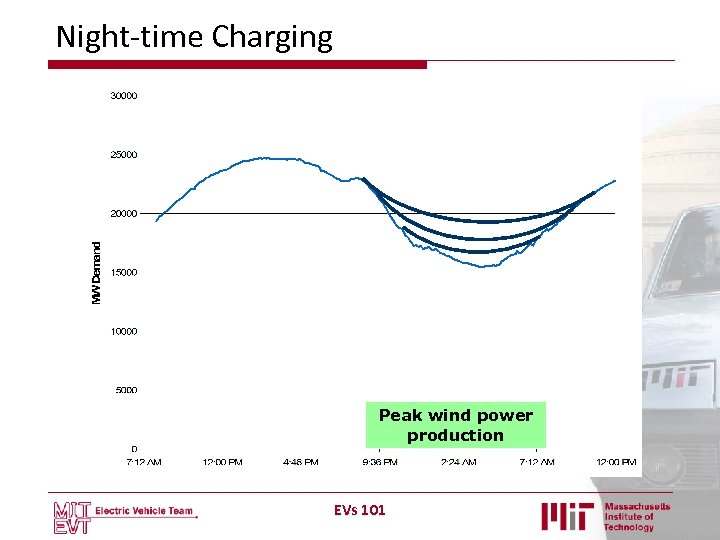
Night-time Charging Peak wind power production EVs 101
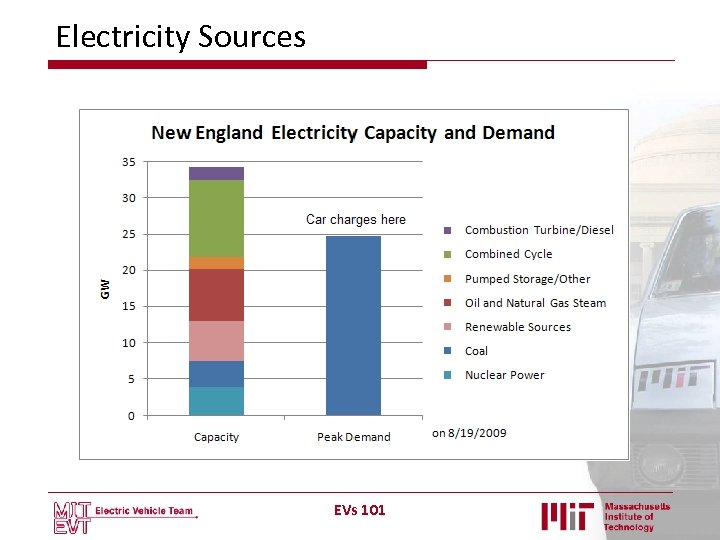
Electricity Sources EVs 101
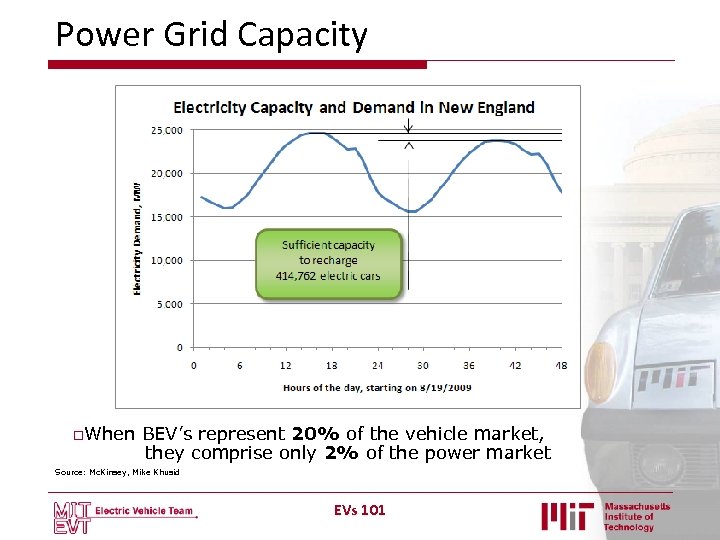
Power Grid Capacity o. When BEV’s represent 20% of the vehicle market, they comprise only 2% of the power market Source: Mc. Kinsey, Mike Khusid EVs 101
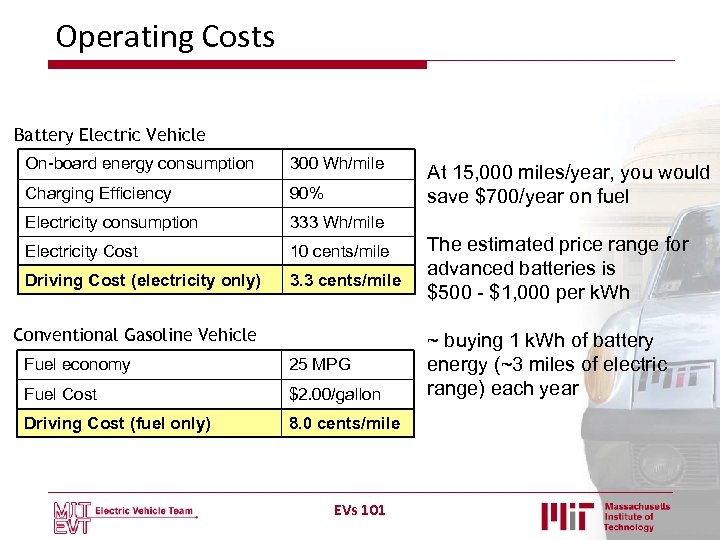
Operating Costs Battery Electric Vehicle On-board energy consumption 300 Wh/mile Charging Efficiency 90% Electricity consumption 333 Wh/mile Electricity Cost 10 cents/mile Driving Cost (electricity only) 3. 3 cents/mile Conventional Gasoline Vehicle Fuel economy 25 MPG Fuel Cost $2. 00/gallon Driving Cost (fuel only) 8. 0 cents/mile EVs 101 At 15, 000 miles/year, you would save $700/year on fuel The estimated price range for advanced batteries is $500 - $1, 000 per k. Wh ~ buying 1 k. Wh of battery energy (~3 miles of electric range) each year
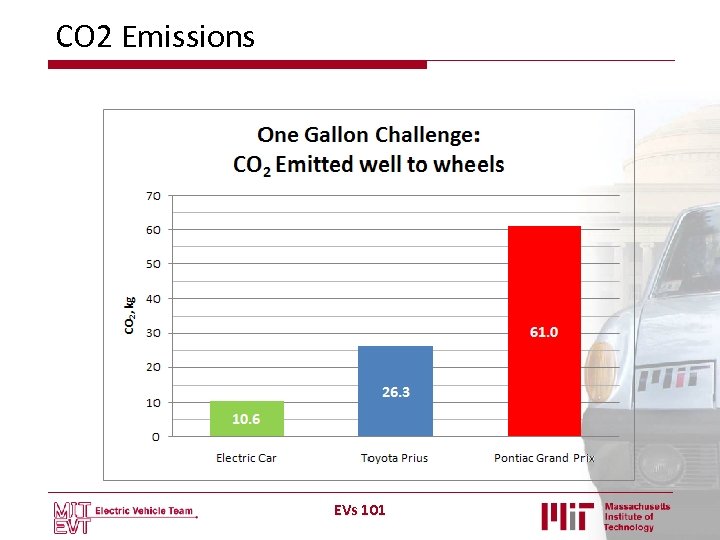
CO 2 Emissions EVs 101
Biofuels vs. Biomass, Solar o o Biomass Electricity about 80% more efficient than Biofuel Solar Panels to charge a car would fit on your roof. EVs 101
Challenges Why don’t they catch on? A conspiracy? EVs 101
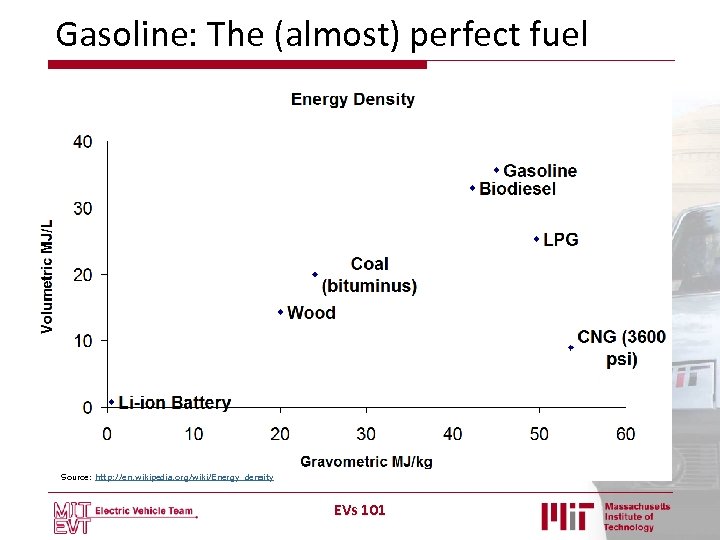
Gasoline: The (almost) perfect fuel Source: http: //en. wikipedia. org/wiki/Energy_density EVs 101
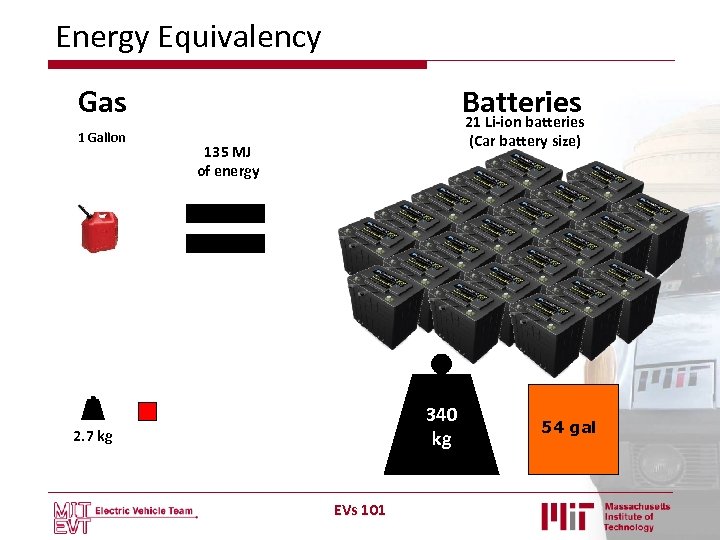
Energy Equivalency Gas 1 Gallon Batteries 21 Li-ion batteries (Car battery size) 135 MJ of energy 340 kg 2. 7 kg EVs 101 54 gal
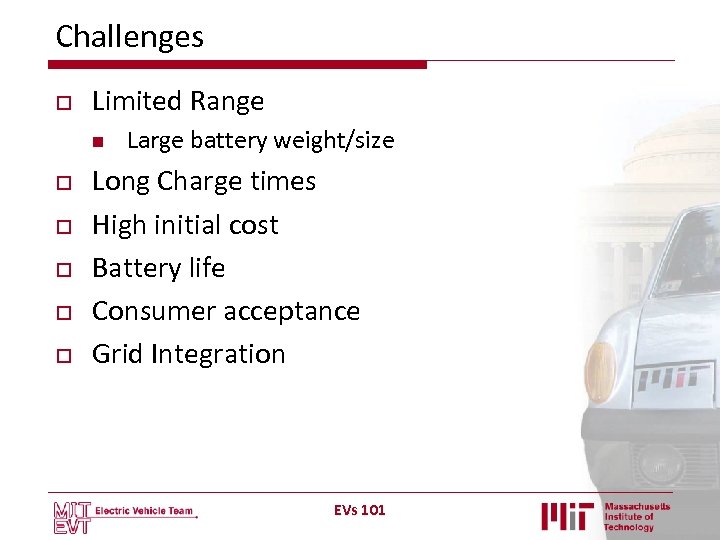
Challenges o Limited Range n o o o Large battery weight/size Long Charge times High initial cost Battery life Consumer acceptance Grid Integration EVs 101
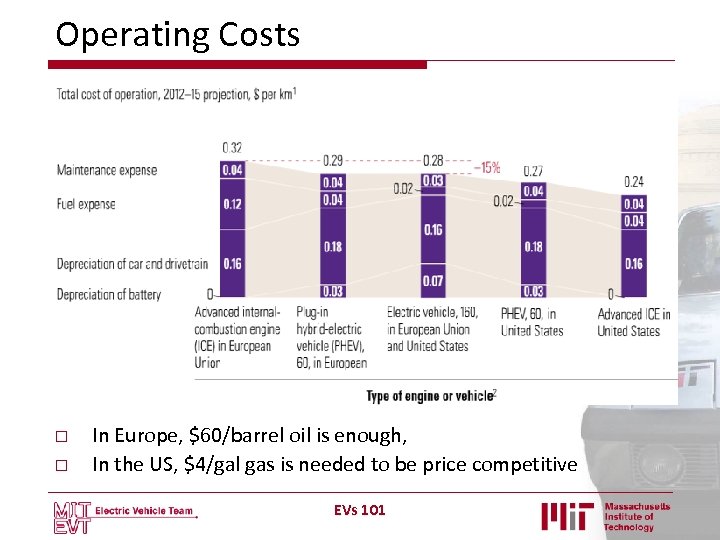
Operating Costs o o In Europe, $60/barrel oil is enough, In the US, $4/gal gas is needed to be price competitive EVs 101
Addressing customer perception o Accepting limited range n n o Smaller vehicles & reduced performance n o Most people drive less than 40 mi/day Most cars are parked 23 hours of the day anyway In the last 30 years, nearly 100% of efficiency improvements have gone to increasing vehicle size and performance, not reducing consumption How do you get people to charge at the right time? Source: On the Road in 2035, Heywood, et. al. EVs 101
Meeting the Challenges EVs 101
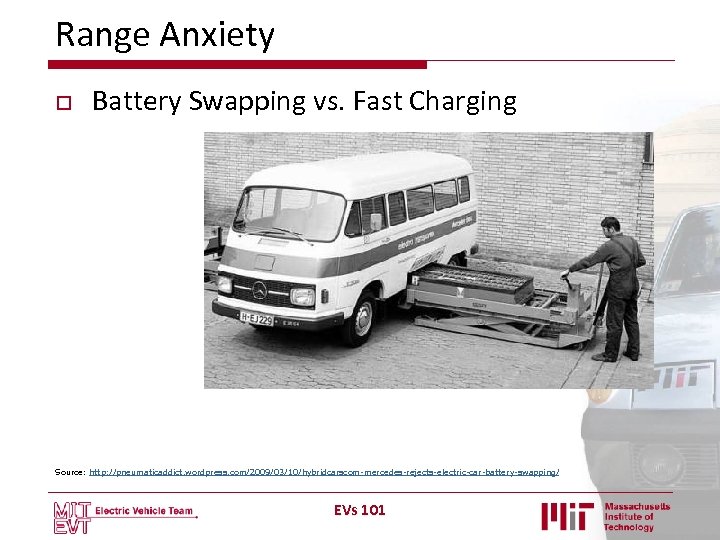
Range Anxiety o Battery Swapping vs. Fast Charging Source: http: //pneumaticaddict. wordpress. com/2009/03/10/hybridcarscom-mercedes-rejects-electric-car-battery-swapping/ EVs 101
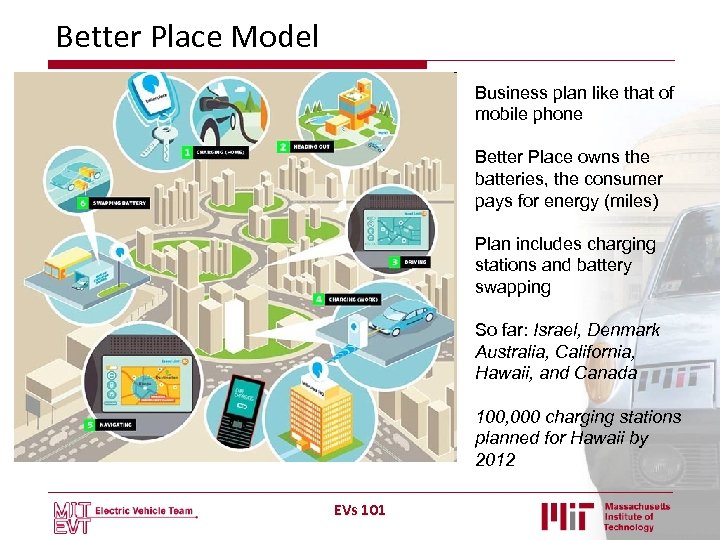
Better Place Model Business plan like that of mobile phone Better Place owns the batteries, the consumer pays for energy (miles) Plan includes charging stations and battery swapping So far: Israel, Denmark Australia, California, Hawaii, and Canada 100, 000 charging stations planned for Hawaii by 2012 EVs 101
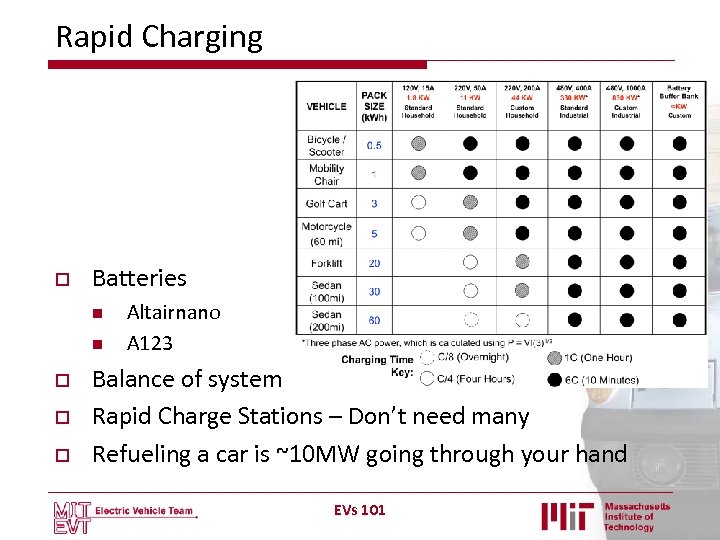
Rapid Charging o Batteries n n o o o Altairnano A 123 Balance of system Rapid Charge Stations – Don’t need many Refueling a car is ~10 MW going through your hand EVs 101
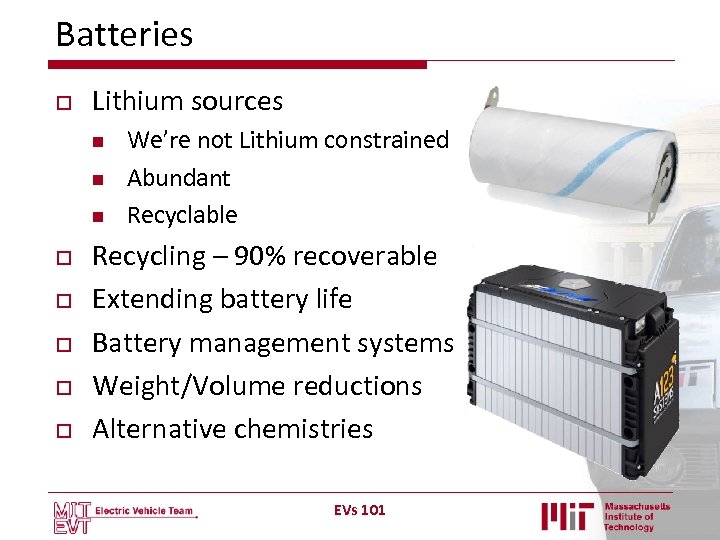
Batteries o Lithium sources n n n o o o We’re not Lithium constrained Abundant Recyclable Recycling – 90% recoverable Extending battery life Battery management systems Weight/Volume reductions Alternative chemistries EVs 101
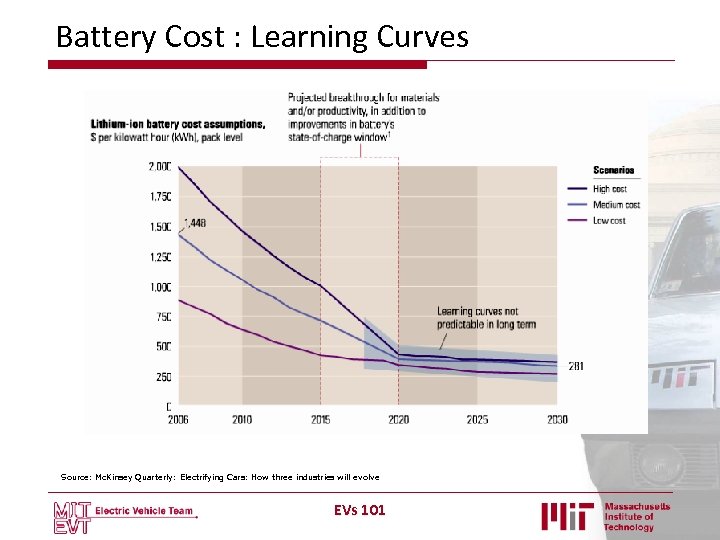
Battery Cost : Learning Curves Source: Mc. Kinsey Quarterly: Electrifying Cars: How three industries will evolve EVs 101
Initial Cost o o Companies that sell cars, but lease the batteries Leases like Power Purchase Agreements n o Split operating cost savings with financer Charging Infrastructure n Charging subscription plans EVs 101
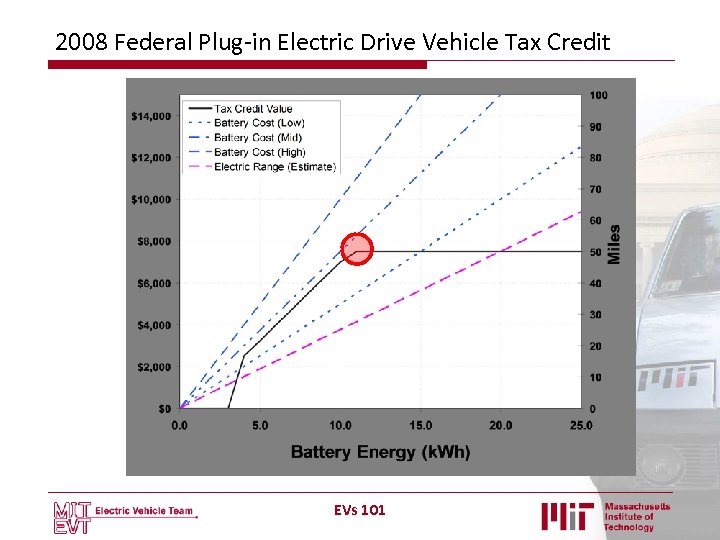
2008 Federal Plug-in Electric Drive Vehicle Tax Credit EVs 101
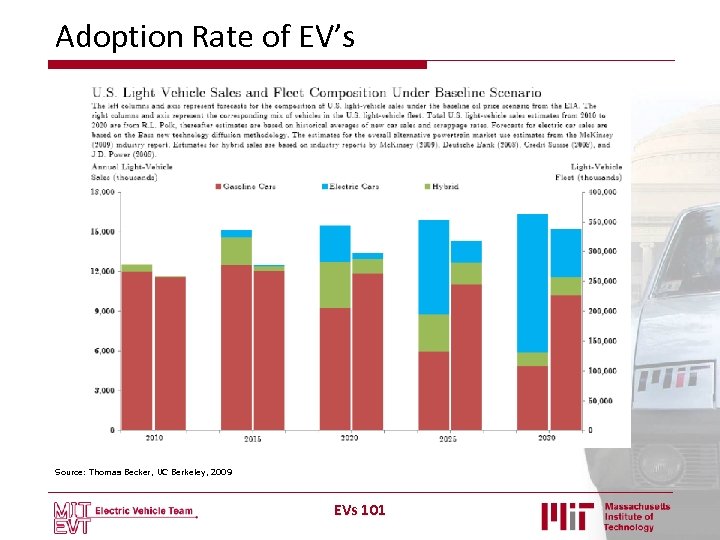
Adoption Rate of EV’s Source: Thomas Becker, UC Berkeley, 2009 EVs 101
Looking Forward o o o Tipping point will be ~2020 when 10% of vehicles sold will be BEV’s Battery cost: ~$700 -$1, 500 / k. Wh, down to $420 by 2015, but still too high. Price Premium n n o o PHEV 40 $11, 800 > ICE EV 100 $24, 100 > ICE Long-term PHEV’s will beat out HEV’s PHEV’s likely to dominate BEVs A 30 -50% reduction in fuel consumption by 2035 *Heywood 47% reduction by 2030 *Mc. Kinsey Source: Mc. Kinsey Quarterly: Electrifying Cars: How three industries will evolve ; http: //newenergynews. blogspot. com/2009/08/mckinsey-looks-at-coming-ev-phenomenon. html EVs 101
EVs NOW When can I get one? EVs 101
EV’s Today EVs 101
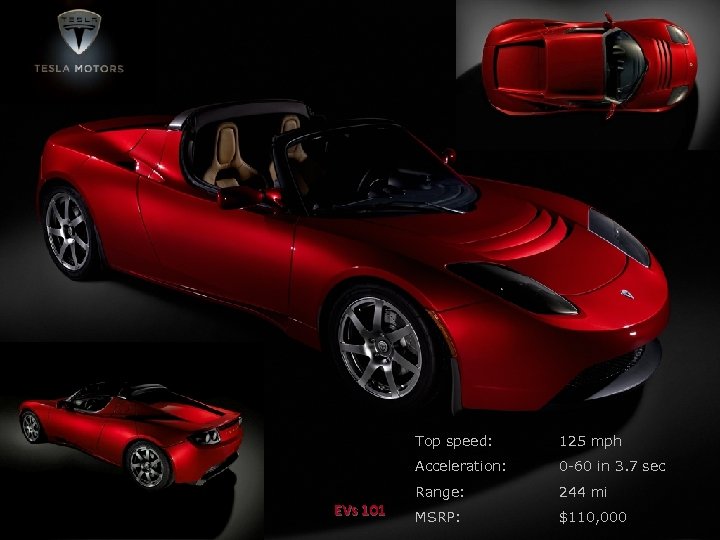
Tesla Roadster Top speed: Acceleration: 0 -60 in 3. 7 sec Range: EVs 101 125 mph 244 mi MSRP: $110, 000
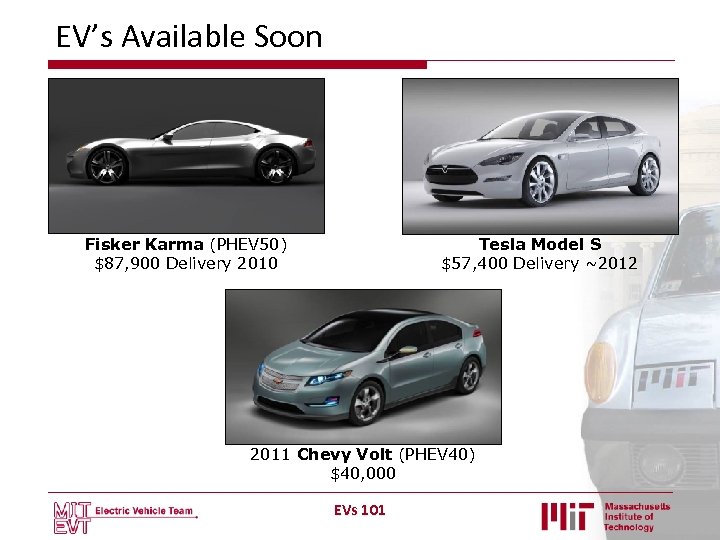
EV’s Available Soon Fisker Karma (PHEV 50) $87, 900 Delivery 2010 Tesla Model S $57, 400 Delivery ~2012 2011 Chevy Volt (PHEV 40) $40, 000 EVs 101
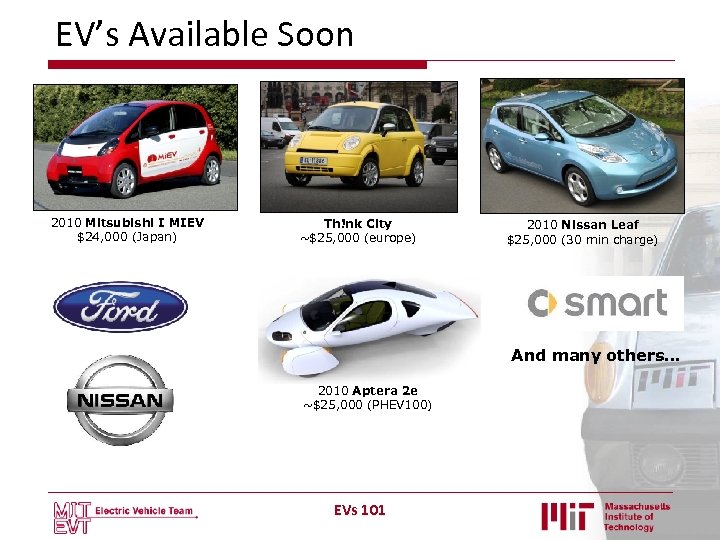
EV’s Available Soon 2010 Mitsubishi I MIEV $24, 000 (Japan) Th!nk City ~$25, 000 (europe) 2010 Nissan Leaf $25, 000 (30 min charge) And many others… 2010 Aptera 2 e ~$25, 000 (PHEV 100) EVs 101
@MIT EVs Around the Institute EVs 101
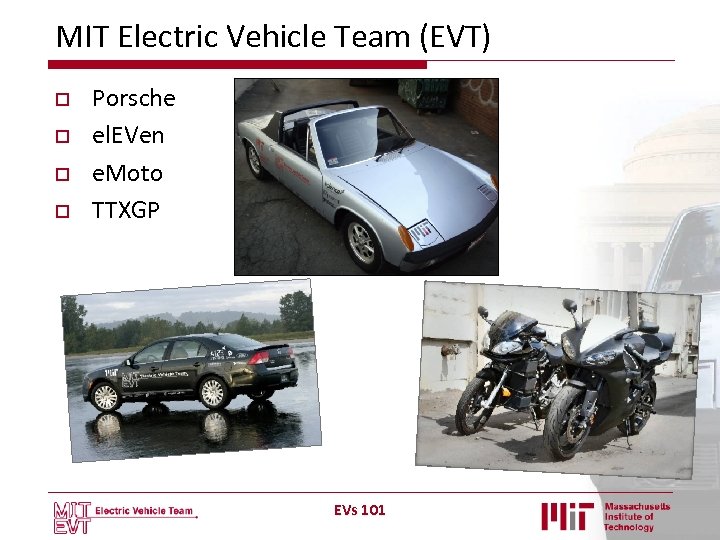
MIT Electric Vehicle Team (EVT) o o Porsche el. EVen e. Moto TTXGP EVs 101
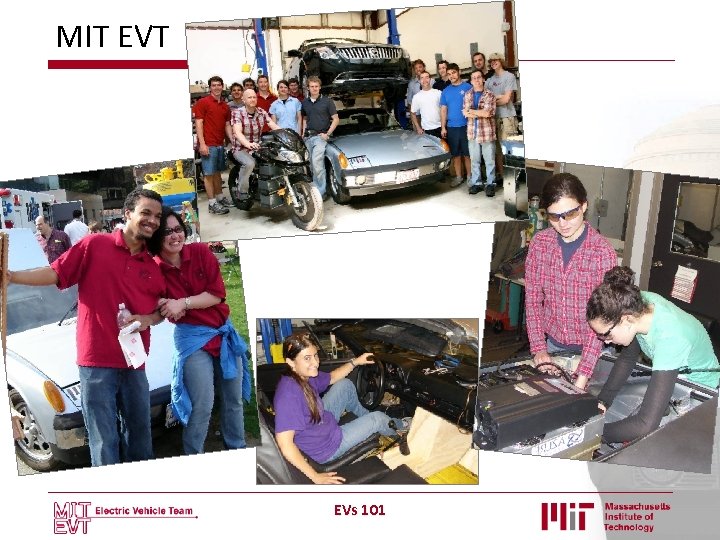
MIT EVs 101
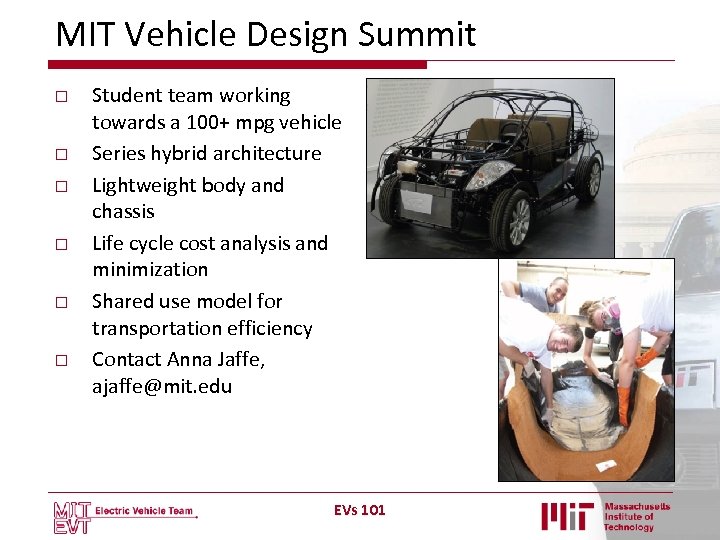
MIT Vehicle Design Summit o o o Student team working towards a 100+ mpg vehicle Series hybrid architecture Lightweight body and chassis Life cycle cost analysis and minimization Shared use model for transportation efficiency Contact Anna Jaffe, ajaffe@mit. edu EVs 101
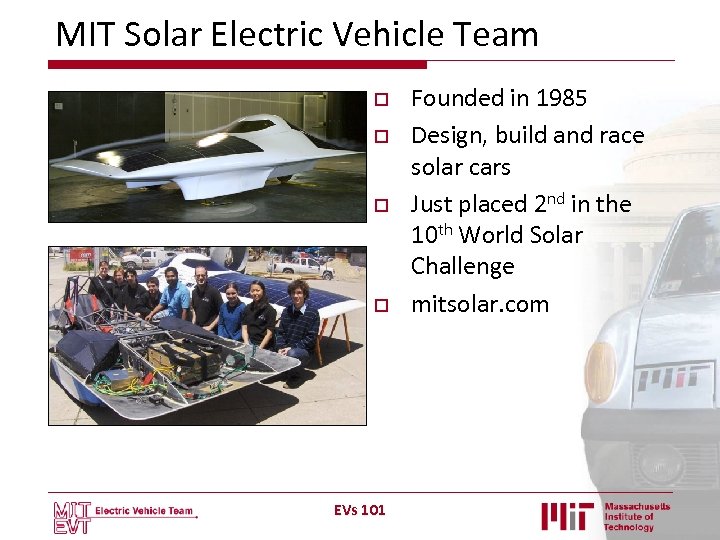
MIT Solar Electric Vehicle Team o o EVs 101 Founded in 1985 Design, build and race solar cars Just placed 2 nd in the 10 th World Solar Challenge mitsolar. com
MIT Vehicle Stuff o o o o EVT SEVT Vehicle Design Summit Transportation @ MIT Sloan Lab Seminars Media Lab – City Car, course Spinoffs n n n A 123 Solectria Genasun EVs 101
Thank You o o “No single technology development or alternative fuel can solve the problems of growing transportation fuel use and GHG emissions. ” – John Heywood Dan Lauber – djlauber@mit. edu http: //mit. edu/evt EVs 101
Скачать презентацию Electric Vehicles 101 An Introduction By Dan Lauber
2dfab6fff9d9a05b62236e3acfc7dc2f.ppt