


 Скачать презентацию Electric Current Everything water heat smells flows
0b6b5696a54bd752e7fbd7970d73d944.ppt
- Количество слайдов: 22
 Electric Current Everything (water, heat, smells, …) flows from areas of high concentration to areas of lower concentration. Electricity is no different. What makes electricity flow? Potential Difference – the difference in voltage between the ends of a conductor - electricity will continue to flow until each end has the same potential
 Electric Current – the flow of electric charge How is current measured? Amperes – the unit used to measure electric current - it is a measurement of how much charge passes a certain point per second - 1 A (ampere) = 1 coulomb of charge per second
 If a wire is carrying a current through it does it have a charge? A current –carrying wire has a net electric charge of zero. - this is because the electrons that are flowing through the wire to make the current are leaving one end as fast as they are entering the other end
 Voltage Source – an object that provides a potential difference. - examples are batteries and generators Voltage Vs Current -voltage is the difference in potential that makes charges want to travel from one area to another (like pressure) where current is the charges that move through a conductor
 Electrical Resistance – how much a conductor resists the flow of current. - in wires resistance will change with the type of wire and the thickness of the wire. Superconductor – a material that has no resistance to current at temperatures near 0 K
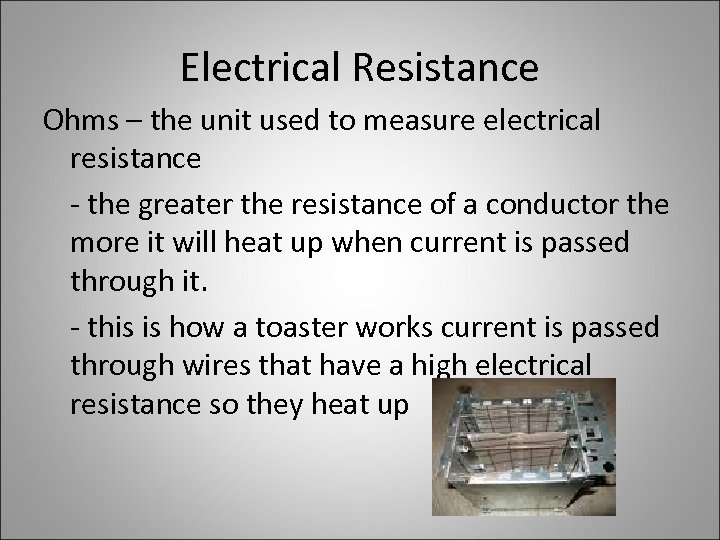 Electrical Resistance Ohms – the unit used to measure electrical resistance - the greater the resistance of a conductor the more it will heat up when current is passed through it. - this is how a toaster works current is passed through wires that have a high electrical resistance so they heat up
 Ohm’s Law – the current in a circuit is directly proportional to the voltage impressed across the circuit, and is inversely proportional to the resistance of the circuit. -In other words, if I increase my voltage from a battery it will increase the amount of energy flow (current)in a circuit, the higher the resistance in the circuit the less energy will flow (current) in a circuit
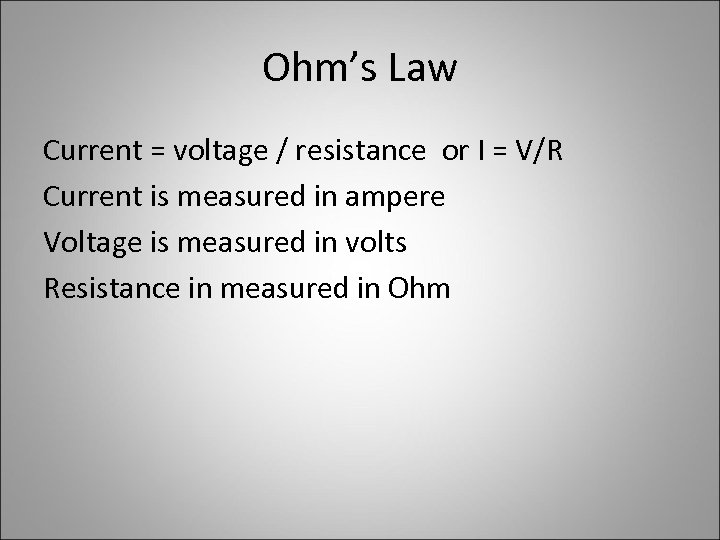 Ohm’s Law Current = voltage / resistance or I = V/R Current is measured in ampere Voltage is measured in volts Resistance in measured in Ohm
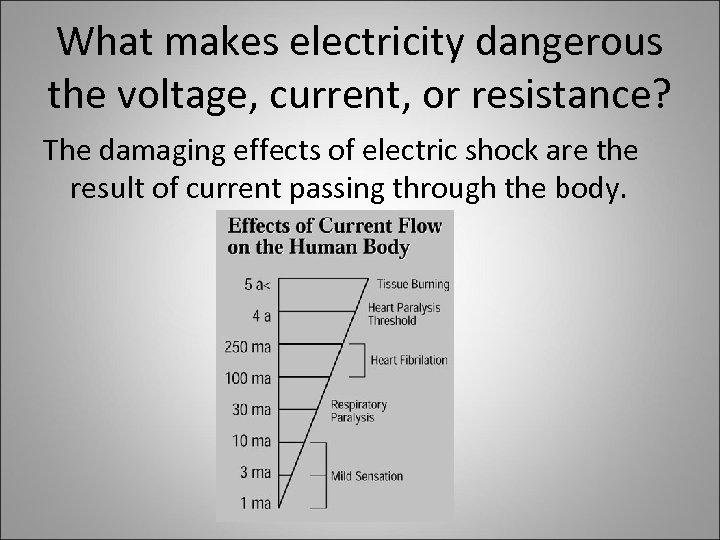 What makes electricity dangerous the voltage, current, or resistance? The damaging effects of electric shock are the result of current passing through the body.
 DC Vs AC Direct Current (DC) – a current that always flows in one direction through a circuit - this is the type of current you get when you use a battery Alternating Current (AC) – and electric current that repeatedly reverses direction in a circuit - AC it the type of current in your house - it switches directions 60 times a second or 60 Hz
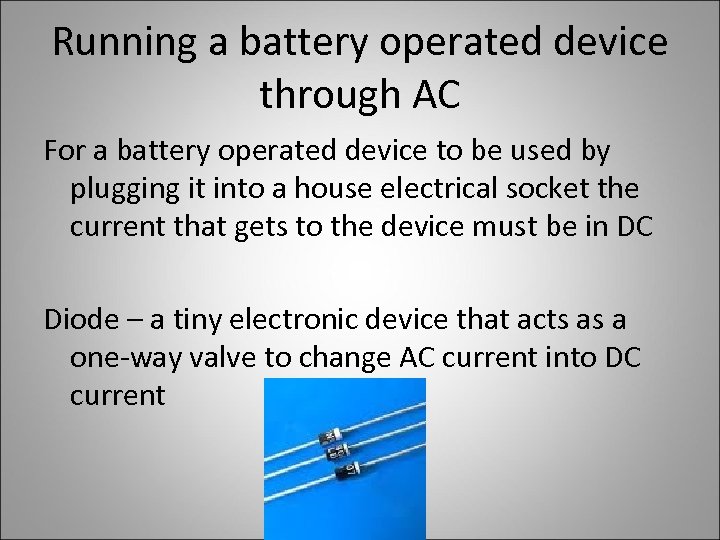 Running a battery operated device through AC For a battery operated device to be used by plugging it into a house electrical socket the current that gets to the device must be in DC Diode – a tiny electronic device that acts as a one-way valve to change AC current into DC current
 The Speed of Electrons through a Circuit When electrons (electricity) is run through a circuit the electrons themselves move vary quickly but move through the circuit very slowly - this happens because there are so many electrons around, they push each other away so that each electron can not move through the circuit quickly
 When current is run through a circuit, where to the electrons come from that power electrical devices? - The electrons come from the conducting material itself (not the battery) - This happens because current moves through a circuit very slowly. The electrons that make it through the circuit are the ones from the conductor (usually a wire)
 Electric Circuits You will need to be able to draw DC circuit diagrams that include; A switch A voltage source (dry cell battery) Resistors Capacitors
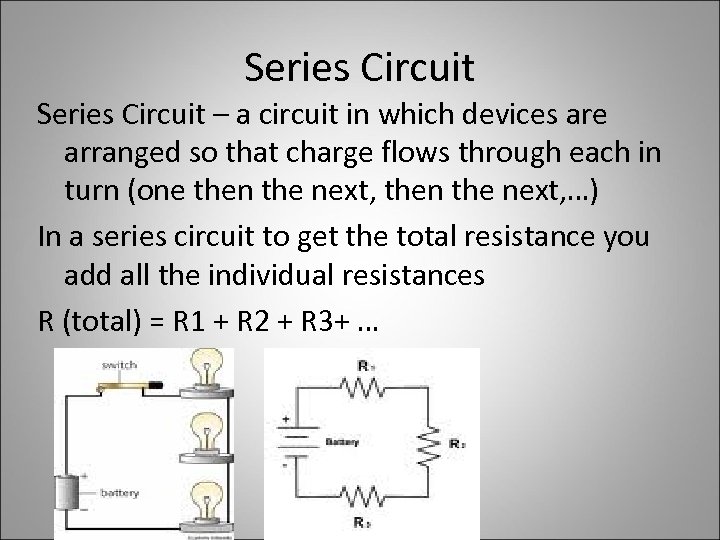 Series Circuit – a circuit in which devices are arranged so that charge flows through each in turn (one then the next, …) In a series circuit to get the total resistance you add all the individual resistances R (total) = R 1 + R 2 + R 3+ …
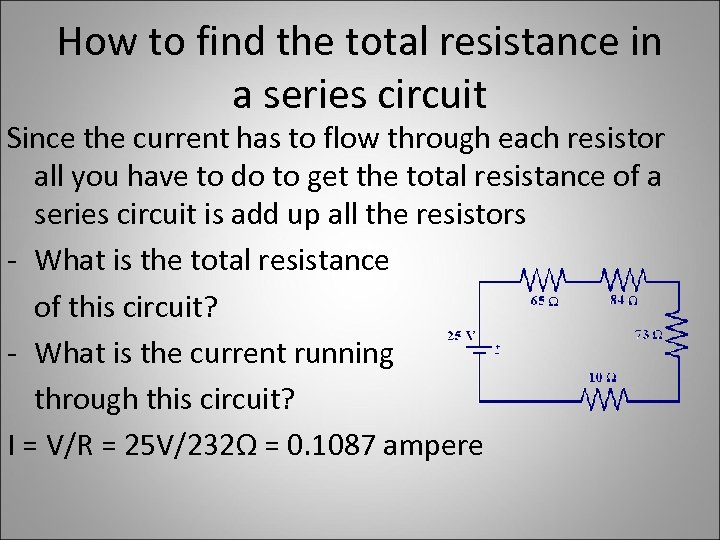 How to find the total resistance in a series circuit Since the current has to flow through each resistor all you have to do to get the total resistance of a series circuit is add up all the resistors - What is the total resistance of this circuit? - What is the current running through this circuit? I = V/R = 25 V/232Ω = 0. 1087 ampere
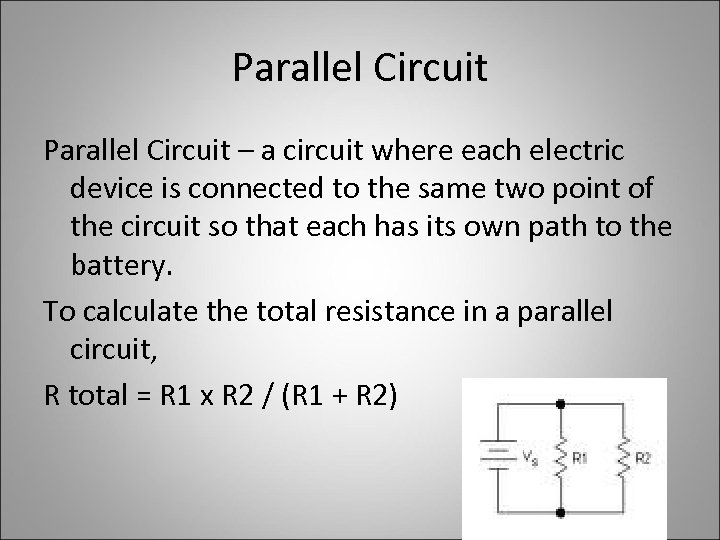 Parallel Circuit – a circuit where each electric device is connected to the same two point of the circuit so that each has its own path to the battery. To calculate the total resistance in a parallel circuit, R total = R 1 x R 2 / (R 1 + R 2)
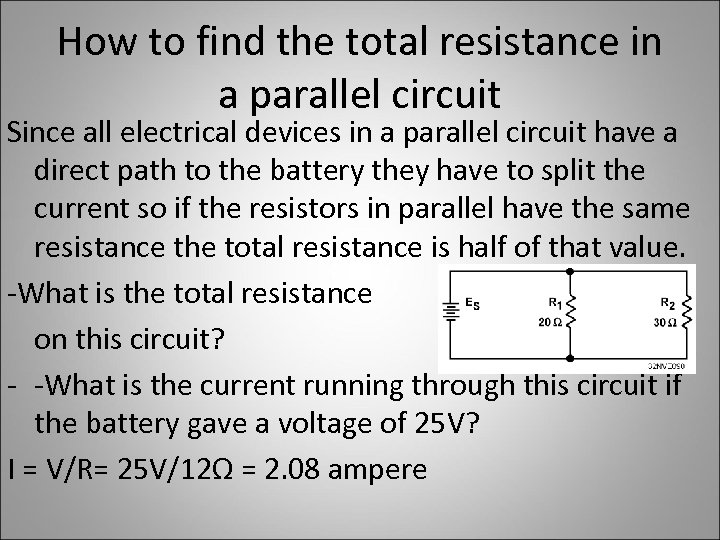 How to find the total resistance in a parallel circuit Since all electrical devices in a parallel circuit have a direct path to the battery they have to split the current so if the resistors in parallel have the same resistance the total resistance is half of that value. -What is the total resistance on this circuit? - -What is the current running through this circuit if the battery gave a voltage of 25 V? I = V/R= 25 V/12Ω = 2. 08 ampere
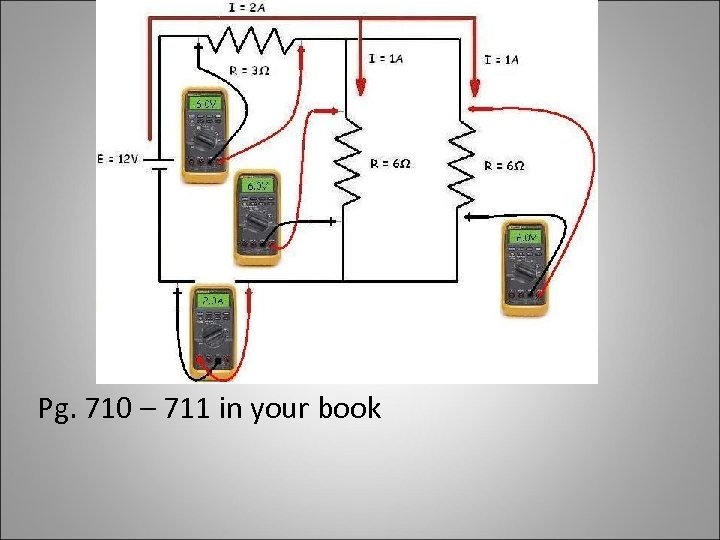 Pg. 710 – 711 in your book
 Electric Power – the rate at which electrical energy is converted into another form such as heat, mechanical energy, or light Electric Power = voltage x current or Power = V x I Electric power is measured in watts Current (I) is measured in amperes Voltage (V) is measured in volts
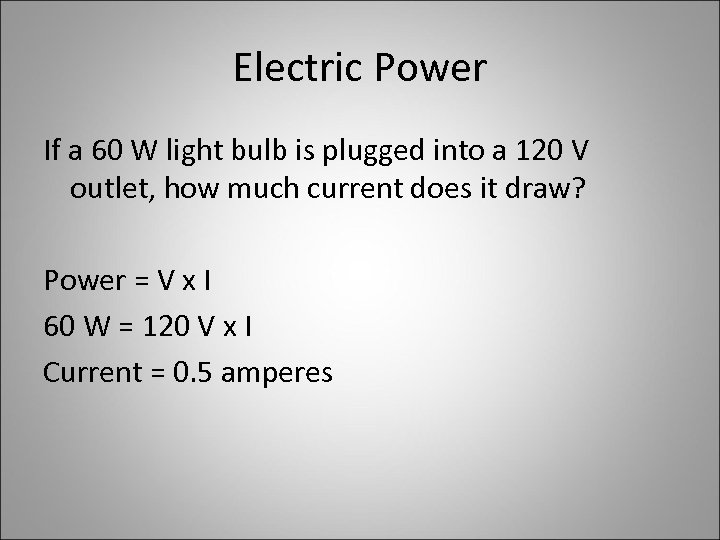 Electric Power If a 60 W light bulb is plugged into a 120 V outlet, how much current does it draw? Power = V x I 60 W = 120 V x I Current = 0. 5 amperes
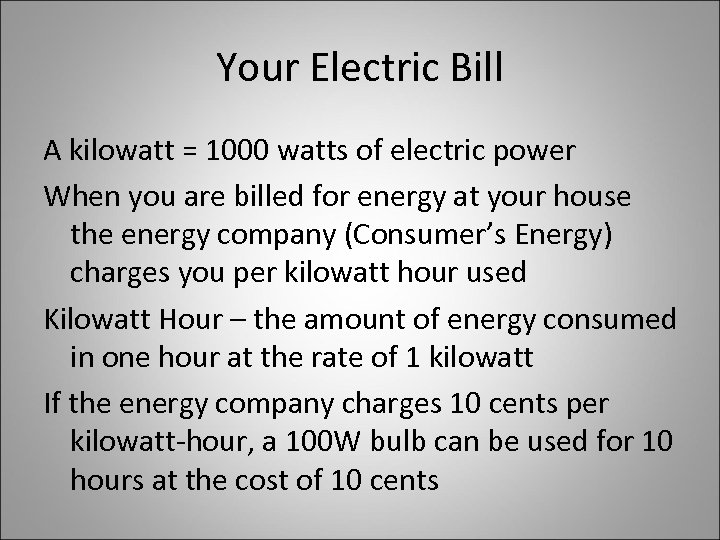 Your Electric Bill A kilowatt = 1000 watts of electric power When you are billed for energy at your house the energy company (Consumer’s Energy) charges you per kilowatt hour used Kilowatt Hour – the amount of energy consumed in one hour at the rate of 1 kilowatt If the energy company charges 10 cents per kilowatt-hour, a 100 W bulb can be used for 10 hours at the cost of 10 cents