


 Скачать презентацию Electoral Systems and Reform How democratic is our
e73d16ba3ecbf16dadf38d0977b1fe1e.ppt
- Количество слайдов: 23
 Electoral Systems and Reform How democratic is our democracy?
 Learning objective To answer in full the opening question How democratic is the UK?
 Elections play an important role Even undemocratic societies, such as the former Soviet Union, China, Zimbabwe, Saddam Husseins Iraq etc. hold elections Why? Ans: Legitimacy
 But what about Democratic states? Task: Draw a spider diagram with all the reason s why elections are needed. How many can you come up with?
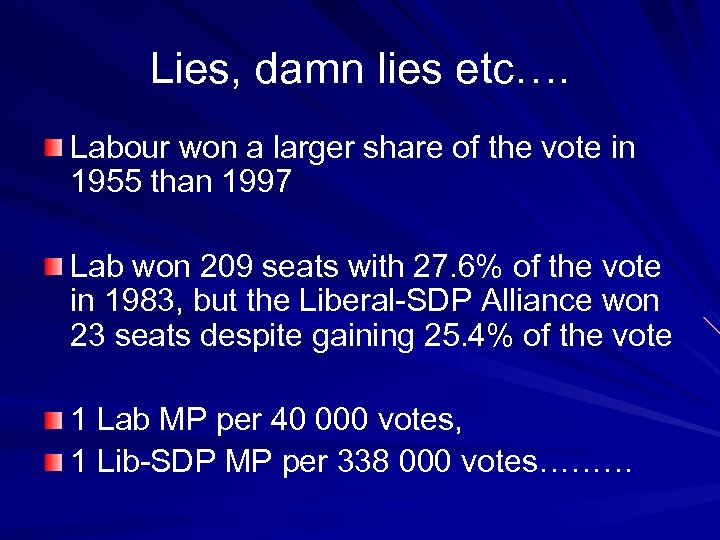 Lies, damn lies etc…. Labour won a larger share of the vote in 1955 than 1997 Lab won 209 seats with 27. 6% of the vote in 1983, but the Liberal-SDP Alliance won 23 seats despite gaining 25. 4% of the vote 1 Lab MP per 40 000 votes, 1 Lib-SDP MP per 338 000 votes………
 Poor Liberal Democrats? ? In 1997 despite their vote falling by 70 000 votes since 1992, still gained an extra 26 seats
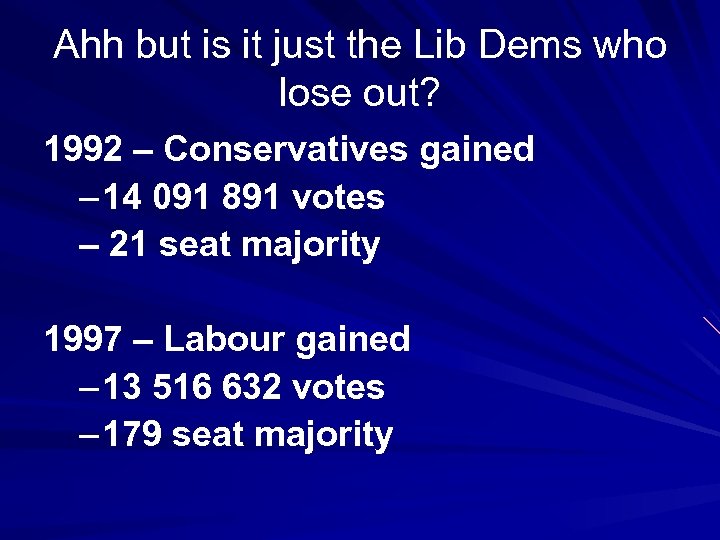 Ahh but is it just the Lib Dems who lose out? 1992 – Conservatives gained – 14 091 891 votes – 21 seat majority 1997 – Labour gained – 13 516 632 votes – 179 seat majority
 Key Words Pspehology – Study of elections and voting behaviour Popular vote - % of Britains voters that support each party
 Majoritarian Systems FIRST PAST THE POST (FPTP) Used in UK, USA, Canada, India Candidate who gains most votes in a constituency wins a seat in Parliament, Party which gains the most constituencies wins power
 First Past the Post For Against Simple Stable Produces a strong constituency link between the electorate and the member Over-represents leading party Under-represents 3 rd parties Encourages tactical voting
 2 -Ballot System Used in France A candidate needs to obtain at least 50% of the vote to avoid a 2 nd ballot Eliminate least popular candidates Voters can reconsider their votes
 Alternative Vote Used in Ashes losing Australia Number each candidate in preferential order Candidates with fewer 1 st preferences are eliminated Preferences are then redistributed until an absolute majority winner (50%+1)
 Supplementary Vote Used in London’s Mayoral Election Just two preferences If no 50% majority then all other candidates are eliminated and the second votes top up the original
 Proportional Systems Definition: An electoral system which produces a proportionate relationship between votes cast and seats won
 List system Used in E. U. elections, Israel Each party draws up a list of candidates Size of list based on # of seats Proportion of votes received determines the number of seats a party can fill 1997 U. K. election if a list system had been used would have seen Labour 89 seats short of a majority
 Single Transferable Vote (STV) Only the Irish could use this system Multi-member constituencies Electors rank candidates in order of preference Quota established as a threshold of winning a seat – for example for a 5 member constituency 20% of the vote required, for a 2 M. C. 50% is required
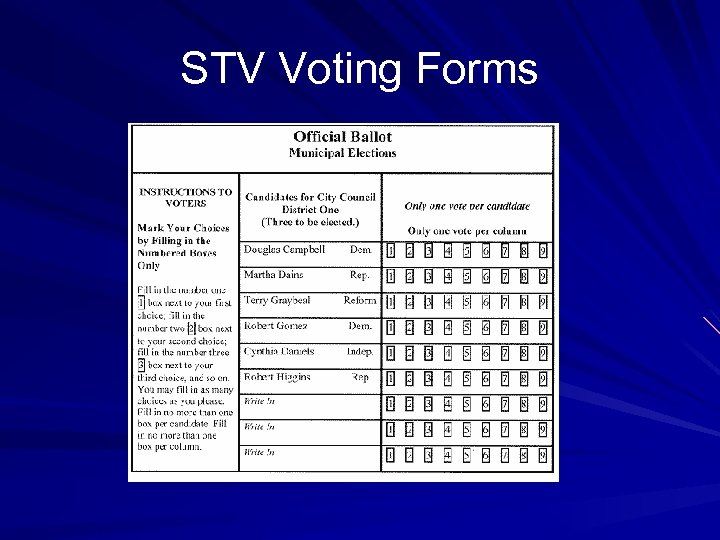 STV Voting Forms
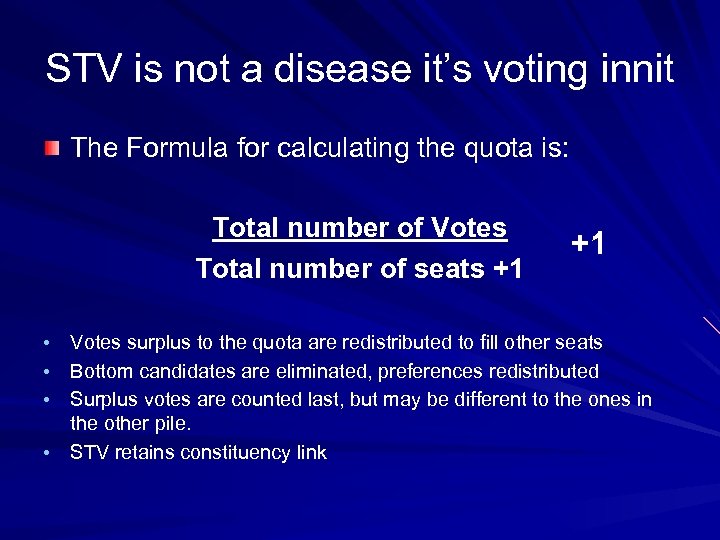 STV is not a disease it’s voting innit The Formula for calculating the quota is: Total number of Votes Total number of seats +1 +1 Votes surplus to the quota are redistributed to fill other seats • Bottom candidates are eliminated, preferences redistributed • Surplus votes are counted last, but may be different to the ones in the other pile. • STV retains constituency link •
 Additional Member System (AMS) Used for electing the Scottish Parliament Combines Proportionality with FPTP Each voter has 2 votes, one for the MP, one for the party Constituency MP voted in under FPTP Other MP’s form a regional and national list and are elected under the List System
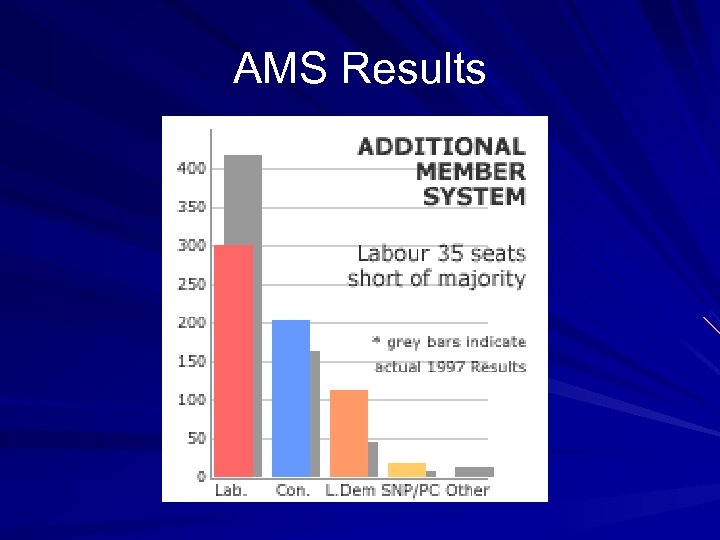 AMS Results
 Electoral Reform in Britain Based on the rise of the Liberal Party – 3 rd parties lose out under FPTP New electoral systems used for E. U. devolved assemblies and the London Mayor
 Jenkins Report Jenkins looked at the issue of electoral reform Suggested the FPTP be replaced with AV top-up A hybrid electoral system based on AMS Elect 80 -85% of the M. P. s by A. V. Topped up by a list system Fortunately the report has disappeared
 TASK Using everything you have learned so far this term, (Democracy, Political Participation and Electoral systems) draw a spider diagram with the various components needed to answer. How democratic is the UK?