


 Скачать презентацию Electoral Rights of Third-Country Nationals in the EU
27d61e3779fbfe280ea98b081c0b9974.ppt
- Количество слайдов: 14
 Electoral Rights of Third-Country Nationals in the EU countries Dr Derek Hutcheson ‘Politická participace migrantu’, Prague, 8 -9 April 2015
 EUDO/FRACIT (http: //eudo-citizenship. eu/about/fracit) • Electoral Laws • http: //eudo-citizenship. eu/databases/nationalelectoral-laws • 28 national Reports • http: //eudo-citizenship. eu/electoral-rights/electoralrights-reports • Study for European Parliament • http: //www. europarl. europa. eu/Reg. Data/etudes/etu des/join/2013/474441/IPOLAFCO_ET%282013%29474441_EN. pdf • Report to AFCO, 26 February 2013 • http: //www. europarl. europa. eu/eplive/en/committees/video? event=20130226 -1500 COMMITTEE-AFCO • Electoral Rights database • http: //eudo-citizenship. eu/electoral-rights/comparing -electoral-rights 2
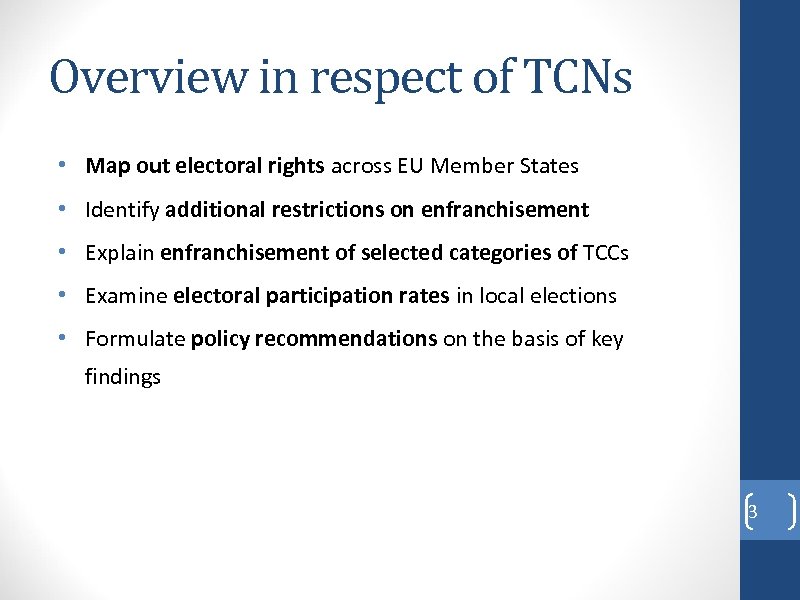 Overview in respect of TCNs • Map out electoral rights across EU Member States • Identify additional restrictions on enfranchisement • Explain enfranchisement of selected categories of TCCs • Examine electoral participation rates in local elections • Formulate policy recommendations on the basis of key findings 3
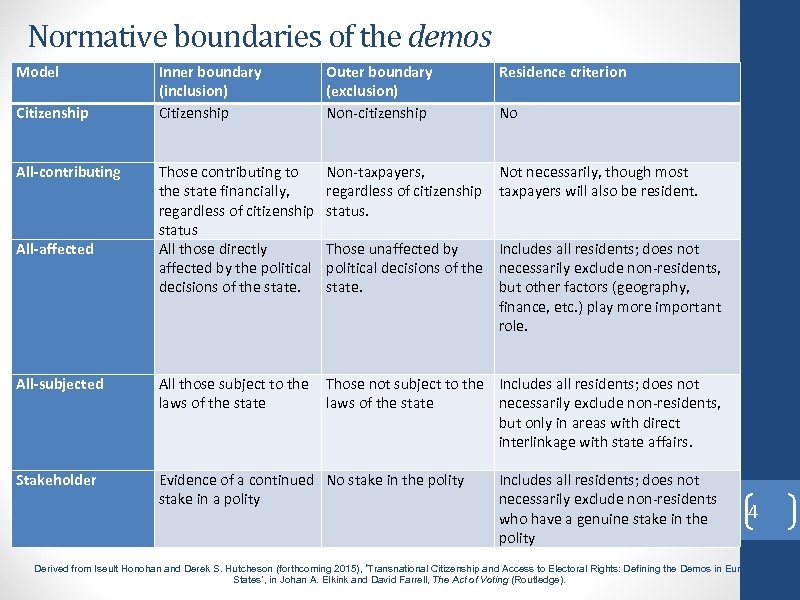 Normative boundaries of the demos Model Inner boundary (inclusion) Citizenship Outer boundary (exclusion) Non-citizenship Residence criterion Those contributing to the state financially, regardless of citizenship status All those directly affected by the political decisions of the state. Non-taxpayers, regardless of citizenship status. Not necessarily, though most taxpayers will also be resident. All-subjected All those subject to the laws of the state Those not subject to the Includes all residents; does not laws of the state necessarily exclude non-residents, but only in areas with direct interlinkage with state affairs. Stakeholder Evidence of a continued No stake in the polity stake in a polity Citizenship All-contributing All-affected No Those unaffected by Includes all residents; does not political decisions of the necessarily exclude non-residents, state. but other factors (geography, finance, etc. ) play more important role. Includes all residents; does not necessarily exclude non-residents who have a genuine stake in the polity 4 Derived from Iseult Honohan and Derek S. Hutcheson (forthcoming 2015), ‘Transnational Citizenship and Access to Electoral Rights: Defining the Demos in European States’, in Johan A. Elkink and David Farrell, The Act of Voting (Routledge).
 Differential voting rights at national and local level • ‘Restricting the local franchise to national citizens, or EU citizens, or to the citizens of those states that grant a reciprocal franchise introduces a conditionality for the local franchise that has nothing to do with the powers and functions of local selfgovernment. ’ – Bauböck 2015. • Immigration status in principle no different from intra-country migrants. • Nested within national regimes. • No local immigration/citizenship status. 5
 Legal Context • EU broadly in favour through ‘soft’ law, as integration tool: • Common Basic Principles for Immigrant Integration in the EU (JHA Council, 2004). • The EP has advocated the extension of the local franchise since 1996. • Article 6 of the 1992 Council of Europe Convention on the Participation of Foreigners in Public Life (signed by 8 Member states and ratified by 5 only). • BUT not through ‘hard’ law: • “[t]he European Parliament and the Council, acting in accordance with the ordinary legislative procedure, may establish measures to provide incentives and support for the action of Member States with a view to promoting the integration of third-country nationals residing legally in their territories, excluding any harmonisation of the laws and regulations of the Member States. ” (Art. 79. 4 TFEU) 6
 Electoral Rights vary greatly • No electoral rights for TCCs (12 states) • Voting Rights: • rare at national level (2 states, selectively) • increasingly common at regional (5) and local level (16) • Candidacy rights: more restricted than those for voting • rare at national level (2 states, selectively) • 4 in regional elections (UK, PT, SE and DK) and • 10 in local elections (DK, FI, SE, IE, EL, LU, NL, PT, SK, UK). • Selective enfranchisement • Special categories only (PT, ES, UK) • Facilitated access - 4 states (FI, SE, DK, EL) 7
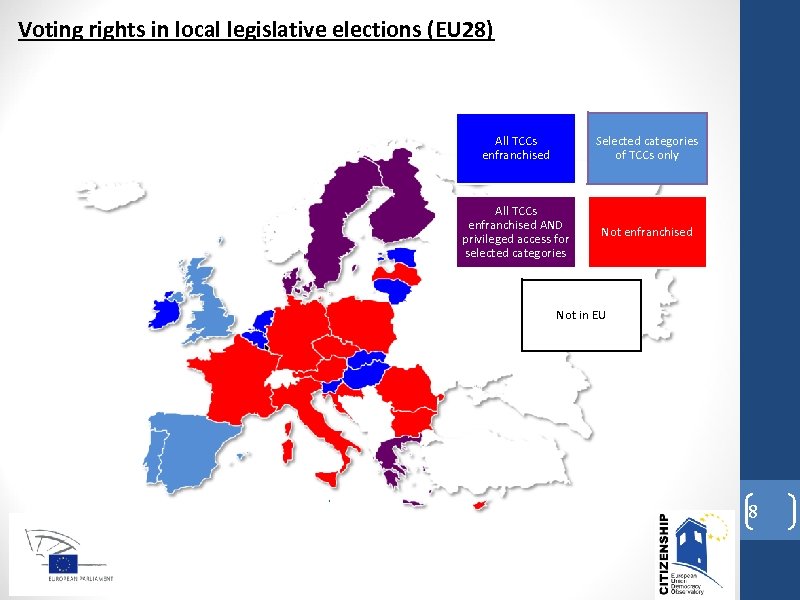 Voting rights in local legislative elections (EU 28) All TCCs enfranchised Selected categories of TCCs only All TCCs enfranchised AND privileged access for selected categories Not enfranchised Not in EU 8
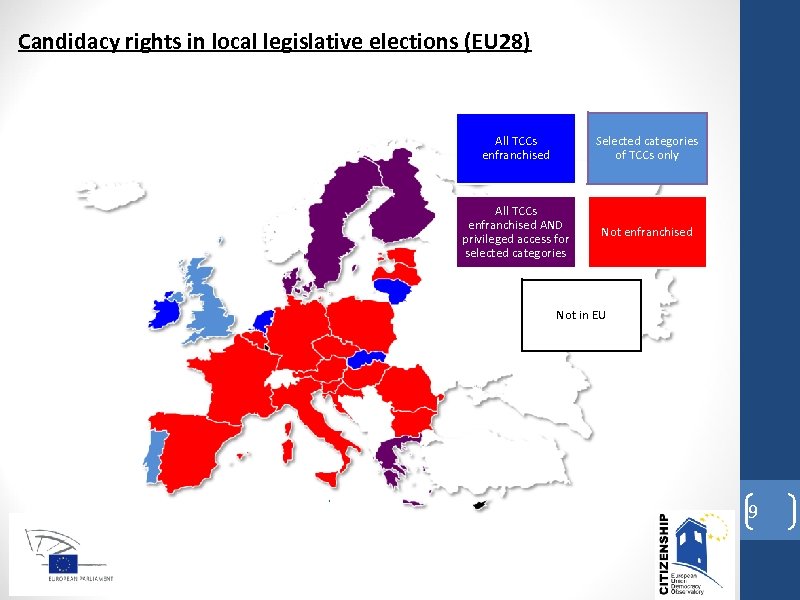 Candidacy rights in local legislative elections (EU 28) All TCCs enfranchised Selected categories of TCCs only All TCCs enfranchised AND privileged access for selected categories Not enfranchised Not in EU 9
 Additional restrictions • Durational residency requirements • From 6 months (IE) to 5 years (BE, LU, NL) • Legal status of residence • Holders of permanent residence permits only (e. g. , LT, EE, SI, SK) = de facto durational requirement • Registration procedures • Same as for natives in 9 states • Additional requirements in 7 states (BE, EL, ES, HU, LU, , PT) • e. g. , Belgian oath, Greek criminal certificate, etc. 10
 Selective enfranchisement • Membership of an international association of states other than the EU: - Nordic Union (Norway and Iceland) in DK, FI & SE - Commonwealth citizens in the United Kingdom - Citizens of the Community of Portuguese Language Countries (CPLP) in Portugal (only applies to Brazil and Cape Verde) • Bilateral agreements applied on the basis of reciprocity - Inactive provisions in Cyprus and the Czech Republic - Growing and eclectic list of countries in Spain and Portugal • Special ties based on linguistic or cultural affinities - Irish citizens residing the UK - Facilitated access for holders of a ‘omogenis’ I. D. in Greece 11
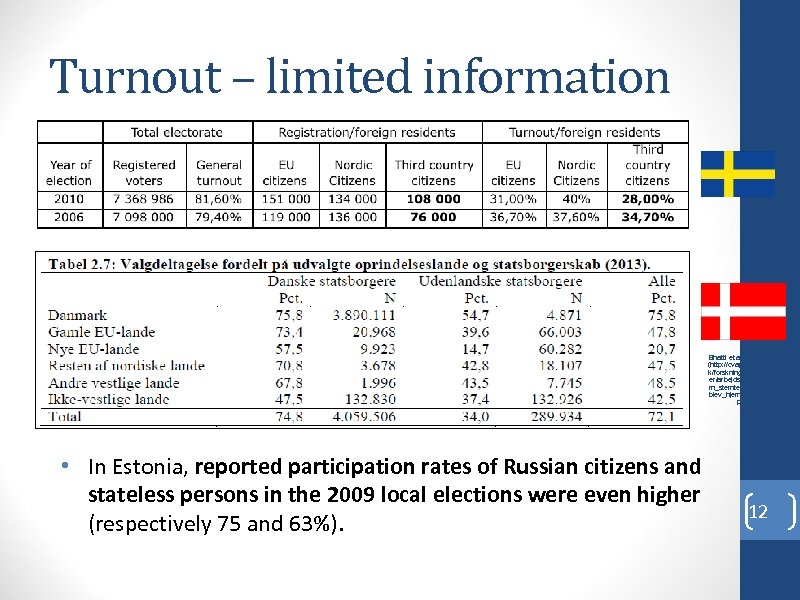 Turnout – limited information Bhatti et al 2014, p. 28 (http: //cvap. polsci. ku. d k/forskning/publikation er/arbejdspapirer/Hve m_stemte_og_hvem_ blev_hjemme__final_. pdf) • In Estonia, reported participation rates of Russian citizens and stateless persons in the 2009 local elections were even higher (respectively 75 and 63%). 12
 Policy recommendations • Converging towards a common approach • Harmonising residence-based conditions is beyond EU competence • BUT Council Directive 2003/109/EC lays down criteria for longterm residence requirements • Recommendation that these should be considered the maximum requirements for enfranchisement • Increasing Electoral Participation • Lowering registration barriers • Information campaigns promoting the benefits of voting. 13
 • See http: //eudo-citizenship. eu for: • Electoral rights database • Country reports • Information on citizenship and integration across Europe 14