


 Скачать презентацию ELEC-E 8422 Introduction to Electrical Energy Systems Lecture
0d8c9018af615732ec914149726c9df0.ppt
- Количество слайдов: 51
 ELEC-E 8422 Introduction to Electrical Energy Systems Lecture 2 Basic Components of Power Systems Matti Lehtonen
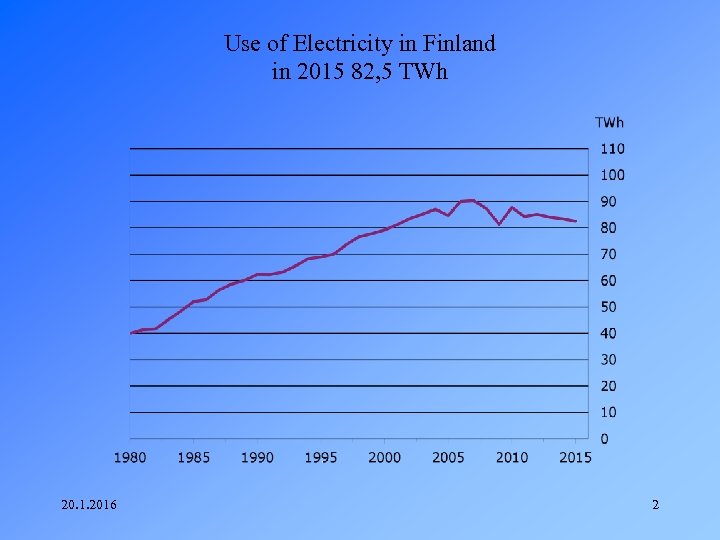 Use of Electricity in Finland in 2015 82, 5 TWh 20. 1. 2016 2
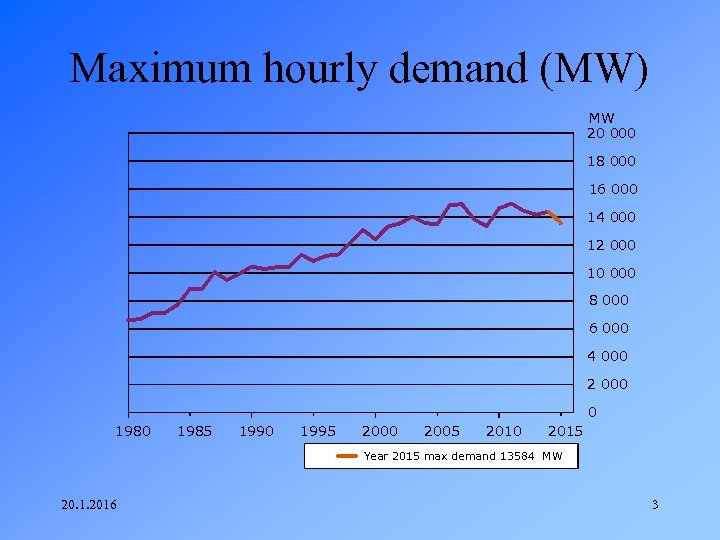 Maximum hourly demand (MW) MW 20 000 18 000 16 000 14 000 12 000 10 000 8 000 6 000 4 000 2 000 0 1985 1990 1995 2000 2005 2010 2015 Year 2015 max demand 13584 MW 20. 1. 2016 3
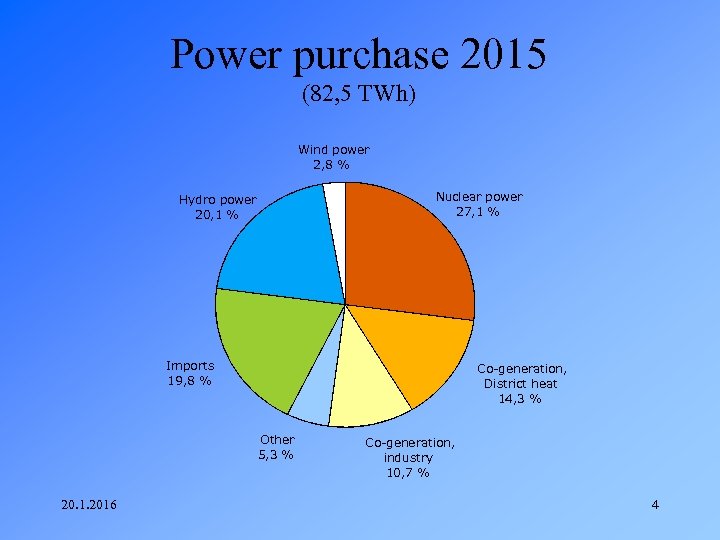 Power purchase 2015 (82, 5 TWh) Wind power 2, 8 % Nuclear power 27, 1 % Hydro power 20, 1 % Imports 19, 8 % Co-generation, District heat 14, 3 % Other 5, 3 % 20. 1. 2016 Co-generation, industry 10, 7 % 4
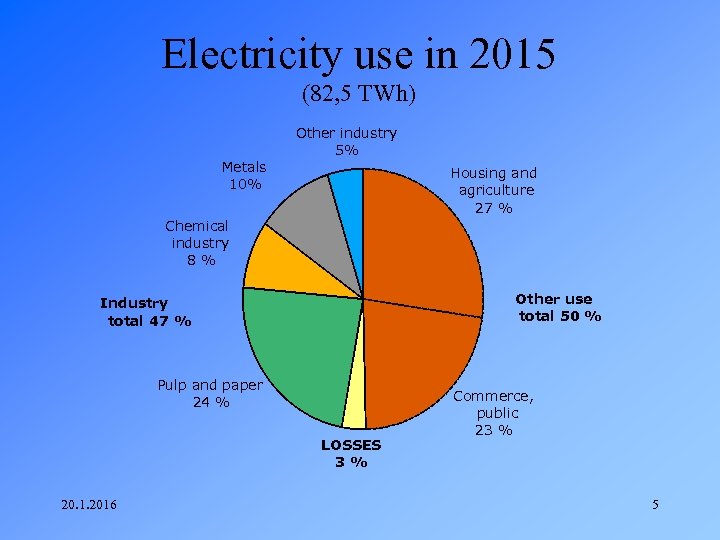 Electricity use in 2015 (82, 5 TWh) Other industry 5% Metals 10% Housing and agriculture 27 % Chemical industry 8% Other use total 50 % Industry total 47 % Pulp and paper 24 % LOSSES 3% 20. 1. 2016 Commerce, public 23 % 5
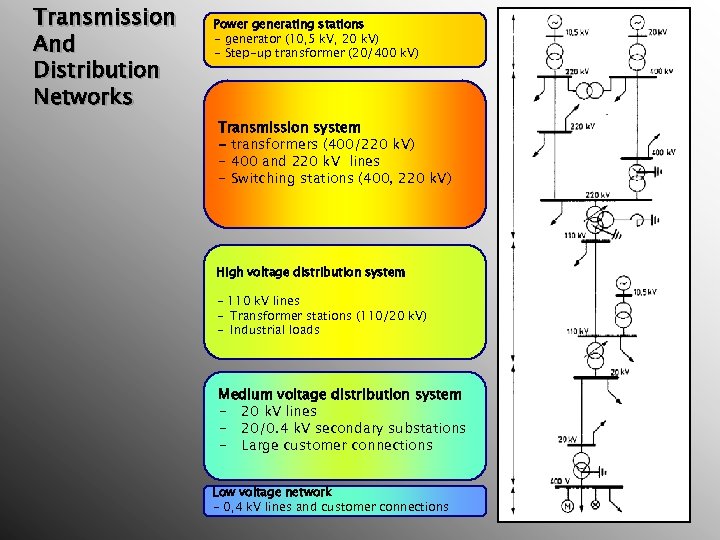 Transmission And Distribution Networks Power generating stations - generator (10, 5 k. V, 20 k. V) - Step-up transformer (20/400 k. V) Transmission system - transformers (400/220 k. V) - 400 and 220 k. V lines - Switching stations (400, 220 k. V) High voltage distribution system - 110 k. V lines - Transformer stations (110/20 k. V) - Industrial loads Medium voltage distribution system - 20 k. V lines - 20/0. 4 k. V secondary substations - Large customer connections Low voltage network - 0, 4 k. V lines and customer connections
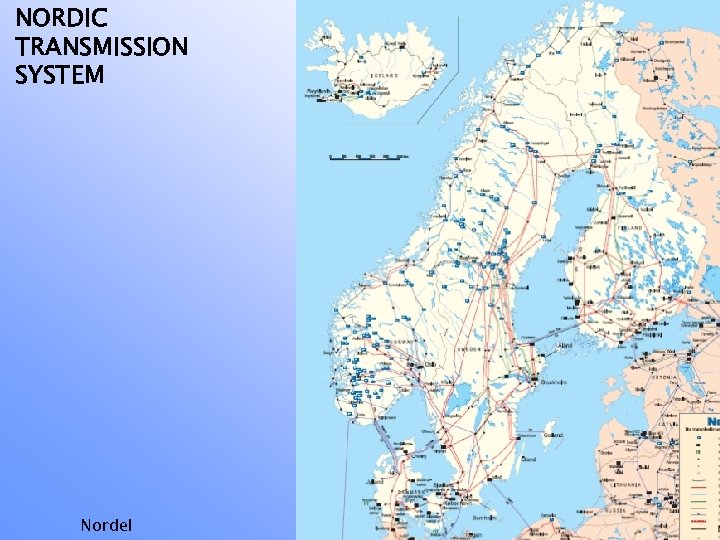 NORDIC TRANSMISSION SYSTEM Nordel
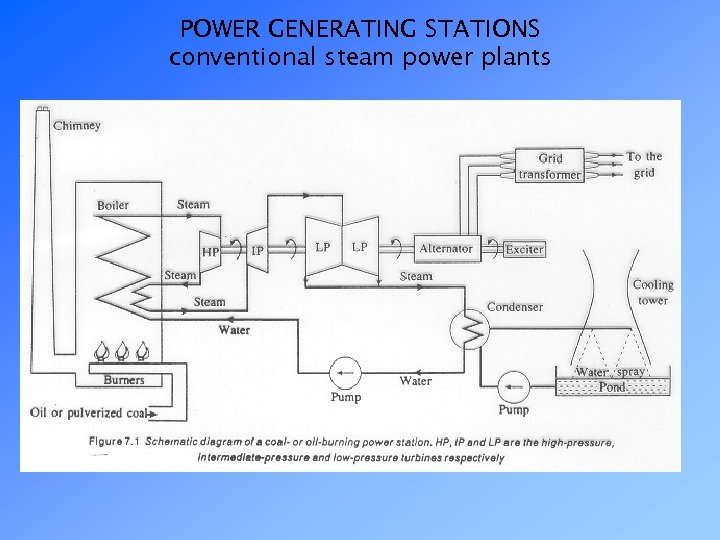 POWER GENERATING STATIONS conventional steam power plants
 POWER GENERATING STATIONS conventional steam power plants Steam produced by coal, oil or peat Efficiency at maximum about 40% Base-load or intermediate generation High environmental impact due to CO 2, SO 2 and NOx Efficiency increased if waste heat energy is used for district heating condenser replaced by heat exchanger ”back-pressure power plant ”
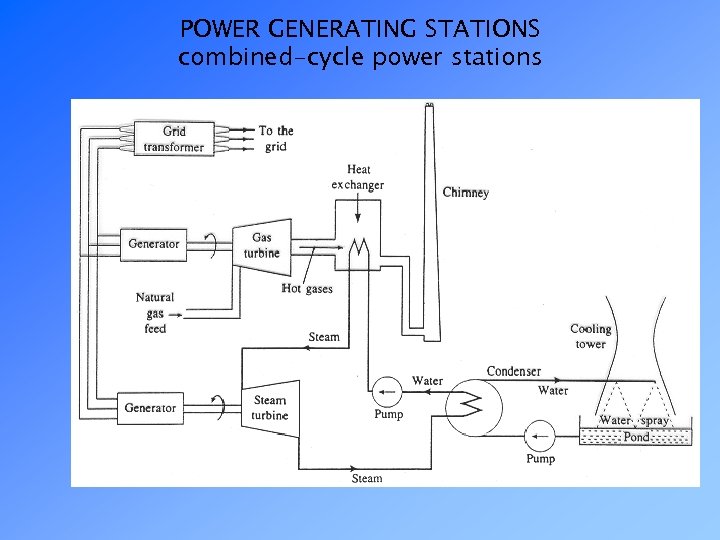 POWER GENERATING STATIONS combined-cycle power stations
 POWER GENERATING STATIONS combined-cycle power stations One generator driven by a gas turbine, one with steam The exhaust heat of gas turbine is utilised in steam production The emission of SO 2 and NOx better controlled than in conventional plants (gasification) In back-pressure connection, thermal efficiency is very high; yield of electricity and heat about 50/50
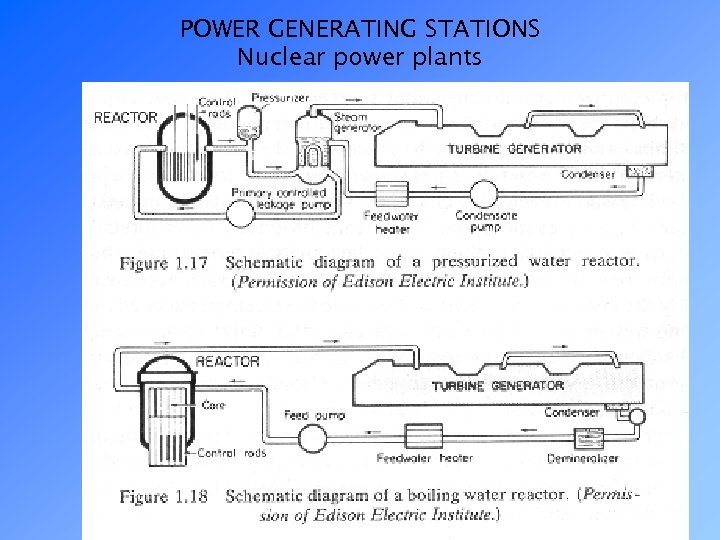 POWER GENERATING STATIONS Nuclear power plants
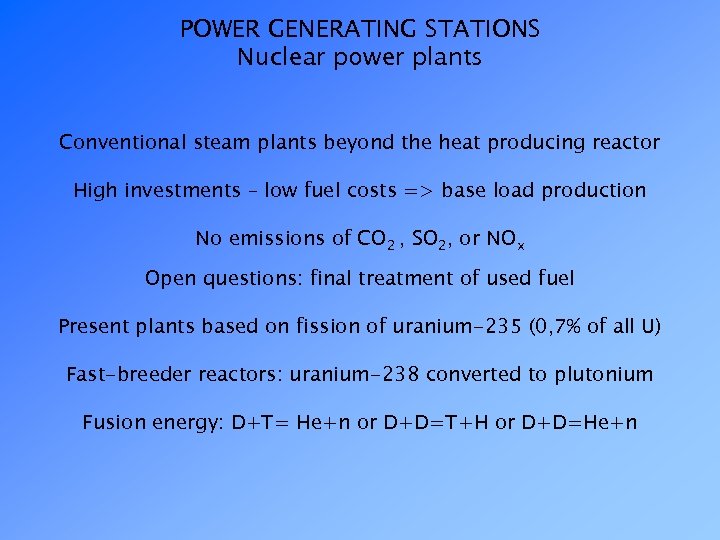 POWER GENERATING STATIONS Nuclear power plants Conventional steam plants beyond the heat producing reactor High investments – low fuel costs => base load production No emissions of CO 2 , SO 2, or NOx Open questions: final treatment of used fuel Present plants based on fission of uranium-235 (0, 7% of all U) Fast-breeder reactors: uranium-238 converted to plutonium Fusion energy: D+T= He+n or D+D=T+H or D+D=He+n
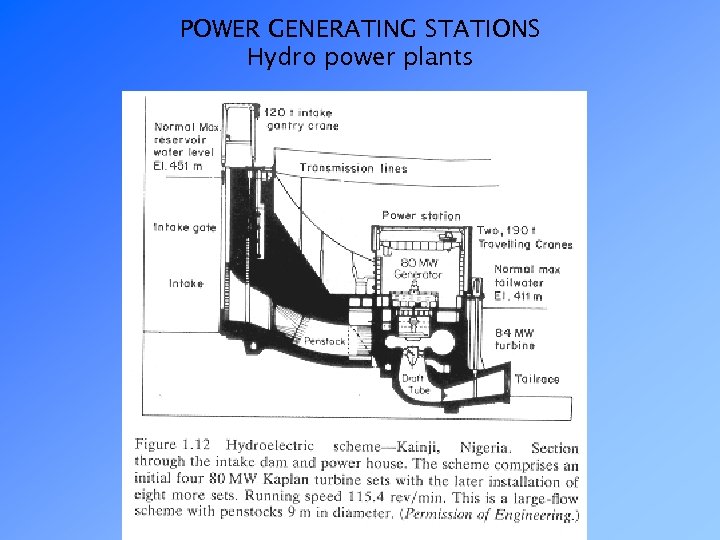 POWER GENERATING STATIONS Hydro power plants
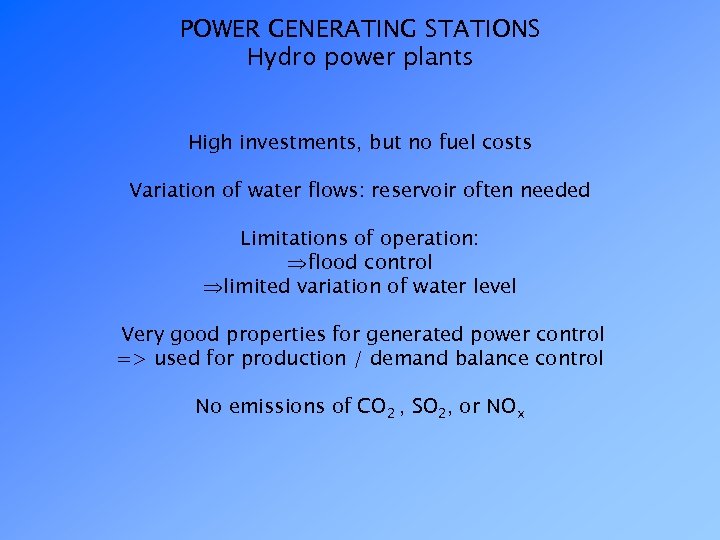 POWER GENERATING STATIONS Hydro power plants High investments, but no fuel costs Variation of water flows: reservoir often needed Limitations of operation: flood control limited variation of water level Very good properties for generated power control => used for production / demand balance control No emissions of CO 2 , SO 2, or NOx
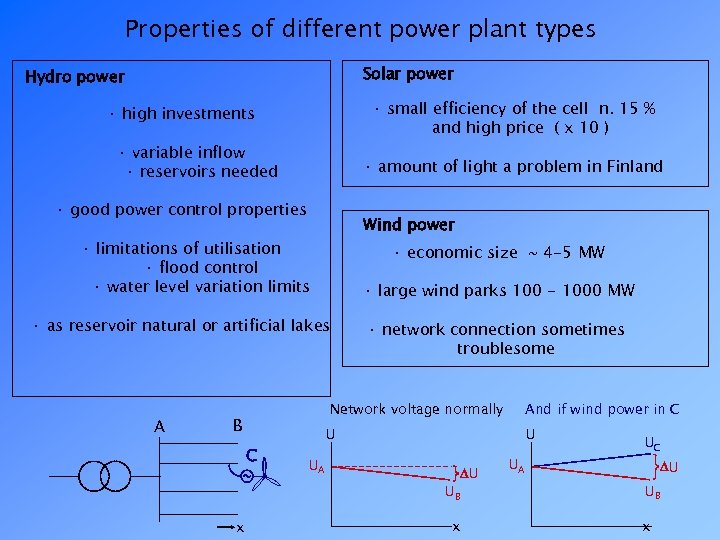 Properties of different power plant types Solar power Hydro power · small efficiency of the cell n. 15 % and high price ( x 10 ) · high investments · variable inflow · reservoirs needed · amount of light a problem in Finland · good power control properties Wind power · limitations of utilisation · flood control · water level variation limits · economic size ~ 4 -5 MW · large wind parks 100 - 1000 MW · as reservoir natural or artificial lakes A · network connection sometimes troublesome Network voltage normally U B C And if wind power in C U UA UB x DU x UA UC DU UB x
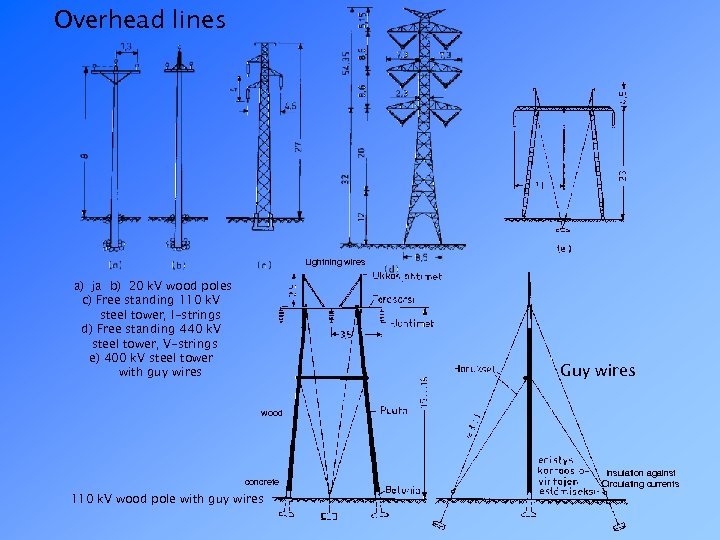 Overhead lines Lightning wires a) ja b) 20 k. V wood poles c) Free standing 110 k. V steel tower, I-strings d) Free standing 440 k. V steel tower, V-strings e) 400 k. V steel tower with guy wires Guy wires wood concrete 110 k. V wood pole with guy wires Insulation against Circulating currents
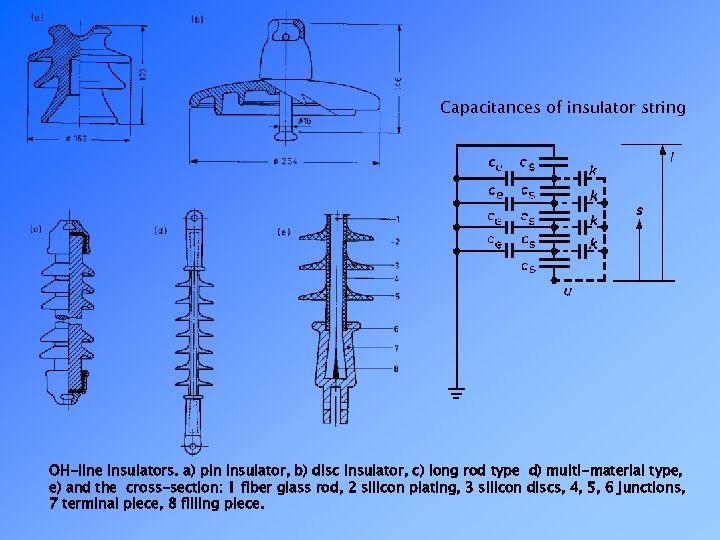 Capacitances of insulator string OH-line insulators. a) pin insulator, b) disc insulator, c) long rod type d) multi-material type, e) and the cross-section: 1 fiber glass rod, 2 silicon plating, 3 silicon discs, 4, 5, 6 junctions, 7 terminal piece, 8 filling piece.
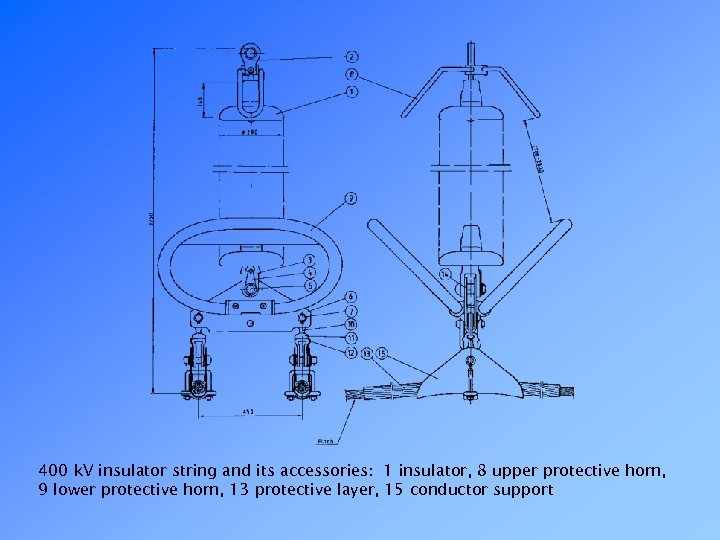 400 k. V insulator string and its accessories: 1 insulator, 8 upper protective horn, 9 lower protective horn, 13 protective layer, 15 conductor support
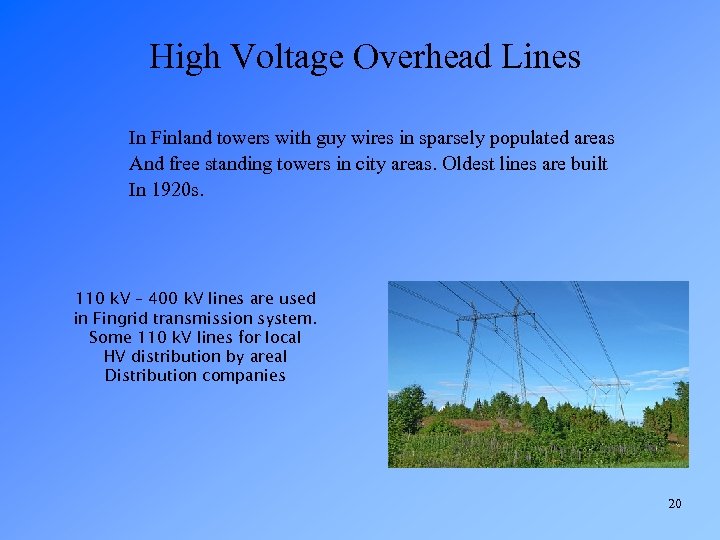 High Voltage Overhead Lines In Finland towers with guy wires in sparsely populated areas And free standing towers in city areas. Oldest lines are built In 1920 s. 110 k. V – 400 k. V lines are used in Fingrid transmission system. Some 110 k. V lines for local HV distribution by areal Distribution companies 20
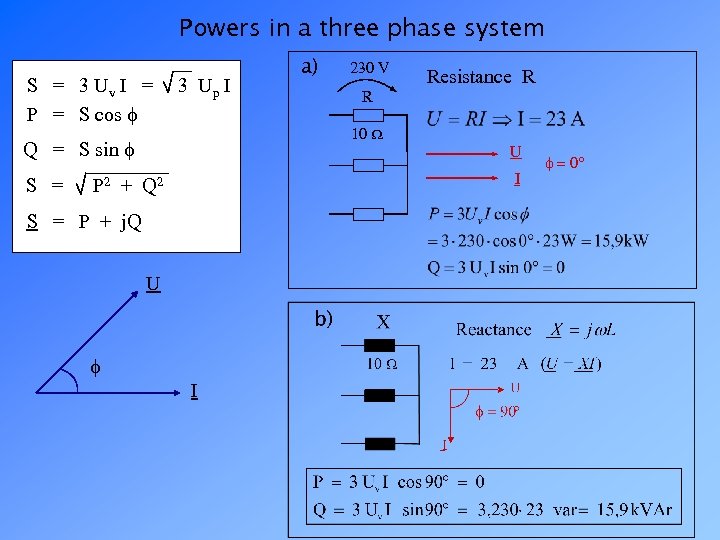 Powers in a three phase system S = 3 Uv I = P = S cos f 3 Up I 230 V Resistance R R 10 W Q = S sin f S = a) U I P 2 + Q 2 S = P + j. Q U f I f = 0°
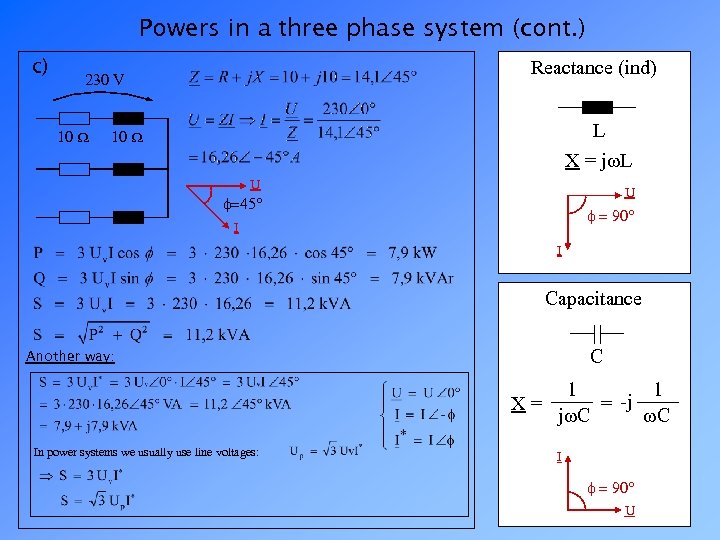 Powers in a three phase system (cont. ) c) Reactance (ind) 230 V 10 W L 10 W X = jw. L U U f=45° f = 90° I I Capacitance C Another way: 1 1 -j X= = w. C jw. C In power systems we usually use line voltages: I f = 90° U
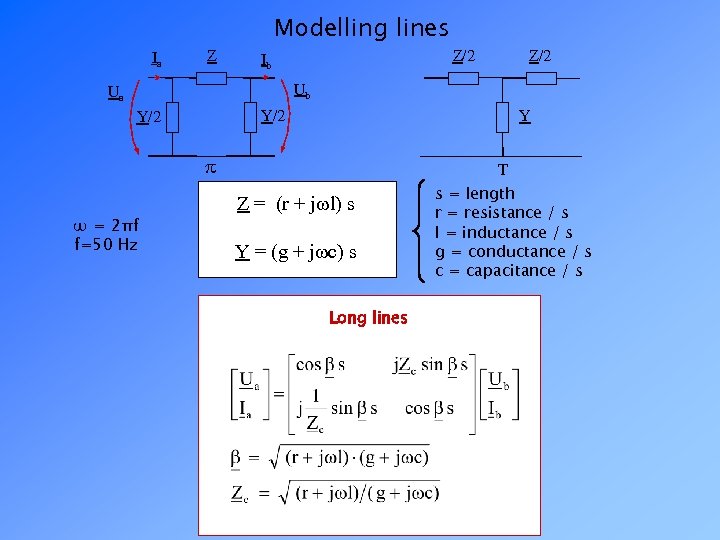 Modelling lines Ia Z Z/2 Ib Z/2 Ub Ua Y/2 Y p ω = 2πf f=50 Hz T Z = (r + jwl) s Y = (g + jwc) s Long lines s = length r = resistance / s l = inductance / s g = conductance / s c = capacitance / s
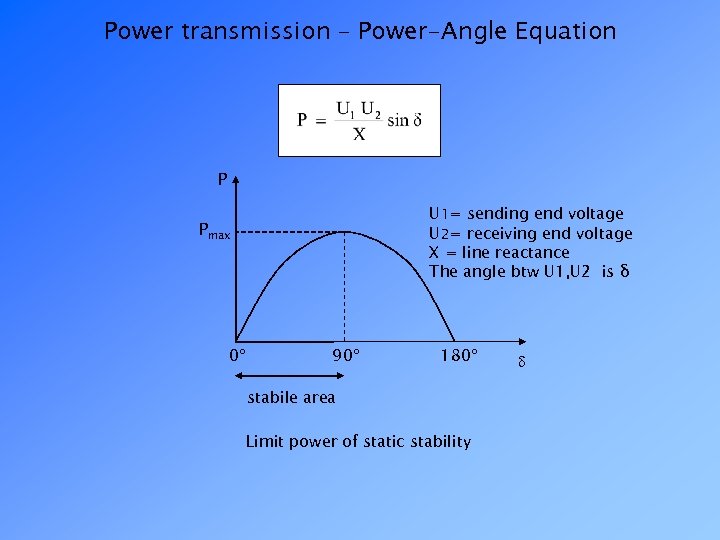 Power transmission – Power-Angle Equation P U 1= sending end voltage U 2= receiving end voltage X = line reactance The angle btw U 1, U 2 is δ Pmax 0º 90º 180º stabile area Limit power of static stability d
 Surge Arresters - Used for fast overvoltage transients due to lightnings and switching actions - In normal operation are isolators, but quickly turn to conducting when protective voltage level of voltage is exceeded - There must be enough margin between insulation level of components and protective level of SA - SA must be located close to the protected equipment, which usually is a transformer or a cable 25
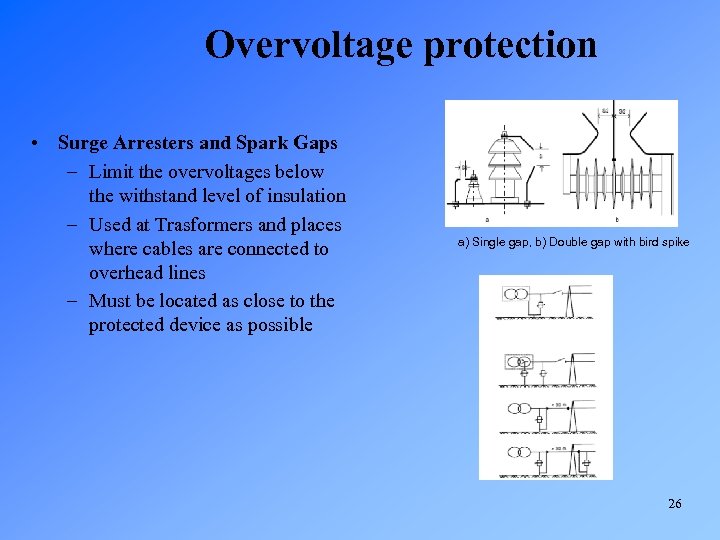 Overvoltage protection • Surge Arresters and Spark Gaps – Limit the overvoltages below the withstand level of insulation – Used at Trasformers and places where cables are connected to overhead lines – Must be located as close to the protected device as possible a) Single gap, b) Double gap with bird spike 26
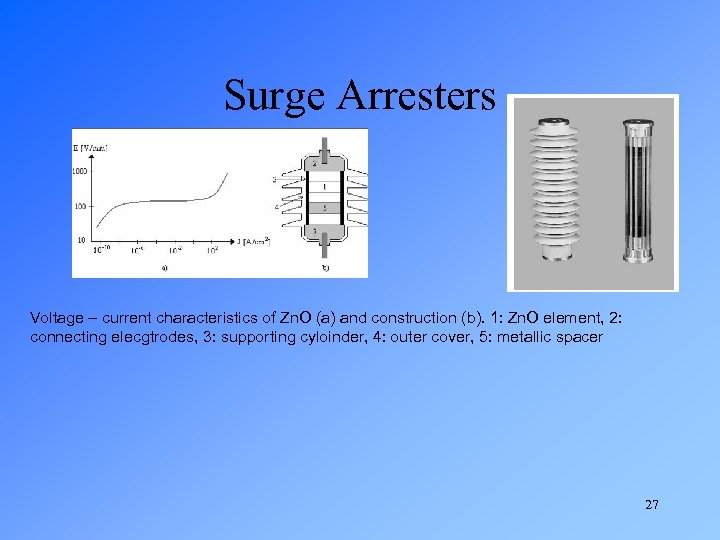 Surge Arresters Voltage – current characteristics of Zn. O (a) and construction (b). 1: Zn. O element, 2: connecting elecgtrodes, 3: supporting cyloinder, 4: outer cover, 5: metallic spacer 27
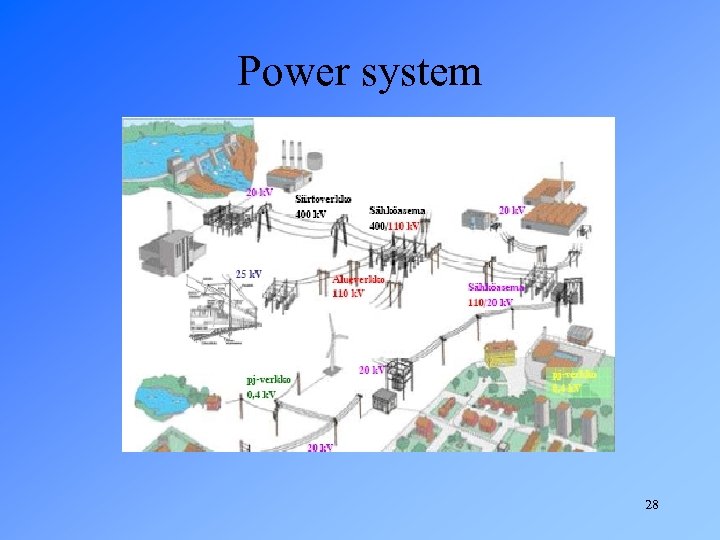 Power system 28
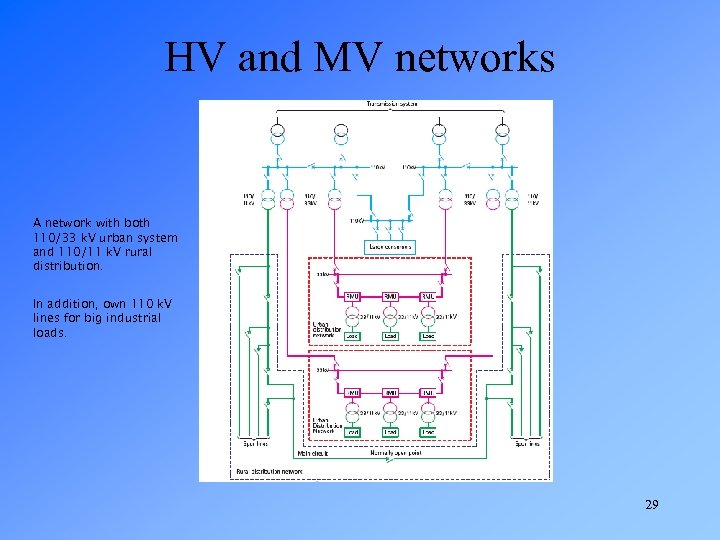 HV and MV networks A network with both 110/33 k. V urban system and 110/11 k. V rural distribution. In addition, own 110 k. V lines for big industrial loads. 29
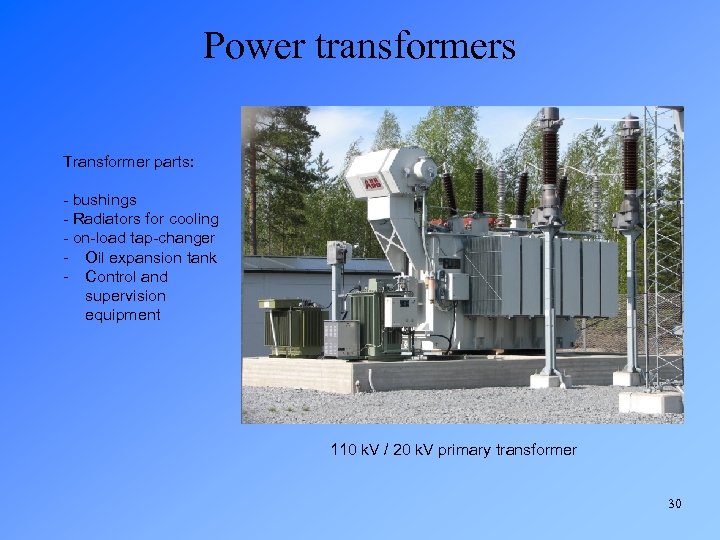 Power transformers Transformer parts: - bushings - Radiators for cooling - on-load tap-changer - Oil expansion tank - Control and supervision equipment 110 k. V / 20 k. V primary transformer 30
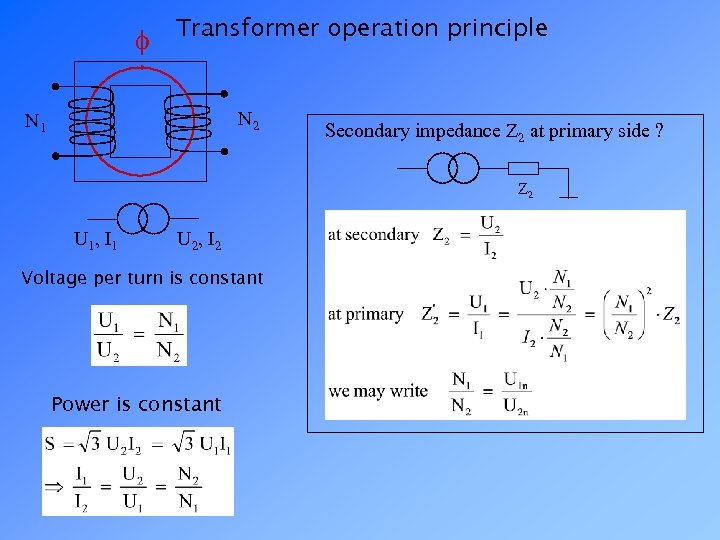 f Transformer operation principle N 2 N 1 Secondary impedance Z 2 at primary side ? Z 2 U 1 , I 1 U 2 , I 2 Voltage per turn is constant Power is constant
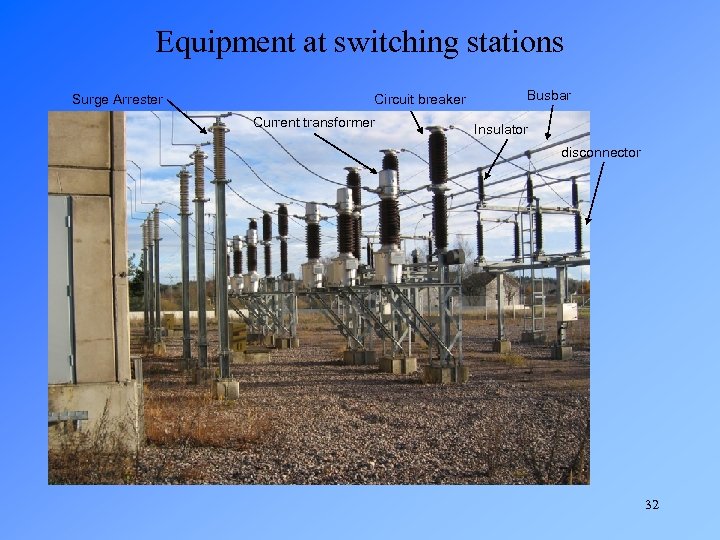 Equipment at switching stations Surge Arrester Circuit breaker Current transformer Busbar Insulator disconnector 32
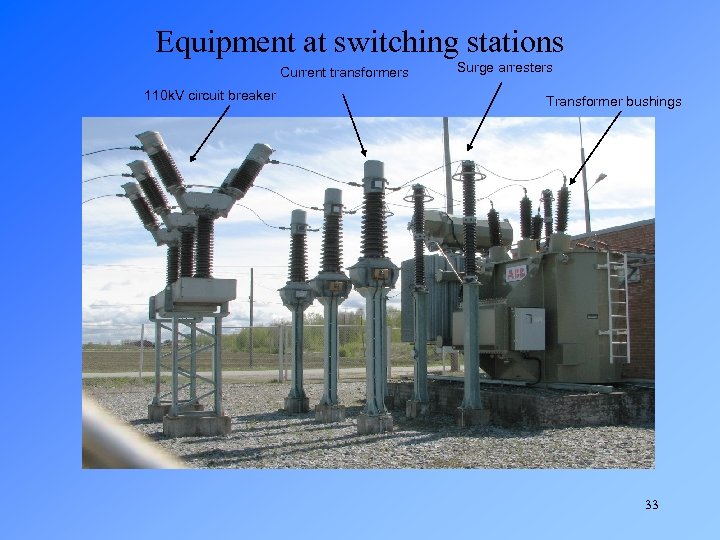 Equipment at switching stations Current transformers 110 k. V circuit breaker Surge arresters Transformer bushings 33
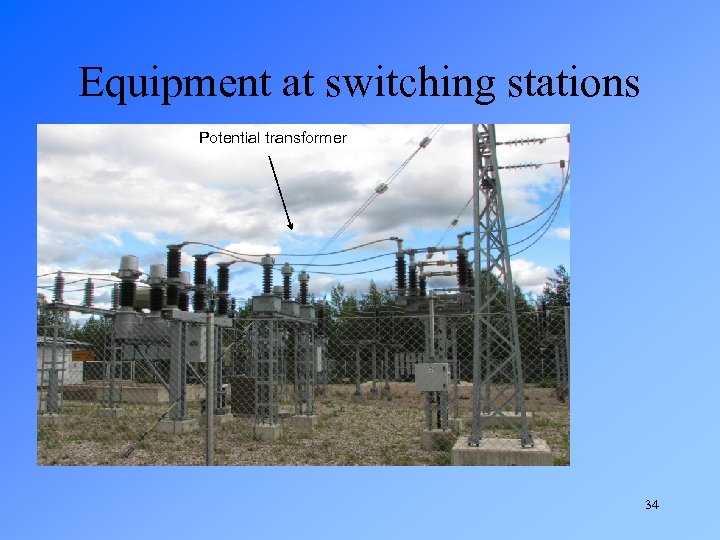 Equipment at switching stations Potential transformer 34
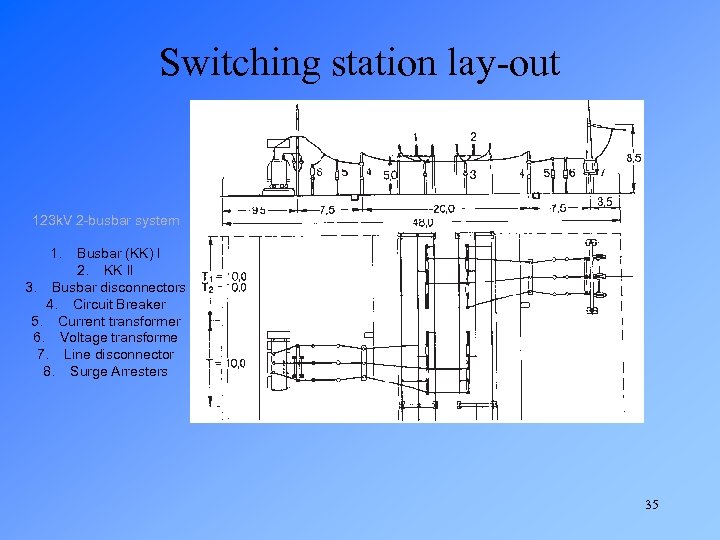 Switching station lay-out 123 k. V 2 -busbar system 1. Busbar (KK) I 2. KK II 3. Busbar disconnectors 4. Circuit Breaker 5. Current transformer 6. Voltage transforme 7. Line disconnector 8. Surge Arresters 35
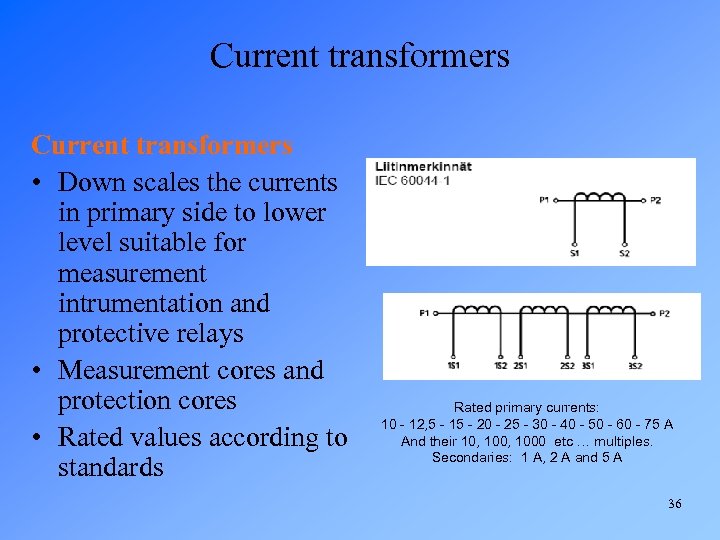 Current transformers • Down scales the currents in primary side to lower level suitable for measurement intrumentation and protective relays • Measurement cores and protection cores • Rated values according to standards Rated primary currents: 10 - 12, 5 - 15 - 20 - 25 - 30 - 40 - 50 - 60 - 75 A And their 10, 1000 etc … multiples. Secondaries: 1 A, 2 A and 5 A 36
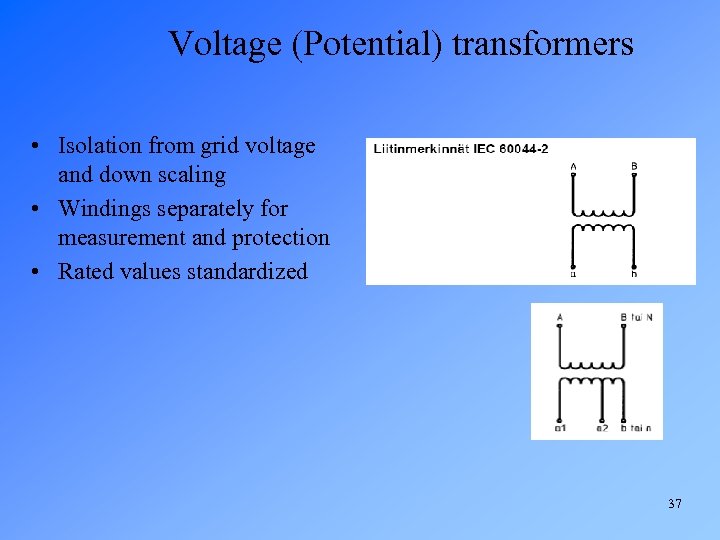 Voltage (Potential) transformers • Isolation from grid voltage and down scaling • Windings separately for measurement and protection • Rated values standardized 37
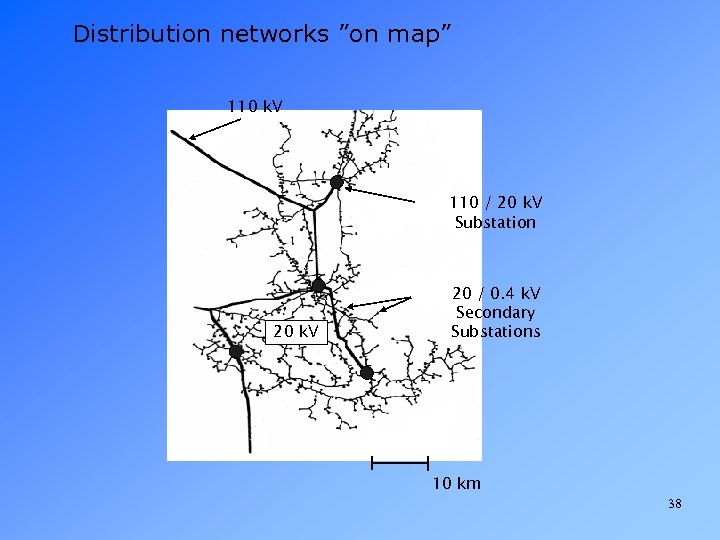 Distribution networks ”on map” 110 k. V 110 / 20 k. V Substation 20 k. V 20 / 0. 4 k. V Secondary Substations 10 km 38
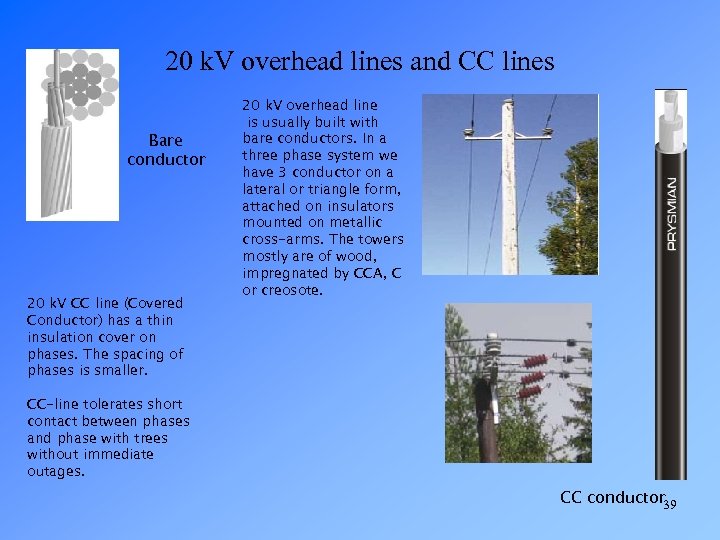 20 k. V overhead lines and CC lines Bare conductor 20 k. V CC line (Covered Conductor) has a thin insulation cover on phases. The spacing of phases is smaller. 20 k. V overhead line is usually built with bare conductors. In a three phase system we have 3 conductor on a lateral or triangle form, attached on insulators mounted on metallic cross-arms. The towers mostly are of wood, impregnated by CCA, C or creosote. CC-line tolerates short contact between phases and phase with trees without immediate outages. CC conductor 39
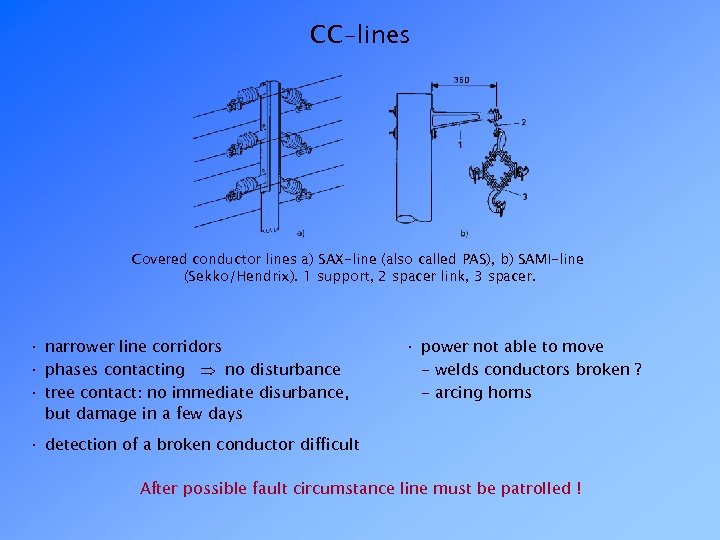 CC-lines Covered conductor lines a) SAX-line (also called PAS), b) SAMI-line (Sekko/Hendrix). 1 support, 2 spacer link, 3 spacer. · narrower line corridors · phases contacting no disturbance · tree contact: no immediate disurbance, but damage in a few days · power not able to move - welds conductors broken ? - arcing horns · detection of a broken conductor difficult After possible fault circumstance line must be patrolled !
 Distribution network structures Medium Voltage Overhead lines (1/3) § 3 -phases, 20 k. V § No zero or neutral wire § Looped, but radial operated § Disconnecting switches, some in remote control § Back-up connections at least at back bone line § § Ungrounded or compensated neutral Protective relays + circuit breakers at primary subs. Typical length 20… 30 km (Lapland even 100 km…) Typical load only a few megawatts 41
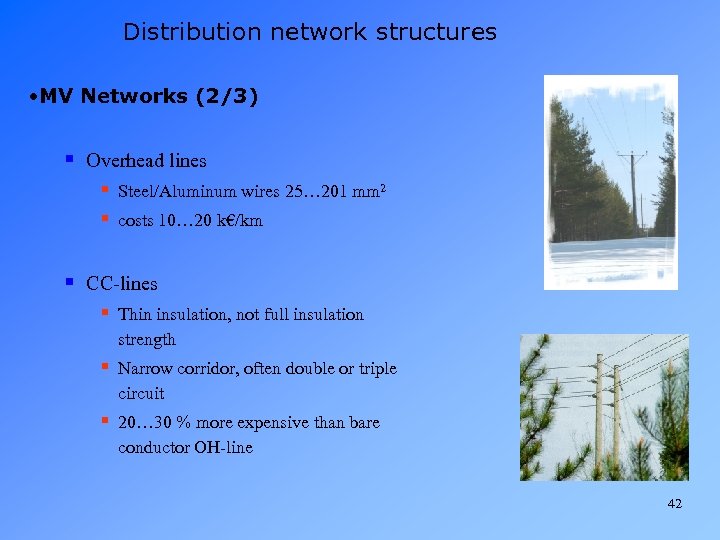 Distribution network structures • MV Networks (2/3) § Overhead lines § Steel/Aluminum wires 25… 201 mm 2 § costs 10… 20 k€/km § CC-lines § Thin insulation, not full insulation strength § Narrow corridor, often double or triple circuit § 20… 30 % more expensive than bare conductor OH-line 42
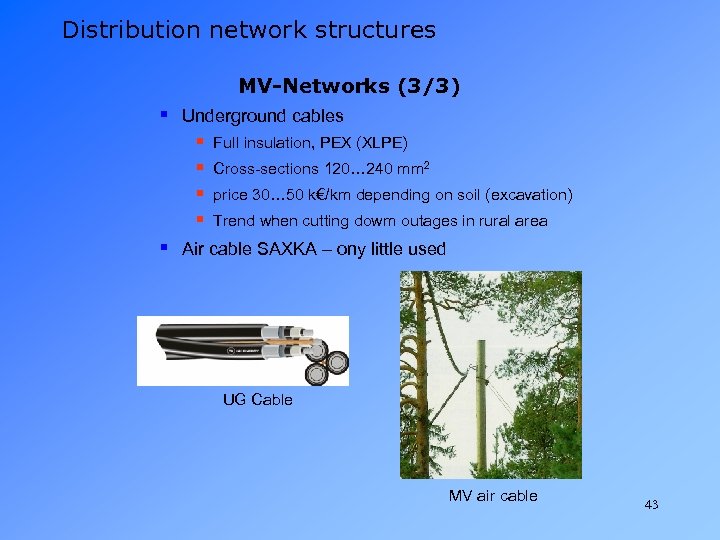 Distribution network structures MV-Networks (3/3) § Underground cables § § Full insulation, PEX (XLPE) Cross-sections 120… 240 mm 2 price 30… 50 k€/km depending on soil (excavation) Trend when cutting dowm outages in rural area § Air cable SAXKA – ony little used UG Cable MV air cable 43
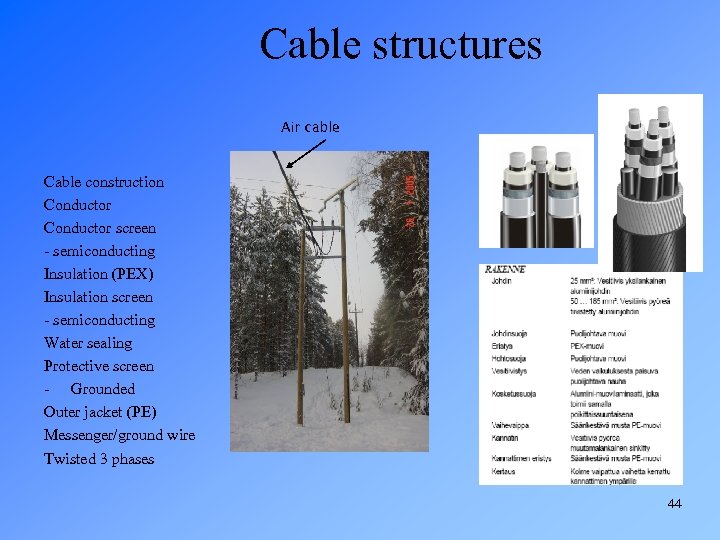 Cable structures Air cable Cable construction Conductor screen - semiconducting Insulation (PEX) Insulation screen - semiconducting Water sealing Protective screen - Grounded Outer jacket (PE) Messenger/ground wire Twisted 3 phases 44
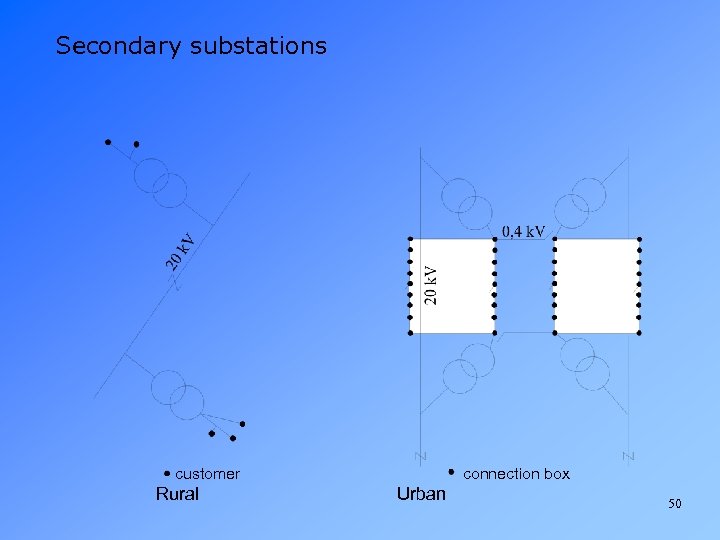
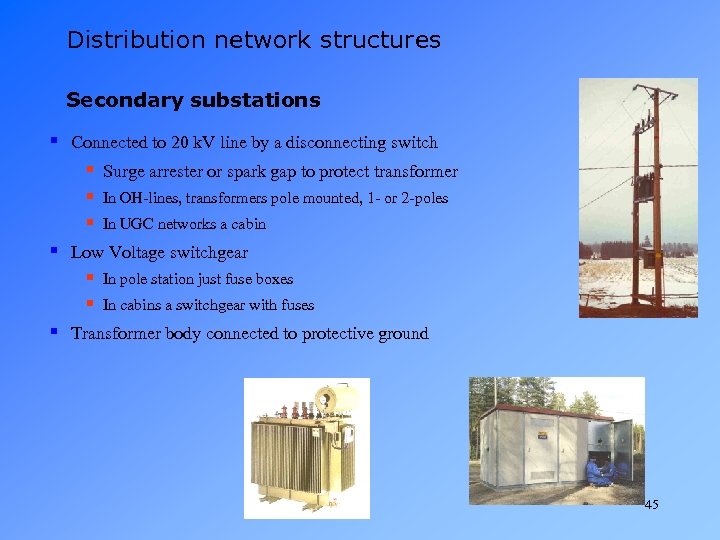 Distribution network structures Secondary substations § Connected to 20 k. V line by a disconnecting switch § Surge arrester or spark gap to protect transformer § In OH-lines, transformers pole mounted, 1 - or 2 -poles § In UGC networks a cabin § Low Voltage switchgear § In pole station just fuse boxes § In cabins a switchgear with fuses § Transformer body connected to protective ground 45
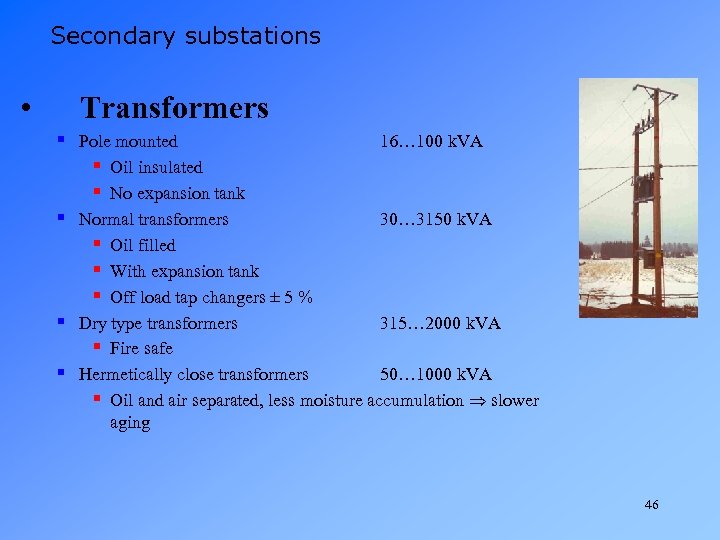 Secondary substations • Transformers § Pole mounted 16… 100 k. VA § Oil insulated § No expansion tank § Normal transformers 30… 3150 k. VA § Oil filled § With expansion tank § Off load tap changers ± 5 % § Dry type transformers 315… 2000 k. VA § Fire safe § Hermetically close transformers 50… 1000 k. VA § Oil and air separated, less moisture accumulation slower aging 46
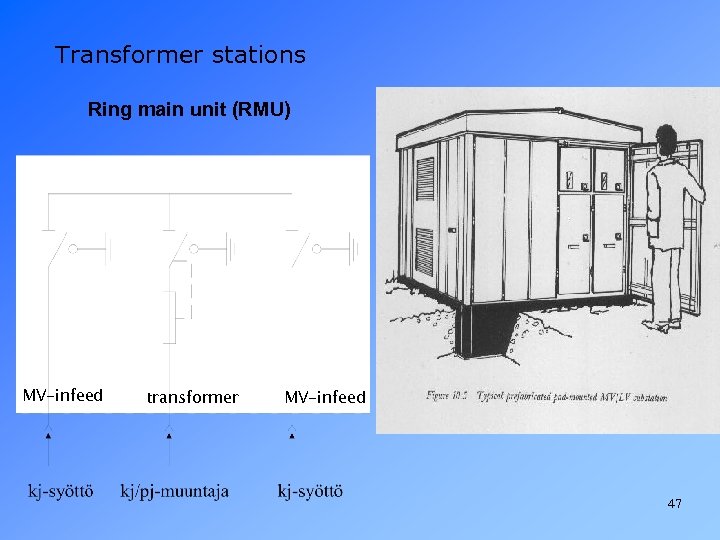 Transformer stations Ring main unit (RMU) MV-infeed transformer MV-infeed 47
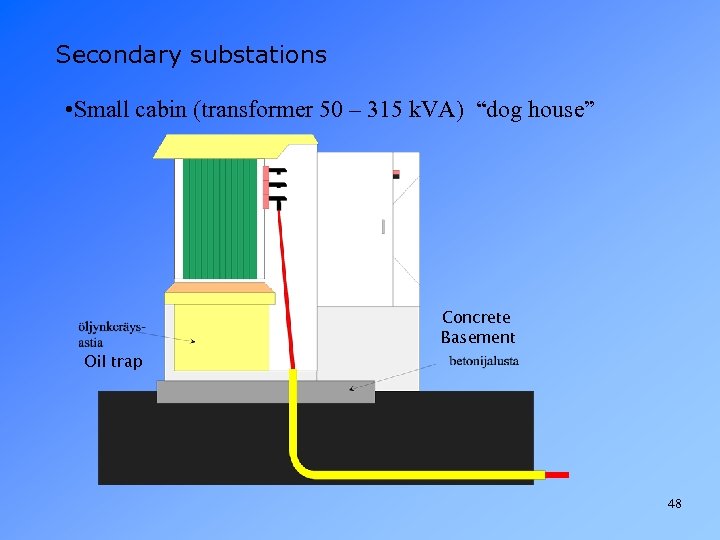 Secondary substations • Small cabin (transformer 50 – 315 k. VA) “dog house” Oil trap Concrete Basement 48
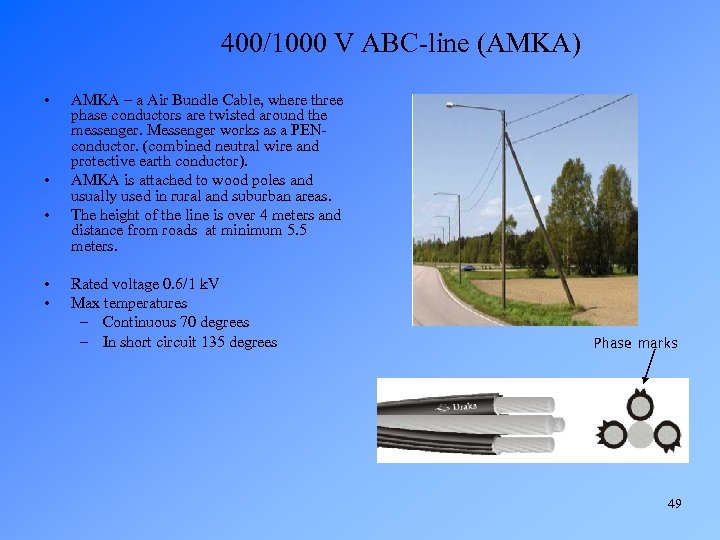 400/1000 V ABC-line (AMKA) • • • AMKA – a Air Bundle Cable, where three phase conductors are twisted around the messenger. Messenger works as a PENconductor. (combined neutral wire and protective earth conductor). AMKA is attached to wood poles and usually used in rural and suburban areas. The height of the line is over 4 meters and distance from roads at minimum 5. 5 meters. Rated voltage 0. 6/1 k. V Max temperatures – Continuous 70 degrees – In short circuit 135 degrees Phase marks 49
 Secondary substations customer Rural connection box Urban 50
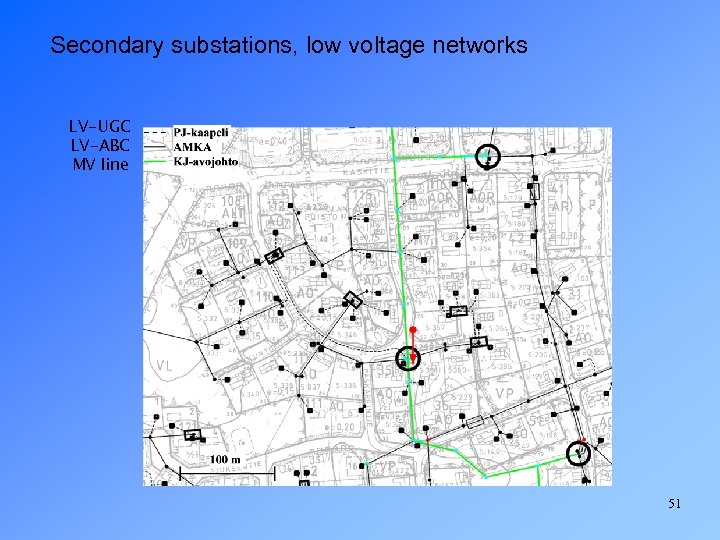 Secondary substations, low voltage networks LV-UGC LV-ABC MV line 51