 Скачать презентацию ELDER ABUSE An Introduction for the Clinician 1
6691625d1fa76ff5219d78d6393fec68.ppt
- Количество слайдов: 58



ELDER ABUSE An Introduction for the Clinician 1
ACKNOWLEDGEMENTS This slide lecture presentation was created by the University of California Irvine Center of Excellence in Elder Abuse and Neglect. 2
LEARNING OBJECTIVES To place knowledge on the definition and categories of elder abuse into clinical context. To encourage the clinician’s routine inquiry about elder abuse in the office, clinic and hospital. To identify the spectrum of presenting signs and symptoms of elder abuse through history taking and physical examination. To define the clinician’s role in documenting and reporting suspected elder abuse. 3
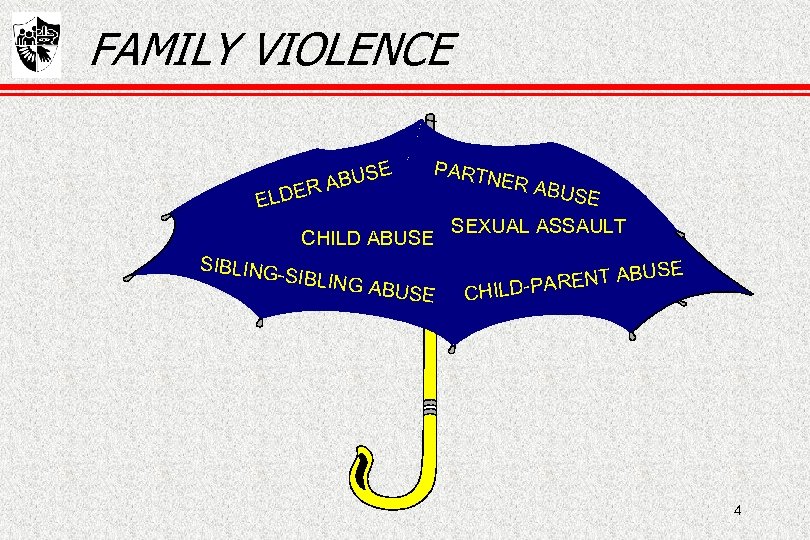
FAMILY VIOLENCE E ABUS ER ELD PART CHILD ABUSE SIBLING -SIBLING ABUSE NER A BUSE SEXUAL ASSAULT SE CH BU ARENT A ILD-P 4
ELDER ABUSE DEFINITIONS Elder: any person residing in California who is 65 years of age or older. Elder abuse: acts of omission or commission by a person who stands in a trust relationship that result in harm or threatened harm to the health and or welfare of an older adult. Caregiver: any person who has the care, custody or control of, or stands in a position of trust with, an elder or dependent adult. 5
PREVALENCE OF ELDER ABUSE Current: w 3 -5% of elders in home/residential facility Victim-perpetrator: w no typical victim w 90% of abusers known to victim Future: w growing proportion of seniors in society w increasing number of abused/at risk elders 6
ELDER ABUSE Only 1 out of 6 cases are reported!! Only 1 of 6 cases are reported!! Unaware + Unspoken = Unrecognized UNTREATED 7
CATEGORIES OF ELDER ABUSE Physical Sexual abuse Abandonment Abduction Emotional Financial Neglect Self-neglect abuse exploitation 8
PHYSICAL ABUSE Use of physical force that causes or may cause non-accidental physical pain, harm or bodily injury. beating pinching shaking burning kicking choking throwing objects unreasonable restraint force feeding misuse of medication assault with deadly weapons 9
EMOTIONAL ABUSE The infliction of mental anguish, pain or distress upon another person. threatening criticizing debasing ridiculing ignoring debasing yelling humiliating intimidating social isolating 10
SEXUAL ABUSE Any form of sexual contact or exposure without consent. unwanted touching and fondling sexual name calling forced and coerced sexual acts purposefully hurtful sex sodomy rape 11
NEGLECT Denial of care: w food, water, shelter w personal hygiene, clothing, bedding w medical care, medicines, assistive devices Isolation: w control of time, activities, contacts w disinformation tactics w false imprisonment 12
ABANDONMENT Willful unattended care or custody by an identified caregiver who has assumed responsibility when a reasonable person in a like situation would not do so: whome wpublic place 13
FINANCIAL ABUSE Exploitation assets: of property, resources and w denying access w stealing, hiding w purposeful mismanagement, deception w fraud, extortion, forging w improper use of legal documents 14
ABDUCTION The removal of a person from California or restraining a person from returning to California who does not have the capacity to consent to this action. 15
SELF-NEGLECT Basic activities of daily living are neglected, threatening personal health and safety: whygiene wfood, water wclothing and bedding wshelter and surroundings wfinances whealth care whoarding 16
RISK FACTORS FOR ELDER ABUSE Isolation of caregiver-elder dyad History of abuse in either Abuser dependent on elder Mental illness in either Substance abuse in either Elder’s vulnerability and frailty Caregiver’s perceived distress 17
CONSEQUENCES OF ELDER ABUSE Hostage in unsafe environment: w? access to medical care w ? chronic disease complications w ? malnutrition and dehydration w ? physical and psychological harm 3 x premature death 18
ASSESSMENT: DEMEANOR Flat affect, listless, apathetic Hesitant, evasive Fearful, anxious Hostile, aggressive Uncooperative, suspicious Abrupt change in a known patient 19
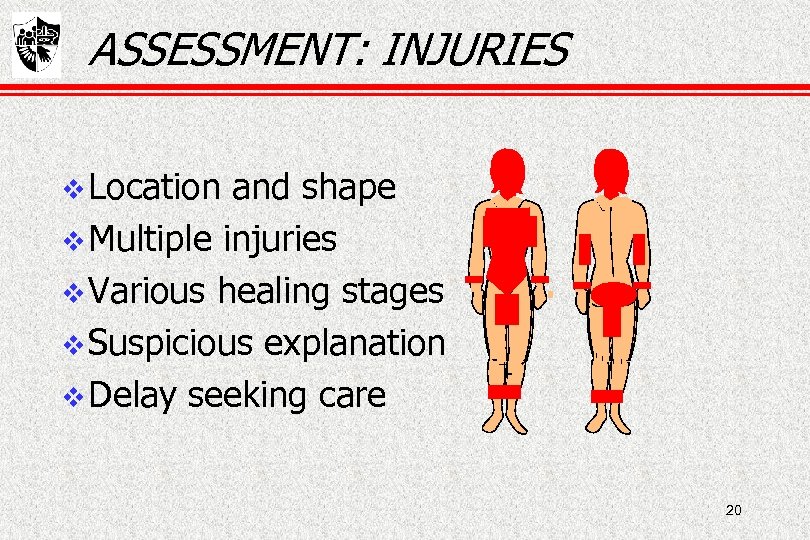
ASSESSMENT: INJURIES Location and shape Multiple injuries Various healing stages Suspicious explanation Delay seeking care 20
ASSESSMENT: SEXUAL ABUSE Fear of being touched Inappropriate modesty on examination Inner thigh bruising, tenderness Perineal bruising, tenderness, blood Breast bruises Unexplained STDs including HIV 21
ASSESSMENT: EMOTIONAL ABUSE Depression: w sleep and appetite disturbances w decreased social contact w loss of interest in self w apathy and suicidal ideation Evasiveness, anxiety, hostility 22
ASSESSMENT: NEGLECT Indicators: w inadequate, dirty or inappropriate clothing w malnutrition, dehydration w odor and poor hygiene w pressure sores w misuse/disregard/absence of: ▪ medicines ▪ medical assistive devices ▪ medical regimens 23
ASSESSMENT: FINANCIAL ABUSE Fear, vague answer, anxiety when asked about personal finances Disparity between assets and appearance and general condition Failure to purchase medicines, medical assistive devices, seek medical care or follow medical regimens 24
ASSESSMENT: SELF-NEGLECT Indicators: w inadequate or dirty clothing w malnutrition, dehydration w odor and poor personal hygiene w misuse/disregard/absence of medicines, health services, medical regimens ? Eccentric or idiosyncratic behavior w self-imposed isolation w marked indifference 25
ASSESSMENT: CHART DESCRIPTORS “accident prone” “noncompliant of medical care” “diffuse anxiety disorder” “depression” “help-rejecting behaviors” impaired patient presenting alone ER visits: injuries, exacerbations of chronic illness under treatment caregiver hostility, anger, distress 26
ASSESSMENT: CAREGIVERS Majority: adult children, partners Clues on observation: w speech, tone, touch interactions w stands watch, monitors interactions w overly protective or lacking concern w answers questions directed to patient w continually tests limits of the visit w refuses to leave room when asked Hostile and surly to staff 27
CONFIRMING THE DIAGNOSIS Ubiquity statements: w “I don’t know if this is a problem for you, but because so many patients I see are dealing with abusive relationships, I have started asking about it routinely. ” w “Because there is help available for my patients who are being abused, I now ask everyone about the possibility if it is occurring to them. ” 28
CONFIRMING THE DIAGNOSIS Direct question examples: w “Does anyone threaten, hurt or abuse you? ” w “Do you feel safe where you live? ” w “Do you feel put down, made fun or ridiculed by your caregiver? ” w “Are you afraid of anyone? ” w “Do you feel your caregiver keeps you from doing what you want? ” w “Are you made to stay in your room or left alone alot? ” 29
CONFIRMING THE DIAGNOSIS Direct question examples: w “Do you call or get out with your friends and family? ” w “Who does the shopping or prepares yours meals? ” w “Have you been forced to sign documents when you did not understand them? ” w “Who handles your checkbook? ” w “Does anyone steal money or take things from you? ” w “Has your caregiver ever refused to help take care of you when you asked for help? ” 30
CONFIRMING THE DIAGNOSIS Direct questions: Sexual abuse: w “Have you been forced to do something sexually that you don’t want to do? ” w “Does anyone force you to have sex or make you do things related to sex that make you feel uncomfortable? ” 31
CONFIRMING THE DIAGNOSIS Direct questions: Lethality potential w “Has your caregiver ever threatened to kill you or himself? ” w “Are there weapons in the house? ” w “Does your caregiver hurt your pets? ” w “Has the abuse increased in frequency or severity recently? ” 32
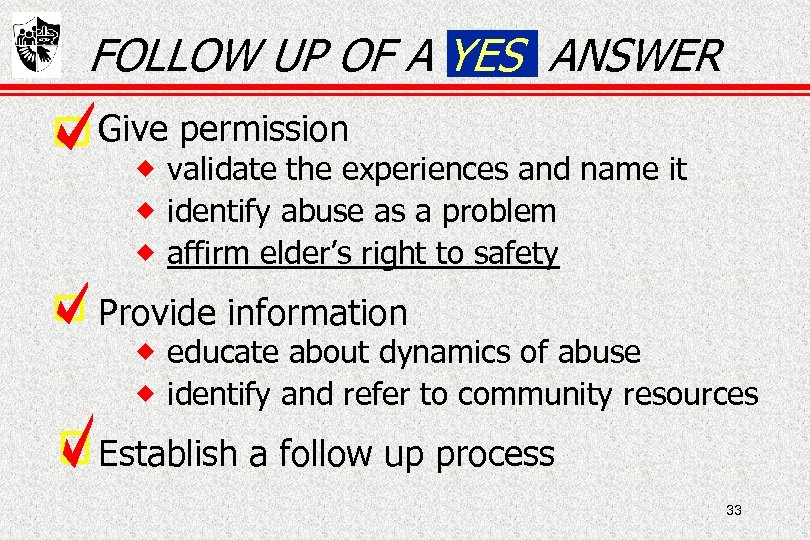
FOLLOW UP OF A YES ANSWER Give permission validate the experiences and name it identify abuse as a problem affirm elder’s right to safety Provide information educate about dynamics of abuse identify and refer to community resources Establish a follow up process 33
FOLLOW UP OF A YES ANSWER Examples of responses: “I am concerned about your safety and well being. ” “You are not alone. ” “The abuse is not your fault; only your abuser can stop the abusive behavior. ” “No one deserves to be abused; there is no excuse for abuse. ” “There are options and resources available. ” 34
SAFETY PLANNING Respect patient’s autonomy Respect patient’s confidentiality Referrals: team approach w Adult Protective Services w Long-term care ombudsman w Family Caregiver Alliance w Law enforcement agencies w Emergency planning 35
ADULT PROTECTIVE SERVICES Authorized and budgeted by California Integral part of safety planning Integral part of care plan Benefits: w prompt response and investigation w comprehensive assessment of elder’s needs w coordinate direct links to resources w advocacy and individual care plan 36
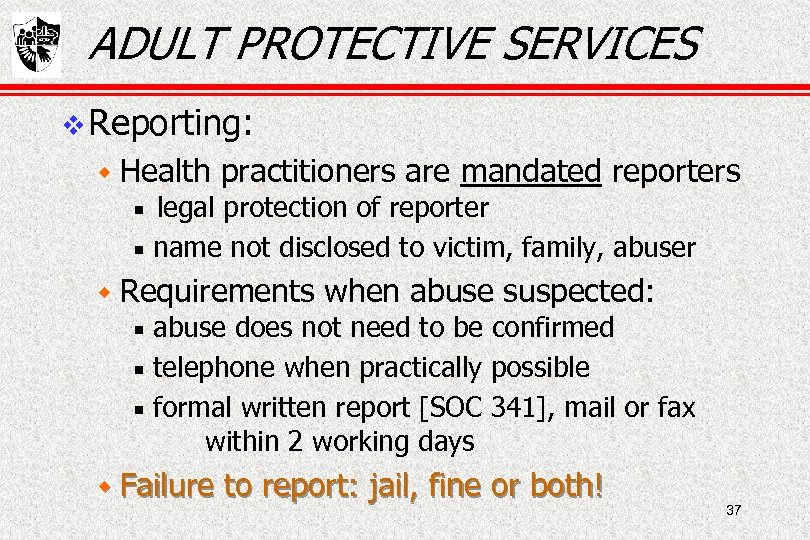
ADULT PROTECTIVE SERVICES Reporting: w Health practitioners are mandated reporters legal protection of reporter name not disclosed to victim, family, abuser w Requirements when abuse suspected: abuse does not need to be confirmed telephone when practically possible formal written report [SOC 341], mail or fax within 2 working days w Failure to report: jail, fine or both! 37
OTHER COMMUNITY SERVICES Law enforcement agencies: w County Sheriff w Local police department Long-Term Care Ombudsman 38
BACKGROUND OF A NO ANSWER Patient: wacceptance of blame wfeeling of shame and embarrassment wfear of loss of independence wfear of reprisal and escalation wbelieves no viable alternatives exist wunaware of community resources wcultural and family structure issues Practitioner: report still must be made! 39
BACKGROUND OF A NO ANSWER Practitioner: wtrust relationship not yet established winappropriate setting wlack of privacy and confidentiality winappropriate history taking winappropriate format 40
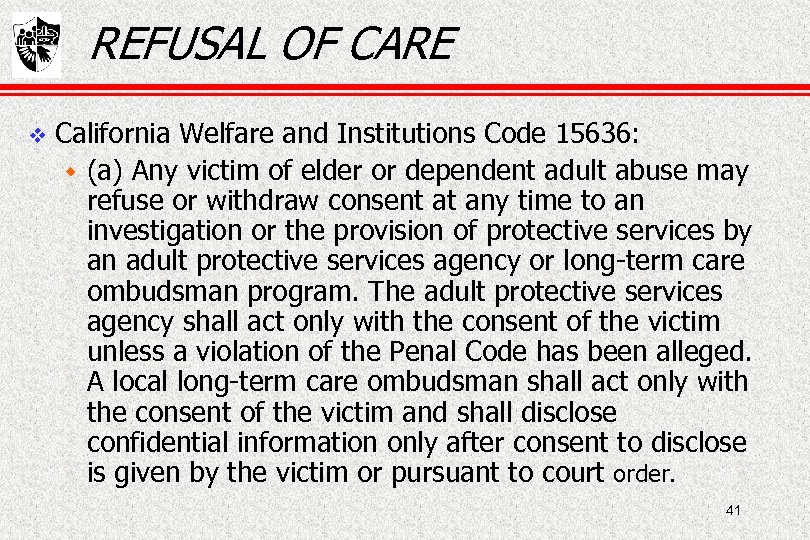
REFUSAL OF CARE California Welfare and Institutions Code 15636: w (a) Any victim of elder or dependent adult abuse may refuse or withdraw consent at any time to an investigation or the provision of protective services by an adult protective services agency or long-term care ombudsman program. The adult protective services agency shall act only with the consent of the victim unless a violation of the Penal Code has been alleged. A local long-term care ombudsman shall act only with the consent of the victim and shall disclose confidential information only after consent to disclose is given by the victim or pursuant to court order. 41
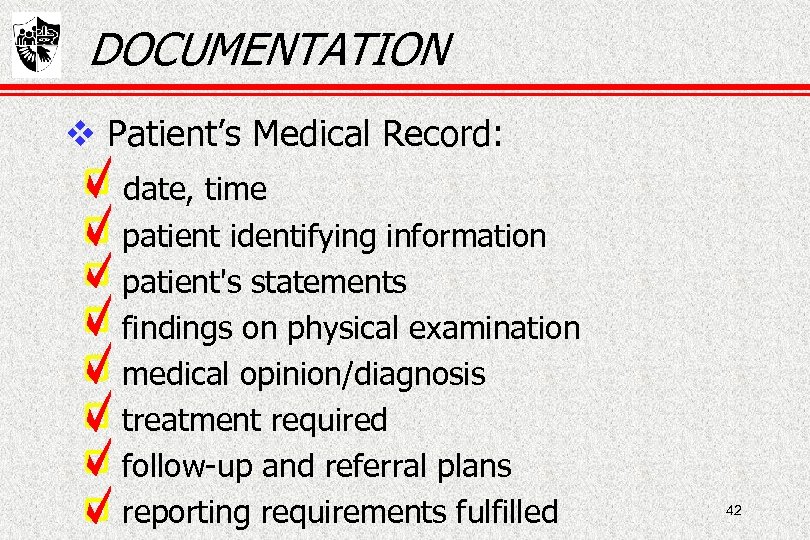
DOCUMENTATION Patient’s Medical Record: date, time patient identifying information patient's statements findings on physical examination medical opinion/diagnosis treatment required follow-up and referral plans reporting requirements fulfilled 42
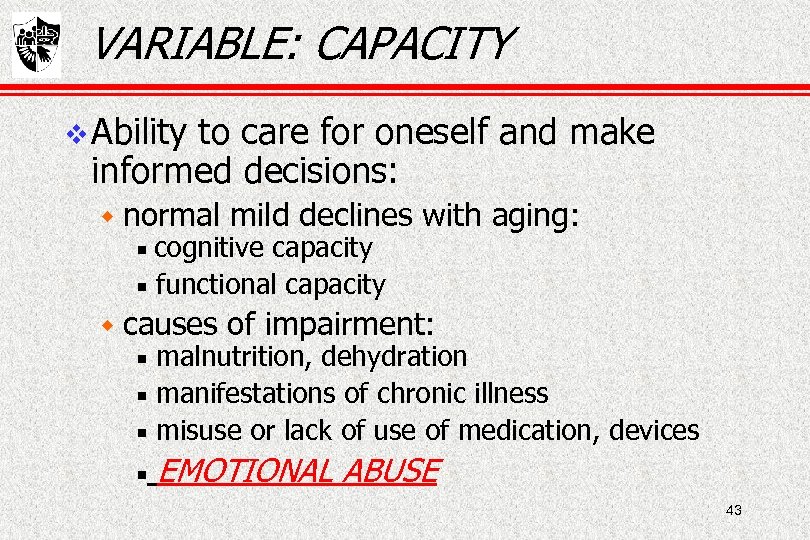
VARIABLE: CAPACITY Ability to care for oneself and make informed decisions: w normal mild declines with aging: cognitive capacity functional capacity w causes of impairment: malnutrition, dehydration manifestations of chronic illness misuse or lack of use of medication, devices EMOTIONAL ABUSE 43
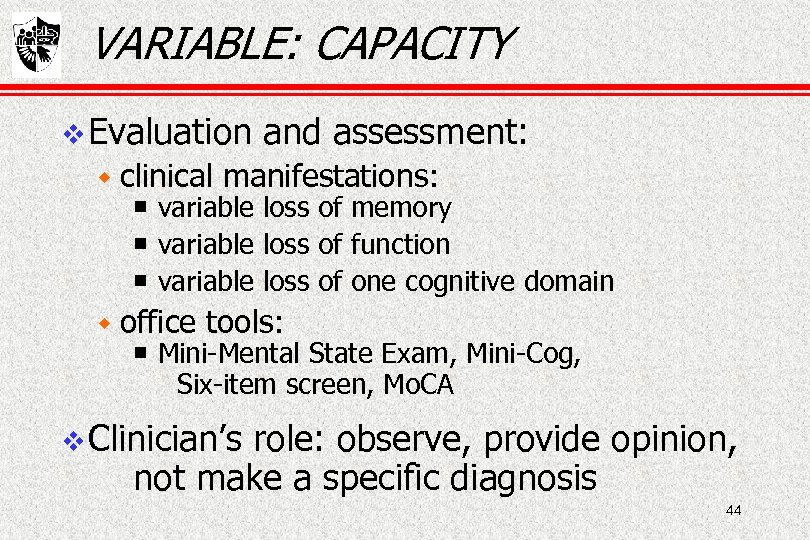
VARIABLE: CAPACITY Evaluation w clinical and assessment: manifestations: variable loss of memory variable loss of function variable loss of one cognitive domain w office tools: Mini-Mental State Exam, Mini-Cog, Six-item screen, Mo. CA Clinician’s role: observe, provide opinion, not make a specific diagnosis 44
VARIABLE: FAILURE TO SCREEN Lack of knowledge Legal concerns Discomfort in showing ignorance Sense of powerlessness Fear of offending patient or the abuser Minimization and denial Reluctance to become involved Time constraints 45
TRUISM “I don’t have enough time. ” EQUALS “I don’t want to get involved. ” 46
VARIABLE: CAREGIVER STRESS Unintentional harm: w lack of necessary knowledge, training, skills w response to patient’s aggressive behavior Intentional abuse: w characteristics of caregiver w exercise power and control Etiology for elder abuse ? : w blames the victim w discourages reporting suspected abuse 47
ASSESSMENT: CAREGIVER Ubiquity statements: w “Some people find it difficult to care for a parent with your mother’s condition. Do you? ” w “Are you able to meet your personal and family needs? ” w “Sometimes providing care for a family member is challenging. Do you ever feel like you will l lose control? ” 48
ASSESSMENT: CAREGIVER Direct w w w w question examples: “Now that you are caring for X, have you feelings become negative? ” “Is X physically or verbally abusive toward you? ” “Are you overwhelmed, confused, fearful, or angry as a result of being a caregiver? ” “Are problems from your family’s past resurfacing? “Are you neglecting your own health? ” “I am worried about the bruises on X, do you know how X got them? ” “Is there a reason for waiting this long to seek medical care for X? ” 49
ASSESSMENT: CAREGIVER Direct w w w question examples: “What does X need help with every day? ” “How do you and X handle disagreements? ” “What expectations does X have of you? ” “Is caring for X different than you thought it would be? ” “Have you ever felt out of control when caring for X? What did you do? ” “What do you do or who do you tell when you are feeling stressed? ” 50
VARIABLE: SYSTEM BARRIERS Lack of institutional support Disinterest of colleagues Lack of reimbursement for time and effort spent Overt and covert Ageism 51
Mission: w Identify and promote legal remedies for elder abuse through collaborative evaluation, consultation, education and research. Participating agencies: w w w w w UCI Program in Geriatrics Adult Protective Services Law enforcement agencies District Attorney Public Administrator, Public Guardian Long-Term Care Ombudsman Older Adult Mental Health Services Human Options Domestic Violence Assistance Program 52
SUMMARY: FACTS Elder abuse: wa reality in our society w increasing prevalence w present in all demographics w most is unrecognized by clinician w can be addressed effectively through collaborative, coordinated community resources 53
SUMMARY: AGENTS OF CHANGE Practitioners can: R outinely integrate questions A sk ubiquity and direct questions D ocument findings A ssure patient safety R efer to community resources 54
GOALS Elder Abuse must become a CULTURAL TABOO ZERO tolerance of Elder Abuse 55
RESOURCES: NATIONAL AARP: www. aarp. org Administration on Aging: www. aoa. gov American Bar Association Commission on Law and Aging: www. abanet. org/aging American Society on Aging: www/asaging. org; Generationsjournal. org Family Caregiver Alliance: www. caregiver. org Clearinghouse on Abuse and Neglect of the Elderly: http: //db. rdms. udel. edu: 8080/CANE/ 56
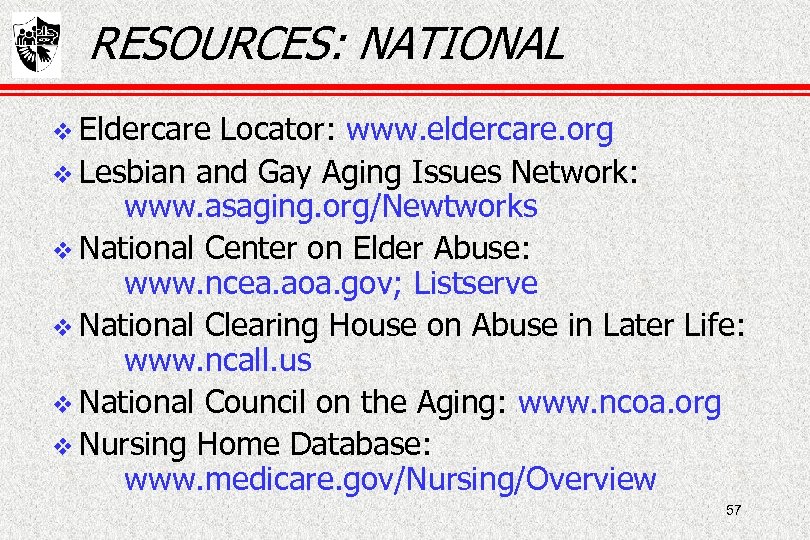
RESOURCES: NATIONAL Eldercare Locator: www. eldercare. org Lesbian and Gay Aging Issues Network: www. asaging. org/Newtworks National Center on Elder Abuse: www. ncea. aoa. gov; Listserve National Clearing House on Abuse in Later Life: www. ncall. us National Council on the Aging: www. ncoa. org Nursing Home Database: www. medicare. gov/Nursing/Overview 57
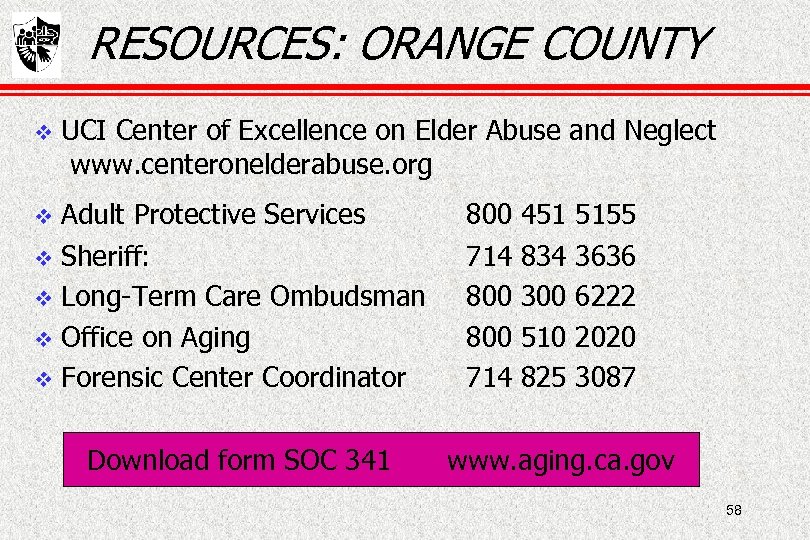
RESOURCES: ORANGE COUNTY UCI Center of Excellence on Elder Abuse and Neglect www. centeronelderabuse. org Adult Protective Services Sheriff: Long-Term Care Ombudsman Office on Aging Forensic Center Coordinator Download form SOC 341 800 451 5155 714 800 714 834 300 510 825 3636 6222 2020 3087 www. aging. ca. gov 58
Скачать презентацию ELDER ABUSE An Introduction for the Clinician 1
6691625d1fa76ff5219d78d6393fec68.ppt