


 Скачать презентацию ELC 200 Introduction to E-Commerce Copyright Tony Gauvin
2a11c7a62f7cdf0c5ffadc943f94ebf6.ppt
- Количество слайдов: 82
 ELC 200 Introduction to E-Commerce Copyright, Tony Gauvin, UMFK, 2011 1
 Introduction n n n Class roll call Instructor Introduction Instructor’s Educational Philosophy Syllabus review General Information about class Classroom Contract Discussion Introduction to Electronic Commerce 2
 Instructor n Tony Gauvin ¨ Associate Professor Of E-Commerce ¨ 218 Nadeau Hall ¨ (207) 834 -7519 or Extension 7519 ¨ Tony. G@maine. edu ¨ Black. Board ¨ Tony's Resume 3
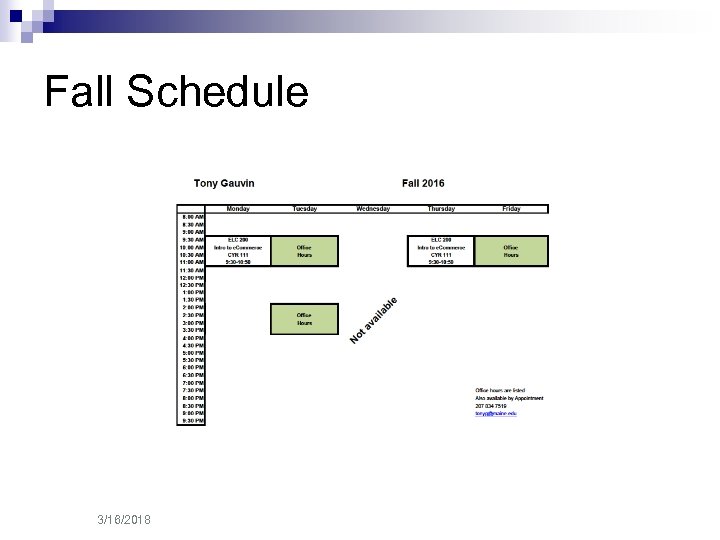 Fall Schedule 3/16/2018
 Instructional Philosophy Out-Come based education n Would rather discuss than lecture n ¨ Requires student preparation n Hate grading assignments ¨ Especially LATE assignments n Use class interaction, assignments, quizzes and projects to determine if outcomes are met. 5
 ELC 200 Survival Primer n Read Material BEFORE the class discussion ¨ n Use textbook’s website ¨ n n n n Key Terms, Review Questions and Exercises at EOC https: //www. cengagebrain. com/shop/Product. Display? lang. Id=1&store. Id=10151&catalog. Id=10057&product. Id=120139 / Check Black. Board Often Use the additional resources identified in syllabus & in Black. Board ASK questions about what you didn’t understand in readings DON’T do homework at last minute. REVIEW lectures and notes Seek HELP if you are having difficulties OFFER feedback and suggestions to the instructor in a constructive manner 6
 ELC 200 Specifics n n Blackboard used to augment course Two Desired outcomes E-Commerce’s impact on Business, Global Economies and Society ¨ Entrepreneurship ¨ n n Students have the ability to create the framework for a viable ecommerce initiative Managerial Perspectives instead of technical ¨ ¨ Technical Portions will be covered in COS XXX classes Understanding “Why” instead of “How” 7
 Blackboard n https: //www. courses. maine. edu n Login ¨ Your @maine. edu name and password n n n Help with Blackboard is available from Blake Library staff All quizzes and assignments will be administered from Black. Board Uses your maine. edu email account which you should also use for UMFK communications 8
 Computer Accounts n Computer login ¨ Sys admin n Pete Cyr (x 7547) or Art Drolet (x 7809) ¨ Applications n MSDN Academic Alliance ¨ Free Stuff ¨ See Dr. Ray Albert n Access Cards ¨ $10 deposit ¨ See Lisa Fournier 9
 Syllabus review Requirements n Grading n Course outline n Special Notes n Subject to change n 10
 Contract on Classroom Behavior A contract for students and the professor on what is expected and encouraged behavior in the classroom n Was created through a collaborative process with former students n 11
 Bribe List (2016) n n n n n 1947 HD FLH “knucklehead” 2014 Audi R 8 (V 10+) 1950 Buick Road. Master 1955 Buick Special 1965 Shelby Cobra S/C 427 2013 M/B SLS AMG GT 2006 Dodge Viper SRT 2016 Harley CVO Limted 2017 Corvette Grad Sport Current Collection Ch 1 -12
 Why study ecommerce? ? ? n Business reasons n Social impacts n Political impacts n 13
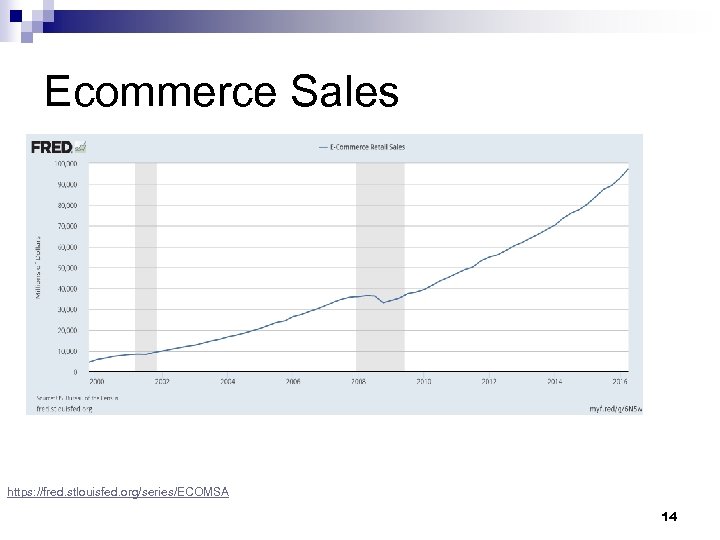 Ecommerce Sales https: //fred. stlouisfed. org/series/ECOMSA 14
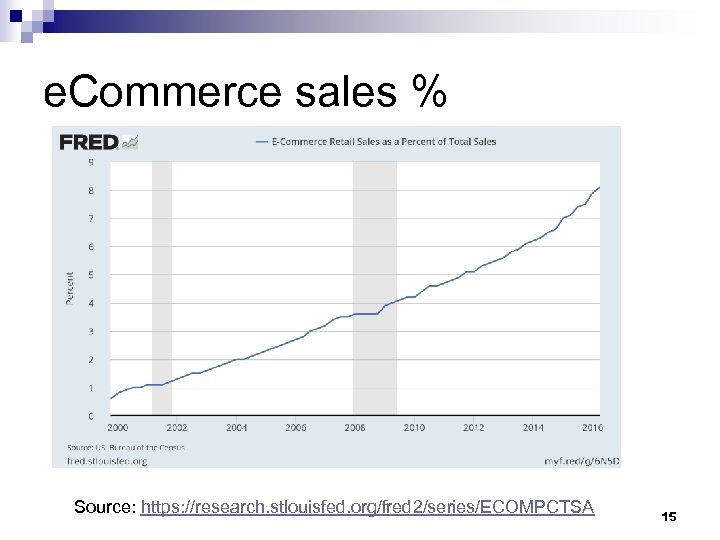 e. Commerce sales % Source: https: //research. stlouisfed. org/fred 2/series/ECOMPCTSA 15
 16
16
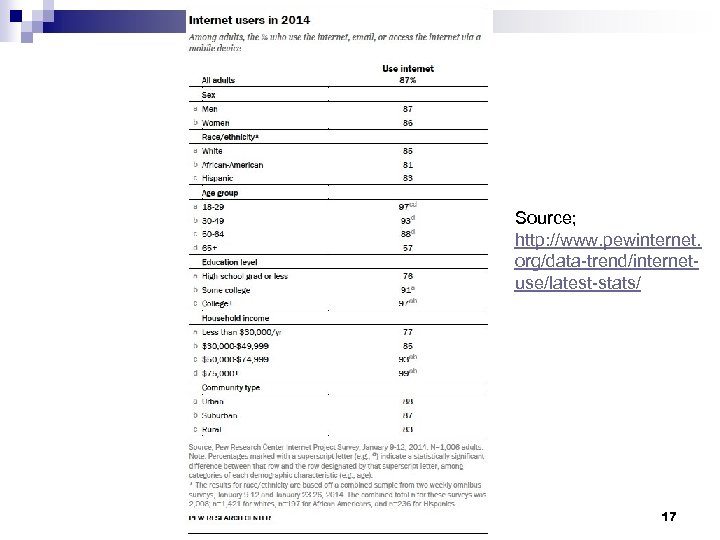 Source; http: //www. pewinternet. org/data-trend/internetuse/latest-stats/ 17
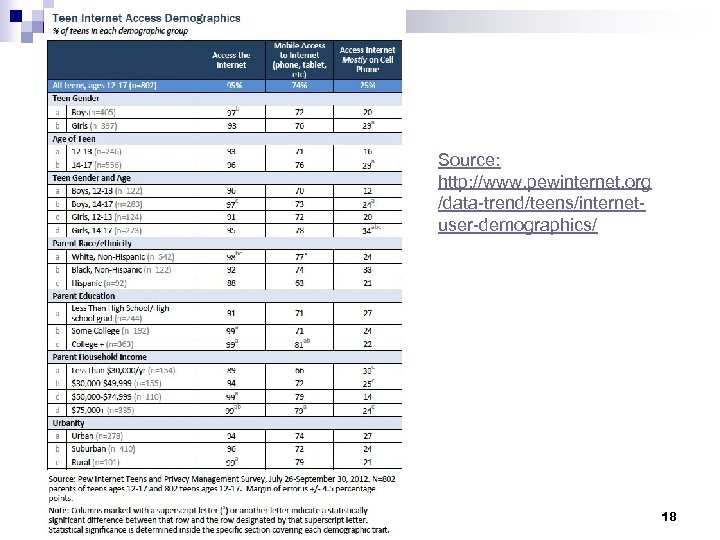 Source: http: //www. pewinternet. org /data-trend/teens/internetuser-demographics/ 18
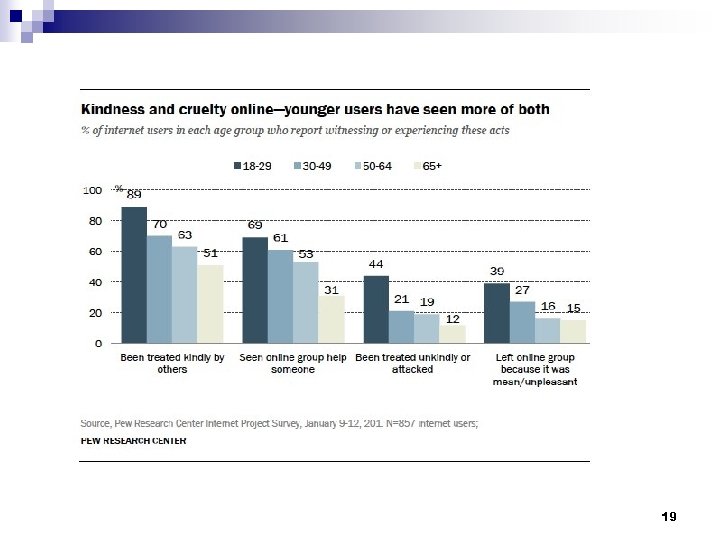 19
19
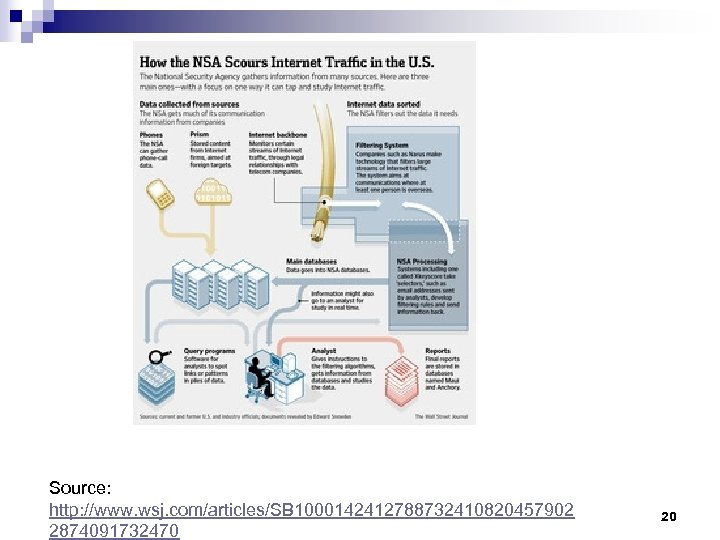 Source: http: //www. wsj. com/articles/SB 1000142412788732410820457902 2874091732470 20
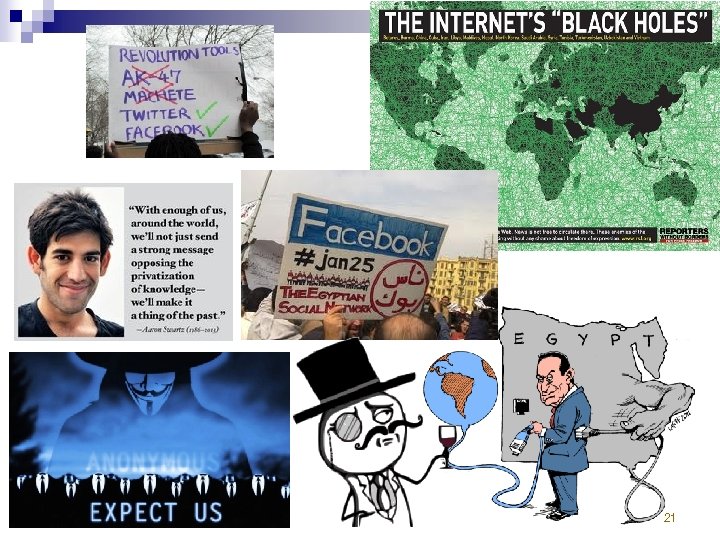 21
21
 CHAPTER 1 Introduction to Electronic Commerce © 2017 Cengage Learning®. May not be scanned, copied or duplicated, or posted to a. publicly accessible website, in whole or in part, except for use as permitted in a license distributed with a certain product or service or otherwise on a password-protected website or school-approved learning management system for classroom use.
 Learning Objectives In this chapter, you will learn: • What electronic commerce is and how it has evolved in three waves of development • Why companies concentrate on revenue models and the analysis of business processes instead of business models when they undertake electronic commerce initiatives • How to identify opportunities for and barriers to electronic commerce initiatives © 2017 Cengage Learning®. May not be scanned, copied or duplicated, or posted to a publicly accessible website, in whole or in part, except for use as permitted in a license distributed with a certain product or service or otherwise on a password-protected website or school-approved learning management system for classroom use. 23 2 3
 Learning Objectives (cont’d. ) • How economic forces have led to the development and continued growth of electronic commerce • How businesses use value chains and SWOT analysis to identify electronic commerce opportunities • How the international nature of electronic commerce affects its growth and development © 2017 Cengage Learning®. May not be scanned, copied or duplicated, or posted to a publicly accessible website, in whole or in part, except for use as permitted in a license distributed with a certain product or service or otherwise on a password-protected website or school-approved learning management system for classroom use. 24
 Introduction • Electronic commerce began in the United States – China the leader in online retail sales since 2013 – More and more sales being made on smartphones • China is the world’s largest potential online market – Active Internet users and upward economic growth – Buyers use U. S. and domestic sites and are influenced by online reviews and discussions – Has led to online review sites and seller participation in Chinese chat and messaging sites – http: //www. internetlivestats. com/internet-users/china/ © 2017 Cengage Learning®. May not be scanned, copied or duplicated, or posted to a publicly accessible website, in whole or in part, except for use as permitted in a license distributed with a certain product or service or otherwise on a password-protected website or school-approved learning management system for classroom use. 25
 Introduction (cont’d. ) • Sellers in China must account for regional differences within a diverse country – Distribution and delivery difficult without welldeveloped roads and standardized shipping practices – Some sellers have created their own distribution systems • Chapter addresses how online businesses have emerged and grown to accommodate various cultures and infrastructure challenges around the world © 2017 Cengage Learning®. May not be scanned, copied or duplicated, or posted to a publicly accessible website, in whole or in part, except for use as permitted in a license distributed with a certain product or service or otherwise on a password-protected website or school-approved learning management system for classroom use. 26
 The Evolution of Electronic Commerce • Electronic commerce history – – Rapid growth from mid-1990 s to 2000 “Dot-com boom” followed by “dot-com bust” 2000 to 2003: Overly gloomy news reports 2003: Signs of profound rebirth • Sales and profit growth returned • Electronic commerce grew faster than overall economy and became a larger part of the total economy © 2017 Cengage Learning®. May not be scanned, copied or duplicated, or posted to a publicly accessible website, in whole or in part, except for use as permitted in a license distributed with a certain product or service or otherwise on a password-protected website or school-approved learning management system for classroom use. 27
 The Evolution of Electronic Commerce • Electronic commerce history (cont’d. ) – 2008 general recession • Electronic commerce suffered far less than most of economy – From 2003 to the present • Electronic commerce has expanded more in good times and contracted less in bad times than other economic sectors – e-commerceoverviewapr. pdf © 2017 Cengage Learning®. May not be scanned, copied or duplicated, or posted to a publicly accessible website, in whole or in part, except for use as permitted in a license distributed with a certain product or service or otherwise on a password-protected website or school-approved learning management system for classroom use. 28
 Electronic Commerce and Electronic Business • Electronic commerce – – – Shopping on the Web Businesses trading with other businesses Internal company processes Broader term: electronic business (e-business) Includes all business activities using Internet technologies • Internet and World Wide Web (Web) • Wireless transmissions on mobile telephone networks • Dot-com (pure dot-com) – Businesses operating only online © 2017 Cengage Learning®. May not be scanned, copied or duplicated, or posted to a publicly accessible website, in whole or in part, except for use as permitted in a license distributed with a certain product or service or otherwise on a password-protected website or school-approved learning management system for classroom use. 29
 Categories of Electronic Commerce • Business-to-consumer (B 2 C) – Consumer shopping on the Web • Business-to-business (B 2 B): e-procurement – Transactions conducted between Web businesses – Supply management (procurement) departments • Negotiate purchase transactions with suppliers • Business processes – Use of Internet technologies within the business © 2017 Cengage Learning®. May not be scanned, copied or duplicated, or posted to a publicly accessible website, in whole or in part, except for use as permitted in a license distributed with a certain product or service or otherwise on a password-protected website or school-approved learning management system for classroom use. 30
 Business Processes • Business activity is a task performed by a worker doing his or her job – May or may not be related to a transaction • Transaction is an exchange of value – Purchase, sale, or conversion of raw materials into finished product – Involves at least one business activity • Business processes are groups of logical, related, sequential activities and transactions • Web helps people work more effectively © 2017 Cengage Learning®. May not be scanned, copied or duplicated, or posted to a publicly accessible website, in whole or in part, except for use as permitted in a license distributed with a certain product or service or otherwise on a password-protected website or school-approved learning management system for classroom use. 31
 Relative Size of Electronic Commerce Elements • Rough approximation shown in Figure 1 -1 • Dollar volume and number of transactions – B 2 B much greater than B 2 C • Number of transactions – Supporting business processes greater than B 2 C and B 2 B combined © 2017 Cengage Learning®. May not be scanned, copied or duplicated, or posted to a publicly accessible website, in whole or in part, except for use as permitted in a license distributed with a certain product or service or otherwise on a password-protected website or school-approved learning management system for classroom use. 32
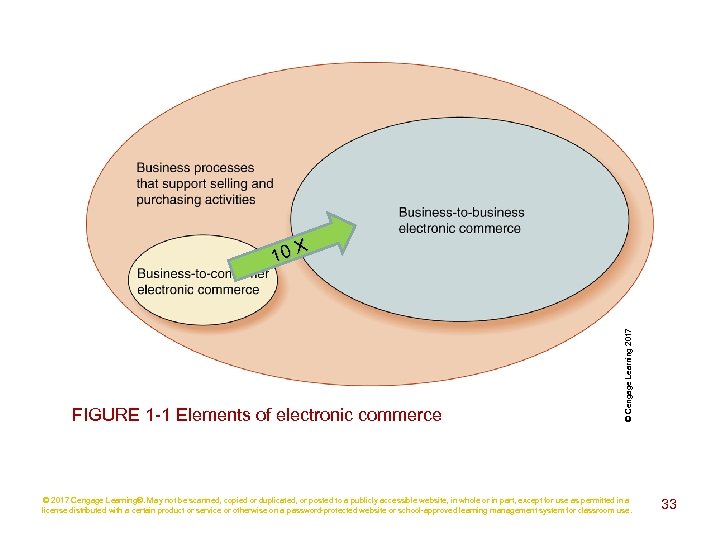 FIGURE 1 -1 Elements of electronic commerce © Cengage Learning 2017 10 X © 2017 Cengage Learning®. May not be scanned, copied or duplicated, or posted to a publicly accessible website, in whole or in part, except for use as permitted in a license distributed with a certain product or service or otherwise on a password-protected website or school-approved learning management system for classroom use. 33
 Relative Size of Electronic Commerce Elements (cont’d. ) • Consumer-to-consumer (C 2 C) – Individuals buying and selling among themselves • Web auction site – C 2 C sales included in B 2 C category • Seller acts as a business (for transaction purposes) • Business-to-government (B 2 G) – Business transactions with government agencies • Paying taxes, filing required reports – B 2 G transactions included in B 2 B discussions © 2017 Cengage Learning®. May not be scanned, copied or duplicated, or posted to a publicly accessible website, in whole or in part, except for use as permitted in a license distributed with a certain product or service or otherwise on a password-protected website or school-approved learning management system for classroom use. 34
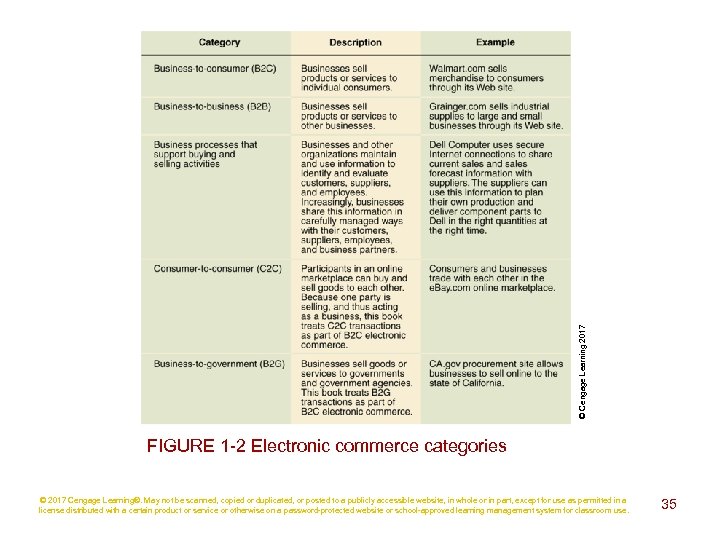 © Cengage Learning 2017 FIGURE 1 -2 Electronic commerce categories © 2017 Cengage Learning®. May not be scanned, copied or duplicated, or posted to a publicly accessible website, in whole or in part, except for use as permitted in a license distributed with a certain product or service or otherwise on a password-protected website or school-approved learning management system for classroom use. 35
 Early Electronic Commerce • Electronic Funds Transfers (EFTs) (mid -1960’s) – Wire transfers – Electronic transmissions of account exchange information over private communications networks • Electronic Data Interchange (EDI) (1960’s) – Business-to-business transmission of computerreadable data in standard format – Standard transmitting formats benefits • Reduces errors, avoids printing and mailing costs and eliminates need to reenter data © 2017 Cengage Learning®. May not be scanned, copied or duplicated, or posted to a publicly accessible website, in whole or in part, except for use as permitted in a license distributed with a certain product or service or otherwise on a password-protected website or school-approved learning management system for classroom use. 36
 Early Electronic Commerce (cont’d. ) • Trading partners – Businesses engaging in EDI with each other – EDI pioneers (example: Walmart) improved purchasing processes and supplier relationships – Pioneers faced high implementation costs • Value-added network (VAN) – Independent firm offering EDI connection and transaction-forwarding services • EDI continues to be a large portion of B 2 B electronic commerce (mostly web based) © 2017 Cengage Learning®. May not be scanned, copied or duplicated, or posted to a publicly accessible website, in whole or in part, except for use as permitted in a license distributed with a certain product or service or otherwise on a password-protected website or school-approved learning management system for classroom use. 37
 The First Wave of Electronic Commerce, 1995 -2003 • 1997 to 2000 – More than 12, 000 Internet businesses were started • 2000 to 2003 – More than 5, 000 start-ups went out of business – Extensive coverage of “dot. com bust” – $200 billion spent on bailing out and starting businesses • Set the stage for significant future growth © 2017 Cengage Learning®. May not be scanned, copied or duplicated, or posted to a publicly accessible website, in whole or in part, except for use as permitted in a license distributed with a certain product or service or otherwise on a password-protected website or school-approved learning management system for classroom use. 38
 The Second Wave of Electronic Commerce, 2004 -2009 • Expanding international scope • Established companies used own funds to finance gradual expansion • Faster, less expensive Internet technologies available – Increase in broadband connections a key element of the B 2 C component of this wave • E-mail became an integral part of marketing and customer contact • Renewed interest in Internet advertising © 2017 Cengage Learning®. May not be scanned, copied or duplicated, or posted to a publicly accessible website, in whole or in part, except for use as permitted in a license distributed with a certain product or service or otherwise on a password-protected website or school-approved learning management system for classroom use. 39
 The Second Wave of Electronic Commerce, 2004 -2009 (cont’d. ) • Promise of available technologies fulfilled – Legal distribution of music, video, and other digital products • Web 2. 0 technologies – Users participate in creating and modifying content on third party Web sites • Shift in online business strategy – Away from the first-mover advantage which is expensive and not always successful to a smartfollower strategy • “Second mouse gets the cheese” © 2017 Cengage Learning®. May not be scanned, copied or duplicated, or posted to a publicly accessible website, in whole or in part, except for use as permitted in a license distributed with a certain product or service or otherwise on a password-protected website or school-approved learning management system for classroom use 40
 The Third Wave of Electronic Commerce, 2010 - Present • Factors in the third wave – Critical mass of mobile users with powerful devices • Increased availability of smartphones and tablets • Mobile apps used for over 40% of online sales – Increase in electronic commerce activity • Growing number of people using handheld devices to access the Internet – Widespread participation in social networking • Businesses can use social commerce to advertise, promote or suggest specific products and services © 2017 Cengage Learning®. May not be scanned, copied or duplicated, or posted to a publicly accessible website, in whole or in part, except for use as permitted in a license distributed with a certain product or service or otherwise on a password-protected website or school-approved learning management system for classroom use 41
 The Third Wave of Electronic Commerce, 2010 - Present • Factors in the third wave (cont’d) – Increased online participation by smaller businesses in sales, purchasing, and capital-raising activities • Crowdsourcing – Sophisticated analysis of data companies collect about online customers • Big data and data analytics – Increased integration of tracking technologies into B 2 B electronic commerce and the management of business processes within companies • RFID devices and biometric technologies © 2017 Cengage Learning®. May not be scanned, copied or duplicated, or posted to a publicly accessible website, in whole or in part, except for use as permitted in a license distributed with a certain product or service or otherwise on a password-protected website or school-approved learning management system for classroom use 42
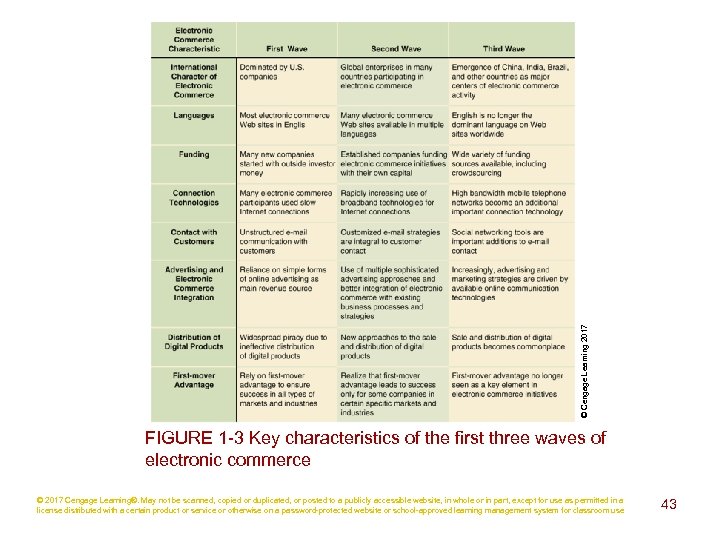 © Cengage Learning 2017 FIGURE 1 -3 Key characteristics of the first three waves of electronic commerce © 2017 Cengage Learning®. May not be scanned, copied or duplicated, or posted to a publicly accessible website, in whole or in part, except for use as permitted in a license distributed with a certain product or service or otherwise on a password-protected website or school-approved learning management system for classroom use 43
 © 2017 Cengage Learning®. May not be scanned, copied or duplicated, or posted to a publicly accessible website, in whole or in part, except for use as permitted in a license distributed with a certain product or service or otherwise on a password-protected website or school-approved learning management system for classroom use. 44
 Business Models, Revenue Models, and Business Processes • Business model – Set of processes combined to achieve company goal • In the first wave of electronic commerce, investors sought Internet-driven business models – – Expectations of rapid sales growth, market dominance Successful “dot-com” business models emulated Led to many business failures Michael Porter (HBS) argued business models did not exist © 2017 Cengage Learning®. May not be scanned, copied or duplicated, or posted to a publicly accessible website, in whole or in part, except for use as permitted in a license distributed with a certain product or service or otherwise on a password-protected website or school-approved learning management system for classroom use 45
 Business Models, Revenue Models, and Business Processes (cont’d. ) • Instead of copying model, companies should examine their business elements – Streamline, enhance, or replace with Internet technology driven processes • Revenue model – Specific collection of business processes used to identify, market and make sales to customers – Classifies revenue-generating activities for communication and analysis purposes © 2017 Cengage Learning®. May not be scanned, copied or duplicated, or posted to a publicly accessible website, in whole or in part, except for use as permitted in a license distributed with a certain product or service or otherwise on a password-protected website or school-approved learning management system for classroom use 46
 Focus on Specific Business Processes • Examples of business processes – – – Purchasing raw materials or goods for resale Converting materials and labor into finished goods Managing transportation and logistics Hiring and training employees Managing business finances • Identify processes that benefit from ecommerce technologies – Not all processes can be improved with technology – Firms can use it to help them adapt to change © 2017 Cengage Learning®. May not be scanned, copied or duplicated, or posted to a publicly accessible website, in whole or in part, except for use as permitted in a license distributed with a certain product or service or otherwise on a password-protected website or school-approved learning management system for classroom use 47
 Role of Merchandising • Combination of store design, layout, and product display knowledge • Salespeople have skills to identify customer needs and meet them • Merchandising and personal selling skills can be difficult to practice remotely – Companies must be able to transfer these skills to have Web site success – Some products are easier to sell on the Internet than others © 2017 Cengage Learning®. May not be scanned, copied or duplicated, or posted to a publicly accessible website, in whole or in part, except for use as permitted in a license distributed with a certain product or service or otherwise on a password-protected website or school-approved learning management system for classroom use 48
 Product/Process Suitability to Electronic Commerce • Some products good candidates for electronic commerce – Customers do not need to experience physical characteristics before purchase – Technology has made more processes suitable for electronic commerce • Commodity items are standardized, well-known products only differentiated by price – Must have attractive shipping profile to sell online – Includes books, clothing, shoes, kitchen accessories and other small household items © 2017 Cengage Learning®. May not be scanned, copied or duplicated, or posted to a publicly accessible website, in whole or in part, except for use as permitted in a license distributed with a certain product or service or otherwise on a password-protected website or school-approved learning management system for classroom use 49
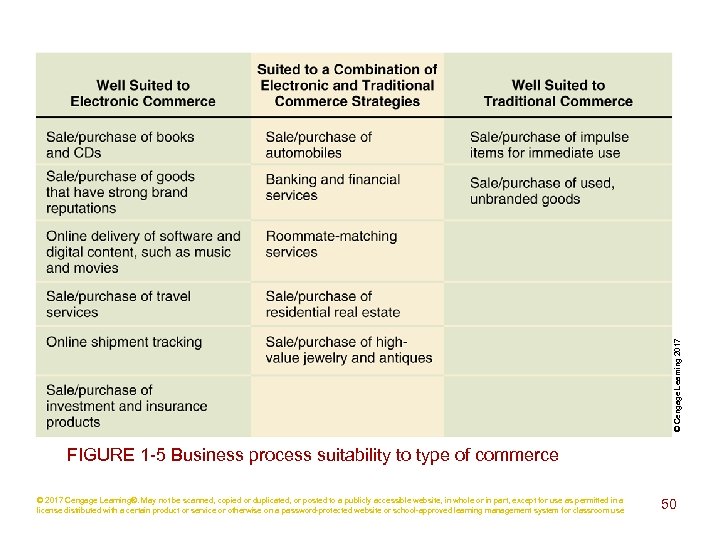 © Cengage Learning 2017 FIGURE 1 -5 Business process suitability to type of commerce © 2017 Cengage Learning®. May not be scanned, copied or duplicated, or posted to a publicly accessible website, in whole or in part, except for use as permitted in a license distributed with a certain product or service or otherwise on a password-protected website or school-approved learning management system for classroom use 50
 Product/Process Suitability to Electronic Commerce (cont’d. ) • Easier-to-sell products have: – Strong brand reputation – Appeal to small but geographically diverse groups • Traditional commerce better for: – Products relying on personal selling skills – Transactions involving large amounts of money • Combination of electronic and traditional commerce strategies best when: – Business process includes both commodity and personal inspection aspects © 2017 Cengage Learning®. May not be scanned, copied or duplicated, or posted to a publicly accessible website, in whole or in part, except for use as permitted in a license distributed with a certain product or service or otherwise on a password-protected website or school-approved learning management system for classroom use 51
 Opportunities for Electronic Commerce • Electronic commerce can help increase profits and sales and decrease business costs • Virtual community – Gathering of people sharing a common interest • E-commerce purchasing opportunities – – Identify new suppliers and business partners Efficiently obtain competitive bid information Increase speed, information exchange accuracy Wider range of choices available 24 hours a day © 2017 Cengage Learning®. May not be scanned, copied or duplicated, or posted to a publicly accessible website, in whole or in part, except for use as permitted in a license distributed with a certain product or service or otherwise on a password-protected website or school-approved learning management system for classroom use 52
 Opportunities for Electronic Commerce (cont’d. ) • Benefits extend to general society – Lower costs to issue and secure • Electronic payments of tax refunds • Public retirement • Welfare support – Provides faster transmission – Provides fraud, theft loss protection • Electronic payments easier to audit and monitor – Telecommuting reduces traffic, pollution – Products and services available in remote areas © 2017 Cengage Learning®. May not be scanned, copied or duplicated, or posted to a publicly accessible website, in whole or in part, except for use as permitted in a license distributed with a certain product or service or otherwise on a password-protected website or school-approved learning management system for classroom use 53
 Electronic Commerce: Current Barriers • Poor choices for electronic commerce – Perishable foods and high-cost, unique items • Four barriers – Need for critical mass of customers with appropriate technology – Unpredictability in costs and revenues – Insufficient tools for hardware and software integration – Cultural and legal barriers © 2017 Cengage Learning®. May not be scanned, copied or duplicated, or posted to a publicly accessible website, in whole or in part, except for use as permitted in a license distributed with a certain product or service or otherwise on a password-protected website or school-approved learning management system for classroom use 54
 Economic Forces and Electronic Commerce • Economics – Study how people allocate scarce resources • Markets – Potential sellers come into contact with buyers – Medium of exchange available (currency or barter) • Hierarchical business organizations – Firms or companies • Transaction costs – Motivation for moving economic activity to hierarchically structured firms © 2017 Cengage Learning®. May not be scanned, copied or duplicated, or posted to a publicly accessible website, in whole or in part, except for use as permitted in a license distributed with a certain product or service or otherwise on a password-protected website or school-approved learning management system for classroom use 55
 Transaction Costs • Total costs a buyer and seller incur while gathering information and negotiating purchase-and-sale transaction • Costs include: – Brokerage fees and sales commissions – Cost of information search and acquisition • Sweater dealer example (Figure 1 -6) © 2017 Cengage Learning®. May not be scanned, copied or duplicated, or posted to a publicly accessible website, in whole or in part, except for use as permitted in a license distributed with a certain product or service or otherwise on a password-protected website or school-approved learning management system for classroom use 56
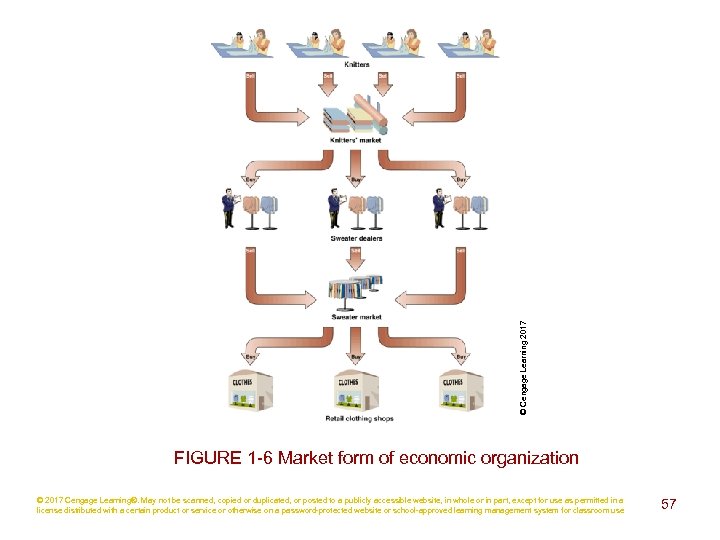 © Cengage Learning 2017 FIGURE 1 -6 Market form of economic organization © 2017 Cengage Learning®. May not be scanned, copied or duplicated, or posted to a publicly accessible website, in whole or in part, except for use as permitted in a license distributed with a certain product or service or otherwise on a password-protected website or school-approved learning management system for classroom use 57
 Markets and Hierarchies • Coase’s analysis of high transaction costs – Hierarchical organizations replace market-negotiated transactions – Supervision and worker-monitoring elements – Vertical integration sweater example (Figure 1 -7) • Oliver Williamson (extended Coase’s analysis) – Complex manufacturing, assembly operations • Hierarchically organized, vertically integrated – Manufacturing innovations increased monitoring activities’ efficiency and effectiveness © 2017 Cengage Learning®. May not be scanned, copied or duplicated, or posted to a publicly accessible website, in whole or in part, except for use as permitted in a license distributed with a certain product or service or otherwise on a password-protected website or school-approved learning management system for classroom use 58
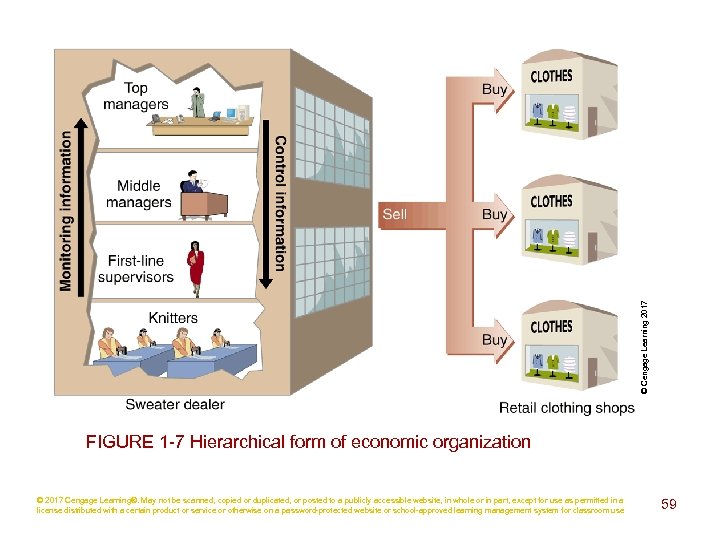 © Cengage Learning 2017 FIGURE 1 -7 Hierarchical form of economic organization © 2017 Cengage Learning®. May not be scanned, copied or duplicated, or posted to a publicly accessible website, in whole or in part, except for use as permitted in a license distributed with a certain product or service or otherwise on a password-protected website or school-approved learning management system for classroom use 59
 Markets and Hierarchies (cont’d. ) • Strategic business unit (business unit) – Part of a company large enough to manage itself – Small enough to quickly respond to business environment changes • Exception to hierarchy trend – Commodities © 2017 Cengage Learning®. May not be scanned, copied or duplicated, or posted to a publicly accessible website, in whole or in part, except for use as permitted in a license distributed with a certain product or service or otherwise on a password-protected website or school-approved learning management system for classroom use 60
 Using Electronic Commerce to Reduce Transaction Costs • Electronic commerce can – Improve flow of information – Increase coordination of actions – Change attractiveness of vertical integration • Example: employment transaction – Telecommuting reduces or eliminates transaction costs © 2017 Cengage Learning®. May not be scanned, copied or duplicated, or posted to a publicly accessible website, in whole or in part, except for use as permitted in a license distributed with a certain product or service or otherwise on a password-protected website or school-approved learning management system for classroom use 61
 Network Economic Structures • Neither market nor hierarchy • Strategic alliances (strategic partnerships) – Coordinate strategies, resources, skill sets by forming long-term relationships based on shared purposes – Strategic partners come together for specific projects • Network organizations well suited to informationintensive technology industries – Electronic commerce makes networks easier to construct and maintain – Castells predicts economic networks will become the organizing structure for social interactions © 2017 Cengage Learning®. May not be scanned, copied or duplicated, or posted to a publicly accessible website, in whole or in part, except for use as permitted in a license distributed with a certain product or service or otherwise on a password-protected website or school-approved learning management system for classroom use 62
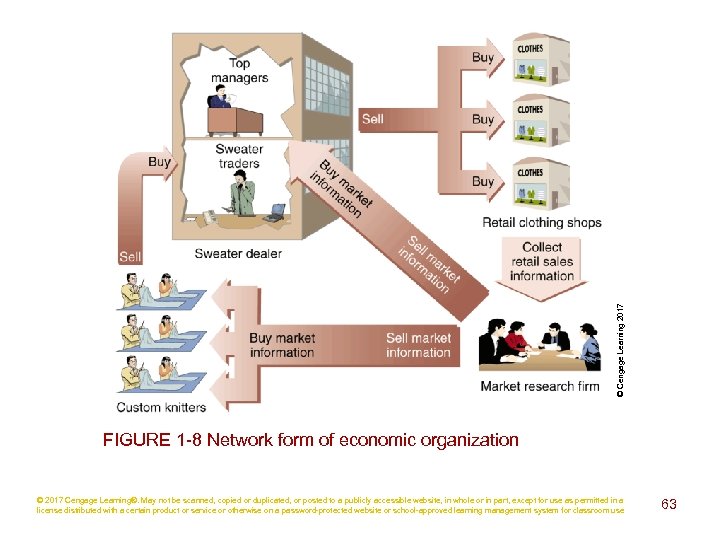 © Cengage Learning 2017 FIGURE 1 -8 Network form of economic organization © 2017 Cengage Learning®. May not be scanned, copied or duplicated, or posted to a publicly accessible website, in whole or in part, except for use as permitted in a license distributed with a certain product or service or otherwise on a password-protected website or school-approved learning management system for classroom use 63
 Network Effects • Law of diminishing returns – Activities yield less value as consumption amount increases • Example: hamburger consumption • Network effect – Exception to law of diminishing returns – As more people or organizations participate in network, the value to each participant increases – Examples: Landline phones, e-mail © 2017 Cengage Learning®. May not be scanned, copied or duplicated, or posted to a publicly accessible website, in whole or in part, except for use as permitted in a license distributed with a certain product or service or otherwise on a password-protected website or school-approved learning management system for classroom use 64
 Identifying Electronic Commerce Opportunities • Focus on specific business processes – Break business down – Series of value-adding activities that combine to meet firm’s goals • Business activities conducted by firms of all sizes • Firm – Multiple business units owned by a common set of shareholders • Industry – Multiple firms selling similar products to similar customers © 2017 Cengage Learning®. May not be scanned, copied or duplicated, or posted to a publicly accessible website, in whole or in part, except for use as permitted in a license distributed with a certain product or service or otherwise on a password-protected website or school-approved learning management system for classroom use 65
 Strategic Business Unit Value Chains • Value chain – Organizing strategic business unit activities to design, produce, promote, market, deliver, and support the products or services – Michael Porter includes supporting activities such as human resource management and purchasing • Strategic business unit primary activities – Design, identify customers, purchase materials and supplies, manufacture product or create service, market and sell, deliver, provide after-sale service and support © 2017 Cengage Learning®. May not be scanned, copied or duplicated, or posted to a publicly accessible website, in whole or in part, except for use as permitted in a license distributed with a certain product or service or otherwise on a password-protected website or school-approved learning management system for classroom use 66
 Strategic Business Unit Value Chains (cont’d. ) • Importance of primary activities depends on: – Product or service – Customers • Central corporate organization support activities – Finance and administration – Human resource – Technology development © 2017 Cengage Learning®. May not be scanned, copied or duplicated, or posted to a publicly accessible website, in whole or in part, except for use as permitted in a license distributed with a certain product or service or otherwise on a password-protected website or school-approved learning management system for classroom use 67
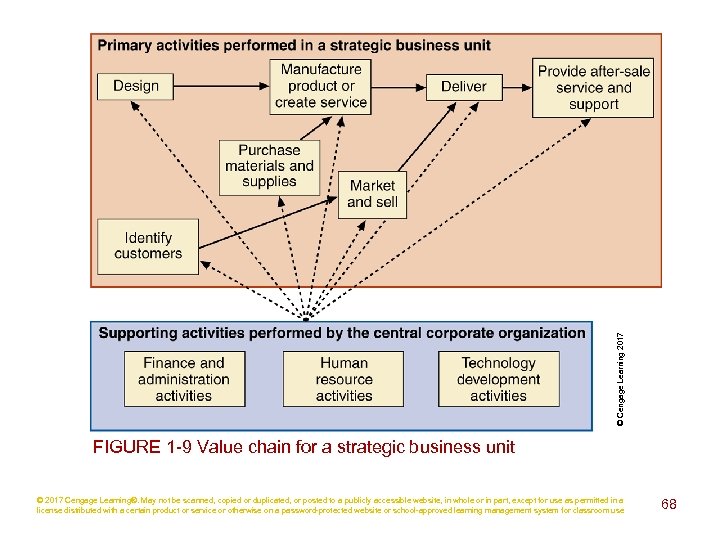 © Cengage Learning 2017 FIGURE 1 -9 Value chain for a strategic business unit © 2017 Cengage Learning®. May not be scanned, copied or duplicated, or posted to a publicly accessible website, in whole or in part, except for use as permitted in a license distributed with a certain product or service or otherwise on a password-protected website or school-approved learning management system for classroom use 68
 Industry Value Chains • Examine where strategic business unit fits within industry • Porter’s value system – Describes larger activities stream into which particular business unit’s value chain is embedded – Industry value chain refers to value systems • Awareness of businesses value chain activities – Allows identification of new opportunities – Useful way to think about general business strategy © 2017 Cengage Learning®. May not be scanned, copied or duplicated, or posted to a publicly accessible website, in whole or in part, except for use as permitted in a license distributed with a certain product or service or otherwise on a password-protected website or school-approved learning management system for classroom use 69
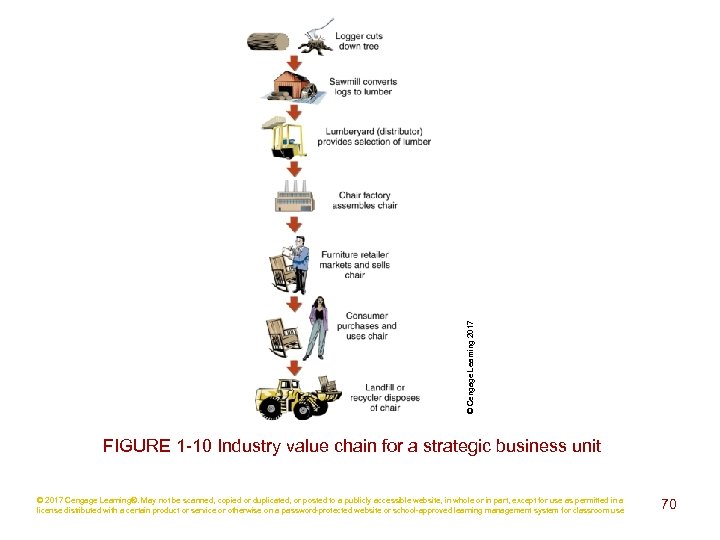 © Cengage Learning 2017 FIGURE 1 -10 Industry value chain for a strategic business unit © 2017 Cengage Learning®. May not be scanned, copied or duplicated, or posted to a publicly accessible website, in whole or in part, except for use as permitted in a license distributed with a certain product or service or otherwise on a password-protected website or school-approved learning management system for classroom use 70
 SWOT Analysis: Evaluating Business Unit Opportunities • Define SWOT (strengths, weaknesses, opportunities, and threats) • First look into business unit – Identify strengths and weaknesses • Then review operating environment – Identify opportunities and threats presented • Take advantage of opportunities – Build on strengths – Avoid threats – Compensate for weaknesses © 2017 Cengage Learning®. May not be scanned, copied or duplicated, or posted to a publicly accessible website, in whole or in part, except for use as permitted in a license distributed with a certain product or service or otherwise on a password-protected website or school-approved learning management system for classroom use 71
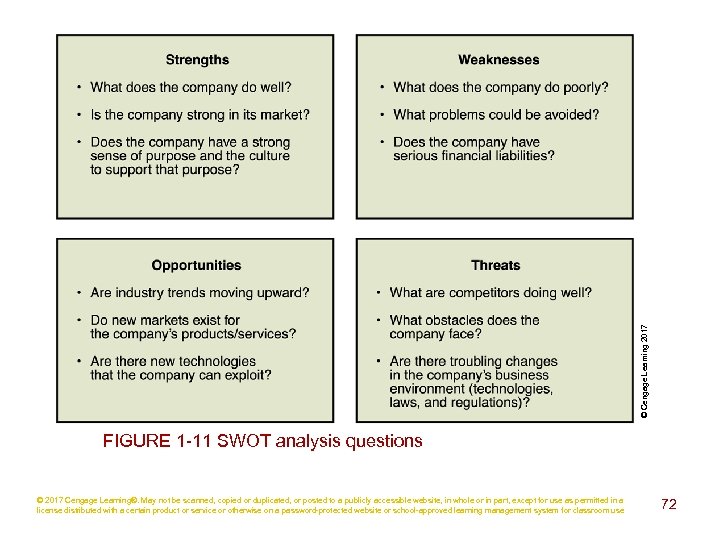 © Cengage Learning 2017 FIGURE 1 -11 SWOT analysis questions © 2017 Cengage Learning®. May not be scanned, copied or duplicated, or posted to a publicly accessible website, in whole or in part, except for use as permitted in a license distributed with a certain product or service or otherwise on a password-protected website or school-approved learning management system for classroom use 72
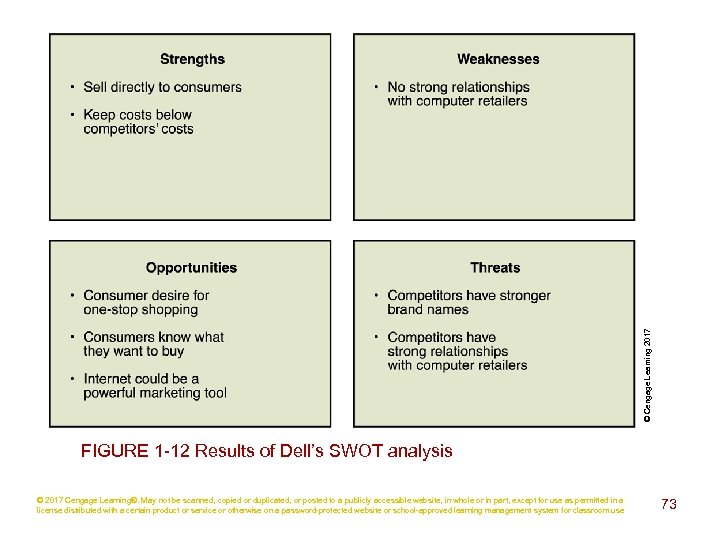 © Cengage Learning 2017 FIGURE 1 -12 Results of Dell’s SWOT analysis © 2017 Cengage Learning®. May not be scanned, copied or duplicated, or posted to a publicly accessible website, in whole or in part, except for use as permitted in a license distributed with a certain product or service or otherwise on a password-protected website or school-approved learning management system for classroom use 73
 International Nature of Electronic Commerce • Internet connects computers worldwide • When companies use Web to improve business process they automatically operate in global environment • Third wave – Rapidly increasing proportion outside US – China, India, and Brazil have seen enormous recent growth • Key issues in international commerce include trust, culture, language, government and infrastructure © 2017 Cengage Learning®. May not be scanned, copied or duplicated, or posted to a publicly accessible website, in whole or in part, except for use as permitted in a license distributed with a certain product or service or otherwise on a password-protected website or school-approved learning management system for classroom use 74
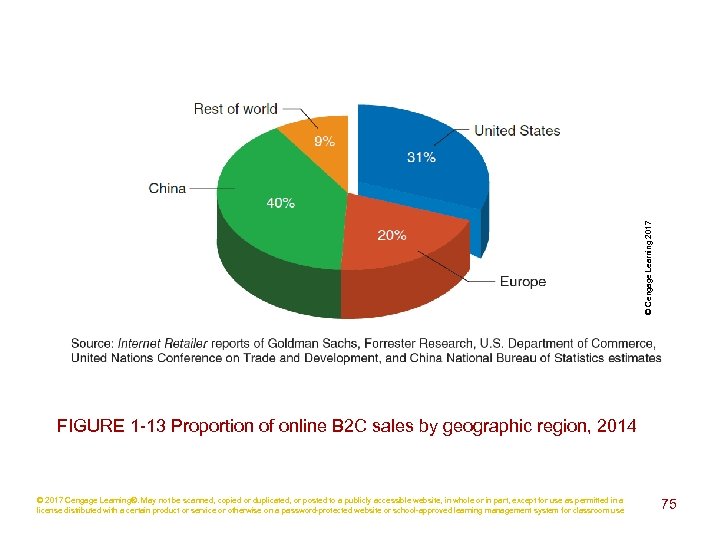 © Cengage Learning 2017 FIGURE 1 -13 Proportion of online B 2 C sales by geographic region, 2014 © 2017 Cengage Learning®. May not be scanned, copied or duplicated, or posted to a publicly accessible website, in whole or in part, except for use as permitted in a license distributed with a certain product or service or otherwise on a password-protected website or school-approved learning management system for classroom use 75
 Trust Issues on the Web • Important for all businesses to establish trusting relationships with customers • Companies can rely on established brand names • Challenging for new companies because anonymity exists when trying to establish a Web presence – Plan for establishing credibility is essential – Sellers cannot assume site visitors will know they are trustworthy • Business must overcome distrust in Web “strangers” © 2017 Cengage Learning®. May not be scanned, copied or duplicated, or posted to a publicly accessible website, in whole or in part, except for use as permitted in a license distributed with a certain product or service or otherwise on a password-protected website or school-approved learning management system for classroom use 76
 Language Issues • Business must adapt to local cultures – “Think globally, act locally” – Provide local language versions of Web site as customers are more likely to buy from sites in own language • Websites available in English only have declined dramatically to about 25% of total sites • Languages may require multiple translations for separate dialects – Localization means a translation considers multiple elements of the local environment © 2017 Cengage Learning®. May not be scanned, copied or duplicated, or posted to a publicly accessible website, in whole or in part, except for use as permitted in a license distributed with a certain product or service or otherwise on a password-protected website or school-approved learning management system for classroom use 77
 Cultural Issues • Important element of business trust is anticipating how the other party to a transaction will act in specific circumstances • Culture is the combination of language and customs – Varies across national boundaries, regions within nations • Care must be taken in choosing packaging, product names, icons used to represent common actions and even colors • Japanese shoppers resisted US sites for years because of their resistance to use of credit cards © 2017 Cengage Learning®. May not be scanned, copied or duplicated, or posted to a publicly accessible website, in whole or in part, except for use as permitted in a license distributed with a certain product or service or otherwise on a password-protected website or school-approved learning management system for classroom use 78
 Culture and Government • Some areas have cultural environments inhospitable to online discussions that occur on the Internet – May lead to government controls that limit electronic commerce development – Many countries filter available Web content and some have denounced the Internet • Countries such as the People’s Republic of China and Singapore traditionally control access to information but want to reap the benefits of electronic commerce – Result has been many regulations and requirements © 2017 Cengage Learning®. May not be scanned, copied or duplicated, or posted to a publicly accessible website, in whole or in part, except for use as permitted in a license distributed with a certain product or service or otherwise on a password-protected website or school-approved learning management system for classroom use 79
 Infrastructure Issues • Computers and software connected to Internet and the related communications networks • Outside the U. S. the telecommunications industry is either government owned or regulated – Inhibits development or limits expansion • High local telephone connection costs affect online behavior • Over half of all Websites turn away international orders because of no process to handle them – Problem is increasing globally © 2017 Cengage Learning®. May not be scanned, copied or duplicated, or posted to a publicly accessible website, in whole or in part, except for use as permitted in a license distributed with a certain product or service or otherwise on a password-protected website or school-approved learning management system for classroom use 80
 Infrastructure Issues (cont’d. ) • Freight forwarder arranges international transactions’ shipping and insurance • Customs broker arranges tariff payment and compliance with international shipping laws • Bonded warehouse is a secure location that holds international shipments until customs requirements or payments satisfied • Handling international transactions paperwork has an annual cost of $700 billion – Software automates some paperwork © 2017 Cengage Learning®. May not be scanned, copied or duplicated, or posted to a publicly accessible website, in whole or in part, except for use as permitted in a license distributed with a certain product or service or otherwise on a password-protected website or school-approved learning management system for classroom use 81
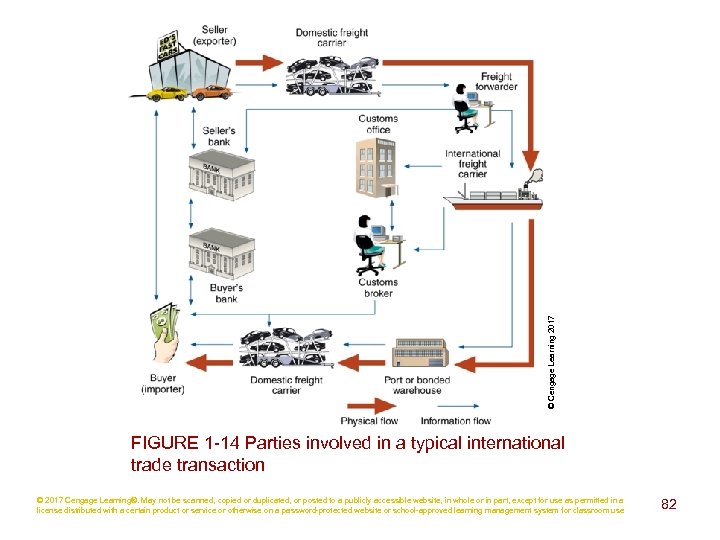 © Cengage Learning 2017 FIGURE 1 -14 Parties involved in a typical international trade transaction © 2017 Cengage Learning®. May not be scanned, copied or duplicated, or posted to a publicly accessible website, in whole or in part, except for use as permitted in a license distributed with a certain product or service or otherwise on a password-protected website or school-approved learning management system for classroom use 82