


 Скачать презентацию ELC 200 Day 4 Prentice Hall 2003 1
c0b3049437538224181e383ff648f5f3.ppt
- Количество слайдов: 105
 ELC 200 Day 4 Prentice Hall, 2003 1
 Agenda Questions from last Class? Assignment One is Due Assignment two posted to Web. CT Due Feb 9 Discussion Chap 2 E-Commerce Market Mechanisms Prentice Hall, 2003 2
 Assignment 2 Provide one paragraph (more than 100 but less than 200 words) describing your business idea. Describe the specific marketplace components in your proposed business in some detail. Stating you will have customers (or sellers, partners, front end, etc) is insufficient; you will need to describe each component you have identified. Describe the supply chain and how it operates in your proposed business. Could your business implement some form of dynamic pricing? Why or Why not? Which of the dynamic pricing models (pages 69 -76) listed in the text would work best for your business? How will your business maintain competitive advantage? Use Porter‘s five forces model for your analysis and describe how each of the five forces impacts your business. See http: //www. marketingteacher. com/Lessons/lesson_fivefoces. htm for more info Prentice Hall, 2003 3
 Chapter 2 E-Commerce Market Mechanisms Prentice Hall, 2003 4
 Learning Objectives Define e-marketplaces and list their components List the major types of electronic markets and describe their features Define supply chains and value chains and understand their roles Describe the role of intermediaries in EC Discuss competition, quality, and liquidity issues in e-marketplaces Describe electronic catalogs, shopping carts, and search engines Prentice Hall, 2003 5
 Learning Objectives (cont. ) Describe the various types of auctions and list their characteristics Discuss the benefits, limitations, and impacts of auctions Describe bartering and negotiating online Describe the impact of e-marketplaces on organizations Define m-commerce and explain its role as a market mechanism Prentice Hall, 2003 6
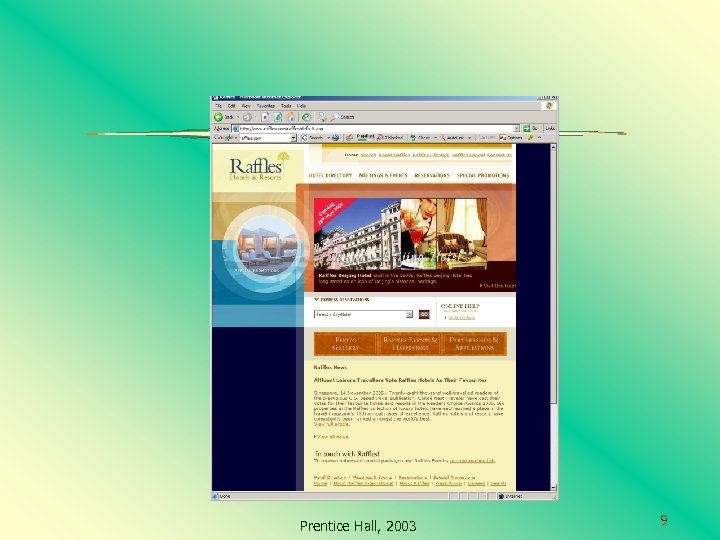
 How Raffles Hotel is Conducting E-Commerce The Problem The company’s success depends on the its ability to lure customers to its hotels and facilities and on its ability to contain costs. Solution Business-to-consumer—maintains a public portal (raffles. com) that includes: Information on the hotels Reservation system Links to travelers’ resources Customer relationship management (CRM) program Online store for Raffles products Prentice Hall, 2003 7
 Raffles Hotel (cont. ) Business-to-business—maintains an interorganizational systems that enable efficient contacts with its suppliers The e-marketplace also has a sell-side, allowing other hotels to buy Raffles-branded products from electronic catalogs (bathrobes) Competitors buy Raffles-branded products because they are inexpensive, but look upscale Prentice Hall, 2003 8
 Prentice Hall, 2003 9
 Raffles Hotel (cont. ) The Results Public portal helps in customer acquisition Hotel is able to maintain high occupancy rates using: Promotions Direct sales Prentice Hall, 2003 10
 Raffles Hotel (cont. ) The private marketplace is strategically advantageous: Raffles in forcing suppliers to disclose their prices, thus increasing competition among suppliers Raffles is saving about $1 million a year on procurement of eight high-volume supplies; more savings on other products Success is evident in its aggressive expansion in the Asian markets Prentice Hall, 2003 11
 Electronic Marketplaces Markets facilitate exchange of Information Goods Services Payments Markets create economic value (incentive) for Buyers Sellers Market intermediaries Society at large Prentice Hall, 2003 12
 Electronic Marketplaces (cont. ) 3 main functions of markets Matching buyers and sellers Facilitating the exchange of information, goods, services, and payments associated with market transactions Providing an institutional infrastructure Prentice Hall, 2003 13
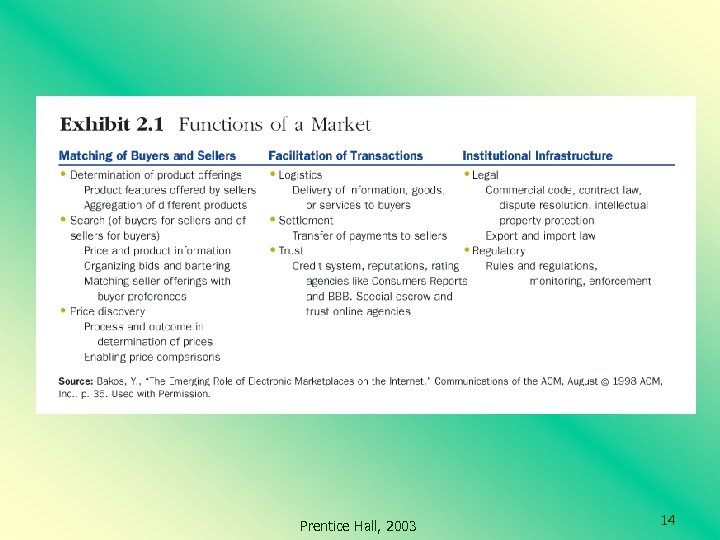 Prentice Hall, 2003 14
 NTE Evens the Load National Transportation Exchange (nte. com) is attempting to keep trucks on the road full on both outbound and return trips—uses the Internet to connect shippers with fleet managers who have space to fill Creates a spot market Gets information from shippers about their needs and flexibility in dates Works out the best deals for the shippers and the haulers Issues the contract and handles payments The process takes only a few minutes Prentice Hall, 2003 15
 NTE Evens the Load (cont. ) NTE collects a commission based on the value of each deal Fleet manager gets extra revenue that they would otherwise have missed out on The shipper gets a bargain price, at the cost of some loss of flexibility NTE reaches down to the level of individual truck drivers and provides a much wider range of services (wireless Internet access) Prentice Hall, 2003 16
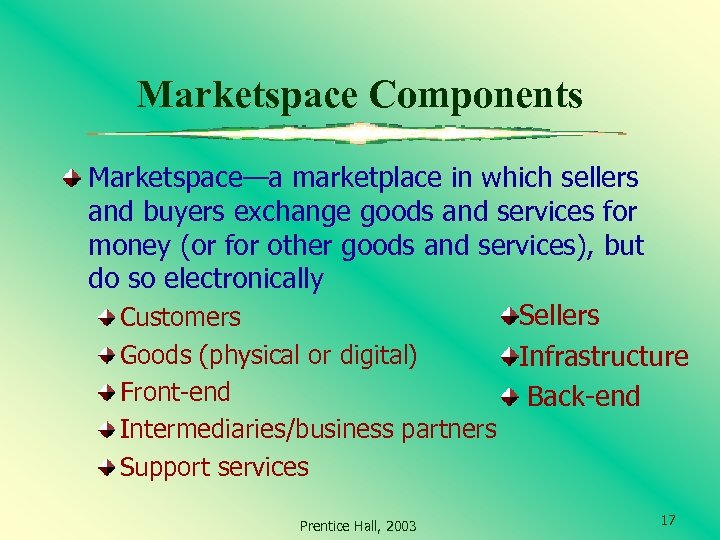 Marketspace Components Marketspace—a marketplace in which sellers and buyers exchange goods and services for money (or for other goods and services), but do so electronically Sellers Customers Goods (physical or digital) Infrastructure Front-end Back-end Intermediaries/business partners Support services Prentice Hall, 2003 17
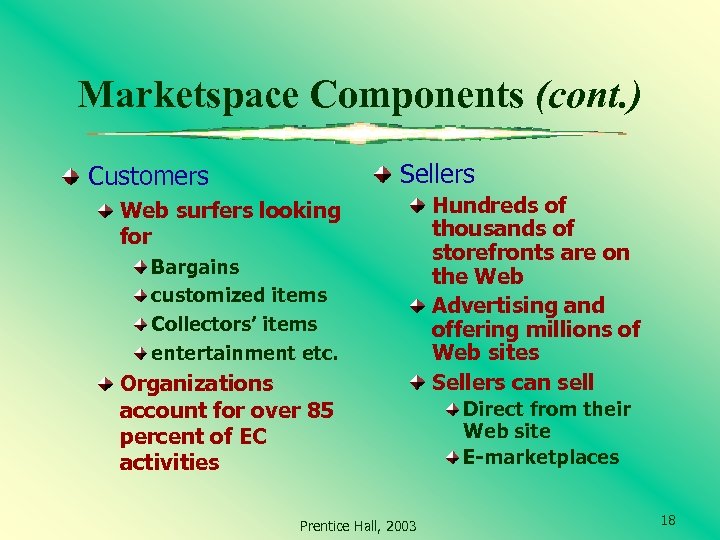 Marketspace Components (cont. ) Sellers Customers Web surfers looking for Bargains customized items Collectors’ items entertainment etc. Organizations account for over 85 percent of EC activities Prentice Hall, 2003 Hundreds of thousands of storefronts are on the Web Advertising and offering millions of Web sites Sellers can sell Direct from their Web site E-marketplaces 18
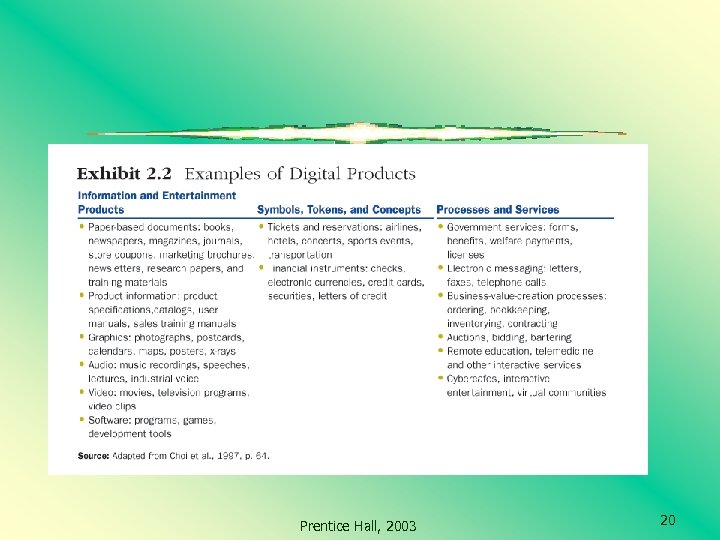
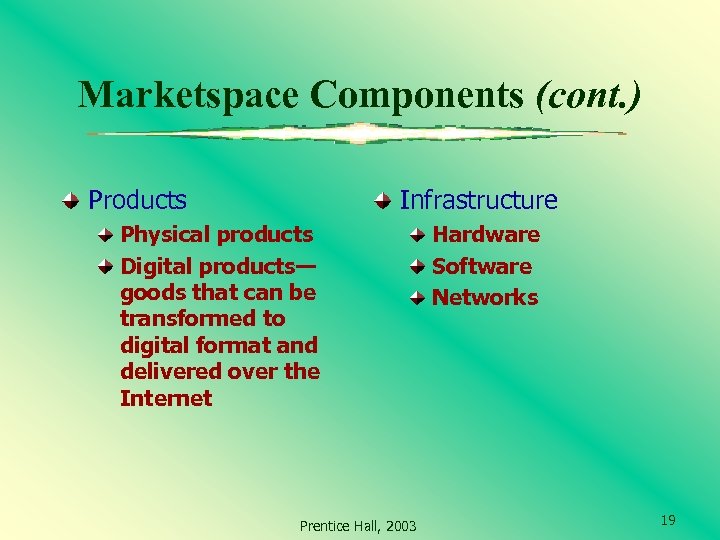 Marketspace Components (cont. ) Products Infrastructure Physical products Digital products— goods that can be transformed to digital format and delivered over the Internet Prentice Hall, 2003 Hardware Software Networks 19
 Prentice Hall, 2003 20
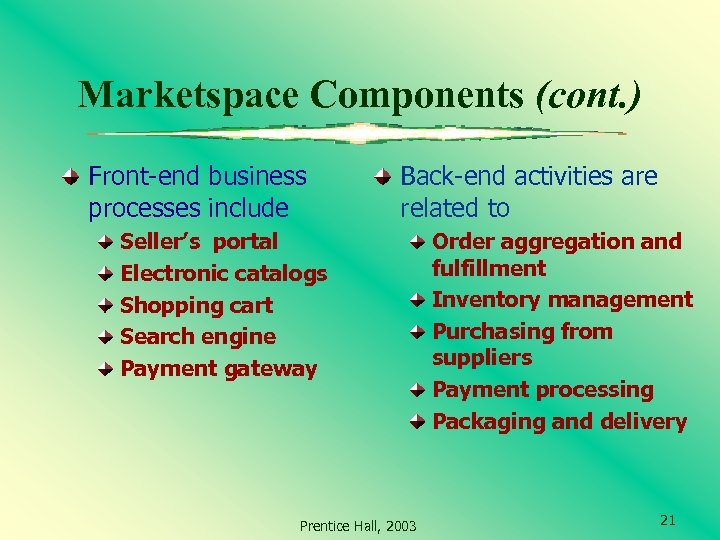 Marketspace Components (cont. ) Front-end business processes include Back-end activities are related to Seller’s portal Electronic catalogs Shopping cart Search engine Payment gateway Prentice Hall, 2003 Order aggregation and fulfillment Inventory management Purchasing from suppliers Payment processing Packaging and delivery 21
 Marketspace Components (cont. ) Intermediary—a third party that operates between sellers and buyers Other business partners—collaborate on the Internet, mostly along the supply chain Support services such as Certification and trust services Knowledge providers Prentice Hall, 2003 22
 Types of Electronic Markets Electronic storefronts—a single company’s Web site where products and services are sold Mechanisms for conducting sales Electronic catalogs Search engine Customer services E-auction facilities Electronic cart Payment gateway Shipment court Electronic malls (e-malls)—an online shopping center where many stores are located Prentice Hall, 2003 23
 Types of Electronic Markets (cont. ) Types of stores and malls General stores/malls—large marketspaces that sell all types of products Public portals Specialized stores/malls— sell only one or a few types of products Regional vs. global stores Pure online organizations vs. clickand-mortar stores E-marketplaces—online market, usually B 2 B, in which buyers and sellers negotiate; the three types of emarketplaces are private , public , consortia Prentice Hall, 2003 24
 E-Marketplaces Private e-marketplaces—online markets owned by a single company: Sell-side—company sells either standard or customized products to qualified companies Buy-side marketplaces—company makes purchases from invited suppliers Public e-marketplaces—B 2 B markets, usually owned and/or managed by an independent third party, that include many sellers and many buyers (exchanges) Prentice Hall, 2003 25
 Consortia & Information Portals Consortia—e-marketplaces that deal with suppliers and buyers in a single industry Vertical consortia are confined to one industry Horizontal allow different industries trade there Information portal—a personalized, single point of access through a Web browser to business information inside (and marginally from outside) an organization Publishing portals Commercial portals Personal portals Mobile portals Corporate portals Prentice Hall, 2003 26
 Supply Chains Supply chain—the flow of materials, information, money, and services from raw material suppliers through factories and warehouses to the end customers Includes organizations and processes that create and deliver the following to the end customers: Products Information Services Prentice Hall, 2003 27
 Supply Chains (cont. ) A supply chain involves activities that take place during the entire product life cycle It also includes: Movement of information and money and procedures that support the movement of a product or a service The organizations and individuals involved Prentice Hall, 2003 28
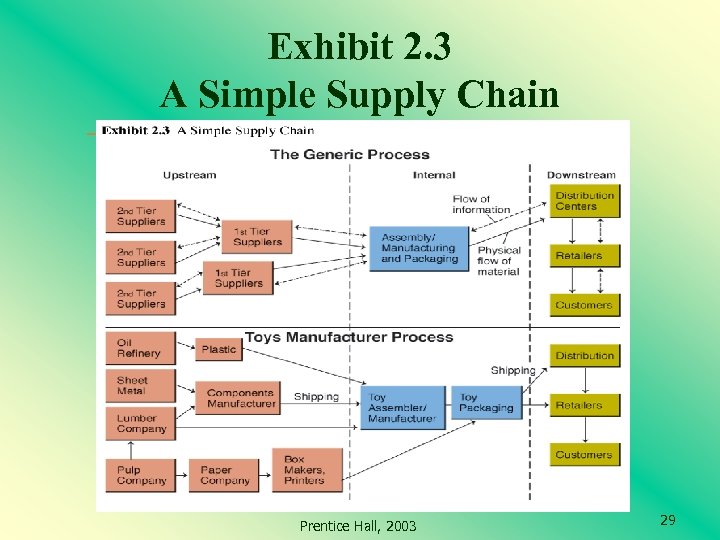 Exhibit 2. 3 A Simple Supply Chain Prentice Hall, 2003 29
 Supply Chain Components Upstream supply chain—includes the activities of suppliers (manufacturers and/or assemblers) and their suppliers Internal supply chain—includes all in-house processes used in transforming the inputs received from the suppliers into the organization’s outputs Downstream supply chain—includes all the activities involved in delivering the product to the final customers Prentice Hall, 2003 30
 Types of Supply Chains Integrated make-to-stock Continuous replenishment Build-to-order—model in which a manufacturer begins assembly of the customer’s order almost immediately upon receipt of the order Channel assembly—model in which product is assembled as it moves through the distribution channel Prentice Hall, 2003 31
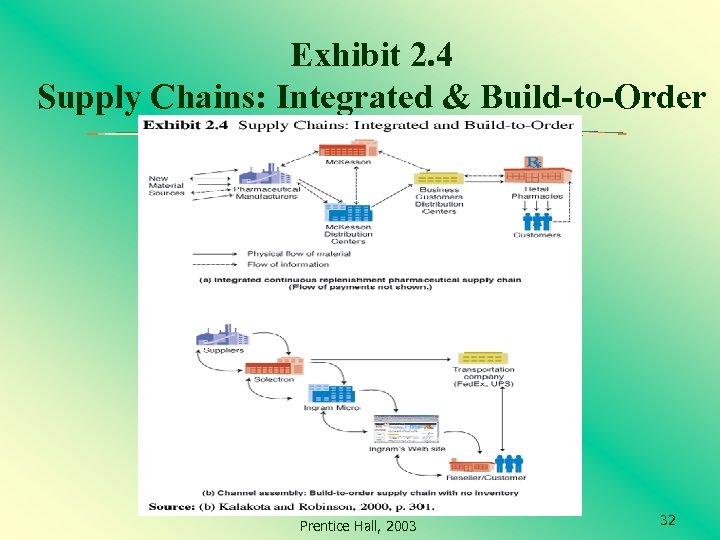 Exhibit 2. 4 Supply Chains: Integrated & Build-to-Order Prentice Hall, 2003 32
 Value Chain & Value System Value chain—the series of activities a company performs to achieve its goal(s) at various stages of the production process; each activity adds value to the company’s product or service, contributes to profit, and enhances competitive position in the market Value system—a set of value chains in an entire industry, including the value chains of tiers of suppliers, distribution channels, and customers http: //www. marketingteacher. com/Lessons/les son_value_chain. htm Prentice Hall, 2003 33
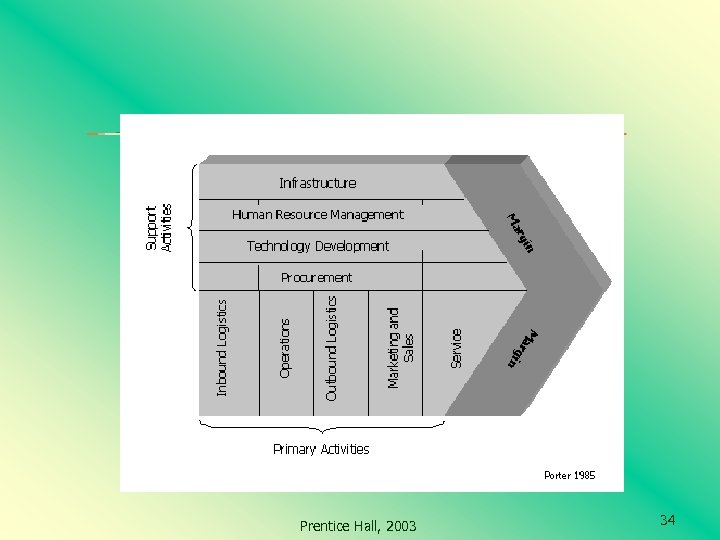 Prentice Hall, 2003 34
 Supply Chain & Value Chain Value chain and the supply chain concepts are interrelated Value chain shows the activities performed by an organization and the values added by each The supply chain shows flows of materials, money, and information that support the execution of these activities Prentice Hall, 2003 35
 Supply Chain & Value Chain (cont. ) EC increases the value added by: Introducing new business models Automating business processes EC smoothes the supply chain by: Reducing problems in the flows of material, money, and information EC facilitates the restructuring of business activities and supply chains Prentice Hall, 2003 36
 Intermediation in E-Commerce Intermediaries provide value-added activities and services to buyers and sellers: wholesalers, retailers, infomediaries Roles of intermediaries Search costs—databases on customer preferences Lack of privacy—anonymity of sellers and buyers Incomplete information—gather product information Contract risk—protect sellers against non-payment Pricing inefficiencies—induce appropriate trades Prentice Hall, 2003 37
 E-Distributors on B 2 B E-distributor—an e-commerce intermediary that connects manufacturers (suppliers) with buyers by aggregating the catalogs of many suppliers in one place—the intermediary’s Web site E-distributors also provide support services Payments Deliveries Escrow services Aggregate buyers’ and or sellers’ orders Prentice Hall, 2003 38
 Disintermediation & Reintermediation Disintermediation—elimination of intermediaries between sellers and buyers Reintermediation—establishment of new intermediary roles for traditional intermediaries that were disintermediated Prentice Hall, 2003 39
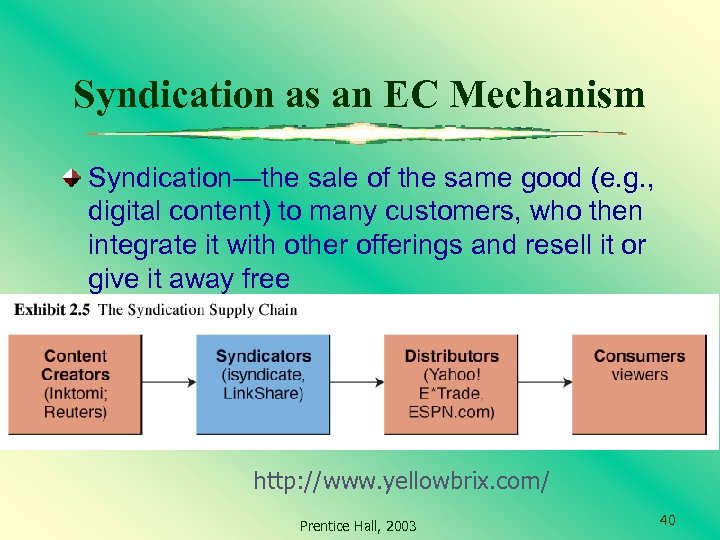 Syndication as an EC Mechanism Syndication—the sale of the same good (e. g. , digital content) to many customers, who then integrate it with other offerings and resell it or give it away free http: //www. yellowbrix. com/ Prentice Hall, 2003 40
 Competition in the Internet Ecosystem Competition in the Internet ecosystem (business model of the online economy) Inclusive with low barriers to entry Self-organizing Old rules may no longer apply Competition is tense Lower buyers’ search cost Speedy comparisons Differentiation and personalization Prentice Hall, 2003 41
 Competition in the Internet Ecosystem (cont. ) Differentiation—providing a product or service that is unique Personalization—the ability to tailor a product, service, or Web content to specific user preferences Lower prices Prentice Hall, 2003 42
 Competition in the Internet Ecosystem (cont. ) Customer service is an extremely important competitive factor Some competitive factors are less important as a result of EC: Size of company is no longer significant Geographical location is insignificant Language barriers are being removed Digital products do not have normal wear and tear Prentice Hall, 2003 43
 Competition in the Internet Ecosystem (cont. ) EC supports efficient markets and could result in almost perfect competition with these characteristics: Many buyers and sellers must be able to enter the market at no entry cost Large buyers or sellers are not able to individually influence the market The products must be homogeneous Buyers and sellers must have comprehensive information about the products and about the market participants’ demands, supplies, and conditions Prentice Hall, 2003 44
 Porter’s Competitive Analysis Porter’s competitive forces model applied to an industry views 5 major forces of competition that determine the industry’s structural attractiveness These forces, in combination, determine how the economic value created in an industry is divided among the players in the industry Such an industry analysis helps companies develop their competitive strategy Prentice Hall, 2003 45
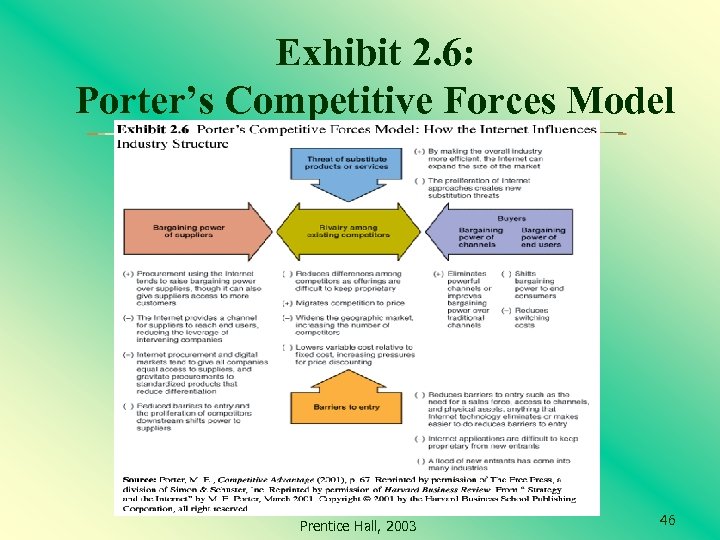 Exhibit 2. 6: Porter’s Competitive Forces Model Prentice Hall, 2003 46
 Liquidity—the need for a critical mass of buyers and sellers The fixed cost of deploying EC can be very high Without a large number of buyers, sellers will not make money Early liquidity—achieving a critical mass of buyers and sellers as fast as possible, before the marketmaker’s cash disappears Get big fast or Get it Right First? http: //workingknowledge. hbs. edu/item. jhtml? i d=1682&t=strategy Prentice Hall, 2003 47
 Quality Uncertainty & Assurance Quality uncertainty—the uncertainty of online buyers about the quality of products that they have never seen, especially from an unknown vendor Provide free samples Return if not satisfied Microproduct—a small digital product costing a few cents Insurance, escrow, and other services Prentice Hall, 2003 48
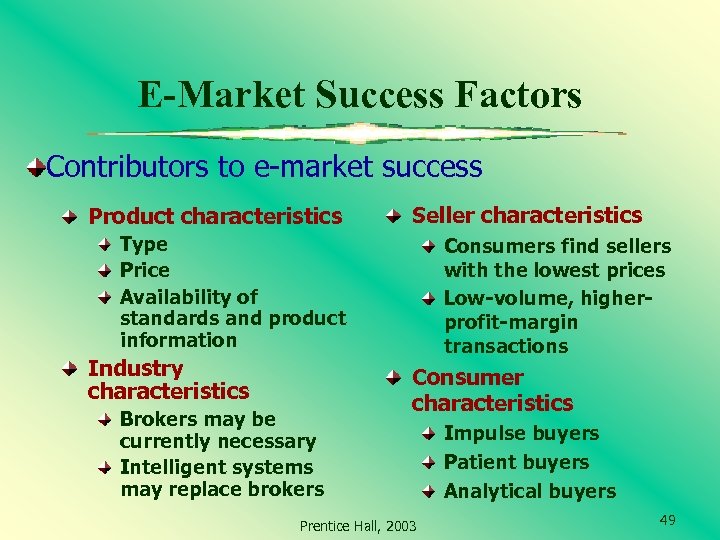 E-Market Success Factors Contributors to e-market success Product characteristics Seller characteristics Type Price Availability of standards and product information Industry characteristics Brokers may be currently necessary Intelligent systems may replace brokers Consumers find sellers with the lowest prices Low-volume, higherprofit-margin transactions Consumer characteristics Prentice Hall, 2003 Impulse buyers Patient buyers Analytical buyers 49
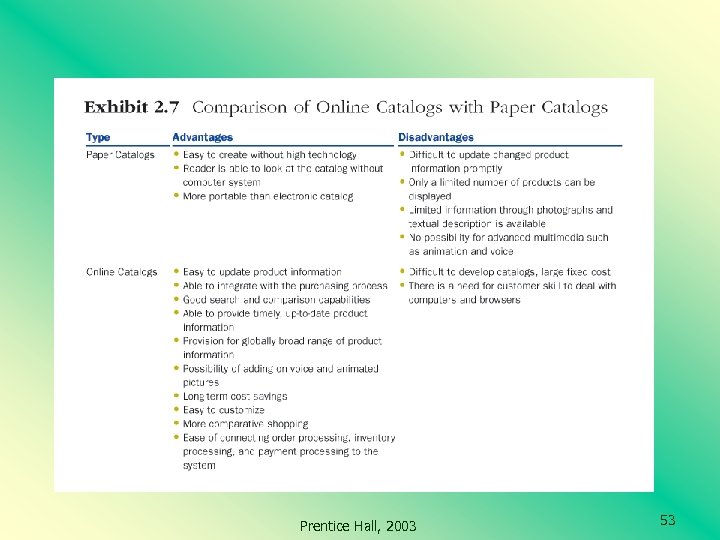
 Market Mechanisms -Electronic Catalogs. Electronic catalogs—the presentation of product information in an electronic form; the backbone of most e-selling sites Evolution of electronic catalogs Merchants—advertise and promote Customers—source of information and price comparisons Consist of product database, directory and search capability and presentation function Replication of text that appears in paper catalogs More dynamic, customized, and integrated Prentice Hall, 2003 50
 Classifications of Electronic Catalogs Dynamics of information presentation—static or dynamic Degree of customization—ready-made or customized Electronic catalogs allow integration of: Order taking and fulfillment Electronic payment Intranet workflow Inventory and accounting system Suppliers’ extranet Relationship to paper catalogs Prentice Hall, 2003 51
 Customized Catalogs Assembled specifically for: A company An individual shopper Customization systems can: Create branded, value-added capabilities Allows user to compose order May include individualized prices, products, and display formats Automatically identify the characteristics of customers based on the transaction records Prentice Hall, 2003 52
 Prentice Hall, 2003 53
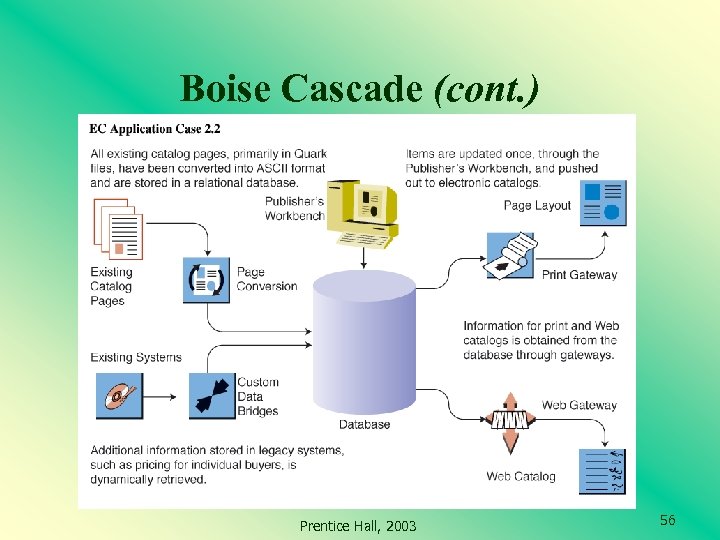
 Electronic Catalogs at Boise Cascade Office Products--$3 -billion office products wholesaler of over 200, 000 different items They had a 900 -page paper catalog that was mailed once each year; minicatalogs tailored to customers’ individual needs The company placed its catalogs online in 1996 (boiseoffice. com) Prentice Hall, 2003 54
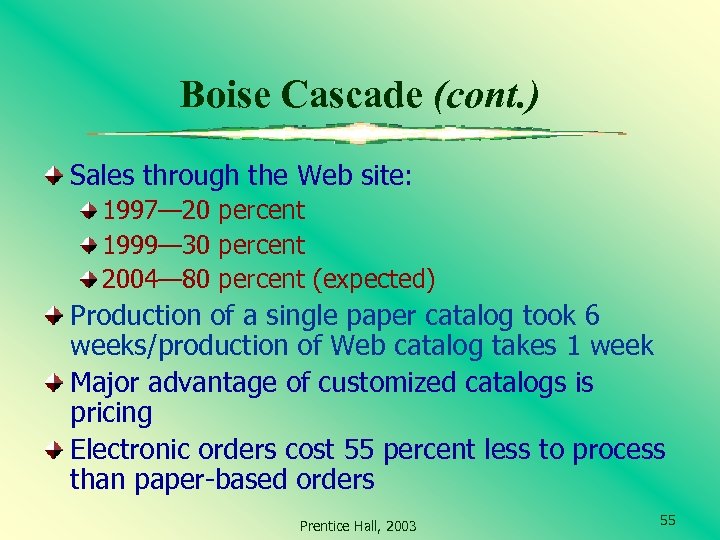 Boise Cascade (cont. ) Sales through the Web site: 1997— 20 percent 1999— 30 percent 2004— 80 percent (expected) Production of a single paper catalog took 6 weeks/production of Web catalog takes 1 week Major advantage of customized catalogs is pricing Electronic orders cost 55 percent less to process than paper-based orders Prentice Hall, 2003 55
 Boise Cascade (cont. ) Prentice Hall, 2003 56
 ELC 200 Day 5 Prentice Hall, 2003 57
 Agenda Questions from last Class? Assignment One is Corrected 10 A’s, 4 B’s, 1 D and 1 F (non-submit) Assignment two posted to Web. CT Due Feb 9 Finish Discussion Chap 2 E-Commerce Market Mechanisms Prentice Hall, 2003 58
 Assignment 1 General Comments These assignments will require some independent thought, it will not suffice to simply “parrot” the text or the instructor. Spelling and Grammar COUNT! Be consistent, whether an answer is correct or not is often determined by what you answered in a previous question or assignment. Writing style should be appropriate for Business http: //owl. english. purdue. edu/handouts/pw/#sub 6 Prentice Hall, 2003 59
 Search Engines Search engine—a computer program that can access a database of Internet resources, search for specific information or keywords, and report the results Software (intelligent) agent—software that can perform routine tasks that require intelligence Prentice Hall, 2003 60
 Search Engines, Intelligent Agents and Shopping Carts E-commerce users use both search engines and intelligent agents Search engines find products or services Software agents conduct other tasks (comparisons) Electronic shopping cart—an order-processing technology that allows customers to accumulate items they wish to buy while they continue to shop Prentice Hall, 2003 61
 Auctions Auction—a market mechanism by which a seller places an offer to sell a product and buyers make bids sequentially and competitively until a final price is reached Auctions deal with products and services for which conventional marketing channels are ineffective or inefficient Example: Any perishable inventory that must be sold like agricultural products Prentice Hall, 2003 62
 Limitations of Traditional Auctions Traditional auctions are generally a rapid process It may be difficult for sellers to move goods to the auction site Commissions are fairly high Prentice Hall, 2003 63
 Electronic Auctions Electronic auctions (e-auctions)—auctions conducted online Host sites on the Internet serve as brokers offering: Services for sellers to post their goods for sale Allowing buyers to bid on those items Many sites have certain etiquette rules that must be adhered to in order to conduct fair business Prentice Hall, 2003 64
 Electronic Auctions (cont. ) Major online auctions offer: Consumer products Electronic parts Artwork Vacation packages Airline tickets Collectibles Excess supplies and inventories being auctioned off by B 2 B marketers Prentice Hall, 2003 65
 Dynamic Pricing Dynamic pricing—prices that change based on supply and demand relationships at any given time The four major categories of dynamic pricing are based on the number of buyers and sellers involved: One buyer, one seller One seller, many potential buyers One buyer, many potential sellers Many sellers, many buyers Prentice Hall, 2003 66
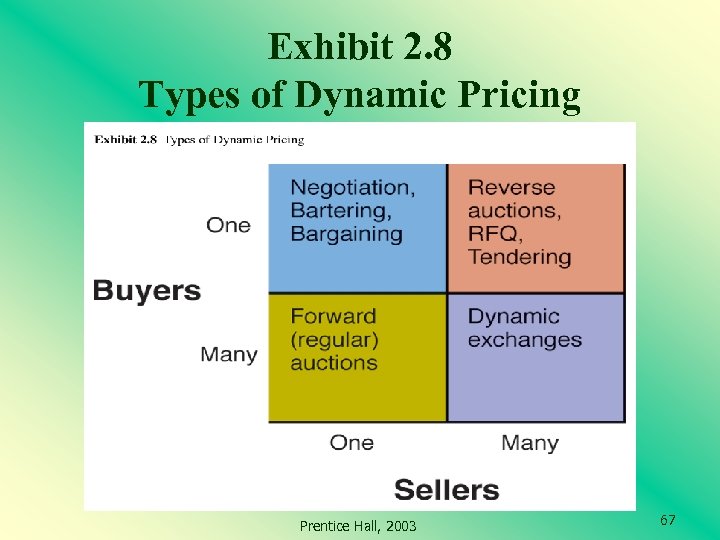 Exhibit 2. 8 Types of Dynamic Pricing Prentice Hall, 2003 67
 Dynamic Pricing (cont. ) One buyer, one seller uses Negotiation Bargaining Bartering Price will be determined by: Each party’s bargaining power Supply and demand in the item’s market Possibly business environment factors Prentice Hall, 2003 68
 Dynamic Pricing (cont. ) One seller, many potential buyers Forward auction—an auction in which a seller entertains bids from buyers English auction—an auction in buyers bid on an item in sequence and the price increases with time Yankee auction—auction of multiple identical items in which bidders can bid for any number of the items offered, and the highest bid wins Prentice Hall, 2003 69
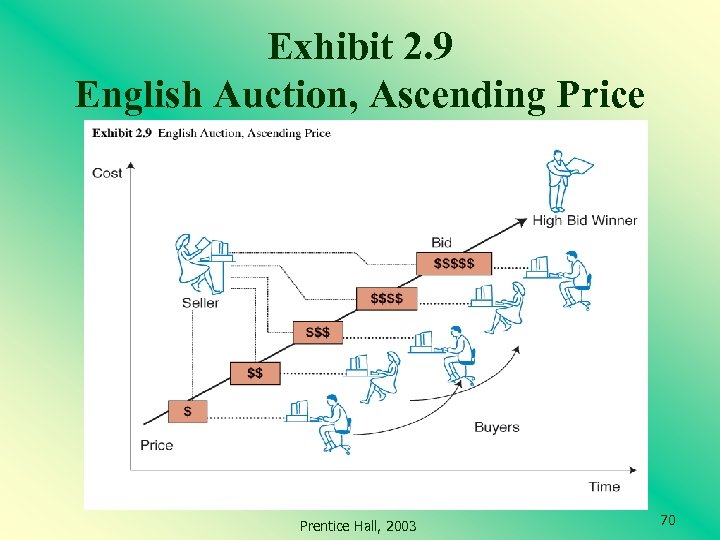 Exhibit 2. 9 English Auction, Ascending Price Prentice Hall, 2003 70
 Dynamic Pricing (cont. ) Dutch auction—auction of multiple identical items, with prices starting at a very high level and declining as the auction time passes Free-fall (declining price) auction—a variation of the Dutch auction in which only one item is auctioned at a time; the price starts at a very high level and declines at fixed time intervals, the winning bid is the lowest one when the time expires Prentice Hall, 2003 71
 Dynamic Pricing (cont. ) One buyer, many potential sellers Reverse auction (bidding, or tendering system) —auction in which the buyer places an item for bid (tender) on a request for quote (RFQ) system, potential suppliers bid on the job, with price reducing sequentially, and the lowest bid wins; primarily a B 2 B or G 2 B mechanism Prentice Hall, 2003 72
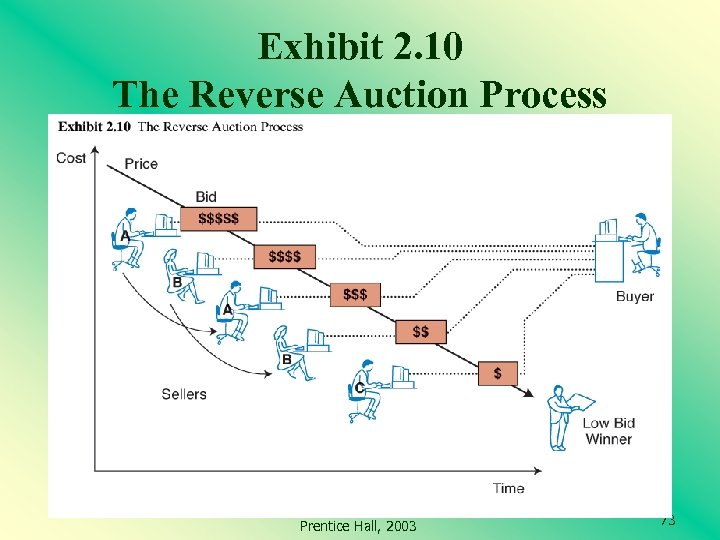 Exhibit 2. 10 The Reverse Auction Process Prentice Hall, 2003 73
 Dynamic Pricing (cont. ) One buyer, many potential sellers (cont. ) ”Name-your-own-price” model Consumer-to-business (C 2 B) model Many sellers, many buyers Double Auction—buyers and their bidding prices and sellers and their asking prices are matched, considering the quantities on both sides Prentice Hall, 2003 74
 Limitations of Electronic Auctions Possibility of fraud—defective goods or receive goods/services without paying Limited participation—invitation only or Open to dealers only Lack of security—C 2 C auctions sometimes not done in an unencrypted environment Limited software—only a few “complete”or “off-the-shelf” market-enabling solutions Prentice Hall, 2003 75
 Impacts of Auctions as a coordination mechanism Auctions as a social mechanism to determine a price Auctions as a highly visible distribution mechanism Auctions as a component in e-commerce Prentice Hall, 2003 76
 Reverse Mortgage Auctions in Singapore Homebuyers like to get the lowest possible mortgage rates In Singapore, Dollardex. com uses reverse auctions that are combined with “group purchasing” Dollardex’s first project: Site invited potential buyers to fill out applications on a secure Web site 7 lending banks were invited to bid on the loans Prentice Hall, 2003 77
 Reverse Mortgage Auctions in Singapore (cont. ) In a secure electronic room, borrowers and lenders negotiated the deal, 2 days later the borrowers voted for one bank Borrowers negotiated loans 0. 5 per-cent less than the regular rate and waiver of the legal fees with United Overseas Bank (UOB) UOB generated $10 million of business Dollardex allows customers to participate in an individual reverse auction if they do not want to join a group Prentice Hall, 2003 78
 Bartering Online Bartering—an exchange of goods and services Bartering exchanges Give your offer to intermediary Intermediary asses value of your product or service in”points” Use “points” to buy what you need Bartering sites must be financially secure Alternative to bartering is to auction surplus and then use the money collected to buy items needed Prentice Hall, 2003 79
 Bartering Online (cont. ) E-bartering—bartering conducted online, usually by a bartering exchange Bartering exchange—a marketplace in which an intermediary arranges barter transactions Prentice Hall, 2003 80
 Online Negotiating Online negotiation—electronic negotiation, usually done by software (intelligent) agents that perform searches and comparisons; improves bundling and customization of products and services Dynamic prices can be determined by negotiation Negotiated prices result from interactions and bargaining among sellers and buyers Expensive items like cars and real estate Deal with nonpricing terms like payment method and credit Prentice Hall, 2003 81
 Online Negotiating (cont. ) Three factors that facilitate negotiated prices Intelligent agents that perform searches and comparisons Computer technology that facilitates negotiation process Products and services that are bundled and customized Prentice Hall, 2003 82
 Mobile Commerce Mobile computing permits real-time access to information, applications, and tools that, until recently, were accessible only from a desktop computer Mobile commerce (m-commerce)— e-commerce conducted via wireless devices M-business—the broadest definition of m-commerce, in which e-business is conducted in a wireless environment Prentice Hall, 2003 83
 The Promise of M-Commerce Mobility significantly changes the manner in which people and customers: Mobile applications are expected to change the way we: Interact Communicate Collaborate Prentice Hall, 2003 Live Play Do business 84
 The Promise of M-Commerce (cont. ) The PC-based Internet culture may change to one based on mobile devices M-commerce creates new business models for EC, notably location-based applications Many large corporations with huge marketing presence are transforming their businesses to include mcommerce-based products and services Microsoft Intel Sony AT&T AOL-Time-Warner Prentice Hall, 2003 85
 I-Mode: Successful Mobile Portal An example of the spread of m-commerce is Do. Co. Mo’s i-Mode; some applications of I-Mode are: http: //www. nttdocomo. co. jp/english/ Shopping guides Maps and transportation Ticketing News and reports Personalized movie service Entertainment Dining and reservations Additional services Banking Stock trading Telephone directory searches Dictionary services Horoscopes Prentice Hall, 2003 86
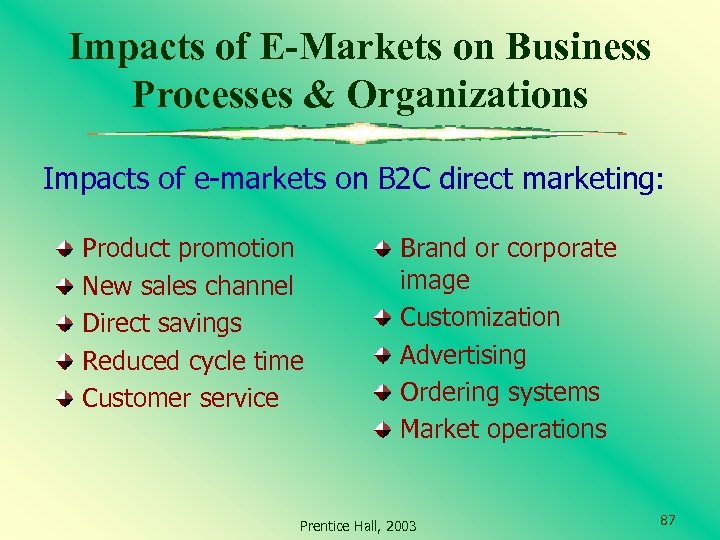 Impacts of E-Markets on Business Processes & Organizations Impacts of e-markets on B 2 C direct marketing: Product promotion New sales channel Direct savings Reduced cycle time Customer service Brand or corporate image Customization Advertising Ordering systems Market operations Prentice Hall, 2003 87
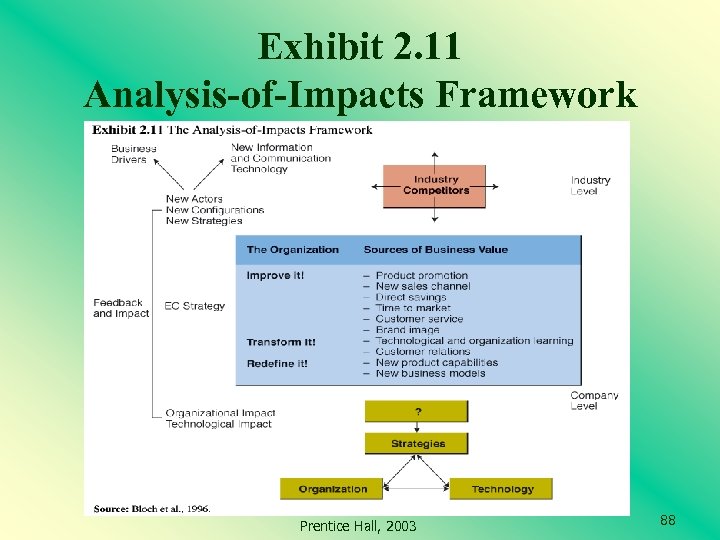 Exhibit 2. 11 Analysis-of-Impacts Framework Prentice Hall, 2003 88
 Transforming Organizations Technology and organizational learning To survive, companies will have to learn and adapt quickly to the new technologies Corporate change must be planned and managed New technologies will require new organizational structures and approaches "We are moving from a world where the big eat the small to a world where the fast eat the slow. " Dick Anderson, IBM "Innovate or Die" by Tom Peters Prentice Hall, 2003 89
 Transforming Organizations (cont. ) The changing nature of work Driven by increased competition in the global marketplace, firms are Reducing the number of employees and Outsourcing whatever work they can to countries where wages are significantly less The upheaval brought on by these changes creates new opportunities and new risks; forces us to think new ways of about jobs, careers, and salaries Prentice Hall, 2003 90
 Transforming Organizations (cont. ) Digital-Age workers will have to be very flexible—truly secure jobs will be few, many will work from home Digital-Age companies will have to prize its core of essential workers as its most valuable asset—empowering them and providing them with means to expand their knowledge and skill base http: //www. tompeters. com/ Prentice Hall, 2003 91
 Redefining Organizations New and improved product capabilities E-markets allow for new products to be created and/or for existing products to be customized in innovative ways Customer profiles and data on customer preferences—source of information for improving products or designing new ones Mass customization enables manufacturers to create specific products for each customer, based on the customer’s exact needs Prentice Hall, 2003 92
 Redefining Organizations (cont. ) New business models E-markets affect individual companies, products, entire industries Improving the supply chain Impacts on manufacturing Manufacturing systems changing from mass production lines to demand-driven, just-in-time manufacturing Virtual manufacturing enables global manufacturing plants to run as though they were one in location Prentice Hall, 2003 93
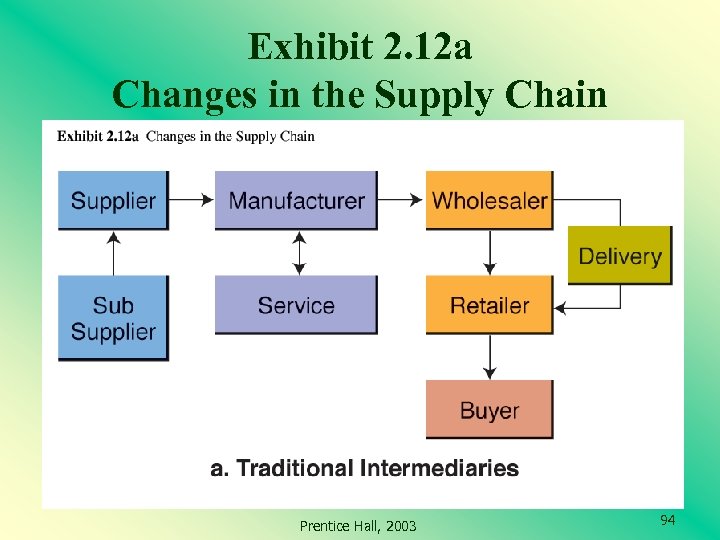 Exhibit 2. 12 a Changes in the Supply Chain Prentice Hall, 2003 94
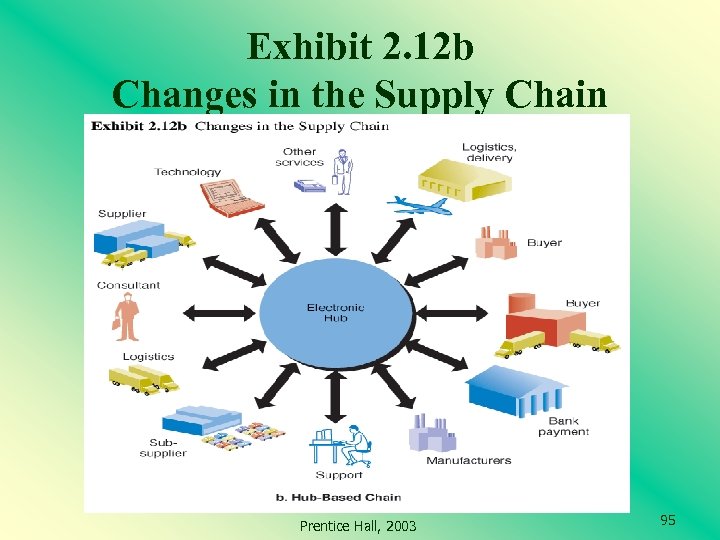 Exhibit 2. 12 b Changes in the Supply Chain Prentice Hall, 2003 95
 Redefining Organizations (cont. ) Impacts on Manufacturing (cont. ) Build-to-Order—the biggest change in manufacturing will be the move to build-toorder systems Manufacturing or assembly will start only after an order (and even payment!) is received Will change not only the production planning and control, but also the entire supply chain Prentice Hall, 2003 96
 A New Model for Small Movers When the U. S. economy started to slow down, and fuel prices increased DM & S (a small trucking company with $1. 8 million in annual sales) started to lose money A major problem in the trucking industry: Trucks need to move cargos at certain times They may not have a full load causing lost revenue DM & S created a reverse-auction service Small moving companies bid on jobs of moving goods for individuals Customers with flexible moving dates benefit the most 97 Prentice Hall, 2003
 Small Movers (cont. ) Dickerabid. com cost $15, 000 to create: Customers place notice of their job on the site Small truckers start to bid Customers can get huge discounts Truckers can earn money to help cover their fuel expenses During the first few months of operation 4 truckers increased to 20 Increased revenues by $14, 000 The Web site won third place in Inc. ’s Web innovations in 2000 Prentice Hall, 2003 98
 Redefining Organizations (cont. ) Impacts on finance and accounting E-markets require special finance and accounting systems—most are electronic payment systems complicated by legal issues and international standards Executing an electronic order triggers back-office transactions These activities must be efficient, synchronized, and fast so the electronic trade will not be slowed down Prentice Hall, 2003 99
 Cisco’s Virtual Close Cisco Systems supplies vast networks that connect computers to the Internet Virtual Close was developed to allow companies to close its accounting records (its “books”) more quickly Cisco is implementing such a system for itself for closing quarterly accounts Used to take up to 10 days; within 4 years it took 2 days—significantly cut its cost By 2002 or 2003 Cisco hopes to close the books with 1 hour’s notice, on any day in the quarter Prentice Hall, 2003 100
 Cisco’s Virtual Close (cont. ) Advantages of Virtual Close Companies can become proactive, spotting problems at any time New opportunities can be detected early Enables quick “drill down” analysis, which locates the causes of either poor or excellent performance Brings huge productivity gains related to corporate financial reporting Prentice Hall, 2003 101
 Redefining Organizations (cont. ) Impact on human resource management and training EC is changing how people are recruited, evaluated, promoted, and developed EC also is changing the way training and education are offered to employees Online distance learning and virtual courses are exploding Companies are cutting training costs by 50 percent or more Prentice Hall, 2003 102
 Redefining Organizations (cont. ) New e-learning systems offer two-way video, on-the-fly interaction, application sharing E- learning may be their ticket to corporate survival as changing environments, new technologies, and continuously changing procedures make it necessary for employees to be trained and retrained constantly Prentice Hall, 2003 103
 Managerial Issues How do we compete in the digital economy? What about intermediaries? What organizational changes will be needed? Should we auction? What should be auctioned? Should we have our own auction site or use a thirdparty site? Should we barter? What m-commerce opportunities are available? Prentice Hall, 2003 104
 Summary E-marketplaces and their components The major types of e-markets Supply chains and value chains The role of intermediation Competition, quality, and liquidity in e-markets Electronic catalogs, search engines, and shopping carts Types of auctions and their characteristics Prentice Hall, 2003 105