


 Скачать презентацию Elasticity Price Cross Income Say you
4991a1d141569b563814b4c8463d32d5.ppt
- Количество слайдов: 55
 Elasticity: Price, Cross, & Income
 Say you own a shop. Where is it? What is it like? Can you see it? What does your shop sell? (I don’t know what it sells so I’ll just say “widgets. ”) If you lower the price of your widgets will you sell more?
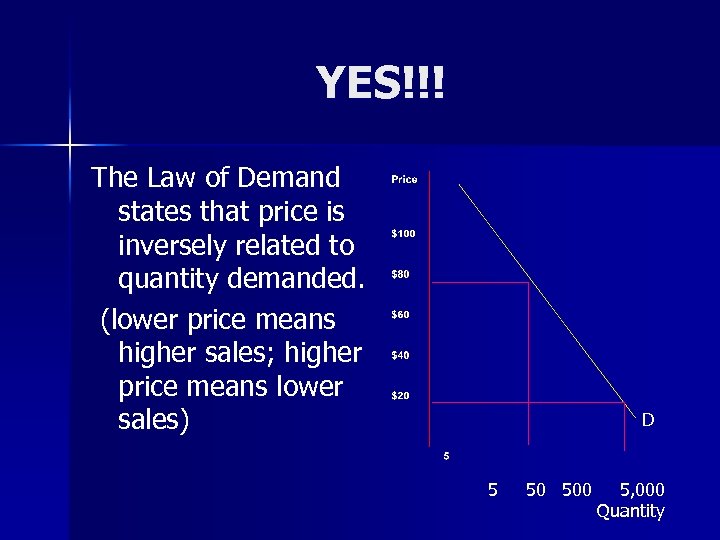 YES!!! The Law of Demand states that price is inversely related to quantity demanded. (lower price means higher sales; higher price means lower sales) D 5 50 500 5, 000 Quantity
 Next question, if you lower the price on widgets will you bring in more money (total revenue)?
 Maybe!!! The answer really depends on whether, in percentage terms, consumers increase their buying more than you, in percentage terms, decrease your price. Thus, we need to know about your product’s Price Elasticity of Demand!
 Price Elasticity of Demand measures the degree to which individuals change buying behavior based on price changes. If a small change in price yields a large change in the amount purchased the product is considered to have a relatively ELASTIC demand.
 Price Elasticity of Demand measures the degree to which individuals change buying behavior based on price changes. If a large change in price yields a small change in the amount purchased the product is considered to have a relatively INELASTIC demand.
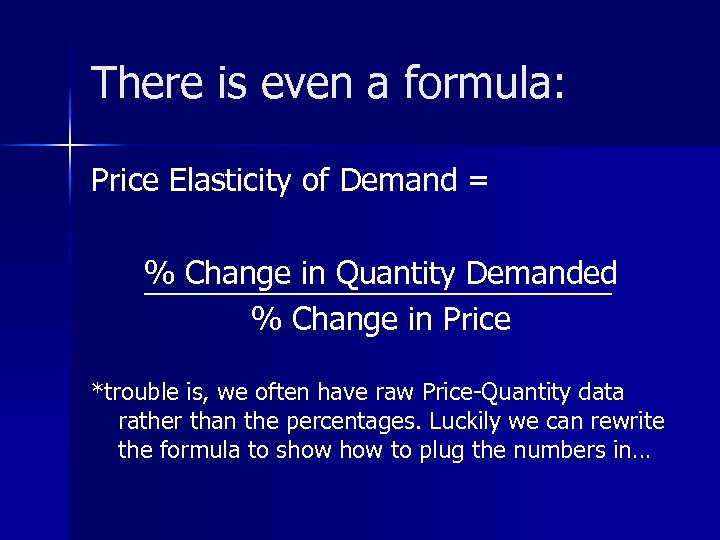 There is even a formula: Price Elasticity of Demand = % Change in Quantity Demanded % Change in Price *trouble is, we often have raw Price-Quantity data rather than the percentages. Luckily we can rewrite the formula to show to plug the numbers in…
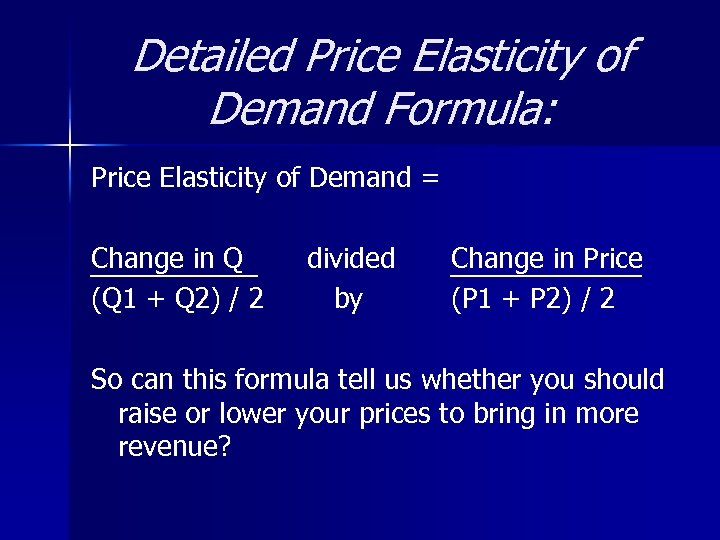 Detailed Price Elasticity of Demand Formula: Price Elasticity of Demand = Change in Q (Q 1 + Q 2) / 2 divided by Change in Price (P 1 + P 2) / 2 So can this formula tell us whether you should raise or lower your prices to bring in more revenue?
 Yes, but you need to practice using it first. No offense, but I think you better hurry!
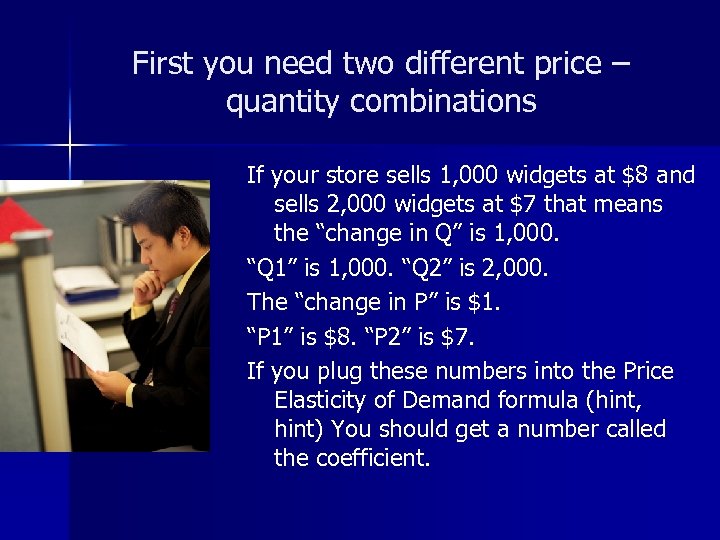 First you need two different price – quantity combinations If your store sells 1, 000 widgets at $8 and sells 2, 000 widgets at $7 that means the “change in Q” is 1, 000. “Q 1” is 1, 000. “Q 2” is 2, 000. The “change in P” is $1. “P 1” is $8. “P 2” is $7. If you plug these numbers into the Price Elasticity of Demand formula (hint, hint) You should get a number called the coefficient.
 What is the coefficient? ? 5! Demand is ELASTIC if the % quantity demanded change is greater than the % price change. Therefore … a coefficient greater than 1 is Elastic.
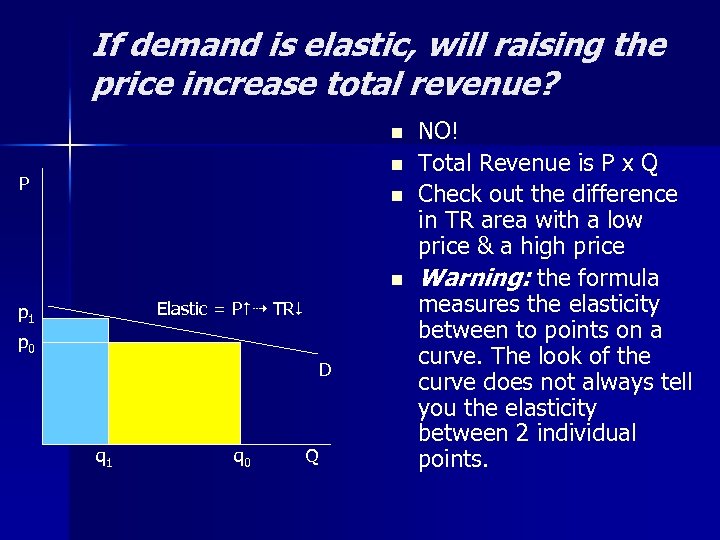 If demand is elastic, will raising the price increase total revenue? n n P n n Elastic = P TR p 1 p 0 D q 1 q 0 Q NO! Total Revenue is P x Q Check out the difference in TR area with a low price & a high price Warning: the formula measures the elasticity between to points on a curve. The look of the curve does not always tell you the elasticity between 2 individual points.
 What if the coefficient had been less than 1? A coefficient less than 1 means that demand is INELASTIC
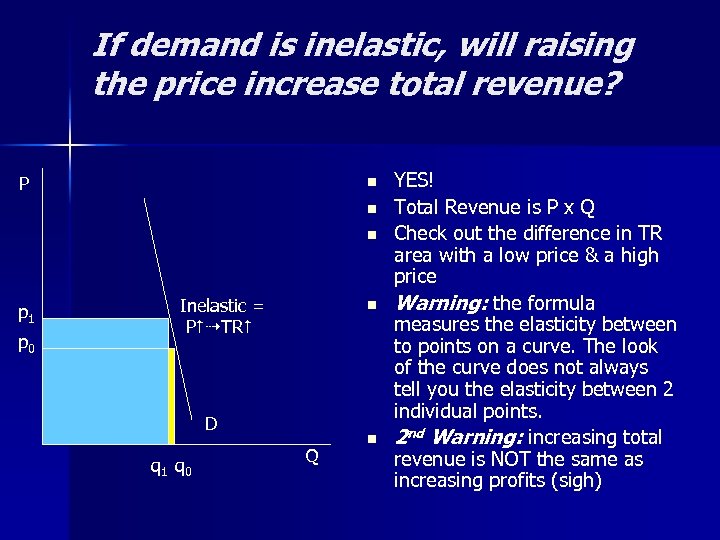 If demand is inelastic, will raising the price increase total revenue? P n n n p 1 p 0 Inelastic = P TR n D q 1 q 0 Q n YES! Total Revenue is P x Q Check out the difference in TR area with a low price & a high price Warning: the formula measures the elasticity between to points on a curve. The look of the curve does not always tell you the elasticity between 2 individual points. 2 nd Warning: increasing total revenue is NOT the same as increasing profits (sigh)
 What if the coefficient had been negative? Can’t happen!! When doing price elasticity we use absolute values. The negative sign doesn’t tell us anything and might be confusing e. g. Negative -4 is more elastic than -2 even though it is a smaller number
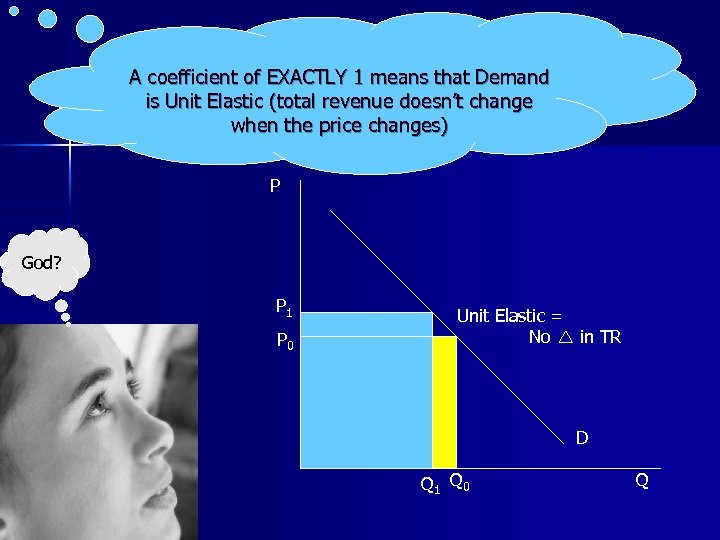 A coefficient of EXACTLY 1 means that Demand is Unit Elastic (total revenue doesn’t change when the price changes) P God? P 1 P 0 Unit Elastic = No in TR D Q 1 Q 0 Q
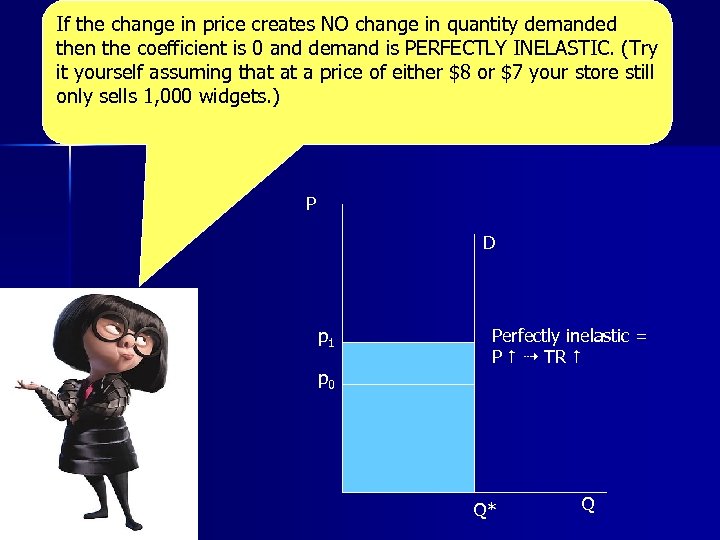 If the change in price creates NO change in quantity demanded then the coefficient is 0 and demand is PERFECTLY INELASTIC. (Try it yourself assuming that at a price of either $8 or $7 your store still only sells 1, 000 widgets. ) P D p 1 p 0 Perfectly inelastic = P TR Q* Q
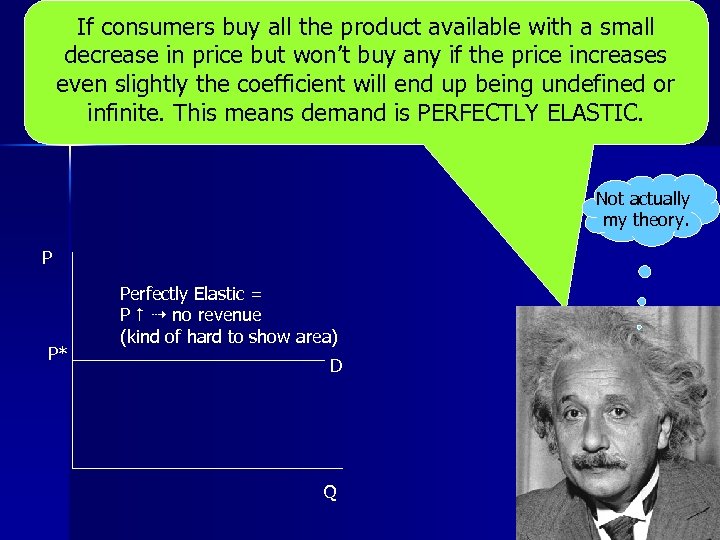 If consumers buy all the product available with a small decrease in price but won’t buy any if the price increases even slightly the coefficient will end up being undefined or infinite. This means demand is PERFECTLY ELASTIC. Not actually my theory. P P* Perfectly Elastic = P no revenue (kind of hard to show area) D Q
 Total Revenue Test You can both check your results and see the significance of Price Elasticity by applying the Total Revenue Test.
 TR Facts 1. Total revenue is the total amount seller receives from sale of product in a given time period. 2. This is NOT the same as profit, a concept we will deal with later. 3. Total revenue doesn’t consider costs and is simply Price x Quantity sold at that price.
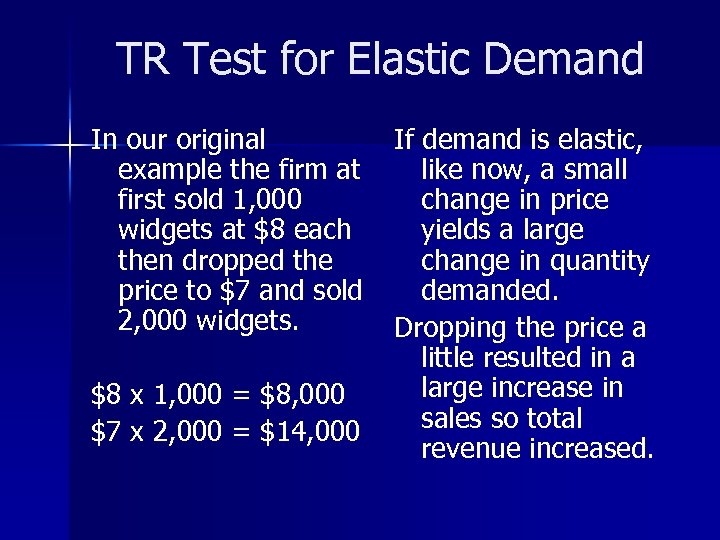 TR Test for Elastic Demand In our original example the firm at first sold 1, 000 widgets at $8 each then dropped the price to $7 and sold 2, 000 widgets. $8 x 1, 000 = $8, 000 $7 x 2, 000 = $14, 000 If demand is elastic, like now, a small change in price yields a large change in quantity demanded. Dropping the price a little resulted in a large increase in sales so total revenue increased.
 When demand is elastic, lowering the price will INREASE total revenue. Just like stretching an ELASTIC rubber band, the 2 ends (price and total revenue) will move in OPPOSITE directions! (P up means TR down; P down means TR up)
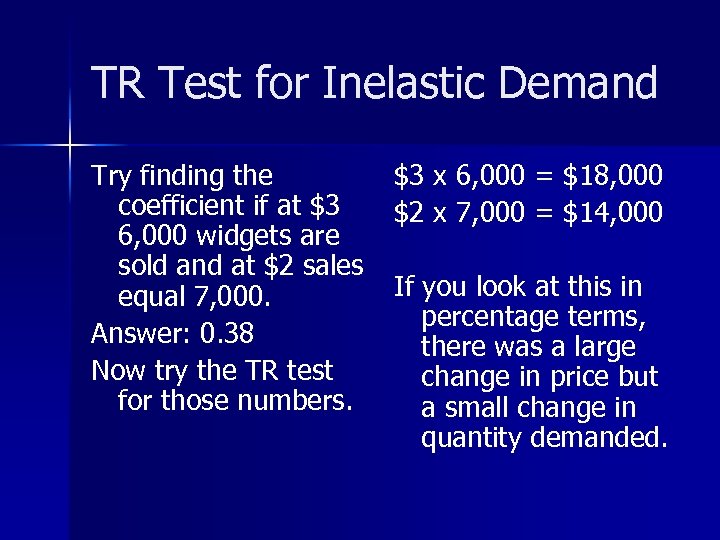 TR Test for Inelastic Demand Try finding the coefficient if at $3 6, 000 widgets are sold and at $2 sales equal 7, 000. Answer: 0. 38 Now try the TR test for those numbers. $3 x 6, 000 = $18, 000 $2 x 7, 000 = $14, 000 If you look at this in percentage terms, there was a large change in price but a small change in quantity demanded.
 When demand is inelastic, lowering the price will DECREASE total revenue. Just like moving an INELASTIC ruler, the 2 ends (price and total revenue) will move in the SAME direction! (P up means TR up; P down means TR down)
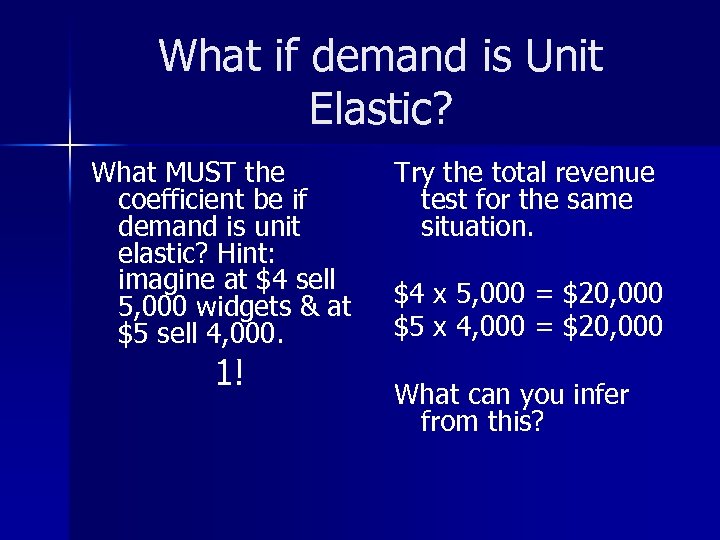 What if demand is Unit Elastic? What MUST the coefficient be if demand is unit elastic? Hint: imagine at $4 sell 5, 000 widgets & at $5 sell 4, 000. 1! Try the total revenue test for the same situation. $4 x 5, 000 = $20, 000 $5 x 4, 000 = $20, 000 What can you infer from this?
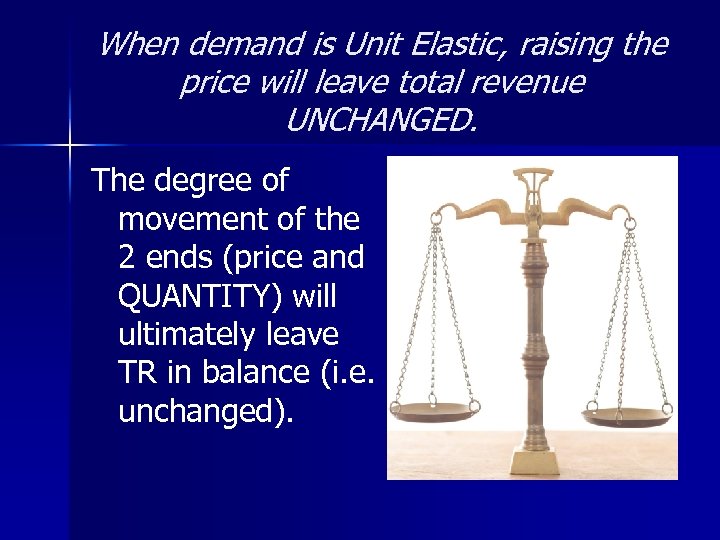 When demand is Unit Elastic, raising the price will leave total revenue UNCHANGED. The degree of movement of the 2 ends (price and QUANTITY) will ultimately leave TR in balance (i. e. unchanged).
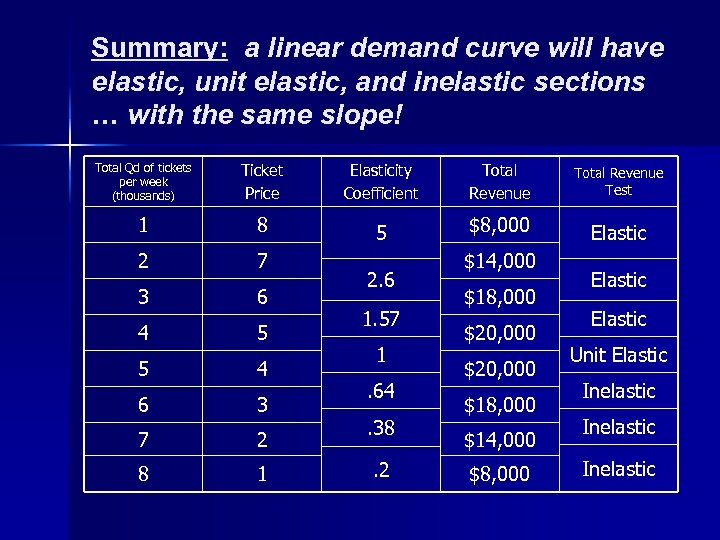 Summary: a linear demand curve will have elastic, unit elastic, and inelastic sections … with the same slope! Total Qd of tickets per week (thousands) Ticket Price Elasticity Coefficient Total Revenue 1 8 5 $8, 000 2 7 3 6 4 5 5 4 6 3 7 2 8 1 2. 6 1. 57 1. 64. 38. 2 $14, 000 $18, 000 $20, 000 $18, 000 $14, 000 $8, 000 Total Revenue Test Elastic Unit Elastic Inelastic
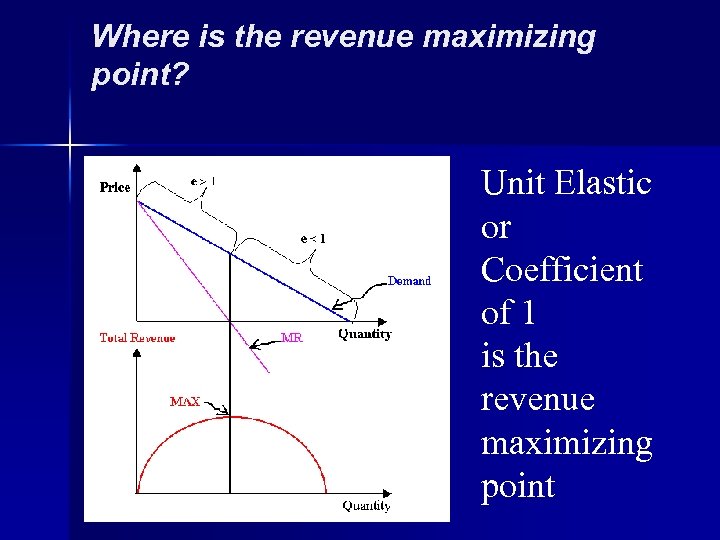 Where is the revenue maximizing point? Unit Elastic or Coefficient of 1 is the revenue maximizing point
 What now? If cost is not a consideration (ha, ha), producers can use price elasticity of demand to maximize their total revenue and maybe get some new digs.
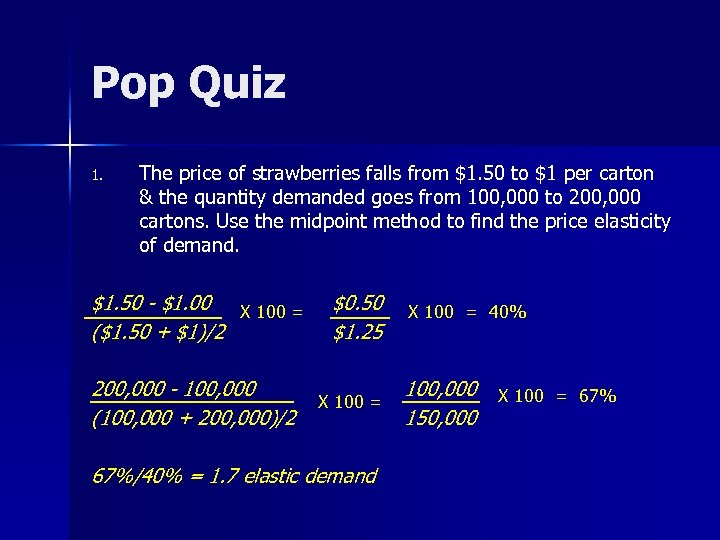 Pop Quiz 1. The price of strawberries falls from $1. 50 to $1 per carton & the quantity demanded goes from 100, 000 to 200, 000 cartons. Use the midpoint method to find the price elasticity of demand. $1. 50 - $1. 00 X 100 = ($1. 50 + $1)/2 200, 000 - 100, 000 (100, 000 + 200, 000)/2 $0. 50 $1. 25 X 100 = 67%/40% = 1. 7 elastic demand X 100 = 40% 100, 000 150, 000 X 100 = 67%
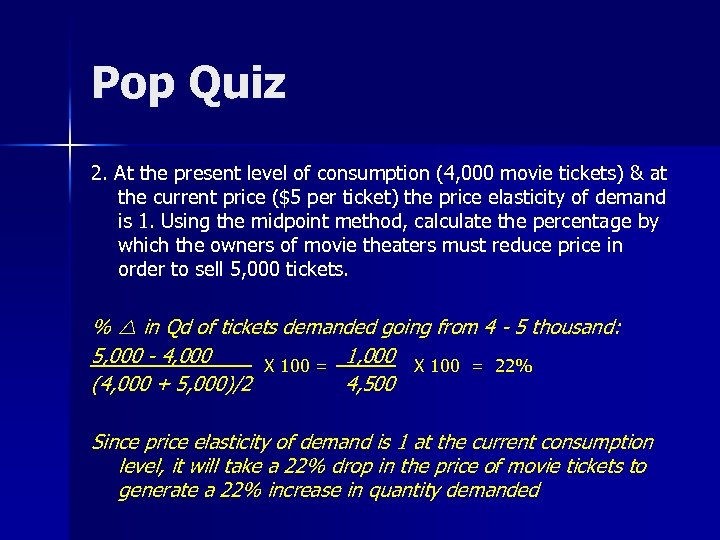 Pop Quiz 2. At the present level of consumption (4, 000 movie tickets) & at the current price ($5 per ticket) the price elasticity of demand is 1. Using the midpoint method, calculate the percentage by which the owners of movie theaters must reduce price in order to sell 5, 000 tickets. % in Qd of tickets demanded going from 4 - 5 thousand: 5, 000 - 4, 000 1, 000 X 100 = 22% X 100 = (4, 000 + 5, 000)/2 4, 500 Since price elasticity of demand is 1 at the current consumption level, it will take a 22% drop in the price of movie tickets to generate a 22% increase in quantity demanded
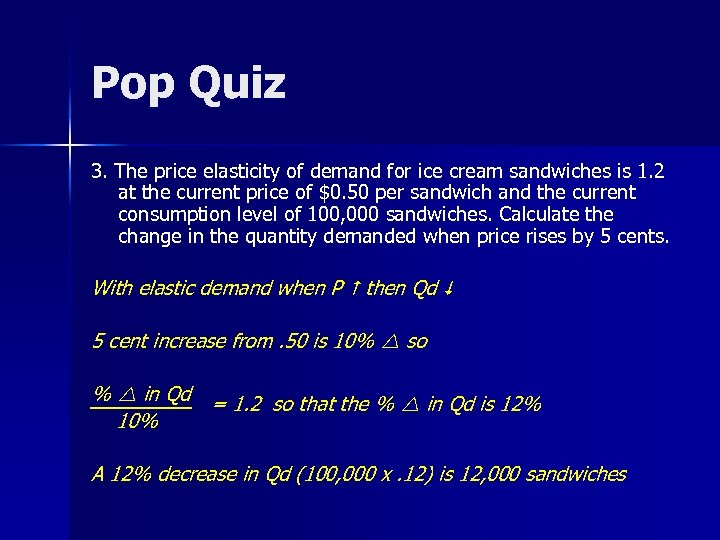 Pop Quiz 3. The price elasticity of demand for ice cream sandwiches is 1. 2 at the current price of $0. 50 per sandwich and the current consumption level of 100, 000 sandwiches. Calculate the change in the quantity demanded when price rises by 5 cents. With elastic demand when P then Qd 5 cent increase from. 50 is 10% so % in Qd = 1. 2 so that the % in Qd is 12% 10% A 12% decrease in Qd (100, 000 x. 12) is 12, 000 sandwiches
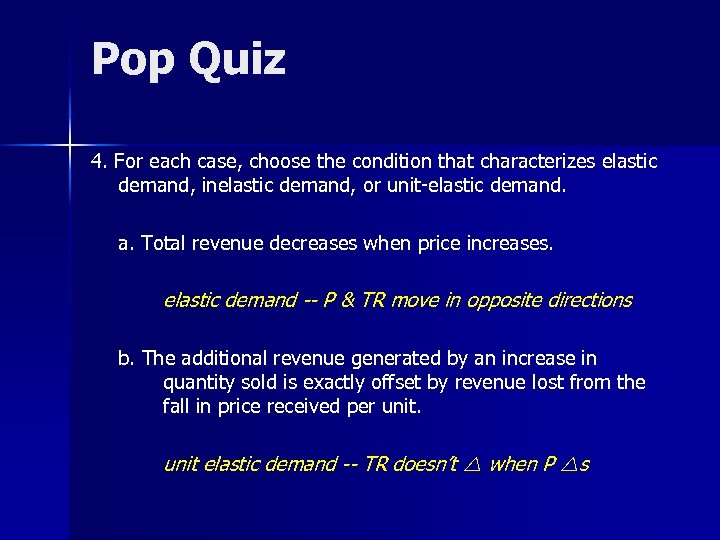 Pop Quiz 4. For each case, choose the condition that characterizes elastic demand, inelastic demand, or unit-elastic demand. a. Total revenue decreases when price increases. elastic demand -- P & TR move in opposite directions b. The additional revenue generated by an increase in quantity sold is exactly offset by revenue lost from the fall in price received per unit elastic demand -- TR doesn’t when P s
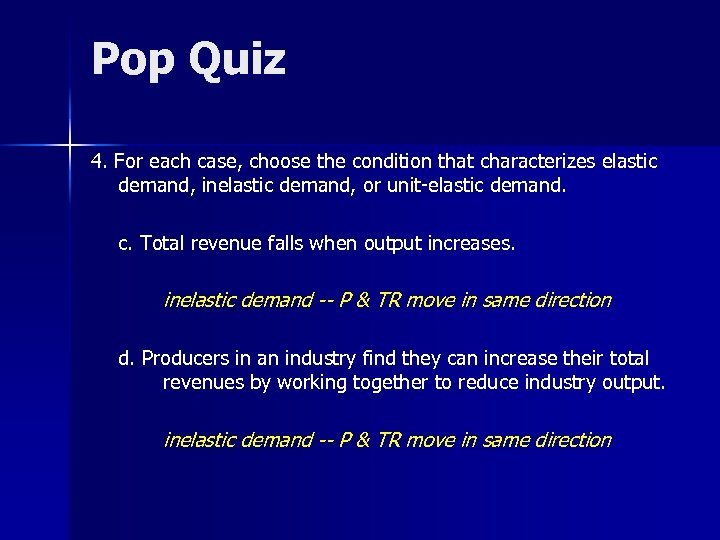 Pop Quiz 4. For each case, choose the condition that characterizes elastic demand, inelastic demand, or unit-elastic demand. c. Total revenue falls when output increases. inelastic demand -- P & TR move in same direction d. Producers in an industry find they can increase their total revenues by working together to reduce industry output. inelastic demand -- P & TR move in same direction
 Price Elasticity of Supply
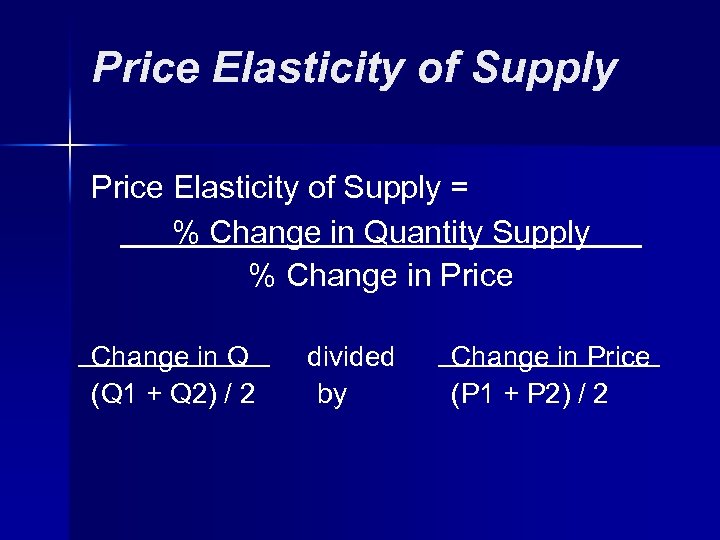 Price Elasticity of Supply = % Change in Quantity Supply % Change in Price Change in Q (Q 1 + Q 2) / 2 divided by Change in Price (P 1 + P 2) / 2
 Determinant of Price Elasticity of Supply: n Amount of time producers have to respond to changes in Price (competitive market firms are price takers; more resources are shiftable over time)
 Determinant of Price Elasticity of Supply: n n n Market Period: no chance to alter supply (supply is perfectly inelastic) e. g. growing season Some products don’t have a market period if it is possible to store the product inexpensively
 Determinant of Price Elasticity of Supply: n n Short Run: capital is fixed (plant size, machines, etc) but can vary some inputs (labor, fertilizer, pesticides)
 Determinant of Price Elasticity of Supply: n n n Long Run: All inputs are variable # of firms in the market are variable
 Cross Elasticity of Demand
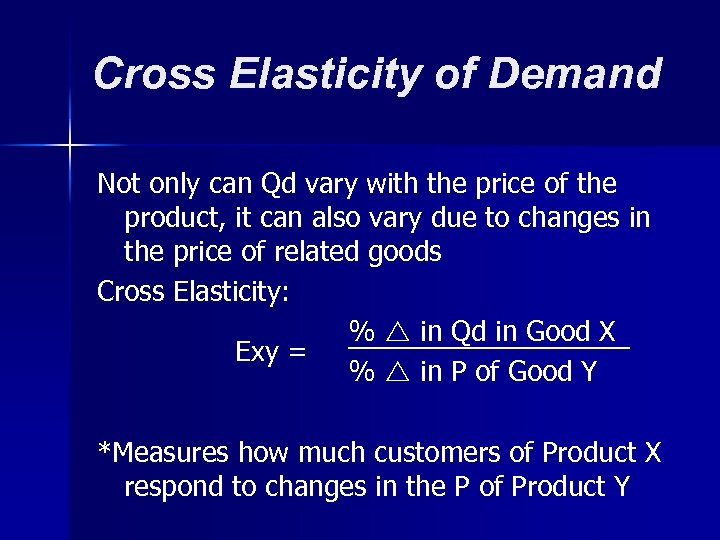 Cross Elasticity of Demand Not only can Qd vary with the price of the product, it can also vary due to changes in the price of related goods Cross Elasticity: % in Qd in Good X Exy = % in P of Good Y *Measures how much customers of Product X respond to changes in the P of Product Y
 Cross Elasticity of Demand Substitute Goods: If cross elasticity is positive then X & Y are substitutes As P of Good Y the Qd of X The larger the coefficient, the better the items act as substitutes
 Cross Elasticity of Demand Complementary Goods: If cross elasticity is negative X & Y are complements As the P of Good Y the Qd of X The larger the coefficient, the better the items act as complements
 Cross Elasticity of Demand Independent Goods: Have 0 or nearly 0 cross elasticity Means goods are not related
 Cross Elasticity of Demand How is cross elasticity used? n Government agencies look at cross elasticity when determining whether or not to approve a merger n Companies which produce a range of product look at cross elasticity effects when determining whether to raise the price of a particular good
 Income Elasticity of Demand
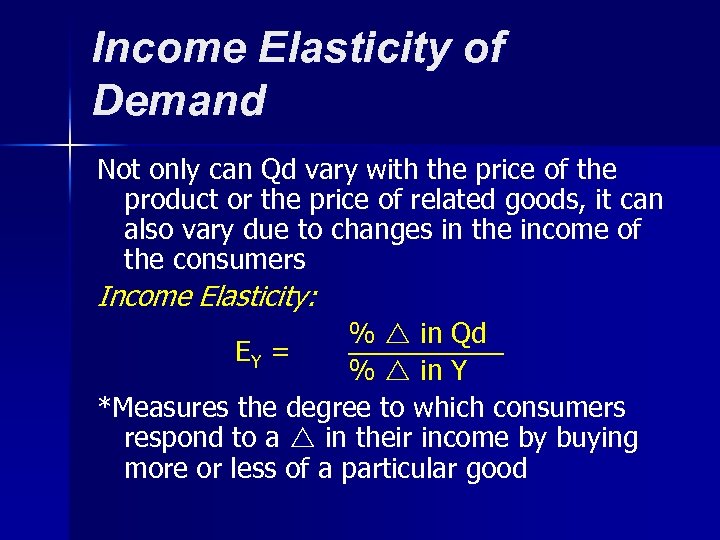 Income Elasticity of Demand Not only can Qd vary with the price of the product or the price of related goods, it can also vary due to changes in the income of the consumers Income Elasticity: % in Qd EY = % in Y *Measures the degree to which consumers respond to a in their income by buying more or less of a particular good
 Income Elasticity of Demand Normal Goods: For most goods EY is positive People buy more of the good as their Y Coefficient varies: Autos = 3; Farm products = 0. 2
 Income Elasticity of Demand Inferior Goods: Comparatively few goods have a negative EY to indicate an inferior good People buy less of the good as their Y Ex. Retread tires, cabbage, used clothing, long distance bus tickets
 When would we use income elasticity of demand? n In a growing economy industries that are highly income elastic grow most rapidly
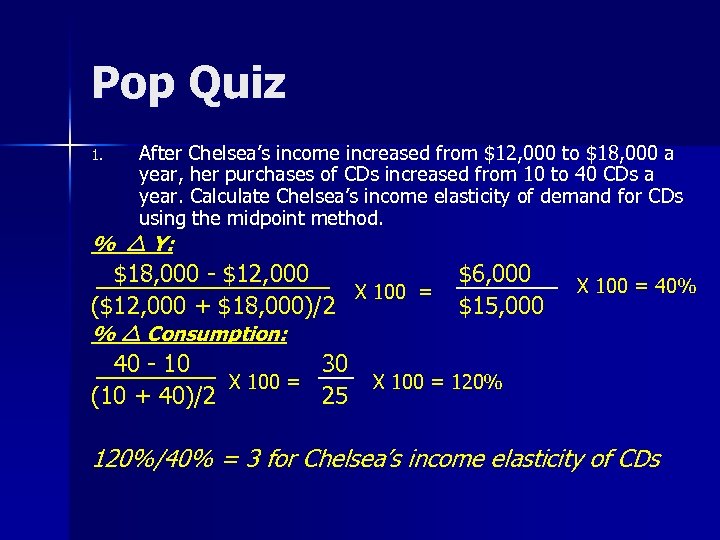 Pop Quiz 1. After Chelsea’s income increased from $12, 000 to $18, 000 a year, her purchases of CDs increased from 10 to 40 CDs a year. Calculate Chelsea’s income elasticity of demand for CDs using the midpoint method. % Y: $18, 000 - $12, 000 X 100 = ($12, 000 + $18, 000)/2 % Consumption: 40 - 10 X 100 = (10 + 40)/2 $6, 000 $15, 000 X 100 = 40% 30 X 100 = 120% 25 120%/40% = 3 for Chelsea’s income elasticity of CDs
 Pop Quiz 2. Expensive restaurant meals are income-elastic goods for most people, including Sanjay. Suppose his income falls by 10% this year. What can you predict about the change in Sanjay’s consumption of expensive restaurant meals will fall more than 10% because a given % in income creates a larger % in consumption of an income-elastic good
 Pop Quiz 3. As the price of margarine rises by 20%, a manufacturer of baked goods increases its quantity of butter demanded by 5%. Calculate the cross-price elasticity of demand between butter and margarine. Are butter and margarine substitutes or complements for this manufacturer? The cross-price elasticity of demand is 5%/20% = 0. 25. Since the cross-price elasticity of demand is positive, the 2 goods are substitutes.