


 Скачать презентацию ELASTICITY Economics 101 WHO ARE MORE RESPONSIVE
57185e1c9b8f19b5ac87964750511988.ppt
- Количество слайдов: 51
 ELASTICITY Economics 101
 WHO ARE MORE RESPONSIVE TO CHANGE IN FARE? Taipei MRT System (1) Passenger with single ride (2) Passenger with one-day unlimited pass (3) Passenger with one-month unlimited pass (4) Passenger with Easy Card
 ELASTICITY彈性 … is a measure of how much buyers and sellers respond to changes in market conditions
 THE ELASTICITY OF DEMAND需求彈 性 Price elasticity of demand is a measure of how much the quantity demanded of a good responds to a change in the price of that good. Price elasticity of demand is the percentage change in quantity demanded given a percent change in the price.
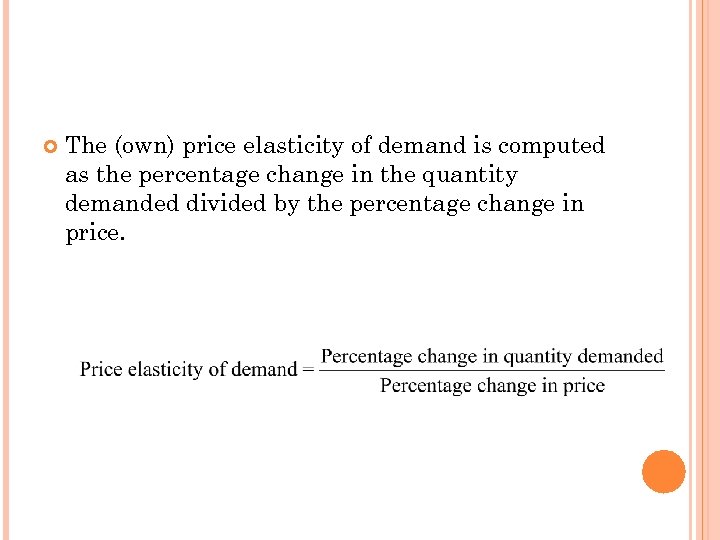 The (own) price elasticity of demand is computed as the percentage change in the quantity demanded divided by the percentage change in price.
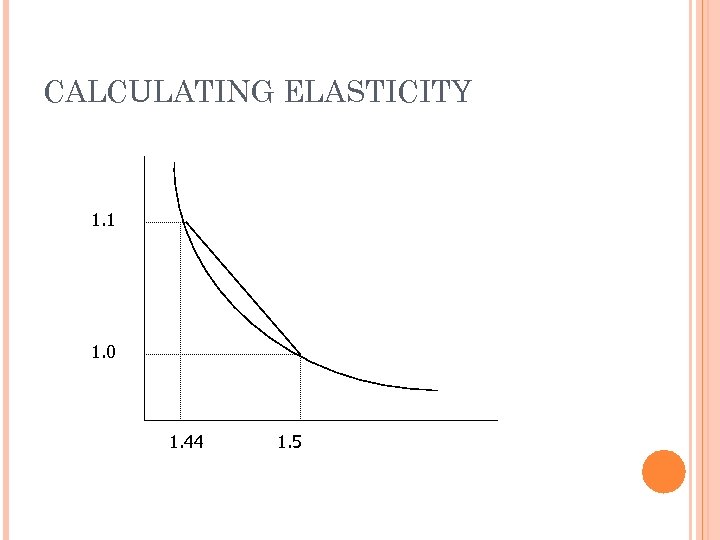 CALCULATING ELASTICITY 1. 1 1. 0 1. 44 1. 5
![CALCULATING ELASTICITY: POINT ELASTICITY點彈性 Point Elasticity={[Q 2 -Q 1]/Q 1}/{[P 2 -P 1]/P 1}](https://present5.com/presentation/57185e1c9b8f19b5ac87964750511988/image-7.jpg "CALCULATING ELASTICITY: POINT ELASTICITY點彈性 Point Elasticity={[Q 2 -Q 1]/Q 1}/{[P 2 -P 1]/P 1}") CALCULATING ELASTICITY: POINT ELASTICITY點彈性 Point Elasticity={[Q 2 -Q 1]/Q 1}/{[P 2 -P 1]/P 1} Case 1: Price rises from 1 to 1. 1 % change in qty = (1. 44 -1. 5)/1. 5= -4% % change in price = (1. 10 -1)/1= 10% Elasticity=-4%/10%=-0. 4
CALCULATING ELASTICITY: POINT ELASTICITY點彈性 Point Elasticity={[Q 2 -Q 1]/Q 1}/{[P 2 -P 1]/P 1} Case 1: Price rises from 1 to 1. 1 % change in qty = (1. 44 -1. 5)/1. 5= -4% % change in price = (1. 10 -1)/1= 10% Elasticity=-4%/10%=-0. 4
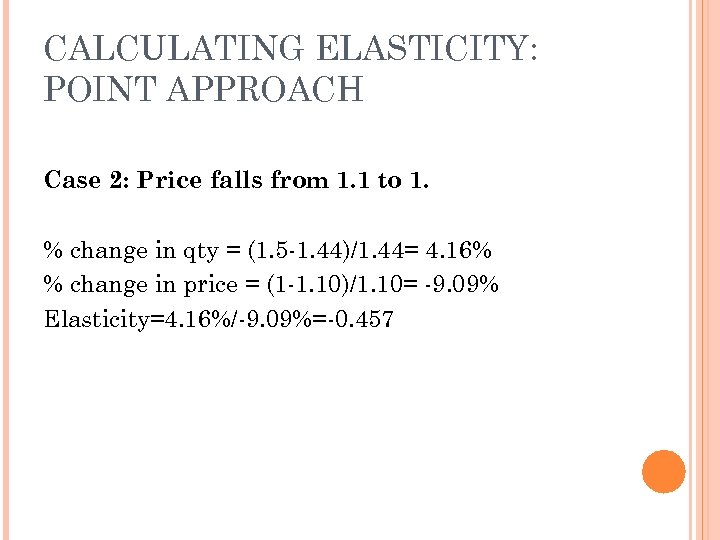 CALCULATING ELASTICITY: POINT APPROACH Case 2: Price falls from 1. 1 to 1. % change in qty = (1. 5 -1. 44)/1. 44= 4. 16% % change in price = (1 -1. 10)/1. 10= -9. 09% Elasticity=4. 16%/-9. 09%=-0. 457
 POTENTIAL PROBLEM OF POINT ELASTICITY (Point) Elasticity level in case 1 is different from (point) elasticity level in case 2
 MIDPOINT METHOD (ARC ELASTICITY弧彈性) The midpoint formula is preferable when calculating the price elasticity of demand because it gives the same answer regardless of the direction of the change.
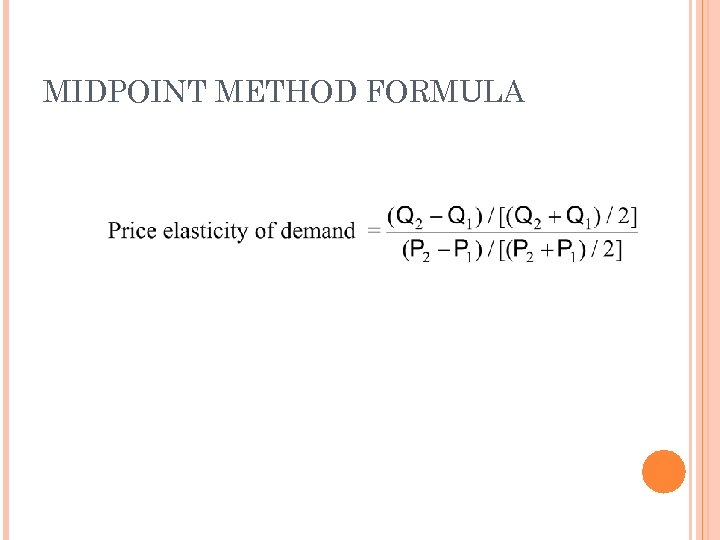 MIDPOINT METHOD FORMULA
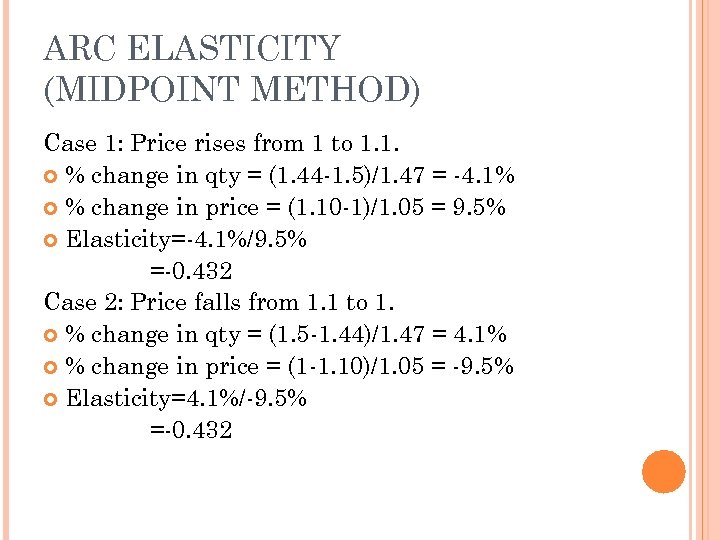 ARC ELASTICITY (MIDPOINT METHOD) Case 1: Price rises from 1 to 1. 1. % change in qty = (1. 44 -1. 5)/1. 47 = -4. 1% % change in price = (1. 10 -1)/1. 05 = 9. 5% Elasticity=-4. 1%/9. 5% =-0. 432 Case 2: Price falls from 1. 1 to 1. % change in qty = (1. 5 -1. 44)/1. 47 = 4. 1% % change in price = (1 -1. 10)/1. 05 = -9. 5% Elasticity=4. 1%/-9. 5% =-0. 432
 ELASTIC 具彈性OR INELASTIC不具彈 性? Inelastic Demand Quantity demanded does not respond strongly to price changes. Price elasticity of demand is less than one. Elastic Demand Quantity demanded responds strongly to changes in price. Price elasticity of demand is greater than one.
 OTHER TYPES Perfectly Inelastic完全不具彈性 Perfectly Elastic完全具彈性 Quantity demanded does not respond to price changes. Quantity demanded changes infinitely with any change in price. Unit Elastic單位彈性 Quantity demanded changes by the same percentage as the price.
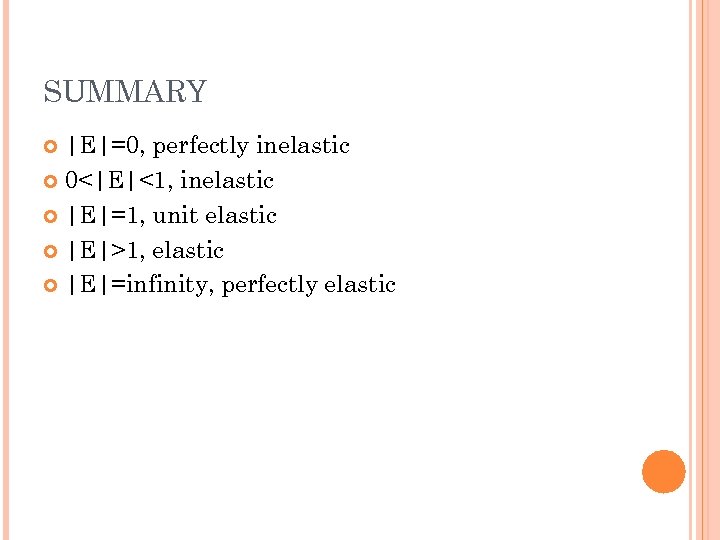 SUMMARY |E|=0, perfectly inelastic 0<|E|<1, inelastic |E|=1, unit elastic |E|>1, elastic |E|=infinity, perfectly elastic
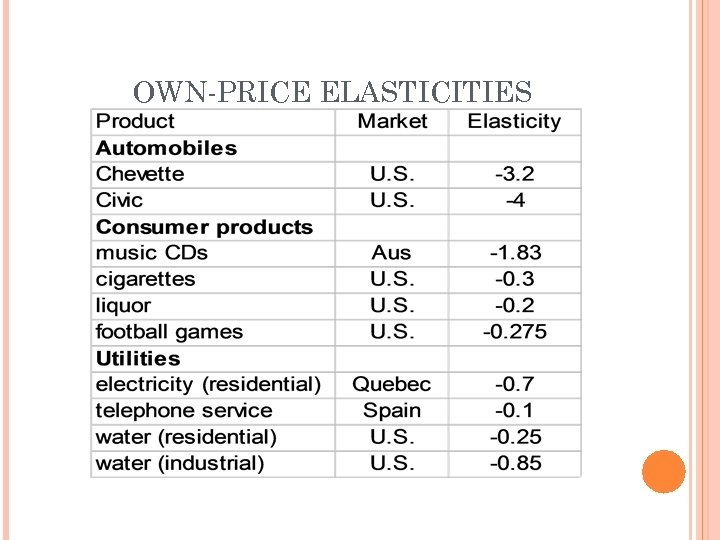 OWN-PRICE ELASTICITIES
 DETERMINANTS OF PRICE ELASTICITY OF DEMAND Availability of Close Substitutes: More close substitutes=More elastic Example: Butter vs Egg Necessities versus Luxuries: inelastic versus elastic Example: visit a doctor vs sailboat
 DETERMINANTS OF PRICE ELASTICITY OF DEMAND Definition of the Market: Narrowly defined market– more elastic Broadly defined market – less elastic Example: Food vs Ice Cream Time Horizon Longer time horizon– more elastic Shorter time horizon– less elastic
 SUMMARY Demand tends to be more elastic : the larger the number of close substitutes. if the good is a luxury. the more narrowly defined the market. the longer the time period.
 SLOPE AND ELASTICITY Because the price elasticity of demand measures how much quantity demanded responds to the price, it is closely related to the slope of the demand curve. Higher slope, lower elasticity
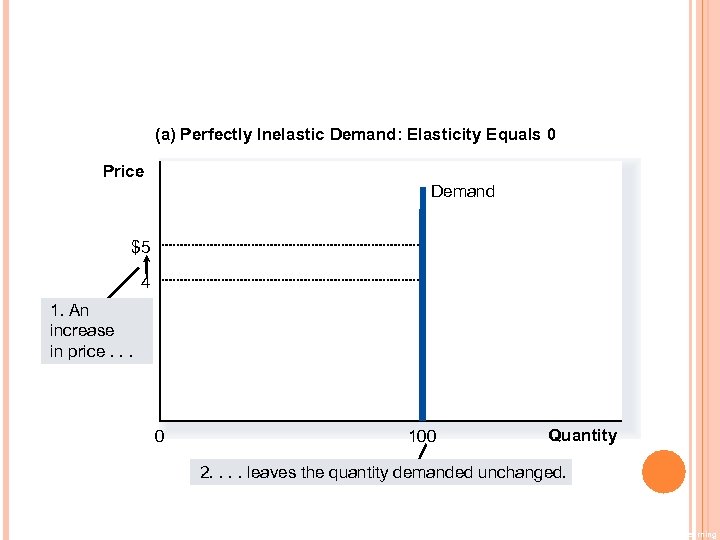 (a) Perfectly Inelastic Demand: Elasticity Equals 0 Price Demand $5 4 1. An increase in price. . . 0 100 Quantity 2. . leaves the quantity demanded unchanged. Copyright© 2003 Southwestern/Thomson Learning
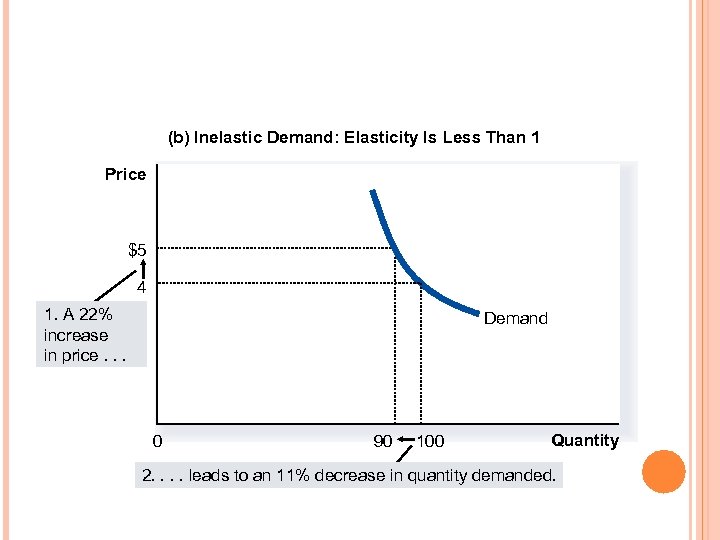 (b) Inelastic Demand: Elasticity Is Less Than 1 Price $5 4 1. A 22% increase in price. . . Demand 0 90 100 Quantity 2. . leads to an 11% decrease in quantity demanded.
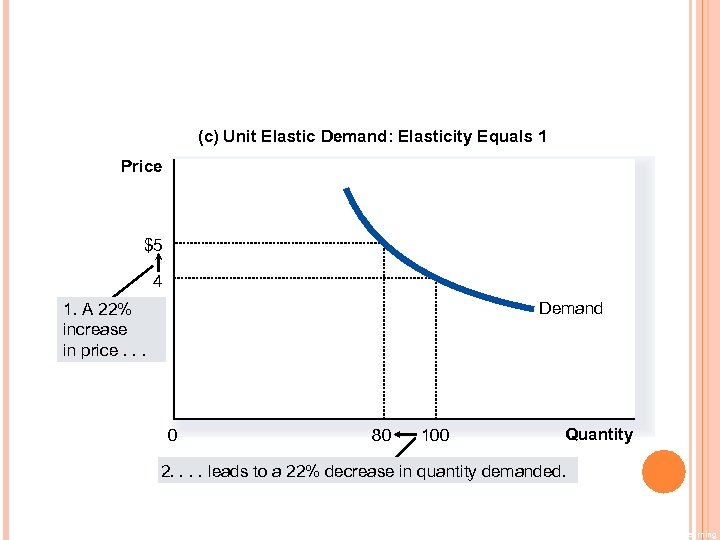 (c) Unit Elastic Demand: Elasticity Equals 1 Price $5 4 Demand 1. A 22% increase in price. . . 0 80 100 Quantity 2. . leads to a 22% decrease in quantity demanded. Copyright© 2003 Southwestern/Thomson Learning
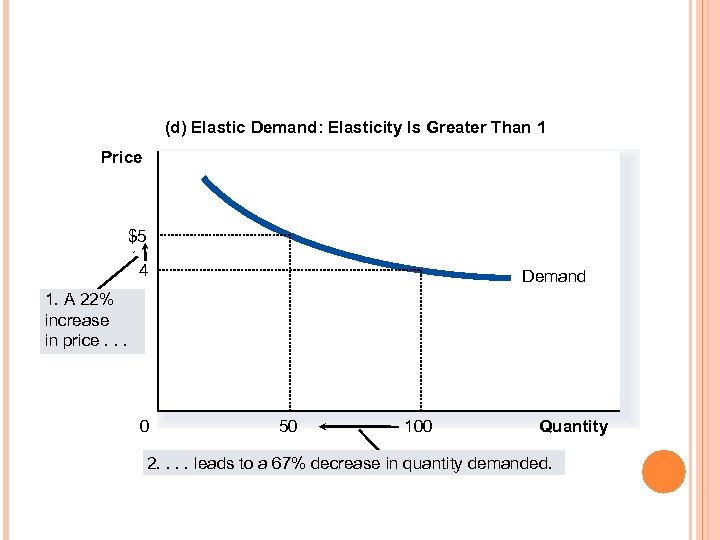 (d) Elastic Demand: Elasticity Is Greater Than 1 Price $5 4 Demand 1. A 22% increase in price. . . 0 50 100 Quantity 2. . leads to a 67% decrease in quantity demanded.
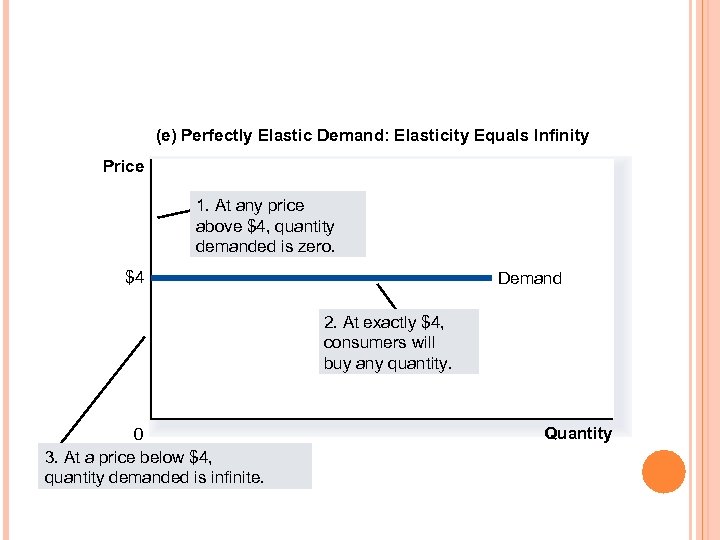 (e) Perfectly Elastic Demand: Elasticity Equals Infinity Price 1. At any price above $4, quantity demanded is zero. $4 Demand 2. At exactly $4, consumers will buy any quantity. 0 3. At a price below $4, quantity demanded is infinite. Quantity
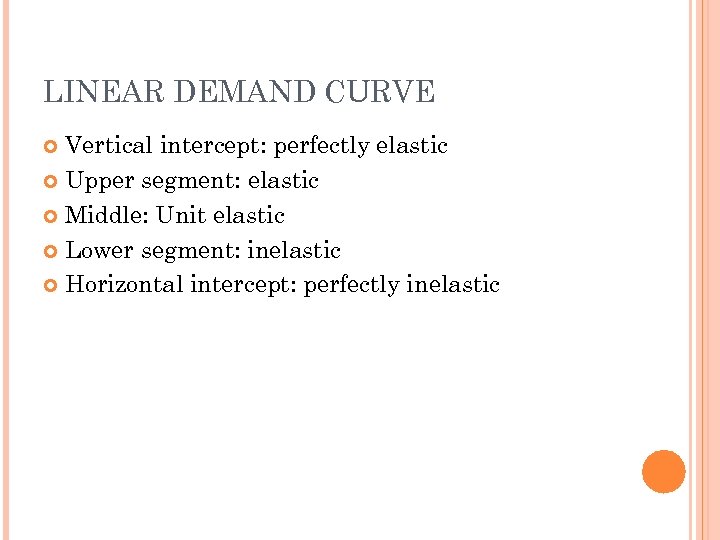 LINEAR DEMAND CURVE Vertical intercept: perfectly elastic Upper segment: elastic Middle: Unit elastic Lower segment: inelastic Horizontal intercept: perfectly inelastic
 TOTAL REVENUE AND ELASTICITY Total revenue is the amount paid by buyers and received by sellers of a good. Computed as the price of the good times the quantity sold. TR = P x Q
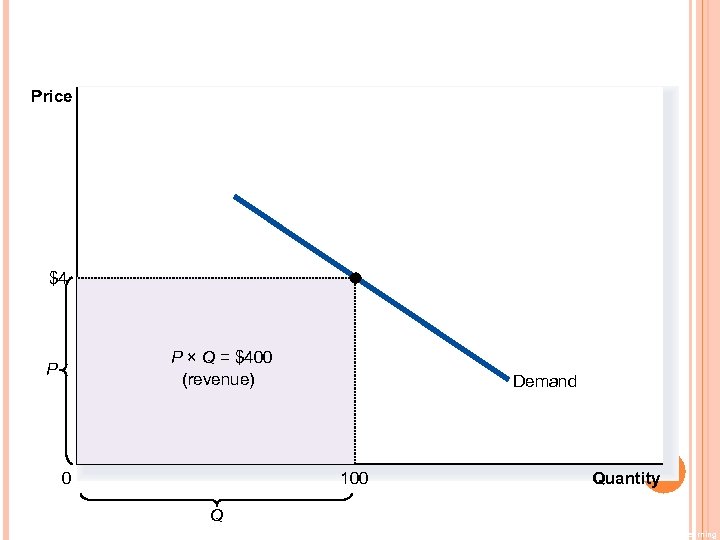 Price $4 P × Q = $400 (revenue) P 0 Demand 100 Quantity Q Copyright© 2003 Southwestern/Thomson Learning
 TOTAL REVENUE AND ELASTICITY With an elastic demand curve, an increase in the price leads to a decrease in quantity demanded that is proportionately larger. Thus, total revenue decreases. With an inelastic demand curve, an increase in the price leads to a decrease in quantity demanded that is proportionately smaller. Thus, total revenue increases.
 QUICK QUIZ If Taipei MRT authority would like to increase the total revenue, then what should he do? (1) Raise the single ride fare? (2) Raise the one-day unlimited pass fare? (3) Raise the one-month unlimited pass fare? (4) Raise the discount of Easy Card?
 INCOME ELASTICITY OF DEMAND Income elasticity of demand measures how much the quantity demanded of a good responds to a change in consumers’ income. It is computed as the percentage change in the quantity demanded divided by the percentage change in income.
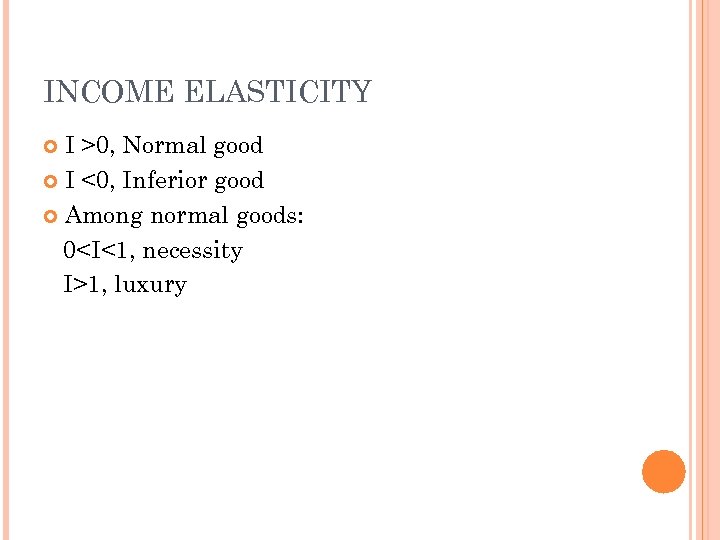
 NORMAL OR INFERIOR? Types of Goods Normal Goods Inferior Goods Higher income raises the quantity demanded for normal goods but lowers the quantity demanded for inferior goods. Normal goods: Positive income elasticity Inferior goods: Negative income elasticity
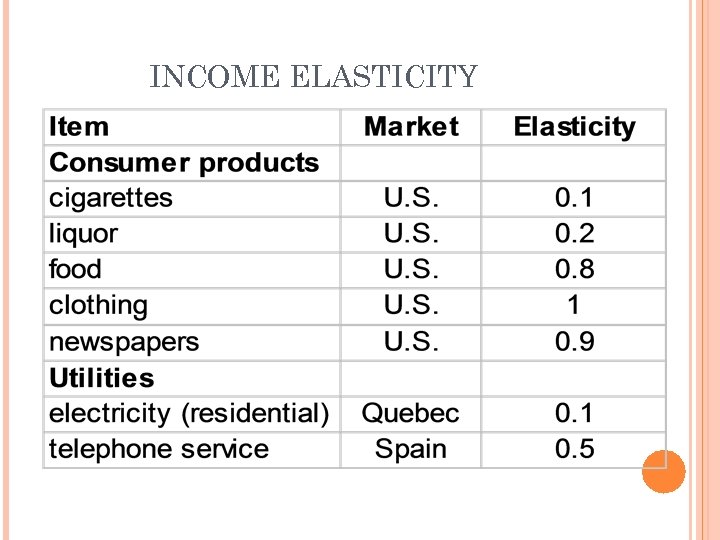
 NECESSITY OR LUXURY? Goods consumers regard as necessities tend to be income inelastic Examples include food, fuel, clothing, utilities, and medical services. Goods consumers regard as luxuries tend to be income elastic. Examples include sports cars, furs, and expensive foods.
 INCOME ELASTICITY I >0, Normal good I <0, Inferior good Among normal goods: 0
 INCOME ELASTICITY
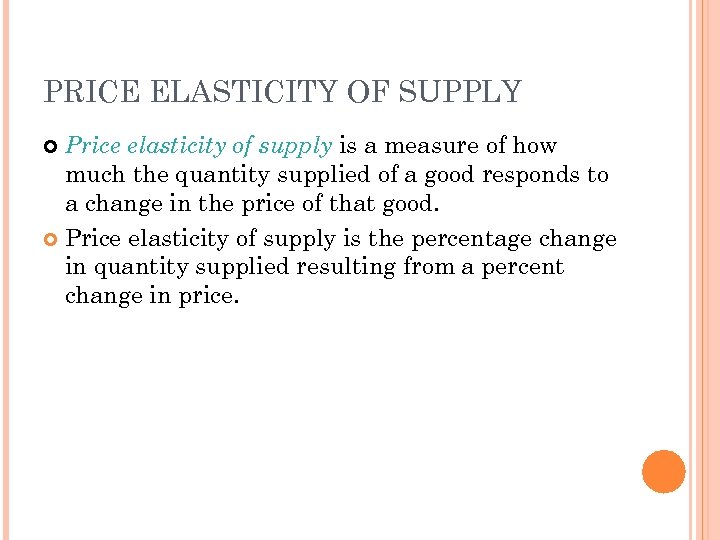 PRICE ELASTICITY OF SUPPLY Price elasticity of supply is a measure of how much the quantity supplied of a good responds to a change in the price of that good. Price elasticity of supply is the percentage change in quantity supplied resulting from a percent change in price.
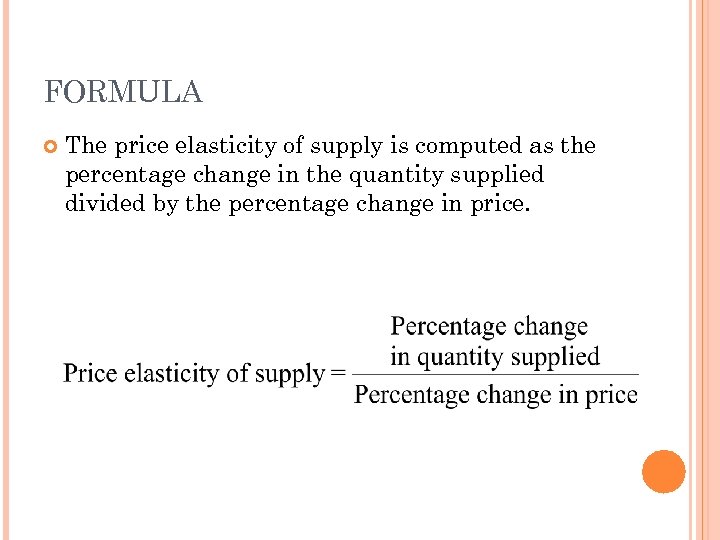 FORMULA The price elasticity of supply is computed as the percentage change in the quantity supplied divided by the percentage change in price.
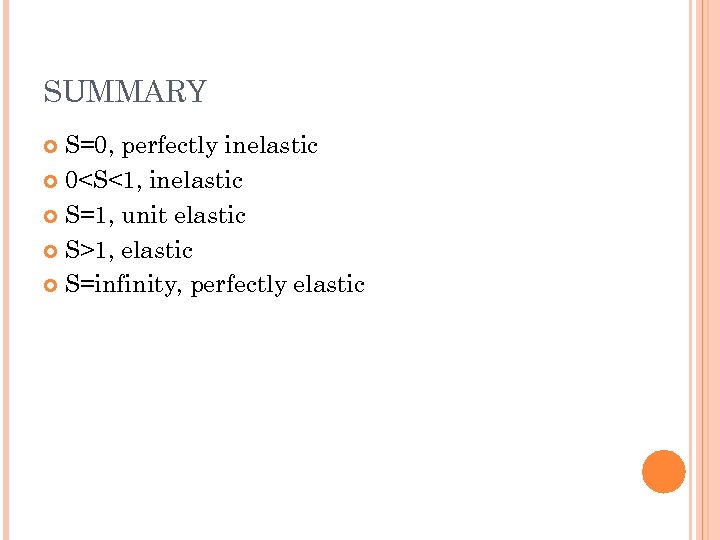 SUMMARY S=0, perfectly inelastic 0
 SLOPE AND ELASTICITY Because the price elasticity of supply measures how much quantity supplied responds to the price, it is closely related to the slope of the supply curve. Higher slope, lower elasticity
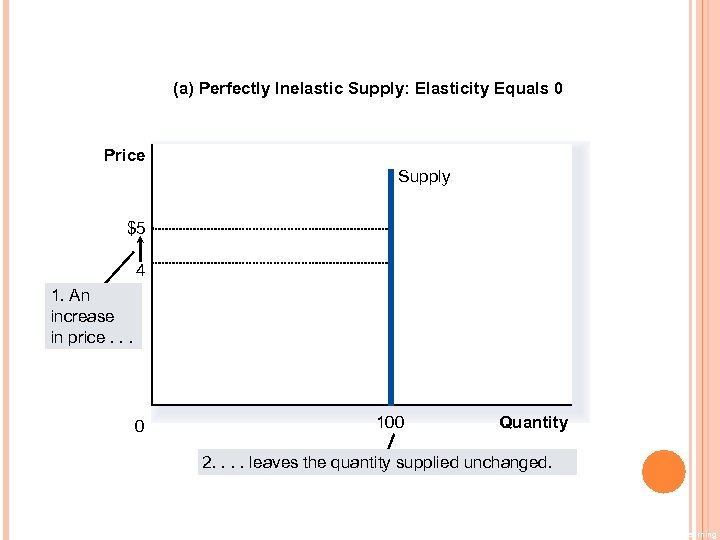 (a) Perfectly Inelastic Supply: Elasticity Equals 0 Price Supply $5 4 1. An increase in price. . . 0 100 Quantity 2. . leaves the quantity supplied unchanged. Copyright© 2003 Southwestern/Thomson Learning
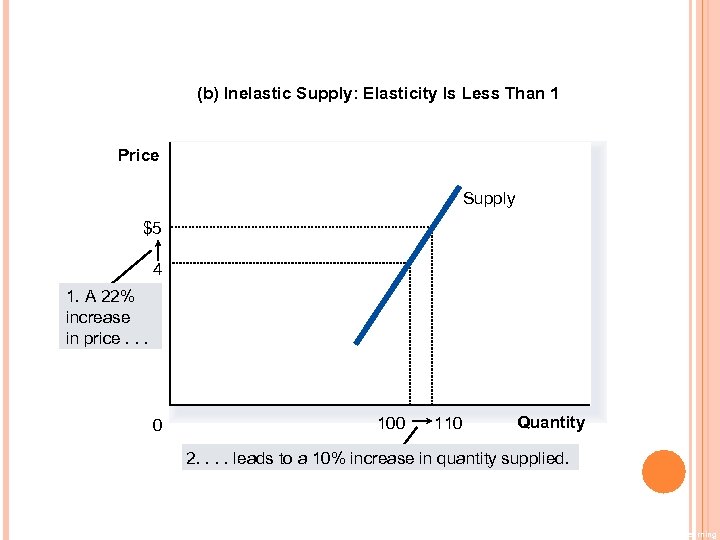 (b) Inelastic Supply: Elasticity Is Less Than 1 Price Supply $5 4 1. A 22% increase in price. . . 0 100 110 Quantity 2. . leads to a 10% increase in quantity supplied. Copyright© 2003 Southwestern/Thomson Learning
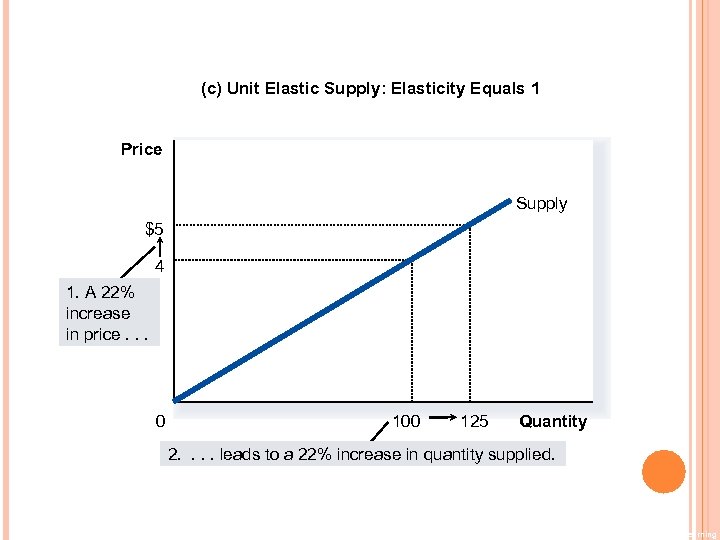 (c) Unit Elastic Supply: Elasticity Equals 1 Price Supply $5 4 1. A 22% increase in price. . . 0 100 125 Quantity 2. . leads to a 22% increase in quantity supplied. Copyright© 2003 Southwestern/Thomson Learning
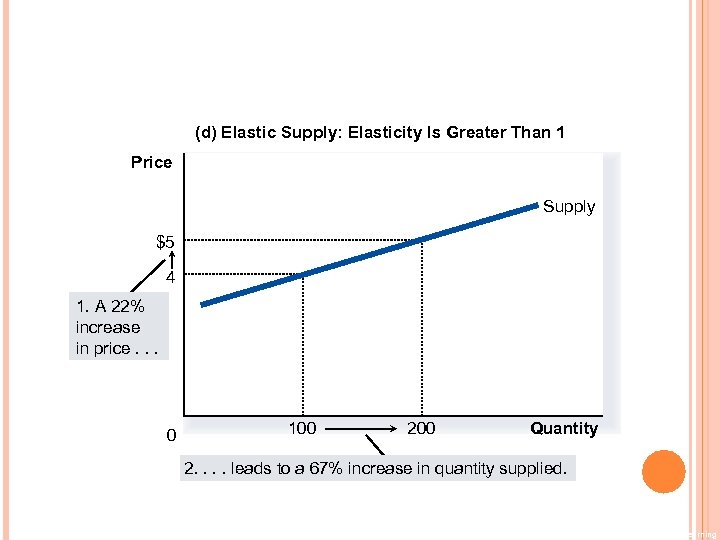 (d) Elastic Supply: Elasticity Is Greater Than 1 Price Supply $5 4 1. A 22% increase in price. . . 0 100 200 Quantity 2. . leads to a 67% increase in quantity supplied. Copyright© 2003 Southwestern/Thomson Learning
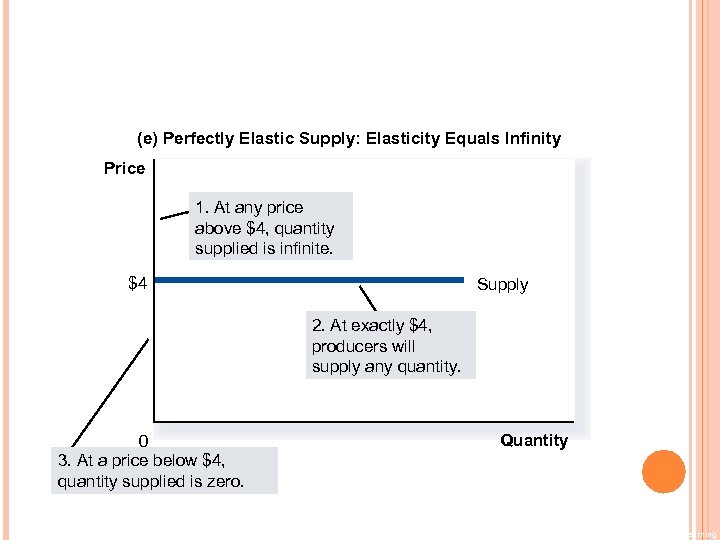 (e) Perfectly Elastic Supply: Elasticity Equals Infinity Price 1. At any price above $4, quantity supplied is infinite. $4 Supply 2. At exactly $4, producers will supply any quantity. 0 3. At a price below $4, quantity supplied is zero. Quantity Copyright© 2003 Southwestern/Thomson Learning
 DETERMINANTS OF PRICE ELASTICITY OF SUPPLY Ability of sellers to change the amount of the good they produce. Beach-front land is inelastic. Books, cars, or manufactured goods are elastic. Time period. Supply is more elastic in the long run.
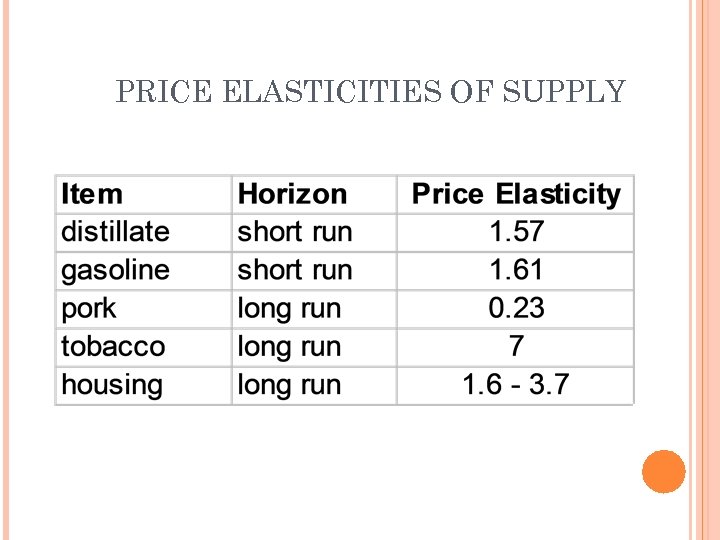 PRICE ELASTICITIES OF SUPPLY
 APPLICATION OF ELASTICITY Can good news for farming be bad news for farmers? What happens to wheat farmers and the market for wheat when university agronomists discover a new wheat hybrid that is more productive than existing varieties?
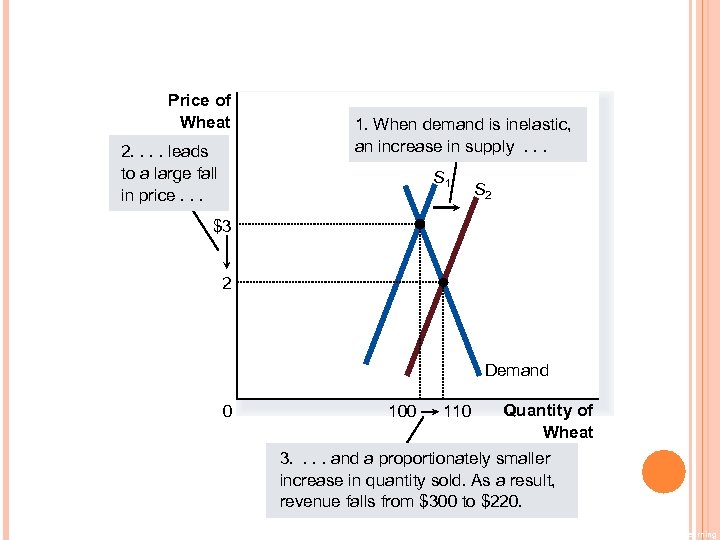 Price of Wheat 2. . leads to a large fall in price. . . 1. When demand is inelastic, an increase in supply. . . S 1 S 2 $3 2 Demand 0 100 110 Quantity of Wheat 3. . and a proportionately smaller increase in quantity sold. As a result, revenue falls from $300 to $220. Copyright© 2003 Southwestern/Thomson Learning
 OTHER APPLICATIONS A reduction in supply in the world market for oil: the response depends on the time horizon. Policies to Reduce the Use of Illegal Drugs: Drug interdiction Drug education
 QUIZ 1 Beachfront resorts: inelastic supply Automobile: elastic supply Suppose a rise in population doubles the demand for both products. Price? Quantity? Consumer spending?
 QUIZ 2 Why? A drought around the world: Total revenue that farmers received from sale of grain rises. However, a drought in Kansas reduces total revenue that Kansas farmers receive.