


 Скачать презентацию Elasticity and Its Applications Copyright 2004 South-Western
401868d5a4fbe5e165c4ce5059e080c1.ppt
- Количество слайдов: 72
 Elasticity and Its Applications Copyright © 2004 South-Western 5
 The Laws of Supply and Demand. . . • … tell us the DIRECTION that quantities will move in response to price (or other) changes. • Often, though, we want to know more precisely HOW MUCH quantities will change. Copyright © 2004 South-Western/Thomson Learning
 Elasticity. . . • … allows us to analyze supply and demand with greater precision. • … is a measure of how much buyers and sellers respond to changes in market conditions Copyright © 2004 South-Western/Thomson Learning
 THE ELASTICITY OF DEMAND • Price elasticity of demand is a measure of how much the quantity demanded of a good responds to a change in the price of that good. • Price elasticity of demand is the percentage change in quantity demanded given a percent change in the price. Copyright © 2004 South-Western/Thomson Learning
 The Price Elasticity of Demand Its Determinants • • Availability of Close Substitutes Necessities versus Luxuries Definition of the Market Time Horizon Copyright © 2004 South-Western/Thomson Learning
 The Price Elasticity of Demand Its Determinants • Demand tends to be more elastic : • • the larger the number of close substitutes. if the good is a luxury. the more narrowly defined the market. the longer the time period. Copyright © 2004 South-Western/Thomson Learning
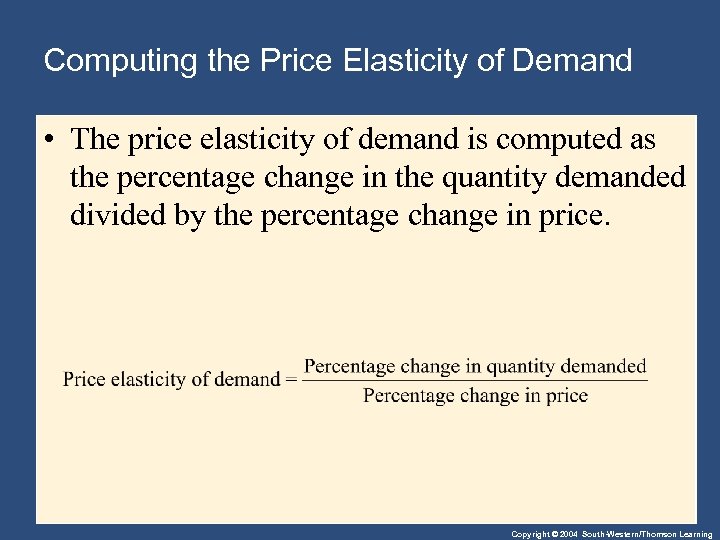 Computing the Price Elasticity of Demand • The price elasticity of demand is computed as the percentage change in the quantity demanded divided by the percentage change in price. Copyright © 2004 South-Western/Thomson Learning
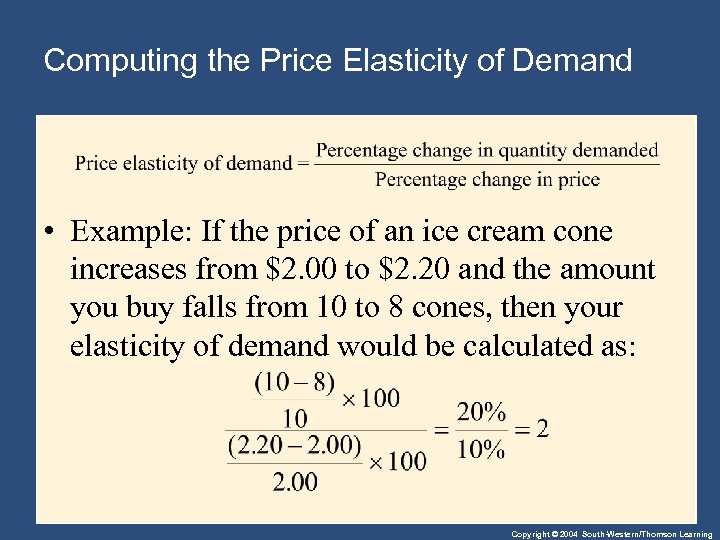 Computing the Price Elasticity of Demand • Example: If the price of an ice cream cone increases from $2. 00 to $2. 20 and the amount you buy falls from 10 to 8 cones, then your elasticity of demand would be calculated as: Copyright © 2004 South-Western/Thomson Learning
 Two Slight Complications • Note: Although the Law of Demand says that quantities fall as prices rise, by convention, we write price elasticity of demand as positive. • Thus although a 10% increase in price might be expected to lead to a negative percentage change in quantity, (say 15%) we would still write this as • Price elasticity =15/10=1. 5 instead of -15/10=-1. 5. • We have to be careful about this issue with other elasticities like income and cross-price elasticities. • And we have one other problem. . . Copyright © 2004 South-Western/Thomson Learning
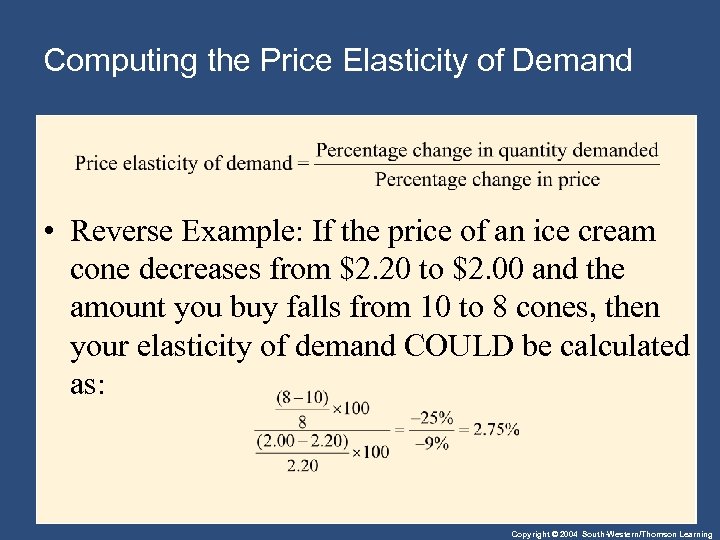 Computing the Price Elasticity of Demand • Reverse Example: If the price of an ice cream cone decreases from $2. 20 to $2. 00 and the amount you buy falls from 10 to 8 cones, then your elasticity of demand COULD be calculated as: Copyright © 2004 South-Western/Thomson Learning
 Computing Elasticities • Having a measure of sensitivity that is different depending on whether you raise price or lower price is not a good thing. • Therefore, we usually compute the percentage by using the MIDPOINT METHOD…… Copyright © 2004 South-Western/Thomson Learning
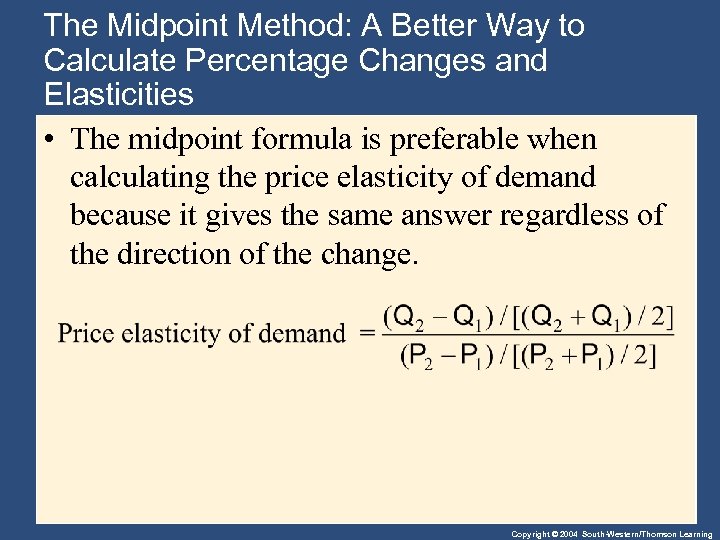 The Midpoint Method: A Better Way to Calculate Percentage Changes and Elasticities • The midpoint formula is preferable when calculating the price elasticity of demand because it gives the same answer regardless of the direction of the change. Copyright © 2004 South-Western/Thomson Learning
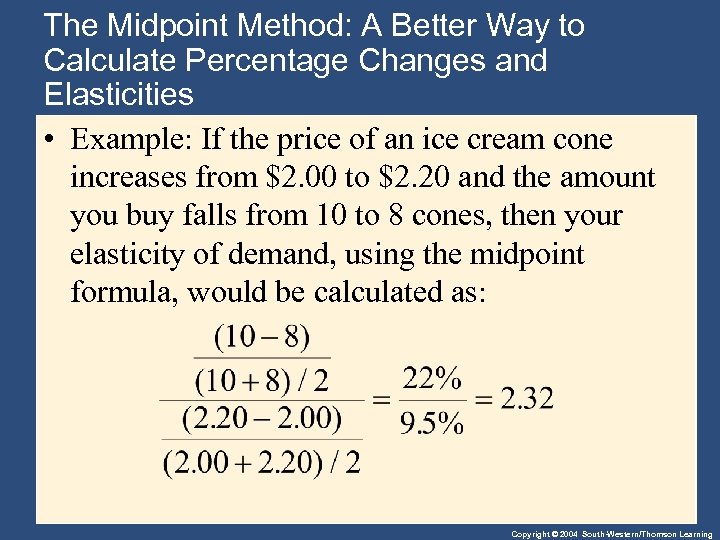 The Midpoint Method: A Better Way to Calculate Percentage Changes and Elasticities • Example: If the price of an ice cream cone increases from $2. 00 to $2. 20 and the amount you buy falls from 10 to 8 cones, then your elasticity of demand, using the midpoint formula, would be calculated as: Copyright © 2004 South-Western/Thomson Learning
 The Variety of Demand Curves • Inelastic Demand • Quantity demanded does not respond strongly to price changes. • Price elasticity of demand is less than one. • Elastic Demand • Quantity demanded responds strongly to changes in price. • Price elasticity of demand is greater than one. Copyright © 2004 South-Western/Thomson Learning
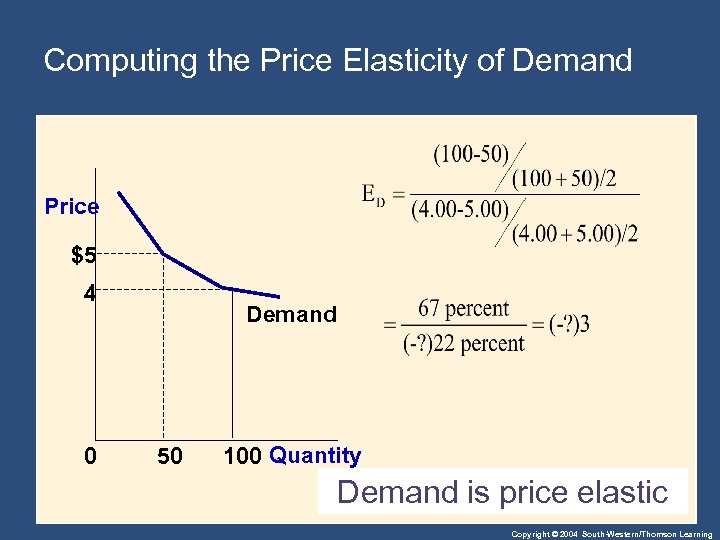 Computing the Price Elasticity of Demand Price $5 4 0 Demand 50 100 Quantity Demand is price elastic Copyright © 2004 South-Western/Thomson Learning
 The Variety of Demand Curves • Perfectly Inelastic • Quantity demanded does not respond to price changes. • Perfectly Elastic • Quantity demanded changes infinitely with any change in price. • Unit Elastic • Quantity demanded changes by the same percentage as the price. Copyright © 2004 South-Western/Thomson Learning
 Testing Your Understanding: Order these goods from most to least elastic • • • 1. Beef 2. Salt 3. European Vacation 4. Steak 5. Honda Accord 6. Dijon Mustard. Copyright © 2004 South-Western/Thomson Learning
 Testing Your Understanding: Order these goods from most to least elastic • A “Typical” Ranking (There is no “right” answer here without data. ) • 1. European Vacation (Luxury, substitutes, cost) • 2. Honda Accord (cost, substitutes) • 3. Steak (Luxury, close Beef substitutes) • 4. Dijon Mustard (luxury, taste specific) • 5. Beef (moderate expense, chicken, pork sub) • 6. Salt (inexpensive, necessity, no substitute? ) Copyright © 2004 South-Western/Thomson Learning
 The Variety of Demand Curves • Because the price elasticity of demand measures how much quantity demanded responds to the price, it is related to the slope of the demand curve. • However, the slope and elasticity ARE NOT THE SAME. • A linear Demand Curve always has the same slope but it can have DIFFERENT elasticity at different parts. Copyright © 2004 South-Western/Thomson Learning
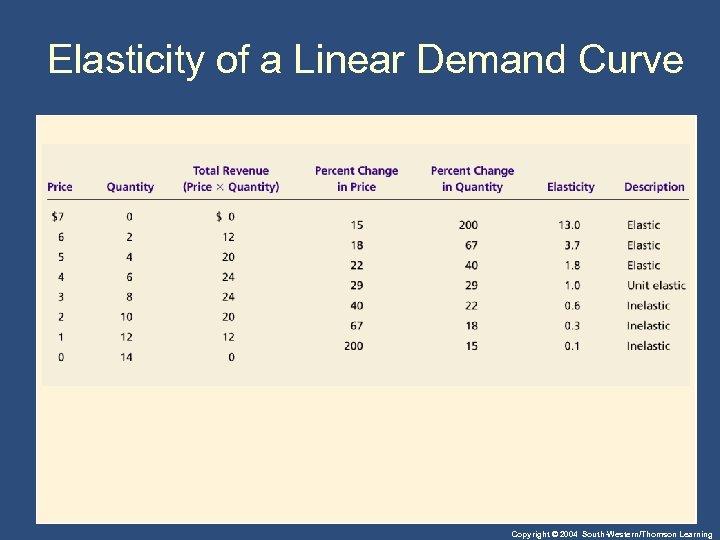 Elasticity of a Linear Demand Curve Copyright © 2004 South-Western/Thomson Learning
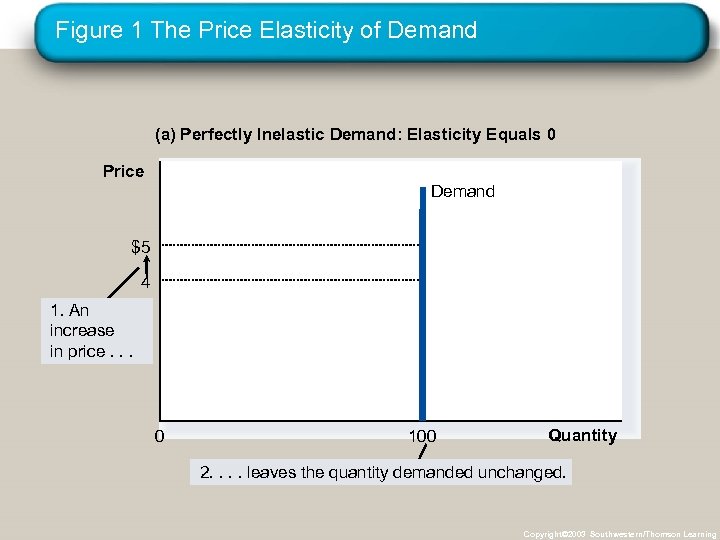 Figure 1 The Price Elasticity of Demand (a) Perfectly Inelastic Demand: Elasticity Equals 0 Price Demand $5 4 1. An increase in price. . . 0 100 Quantity 2. . leaves the quantity demanded unchanged. Copyright© 2003 Southwestern/Thomson Learning
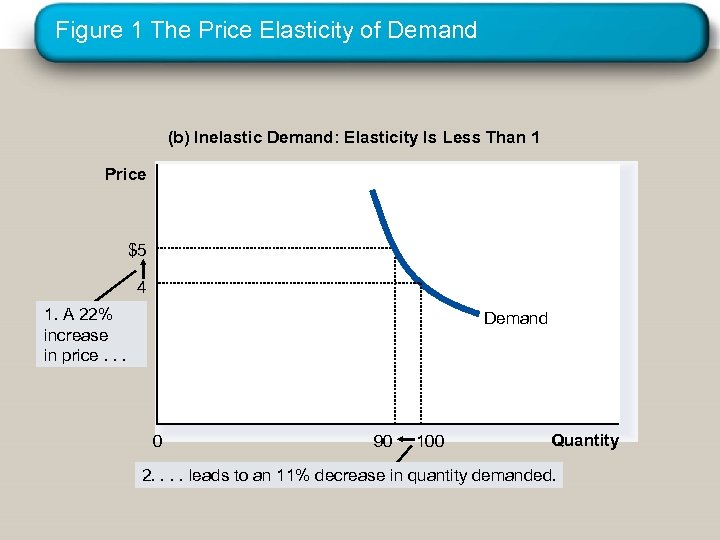 Figure 1 The Price Elasticity of Demand (b) Inelastic Demand: Elasticity Is Less Than 1 Price $5 4 1. A 22% increase in price. . . Demand 0 90 100 Quantity 2. . leads to an 11% decrease in quantity demanded.
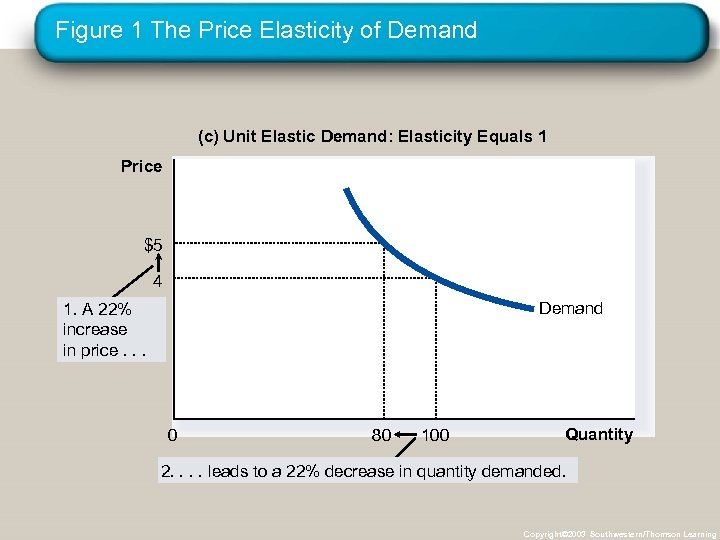 Figure 1 The Price Elasticity of Demand (c) Unit Elastic Demand: Elasticity Equals 1 Price $5 4 Demand 1. A 22% increase in price. . . 0 80 100 Quantity 2. . leads to a 22% decrease in quantity demanded. Copyright© 2003 Southwestern/Thomson Learning
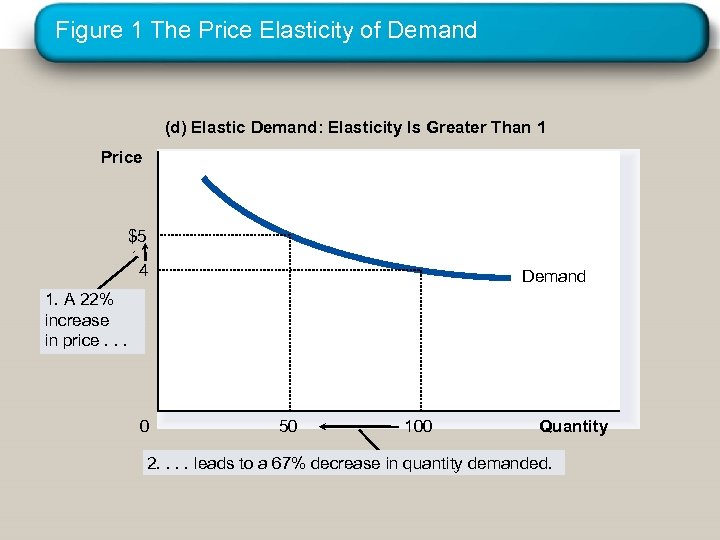 Figure 1 The Price Elasticity of Demand (d) Elastic Demand: Elasticity Is Greater Than 1 Price $5 4 Demand 1. A 22% increase in price. . . 0 50 100 Quantity 2. . leads to a 67% decrease in quantity demanded.
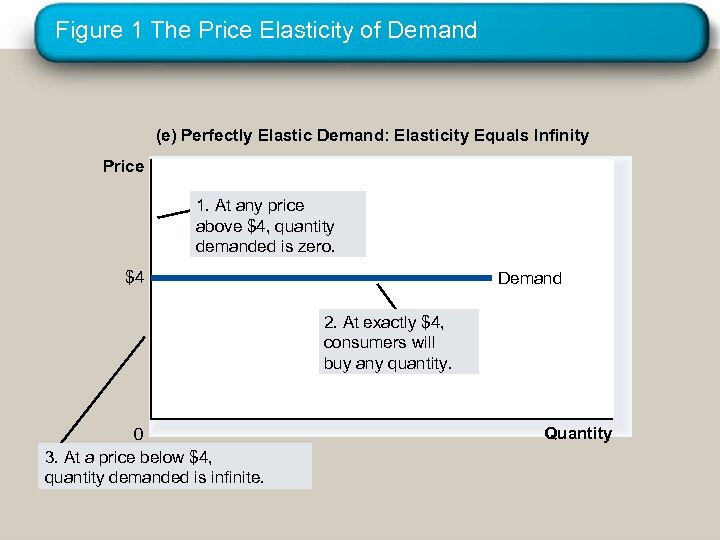 Figure 1 The Price Elasticity of Demand (e) Perfectly Elastic Demand: Elasticity Equals Infinity Price 1. At any price above $4, quantity demanded is zero. $4 Demand 2. At exactly $4, consumers will buy any quantity. 0 3. At a price below $4, quantity demanded is infinite. Quantity
 A Policy Application of Supply and Demand • The summer of 2005 experienced one of the worst hurricane seasons in the nation’s history. • Aside from the tremendous human cost, hurricanes are also often followed by some predictable economic ‘disruptions’. • For example, the prices of bottled water and gasoline both tend to rise sharply. • Given that hurricanes if anything reduce the demand for gasoline (people travel less not more) why should the price of gasoline rise? • Given that hurricanes do not destroy stocks of bottled water, why should the price of bottled water rise? Copyright © 2004 South-Western/Thomson Learning
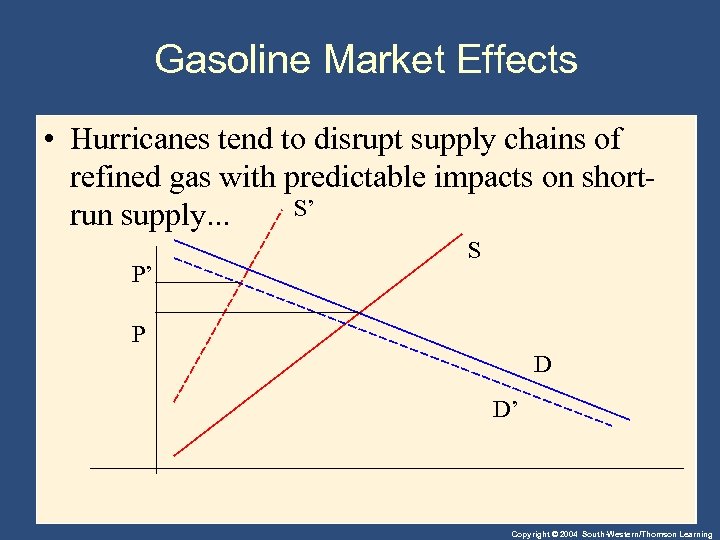 Gasoline Market Effects • Hurricanes tend to disrupt supply chains of refined gas with predictable impacts on short. S’ run supply. . . P’ S P D D’ Copyright © 2004 South-Western/Thomson Learning
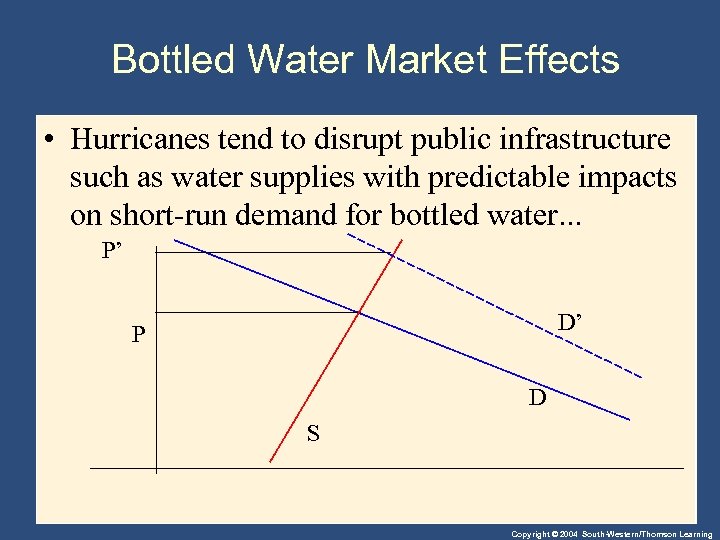 Bottled Water Market Effects • Hurricanes tend to disrupt public infrastructure such as water supplies with predictable impacts on short-run demand for bottled water. . . P’ D’ P D S Copyright © 2004 South-Western/Thomson Learning
 Price Gouging? • In the aftermath of a hurricane comes the inevitable clash over "price gouging". Florida's Attorney General Charlie Crist complained: • Hurricane Charley is the worst natural disaster to befall our state in a dozen years, and it is unthinkable that anyone would try to take advantage of neighbors at a time like this. • “We must enact a national federal price gouging law to prevent exorbitant prices for food, water, housing, and gas. ” From www. housedemocrat. gov, Sept 6, 2005. (just after Hurricane Katrina). Copyright © 2004 South-Western/Thomson Learning
 Price Gouging? • What would be the effect of banning “price gouging” (putting a price ceiling) in the bottled water market? • A) in the market after Katrina? • B) in bottled water markets after the next hurricane? Copyright © 2004 South-Western/Thomson Learning
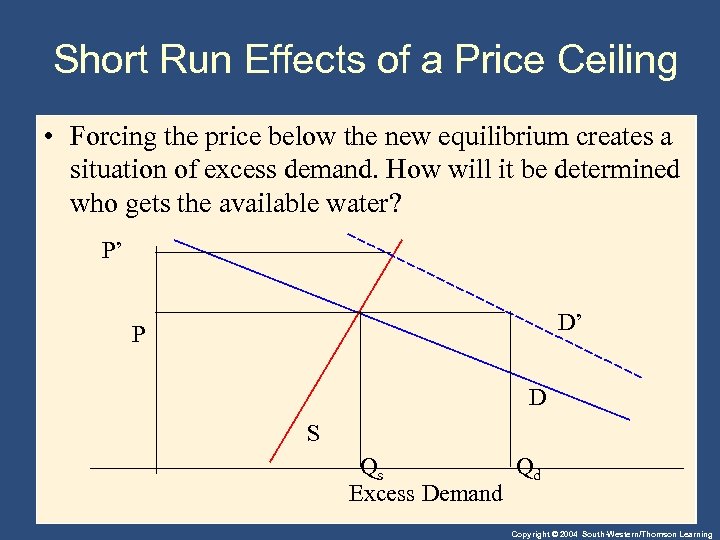 Short Run Effects of a Price Ceiling • Forcing the price below the new equilibrium creates a situation of excess demand. How will it be determined who gets the available water? P’ D’ P D S Qs Qd Excess Demand Copyright © 2004 South-Western/Thomson Learning
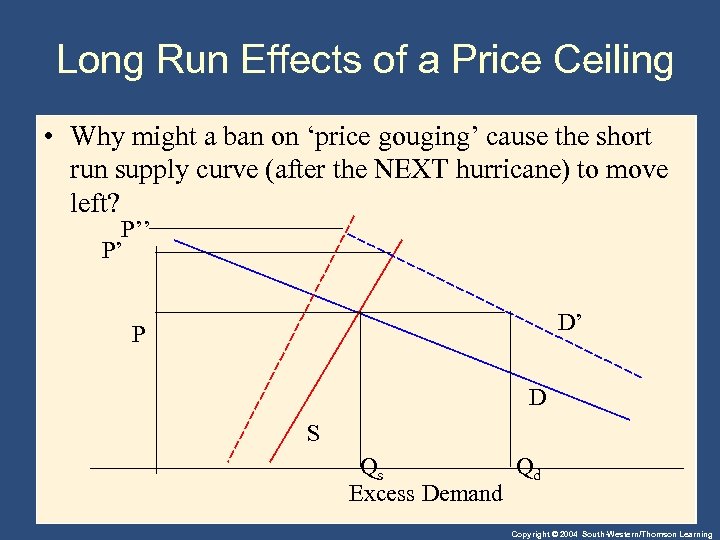 Long Run Effects of a Price Ceiling • Why might a ban on ‘price gouging’ cause the short run supply curve (after the NEXT hurricane) to move left? P’’ P’ D’ P D S Qs Qd Excess Demand Copyright © 2004 South-Western/Thomson Learning
 Total Revenue and the Price Elasticity of Demand • Total revenue is the amount paid by buyers and received by sellers of a good. • Computed as the price of the good times the quantity sold. TR = P x Q • Suppose you were operating a business and was considering raising the price by 10%. • Would your revenues rise or fall? • How could you use elasticity of demand to help you guess right? Copyright © 2004 South-Western/Thomson Learning
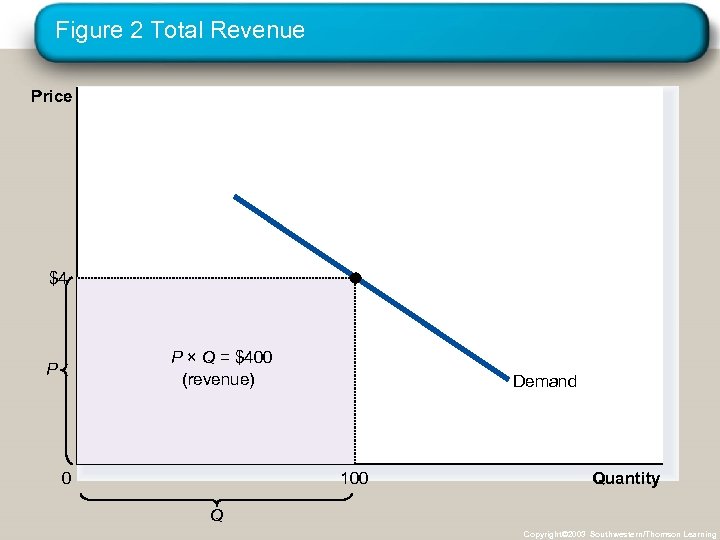 Figure 2 Total Revenue Price $4 P × Q = $400 (revenue) P 0 Demand 100 Quantity Q Copyright© 2003 Southwestern/Thomson Learning
 Elasticity and Total Revenue along a Linear Demand Curve • At an inelastic part of the demand curve, an increase in price leads to a decrease in quantity that is proportionately smaller. Thus, total revenue increases. Copyright © 2004 South-Western/Thomson Learning
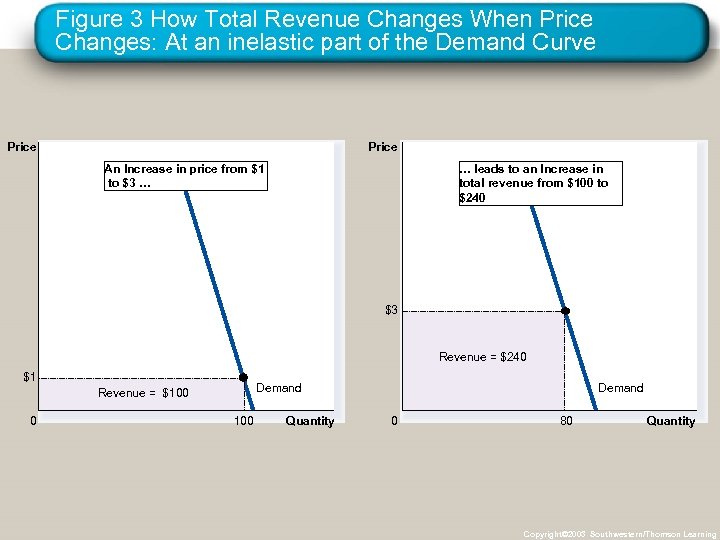 Figure 3 How Total Revenue Changes When Price Changes: At an inelastic part of the Demand Curve Price An Increase in price from $1 to $3 … … leads to an Increase in total revenue from $100 to $240 $3 Revenue = $240 $1 Demand Revenue = $100 0 100 Quantity Demand 0 80 Quantity Copyright© 2003 Southwestern/Thomson Learning
 Elasticity and Total Revenue along a Linear Demand Curve • At an elastic part of the demand curve, an increase in the price leads to a decrease in quantity demanded that is proportionately larger. Thus, total revenue decreases. Copyright © 2004 South-Western/Thomson Learning
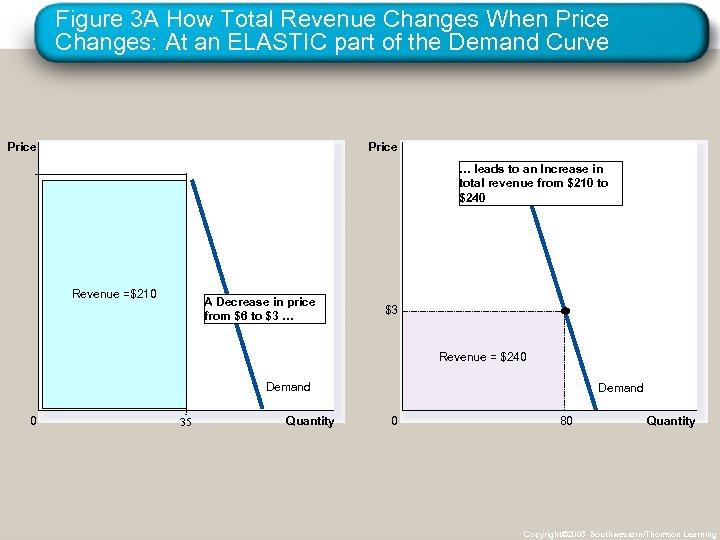 Figure 3 A How Total Revenue Changes When Price Changes: At an ELASTIC part of the Demand Curve Price … leads to an Increase in total revenue from $210 to $240 Revenue =$210 A Decrease in price from $6 to $3 … $3 Revenue = $240 Demand 0 35 Quantity Demand 0 80 Quantity Copyright© 2003 Southwestern/Thomson Learning
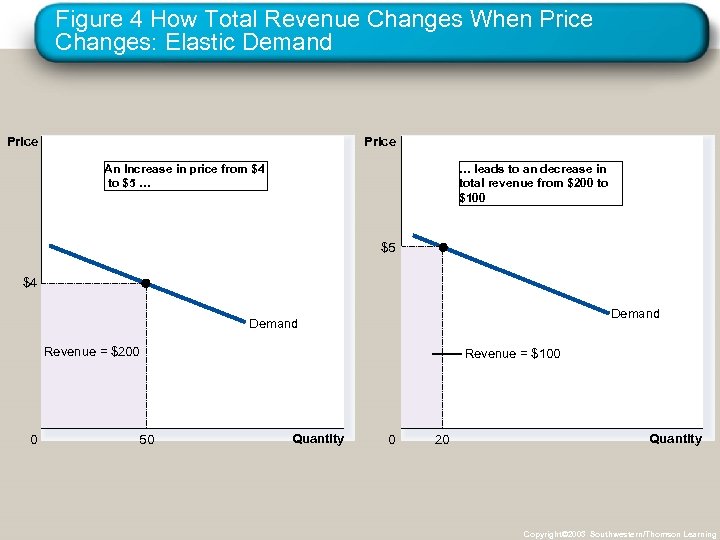 Figure 4 How Total Revenue Changes When Price Changes: Elastic Demand Price An Increase in price from $4 to $5 … … leads to an decrease in total revenue from $200 to $100 $5 $4 Demand Revenue = $200 0 50 Revenue = $100 Quantity 0 20 Quantity Copyright© 2003 Southwestern/Thomson Learning
 Income Elasticity of Demand • Income elasticity of demand measures how much the quantity demanded of a good responds to a change in consumers’ income. • It is computed as the percentage change in the quantity demanded divided by the percentage change in income. Copyright © 2004 South-Western/Thomson Learning
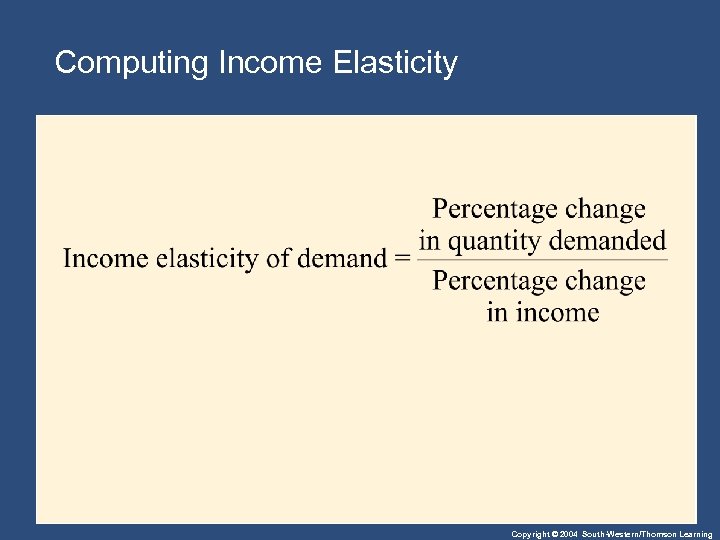 Computing Income Elasticity Copyright © 2004 South-Western/Thomson Learning
 Income Elasticity • Types of Goods • Normal Goods • Inferior Goods • Higher income raises the quantity demanded for normal goods but lowers the quantity demanded for inferior goods. Copyright © 2004 South-Western/Thomson Learning
 Income Elasticity • Goods consumers regard as necessities tend to be income inelastic • Examples include food, fuel, clothing, utilities, and medical services. • Goods consumers regard as luxuries tend to be income elastic. • Examples include sports cars, furs, and expensive foods. Copyright © 2004 South-Western/Thomson Learning
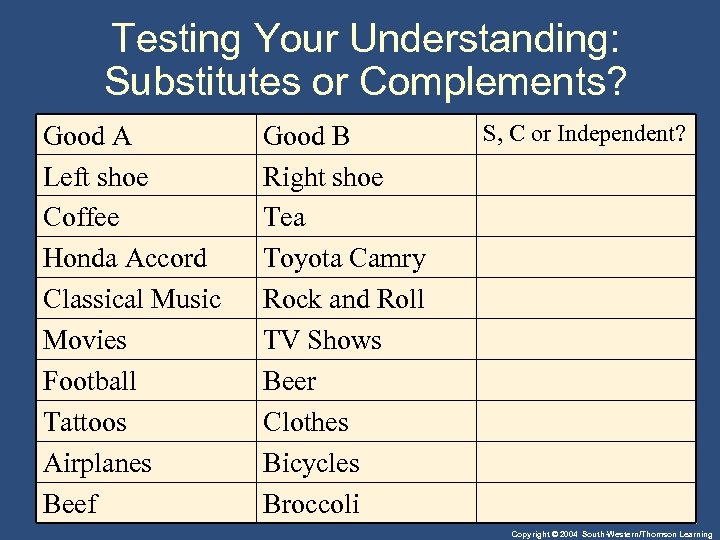 Testing Your Understanding: Substitutes or Complements? Good A Left shoe Coffee Honda Accord Classical Music Movies Football Tattoos Airplanes Beef Good B Right shoe Tea Toyota Camry Rock and Roll TV Shows Beer Clothes Bicycles Broccoli S, C or Independent? Copyright © 2004 South-Western/Thomson Learning
 Cross-Price Elasticity • Since demand for Good A can depend on prices of other goods, we also have the notion of cross-price elasticity. • Recall that Good B is a substitute for Good A if demand for Good A rises when the price of Good B rises. • As in the case of income elasticity, the SIGN of a cross -price elasticity conveys vital information. • The sign of the cross price elasticity between Goods A and B is positive if the two goods are substitutes. • What is the sign if they are complements? Copyright © 2004 South-Western/Thomson Learning
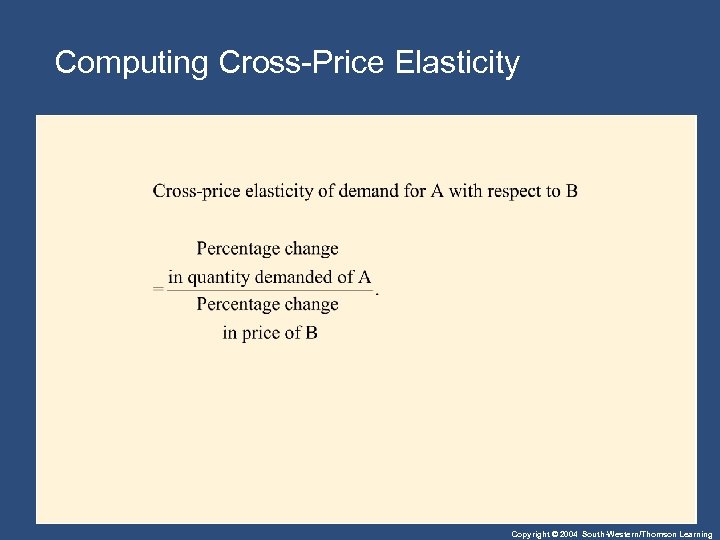 Computing Cross-Price Elasticity Copyright © 2004 South-Western/Thomson Learning
 Cross-Price Elasticity: A Policy Application • When one firm attempts to buy another firm (a “merger’) the purchase typically must be approved by the U. S Department of Justice or the Federal Trade Commission (FTC) to ensure the market remains competitive. • If there are only two firms in the market before the merger, then the proposed transactions would create a monopoly and is usually prohibited. • What determines the market though? Copyright © 2004 South-Western/Thomson Learning
 Cross-Price Elasticity: A Policy Application • The U. S. government often uses cross-price elasticities to decide if there are enough other firms to maintain competitive discipline on prices. • To do this, they analyze cross-price elasticities. • Suppose the newly merged firm were to raise its price by 5%. • Would it lose enough sales to substitute products (more than 5% of its sales) so that the price rise would not be profitable? Copyright © 2004 South-Western/Thomson Learning
 Cross-Price Elasticity: A Policy Application • In a famous case, U. S. vs. Dupont, the government tried to argue that Dupont had monopolised the cellophane wrapper market. • Since Dupont controlled more than 75% of the cellophane market, this claim seemed strong. • However, the Supreme Court held that Dupont’s ability to price monopolistically was severely constrained by the presence of manufacturers of aluminum foil, Saran wrap, waxed paper, etc. • The Court used evidence of high cross-price elasticities of demand between these products to reach their conclusions. Copyright © 2004 South-Western/Thomson Learning
 Cross-Price Elasticity: A Policy Application • The reasoning of the Court remains a matter of significant debate. However, the use of crossprice elasticities is still an important tool in antitrust investigations. • The “Horizontal Merger Guidelines” illustrate how extensive use of cross-price elasticities can be used to determine whether a given market is competitive or not. • See http: //www. atrnet. gov/invest/mergers/mgrguide. htm Copyright © 2004 South-Western/Thomson Learning
 THE ELASTICITY OF SUPPLY • Price elasticity of supply is a measure of how much the quantity supplied of a good responds to a change in the price of that good. • Price elasticity of supply is the percentage change in quantity supplied resulting from a percent change in price. Copyright © 2004 South-Western/Thomson Learning
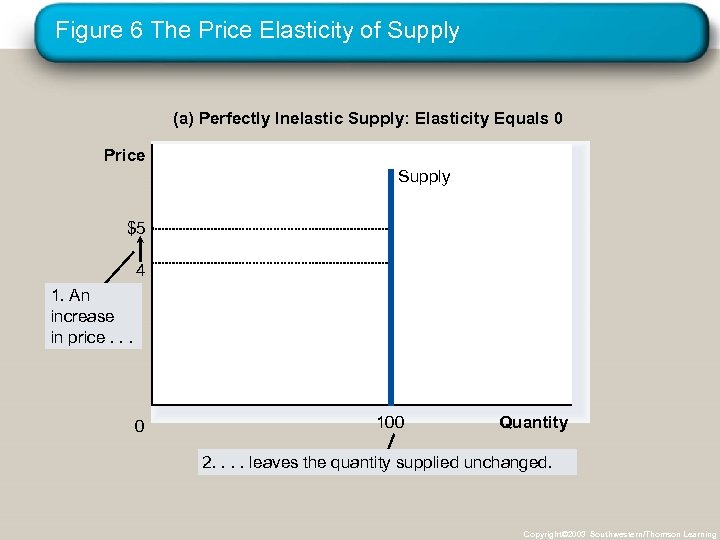 Figure 6 The Price Elasticity of Supply (a) Perfectly Inelastic Supply: Elasticity Equals 0 Price Supply $5 4 1. An increase in price. . . 0 100 Quantity 2. . leaves the quantity supplied unchanged. Copyright© 2003 Southwestern/Thomson Learning
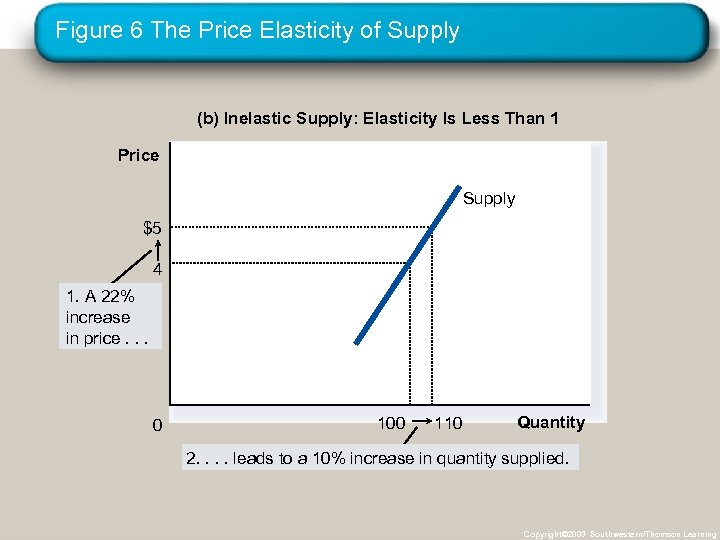 Figure 6 The Price Elasticity of Supply (b) Inelastic Supply: Elasticity Is Less Than 1 Price Supply $5 4 1. A 22% increase in price. . . 0 100 110 Quantity 2. . leads to a 10% increase in quantity supplied. Copyright© 2003 Southwestern/Thomson Learning
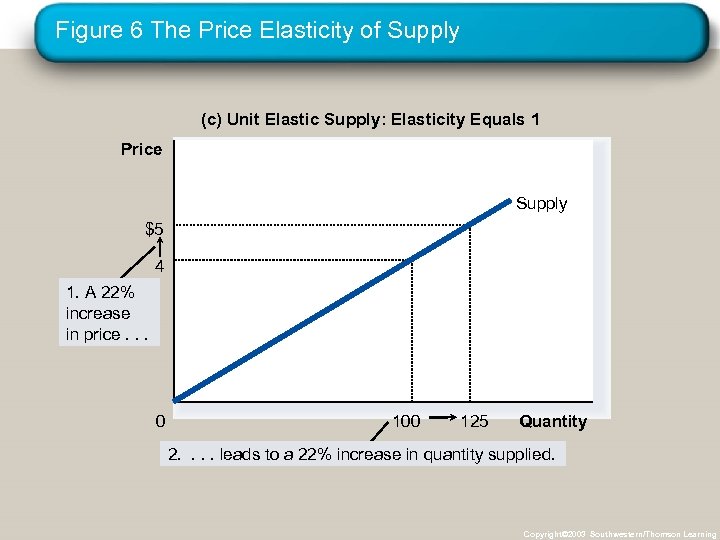 Figure 6 The Price Elasticity of Supply (c) Unit Elastic Supply: Elasticity Equals 1 Price Supply $5 4 1. A 22% increase in price. . . 0 100 125 Quantity 2. . leads to a 22% increase in quantity supplied. Copyright© 2003 Southwestern/Thomson Learning
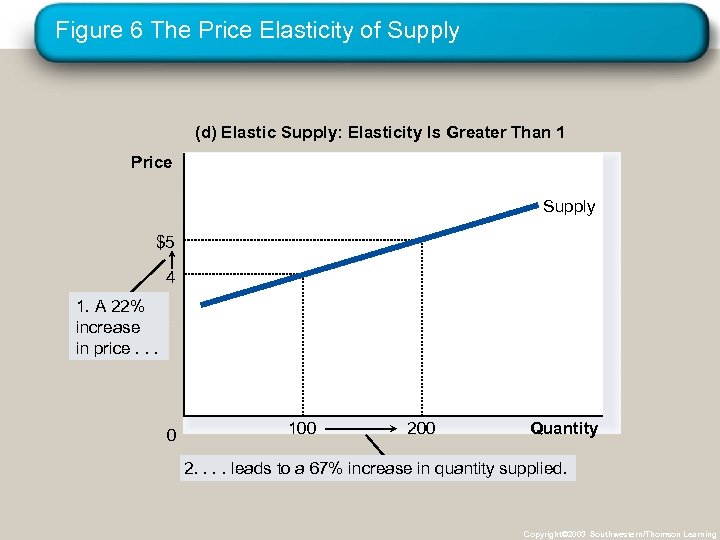 Figure 6 The Price Elasticity of Supply (d) Elastic Supply: Elasticity Is Greater Than 1 Price Supply $5 4 1. A 22% increase in price. . . 0 100 200 Quantity 2. . leads to a 67% increase in quantity supplied. Copyright© 2003 Southwestern/Thomson Learning
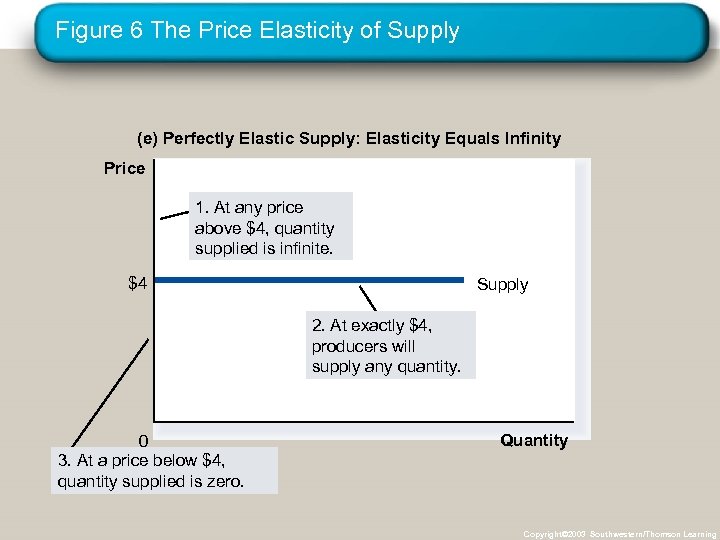 Figure 6 The Price Elasticity of Supply (e) Perfectly Elastic Supply: Elasticity Equals Infinity Price 1. At any price above $4, quantity supplied is infinite. $4 Supply 2. At exactly $4, producers will supply any quantity. 0 3. At a price below $4, quantity supplied is zero. Quantity Copyright© 2003 Southwestern/Thomson Learning
 Determinants of Elasticity of Supply • Ability of sellers to change the amount of the good they produce. • Beach-front land is inelastic. • Books, cars, or manufactured goods are elastic. • Time period. • Supply is more elastic in the long run. Copyright © 2004 South-Western/Thomson Learning
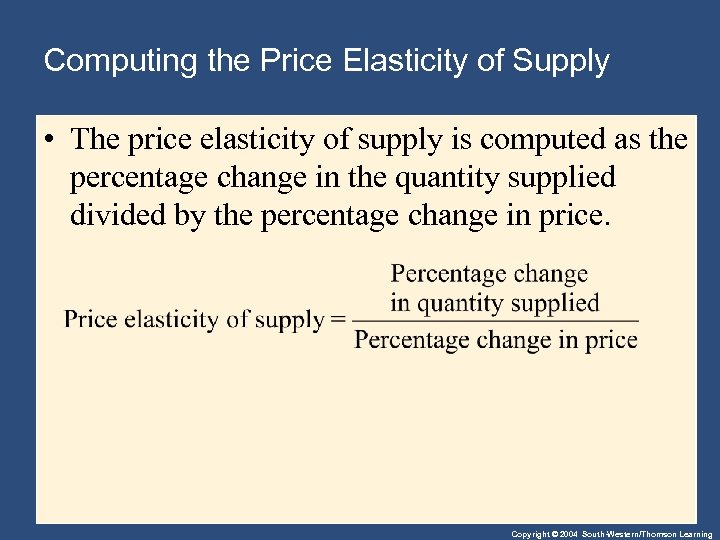 Computing the Price Elasticity of Supply • The price elasticity of supply is computed as the percentage change in the quantity supplied divided by the percentage change in price. Copyright © 2004 South-Western/Thomson Learning
 APPLICATION of ELASTICITY • Can good news for farming be bad news for farmers? • What happens to wheat farmers and the market for wheat when university agronomists discover a new wheat hybrid that is more productive than existing varieties? Copyright © 2004 South-Western/Thomson Learning
 THE APPLICATION OF SUPPLY, DEMAND, AND ELASTICITY • Examine whether the supply or demand curve shifts. • Determine the direction of the shift of the curve. • Use the supply-and-demand diagram to see how the market equilibrium changes. Copyright © 2004 South-Western/Thomson Learning
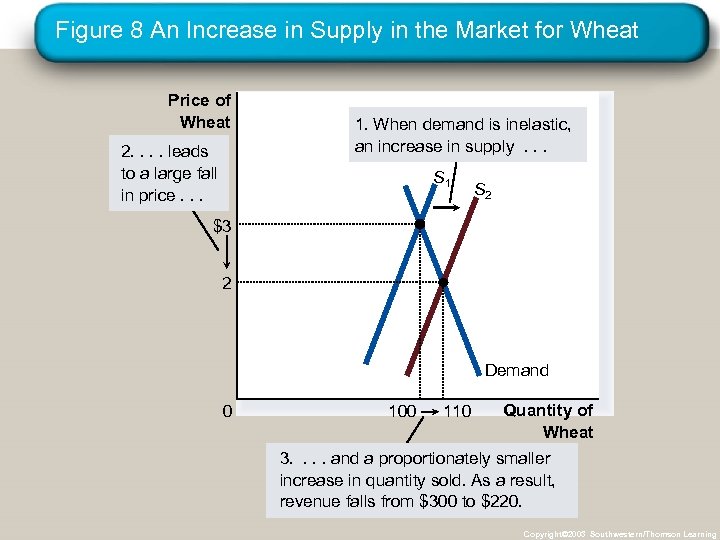 Figure 8 An Increase in Supply in the Market for Wheat Price of Wheat 2. . leads to a large fall in price. . . 1. When demand is inelastic, an increase in supply. . . S 1 S 2 $3 2 Demand 0 100 110 Quantity of Wheat 3. . and a proportionately smaller increase in quantity sold. As a result, revenue falls from $300 to $220. Copyright© 2003 Southwestern/Thomson Learning
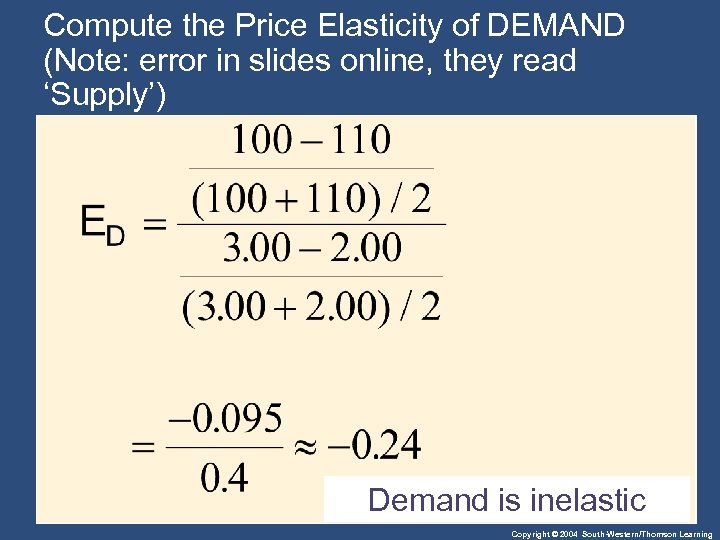 Compute the Price Elasticity of DEMAND (Note: error in slides online, they read ‘Supply’) Demand is inelastic Copyright © 2004 South-Western/Thomson Learning
 Competitive Markets: A First Glance • Although total revenue fell, farmers voluntarily took up the new hybrid. • Why? • Individually, every farmer takes the price of wheat as given. • Individually, it is a profitable strategy for each farmer to take up the invention. • As a group, wheat producers may actually prefer not to increase supply. Copyright © 2004 South-Western/Thomson Learning
 Application • Where does information about elasticity come from? • There a variety of sources: for example, one might be a history of data relating prices to quantity. • Example: Data may be available over the last 12 months on prices and sales of a CD: Copyright © 2004 South-Western/Thomson Learning
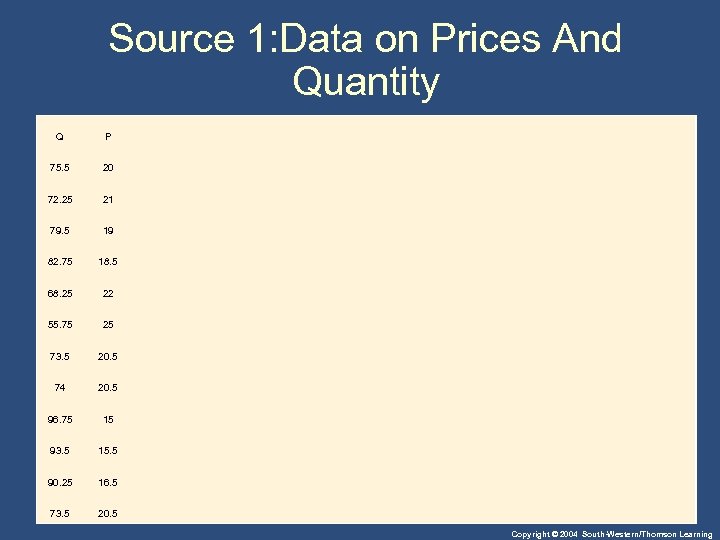 Source 1: Data on Prices And Quantity Q P 75. 5 20 72. 25 21 79. 5 19 82. 75 18. 5 68. 25 22 55. 75 25 73. 5 20. 5 74 20. 5 96. 75 15 93. 5 15. 5 90. 25 16. 5 73. 5 20. 5 Copyright © 2004 South-Western/Thomson Learning
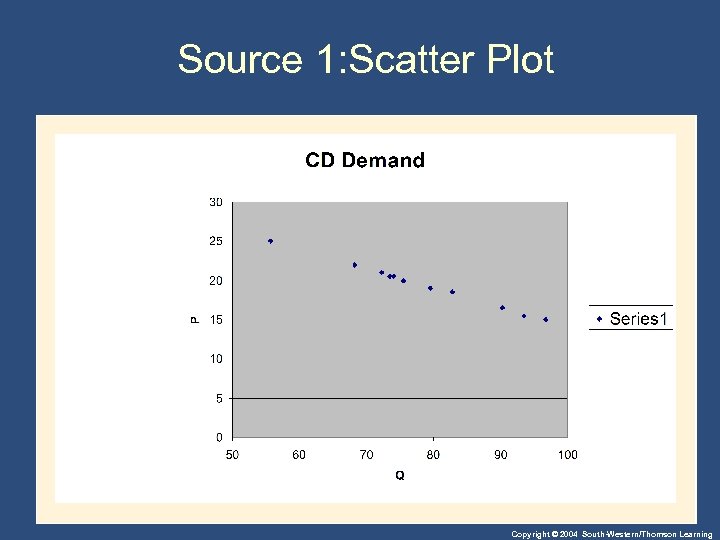 Source 1: Scatter Plot Copyright © 2004 South-Western/Thomson Learning
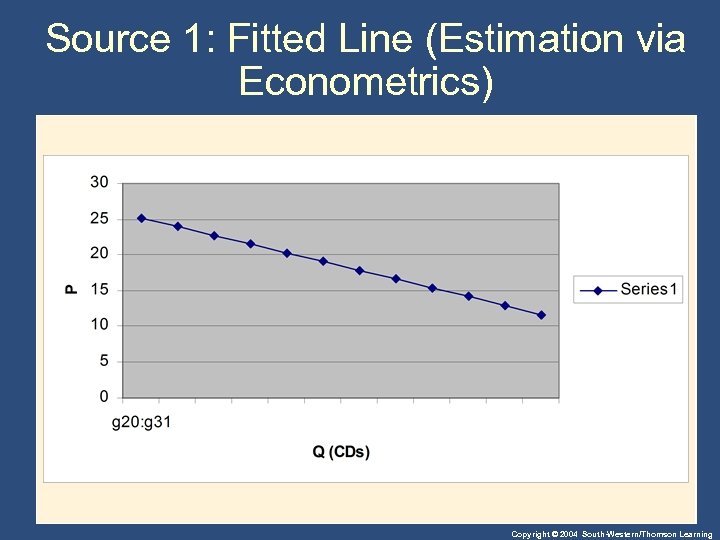 Source 1: Fitted Line (Estimation via Econometrics) Copyright © 2004 South-Western/Thomson Learning
 Source 2: By Case Study • In 2004, the federal government mandated a new safety feature in gas water heaters called FVIR. • It resulted in an industry wide cost rise of $30. • The average gas water heater cost about $230. • Thus, there was about a 12. 25% increase in price (using the midpoint method). • If the change of quantity was, say, a fall in gas water heater purchases of 10% (again using the midpoint method) we could directly compute the elasticity. • If the change in electric water heater purchases was an increase in (say) 5%, we could also compute the cross price elasticity. Copyright © 2004 South-Western/Thomson Learning
 Source 3: By Inference or Introspection • Suppose that we knew the price elasticity of water heaters (gas and electric) was 1. 1. • What could we presume was the lower bound on the elasticity of gas water heaters? • Why? Copyright © 2004 South-Western/Thomson Learning
 Summary • Price elasticity of demand measures how much the quantity demanded responds to changes in the price. • Price elasticity of demand is calculated as the percentage change in quantity demanded divided by the percentage change in price. • If a demand curve is elastic, total revenue falls when the price rises. • If it is inelastic, total revenue rises as the price rises. Copyright © 2004 South-Western/Thomson Learning
 Summary • The income elasticity of demand measures how much the quantity demanded responds to changes in consumers’ income. • The cross-price elasticity of demand measures how much the quantity demanded of one good responds to the price of another good. • The price elasticity of supply measures how much the quantity supplied responds to changes in the price. . Copyright © 2004 South-Western/Thomson Learning
 Summary • In most markets, supply is more elastic in the long run than in the short run. • The price elasticity of supply is calculated as the percentage change in quantity supplied divided by the percentage change in price. • The tools of supply and demand can be applied in many different types of markets. Copyright © 2004 South-Western/Thomson Learning