


 Скачать презентацию Elasticity and Its Applications 1 Elasticity
Economics_4th _slides.ppt
- Количество слайдов: 36
 Elasticity and Its Applications 1
 Elasticity. . . • … allows us to analyze supply and demand with greater precision. • … is a measure of how much buyers and sellers respond to changes in market conditions 2
 THE ELASTICITY OF DEMAND • Price elasticity of demand is a measure of how much the quantity demanded of a good responds to a change in the price of that good. • Price elasticity of demand is the percentage change in quantity demanded given a percent change in the price. 3
 The Price Elasticity of Demand Its Determinants • • Availability of Close Substitutes Necessities versus Luxuries Definition of the Market Time Horizon 4
 The Price Elasticity of Demand Its Determinants • Demand tends to be more elastic : – the larger the number of close substitutes. – if the good is a luxury. – the more narrowly defined the market. – the longer the time period. 5
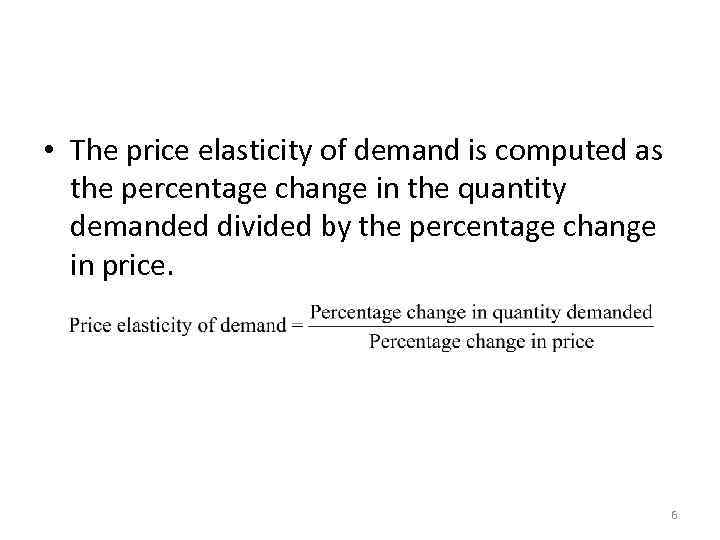 Computing the Price Elasticity of Demand • The price elasticity of demand is computed as the percentage change in the quantity demanded divided by the percentage change in price. 6
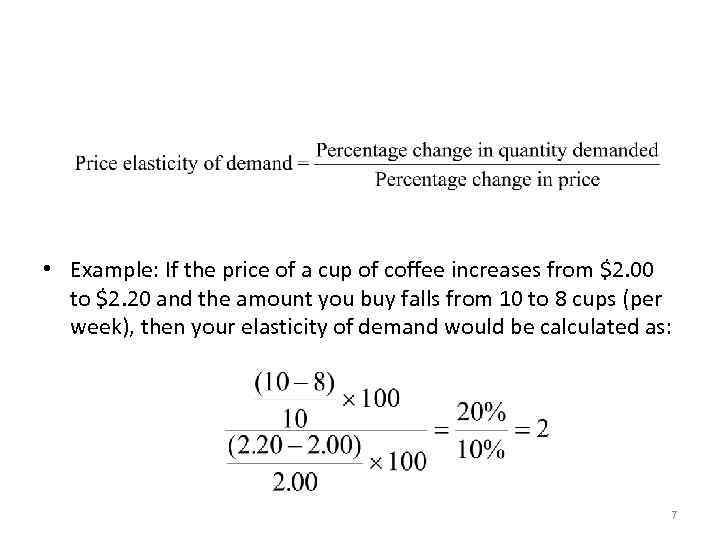 Computing the Price Elasticity of Demand • Example: If the price of a cup of coffee increases from $2. 00 to $2. 20 and the amount you buy falls from 10 to 8 cups (per week), then your elasticity of demand would be calculated as: 7
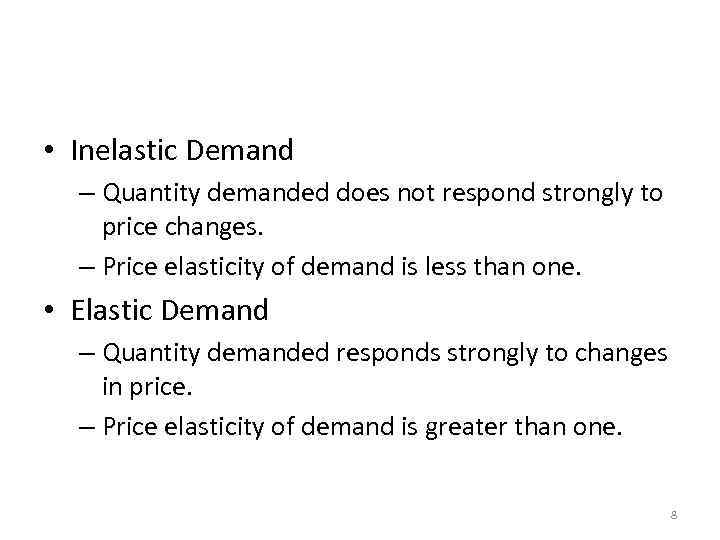 The Variety of Demand Curves • Inelastic Demand – Quantity demanded does not respond strongly to price changes. – Price elasticity of demand is less than one. • Elastic Demand – Quantity demanded responds strongly to changes in price. – Price elasticity of demand is greater than one. 8
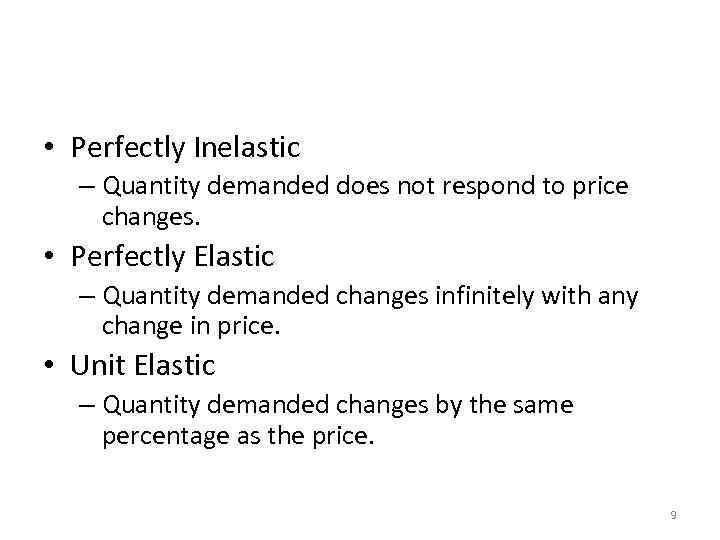 The Variety of Demand Curves • Perfectly Inelastic – Quantity demanded does not respond to price changes. • Perfectly Elastic – Quantity demanded changes infinitely with any change in price. • Unit Elastic – Quantity demanded changes by the same percentage as the price. 9
 The Variety of Demand Curves • Because the price elasticity of demand measures how much quantity demanded responds to the price, it is closely related to the slope of the demand curve. 10
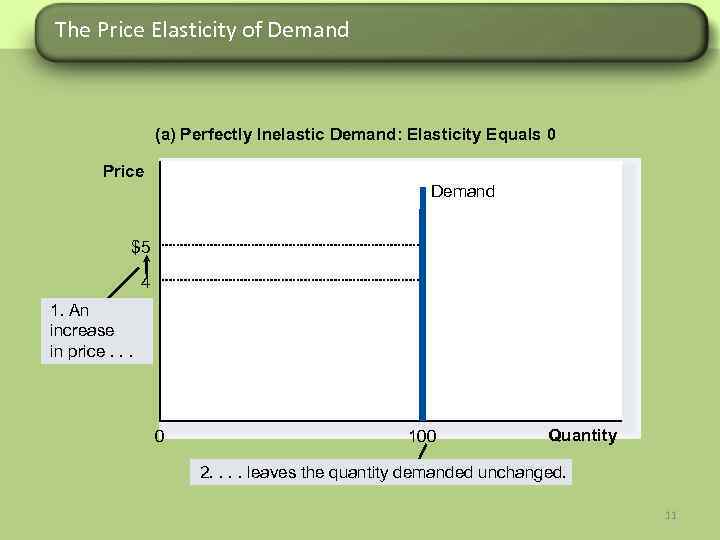 The Price Elasticity of Demand (a) Perfectly Inelastic Demand: Elasticity Equals 0 Price Demand $5 4 1. An increase in price. . . 0 100 Quantity 2. . leaves the quantity demanded unchanged. 11
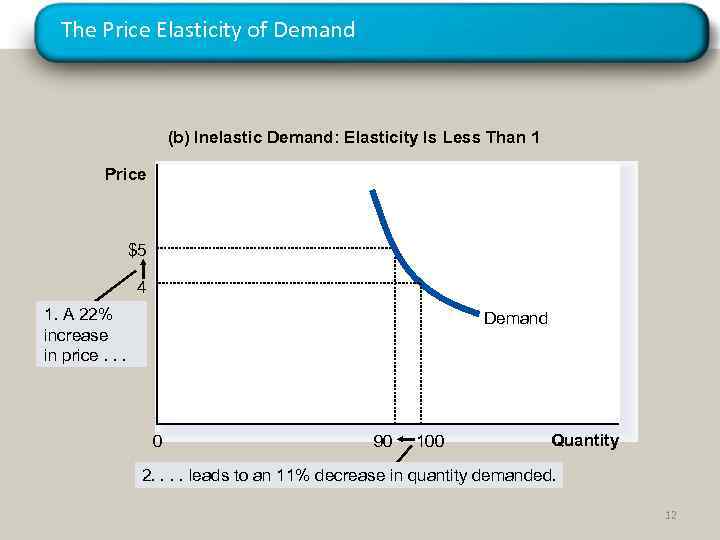 The Price Elasticity of Demand (b) Inelastic Demand: Elasticity Is Less Than 1 Price $5 4 1. A 22% increase in price. . . Demand 0 90 100 Quantity 2. . leads to an 11% decrease in quantity demanded. 12
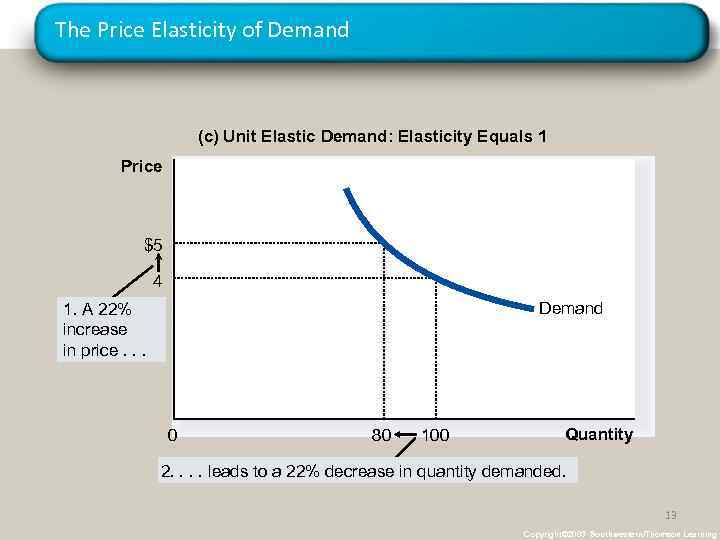 The Price Elasticity of Demand (c) Unit Elastic Demand: Elasticity Equals 1 Price $5 4 Demand 1. A 22% increase in price. . . 0 80 100 Quantity 2. . leads to a 22% decrease in quantity demanded. 13 Copyright© 2003 Southwestern/Thomson Learning
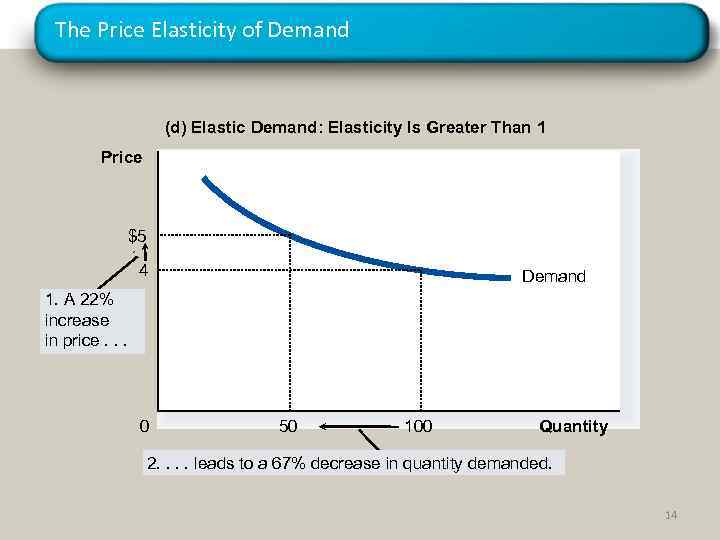 The Price Elasticity of Demand (d) Elastic Demand: Elasticity Is Greater Than 1 Price $5 4 Demand 1. A 22% increase in price. . . 0 50 100 Quantity 2. . leads to a 67% decrease in quantity demanded. 14
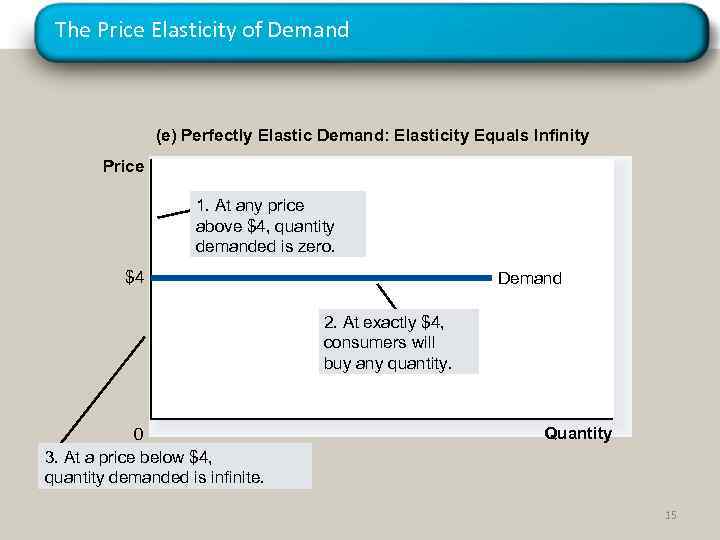 The Price Elasticity of Demand (e) Perfectly Elastic Demand: Elasticity Equals Infinity Price 1. At any price above $4, quantity demanded is zero. $4 Demand 2. At exactly $4, consumers will buy any quantity. 0 3. At a price below $4, quantity demanded is infinite. Quantity 15
 Total Revenue and the Price Elasticity of Demand • Total revenue is the amount paid by buyers and received by sellers of a good. • Computed as the price of the good times the quantity sold. TR = P x Q 16
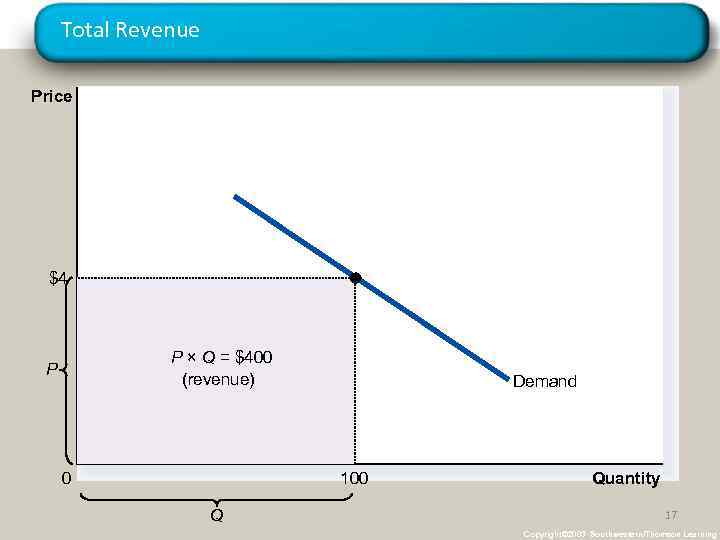 Total Revenue Price $4 P × Q = $400 (revenue) P 0 Demand 100 Q Quantity 17 Copyright© 2003 Southwestern/Thomson Learning
 Elasticity and Total Revenue along a Linear Demand Curve • With an inelastic demand curve, an increase in price leads to a decrease in quantity that is proportionately smaller. Thus, total revenue increases. 18
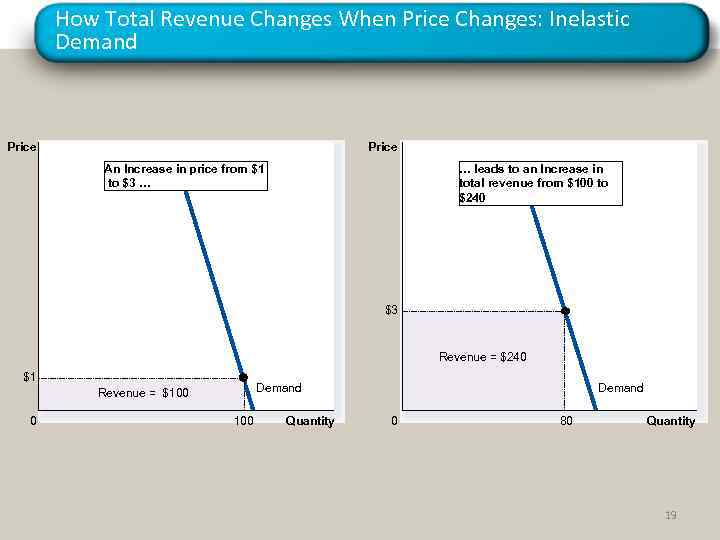 How Total Revenue Changes When Price Changes: Inelastic Demand Price An Increase in price from $1 to $3 … … leads to an Increase in total revenue from $100 to $240 $3 Revenue = $240 $1 Demand Revenue = $100 0 100 Quantity Demand 0 80 Quantity 19
 Elasticity and Total Revenue along a Linear Demand Curve • With an elastic demand curve, an increase in the price leads to a decrease in quantity demanded that is proportionately larger. Thus, total revenue decreases. 20
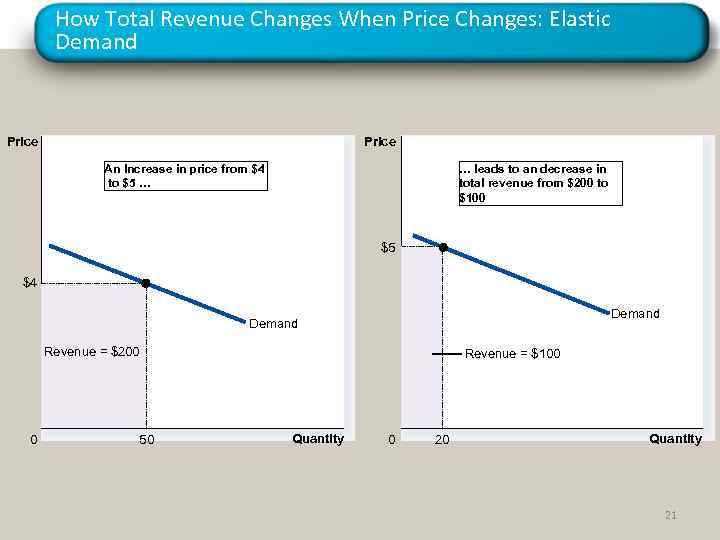 How Total Revenue Changes When Price Changes: Elastic Demand Price An Increase in price from $4 to $5 … … leads to an decrease in total revenue from $200 to $100 $5 $4 Demand Revenue = $200 0 50 Revenue = $100 Quantity 0 20 Quantity 21
 Income Elasticity of Demand • Income elasticity of demand measures how much the quantity demanded of a good responds to a change in consumers’ income. • It is computed as the percentage change in the quantity demanded divided by the percentage change in income. 22
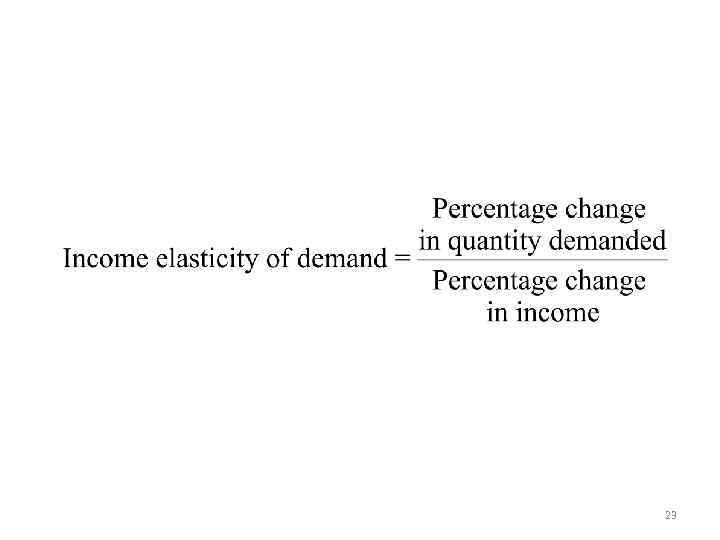 Computing Income Elasticity 23
 Income Elasticity • Types of Goods – Normal Goods – Inferior Goods • Higher income raises the quantity demanded for normal goods but lowers the quantity demanded for inferior goods. 24
 Income Elasticity • Goods consumers regard as necessities tend to be income inelastic – Examples include food, fuel, clothing, utilities, and medical services. • Goods consumers regard as luxuries tend to be income elastic. – Examples include sports cars, furs, and expensive foods. 25
 THE ELASTICITY OF SUPPLY • Price elasticity of supply is a measure of how much the quantity supplied of a good responds to a change in the price of that good. • Price elasticity of supply is the percentage change in quantity supplied resulting from a percent change in price. 26
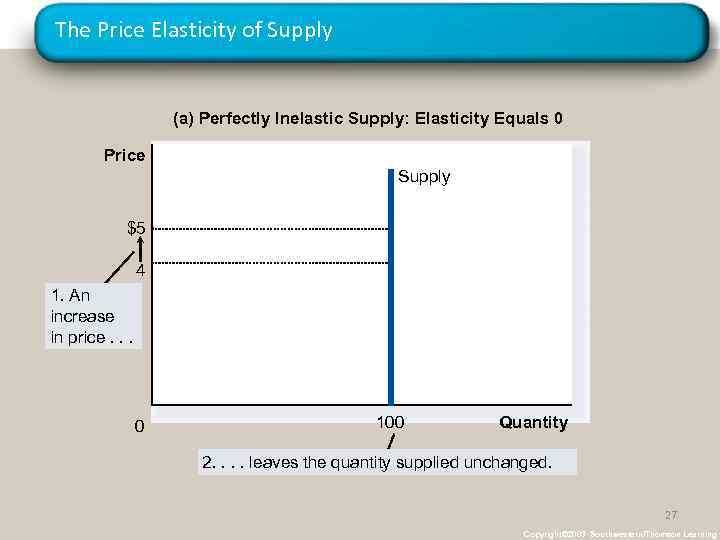 The Price Elasticity of Supply (a) Perfectly Inelastic Supply: Elasticity Equals 0 Price Supply $5 4 1. An increase in price. . . 0 100 Quantity 2. . leaves the quantity supplied unchanged. 27 Copyright© 2003 Southwestern/Thomson Learning
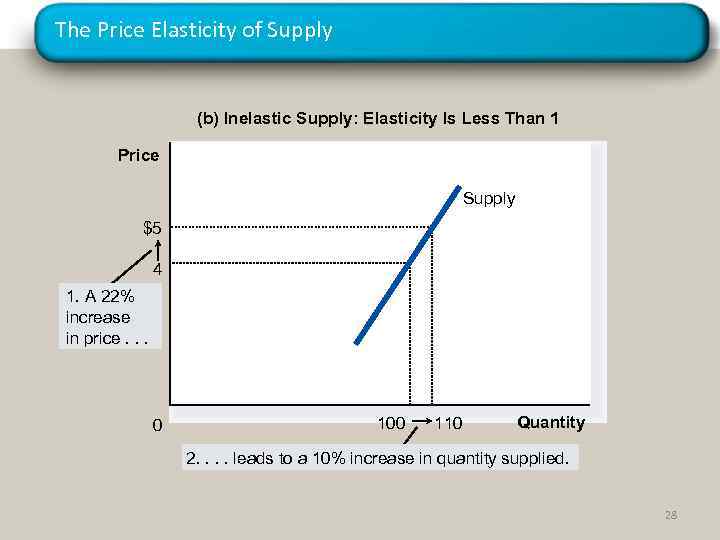 The Price Elasticity of Supply (b) Inelastic Supply: Elasticity Is Less Than 1 Price Supply $5 4 1. A 22% increase in price. . . 0 100 110 Quantity 2. . leads to a 10% increase in quantity supplied. 28
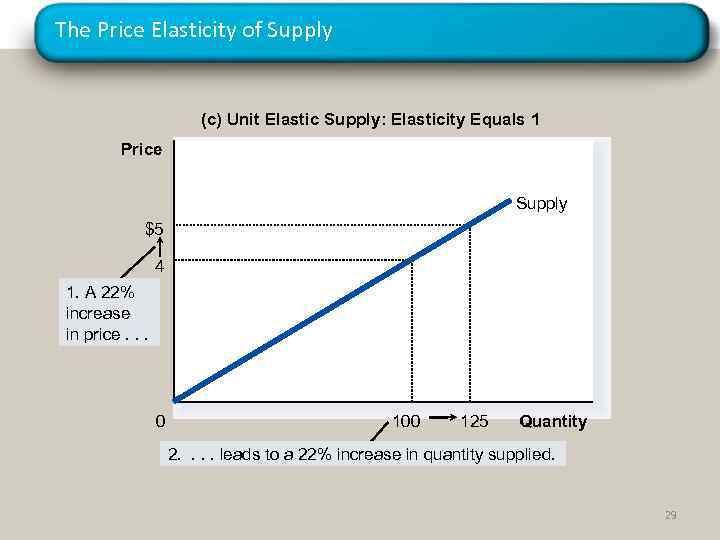 The Price Elasticity of Supply (c) Unit Elastic Supply: Elasticity Equals 1 Price Supply $5 4 1. A 22% increase in price. . . 0 100 125 Quantity 2. . leads to a 22% increase in quantity supplied. 29
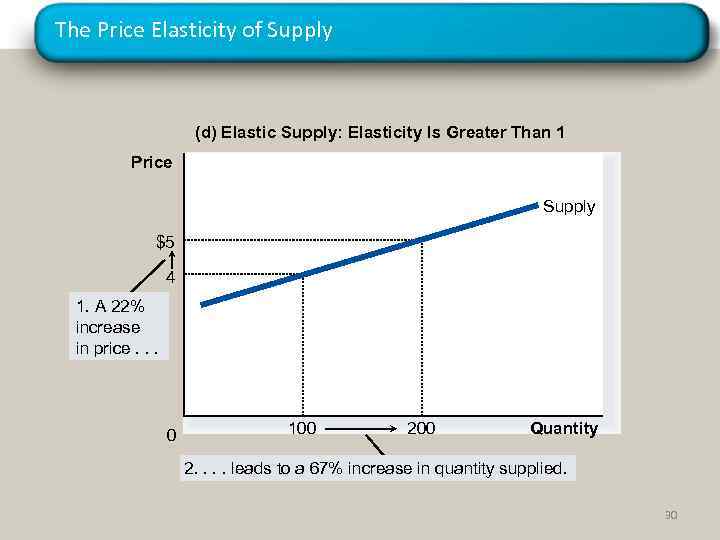 The Price Elasticity of Supply (d) Elastic Supply: Elasticity Is Greater Than 1 Price Supply $5 4 1. A 22% increase in price. . . 0 100 200 Quantity 2. . leads to a 67% increase in quantity supplied. 30
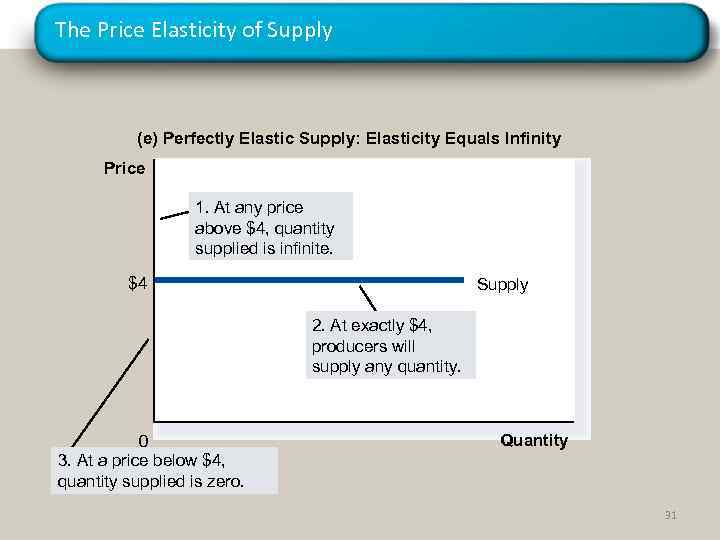 The Price Elasticity of Supply (e) Perfectly Elastic Supply: Elasticity Equals Infinity Price 1. At any price above $4, quantity supplied is infinite. $4 Supply 2. At exactly $4, producers will supply any quantity. 0 3. At a price below $4, quantity supplied is zero. Quantity 31
 Determinants of Elasticity of Supply • Ability of sellers to change the amount of the good they produce. – Real estate by beach is inelastic. – Books, cars, or manufactured goods are elastic. • Time period. – Supply is more elastic in the long run. 32
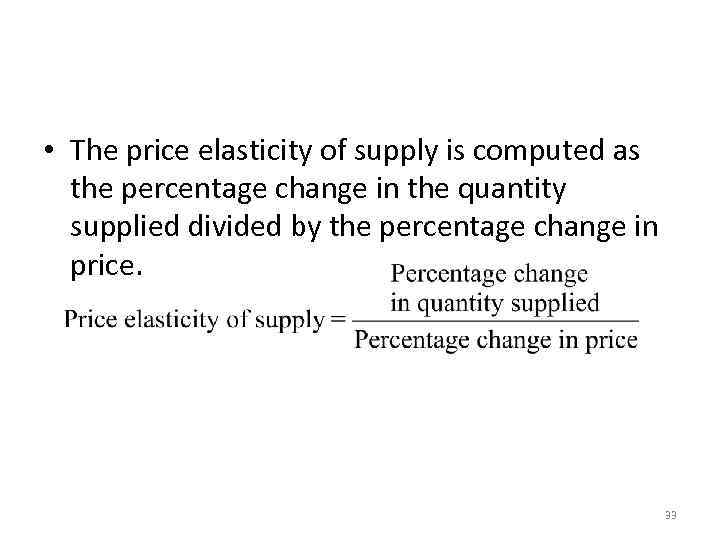 Computing the Price Elasticity of Supply • The price elasticity of supply is computed as the percentage change in the quantity supplied divided by the percentage change in price. 33
 Summary • Price elasticity of demand measures how much the quantity demanded responds to changes in the price. • Price elasticity of demand is calculated as the percentage change in quantity demanded divided by the percentage change in price. • If a demand curve is elastic, total revenue falls when the price rises. • If it is inelastic, total revenue rises as the price rises. 34
 Summary • The income elasticity of demand measures how much the quantity demanded responds to changes in consumers’ income. • The price elasticity of supply measures how much the quantity supplied responds to changes in the price. 35
 Summary • In most markets, supply is more elastic in the long run than in the short run. • The price elasticity of supply is calculated as the percentage change in quantity supplied divided by the percentage change in price. • The tools of supply and demand can be applied in many different types of markets. 36