 Скачать презентацию ELABORATION OF A HANDBOOK IN ENGLISH LANGUAGE FOR
c2ce26aa671c622656cadf1ad0e7361f.ppt
- Количество слайдов: 77




ELABORATION OF A HANDBOOK IN ENGLISH LANGUAGE FOR MEMBERS OF ECUADORIAN CONTINGENT ON BASIS OF MINUSTAH II FOR FURTHER PEACEKEEPING OPERATIONS IN HAITI By: Capt. De E. Hugo F. Avilés León
BRIEF OF THE WORK This investigation tries about the Communication Problems that the Ecuadorian personnel faced in other country with English Language inside the UN operations caused by their relationship with other cultures, other customs and other forms of the English Pronunciation; and, the elaboration of handbook to help to other Ecuadorian Contingents to have a better training in future missions.
INTRODUCTION At the beginning of 2004, U. N. invited Ecuador to be part of a mission with troops in MINUSTAH. Ecuador sent four officers and sixty-two of the enlisted personnel (volunteers). During the field research, I knew the situations in that military people use the English Language determining the most important problems that they faced. The relationships among armies of other countries permitted to establish the real English language level of Ecuadorian personnel.

INTRODUCTION Analyzing the different situations and determining the problems was elaborated a manual with the words and more common sentences used in the daily activities, the same will allow a better preparation in the English Language of the next contingents.
SUMMARY RESEARCH PROBLEM THEORICAL FRAME METHODOLOGICAL DESIGN ADMINISTRATIVE FRAME TESTING THE HYPOTHESIS THE HANDBOOK
RESEARCH PROBLEM IDENTIFICATION The low level of the knowledge in English Language caused a decrease in the works effectiveness during the execution of the tasks.
RESEARCH PROBLEM SETTING Main Problem Is the English level of the personnel in Peacekeeping Operations in Haiti adequate for an accurate communication in that Country?
RESEARCH PROBLEM SETTING Secondary problems • Is the effective communication very important in Peacekeeping Operations in which the misunderstandings can cause errors and the decrease in the effectiveness of the works; and in some cases the death? • Was the English Language used in all personnel activities during the mission time? • Did the problems with the English language affect to the Ecuadorian personnel emotionally?
RESEARCH PROBLEM VARIABLES WORKING OUT Independent Variable: Level of the English Language knowledge Dependent Variable: Problems in Efficacy level when using the English Language during the works.
OBJECTIVES GENERAL To elaborate a handbook in English language for members of Ecuadorian Contingent on basis of MINUSTAH II for further Peacekeeping Operations in Haiti.
OBJECTIVES SPECIFIC • To set up the types of mistakes and skills more commonly used in English Language by Ecuadorian Contingent’s personnel. • To determine the methods and techniques to avoid the English language deficiencies in different circumstances. • To make up a handbook with main structures and expressions used by the personnel.
JUSTIFICATION I want this research to be a support to the Ecuadorian Army. This research has a particular importance to the Ecuadorian Army because it will have a technical criterion to select the members for future contingents as the Ecuadorian Representatives in these kinds of international missions.
JUSTIFICATION This work is authorized and sponsored by Peacekeeping Operations Unit School of Ecuador and this institution will be the biggest beneficiary of this work. The personnel of the future contingents will be other beneficiaries because in the manual they will find many words, expressions, readings and dialogs that can be used in daily activities.
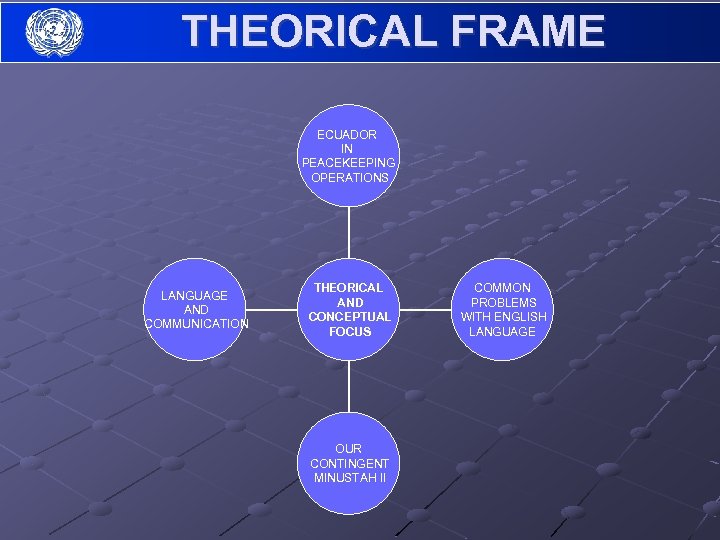
THEORICAL FRAME ECUADOR IN PEACEKEEPING OPERATIONS LANGUAGE AND COMMUNICATION THEORICAL AND CONCEPTUAL FOCUS OUR CONTINGENT MINUSTAH II COMMON PROBLEMS WITH ENGLISH LANGUAGE
THEORICAL FRAME Ecuador in Peacekeeping Operations Precisely in 1945, when UN emerges, Ecuador was present in Conference in San Francisco. The eight delegates share the message of helping the general dream to set free world without violence and this way to reduce the human suffering. Into this environment, the General Staff of the Ecuadorian Armed Forces gather in these pages the history of its soldiers in Peace Missions, as members of the General Staff, Military Observers, or as a group to helping the multinational troops.
THEORICAL FRAME MINUSTAH Haiti has had 42 presidents, 29 of them have been killed, and only 2 have been elected in a legitimate way. Haiti got accustomed to live under the threat of an aggressive delinquency the organized crime, the traffic of weapons and armed groups who have handled the rhythm of the life with the sign of terror: The Chimeres, a paramilitary group adept to Aristide and the ex Fad'H, ex-members of the Armed Forces who were retired from the national security system in 1995. Within this entire context mixed with the instability, the fear and the misery; Haiti has become a divided republic unto two parts: Port au Prince and the rest of the country.
THEORICAL FRAME MINUSTAH In 2004, The first political impact is done when Aristide is overthrown by a group of rebels commanded by Guy Philippe. April 30 th. Security's Council of United Nations approved the Resolution 1542 to restore and preserve the sovereignty, the territorial integrity and the union of the Haitian people. Based in these sacred purposes, is created the Stability Mission of the United Nations in Haiti "MINUSTAH". This Mission commanded by the Special Representative of the United Nations, the Force Commander and the Commissioner of the Civil Police. The military Force composed by more than 6000 soldiers from 20 countries, 60% of them were from Latin America and more than 1300 civilian policemen from 35 countries.
THEORICAL FRAME The Language and the Communication. The language is a system of signs in which is only essential the union of the sense and the acoustic image. It is an entirety in itself; it seems to be the only thing susceptible of autonomous definition. It is acquired, conventional and peculiar of each society. The language and the communication are closely bound and they are supposed reciprocally; the language is necessary so that the communication is intelligible and produces all their effects, but the last one is necessary so that the language settles down. The language is a system of pure values and differences, because this manages ideas (concepts) and sounds (acoustic images).
THEORICAL FRAME Common problems with the English language Phonological component using a language. This involves characterizing sounds in terms of a set of binary features such as voice or voiceless, nasal or non-nasal, and so on. The idea is that any sound can be fully represented by assigning it plus or minus features on these dimensions. We had contact with many people who speak in other non-native language, in English Language mainly; but, these people had a special pronunciation with strange accents that produce rare sounds, strange words and misunderstandings such is the case of Jordanian, Chinese and Nepalese Contingents.
THEORICAL FRAME Common problems with the English language Bilingualism and Multilinguism Haiti is a country which native language is French and Creole but many people speak two or more languages such as Spanish, English, German, etc. This country is a multilingual one. Multilingual speech countries differ from each other in so many ways and the people must grapple with the problem of how best systematize or organize the manifold differences that are readily recognizable.
THEORICAL FRAME Common problems with the English language Standard Language and National Language This is the typical case of the dialects that each Anglophone country. The English Language used by Americans isn’t the same used in Britain, both languages have the same origin but they have changed in the time. It is necessary consider that each dialect has a relationship with the language but it has own characteristics.
THEORICAL FRAME Common problems with the English language Relationship of Behavior Norms A typical example of this case is the regional accent; we have this way that in United States, there are many accents but the same language: The north accent, the south accent, the black accent, etc. Some investigations have demonstrated that inside the same country, in some cases it has been obtained to a modification of the physiology by a different use of the vocal chords caused by the pronunciation difference and accent; inclusive, some people had lost the capacity to produce certain sounds.
THEORICAL FRAME Common problems with the English language Own Feelings of the Personnel about Linguistic Competence This is a Psychological Problem. The personnel had a blend of feelings but the main one was an inferiority feeling in comparison of the other countries caused by some factors. A cause of this Inferiority feeling was the Linguistic Competence to speak English. Our personnel didn't domain English; when they spoke this language had a low performance causing a low self-esteem.
THEORICAL FRAME Common problems with the English language Communication in their Own Groups This problem refers to the fact that a person when it doesn't dominate something, he doesn’t try to carry out a great linguistic work for the opposite it tries to pass unnoticed. The personnel spoke in their own groups where they felt comfortable without any pressure or obligation escaping of their fears.
HYPOTHESIS SYSTEM NULL HYPOTHESIS (H 0) The application of this Handbook in English Language for Members of Ecuadorian Contingent based on Minustah II for Further Peacekeeping Operations in Haiti doesn’t contribute to improve the communication level and the performance of the mission.
HYPOTHESIS SYSTEM ALTERNATIVE HYPOTHESIS (H 1) The application of this Handbook in English Language for Members of Ecuadorian Contingent based on Minustah II for Further Peacekeeping Operations in Haiti contributes to improve the communication level and the performance of the mission.
METHOLOGICAL DESING RESEARCH TYPE AND DESIGN. • Intact Group. • Methodology: Descriptive • Interview • Questionnaire • Data Analysis: Comparative Deductive. and
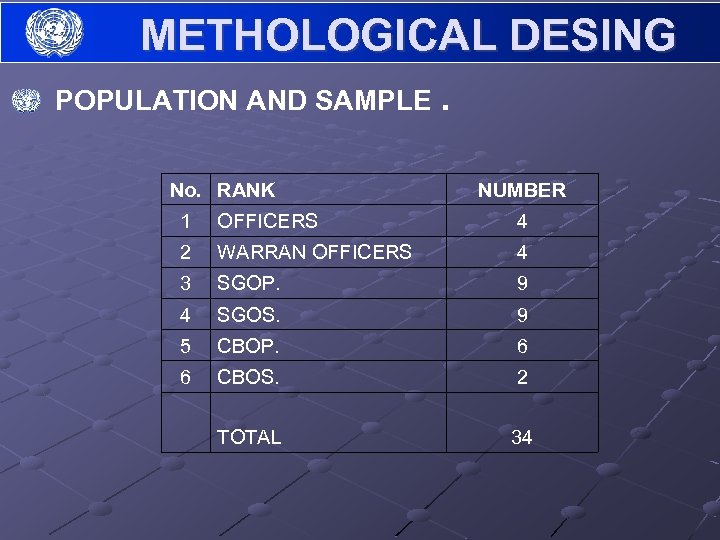
METHOLOGICAL DESING POPULATION AND SAMPLE. No. RANK NUMBER 1 OFFICERS 4 2 WARRAN OFFICERS 4 3 SGOP. 9 4 SGOS. 9 5 CBOP. 6 6 CBOS. 2 TOTAL 34
METHOLOGICAL DESING FIELDING. Inside of Campsite and during the works. INSTRUMENTS FOR DATA COLLECTION. In situ PROCESSING AND ANALYSIS.
ADMINISTRATIVE FRAME MATERIAL RESOURCES HUMAN COMPETENCES BUDGET
TESTING THE HYPOTHESIS • GRAPHICAL EXPOSITION OF RESULTS • INTERVIEW • QUESTIONNAIRE
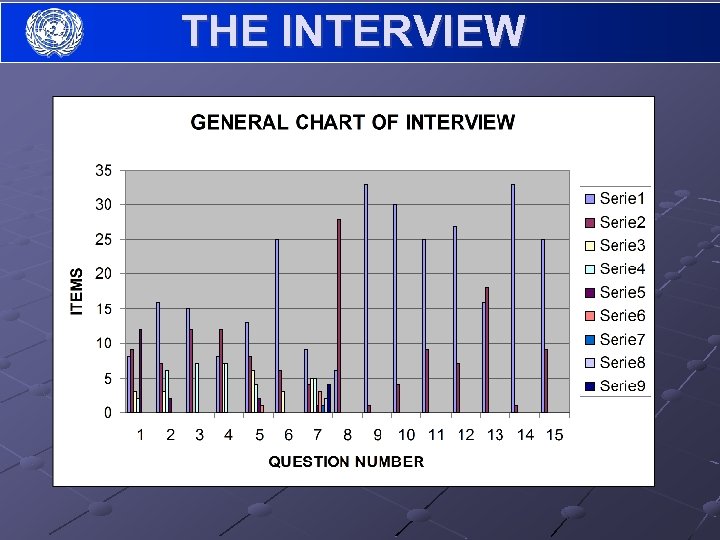
THE INTERVIEW
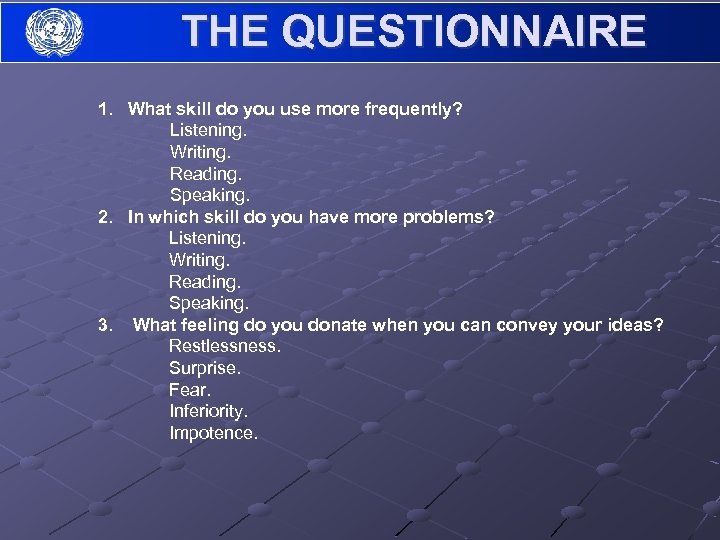
THE QUESTIONNAIRE 1. What skill do you use more frequently? Listening. Writing. Reading. Speaking. 2. In which skill do you have more problems? Listening. Writing. Reading. Speaking. 3. What feeling do you donate when you can convey your ideas? Restlessness. Surprise. Fear. Inferiority. Impotence.
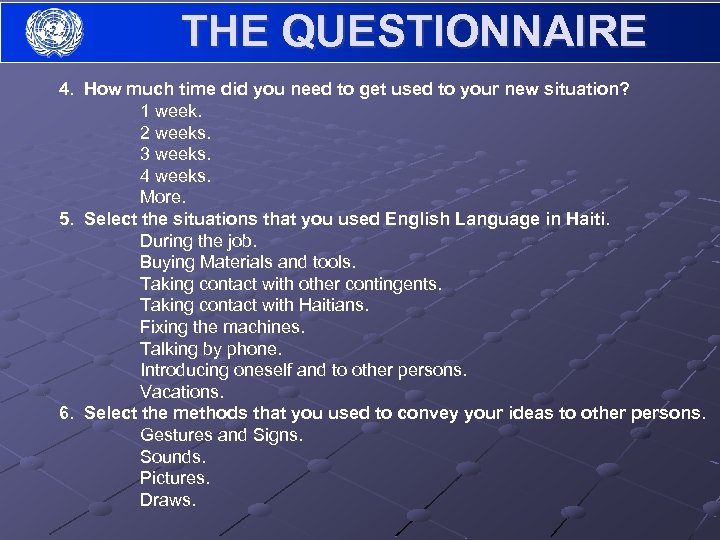
THE QUESTIONNAIRE 4. How much time did you need to get used to your new situation? 1 week. 2 weeks. 3 weeks. 4 weeks. More. 5. Select the situations that you used English Language in Haiti. During the job. Buying Materials and tools. Taking contact with other contingents. Taking contact with Haitians. Fixing the machines. Talking by phone. Introducing oneself and to other persons. Vacations. 6. Select the methods that you used to convey your ideas to other persons. Gestures and Signs. Sounds. Pictures. Draws.
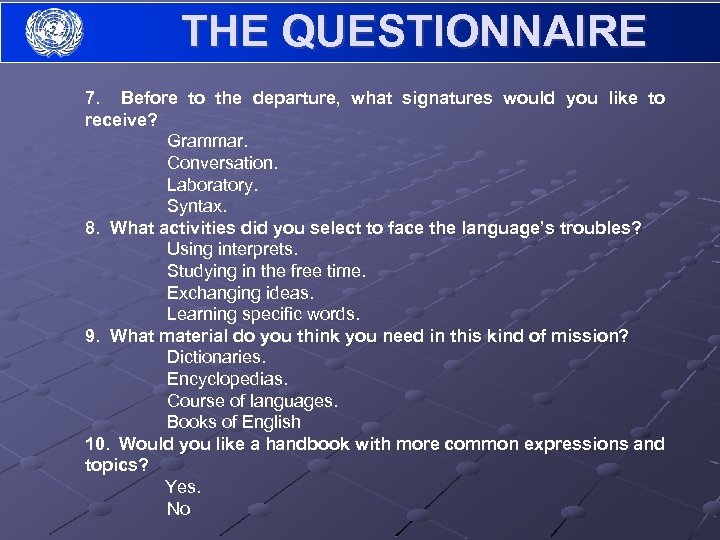
THE QUESTIONNAIRE 7. Before to the departure, what signatures would you like to receive? Grammar. Conversation. Laboratory. Syntax. 8. What activities did you select to face the language’s troubles? Using interprets. Studying in the free time. Exchanging ideas. Learning specific words. 9. What material do you think you need in this kind of mission? Dictionaries. Encyclopedias. Course of languages. Books of English 10. Would you like a handbook with more common expressions and topics? Yes. No
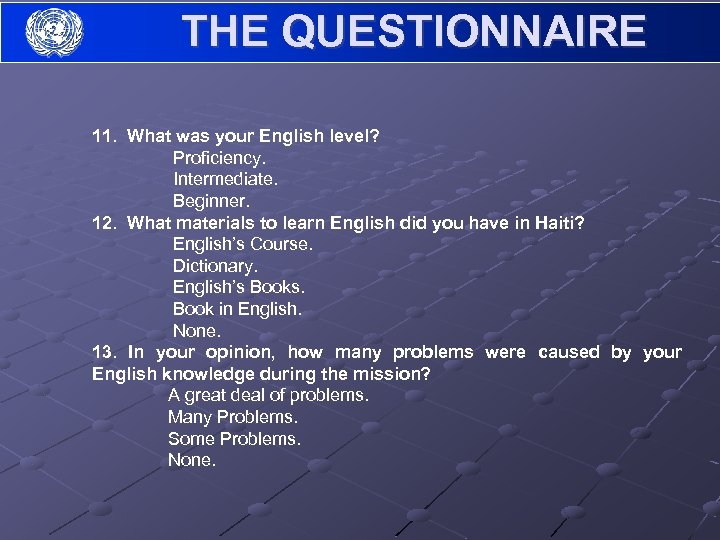
THE QUESTIONNAIRE 11. What was your English level? Proficiency. Intermediate. Beginner. 12. What materials to learn English did you have in Haiti? English’s Course. Dictionary. English’s Books. Book in English. None. 13. In your opinion, how many problems were caused by your English knowledge during the mission? A great deal of problems. Many Problems. Some Problems. None.
THE QUESTIONNAIRE
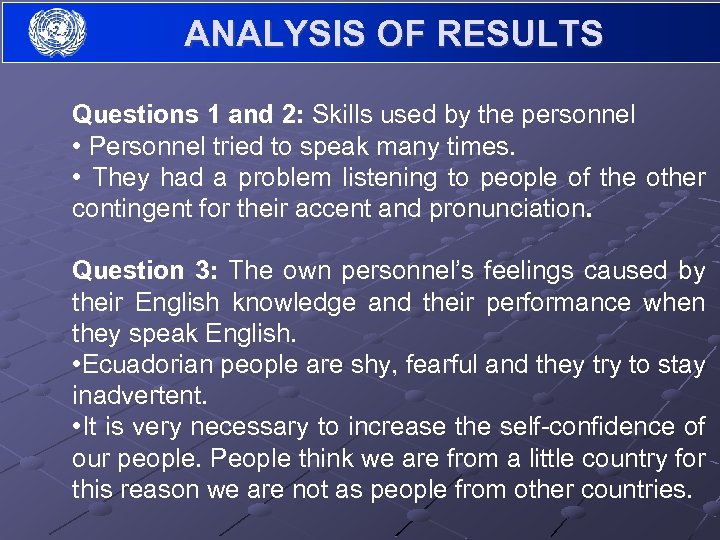
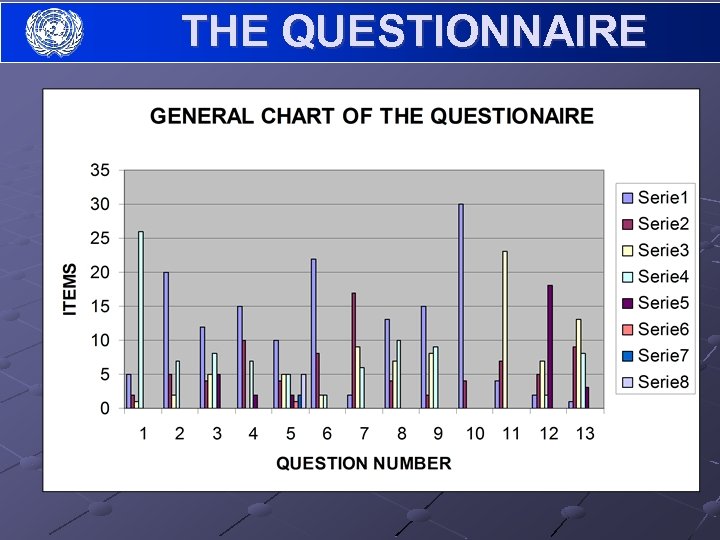
ANALYSIS OF RESULTS Questions 1 and 2: Skills used by the personnel • Personnel tried to speak many times. • They had a problem listening to people of the other contingent for their accent and pronunciation. Question 3: The own personnel’s feelings caused by their English knowledge and their performance when they speak English. • Ecuadorian people are shy, fearful and they try to stay inadvertent. • It is very necessary to increase the self-confidence of our people. People think we are from a little country for this reason we are not as people from other countries.
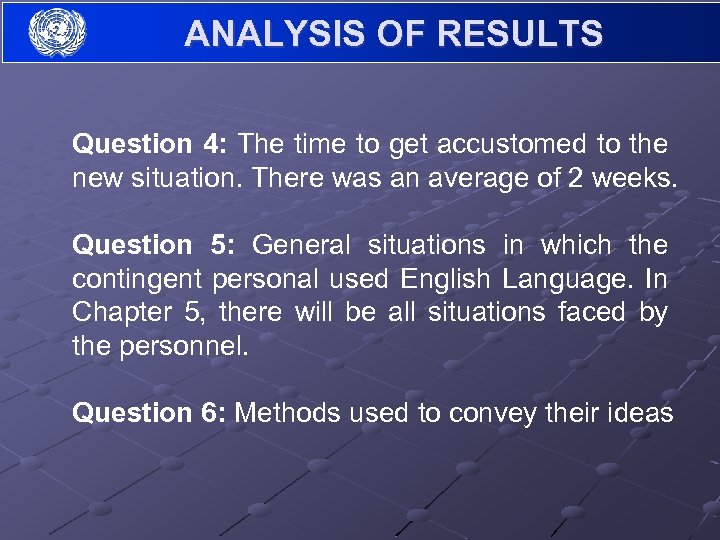
ANALYSIS OF RESULTS Question 4: The time to get accustomed to the new situation. There was an average of 2 weeks. Question 5: General situations in which the contingent personal used English Language. In Chapter 5, there will be all situations faced by the personnel. Question 6: Methods used to convey their ideas
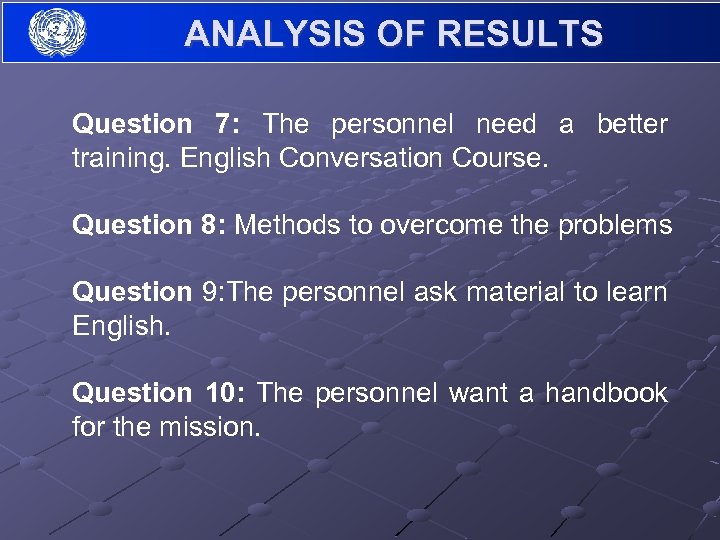
ANALYSIS OF RESULTS Question 7: The personnel need a better training. English Conversation Course. Question 8: Methods to overcome the problems Question 9: The personnel ask material to learn English. Question 10: The personnel want a handbook for the mission.
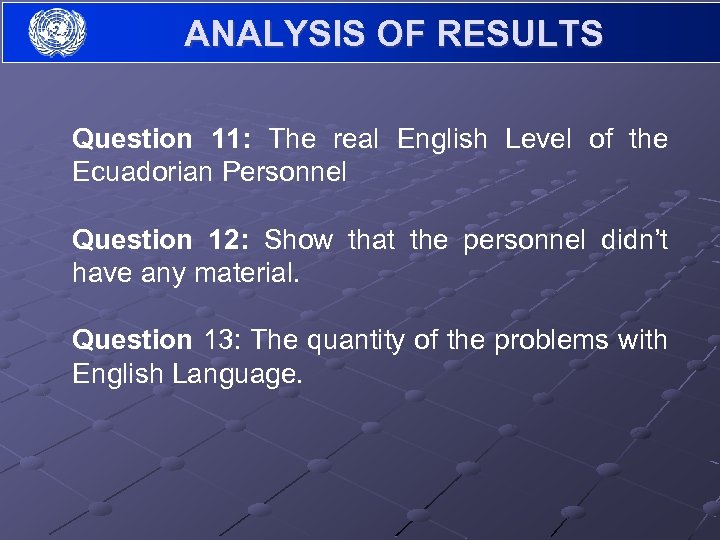
ANALYSIS OF RESULTS Question 11: The real English Level of the Ecuadorian Personnel Question 12: Show that the personnel didn’t have any material. Question 13: The quantity of the problems with English Language.
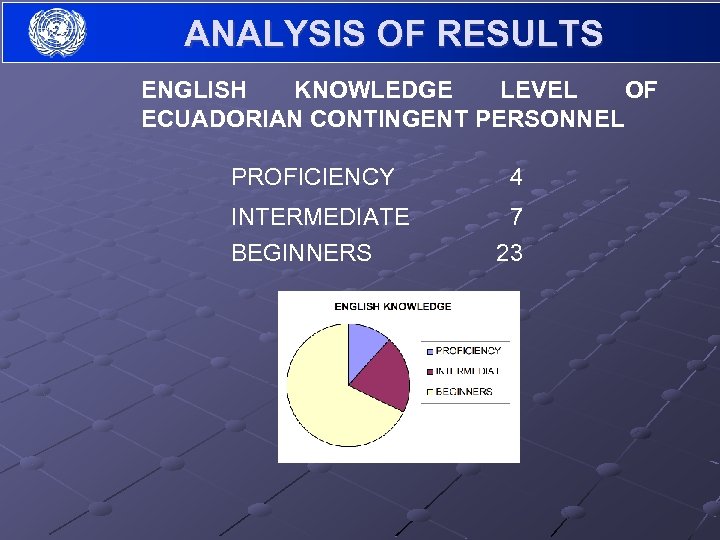
ANALYSIS OF RESULTS ENGLISH KNOWLEDGE LEVEL OF ECUADORIAN CONTINGENT PERSONNEL PROFICIENCY 4 INTERMEDIATE 7 BEGINNERS 23
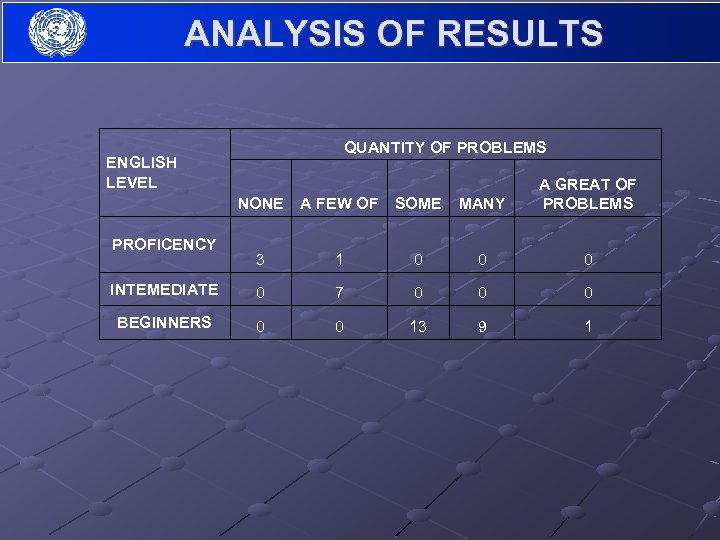
ANALYSIS OF RESULTS QUANTITY OF PROBLEMS ENGLISH LEVEL NONE A FEW OF SOME MANY A GREAT OF PROBLEMS 3 1 0 0 0 INTEMEDIATE 0 7 0 0 0 BEGINNERS 0 0 13 9 1 PROFICENCY
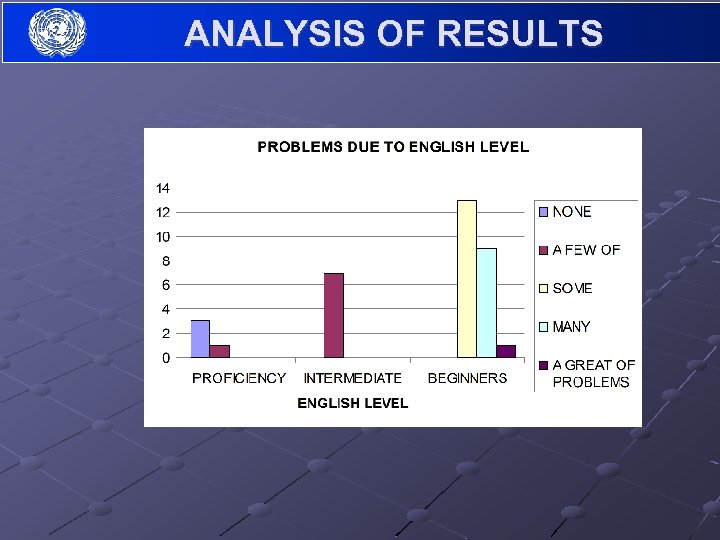
ANALYSIS OF RESULTS
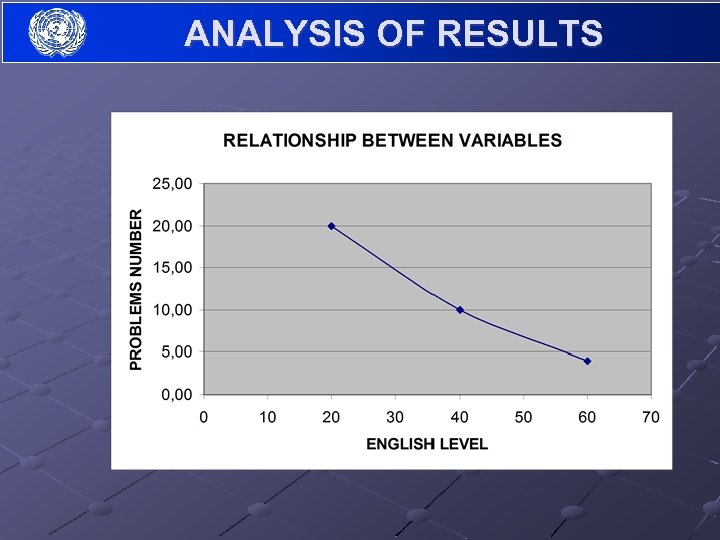
ANALYSIS OF RESULTS
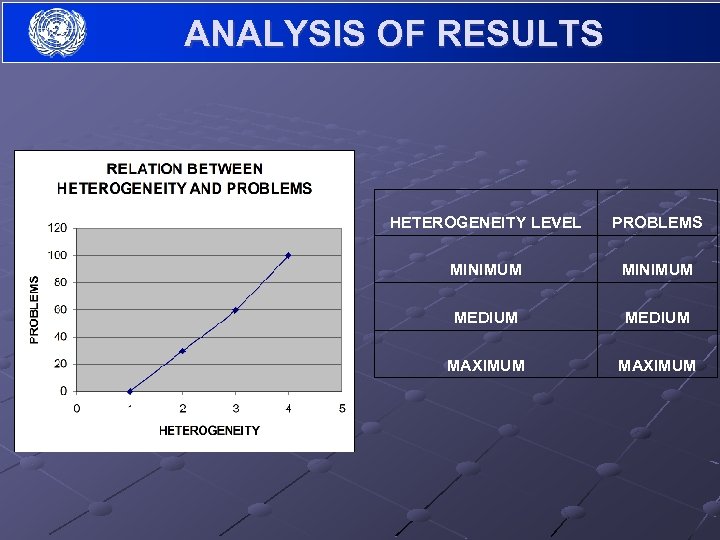
ANALYSIS OF RESULTS HETEROGENEITY LEVEL PROBLEMS MINIMUM MEDIUM MAXIMUM
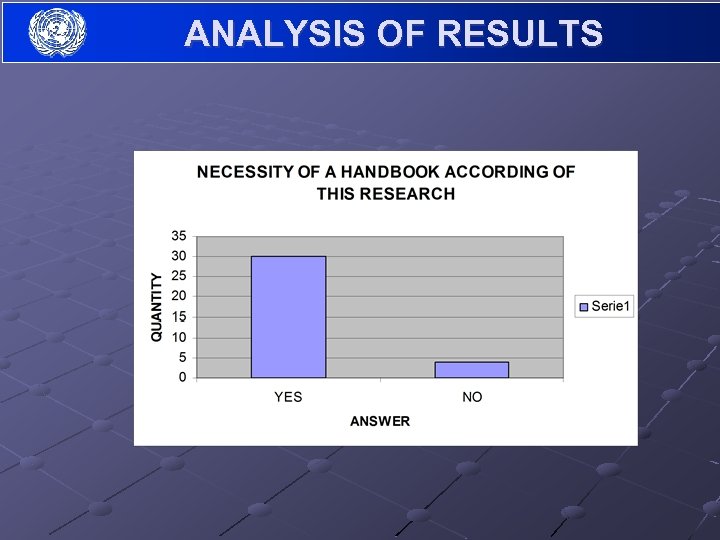
ANALYSIS OF RESULTS
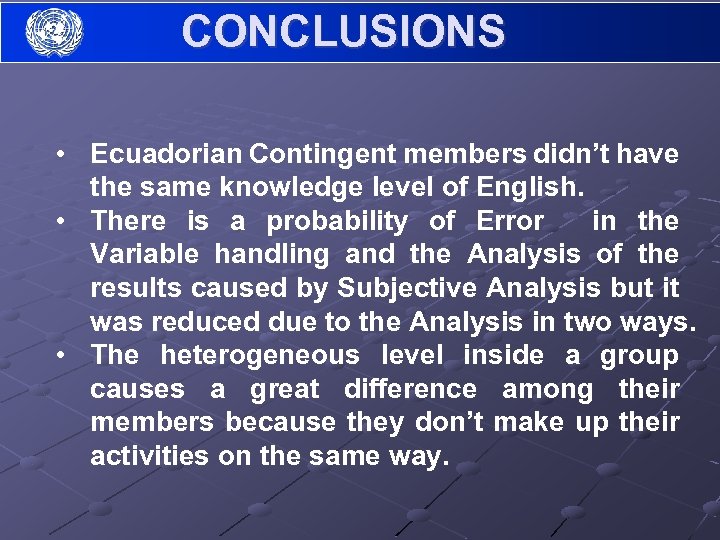
CONCLUSIONS • Ecuadorian Contingent members didn’t have the same knowledge level of English. • There is a probability of Error in the Variable handling and the Analysis of the results caused by Subjective Analysis but it was reduced due to the Analysis in two ways. • The heterogeneous level inside a group causes a great difference among their members because they don’t make up their activities on the same way.
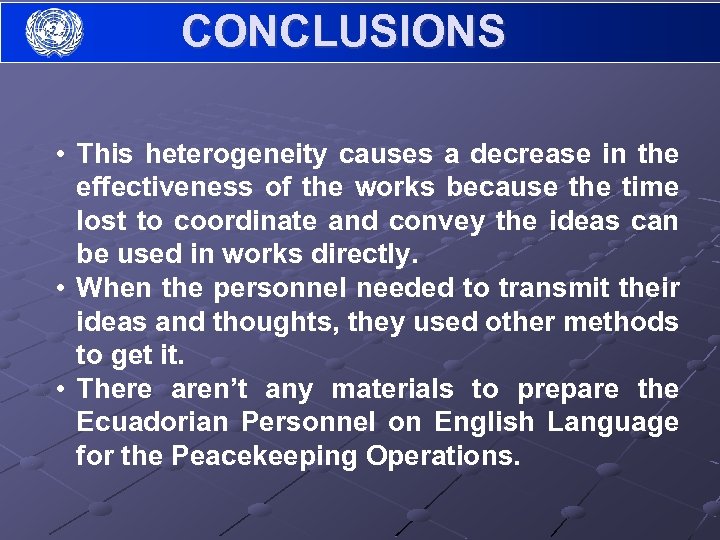
CONCLUSIONS • This heterogeneity causes a decrease in the effectiveness of the works because the time lost to coordinate and convey the ideas can be used in works directly. • When the personnel needed to transmit their ideas and thoughts, they used other methods to get it. • There aren’t any materials to prepare the Ecuadorian Personnel on English Language for the Peacekeeping Operations.
RECOMENDATIONS • English Course to the Ecuadorian Personnel. • To improve the process of the personnel selection for the mission including aspects like the knowledge of English that would allow a better execution of the works during the mission time. • Army Polytechnic School and Peacekeeping Operations Unit School of Ecuador can help to diminish the heterogeneity among the members of Ecuadorian Contingent and to increase the group’s effectiveness.
RECOMENDATIONS • Peacekeeping Operations Unit School of Ecuador can give the Handbook elaborated in this research so the personnel can learn something during their free time during the mission. • Ecuadorian Armed Forces can send an English Teacher with the Contingent so he can teach English Language in the campsite. • The personnel have to receive some lectures to learn some methods to convey their ideas.
RECOMENDATIONS • Peacekeeping Operations Unit School of Ecuador should make up a pursuit of this research when they give the handbook and verify its effectiveness. With these results, the school can improve its courses. • Each contingent should buy new material and transport with them; the next contingents could acquire English Courses and additional material to learn this language and take advantage of the time.
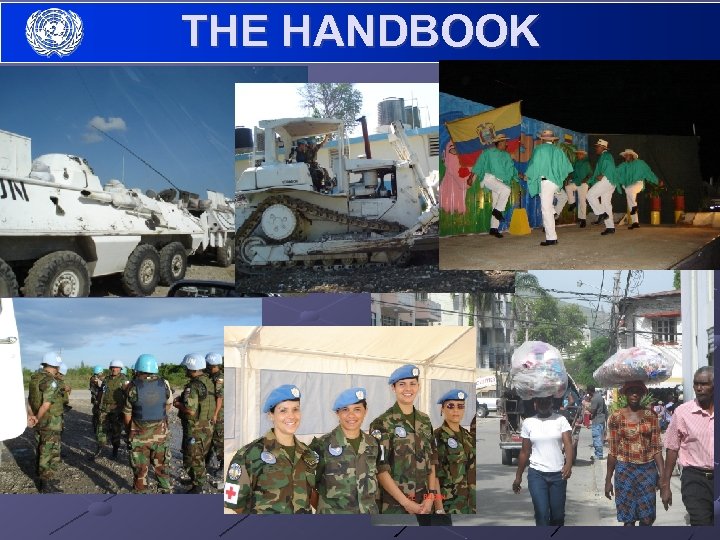
THE HANDBOOK
HANDBOOK This work has been made up for the personnel of the Ecuadorian Contingent that fulfill Peacekeeping Operations in the Republic of Haiti in order to increase their efficiency in the works and to allow a better communication with the contingents during its daily activities.
INTRODUCTION 7 CHAPTERS • Chart with the main expressions, their translation and pronunciation in English Language. • Dialogues with the main sentences and idioms in the English Language. • Readings with topics so that the personnel increases their general culture about the country where they will work, to live and to cohabit with other armies and people.
JUSTIFICATION This Handbook is the first one made in the Ecuador, for Ecuadorian personnel and to the Ecuadorian Contingent fulfils Peacekeeping Operations in the Republic of Haiti. The personnel of the next contingents will be the main beneficiaries because in the handbook, they will find many words, expressions, readings and dialogs that can uses in their daily activities.
OBJECTIVES General Objective. To provide a handbook for the personnel of the Ecuadorian Contingent fulfill Peacekeeping Operations in the Republic of Haiti in order to improve their efficiency and effectiveness in the works and to allow a better communication with the other contingents in their daily activities.
OBJECTIVES Specific Objectives. • To teach some common words, expressions and sentences in English Language. • To increase the culture of the Ecuadorian Contingent personnel. • To improve the personnel communication in English.
HANDBOOK CHAPTERS 1. Military 2. During the Works 3. With other Contingents. 4. Going Shopping. 5. On Vacations. 6. Using Internet. 7. Body Language. CONCLUSIONS RECOMENDATIONS
MILITARY 1. 1 Operations. 1. 1. 1 Offensive Operations. 1. 1. 2 Defensive Operations. 1. 1. 3 Security’s Operations. 1. 1. 4 Commands. 1. 1. 5 Common Expressions. 1. 1. 6 Common Words. 1. 1. 6 Military Ranks. 1. 1. 7 Specialty. 1. 1. 8 Countries. 1. 2 Military Equipment. 1. 2. 1 Equipment’s table. 1. 2. 2 Combustibles and Lubricants. 1. 2. 3 Special Equipment. 1. 2. 4 Ammunition and Explosives. 1. 2. 5 Vehicles.
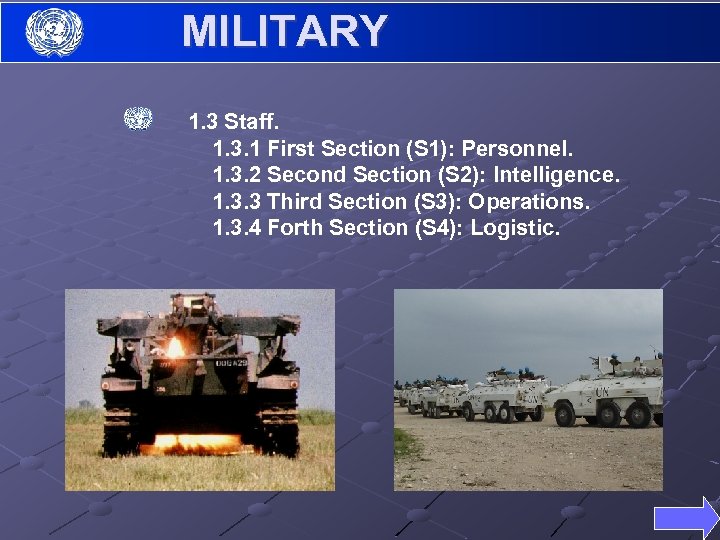
MILITARY 1. 3 Staff. 1. 3. 1 First Section (S 1): Personnel. 1. 3. 2 Second Section (S 2): Intelligence. 1. 3. 3 Third Section (S 3): Operations. 1. 3. 4 Forth Section (S 4): Logistic.
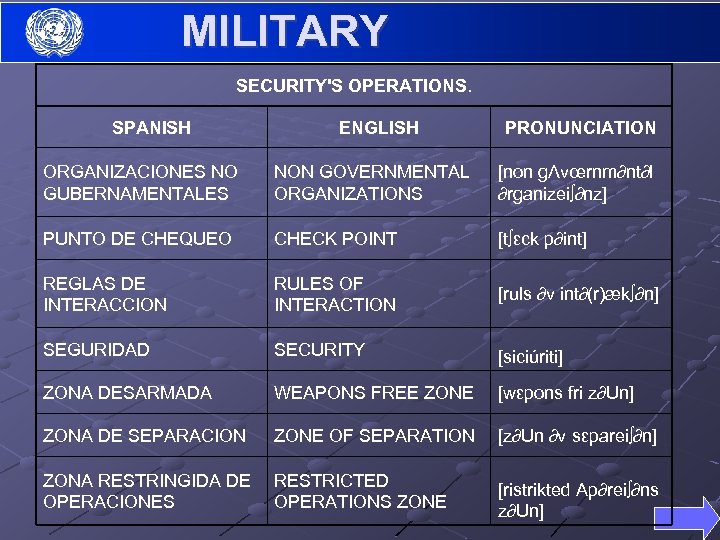
MILITARY SECURITY'S OPERATIONS. SPANISH ENGLISH PRONUNCIATION ORGANIZACIONES NO GUBERNAMENTALES NON GOVERNMENTAL ORGANIZATIONS [non gΛvœrnm∂nt∂l ∂rganizei∫∂nz] PUNTO DE CHEQUEO CHECK POINT [t∫εck p∂int] REGLAS DE INTERACCION RULES OF INTERACTION [ruls ∂v int∂(r)æk∫∂n] SEGURIDAD SECURITY [siciúriti] ZONA DESARMADA WEAPONS FREE ZONE [wεpons fri z∂Un] ZONA DE SEPARACION ZONE OF SEPARATION [z∂Un ∂v sεparei∫∂n] ZONA RESTRINGIDA DE OPERACIONES RESTRICTED OPERATIONS ZONE [ristrikted Ap∂rei∫∂ns z∂Un]
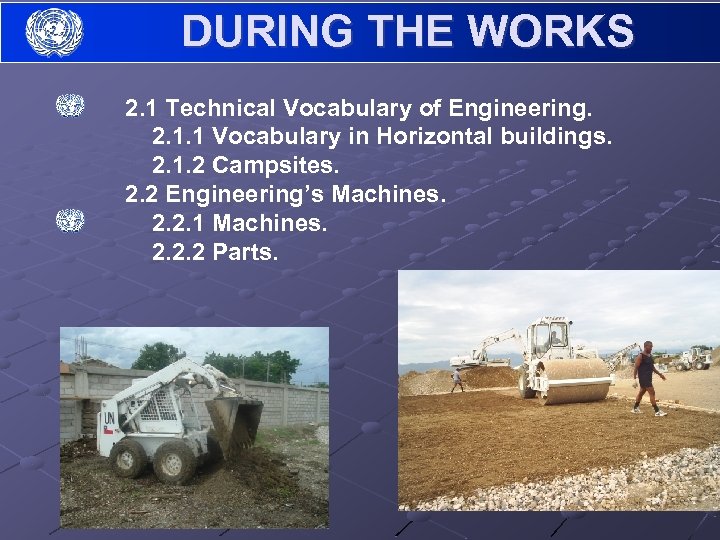
DURING THE WORKS 2. 1 Technical Vocabulary of Engineering. 2. 1. 1 Vocabulary in Horizontal buildings. 2. 1. 2 Campsites. 2. 2 Engineering’s Machines. 2. 2. 1 Machines. 2. 2. 2 Parts.
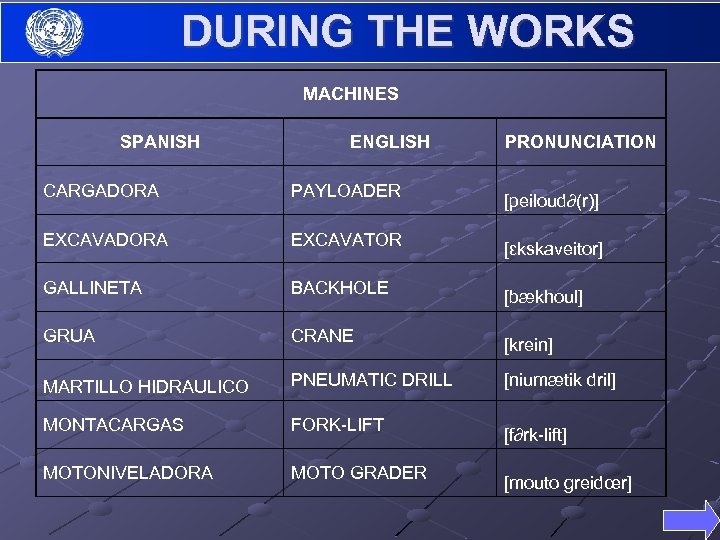
DURING THE WORKS MACHINES SPANISH ENGLISH CARGADORA PAYLOADER EXCAVADORA EXCAVATOR GALLINETA BACKHOLE GRUA CRANE MARTILLO HIDRAULICO PNEUMATIC DRILL MONTACARGAS FORK-LIFT MOTONIVELADORA MOTO GRADER PRONUNCIATION [peiloud∂(r)] [εkskaveitor] [bækhoul] [krein] [niumætik dril] [f∂rk-lift] [mouto greidœr]
WITH OTHER CONTINGENTES HAITI
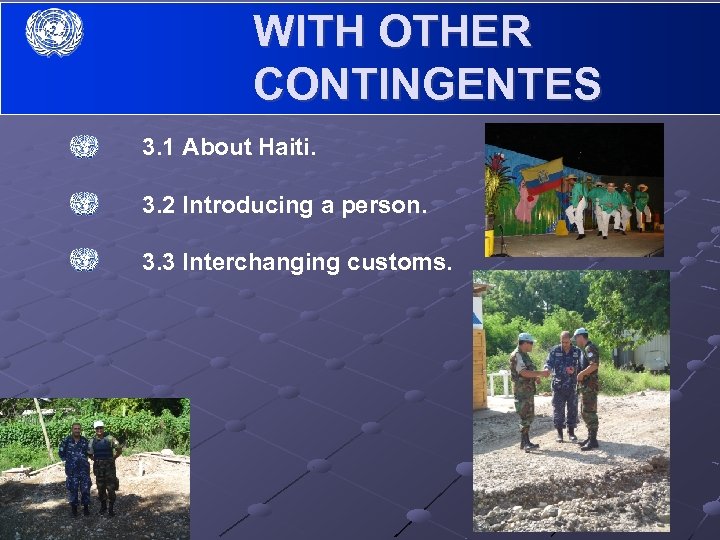
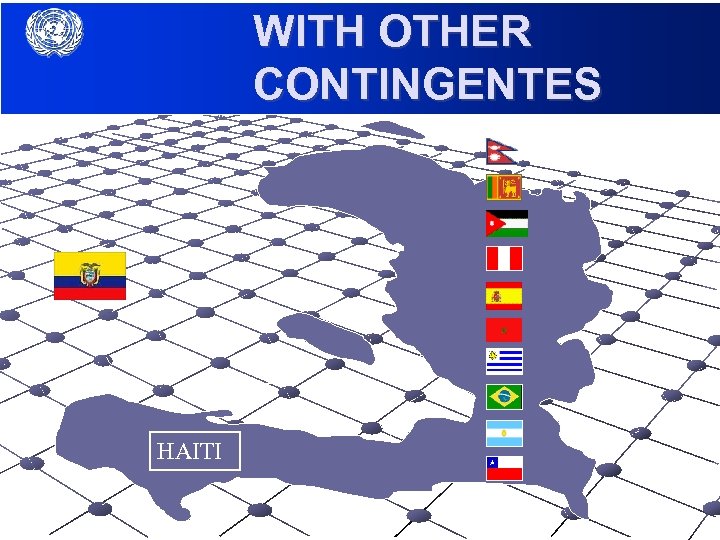
WITH OTHER CONTINGENTES 3. 1 About Haiti. 3. 2 Introducing a person. 3. 3 Interchanging customs.
WITH OTHER CONTINGENTES Dialog Ecuadorian: Hello, I am Sergeant Carlos Cabezas. Jordanian: Hello, I am Sergeant Mijeel. Ecuadorian: I am from Ecuador. Jordanian: Oh. I am from Jordan. Ecuadorian: Glad to meet you. Jordanian: Glad to meet you, too. Ecuadorian: I am serving in Ecuadorian Contingent. Jordanian: Very well. I am serving in Force Police Unit of United Nations. Ecuadorian: I am working in your campsite in this moment. Jordanian: I know that. I saw you yesterday. Ecuadorian: Ok, bye. Jordanian: Ok, see you later.

GOING SHOPPING 4. 1 In a Store. 4. 2 Paying a bill.
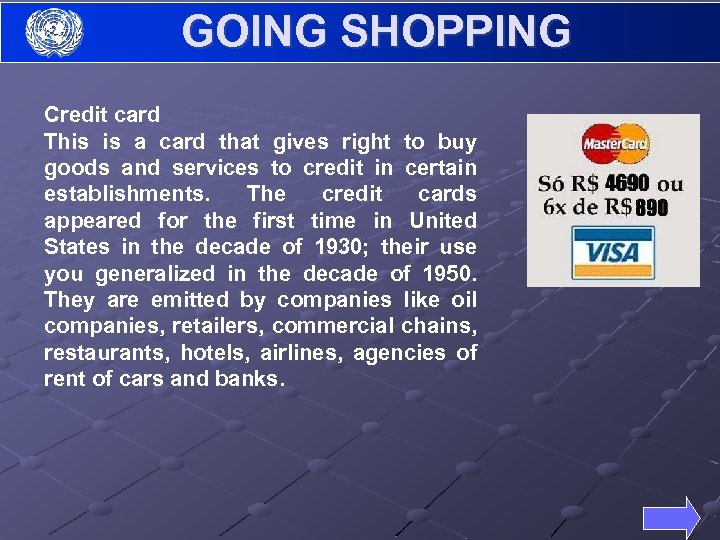
GOING SHOPPING Credit card This is a card that gives right to buy goods and services to credit in certain establishments. The credit cards appeared for the first time in United States in the decade of 1930; their use you generalized in the decade of 1950. They are emitted by companies like oil companies, retailers, commercial chains, restaurants, hotels, airlines, agencies of rent of cars and banks.
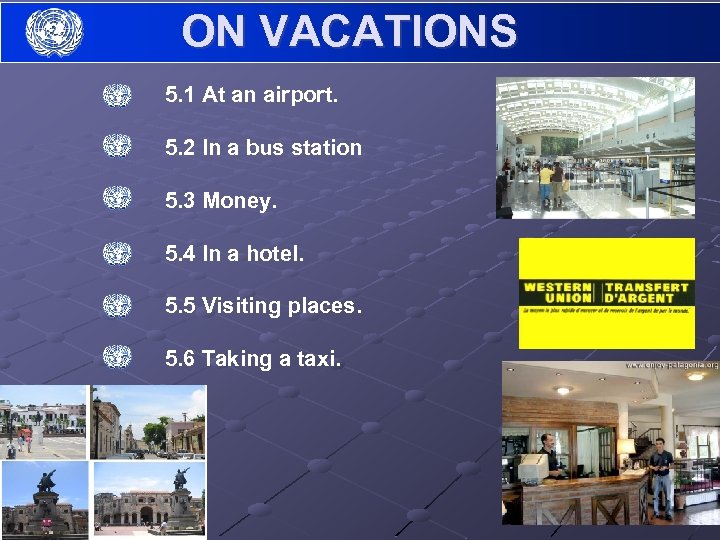
ON VACATIONS 5. 1 At an airport. 5. 2 In a bus station 5. 3 Money. 5. 4 In a hotel. 5. 5 Visiting places. 5. 6 Taking a taxi.
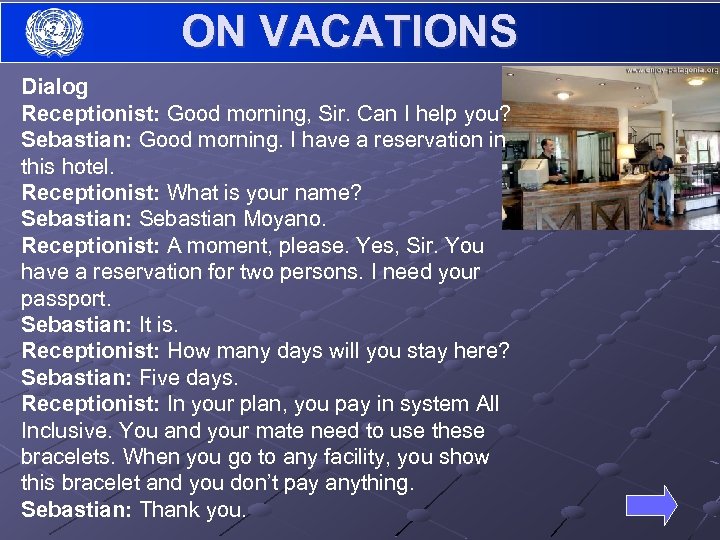
ON VACATIONS Dialog Receptionist: Good morning, Sir. Can I help you? Sebastian: Good morning. I have a reservation in this hotel. Receptionist: What is your name? Sebastian: Sebastian Moyano. Receptionist: A moment, please. Yes, Sir. You have a reservation for two persons. I need your passport. Sebastian: It is. Receptionist: How many days will you stay here? Sebastian: Five days. Receptionist: In your plan, you pay in system All Inclusive. You and your mate need to use these bracelets. When you go to any facility, you show this bracelet and you don’t pay anything. Sebastian: Thank you.
USING INTERNET Internet was the most important means that the personnel used to communicate with their families. Many people didn’t know how to use it but they learned by practice. The Internet has its own language and special terms for this reason I consider a special point for it.
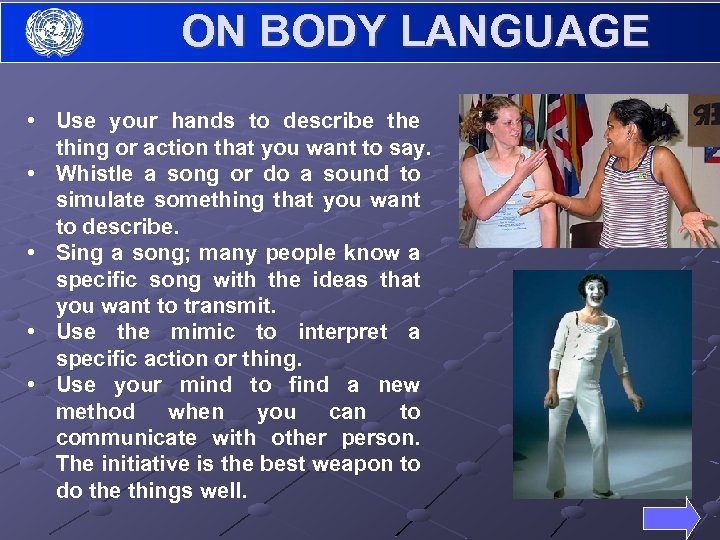
ON BODY LANGUAGE • Use your hands to describe thing or action that you want to say. • Whistle a song or do a sound to simulate something that you want to describe. • Sing a song; many people know a specific song with the ideas that you want to transmit. • Use the mimic to interpret a specific action or thing. • Use your mind to find a new method when you can to communicate with other person. The initiative is the best weapon to do the things well.
CONCLUSIONS • • This Handbook was elaborated for the Personnel of the Ecuadorian Contingent that fulfill Peacekeeping Operations in the Republic of Haiti and contains words, expressions, sentences, dialogues and readings that the personnel can use during the execution of the different works and their daily activities. This manual has not still been evaluated because it was made up when the contingent returned to Ecuador.
RECOMMENDATIONS • It is necessary to carry out a pursuit in the employment of this manual to perfect it with the personnel that are in Haiti. • The next contingents can include a person that has the knowledge for the evaluation of this Handbook and organizes courses and teaches the English Language to the personnel in Haiti. • Using this handbook, the personnel can learn English Language and practice all time.
THE PEACEKEEPING OPERATIONS ARE NOT FOR THE SOLDIERS BUT THEY ONLY CAN DO THEM THANK YOU
Скачать презентацию ELABORATION OF A HANDBOOK IN ENGLISH LANGUAGE FOR
c2ce26aa671c622656cadf1ad0e7361f.ppt