


 Скачать презентацию Егорова Людмила Алексеевна ИИЯ egorova_la pfur ru legorova mail ru
6b63f0a74d4a3375175a549c3c9335ba.ppt
- Количество слайдов: 66
 Егорова Людмила Алексеевна ИИЯ egorova_la@pfur. ru legorova@mail. ru ауд. 404
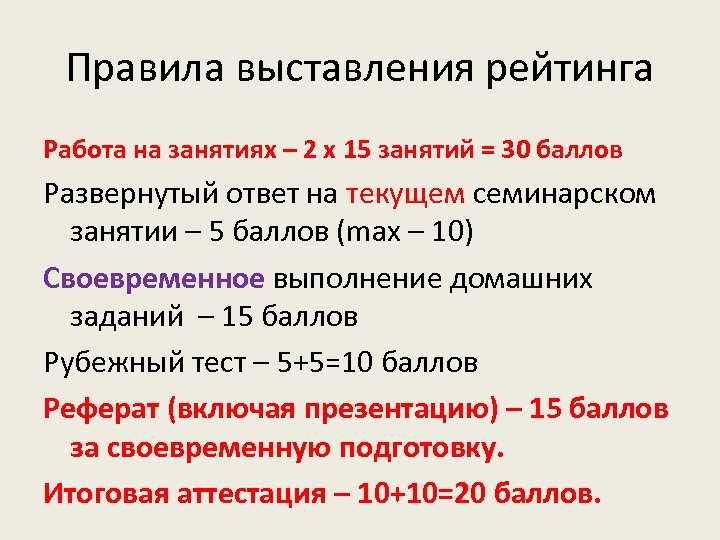 Правила выставления рейтинга Работа на занятиях – 2 х 15 занятий = 30 баллов Развернутый ответ на текущем семинарском занятии – 5 баллов (max – 10) Своевременное выполнение домашних заданий – 15 баллов Рубежный тест – 5+5=10 баллов Реферат (включая презентацию) – 15 баллов за своевременную подготовку. Итоговая аттестация – 10+10=20 баллов.
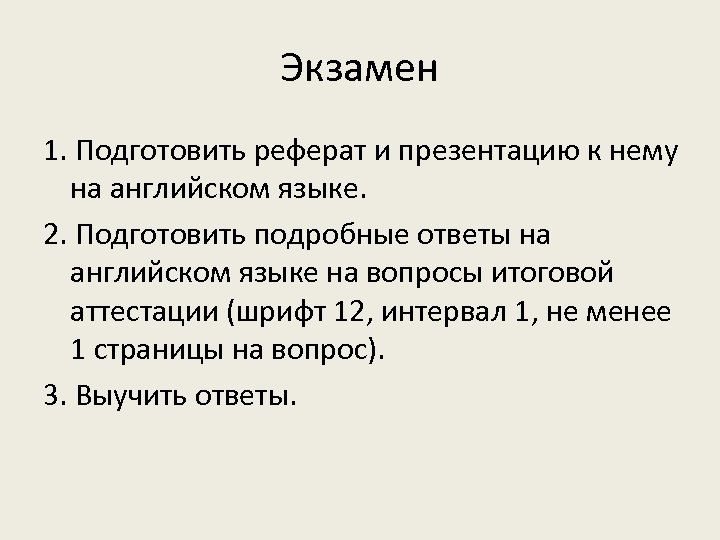 Экзамен 1. Подготовить реферат и презентацию к нему на английском языке. 2. Подготовить подробные ответы на английском языке на вопросы итоговой аттестации (шрифт 12, интервал 1, не менее 1 страницы на вопрос). 3. Выучить ответы.
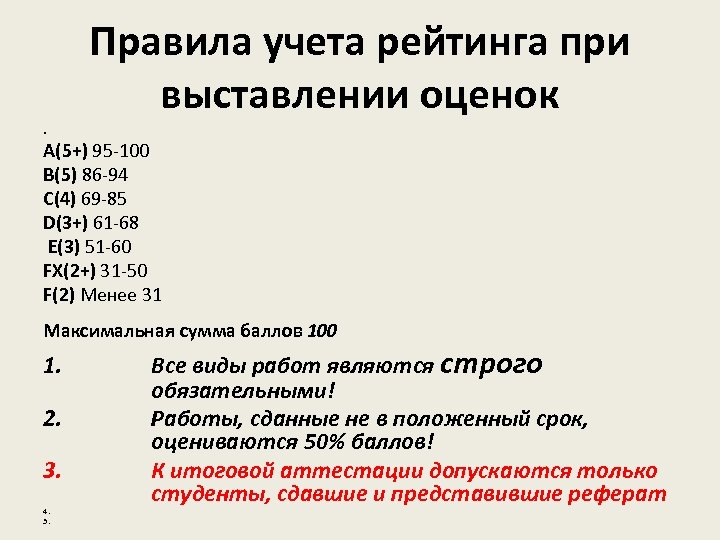 Правила учета рейтинга при выставлении оценок • A(5+) 95 -100 B(5) 86 -94 C(4) 69 -85 D(3+) 61 -68 E(3) 51 -60 FX(2+) 31 -50 F(2) Менее 31 Максимальная сумма баллов 100 1. 2. 3. 4. 5. Все виды работ являются строго обязательными! Работы, сданные не в положенный срок, оцениваются 50% баллов! К итоговой аттестации допускаются только студенты, сдавшие и представившие реферат
 Требования к оформлению реферата (1) • Структура реферата включает: – Титульный лист – Содержание – Введение – Основная часть – Заключение – Список использованной литературы и источников (не менее 15 по теме, из них ссылки на 6, учебники не использовать)
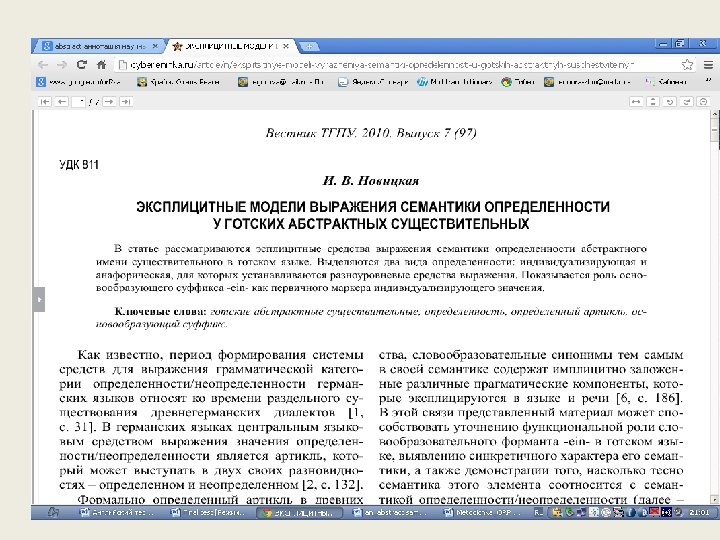
 Useful Links • http: //linguistlist. org/pubs/publisherdetail. cfm? Payer. ID=27305 • http: //shop. ebrary. com/home. action • http: //journalseek. net/
 Требования к оформлению реферата (2) • Список использованной литературы дается в алфавитном порядке и должен содержать не менее 15 источников, оформляется согласно ГОСТ Р 7. 0. 5. – 2008. • В тексте реферата каждому из разделов должен предшествовать заголовок.
 Описание книги с одним, двумя и более авторами • Мухина В. С. Возрастная психология. - М. : Академия, 1997. - 432 с. • Волков Б. С. , Волкова Н. В. Детская психология в вопросах. - М. : Сфера, 2004. - 256 с. • Орлов Ю. М. и др. Психологические основы воспитания и самовоспитания / Ю. М. Орлов, Н. Д. Творогова, И. И. Косарев. - М. : Педагогика, 1994. - 60 с. • Примечание: более подробное перечисление авторов производится в сведениях, относящихся к заглавию после косой черты.
 Сборник работ разных авторов с общим заглавием • Психология детства: Учебник / Под ред. А. А. Реана - СПб. : Прайм-ЕВРО-ЗНАК, 2003. - 368 с. • Практикум по возрастной психологии / Под ред. Л. А. Головей, Е. Ф. Рыбалко. - СПб. : Речь, 2001. - 688 с.
 Многотомное издание • Самойлов Д. С. Избранные произведения: В 2 т. / Вступ. ст. И. Иванова. - М. : Худож. лит. , 1994. - Т. 1 -2.
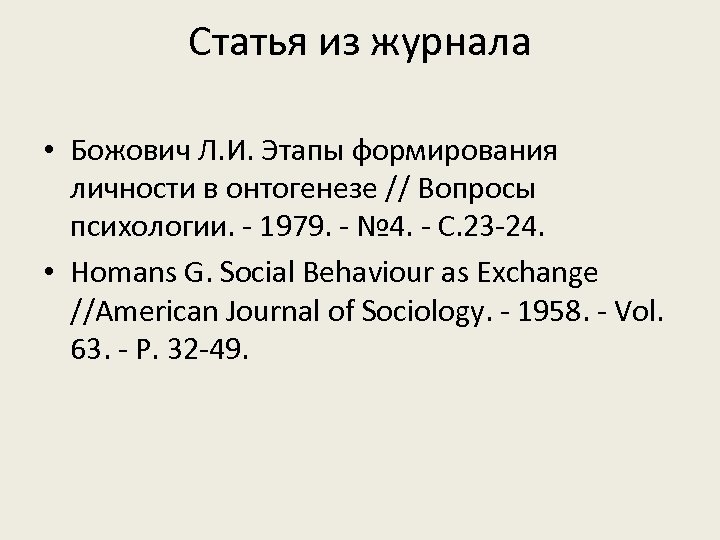 Статья из журнала • Божович Л. И. Этапы формирования личности в онтогенезе // Вопросы психологии. - 1979. - № 4. - С. 23 -24. • Homans G. Social Behaviour as Exchange //American Journal of Sociology. - 1958. - Vol. 63. - P. 32 -49.
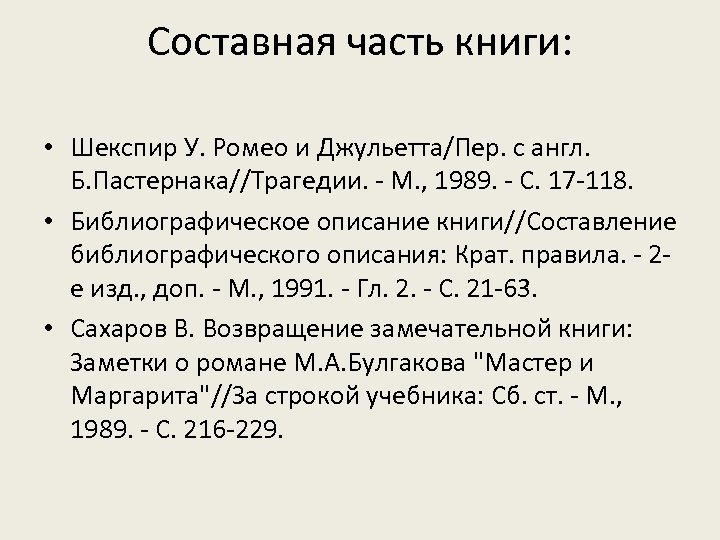 Cоставная часть книги: • Шекспир У. Ромео и Джульетта/Пер. с англ. Б. Пастернака//Трагедии. - М. , 1989. - С. 17 -118. • Библиографическое описание книги//Составление библиографического описания: Крат. правила. - 2 е изд. , доп. - М. , 1991. - Гл. 2. - С. 21 -63. • Сахаров В. Возвращение замечательной книги: Заметки о романе М. А. Булгакова "Мастер и Маргарита"//За строкой учебника: Сб. ст. - М. , 1989. - С. 216 -229.
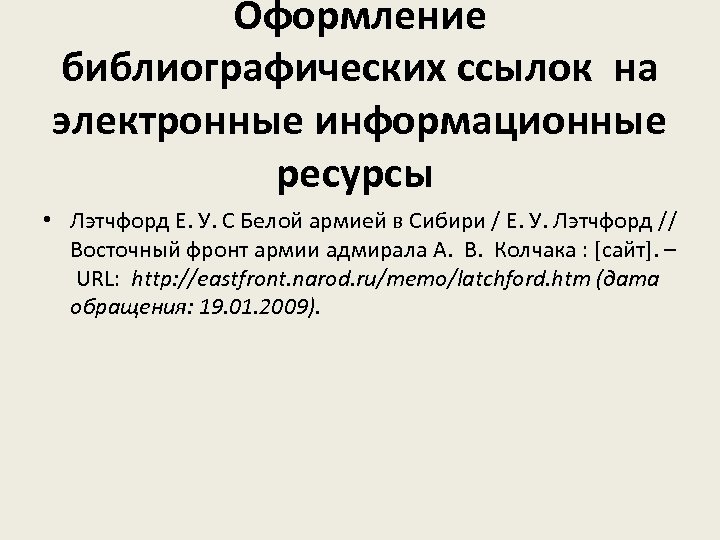 Оформление библиографических ссылок на электронные информационные ресурсы • Лэтчфорд Е. У. С Белой армией в Сибири / Е. У. Лэтчфорд // Восточный фронт армии адмирала А. В. Колчака : [сайт]. – URL: http: //eastfront. narod. ru/memo/latchford. htm (дата обращения: 19. 01. 2009).
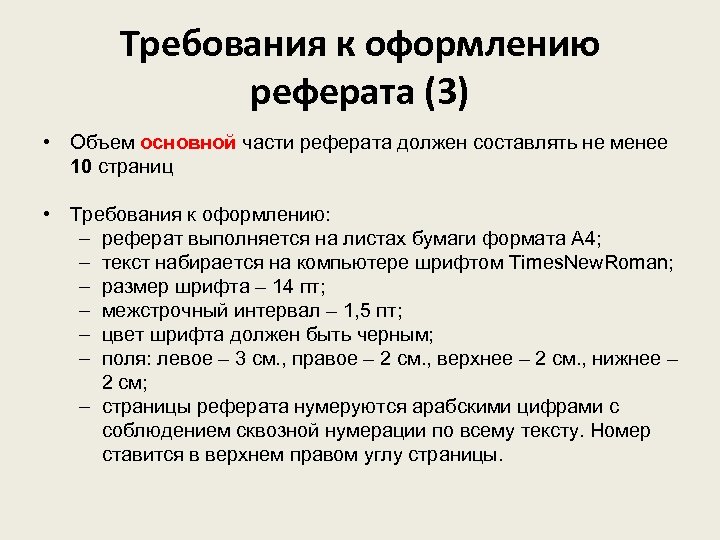 Требования к оформлению реферата (3) • Объем основной части реферата должен составлять не менее 10 страниц • Требования к оформлению: – реферат выполняется на листах бумаги формата А 4; – текст набирается на компьютере шрифтом Times. New. Roman; – размер шрифта – 14 пт; – межстрочный интервал – 1, 5 пт; – цвет шрифта должен быть черным; – поля: левое – 3 см. , правое – 2 см. , верхнее – 2 см. , нижнее – 2 см; – страницы реферата нумеруются арабскими цифрами с соблюдением сквозной нумерации по всему тексту. Номер ставится в верхнем правом углу страницы.
 Методические рекомендации по написанию рефератов • Реферат – это краткое изложение в письменном виде содержания книги, научной работы, результатов изучения научной проблемы. Цель написания реферата – осмысленное систематическое изложение крупной научной проблемы, темы, приобретение навыка «сжатия» информации, выделения в теме главного, а также освоение приемов работы с научной и учебной литературой, приобретение практики правильного оформления текстов научноинформационного характера.
 Library-research paper Рекомендуемый объем реферата – от 10 страниц (без библиографического списка литературы). В структуре реферата должны быть представлены: – – – титульный лист, оглавление, введение с указанием цели и задач работы – 1 стр. , реферативный раздел с обязательной рубрикацией – от 10 стр. , заключение и выводы – 1 стр. , список литературы. Следует обратить внимание на правильное оформление текста реферата, ссылок, цитат, списка литературы, который должен быть оформлен в сроки, предусмотренные учебным графиком (до 1 мая).
 Примерная тематика рефератов по курсу «Лексикология» • • • Interrelation of causes, nature and results of semantic change of meaning. Historical changeability of semantic structure. Polysemy and homonymy: etymological and semantic criteria. Interrelation of denotational and connotational meanings of synonyms. Etymological analysis of lexical suppletion in word families. Extra-linguistic context in determining the meaning of the word. Analysis of semantic classification of vocabulary items. Phraseological units versus free word-groups. Phraseological units and proverbs. Phraseology as a subsystem of language. Derivational patterns as meaningful arrangements of various types of ICs.
 Tips for presenting ideas

 Presentations • Many people feel the need to fill their Power. Point slides with long and complicated messages • There seems to be a need to include every last word and detail on the slide and cover every last piece of space with text • Many people tend to use the screen a script for themselves and read the entire message to their audience (who can presumably read for themselves) • This usually leaves the presenter with their back to their audience so they have no eye contact or interaction and the audience is missing much of what is being said as the words are being spoken to the wall • Humans find it very difficult to read and listen and learn all at the same time, therefore much of what you are saying, showing or hoping your audience will take away with them is wasted and you might as well give up now
 • According to the Ministry of Labour survey, 72% of part-time workers are women
 72% of part time workers are women
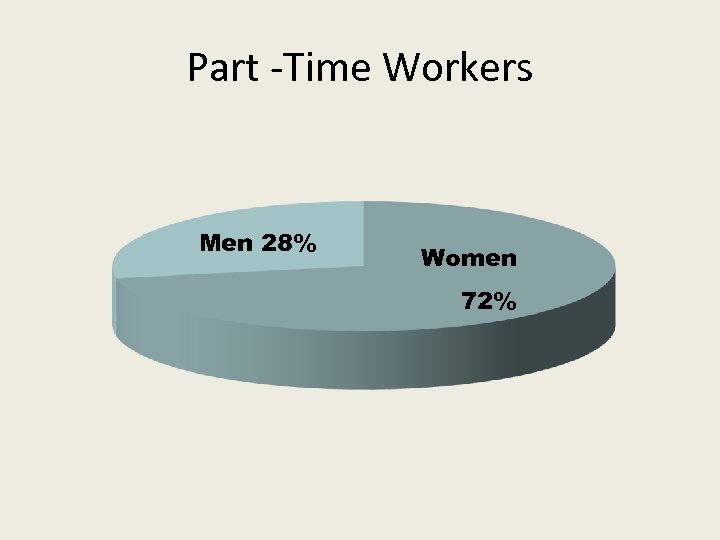 Part -Time Workers Men 28% Women 72%
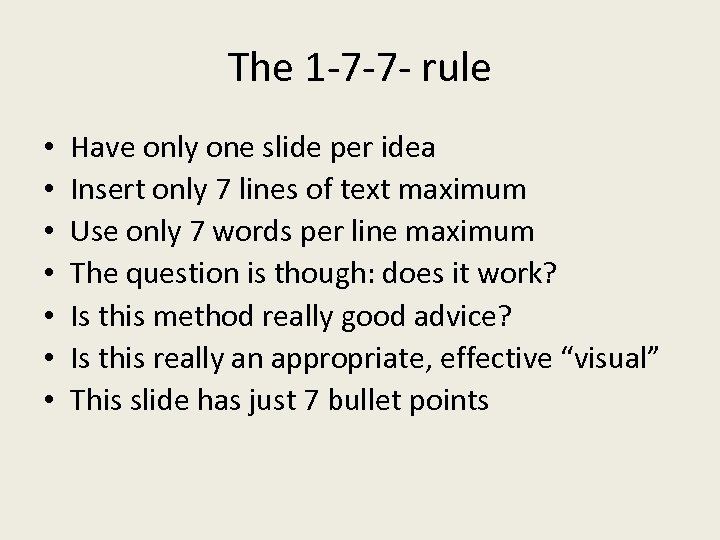 The 1 -7 -7 - rule • • Have only one slide per idea Insert only 7 lines of text maximum Use only 7 words per line maximum The question is though: does it work? Is this method really good advice? Is this really an appropriate, effective “visual” This slide has just 7 bullet points
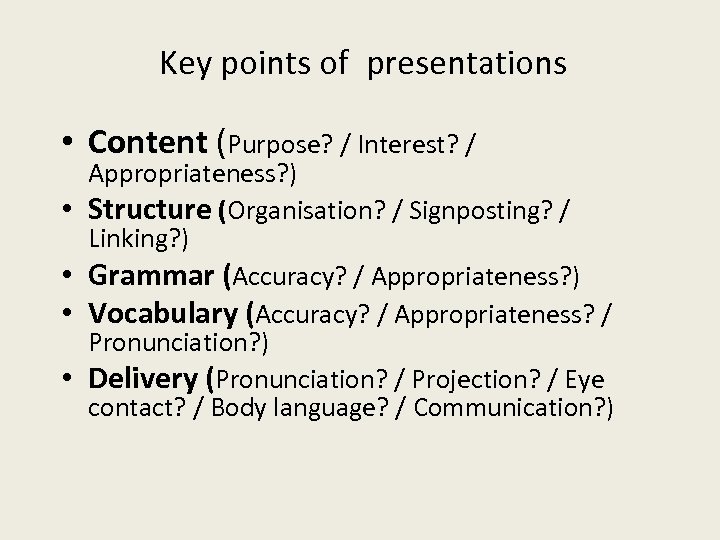 Key points of presentations • Content (Purpose? / Interest? / • • Appropriateness? ) Structure (Organisation? / Signposting? / Linking? ) Grammar (Accuracy? / Appropriateness? ) Vocabulary (Accuracy? / Appropriateness? / Pronunciation? ) Delivery (Pronunciation? / Projection? / Eye contact? / Body language? / Communication? )
 Preparation is the key to success “If I had eight hours to chop down a tree, I’d spend six sharpening my axe” Abraham Lincoln
 delivery tip # 9 Be professional.
 delivery tip #8 Limit the barriers.
 delivery tip #7 Make eye contact.
 delivery tip #6 Be natural.
 delivery tip #5 Keep it short.
 delivery tip #4 Start strong.
 delivery tip #3 Close strong.
 delivery tip #2 Show confidence.
 delivery tip #1 Show your passion.

 ТЕМА 1. СОДЕРЖАНИЕ И ЗАДАЧИ ПРЕДМЕТА ЛЕКСИКОЛОГИИ. СВЯЗЬ ЛЕКСИКОЛОГИИ С ДРУГИМИ РАЗДЕЛАМИ ЯЗЫКОЗНАНИЯ. СЛОВО КАК ОСНОВНАЯ ЕДИНИЦА ЛЕКСИЧЕСКОЙ СИСТЕМЫ
 Basic Terms • The term ‘lexicology’ is composed of two Greek morphemes: lexis denoting ‘word’ and logos denoting ‘learning’. Thus the literal meaning of the term ‘lexicology’ is ‘the science of the word’. In modern linguistics lexicology is one of the branches of science dealing with different properties of words and the vocabulary of a language.
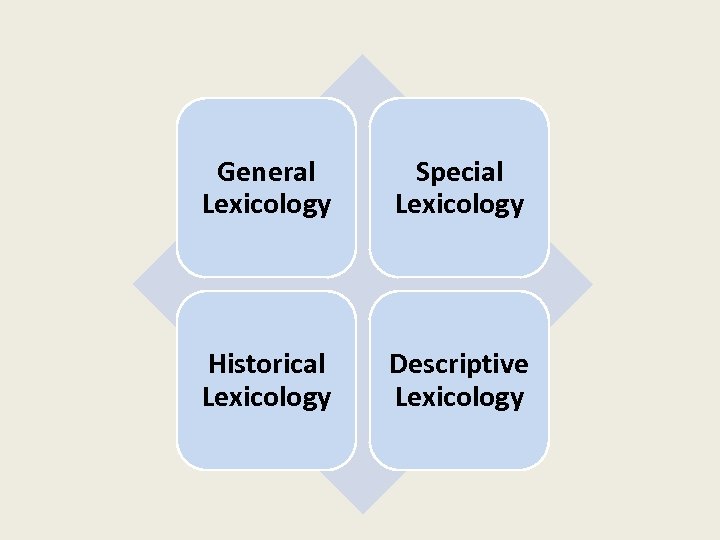 General Lexicology Special Lexicology Historical Lexicology Descriptive Lexicology
 GENERAL LEXICOLOGY • The general study of words and vocabulary, irrespective of the specific features of any particular language. • Linguistic phenomena and properties common to all languages are generally referred to as language universals
 SPECIAL LEXICOLOGY • devotes its attention to the description of the characteristic peculiarities in the vocabulary of a given language.
 HISTORICAL LEXICOLOGY ETYMOLOGY This branch of linguistics discusses the origin of various words, their change and development, and investigates the linguistic and extra -linguistic forces modifying their structure, meaning and usage.
 Descriptive lexicology deals with the vocabulary of a given language at a given stage of its development. • It will contrast the word boy with its derivatives: boyhood, boyishly, etc. • It will describe its semantic structure comprising alongside with its most frequent meaning, such variants as ‘a son of any age’, ‘a male servant’, and observe its syntactic functioning and combining possibilities. • This word, for instance, can be also used vocatively in such combinations as old boy, my dear boy, and attributively, meaning ‘male’, as in boy-friend
 CONTRASTIVE LEXICOLOGY • provides a theoretical basis on which the vocabularies of different languages can be compared and described.
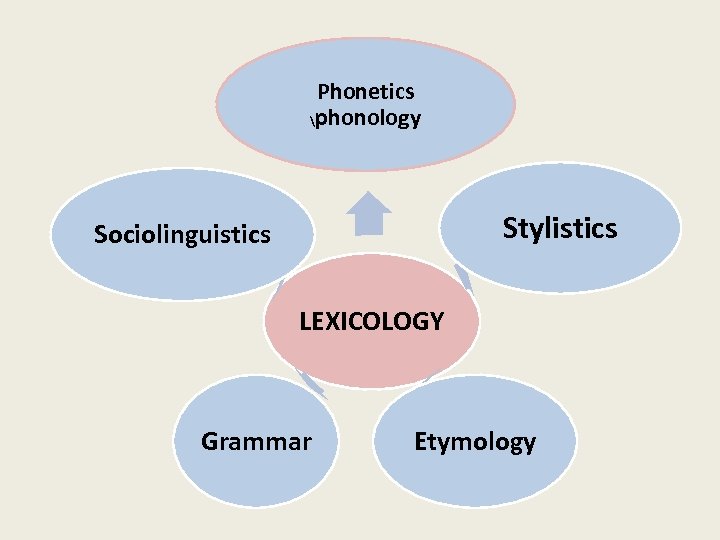 Phonetics phonology Stylistics Sociolinguistics LEXICOLOGY Grammar Etymology
 Within the scope of linguistics the word has been defined • syntactically, • semantically, • phonologically and • by combining various approaches.
 SYNTACTIC ASPECTS • “a minimum sentence” by H. Sweet; • “a minimum free form” by L. Bloomfield.
 SYNTACTIC AND SEMANTIC ASPECTS E. Sapir : “one of the smallest completely satisfying bits of isolated ‘meaning’, into which the sentence resolves itself” + its indivisibility: “It cannot be cut into without a disturbance of meaning, one or two other or both of the several parts remaining as a helpless waif on our hands”.
 The essence of indivisibility the article a and the prefix a in a lion and alive. • A lion is a word-group because we can separate its elements and insert other words between them: a living lion, a dead lion. • Alive is a word: it is indivisible, i. e. structurally impermeable: nothing can be inserted between its elements. The morpheme a- is not free, is not a word.
 SEMANTIC ASPECTS Stephen Ullmann’s explanation: connected discourse, if analysed from the semantic point of view, “will fall into a certain number of meaningful segments which are ultimately composed of meaningful units. These meaningful units are called words. "
 THE SEMANTIC-PHONOLOGICAL APPROACH A. H. Gardiner’s definition: “A word is an articulate sound-symbol in its aspect of denoting something which is spoken about. "
 SEMANTIC, PHONOLOGICAL AND GRAMMATICAL CRITERIA The eminent French linguist A. Meillet (18661936) advances a formula which underlies many subsequent definitions: “A word is defined by the association of a particular meaning with a particular group of sounds capable of a particular grammatical employment. "
 WIDESPREAD SCEPTICISM CONCERNING THE SUBJECT S. Potter: “unlike a phoneme or a syllable, a word is not a linguistic unit at all. "
 The main points may now be summarised: 1. The word is the fundamental unit of language. It is a dialectical unity of form and content. Its content or meaning is not identical to notion, but it may reflect human notions, and in this sense may be considered as the form of their existence. Concepts fixed in the meaning of words are formed as generalised and approximately correct reflections of reality, therefore in signifying them words reflect reality in their content.
 2. The acoustic aspect of the word serves to name objects of reality, not to reflect them. In this sense the word may be regarded as a sign. This sign, however, is not arbitrary but motivated by the whole process of its development. That is to say, when a word first comes into existence it is built out of the elements already available in the language and according to the existing patterns.
 WORD The word is a speech unit used for the purposes of human communication, possessing a meaning, susceptible to grammatical employment and characterized by formal and semantic unity.
 SCHEME OF LEXICAL UNIT ANALYSIS Each lexical unit is expected to be analysed on the following five levels: 1) derivational level; 2) morphemic level; 3) etymological level; 4) semantic level; 5) stylistic level.
 The derivational level of analysis 1. The derivational level of analysis is aimed at establishing the derivational history of the word in question, i. e. at establishing through what word building means it is built and what is its structural or word-building pattern. The method of analysis into Immediate (IC) and Ultimate Constituents (UC) is very effective on this level. For example, • threateningly is an adverb which falls into the following IC‟s: 1) threatening + -ly on the pattern A + -ly; 2) threaten + -ing on the pattern V + -ing; 3) threat + -en on the pattern N- + -en. The adverb threateningly is a derivative built through affixation.
 The morphemic level is aimed at establishing the number and type of the morphemes making up the word. Here it is necessary to make use of the data gathered on the derivational level as a result of establishing the UC‟s. For example, • in the adverb threateningly they are (arranged in the order of the stages of the IC‟s analysis of the word) -ly, -ing, -en, threat. Thus, the adverb threateningly is a polymorphemic word consisting of four morphemes of which one is a root morpheme and three derivational morphemes; • to head is a monomorphemic word consisting of one root morpheme, it is a root word; • teaspoon is a polymorphemic word consisting of two root morphemes. It is a compound.
 The etymological level is aimed at establishing the etymology (origin) of the word under analysis, i. e. at finding out whether it is a native English word, a borrowing or a hybrid. For example, • challenge is a Romance borrowing (French, to be exact); • threateningly is a native English word; • nourishing is a hybrid composed of morphemes of different origin: nourish is a Romance (Fr. ) borrowing, but -ing is a native English suffix.
 The semantic level is aimed at establishing the word's semantic structure or the type of meaning in which the word under analysis is used in a given context. For example, • sense is a polysemantic word (enumerate its meanings); • contemptuous is a monosemantic word; • ear – “He‟s got a musical ear”. The word ear is a polysemantic word. In this sentence it is used in one of its secondary, figurative, abstract, wide meanings which is a result of a shift (semantic change) metonymic in nature because the name of the organ of hearing is used as the name of its power or faculty.
 . The stylistic level is aimed at establishing the stylistic colouring of the word. For example, • nourishment is a word of literary style; • threat is a word of neutral style.
 Sample Analysis • To busy is a verb which means occupy, keep busy. • Derivational level. On the derivational level of analysis it is a derivative built through conversion from the adjective stem busy (V ← adj). • Morphemic level. On the morphemic level of analysis it is a monomorphemic word consisting of one root morpheme. • Etymological level. Etymologically it is a native word. • Semantic level. Semantically – polysemantic. • Stylistic level. Stylistically – neutral.