

Egor D. Nikulin Ph.D., Assistant Professor, Department of


 Скачать презентацию Egor D. Nikulin Ph.D., Assistant Professor, Department of
40478-topic1_for_students.ppt
- Количество слайдов: 44
Egor D. Nikulin Ph.D., Assistant Professor, Department of Finance and Accounting [email protected] Introduction to business management: finance
Course objectives to give an introduction to corporate finance, providing a pre-requisite for Corporate Finance course to provide an understanding of the most important concepts and issues of corporate finance at a level that is approachable for a wide audience to develop basic skills of making financial decisions in accordance with the concept of time value of money.
Schedule of classes Class 1. Tuesday, September, 4th, 13.00-16.15 Class 2. Wednesday, September, 5th, 13.00-16.15 Class 3. Friday, September, 7th, 13.00-16.15 Class 4. Saturday, September, 15th, 14.45 -16.30 Final exam: Saturday, September, 15th, 16.30 – 17.15
Individual consultation Friday, September, 7th, 16.30-17.30 (room TBA)
Course content Topic 1. Introduction to Finance. Overview of Сorporate Financial Decisions. Topic 2. Financial Statements and Cash Flows. Topic 3. Discounted Cash Flow Analysis and Present Value Concept. Topic 4. Essentials of Investment Evaluation.
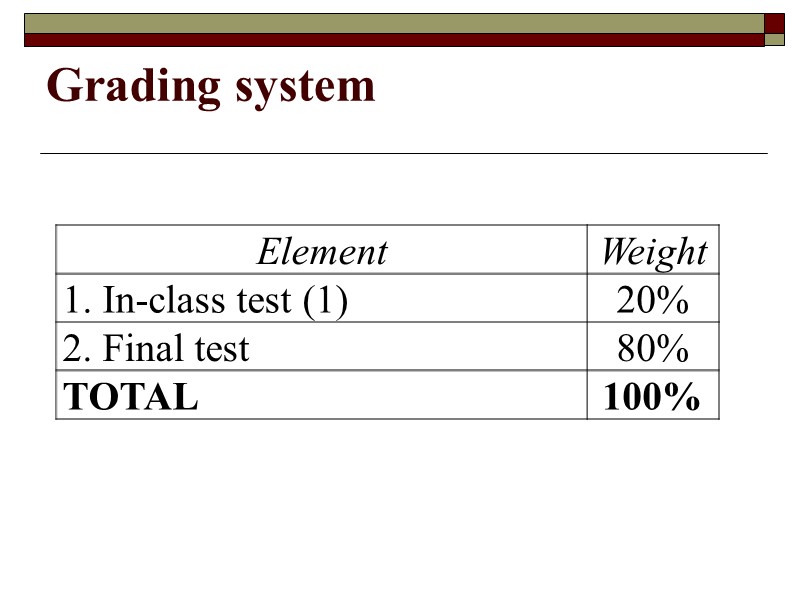
Grading system
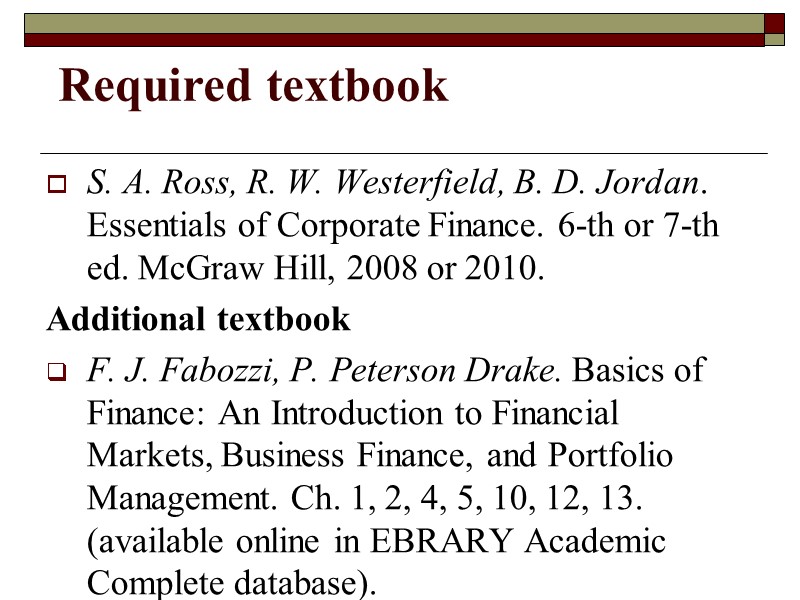
Required textbook S. A. Ross, R. W. Westerfield, B. D. Jordan. Essentials of Corporate Finance. 6-th or 7-th ed. McGraw Hill, 2008 or 2010. Additional textbook F. J. Fabozzi, P. Peterson Drake. Basics of Finance: An Introduction to Financial Markets, Business Finance, and Portfolio Management. Ch. 1, 2, 4, 5, 10, 12, 13. (available online in EBRARY Academic Complete database).
Introduction to Finance. Overview of Сorporate Financial Decisions. Topic 1
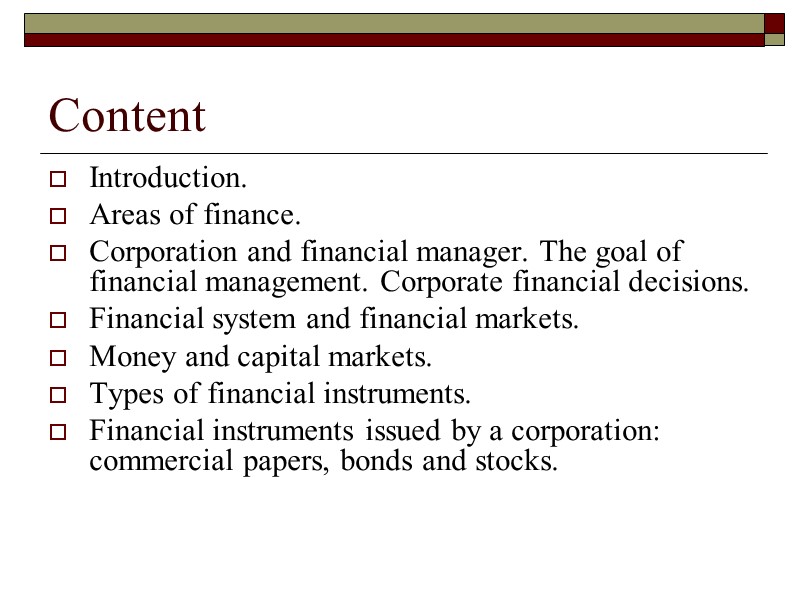
Content Introduction. Areas of finance. Corporation and financial manager. The goal of financial management. Corporate financial decisions. Financial system and financial markets. Money and capital markets. Types of financial instruments. Financial instruments issued by a corporation: commercial papers, bonds and stocks.
Origin of the word “finance” Two versions: medieval Latin language (XIII-XIV centuries) contained words finatio, financia meaning “obligatory payment”; in English language the word is alleged to be derived from the word fine (XI century) which was the synonym of tax.
Finance: evolution of meaning XVIII century – mid-XX century – “finance” meant funds of the state; since mid-XX century – “finance” also covers the area of financial decisions made by corporations and individuals. .
What is finance? Finance can be defined as the art and science of managing money [Gitman, 1989]. Finance is concerned with the process, institutions, markets, and instruments involved in the transfer of money among individuals, businesses and governments. .
Main areas of finance Public Corporate or business Personal .
Basic types of business organization Sole proprietorship Partnership general partnership limited partnership Corporation .
Basic types of business organization: sole proprietorship Strengths: Easy to create Owner receives all profits Low organizational costs Flexible Weaknesses: Owner has unlimited liability for proprietorship’s debts Limited life cycle Low fund-raising power .
Basic types of business organization: partnership Strengths: Easy and inexpensive to form Weaknesses: Owners (general partners) have unlimited liability for partnership’s debts Limited life cycle due to difficulties to transfer ownership .
Characteristics of corporation Separate legal entity The shareholders have a limited liability for the business debts It’s difficult to create: Articles of incorporation Set of bylaws Separation of ownership and management ownership can be relatively easily transferred Provides an ample opportunity to raise capital Main disadvantage: possible mismatch between objectives of managers and shareholders (agency problem). .
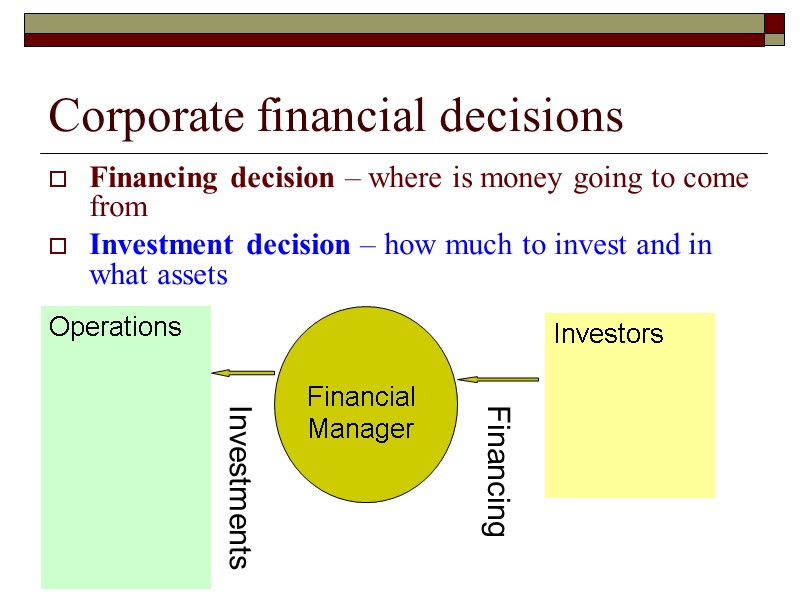
Corporate financial decisions Financing decision – where is money going to come from Investment decision – how much to invest and in what assets Operations Investors Financial Manager Investments Financing
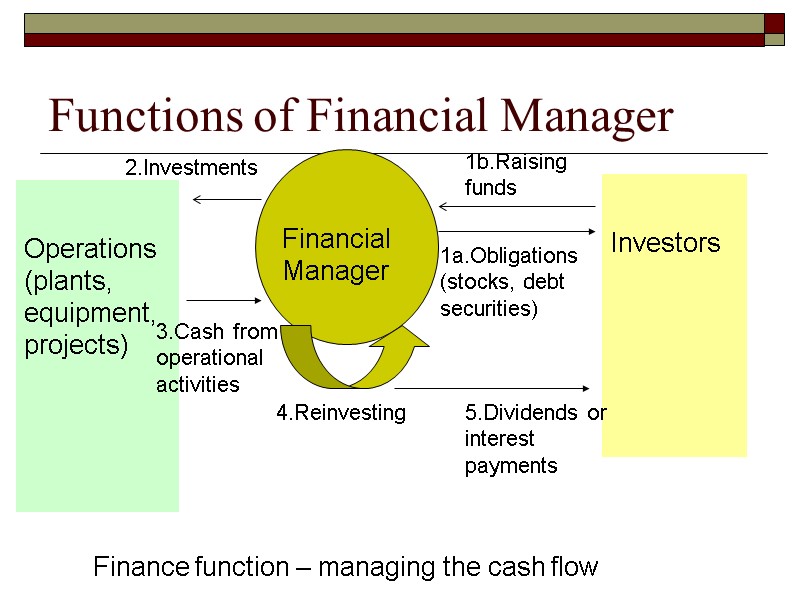
Functions of Financial Manager Operations (plants, equipment, projects) Financial Manager Investors 1b.Raising funds 2.Investments 3.Cash from operational activities 4.Reinvesting 1a.Obligations (stocks, debt securities) 5.Dividends or interest payments Finance function – managing the cash flow
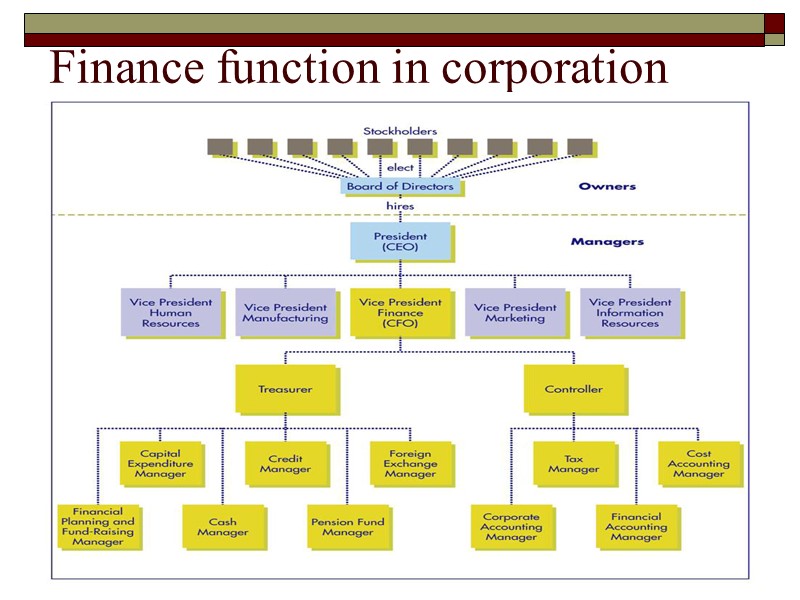
Finance function in corporation .
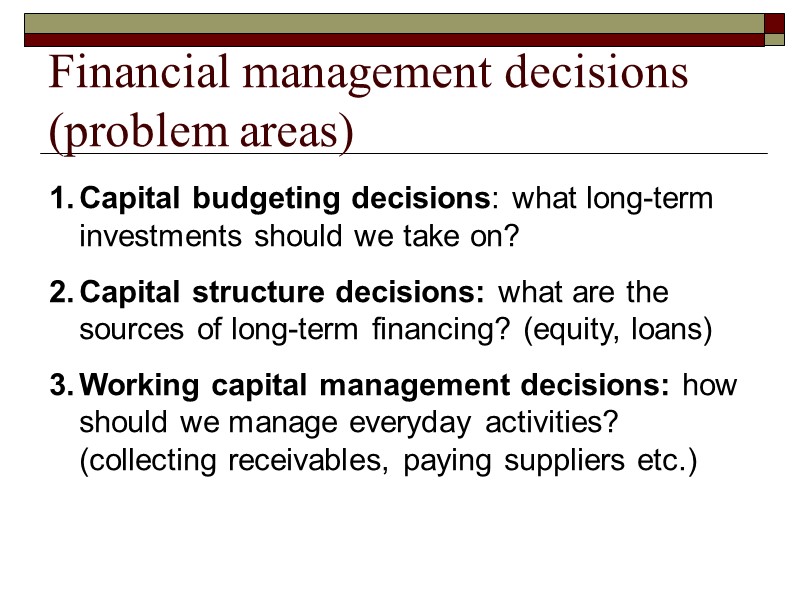
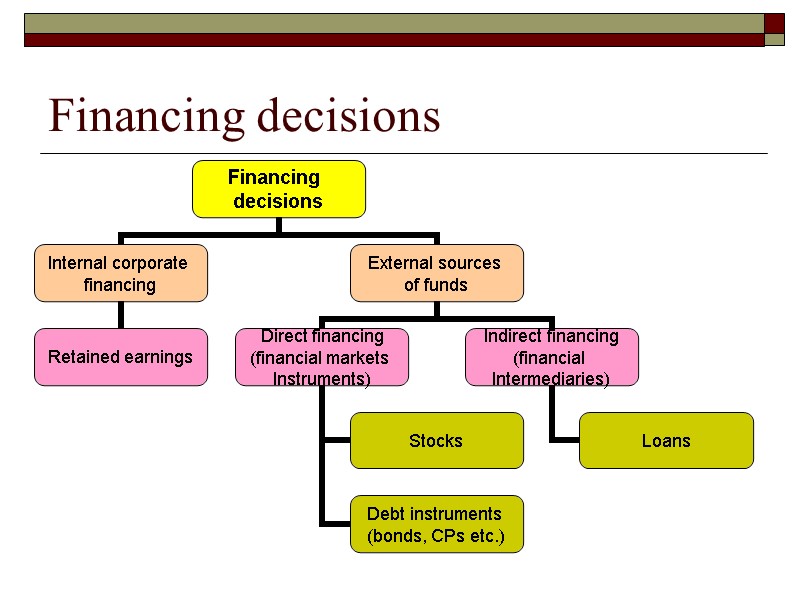
Financial management decisions (problem areas) Capital budgeting decisions: what long-term investments should we take on? Capital structure decisions: what are the sources of long-term financing? (equity, loans) Working capital management decisions: how should we manage everyday activities? (collecting receivables, paying suppliers etc.)
What is the goal of financial management?
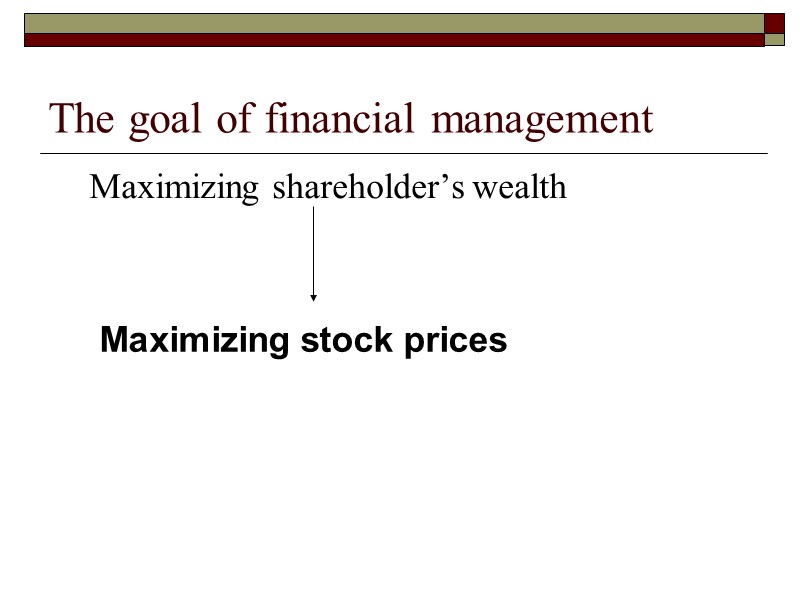
The goal of financial management Maximizing shareholder’s wealth Maximizing stock prices
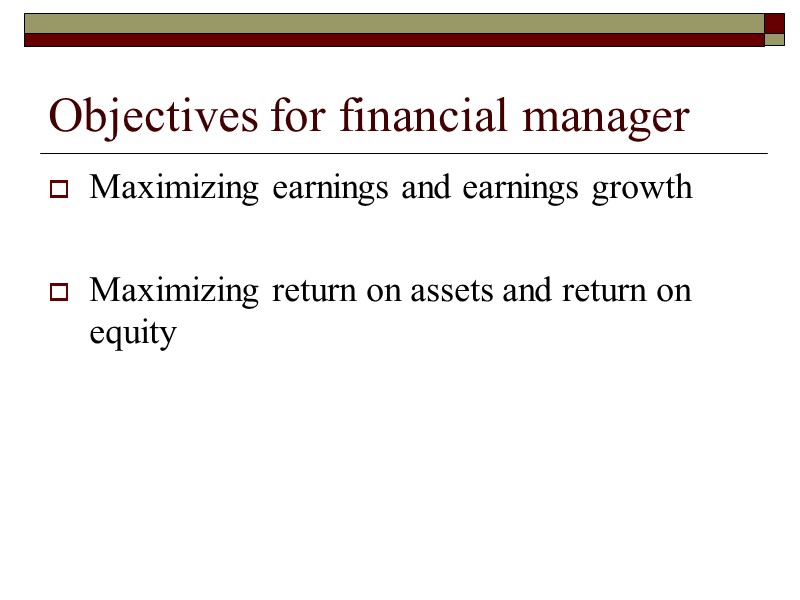
Objectives for financial manager Maximizing earnings and earnings growth Maximizing return on assets and return on equity
Financing decisions
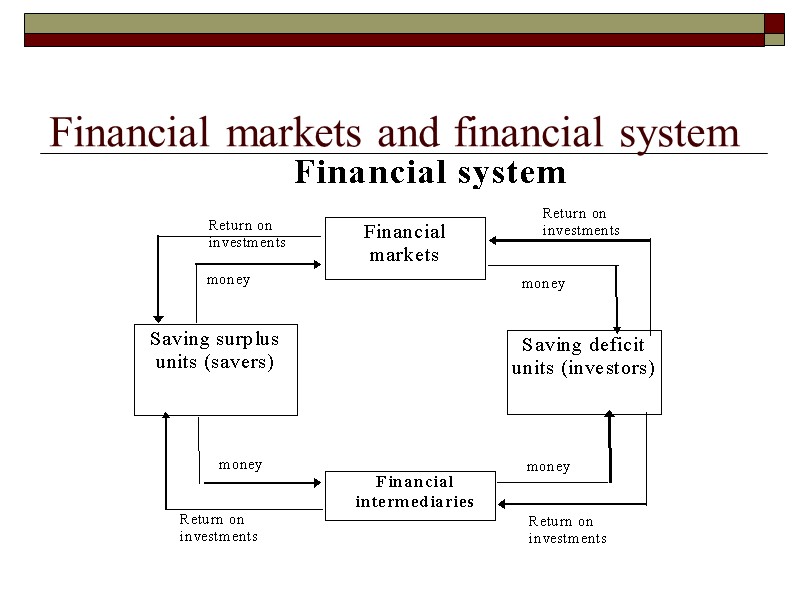
Financial markets The main goal of financial markets: Take savings from those who do not wish to consume (savings surplus units) and to channel them to those who wish to invest more than they have presently (saving deficit units)
Financial markets and financial system
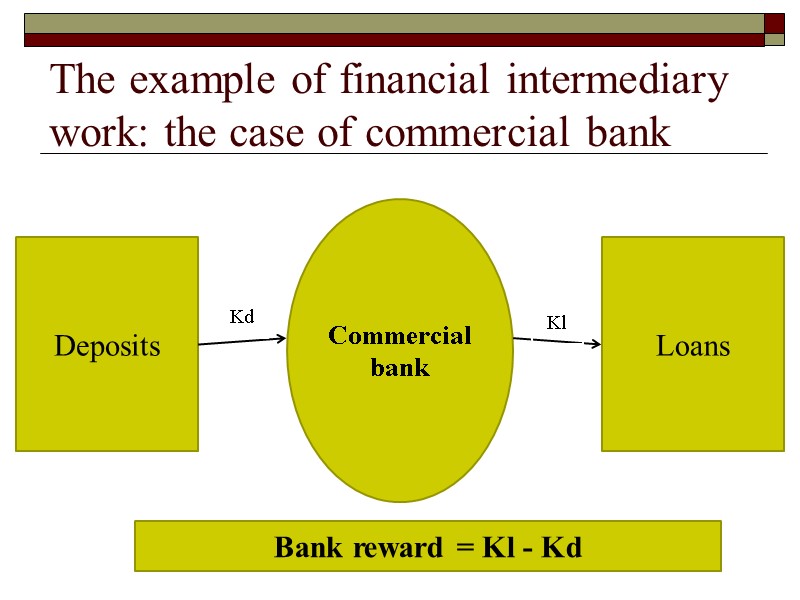
The example of financial intermediary work: the case of commercial bank Deposits Loans Commercial bank Kd Kl Bank reward = Kl - Kd
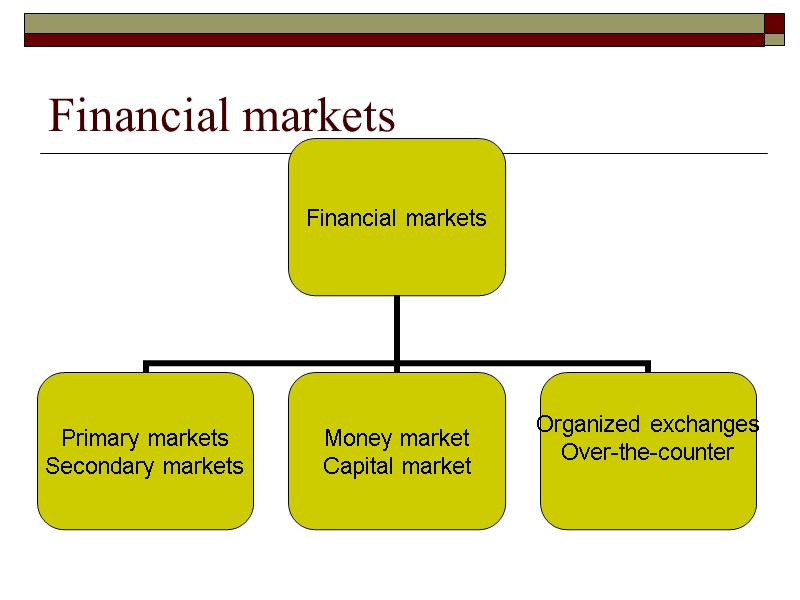
Financial markets
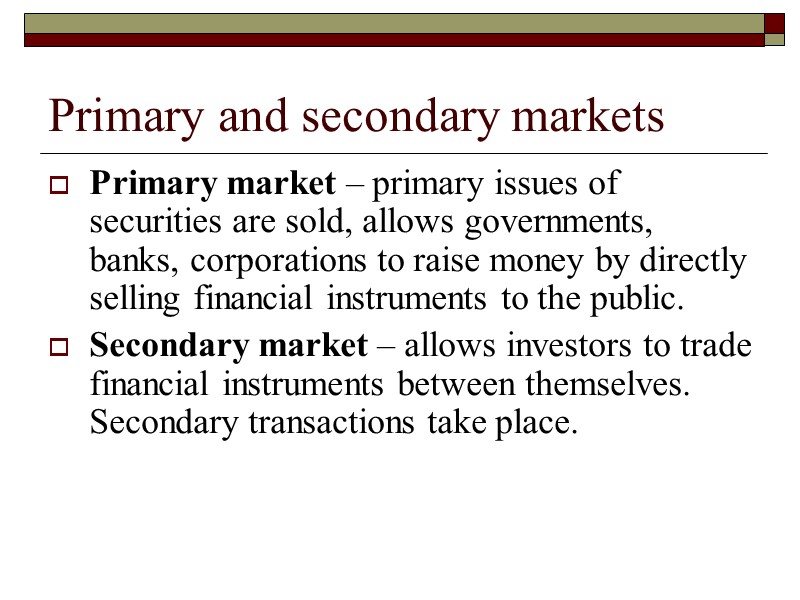
Primary and secondary markets Primary market – primary issues of securities are sold, allows governments, banks, corporations to raise money by directly selling financial instruments to the public. Secondary market – allows investors to trade financial instruments between themselves. Secondary transactions take place.
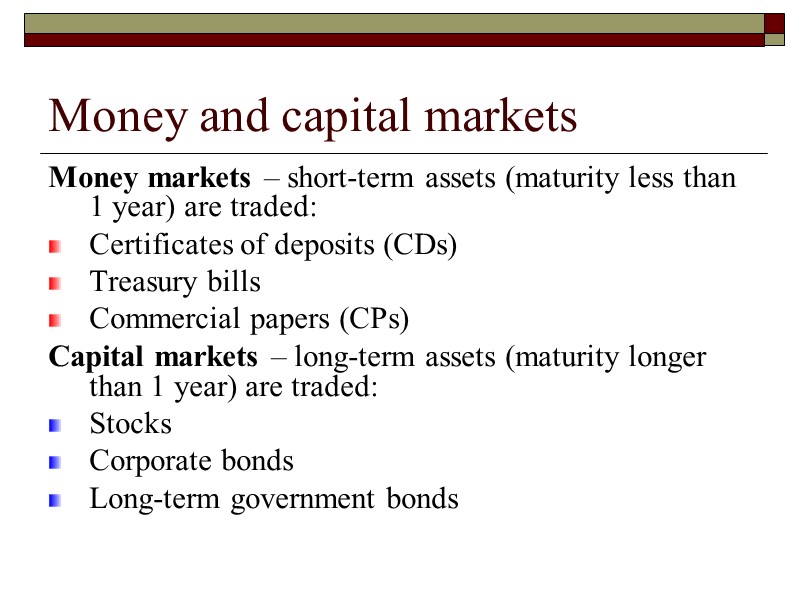
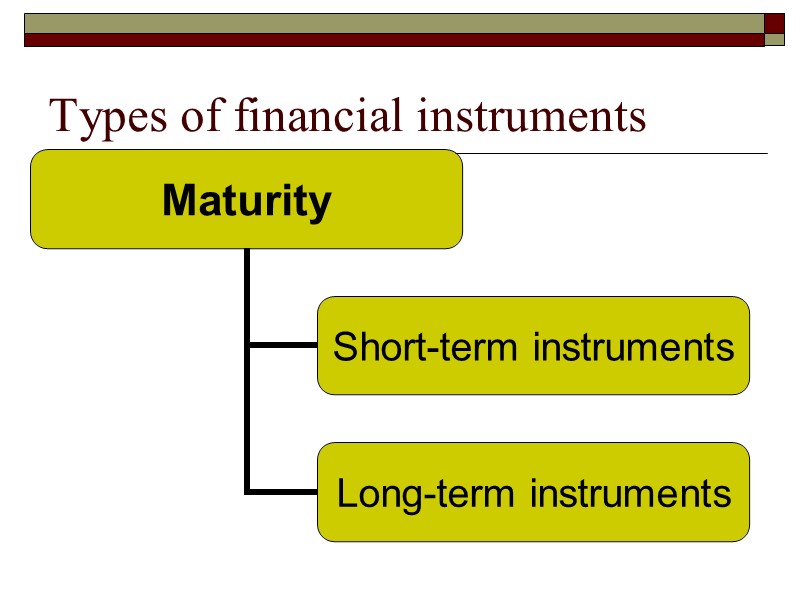
Money and capital markets Money markets – short-term assets (maturity less than 1 year) are traded: Certificates of deposits (CDs) Treasury bills Commercial papers (CPs) Capital markets – long-term assets (maturity longer than 1 year) are traded: Stocks Corporate bonds Long-term government bonds
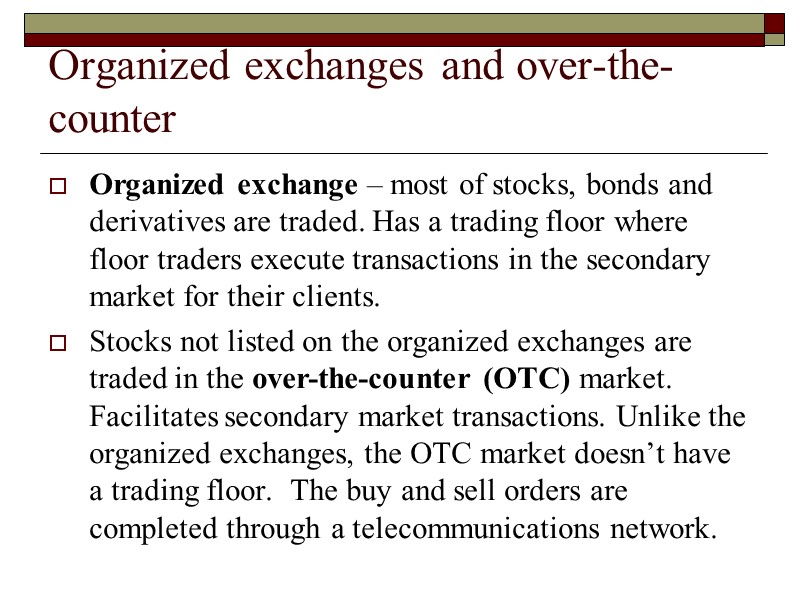
Organized exchanges and over-the-counter Organized exchange – most of stocks, bonds and derivatives are traded. Has a trading floor where floor traders execute transactions in the secondary market for their clients. Stocks not listed on the organized exchanges are traded in the over-the-counter (OTC) market. Facilitates secondary market transactions. Unlike the organized exchanges, the OTC market doesn’t have a trading floor. The buy and sell orders are completed through a telecommunications network.
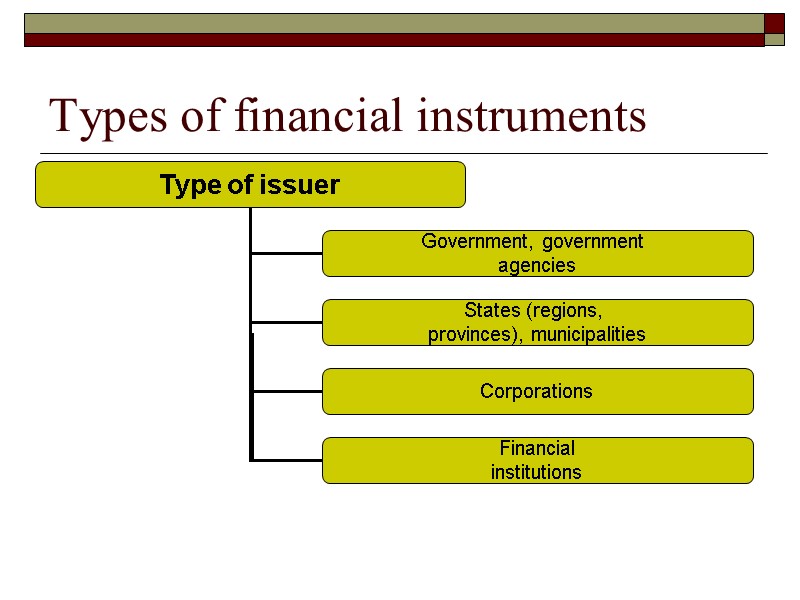
Types of financial instruments
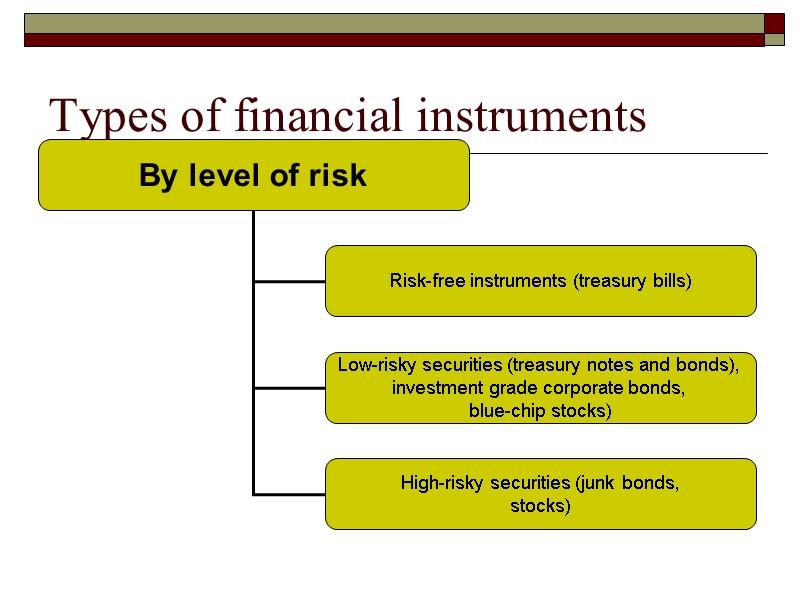
Types of financial instruments
Types of financial instruments
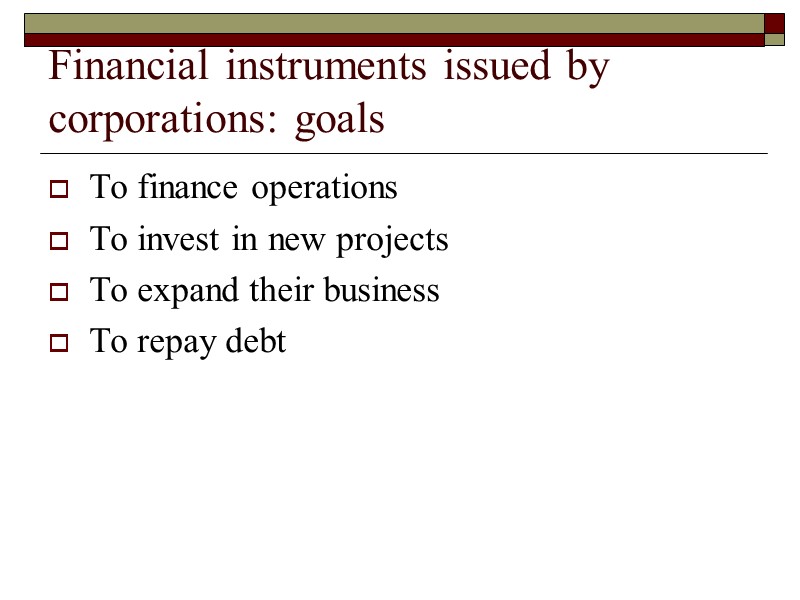
Financial instruments issued by corporations: goals To finance operations To invest in new projects To expand their business To repay debt
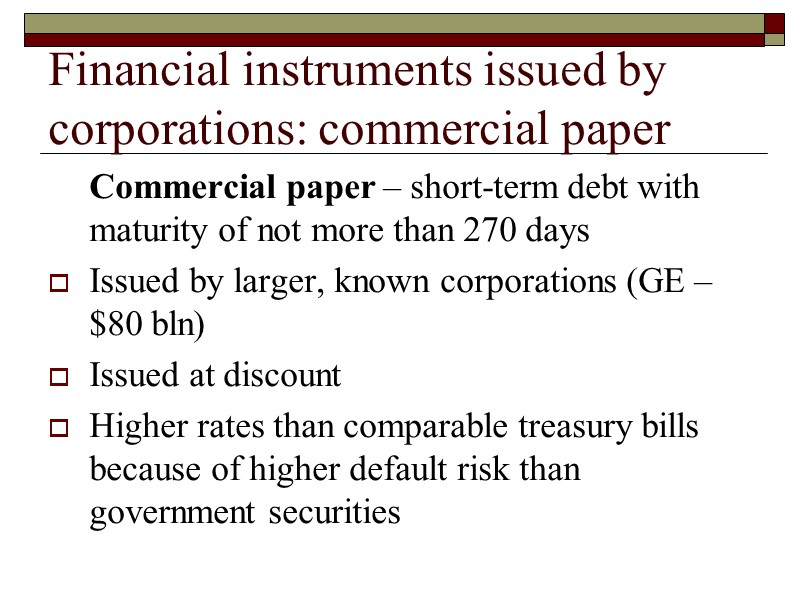
Commercial paper – short-term debt with maturity of not more than 270 days Issued by larger, known corporations (GE – $80 bln) Issued at discount Higher rates than comparable treasury bills because of higher default risk than government securities Financial instruments issued by corporations: commercial paper
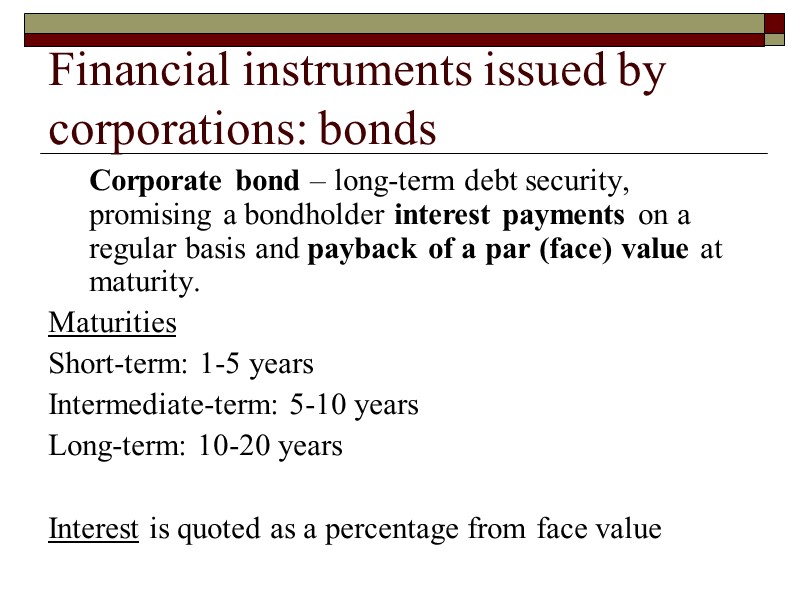
Corporate bond – long-term debt security, promising a bondholder interest payments on a regular basis and payback of a par (face) value at maturity. Maturities Short-term: 1-5 years Intermediate-term: 5-10 years Long-term: 10-20 years Interest is quoted as a percentage from face value Financial instruments issued by corporations: bonds
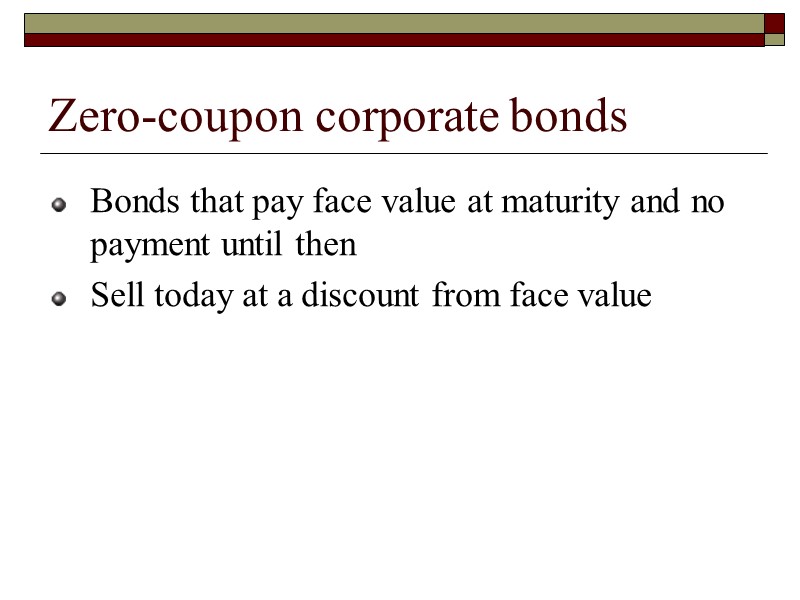
Zero-coupon corporate bonds Bonds that pay face value at maturity and no payment until then Sell today at a discount from face value
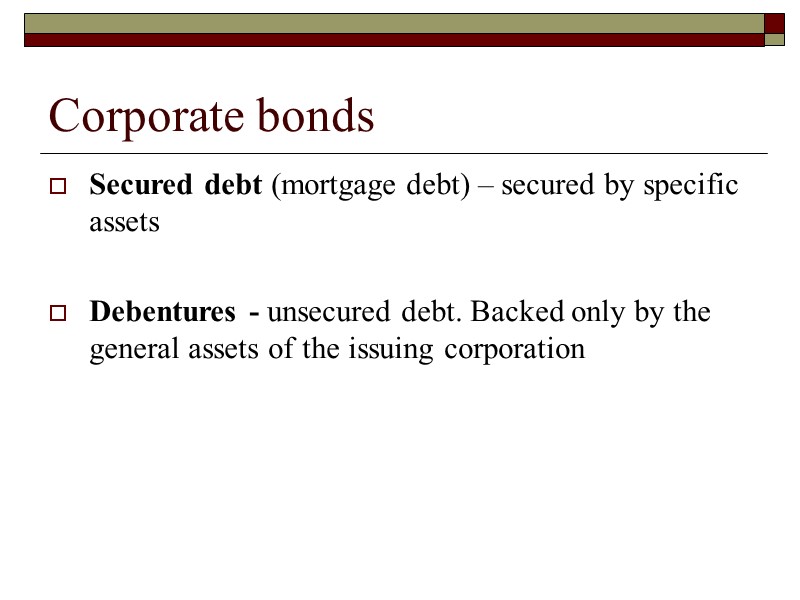
Corporate bonds Secured debt (mortgage debt) – secured by specific assets Debentures - unsecured debt. Backed only by the general assets of the issuing corporation
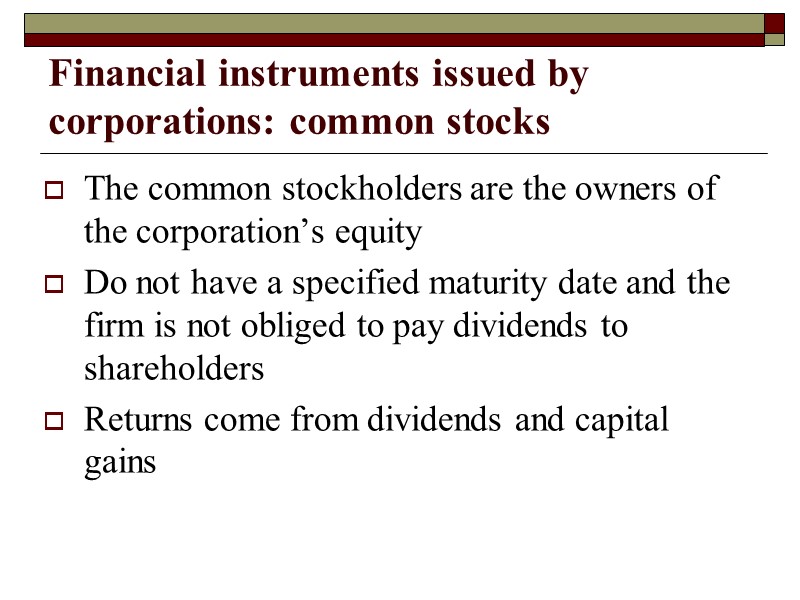
Financial instruments issued by corporations: common stocks The common stockholders are the owners of the corporation’s equity Do not have a specified maturity date and the firm is not obliged to pay dividends to shareholders Returns come from dividends and capital gains
Common stockholders are called the residual claimants of the firm Stockholders have only limited liabilities Financial instruments issued by corporations: common stocks
Hybrid securities: has characteristics of debt and equity Have face value, predetermined periodical (dividend) payments with priority over common stockholders If dividend payment is not made, preferred stockholders may get voting rights Financial instruments issued by corporations: preferred stocks
Summary of companies: stocks, financials, ownership etc. http://finance.yahoo.com General Electric http://finance.yahoo.com/q?s=GE