 Скачать презентацию EFTF — IEEE 2009 Besanҫon France April 21
5ffd85e26879e851fb2c72c32b0bc84d.ppt
- Количество слайдов: 57



EFTF - IEEE 2009 Besanҫon, France April 21, 2009 blackbody radiation shifts and theoretical contributions to atomic clock research marianna safronova
outline • Black-body radiation shifts • Microwave vs. Optical transitions • Methods of calculating BBR shifts in optical transitions Evaluation of uncertainties • • Monovalent systems: all-order method Other properties: quadrupole moments Other systems: CI + MBPT method Development of the CI + all-order method • Future prospects
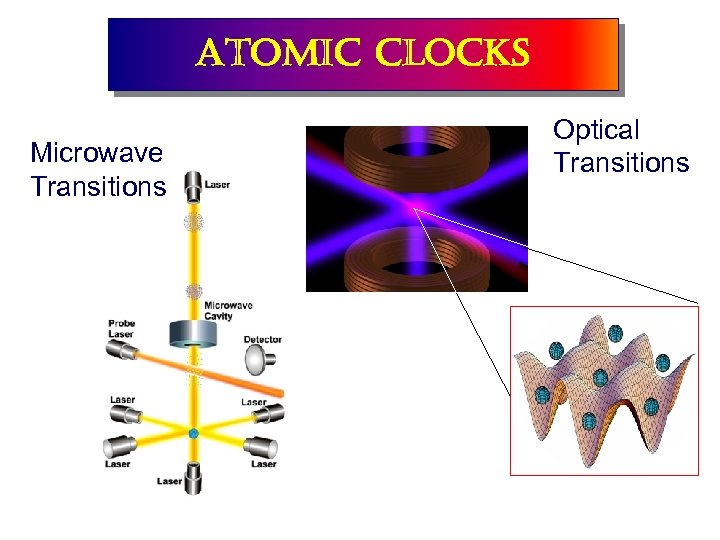
atomic clocks Microwave Transitions Optical Transitions
atomic clocks black-body radiation ( bbr ) shift Motivation: BBR shift gives large contribution into uncertainty budget for some of the atomic clock schemes. Accurate calculations are needed to achieve ultimate precision goals.
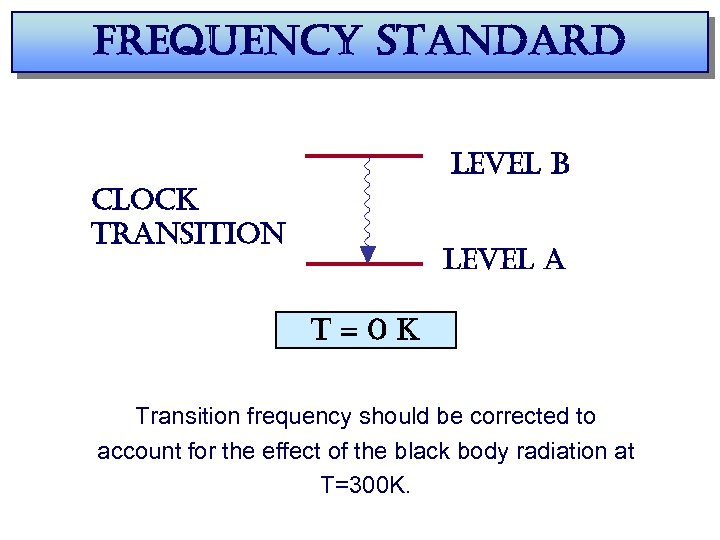
frequency standard level b clock transition level a t=0 k Transition frequency should be corrected to account for the effect of the black body radiation at T=300 K.
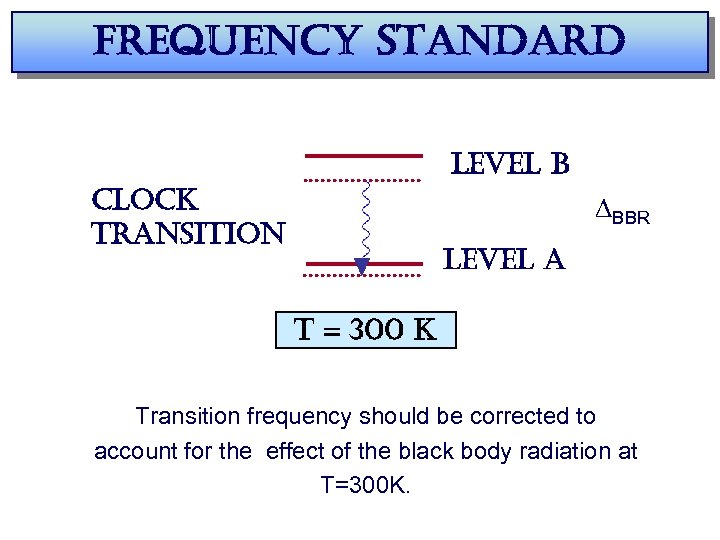
frequency standard level b clock transition DBBR level a t = 300 k Transition frequency should be corrected to account for the effect of the black body radiation at T=300 K.
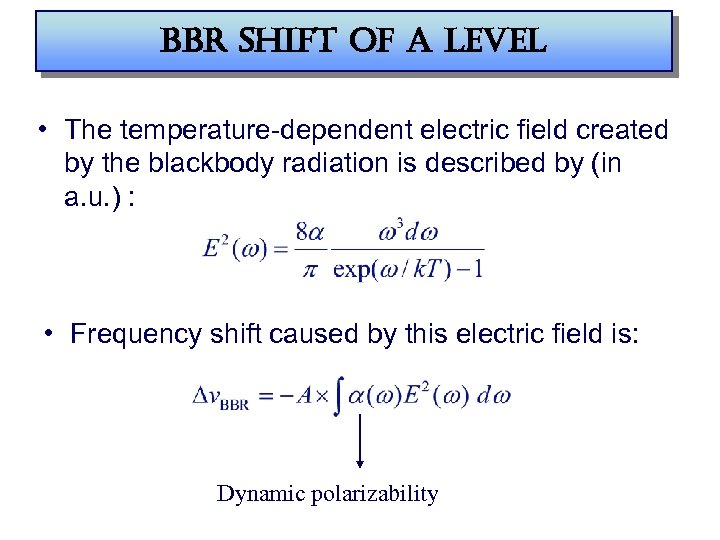
bbr shift of a level • The temperature-dependent electric field created by the blackbody radiation is described by (in a. u. ) : • Frequency shift caused by this electric field is: Dynamic polarizability
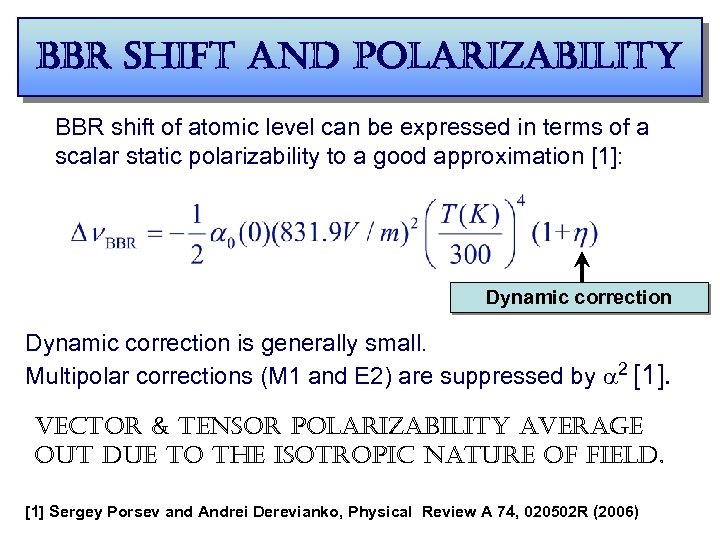
bbr shift and polarizability BBR shift of atomic level can be expressed in terms of a scalar static polarizability to a good approximation [1]: Dynamic correction is generally small. Multipolar corrections (M 1 and E 2) are suppressed by a 2 [1]. vector & tensor polarizability average out due to the isotropic nature of field. [1] Sergey Porsev and Andrei Derevianko, Physical Review A 74, 020502 R (2006)
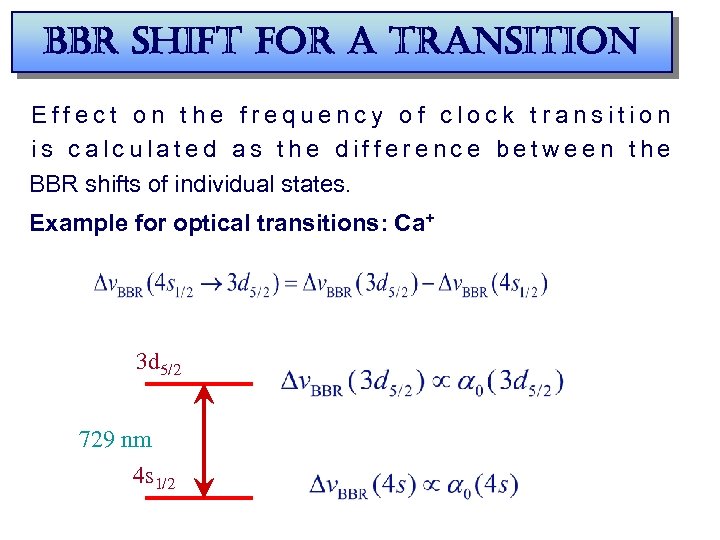
bbr shift for a transition Effect on the frequency of clock transition is calculated as the difference between the BBR shifts of individual states. Example for optical transitions: Ca+ 3 d 5/2 729 nm 4 s 1/2
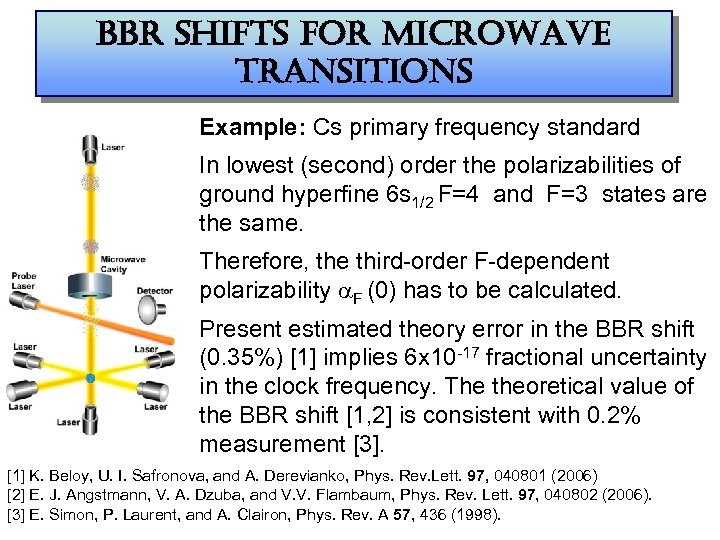
bbr shifts for microwave transitions Example: Cs primary frequency standard In lowest (second) order the polarizabilities of ground hyperfine 6 s 1/2 F=4 and F=3 states are the same. Therefore, the third-order F-dependent polarizability a. F (0) has to be calculated. Present estimated theory error in the BBR shift (0. 35%) [1] implies 6 x 10 -17 fractional uncertainty in the clock frequency. The theoretical value of the BBR shift [1, 2] is consistent with 0. 2% measurement [3]. [1] K. Beloy, U. I. Safronova, and A. Derevianko, Phys. Rev. Lett. 97, 040801 (2006) [2] E. J. Angstmann, V. A. Dzuba, and V. V. Flambaum, Phys. Rev. Lett. 97, 040802 (2006). [3] E. Simon, P. Laurent, and A. Clairon, Phys. Rev. A 57, 436 (1998).
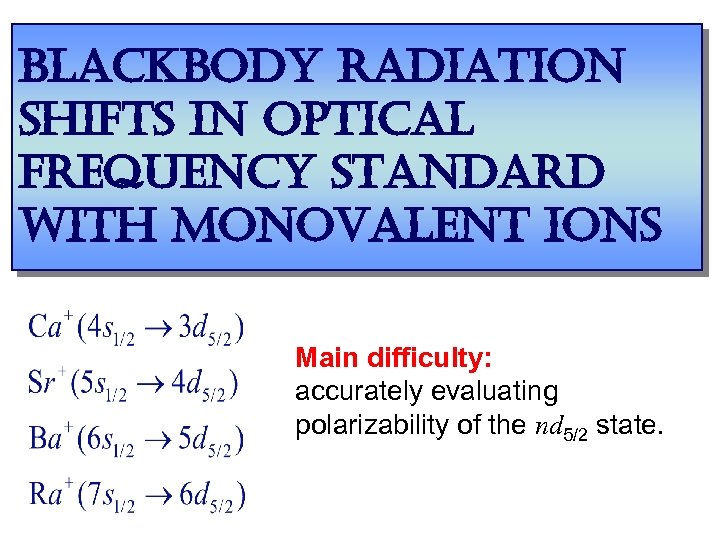
blackbody radiation shifts in optical frequency standard with monovalent ions Main difficulty: accurately evaluating polarizability of the nd 5/2 state.
examples: bbr shift in optical frequency standards with 43 ca+ and 88 sr+ ions Ca+: Bindiya Arora, M. S. Safronova, and Charles W. Clark, Phys. Rev. A 76, 064501 (2007) Sr+: Dansha Jiang, Bindiya Arora, M. S. Safronova, and Charles W. Clark, submitted to special issue of J. Phys. B (2009)
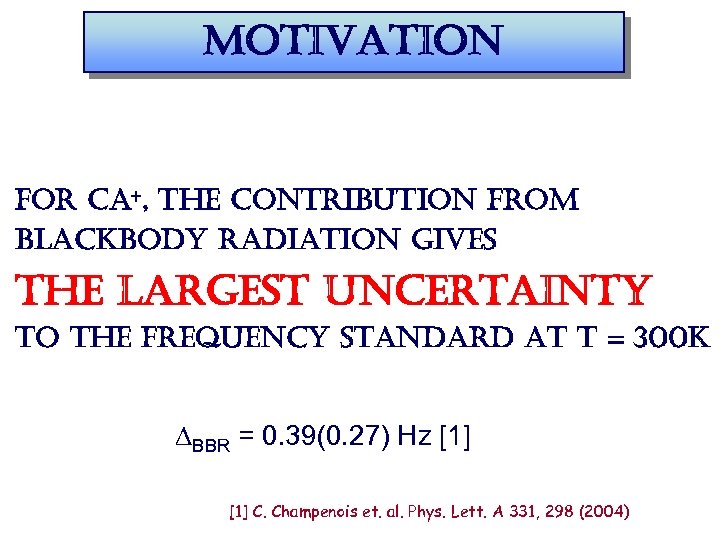
motivation for ca+, the contribution from blackbody radiation gives the largest uncertainty to the frequency standard at t = 300 k DBBR = 0. 39(0. 27) Hz [1] C. Champenois et. al. Phys. Lett. A 331, 298 (2004)
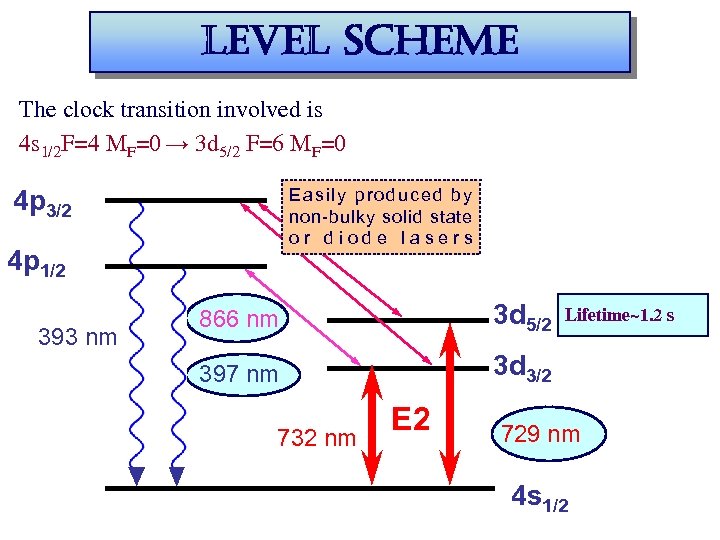
level scheme The clock transition involved is 4 s 1/2 F=4 MF=0 → 3 d 5/2 F=6 MF=0 4 p 3/2 Easily produced by non-bulky solid state o r 854 d e l a s e r s d i o nm 4 p 1/2 393 nm 866 nm 3 d 5/2 397 nm 3 d 3/2 732 nm E 2 Lifetime~1. 2 s 729 nm 4 s 1/2
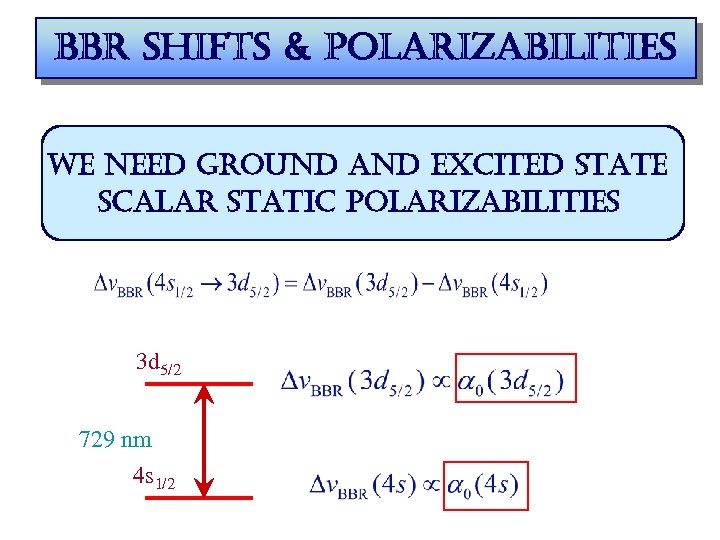
bbr shifts & polarizabilities we need ground and excited state scalar static polarizabilities 3 d 5/2 729 nm 4 s 1/2
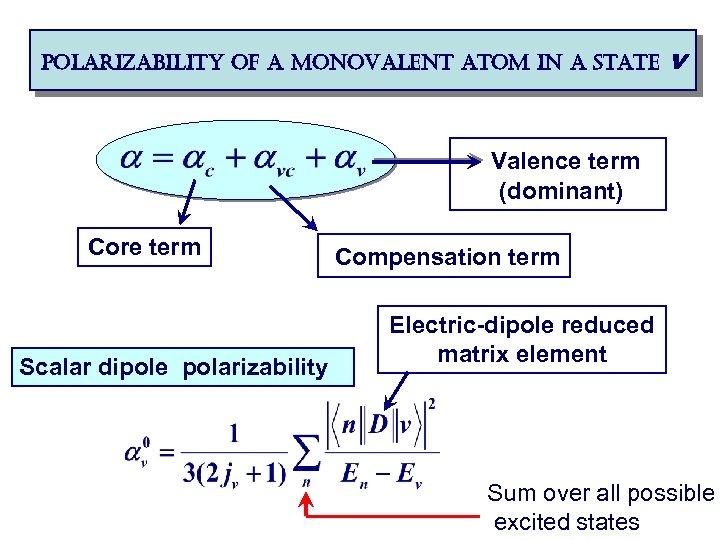
polarizability of a monovalent atom in a state v Valence term (dominant) Core term Compensation term Scalar dipole polarizability Electric-dipole reduced matrix element Sum over all possible excited states
how to accurately calculate e 1 matrix elements ? Very precise calculation of atomic properties We also need to evaluate uncertainties of theoretical values!

how to accurately calculate e 1 matrix elements ? ! D E Very precise calculation of atomic properties T N A W We also need to evaluate uncertainties of theoretical values!
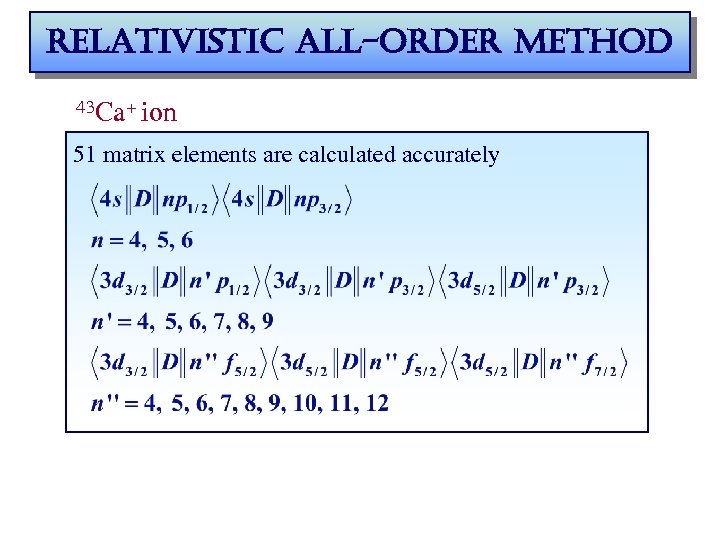
relativistic all-order method 43 Ca+ ion 51 matrix elements are calculated accurately

theory: all-order method (relativistic linearized coupledcluster approach)
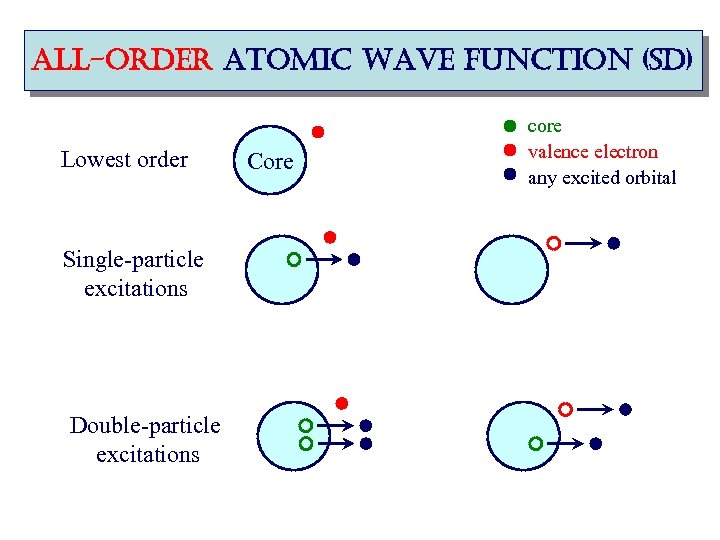
all-order atomic wave function (sd) Lowest order Single-particle excitations Double-particle excitations Core core valence electron any excited orbital
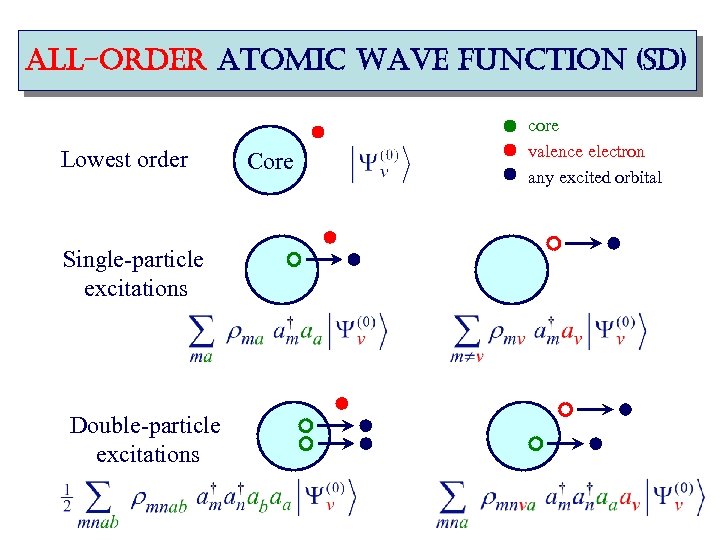
all-order atomic wave function (sd) Lowest order Single-particle excitations Double-particle excitations Core core valence electron any excited orbital
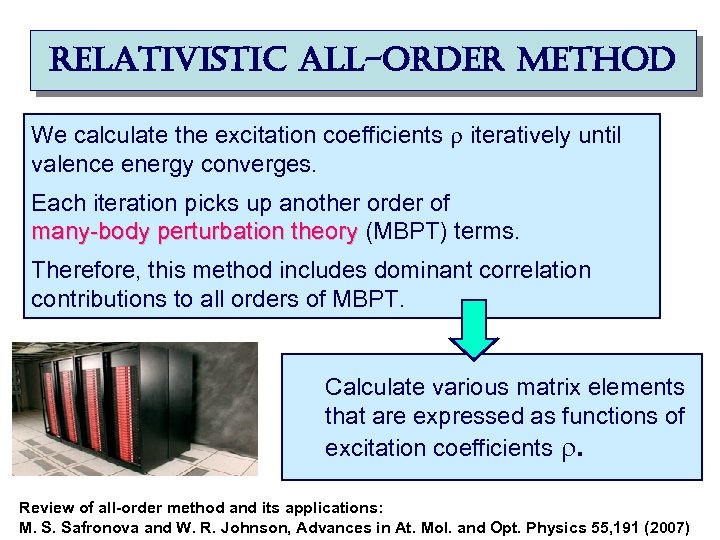
relativistic all-order method We calculate the excitation coefficients r iteratively until valence energy converges. Each iteration picks up another order of many-body perturbation theory (MBPT) terms. Therefore, this method includes dominant correlation contributions to all orders of MBPT. Calculate various matrix elements that are expressed as functions of excitation coefficients r. Review of all-order method and its applications: M. S. Safronova and W. R. Johnson, Advances in At. Mol. and Opt. Physics 55, 191 (2007)

Various extentions of the all-order method: Automated formula and code generation Codes that write formulas Codes that write codes Input: Output: list of formulas to be programmed final code (need to be put into a main shell) Features: simple input, essentially just type in a formula!
![Static polarizabilities of np states theory [ 1 ] experiment* Na (3 P 1/2)](https://present5.com/presentation/5ffd85e26879e851fb2c72c32b0bc84d/image-25.jpg "Static polarizabilities of np states theory [ 1 ] experiment* Na (3 P 1/2)")
Static polarizabilities of np states theory [ 1 ] experiment* Na (3 P 1/2) (3 P 3/2) K (4 P 1/2) (4 P 3/2) 606(6) 616(6) -109(2) 606. 7(6) 614 (10) -107 (2) Rb (5 P 1/2) (5 P 3/2) 807(14) 869(14) -166(3) 810. 6(6) 857 (10) -163(3) 359. 9(4) 359. 2(6) 361. 6(4) -88. 4(10) 360. 4(7) -88. 3 (4) excellent agreement with experiments ! *Zhu et al. PRA 70 03733(2004) [1] Bindiya Arora, M. S. Safronova, and Charles W. Clark, Phys. Rev. A 76, 052509 (2007)
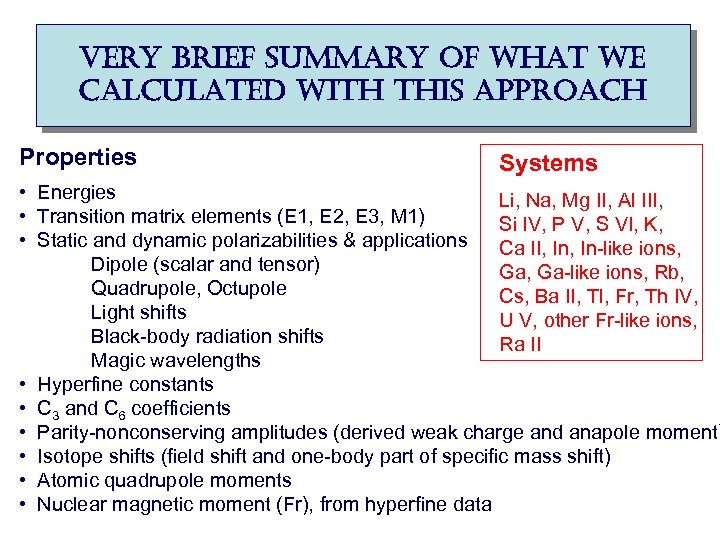
very brief summary of what we calculated with this approach Properties Systems • Energies Li, Na, Mg II, Al III, • Transition matrix elements (E 1, E 2, E 3, M 1) Si IV, P V, S VI, K, • Static and dynamic polarizabilities & applications Ca II, In-like ions, Dipole (scalar and tensor) Ga, Ga-like ions, Rb, Quadrupole, Octupole Cs, Ba II, Tl, Fr, Th IV, Light shifts U V, other Fr-like ions, Black-body radiation shifts Ra II Magic wavelengths • Hyperfine constants • C 3 and C 6 coefficients • Parity-nonconserving amplitudes (derived weak charge and anapole moment) • Isotope shifts (field shift and one-body part of specific mass shift) • Atomic quadrupole moments • Nuclear magnetic moment (Fr), from hyperfine data
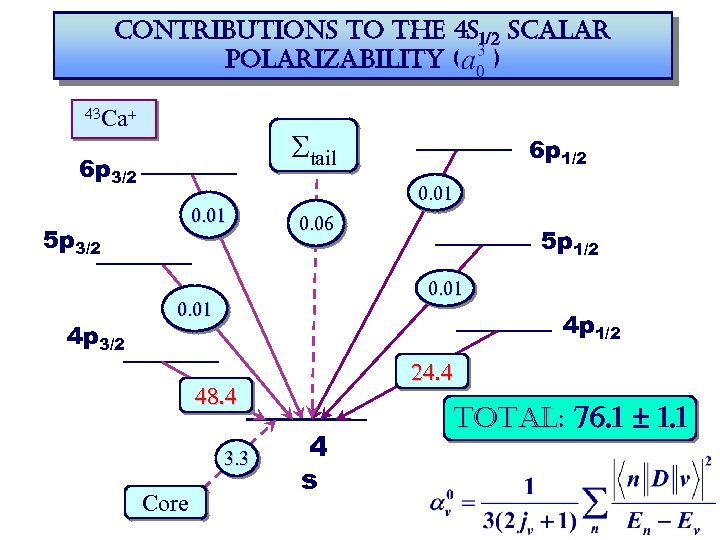
contributions to the 4 s 1/2 scalar polarizability ( ) 43 Ca+ Stail 6 p 3/2 0. 01 5 p 3/2 4 p 3/2 0. 01 0. 06 5 p 1/2 0. 01 4 p 1/2 24. 4 48. 4 3. 3 Core 6 p 1/2 4 s total: 76. 1 ± 1. 1
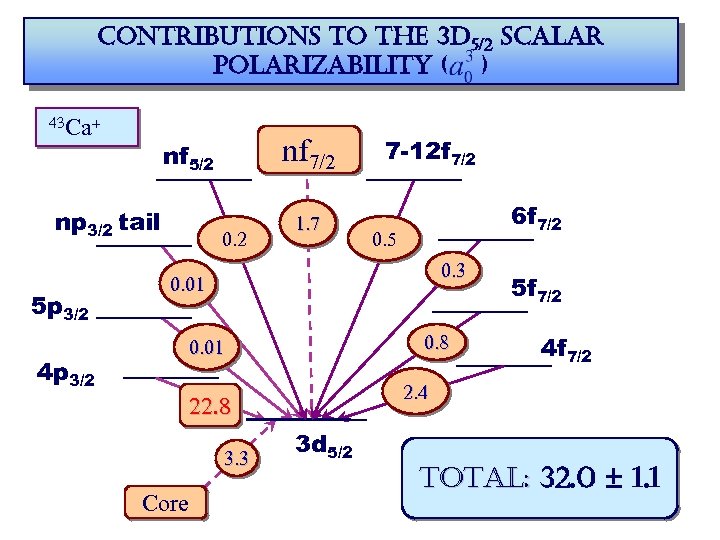
contributions to the 3 d 5/2 scalar polarizability ( ) 43 Ca+ np 3/2 tail 5 p 3/2 4 p 3/2 nf 7/2 nf 5/2 0. 2 1. 7 7 -12 f 7/2 6 f 7/2 0. 5 0. 3 0. 01 0. 8 0. 01 Core 4 f 7/2 2. 4 22. 8 3. 3 5 f 7/2 3 d 5/2 total: 32. 0 ± 1. 1
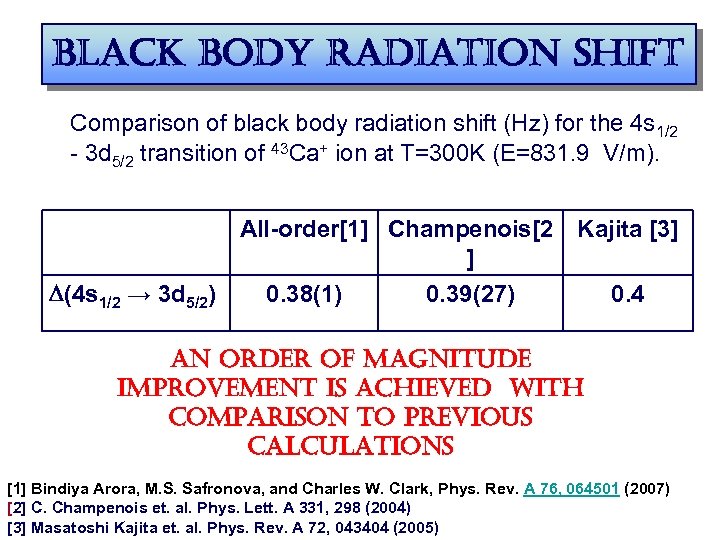
black body radiation shift Comparison of black body radiation shift (Hz) for the 4 s 1/2 - 3 d 5/2 transition of 43 Ca+ ion at T=300 K (E=831. 9 V/m). All-order[1] Champenois[2 ] D(4 s 1/2 → 3 d 5/2) 0. 38(1) Kajita [3] 0. 39(27) 0. 4 an order of magnitude improvement is achieved with comparison to previous calculations [1] Bindiya Arora, M. S. Safronova, and Charles W. Clark, Phys. Rev. A 76, 064501 (2007) [2] C. Champenois et. al. Phys. Lett. A 331, 298 (2004) [3] Masatoshi Kajita et. al. Phys. Rev. A 72, 043404 (2005)
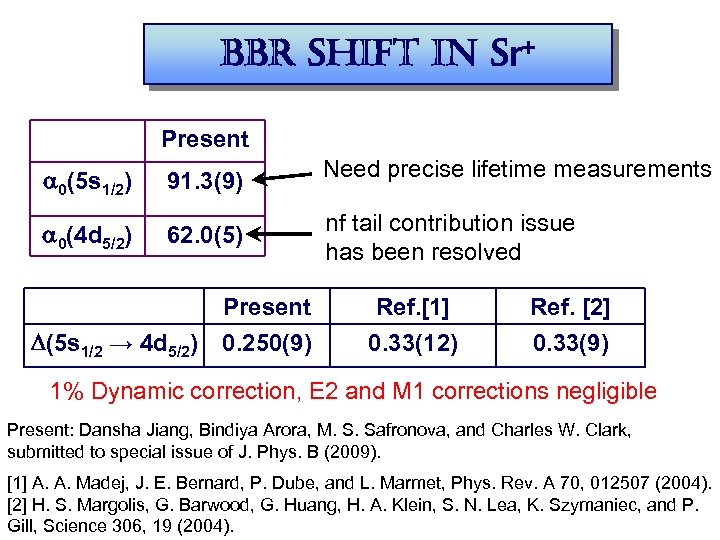
bbr shift in sr+ Present a 0(5 s 1/2) 91. 3(9) Need precise lifetime measurements a 0(4 d 5/2) 62. 0(5) nf tail contribution issue has been resolved D(5 s 1/2 → 4 d 5/2) Present 0. 250(9) Ref. [1] 0. 33(12) Ref. [2] 0. 33(9) 1% Dynamic correction, E 2 and M 1 corrections negligible Present: Dansha Jiang, Bindiya Arora, M. S. Safronova, and Charles W. Clark, submitted to special issue of J. Phys. B (2009). [1] A. A. Madej, J. E. Bernard, P. Dube, and L. Marmet, Phys. Rev. A 70, 012507 (2004). [2] H. S. Margolis, G. Barwood, G. Huang, H. A. Klein, S. N. Lea, K. Szymaniec, and P. Gill, Science 306, 19 (2004).
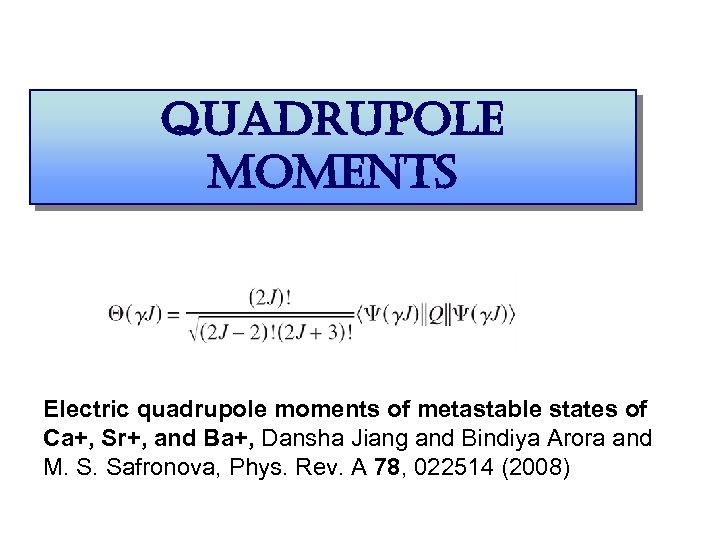
quadrupole moments Electric quadrupole moments of metastable states of Ca+, Sr+, and Ba+, Dansha Jiang and Bindiya Arora and M. S. Safronova, Phys. Rev. A 78, 022514 (2008)
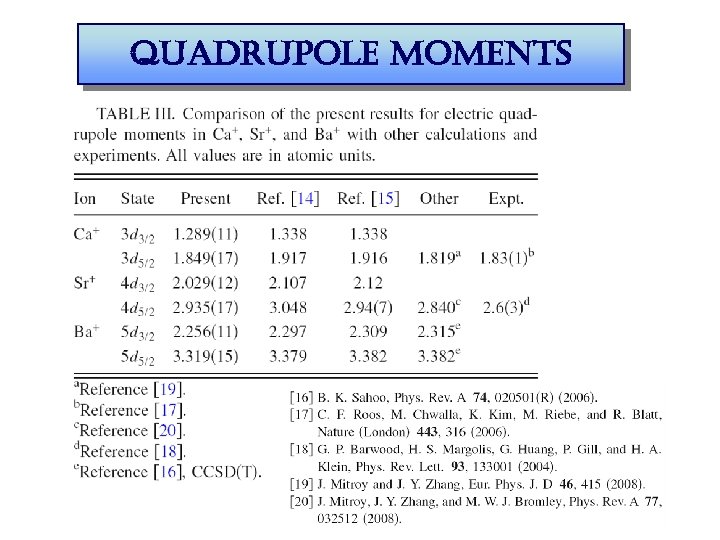
quadrupole moments

how to evaluate uncertainty of theoretical calculations?
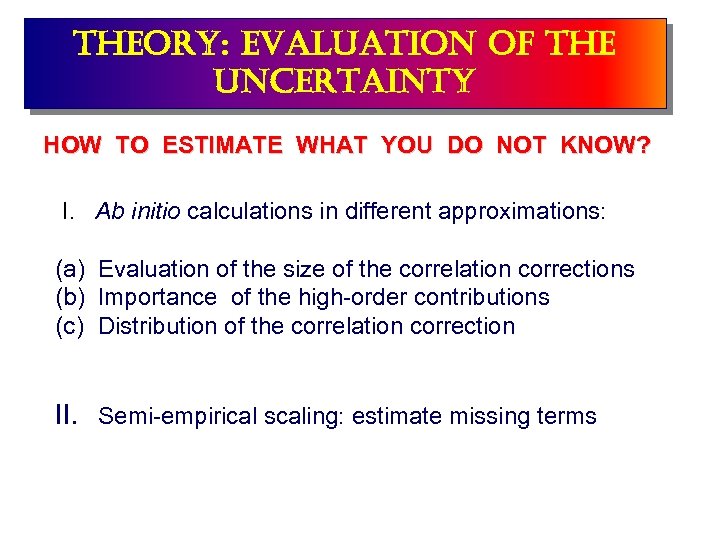
theory: evaluation of the uncertainty HOW TO ESTIMATE WHAT YOU DO NOT KNOW? I. Ab initio calculations in different approximations: (a) Evaluation of the size of the correlation corrections (b) Importance of the high-order contributions (c) Distribution of the correlation correction II. Semi-empirical scaling: estimate missing terms

example: quadrupole moment of 3 d 5/2 state in ca+
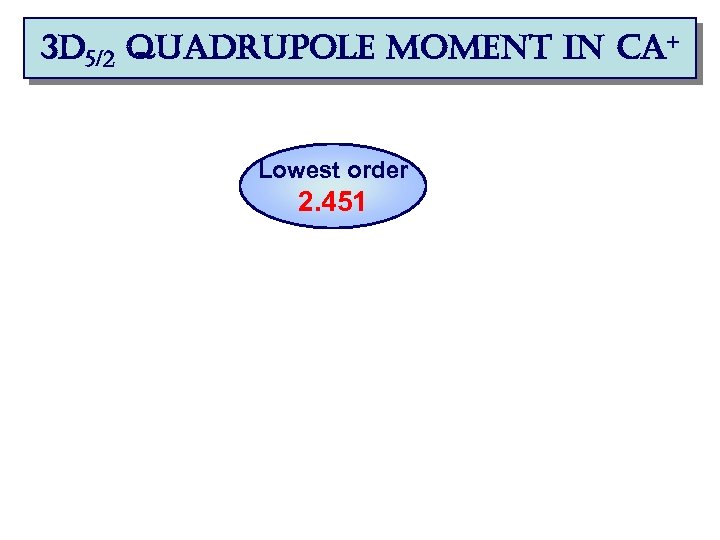
3 d 5/2 quadrupole moment in ca+ Lowest order 2. 451
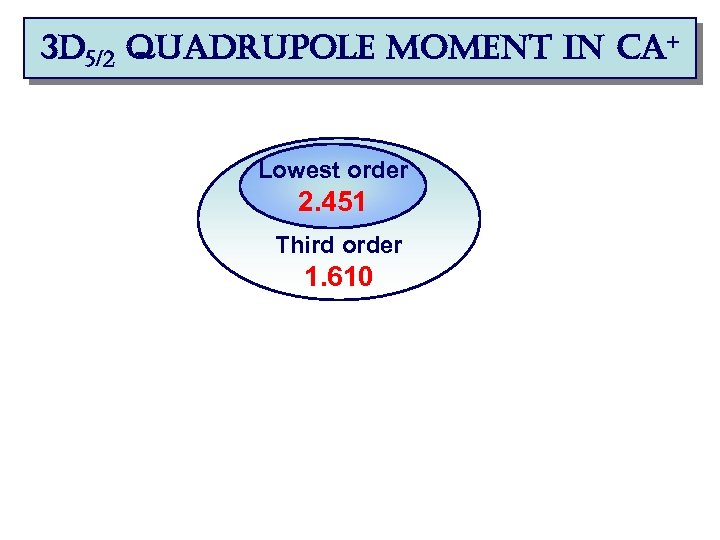
3 d 5/2 quadrupole moment in ca+ Lowest order 2. 451 Third order 1. 610
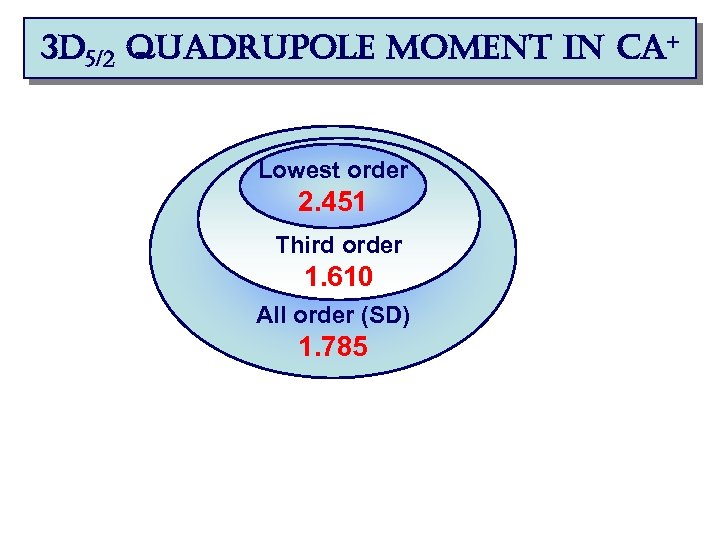
3 d 5/2 quadrupole moment in ca+ Lowest order 2. 451 Third order 1. 610 All order (SD) 1. 785
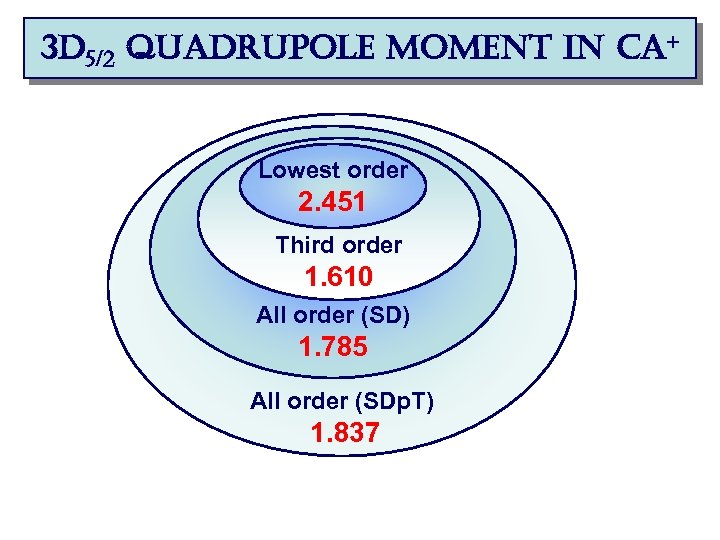
3 d 5/2 quadrupole moment in ca+ Lowest order 2. 451 Third order 1. 610 All order (SD) 1. 785 All order (SDp. T) 1. 837
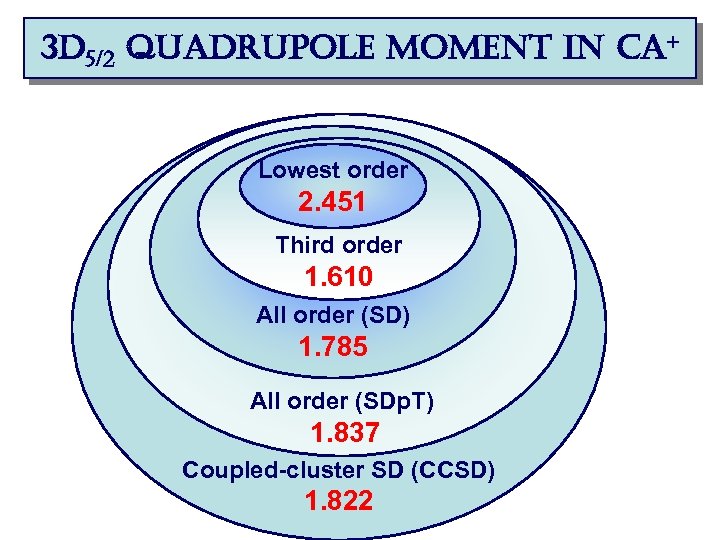
3 d 5/2 quadrupole moment in ca+ Lowest order 2. 451 Third order 1. 610 All order (SD) 1. 785 All order (SDp. T) 1. 837 Coupled-cluster SD (CCSD) 1. 822
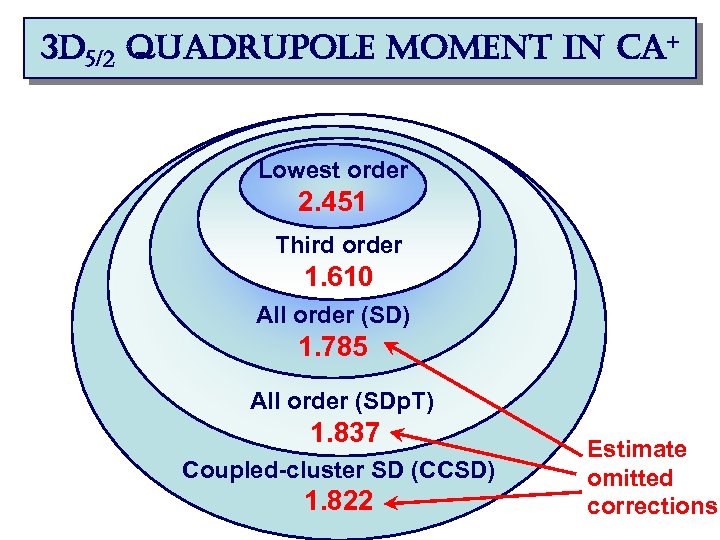
3 d 5/2 quadrupole moment in ca+ Lowest order 2. 451 Third order 1. 610 All order (SD) 1. 785 All order (SDp. T) 1. 837 Coupled-cluster SD (CCSD) 1. 822 Estimate omitted corrections
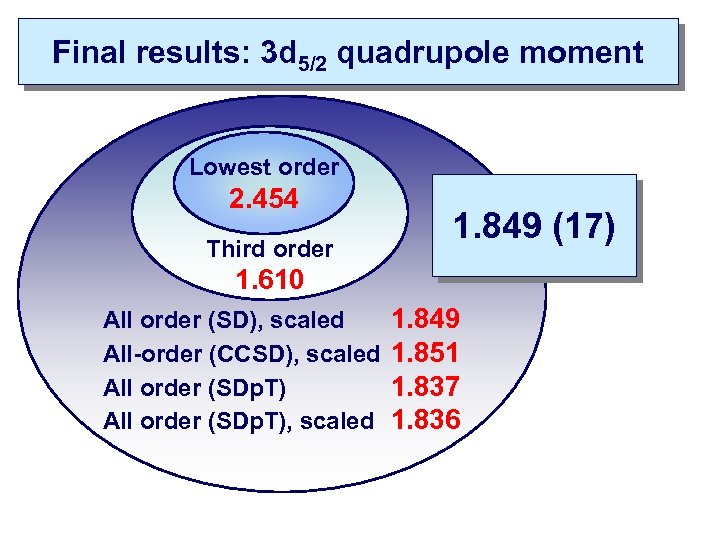
Final results: 3 d 5/2 quadrupole moment Lowest order 2. 454 Third order 1. 849 (17) 1. 610 All order (SD), scaled 1. 849 All-order (CCSD), scaled 1. 851 All order (SDp. T) 1. 837 All order (SDp. T), scaled 1. 836
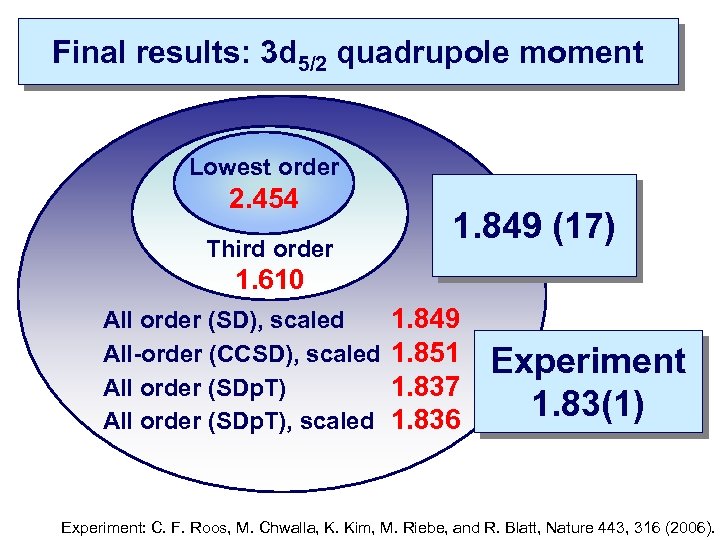
Final results: 3 d 5/2 quadrupole moment Lowest order 2. 454 Third order 1. 849 (17) 1. 610 All order (SD), scaled 1. 849 All-order (CCSD), scaled 1. 851 All order (SDp. T) 1. 837 All order (SDp. T), scaled 1. 836 Experiment 1. 83(1) Experiment: C. F. Roos, M. Chwalla, K. Kim, M. Riebe, and R. Blatt, Nature 443, 316 (2006).
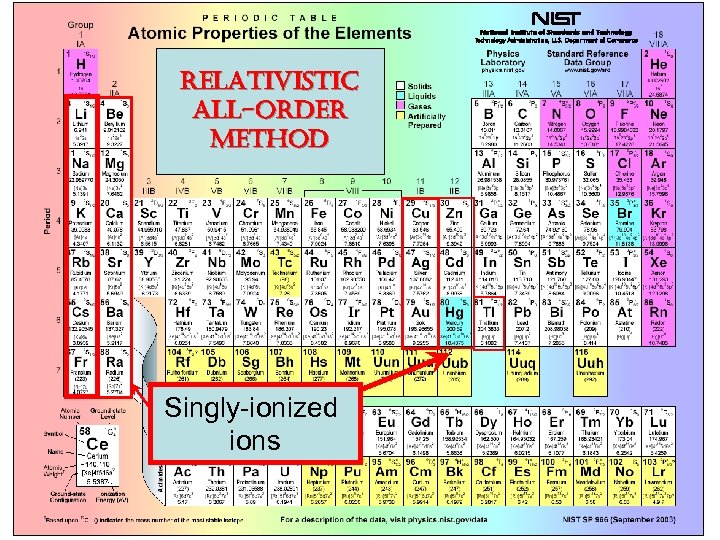
relativistic all-order method Singly-ionized ions
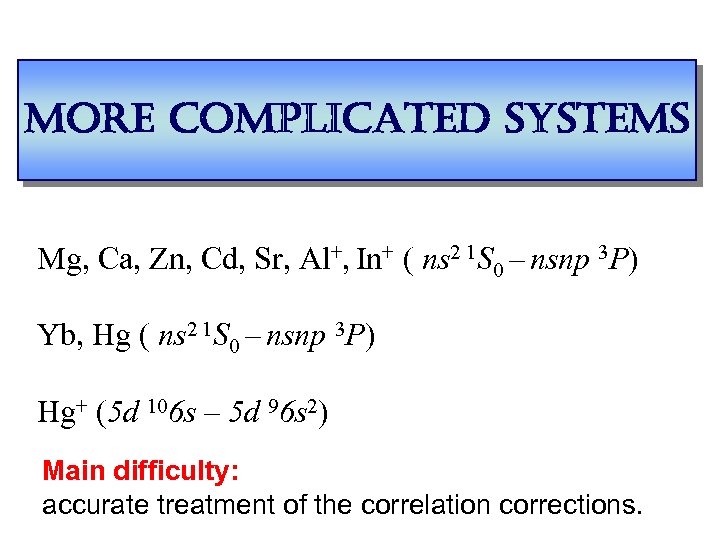
more complicated systems Mg, Ca, Zn, Cd, Sr, Al+, In+ ( ns 2 1 S 0 – nsnp 3 P) Yb, Hg ( ns 2 1 S 0 – nsnp 3 P) Hg+ (5 d 106 s – 5 d 96 s 2) Main difficulty: accurate treatment of the correlation corrections.
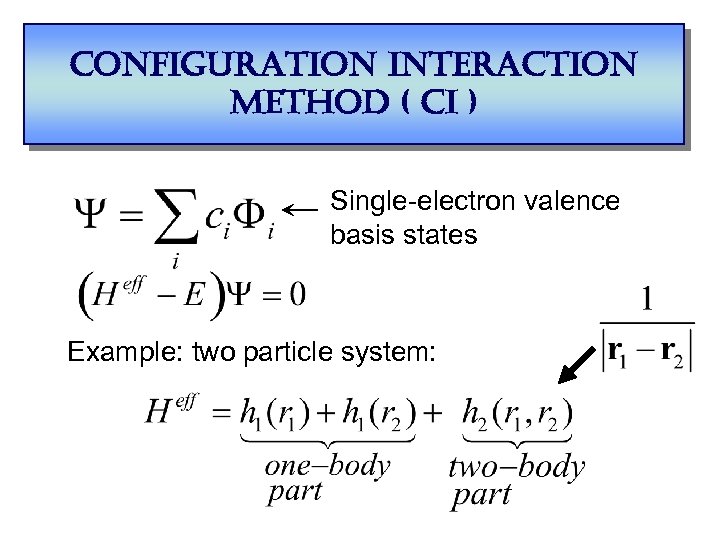
configuration interaction method ( ci ) Single-electron valence basis states Example: two particle system:
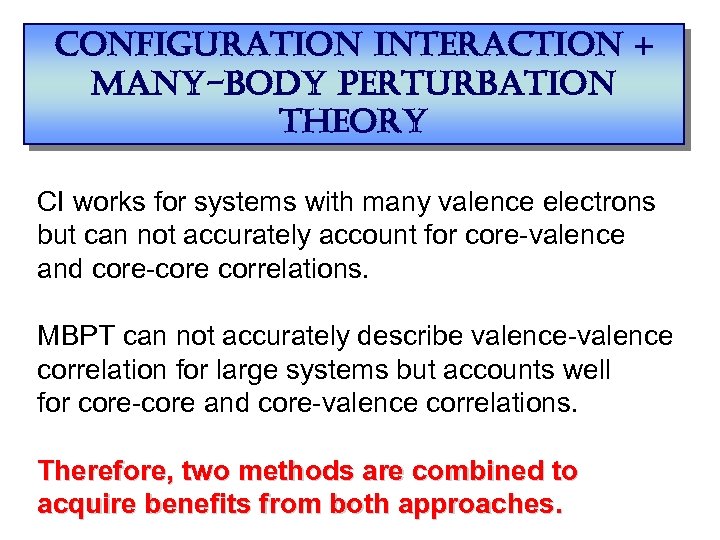
configuration interaction + many-body perturbation theory CI works for systems with many valence electrons but can not accurately account for core-valence and core-core correlations. MBPT can not accurately describe valence-valence correlation for large systems but accounts well for core-core and core-valence correlations. Therefore, two methods are combined to acquire benefits from both approaches.
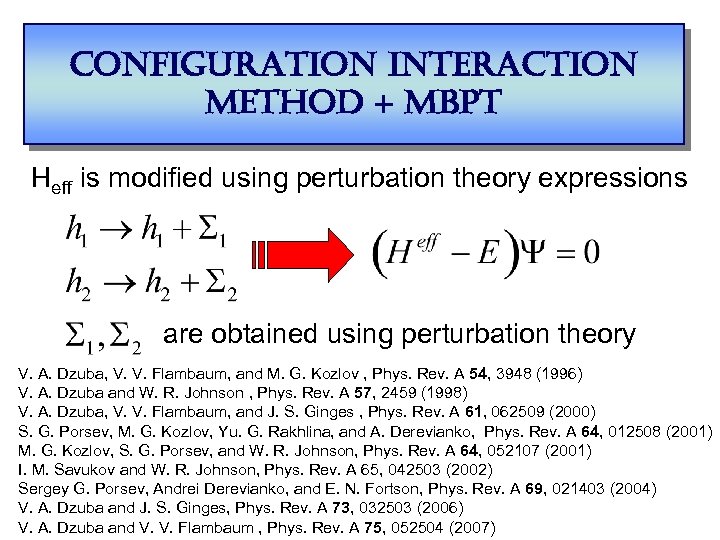
configuration interaction method + mbpt Heff is modified using perturbation theory expressions are obtained using perturbation theory V. A. Dzuba, V. V. Flambaum, and M. G. Kozlov , Phys. Rev. A 54, 3948 (1996) V. A. Dzuba and W. R. Johnson , Phys. Rev. A 57, 2459 (1998) V. A. Dzuba, V. V. Flambaum, and J. S. Ginges , Phys. Rev. A 61, 062509 (2000) S. G. Porsev, M. G. Kozlov, Yu. G. Rakhlina, and A. Derevianko, Phys. Rev. A 64, 012508 (2001) M. G. Kozlov, S. G. Porsev, and W. R. Johnson, Phys. Rev. A 64, 052107 (2001) I. M. Savukov and W. R. Johnson, Phys. Rev. A 65, 042503 (2002) Sergey G. Porsev, Andrei Derevianko, and E. N. Fortson, Phys. Rev. A 69, 021403 (2004) V. A. Dzuba and J. S. Ginges, Phys. Rev. A 73, 032503 (2006) V. A. Dzuba and V. V. Flambaum , Phys. Rev. A 75, 052504 (2007)
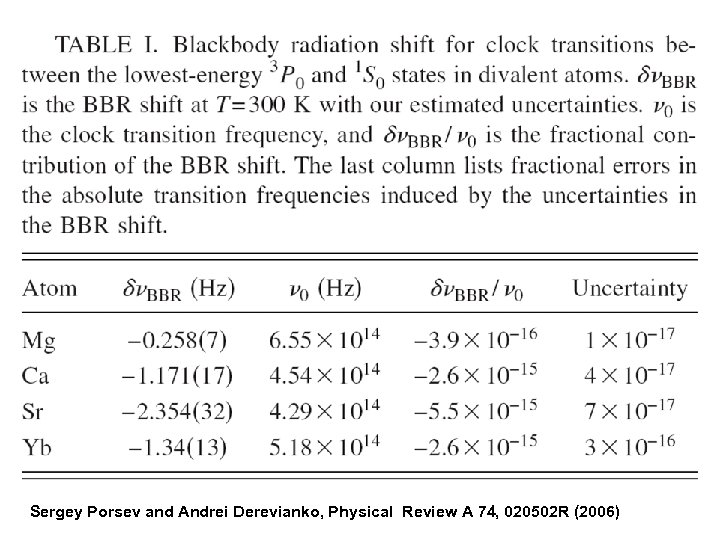
Sergey Porsev and Andrei Derevianko, Physical Review A 74, 020502 R (2006)
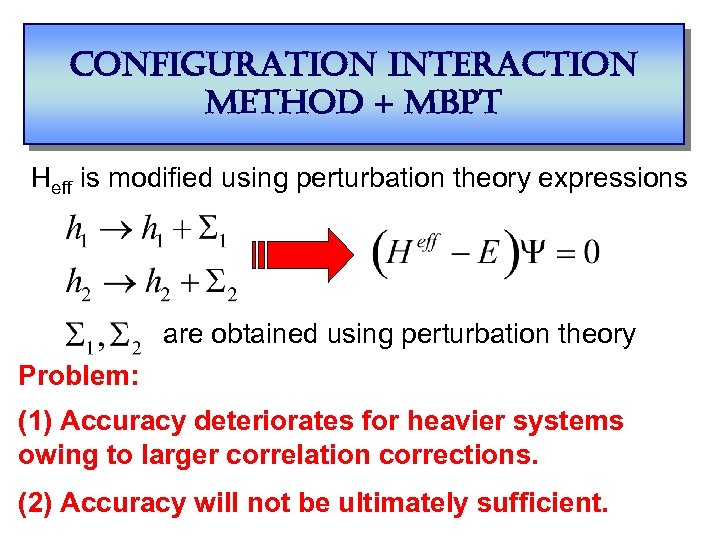
configuration interaction method + mbpt Heff is modified using perturbation theory expressions are obtained using perturbation theory Problem: (1) Accuracy deteriorates for heavier systems owing to larger correlation corrections. (2) Accuracy will not be ultimately sufficient.
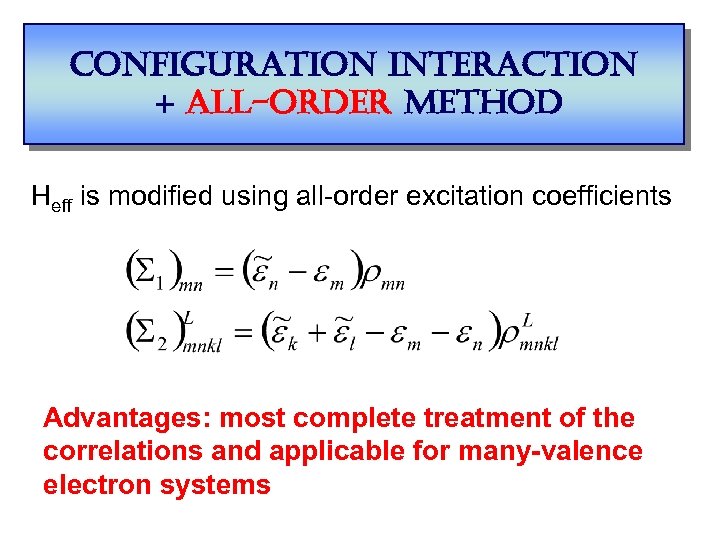
configuration interaction + all-order method Heff is modified using all-order excitation coefficients Advantages: most complete treatment of the correlations and applicable for many-valence electron systems
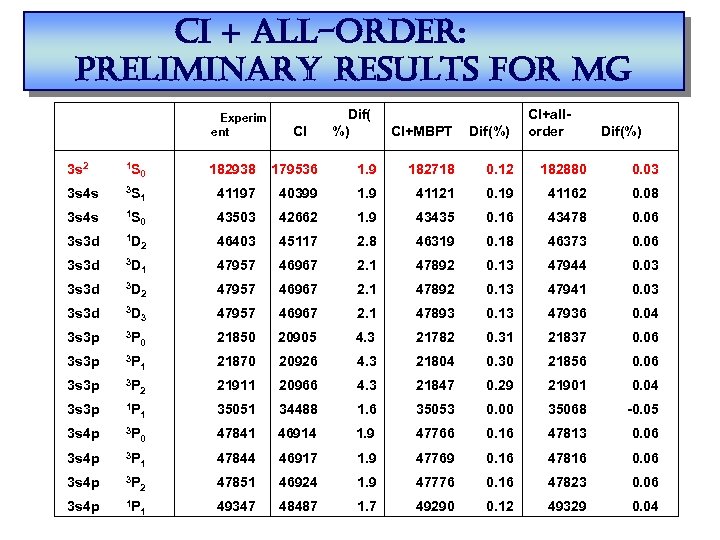
ci + all-order: preliminary results for mg Experim ent CI Dif( %) CI+MBPT Dif(%) CI+all- order Dif(%) 3 s 2 1 S 0 182938 179536 1. 9 182718 0. 12 182880 0. 03 3 s 4 s 3 S 1 41197 40399 1. 9 41121 0. 19 41162 0. 08 3 s 4 s 1 S 0 43503 42662 1. 9 43435 0. 16 43478 0. 06 3 s 3 d 1 D 2 46403 45117 2. 8 46319 0. 18 46373 0. 06 3 s 3 d 3 D 1 47957 46967 2. 1 47892 0. 13 47944 0. 03 3 s 3 d 3 D 2 47957 46967 2. 1 47892 0. 13 47941 0. 03 3 s 3 d 3 D 3 47957 46967 2. 1 47893 0. 13 47936 0. 04 3 s 3 p 3 P 0 21850 20905 4. 3 21782 0. 31 21837 0. 06 3 s 3 p 3 P 1 21870 20926 4. 3 21804 0. 30 21856 0. 06 3 s 3 p 3 P 2 21911 20966 4. 3 21847 0. 29 21901 0. 04 3 s 3 p 1 P 1 35051 34488 1. 6 35053 0. 00 35068 -0. 05 3 s 4 p 3 P 0 47841 46914 1. 9 47766 0. 16 47813 0. 06 3 s 4 p 3 P 1 47844 46917 1. 9 47769 0. 16 47816 0. 06 3 s 4 p 3 P 2 47851 46924 1. 9 47776 0. 16 47823 0. 06 3 s 4 p 1 P 1 49347 48487 1. 7 49290 0. 12 49329 0. 04
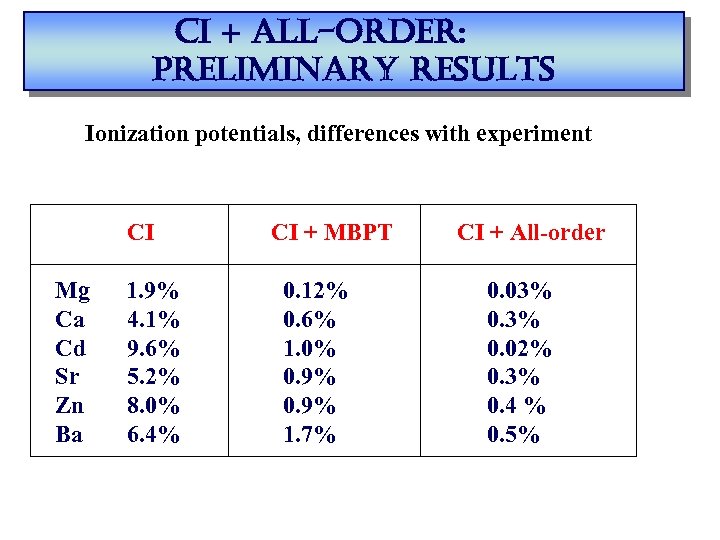
ci + all-order: preliminary results Ionization potentials, differences with experiment CI Mg Ca Cd Sr Zn Ba 1. 9% 4. 1% 9. 6% 5. 2% 8. 0% 6. 4% CI + MBPT 0. 12% 0. 6% 1. 0% 0. 9% 1. 7% CI + All-order 0. 03% 0. 02% 0. 3% 0. 4 % 0. 5%
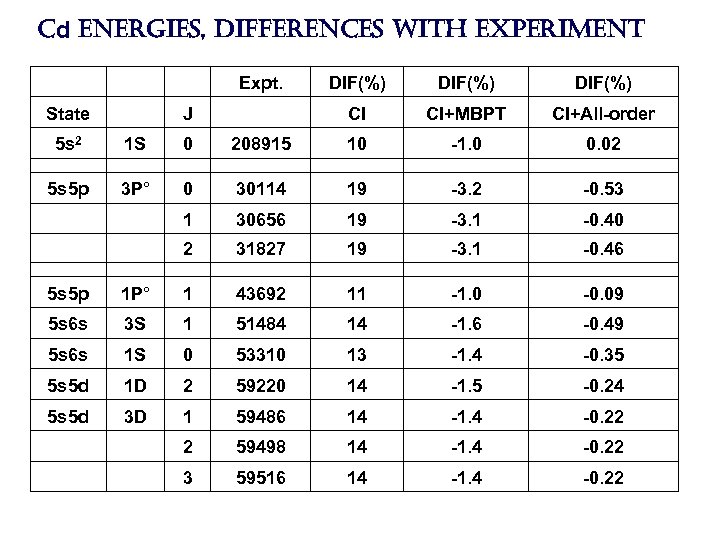
cd energies, differences with experiment Expt. DIF(%) State J CI CI+MBPT CI+All-order 5 s 2 1 S 0 208915 10 -1. 0 0. 02 5 s 5 p 3 P° 0 30114 19 -3. 2 -0. 53 1 30656 19 -3. 1 -0. 40 2 31827 19 -3. 1 -0. 46 5 s 5 p 1 P° 1 43692 11 -1. 0 -0. 09 5 s 6 s 3 S 1 51484 14 -1. 6 -0. 49 5 s 6 s 1 S 0 53310 13 -1. 4 -0. 35 5 s 5 d 1 D 2 59220 14 -1. 5 -0. 24 5 s 5 d 3 D 1 59486 14 -1. 4 -0. 22 2 59498 14 -1. 4 -0. 22 3 59516 14 -1. 4 -0. 22
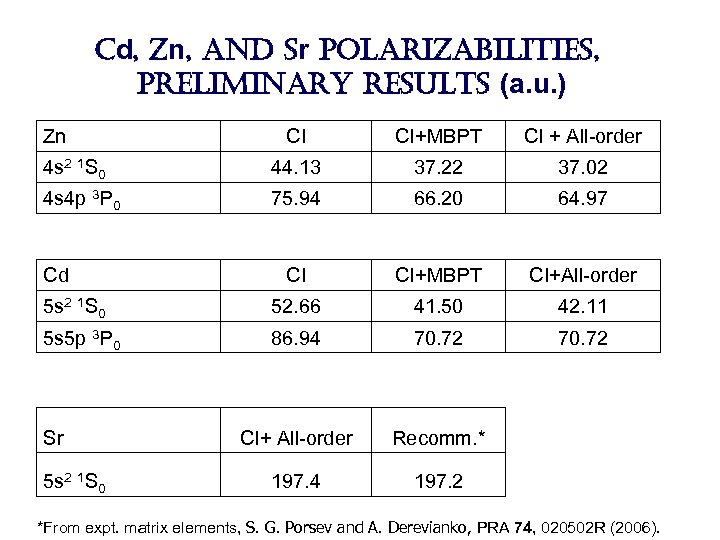
cd, zn, and sr polarizabilities, preliminary results (a. u. ) Zn CI CI+MBPT CI + All-order 4 s 2 1 S 0 44. 13 37. 22 37. 02 4 s 4 p 3 P 0 75. 94 66. 20 64. 97 CI CI+MBPT CI+All-order 5 s 2 1 S 0 52. 66 41. 50 42. 11 5 s 5 p 3 P 0 86. 94 70. 72 CI+ All-order Recomm. * 197. 4 197. 2 Cd Sr 5 s 2 1 S 0 *From expt. matrix elements, S. G. Porsev and A. Derevianko, PRA 74, 020502 R (2006).
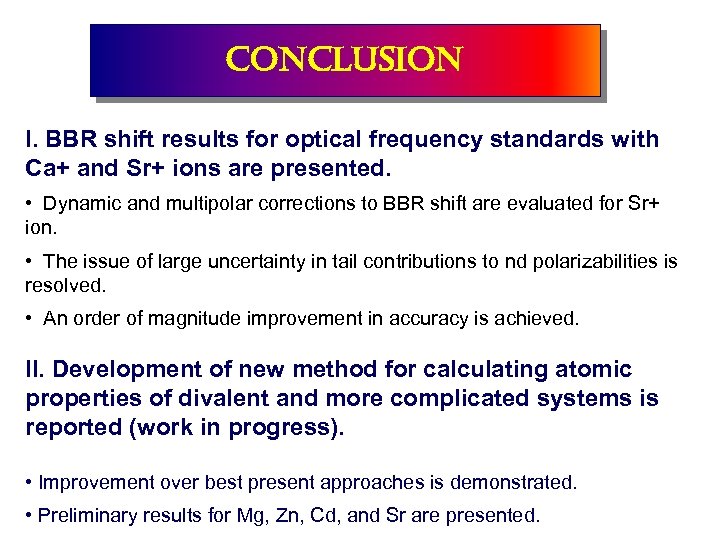
conclusion I. BBR shift results for optical frequency standards with Ca+ and Sr+ ions are presented. • Dynamic and multipolar corrections to BBR shift are evaluated for Sr+ ion. • The issue of large uncertainty in tail contributions to nd polarizabilities is resolved. • An order of magnitude improvement in accuracy is achieved. II. Development of new method for calculating atomic properties of divalent and more complicated systems is reported (work in progress). • Improvement over best present approaches is demonstrated. • Preliminary results for Mg, Zn, Cd, and Sr are presented.
graduate students: bindiya arora (graduated August 2008) rupsi pal (graduated January 2009) Jenny tchoukova (graduated August 2008) dansha Jiang collaborations: Michael Kozlov (Petersburg Nuclear Physics Institute) Walter Johnson (University of Notre Dame) Charles Clark (NIST) Ulyana Safronova (University of Nevada-Reno)
Скачать презентацию EFTF — IEEE 2009 Besanҫon France April 21
5ffd85e26879e851fb2c72c32b0bc84d.ppt