


 Скачать презентацию Efficiency of Algorithms Csci 107 Lecture 6
dd9893f2f31b09cf9ab1d83788098220.ppt
- Количество слайдов: 12
 Efficiency of Algorithms Csci 107 Lecture 6
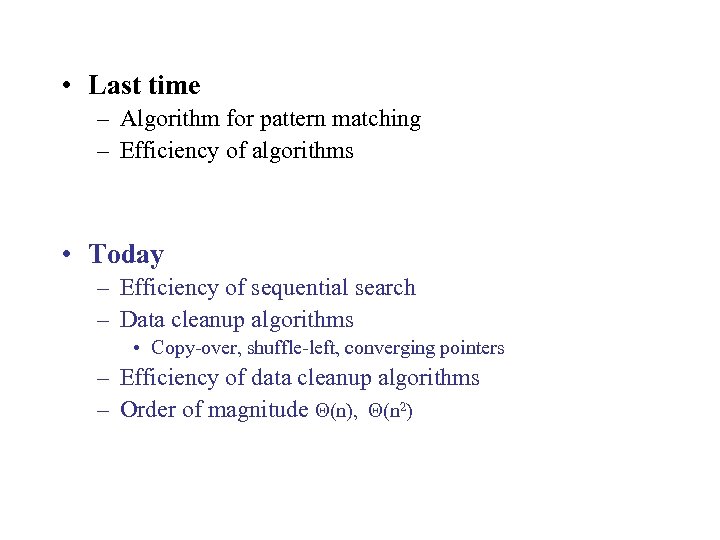 • Last time – Algorithm for pattern matching – Efficiency of algorithms • Today – Efficiency of sequential search – Data cleanup algorithms • Copy-over, shuffle-left, converging pointers – Efficiency of data cleanup algorithms – Order of magnitude (n), (n 2)
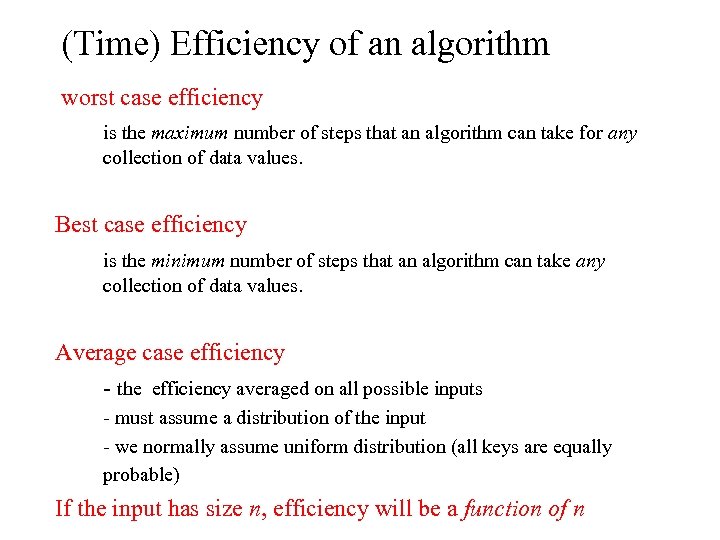 (Time) Efficiency of an algorithm worst case efficiency is the maximum number of steps that an algorithm can take for any collection of data values. Best case efficiency is the minimum number of steps that an algorithm can take any collection of data values. Average case efficiency - the efficiency averaged on all possible inputs - must assume a distribution of the input - we normally assume uniform distribution (all keys are equally probable) If the input has size n, efficiency will be a function of n
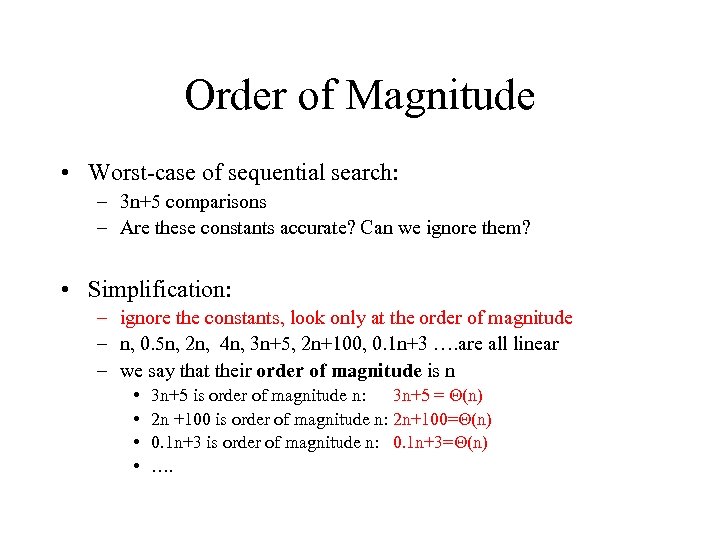 Order of Magnitude • Worst-case of sequential search: – 3 n+5 comparisons – Are these constants accurate? Can we ignore them? • Simplification: – ignore the constants, look only at the order of magnitude – n, 0. 5 n, 2 n, 4 n, 3 n+5, 2 n+100, 0. 1 n+3 …. are all linear – we say that their order of magnitude is n • • 3 n+5 is order of magnitude n: 3 n+5 = (n) 2 n +100 is order of magnitude n: 2 n+100= (n) 0. 1 n+3 is order of magnitude n: 0. 1 n+3= (n) ….
 Efficiency of Copy-Over • Best case: – all values are zero: no copying, no extra space • Worst-case: – No zero value: n elements copied, n extra space – Time: (n) – Extra space: n
 Efficiency of Shuffle-Left • Space: – no extra space (except few variables) • Time – Best-case • No zero value: • no copying ==> order of n = (n) – Worst case • All zero values: – every element thus requires copying n-1 values one to the left • n x (n-1) = n 2 - n = order of n 2 = (n 2) (why? ) – Average case • Half of the values are zero • n/2 x (n-1) = (n 2 - n)/2 = order of n 2 = (n 2)
 Efficiency of Converging Pointers Algorithm • Space – No extra space used (except few variables) • Time – Best-case • No zero value • No copying => order of n = (n) – Worst-case • All values zero: • One copy at each step => n-1 copies • order of n = (n) – Average-case • Half of the values are zero: • n/2 copies • order of n = (n)
 Data Cleanup Algorithms • Copy-Over – worst-case: time (n), extra space n – best case: time (n), no extra space • Shuffle-left – worst-case: time (n 2), no extra space – Best-case: time (n), no extra space • Converging pointers – worst-case: time (n), no extra space – Best-case: time (n), no extra space
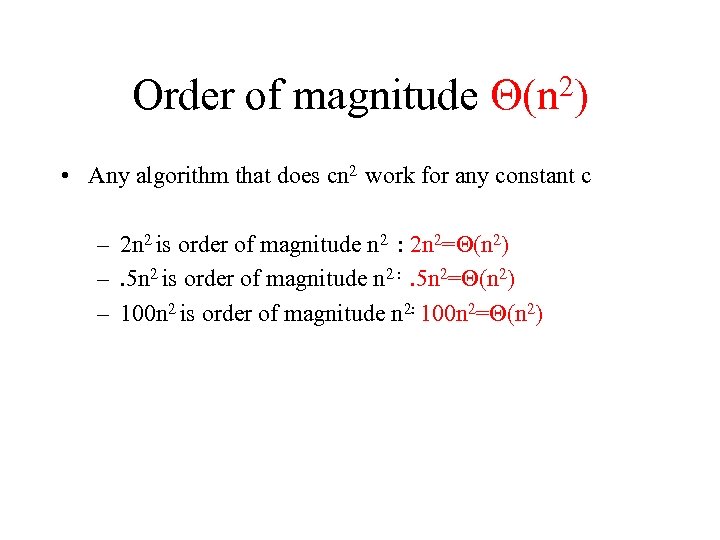 Order of magnitude 2) (n • Any algorithm that does cn 2 work for any constant c – 2 n 2 is order of magnitude n 2 : 2 n 2= (n 2) –. 5 n 2 is order of magnitude n 2 : . 5 n 2= (n 2) – 100 n 2 is order of magnitude n 2: 100 n 2= (n 2)
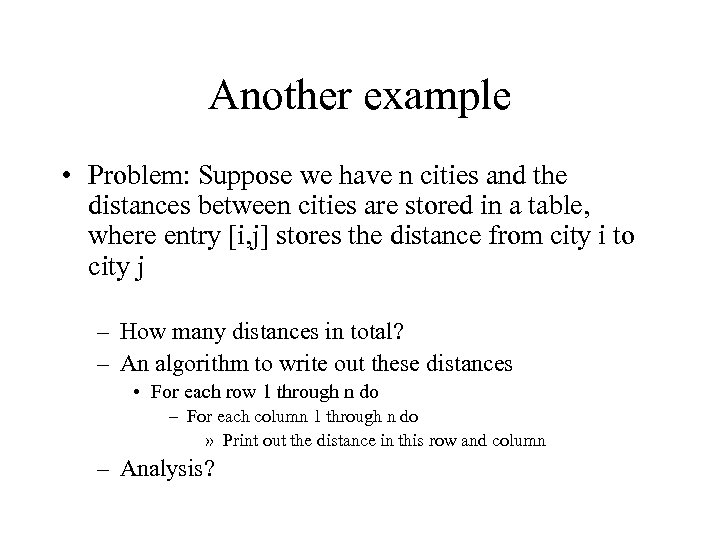 Another example • Problem: Suppose we have n cities and the distances between cities are stored in a table, where entry [i, j] stores the distance from city i to city j – How many distances in total? – An algorithm to write out these distances • For each row 1 through n do – For each column 1 through n do » Print out the distance in this row and column – Analysis?
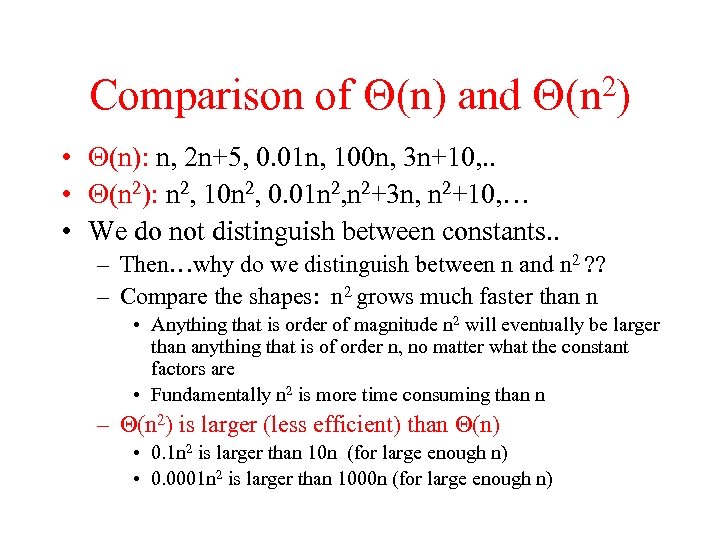 Comparison of (n) and 2) (n • (n): n, 2 n+5, 0. 01 n, 100 n, 3 n+10, . . • (n 2): n 2, 10 n 2, 0. 01 n 2, n 2+3 n, n 2+10, … • We do not distinguish between constants. . – Then…why do we distinguish between n and n 2 ? ? – Compare the shapes: n 2 grows much faster than n • Anything that is order of magnitude n 2 will eventually be larger than anything that is of order n, no matter what the constant factors are • Fundamentally n 2 is more time consuming than n – (n 2) is larger (less efficient) than (n) • 0. 1 n 2 is larger than 10 n (for large enough n) • 0. 0001 n 2 is larger than 1000 n (for large enough n)
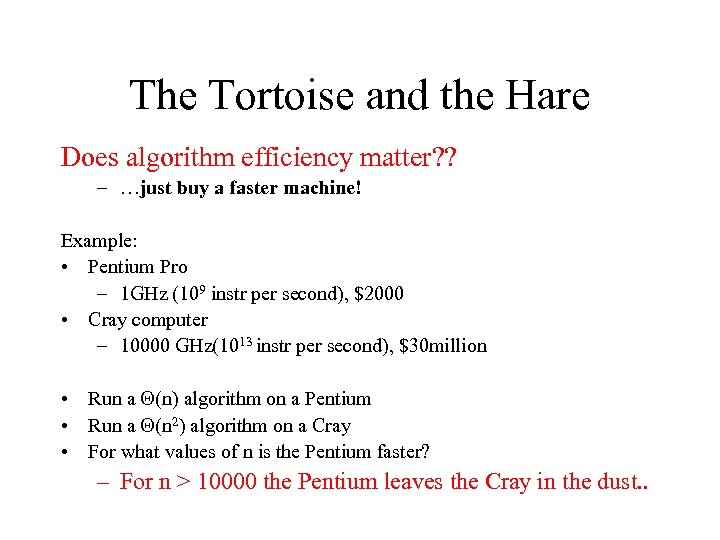 The Tortoise and the Hare Does algorithm efficiency matter? ? – …just buy a faster machine! Example: • Pentium Pro – 1 GHz (109 instr per second), $2000 • Cray computer – 10000 GHz(1013 instr per second), $30 million • Run a (n) algorithm on a Pentium • Run a (n 2) algorithm on a Cray • For what values of n is the Pentium faster? – For n > 10000 the Pentium leaves the Cray in the dust. .