


 Скачать презентацию Effects of Stress on Adult Development Name
9ba0214d99ad45ed3ce554e62f043e35.ppt
- Количество слайдов: 11
 Effects of Stress on Adult Development Name
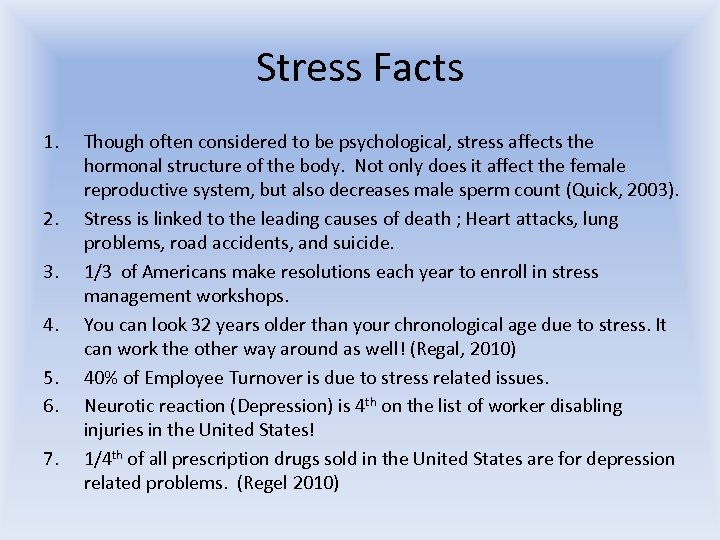 Stress Facts 1. 2. 3. 4. 5. 6. 7. Though often considered to be psychological, stress affects the hormonal structure of the body. Not only does it affect the female reproductive system, but also decreases male sperm count (Quick, 2003). Stress is linked to the leading causes of death ; Heart attacks, lung problems, road accidents, and suicide. 1/3 of Americans make resolutions each year to enroll in stress management workshops. You can look 32 years older than your chronological age due to stress. It can work the other way around as well! (Regal, 2010) 40% of Employee Turnover is due to stress related issues. Neurotic reaction (Depression) is 4 th on the list of worker disabling injuries in the United States! 1/4 th of all prescription drugs sold in the United States are for depression related problems. (Regel 2010)
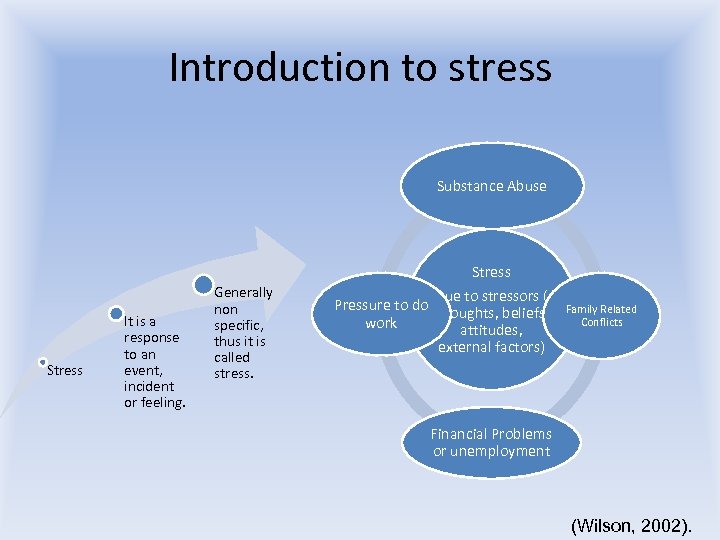 Introduction to stress Substance Abuse Stress It is a response to an event, incident or feeling. Generally non specific, thus it is called stress. Due to stressors ( Pressure to do Thoughts, beliefs, work attitudes, Family Related Conflicts external factors) Financial Problems or unemployment (Wilson, 2002).
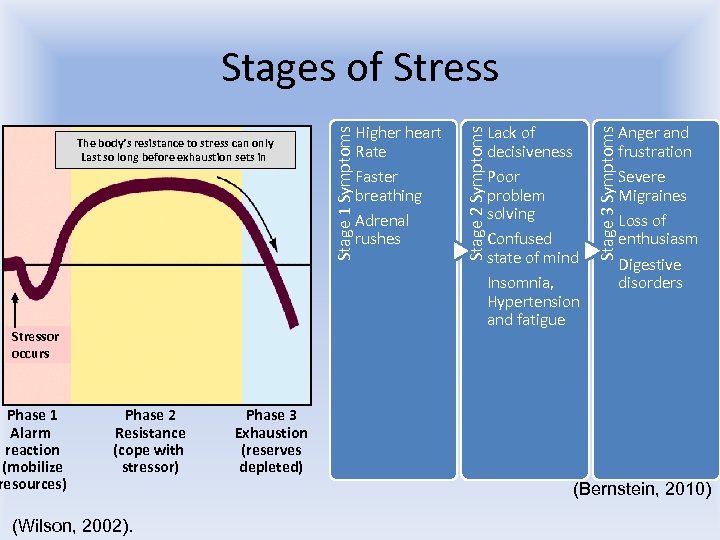 Stressor occurs Phase 1 Alarm reaction (mobilize resources) Phase 2 Resistance (cope with stressor) (Wilson, 2002). Lack of decisiveness Poor problem solving Confused state of mind Insomnia, Hypertension and fatigue Stage 3 Symptoms Higher heart Rate Faster breathing Adrenal rushes Stage 2 Symptoms The body’s resistance to stress can only Last so long before exhaustion sets in Stage 1 Symptoms Stages of Stress Anger and frustration Severe Migraines Loss of enthusiasm Digestive disorders Phase 3 Exhaustion (reserves depleted) (Bernstein, 2010)
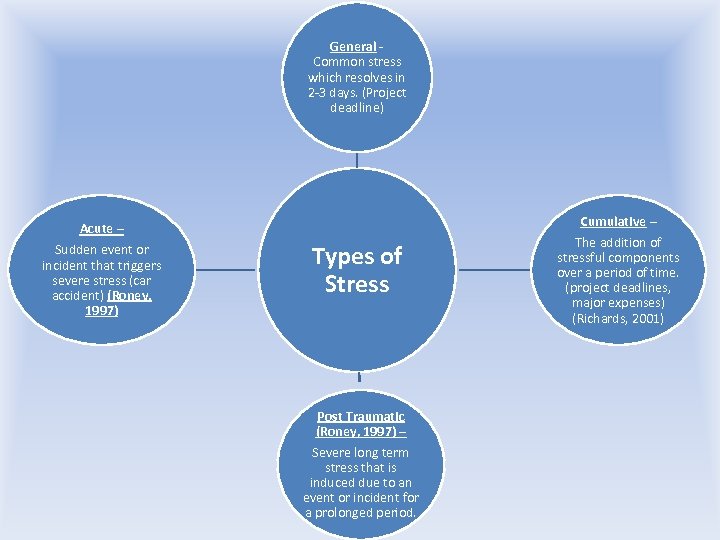 General - Common stress which resolves in 2 -3 days. (Project deadline) Cumulative – Acute – Sudden event or incident that triggers severe stress (car accident) (Roney, 1997) Types of Stress Post Traumatic (Roney, 1997) – Severe long term stress that is induced due to an event or incident for a prolonged period. The addition of stressful components over a period of time. (project deadlines, major expenses) (Richards, 2001)
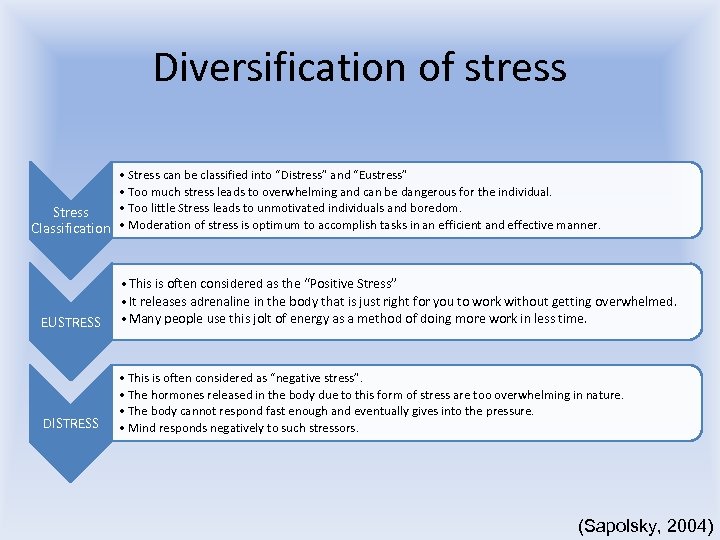 Diversification of stress • Stress can be classified into “Distress” and “Eustress” • Too much stress leads to overwhelming and can be dangerous for the individual. • Too little Stress leads to unmotivated individuals and boredom. Stress Classification • Moderation of stress is optimum to accomplish tasks in an efficient and effective manner. EUSTRESS • This is often considered as the “Positive Stress” • It releases adrenaline in the body that is just right for you to work without getting overwhelmed. • Many people use this jolt of energy as a method of doing more work in less time. DISTRESS • This is often considered as “negative stress”. • The hormones released in the body due to this form of stress are too overwhelming in nature. • The body cannot respond fast enough and eventually gives into the pressure. • Mind responds negatively to such stressors. (Sapolsky, 2004)
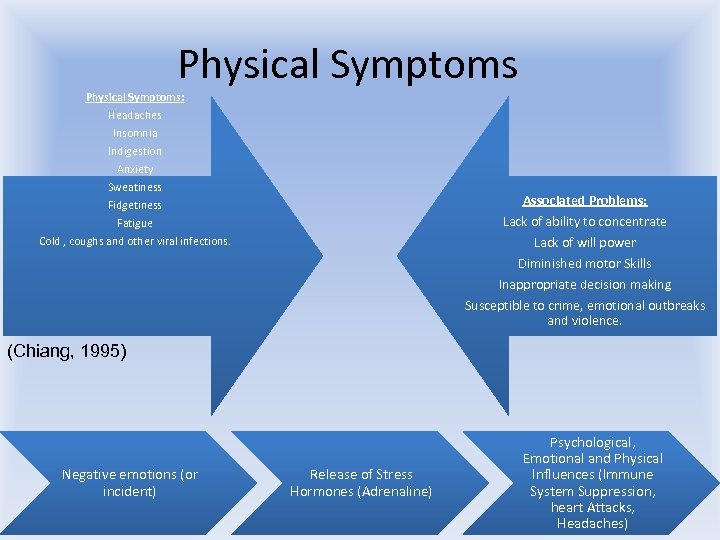 Physical Symptoms: Headaches Insomnia Indigestion Anxiety Sweatiness Fidgetiness Fatigue Cold , coughs and other viral infections. Associated Problems: Lack of ability to concentrate Lack of will power Diminished motor Skills Inappropriate decision making Susceptible to crime, emotional outbreaks and violence. (Chiang, 1995) Negative emotions (or incident) Release of Stress Hormones (Adrenaline) Psychological, Emotional and Physical Influences (Immune System Suppression, heart Attacks, Headaches)
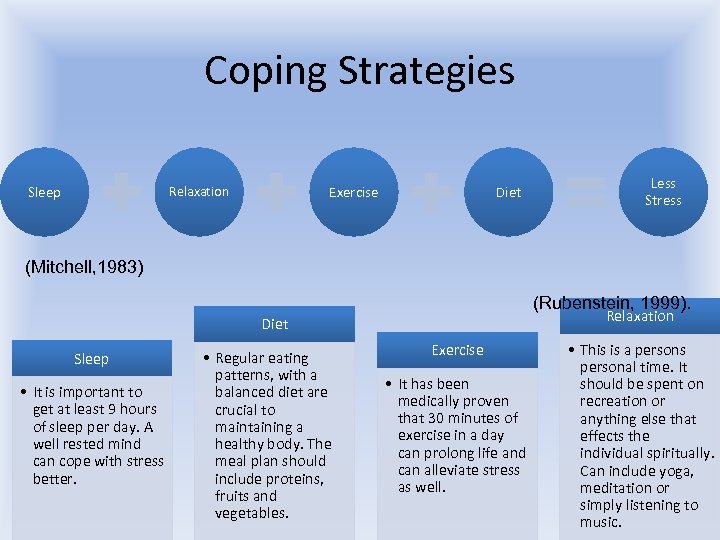 Coping Strategies Sleep Exercise Relaxation Diet Less Stress (Mitchell, 1983) (Rubenstein, 1999). Relaxation Diet Sleep • It is important to get at least 9 hours of sleep per day. A well rested mind can cope with stress better. • Regular eating patterns, with a balanced diet are crucial to maintaining a healthy body. The meal plan should include proteins, fruits and vegetables. Exercise • It has been medically proven that 30 minutes of exercise in a day can prolong life and can alleviate stress as well. • This is a persons personal time. It should be spent on recreation or anything else that effects the individual spiritually. Can include yoga, meditation or simply listening to music.
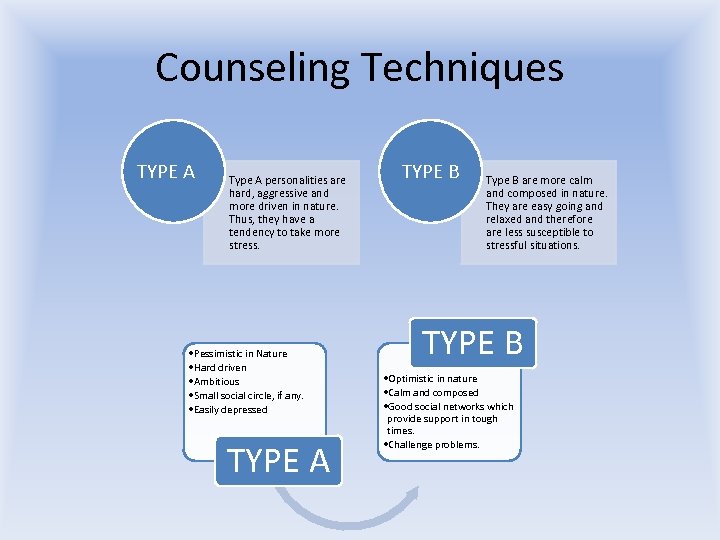 Counseling Techniques TYPE A Type A personalities are hard, aggressive and more driven in nature. Thus, they have a tendency to take more stress. • Pessimistic in Nature • Hard driven • Ambitious • Small social circle, if any. • Easily depressed TYPE A TYPE B Type B are more calm and composed in nature. They are easy going and relaxed and therefore are less susceptible to stressful situations. TYPE B • Optimistic in nature • Calm and composed • Good social networks which provide support in tough times. • Challenge problems.
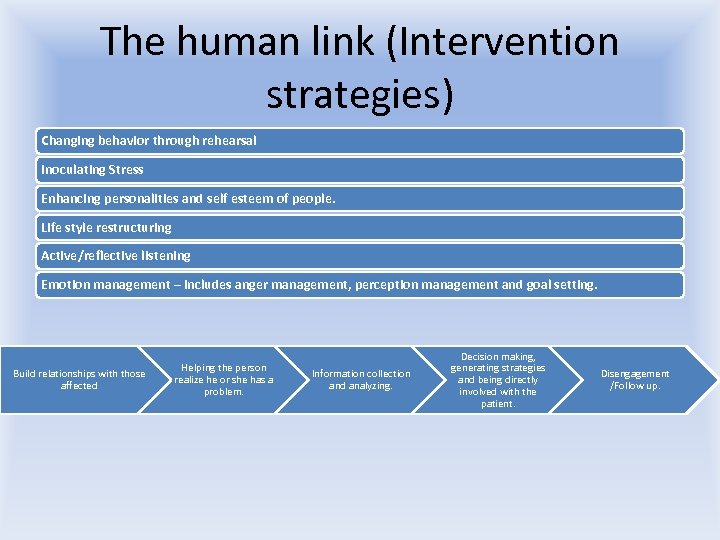 The human link (Intervention strategies) Changing behavior through rehearsal Inoculating Stress Enhancing personalities and self esteem of people. Life style restructuring Active/reflective listening Emotion management – includes anger management, perception management and goal setting. Build relationships with those affected Helping the person realize he or she has a problem. Information collection and analyzing. Decision making, generating strategies and being directly involved with the patient. Disengagement /Follow up.
 Resources • • • • Greenberg, J. (2008). Comprehensive stress management. Mc. Graw-Hill Humanities. Weiss, B. (2003). Eliminating stress, finding inner peace. Hay House. Bernstein, A. (2010). The Myth of stress: where stress really comes from and how to live a happier and healthier life. Free Press. Rubenstein, L. (1999). The Stress management handbook: strategies for health and inner peace. : Keats Publishing. Wilson, J. (2002). Adrenal fatigue: the 21 st century stress syndrome. Smart Publications. Sapolsky, R. (2004). Why Zebras don't get ulcers. Holt Paperbacks. Chiang, C. X. (1995). A Study of Stress Reactions among Adolescents. Chinese Journal of School Health, 26, 33 -37. Nathan, R. (2004). Stress management: a comprehensive guide to wellness. Ballantine Books. Quick , J. (2003). Stress and strain (fast facts). : Health Press. Roney, A. (1997). Professionals on workplace stress - the essential facts. John Wiley and Sons. Mitchell, J. T. (1983). Effects of Stress Management Training on Paramedic Coping Styles and Perceived Stress Levels Doctoral Dissertation). Ann Arbor, MI: University Microfilms International. Regel, S. (2010). Post-traumatic stress (the facts). Oxford University Press. Parad, H. J. (1971). Crisis Intervention. In R. Morris (Ed. ) Encyclopedia of Social Work, vol. 1, 196 -202). 4 Mimura C & Griffiths P (2003) The effectiveness of current approaches to workplace stress management in the nursing profession: an evidence based literature review, Occupational and Environmental Medicine, Jan (60)1. Richards, D. (2001). A field study of critical incident stress debriefing versus critical incident stress management. Journal of Mental Health, 10, 351 -362. Cohen, Kamarack , Mermelstein. (1983) A global measure of perceived stress. J Health Soc Behav. : 24: 385– 396.