


 Скачать презентацию Effects of long term irrigation with reclaimed wastewater
fbd4a9be7e5021c2f5988cbc35ec571a.ppt
- Количество слайдов: 26
 Effects of long term irrigation with reclaimed wastewater on the efficacy and fate of ALS inhibiting herbicides Gal Dvorkin, M Manor, M Sibony, B Chefetz and B Rubin The Robert H. Smith Faculty of Agriculture, Food and Environment, The Hebrew University in Jerusalem, Rehovot, Israel
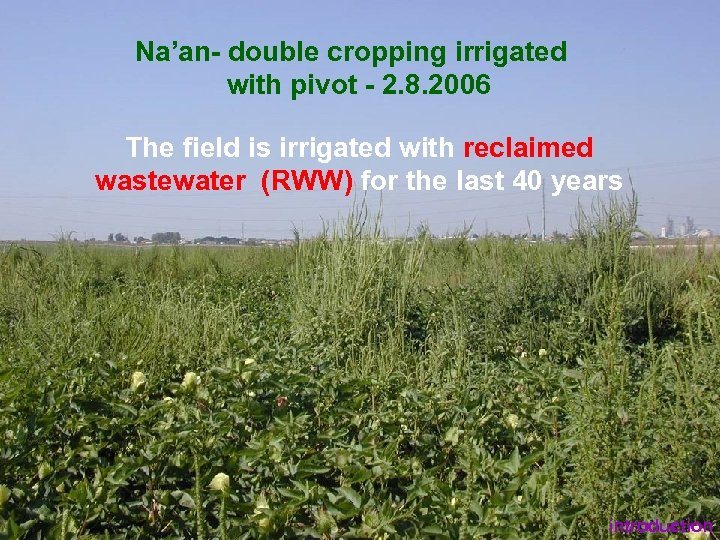 Na’an- double cropping irrigated with pivot - 2. 8. 2006 The field is irrigated with reclaimed wastewater (RWW) for the last 40 years introduction
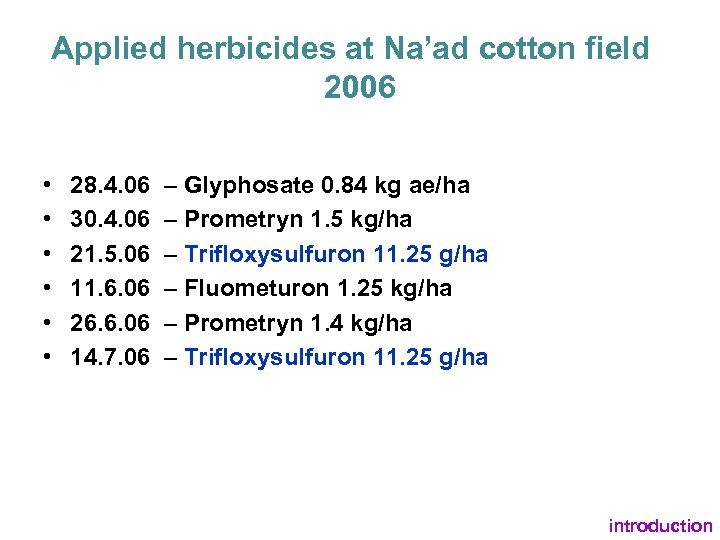 Applied herbicides at Na’ad cotton field 2006 • • • 28. 4. 06 30. 4. 06 21. 5. 06 11. 6. 06 26. 6. 06 14. 7. 06 – Glyphosate 0. 84 kg ae/ha – Prometryn 1. 5 kg/ha – Trifloxysulfuron 11. 25 g/ha – Fluometuron 1. 25 kg/ha – Prometryn 1. 4 kg/ha – Trifloxysulfuron 11. 25 g/ha introduction
 The main problems in Na’an field • The trifloxysulfuron that was applied twice in the highest recommended dose, was not able to control the Amaranthus palmeri. • Wheat that followed the cotton 4 months after the trifloxysulfuron application, was not damaged by residues that were supposed to remain in the soil. introduction
 Hypothesis • The long term irrigation with RWW have caused changes in the soil (OM and microorganisms), thus decreasing the persistence of ALS herbicides. • The Amaranthus palmeri population developed resistance to trifloxysulfuron hypothesis
 Research Objective • To elucidate the effect of a long term irrigation with RWW on the behavior of ALS inhibiting herbicide trifloxysulfuron in the soil
 Materials and Methods • Field experiments were conducted at the problematic field, in 2007, 2008 and 2009. • Dose response curves to trifloxysulfuron in RWW irrigated soil and in fresh water (FW) irrigated soil • Develop chemical analysis method to extract and estimate trifloxysulfuron residues from the soil.
 The field experiments • Herbicides were sprayed with a “backpack sprayer”, each plot 2 m wide and 12 m long • Every 2 weeks soil samples were taken using soil driller • Herbicide content in the soil samples was examined using Sorghum bicolor as test plant, and harvested 3 weeks later. Materials and methods
 Results of field experiments
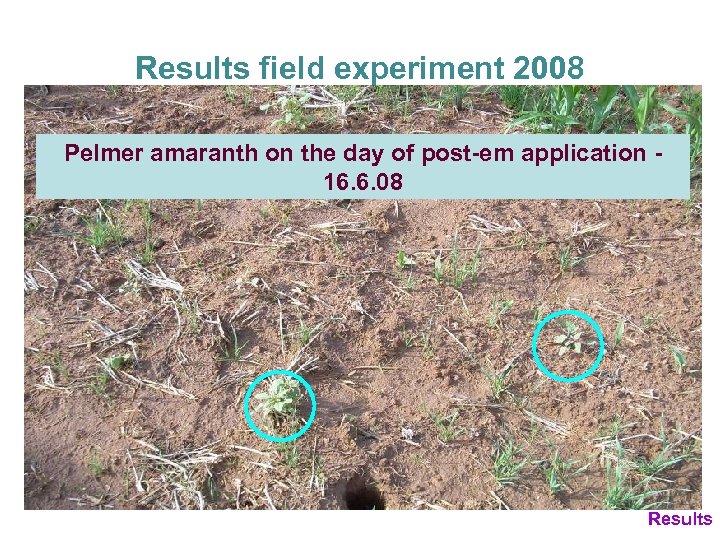 Results field experiment 2008 Pelmer amaranth on the day of post-em application 16. 6. 08 Results
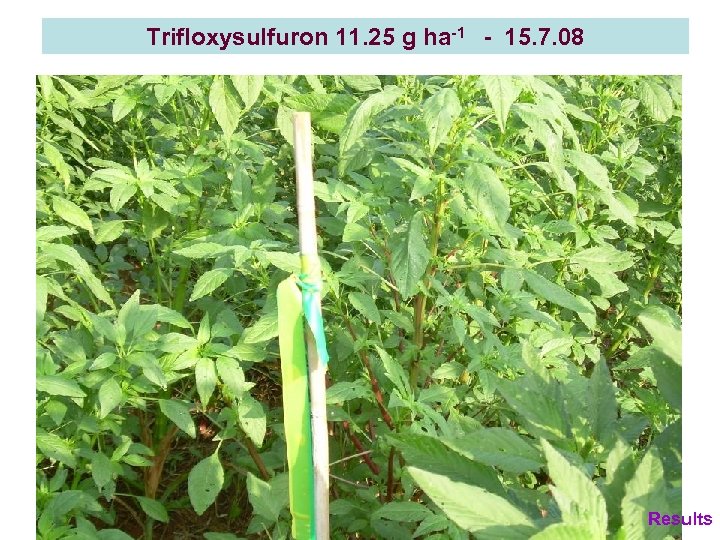 Trifloxysulfuron 11. 25 g ha-1 - 15. 7. 08 Results
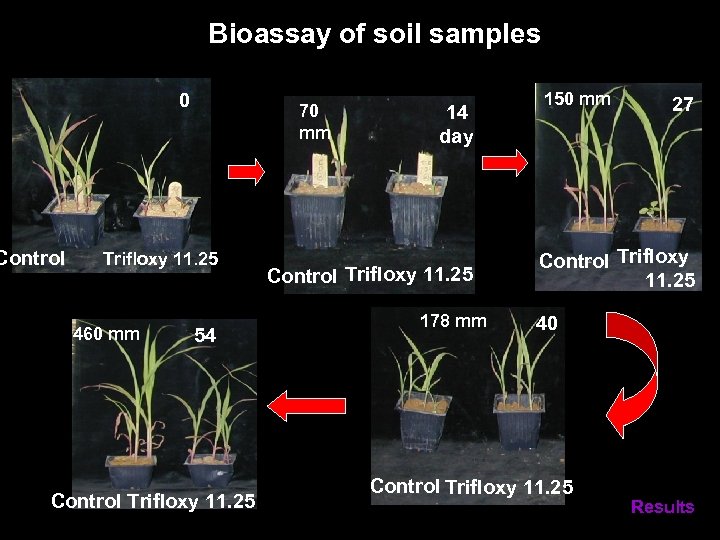 Bioassay of soil samples 0 Control 70 mm Trifloxy 11. 25 460 mm 54 Control Trifloxy 11. 25 14 day Control Trifloxy 11. 25 178 mm 150 mm 27 Control Trifloxy 11. 25 40 Control Trifloxy 11. 25 Results
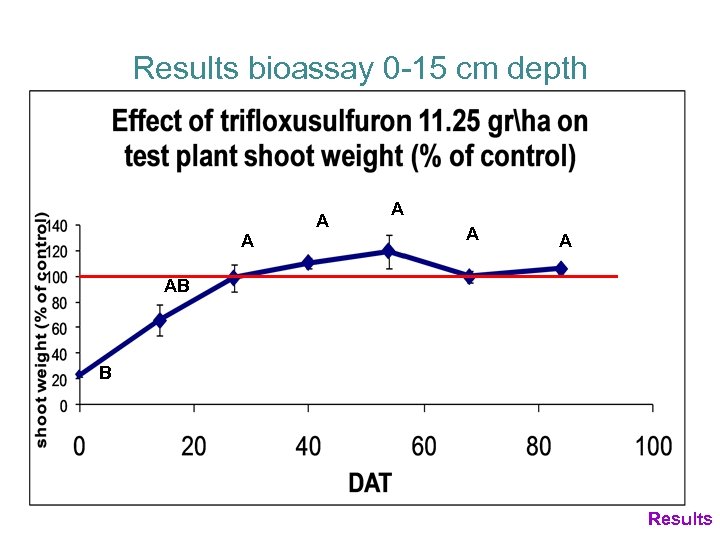 Results bioassay 0 -15 cm depth A A AB B Results
 Lab experiments
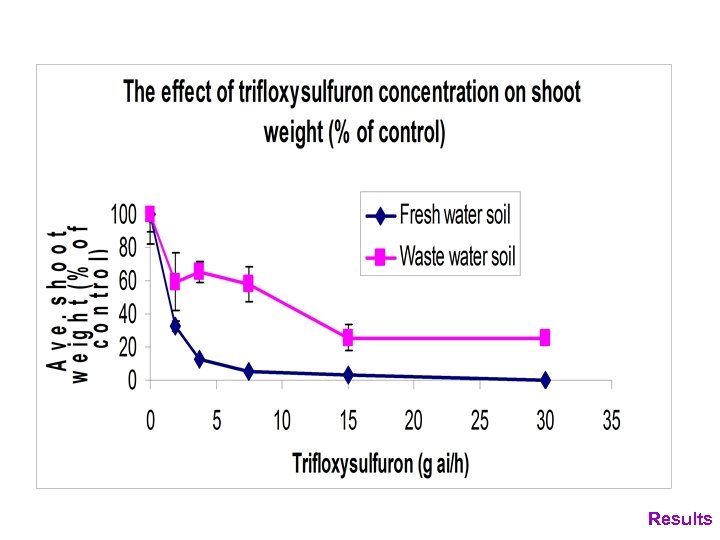
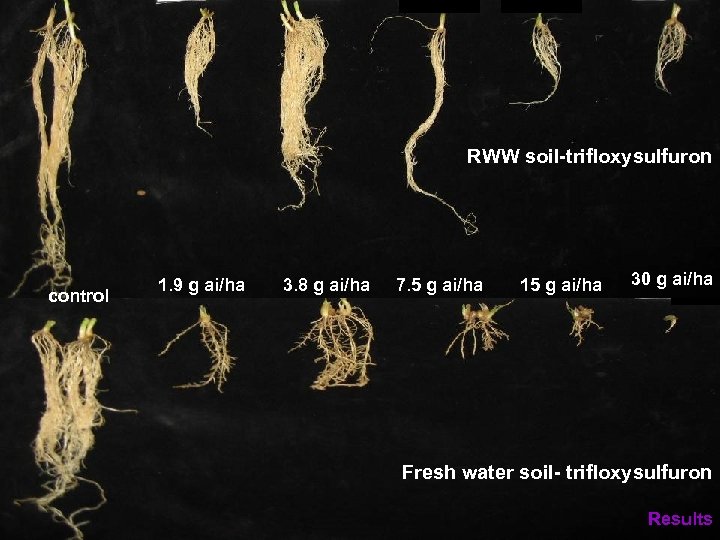
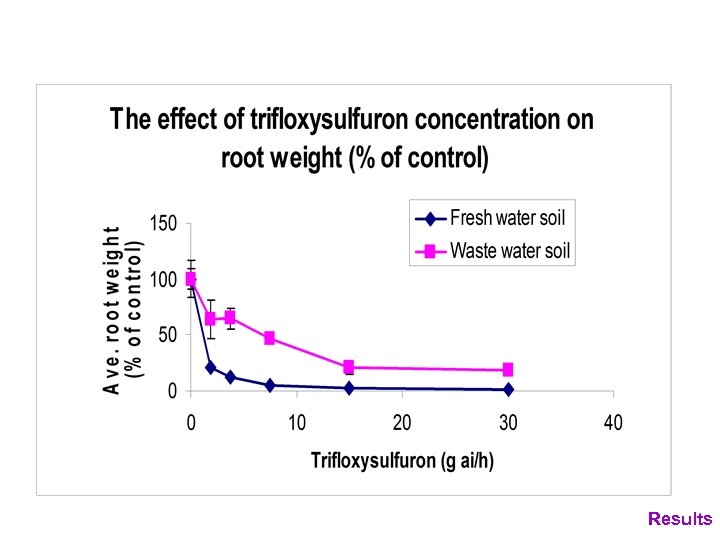
 Comparing the effect of trifloxysulfuron in RWW soil and FW irrigated soil • RWW irrigated soil was collected from Na’an field, and FW irrigated soil was collected from near by field. • Both soils were air dried, sieved (5 mm), and were put in 7*7*7 (cm) plastic pots. • The pots were planted with wheat, and sprayed with trifloxysulfuron and irrigated with FW. • After 3 weeks in the screen house, Plant harvested and shoot fresh wt was recorded Materials and methods
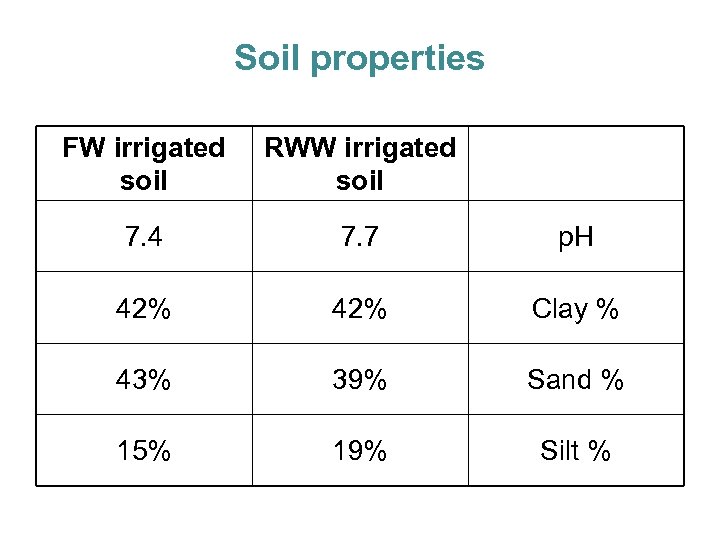 Soil properties FW irrigated soil RWW irrigated soil 7. 4 7. 7 p. H 42% Clay % 43% 39% Sand % 15% 19% Silt %
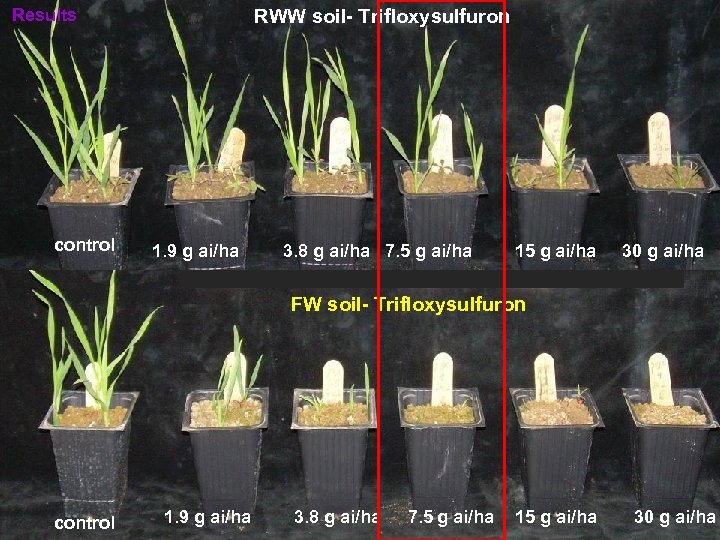 Results control RWW soil- Trifloxysulfuron 1. 9 g ai/ha 3. 8 g ai/ha 7. 5 g ai/ha 15 g ai/ha 30 g ai/ha FW soil- Trifloxysulfuron control 1. 9 g ai/ha 3. 8 g ai/ha 7. 5 g ai/ha 15 g ai/ha 30 g ai/ha
 Results
 RWW soil-trifloxysulfuron control 1. 9 g ai/ha 3. 8 g ai/ha 7. 5 g ai/ha 15 g ai/ha 30 g ai/ha Fresh water soil- trifloxysulfuron Results
 Results
 Chemical analysis of Trifloxysulfuron in the soil • Soil samples were collected from the field experiment in Na’an. • The samples were extracted and filtered. • Extracts were injected to LC/MS and a method for identifying trifloxysulfuron residues in the soil was developed.
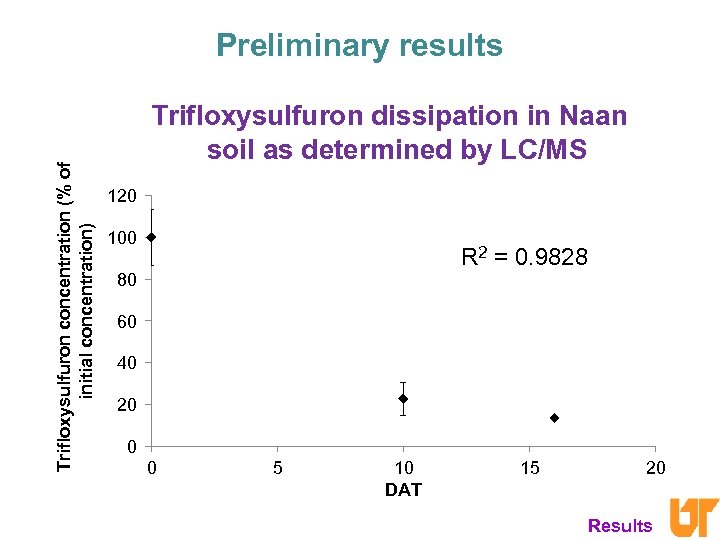 Trifloxysulfuron concentration (% of initial concentration) Preliminary results Trifloxysulfuron dissipation in Naan soil as determined by LC/MS 120 100 R 2 = 0. 9828 80 60 40 20 0 0 5 10 DAT 15 20 Results
 Conclusions • Trifloxysulfuron dissipates faster in RWW soil compare to FW soil. • Enhanced dissipation of trifloxysulfuron under field conditions is evident. • More experiments are required in order to determine the factors involved in the faster dissipation of trifloxysulfuron in the soil
 Acknowledgments • Prof. Tom Mueller, University of Tennessee. • Weed lab group: Coby Goldwasser, Hadas Rozenberg, Or Levy, Maor Mazraffi, Ella Cohen Alon Vallch and Tal Naamat. • Soil & Water lab- Michal Shechter, Ziva Hochman, Daniela Harush, Yaniv Olshansky and Shay Eldad.
 Thank you very much for listening
 Questions?