 Скачать презентацию Effectiveness of a quality improvement collaborative to accelerate
db888c90530c3879f614e0ccced39a34.ppt
- Количество слайдов: 5



Effectiveness of a quality improvement collaborative to accelerate elimination of mother to child transmission: Key outcomes and determinants, South Africa A. Chirowodza 1, D. Williams 1, C. Diergaardt 1, O. Adetokunboh 1, S. Gede 2, N. Gobodo 2, N. Makeleni 2, N. Tuswa 2, M. Eckard 3, L. Koekemoer 3, T. O'rie 4, N. Shingwenyana 1, B. Green 1 & I. Oluwatimilehin 1 Affiliation and address 1 South to South Programme for Comprehensive Family HIV Care and Treatment, Department of Paediatrics and Child Health, Faculty of Medicine and Health Sciences, Cape Town, South Africa, 2 Amathole District, Department of Health, East London, South Africa, 3 Pixley Ka Seme District, Department of Health, De Aar, South Africa, 4 Cape Winelands District, Department of Health, Worcester, South Africa
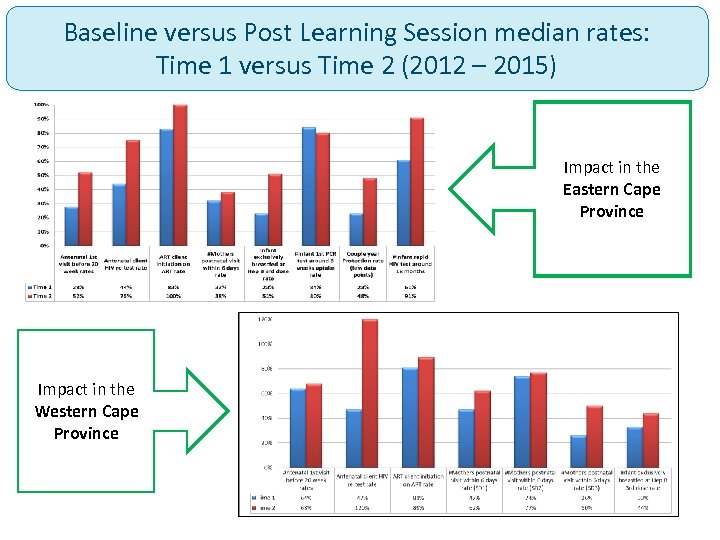
Baseline versus Post Learning Session median rates: Time 1 versus Time 2 (2012 – 2015) Impact in the Eastern Cape Province Impact in the Western Cape Province
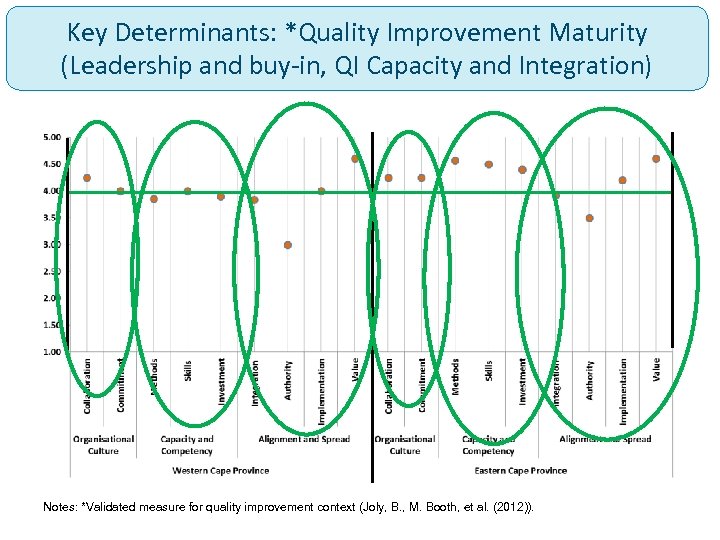
Key Determinants: *Quality Improvement Maturity (Leadership and buy-in, QI Capacity and Integration) Notes: *Validated measure for quality improvement context (Joly, B. , M. Booth, et al. (2012)).
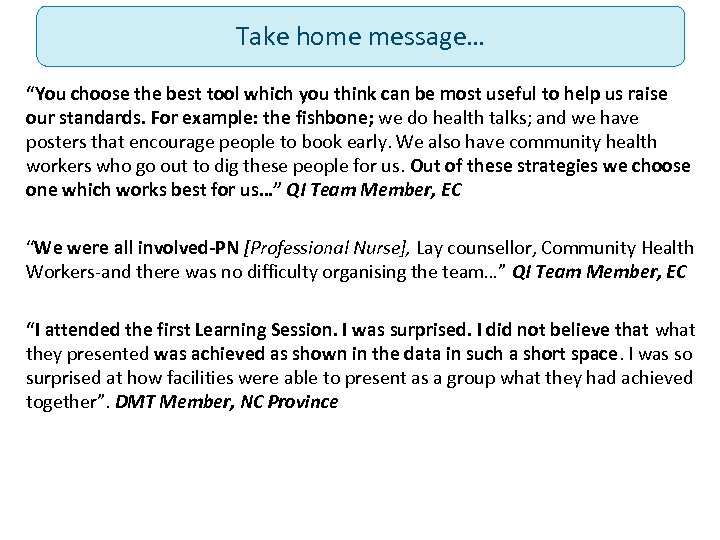
Take home message… “You choose the best tool which you think can be most useful to help us raise our standards. For example: the fishbone; we do health talks; and we have posters that encourage people to book early. We also have community health workers who go out to dig these people for us. Out of these strategies we choose one which works best for us…” QI Team Member, EC “We were all involved-PN [Professional Nurse], Lay counsellor, Community Health Workers-and there was no difficulty organising the team…” QI Team Member, EC “I attended the first Learning Session. I was surprised. I did not believe that what they presented was achieved as shown in the data in such a short space. I was so surprised at how facilities were able to present as a group what they had achieved together”. DMT Member, NC Province
Acknowledgements Special thanks to the District Management Teams and Staff of Primary Health Care Facilities that participated in the Eastern Cape, Northern Cape and Western Cape Provincial Department of Health. Abstract Number: TUPDE 0102
Скачать презентацию Effectiveness of a quality improvement collaborative to accelerate
db888c90530c3879f614e0ccced39a34.ppt