


 Скачать презентацию EFFECTIVE MEDICAL WRITING AND CRITICAL INTERPRETATION OF THE
fb567af0c20f910c647d2af244a9b180.ppt
- Количество слайдов: 35
 EFFECTIVE MEDICAL WRITING AND CRITICAL INTERPRETATION OF THE LITERATURE
 PREPARING A SCIENTIFIC PAPER
 What is the purpose? • Graduation • Advance knowledge • Learn about the value of published manuscripts and how to evaluate what you read (Critical Thinking)
 Should I write it? • Is the topic relevant? Will it benefit the orthopaedic patient or community? • Is it already in the literature? • Does our institution have the resources to carry out the study? • Do I have time to complete the entire project? • Does the project require the buy in or support of another party? B. Morrey
 How to go about it • Plan, plan (“Plans are nothing, planning is everything” DDE, 1941) • Have a mentor
 STEP 1 Ask a question
 STEP 2 Refine the question
 STEP 3 Critical Literature Review OOPS!!
 ANSWER FOUND: • Write a review paper • Or, better, a metaanalysis • Or, ask another question (Back to step #1)
 STEP 5 • Find out how relevant your question is • The first step in the peer review process • Use colleagues, mentor, enemies, cynics
 STEP 6 Write the introduction and state the hypothesis
 Always ask a question that will yield an answer and, thus, a publishable result
 STEP 7 • Formulate a study design. • What is the best way to address the question(clinical, lab, etc. ) ? • The Randomized Clinical Trial is the gold standard.
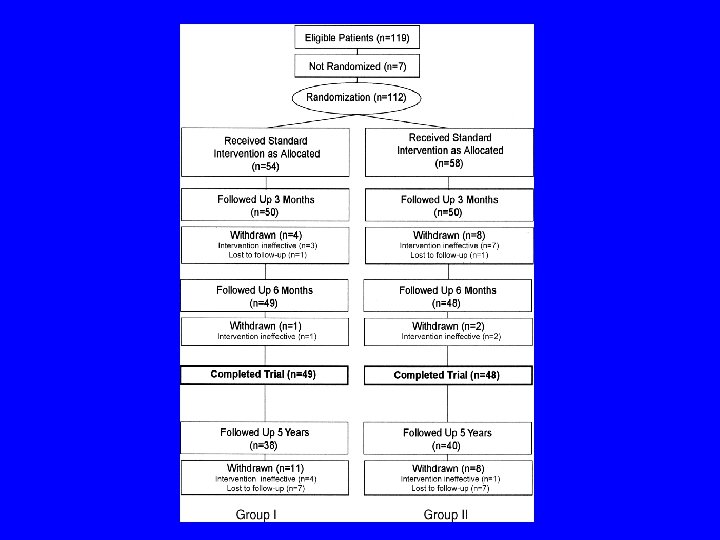
 STUDY DESIGN • RCT • Cohort study: prospective or retrospective • Prospective is always preferred
 Even with cohort study you need comparisons • Historical controls • Case matched • Population matched
 Historical Controls • Weak • Key variables not addressed or identified • Not contemporary (Nobody does it that way now!!) • Key outcomes not measured or reported (Ex: hip ROM & xrays vs. WOMAC)
 Case or population matched (prospective) • Key variables can be defined up front and patients or populations can be matched • Outcomes can be defined • A power study can be done
 STEP 8 • Do the experiment • Have a finish line and date • Have an alternative (abortion) plan.
 STEP 9 • • Keep good records Timely recording Accurate recording Lab notebook/file
 STEP 10 • When data collection nears completion, write Materials and Methods • Materials= study subjects • Methods in sufficient detail so that any one could repeat the experiment • Statistics
 STEP 11: RESULTS • • Clear, concise Good graphics Significant only Distinguish statistical and clinical significance
 STEP 12: DISCUSSION • Hypothesis- prove or disprove • Compare with other studies in literature (pro and con) • Brief conclusion : the take home message • Remember that most papers only have one message
 STEP 13 • Local peer review : friends, family, foe • What is not clear? • Heckman test • Abjure pride of authorship
 STEP 14: AUTHORSHIP (Who qualifies? ? ) • Significant ongoing contribution • More than technical • Can defend entire paper in a public forum • No courtesy authorship
 STEP 15 Send manuscript to the journal that will perform the most rigorous peer review (overshoot!)
 STEP 16 • Never give up • Revise and resubmit • Virtually all manuscripts get published!!
 HELPFUL HINTS • • Follow the Instructions to Authors Brevity Focus on Subject Limit speculation/opinion Use easy to read format Use a few key illustrations Never give up!
 CRITICAL INTERPRETATION OF THE LITERATURE
 Is the paper hypothesis driven? • What is the hypothesis? • Was it tested?
 Is the question relevant to clinical practice? Clinical significance vs. statistical significance
 It has been said that a fellow with one leg frozen in ice and the other leg in boiling water is comfortable, on average. J. M. Yancey
 Was the proper methodology used to address the question posed in the hypothesis? • Research design • Statistics
 Are the results reported clearly and concisely? Are they consistent with the question asked?
 Is the discussion reasonable or speculative?