 Скачать презентацию Effective Evidence-based Tier II Supports Matching Student Needs
6ebd9fa81598aab8e02531f677ce45bf.ppt
- Количество слайдов: 118



Effective, Evidence-based Tier II Supports: Matching Student Needs to 6 Behavioral Interventions Diana Browning Wright, M. S. , L. E. P. www. dianabrowningwright. com dbrowningw@gmail. com 1
Learning Objectives Participants will learn: • Practical findings from research • The proper context for Tier 2 supports • How to identify students in need of Tier 2 behavior supports • How to match student characteristics to specific behavioral interventions most likely to achieve success • The role of Tier 2 supports for students with IEPs • The use of reinforcement in all tiers 2
Session Road Map • Practical findings from research educators should know • 7 Big Ideas: Before we begin the Tier 2 discussion, where does it fit? • Tier 2 interventions and special education law, making sense of behavior impeding learning, BIPs and Tiers • The Tier 2 interventions, what makes each evidence-based? 3
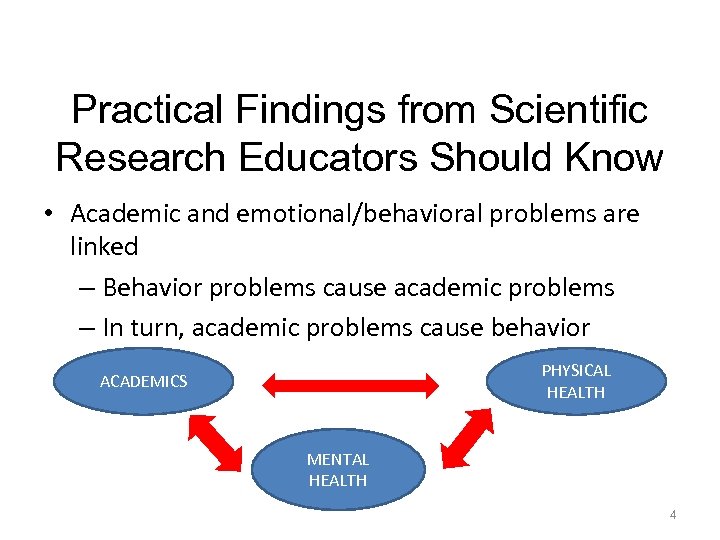
Practical Findings from Scientific Research Educators Should Know • Academic and emotional/behavioral problems are linked – Behavior problems cause academic problems – In turn, academic problems cause behavior problems PHYSICAL ACADEMICS HEALTH MENTAL HEALTH 4

Practical Findings from Scientific Research Educators Should Know • Social skills are the best predictor of later academic performance: – Prosocial skills (cooperating, helping, sharing, and consoling) are a better predictor of later academic achievement than is earlier academic achievement – School-based emotional and behavioral supports produce significant gains in end-of-the-year academic state testing results Caprara, Barbaranelli, Pastorelli, Bandura, & Zimbardo (2000); Malecki & Elliott (2002) 5
Practical Findings from Scientific Research Educators Should Know • A student’s emotional/behavior problems are more stable than his IQ, if untreated. – If untreated, students will continue to exhibit behavior problems into the secondary grades and beyond – (Moffitt, 1998; Walker, Ramsey, & Gresham, 2004) 6
The Old “Wait to Fail” Model • Withholding services for students until their problems are severe enough to unequivocally warrant services – Wait until • The achievement gap has significantly widened • Staff can no longer tolerate the student • Student needs are very pronounced • After services have been delayed, special education is the service 7
Practical Findings from Scientific Research Educators Should Know All people, including students, are motivated intrinsically and extrinsically – Depending on the academic activity, a person may rely more on intrinsic or extrinsic motivation – Schools that employ a combo of intrinsic & extrinsic strategies are most successful 8
Practical Findings from Scientific Research Educators Should Know • Students are responsive to school-based supports, even during the adolescent years & without parental support (Cook, et al. , 2008) – Teachers can play a vital role in the prevention and remediation of academic and emotional/behavioral disorders (Wagner, et al. , 2006) 9
Practical Findings from Scientific Research Educators Should Know • The Double Whammy – Merriam-Webster Definition • A combination of two forces, circumstances, or effects that saves time, energy, and frustration • Also known as – Killing two birds with one stone • Achieving two outcomes with one action 10
The Triple Whammy: Academic and Behavioral Supports Implementing proactive, prevention-oriented school-based practices 1. Improve students’ academic achievement 2. Improve student behavior and the orderliness and safety of the school environment 3. Prevent students from traveling down a path toward negative life course outcomes (Kratochwill, Albers, & Shernoff, 2004; Wilson & Lipsey, 2007) 11
Practical Findings from Scientific Research Educators Should Know • Educators condition certain students to dislike school through their decisions and actions—albeit unintentionally – Classical conditioning is how students develop likes or dislikes for school 12
Classical Conditioning • In dogs: Pavlov’s famous pairing of bell ringing with meat resulted in salivation when the bell rang, even with no meat • In humans: The Little Albert Studies (Infant) – Conditioned to fear white laboratory rat – Fear generalized to anything white and furry, including rabbits, fuzzy slippers 13
Counter Conditioning • Counter conditioning – A conditioned stimulus is paired with some other stimulus that is incompatible with the unwanted response • Now what can we do with Little Albert? – Begin pairing milk and cookies with every presentation of a furry object 14
Practical Findings from Scientific Research Educators Should Know • The most effective educational systems around the globe do not take a one-size fits all approach – Provide a continuum of services in an attempt to meet the needs of ALL students • E. g. , Finland 15
Practical Findings from Scientific Research Educators Should Know Mirror Neuron Effect: Neurons that fire when another person acts; thus, the neuron "mirrors” the behavior of the other • IMPLICATIONS: – Students learn via modeling from educators and peers – Students will treat us how we treat them (if we’re mean, they’re mean; if we’re nice, they’re nice) 16
Mirror Neurons – The Power of Smiling • Randomized trial looking at performance under smiling versus no smiling conditions: – Those in the smile group perceived the world in a better light: • Boring material was more interesting • Neutral images looked more positive • Even bland drinks seemed tastier • PLUS, people who smile more live an average of 7 years longer than those who smile less 17
Practical Findings from Scientific Research Educators Should Know • All people, including students, are motivated intrinsically and extrinsically – Depending on the academic activity, a person may rely more on intrinsic or extrinsic motivation – Schools that employ a combo of intrinsic & extrinsic strategies are most successful 18
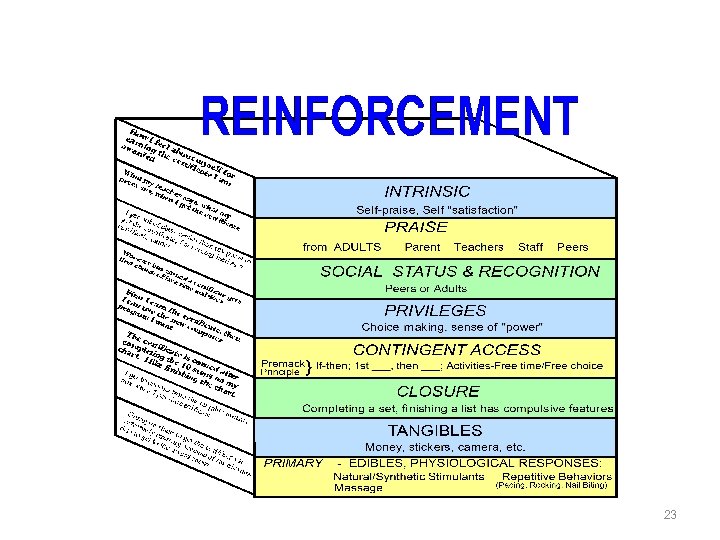
Reinforcement! • Know the difference between reinforcer and reward ü A reward is what we think will cause the behavior to repeat ü A reinforcer is what has been proven to make the behavior repeat for this student 19
Reinforcement! • Know the four elements of reinforcement ü Power ü Frequency ü Variety ü Immediacy • All behaviors motivated by getting something desired or getting rid of something not desired 20
5: 1 Gets the job done!!! 21
Why use reinforcement? • Reinforcement systems are not advocated for behavior controls, rather • Reinforcement systems are advocated for relationship building and the shaping of prosocial behaviors • Reinforcement has no side effects 22
23
Practical Findings from Scientific Research Educators Should Know Students are responsive to school-based supports, even during the adolescent years & without parental support (Cook, et al. , 2008) – Teachers can play a vital role in the prevention and remediation of academic and emotional/behavioral disorders (Wagner, et al. , 2006) 24
Boring-Induced “ADHD” • Children, as well as us, don’t pay attention to boring things • All organisms vigorously avoid boredom (i. e. , nothingness) by doing something else • Invariably there are subjects or lessons that students find boring • There are procedures and games that make even less interesting material acceptable 25
Parental Involvement/ Support • Can we teach students who come from homes with limited parental support how to read? • Can we teach students who come from homes with limited parental support behavioral expectations and social-emotional skills? • If we can’t count on parents, then what other system in society can we count on to teach students social, emotional, and academic skills? 26
Practical Findings from Scientific Research Educators Should Know • Educator judgments are error-prone due to biases, reputation effects, cultural mismatch, and misperceptions • Relying on a student referral system is flawed 27
Prevalence • 20% of students from a typical school have social-emotional deficits • Less than 1% of students are served as EBD (Angold, 2000; Hoagwood & Erwin, 1997; CDC, 2010) • Ignore and neglect students with internalizing problems • Reported as having characteristics of the ideal student: • docile, quiet, & still 28
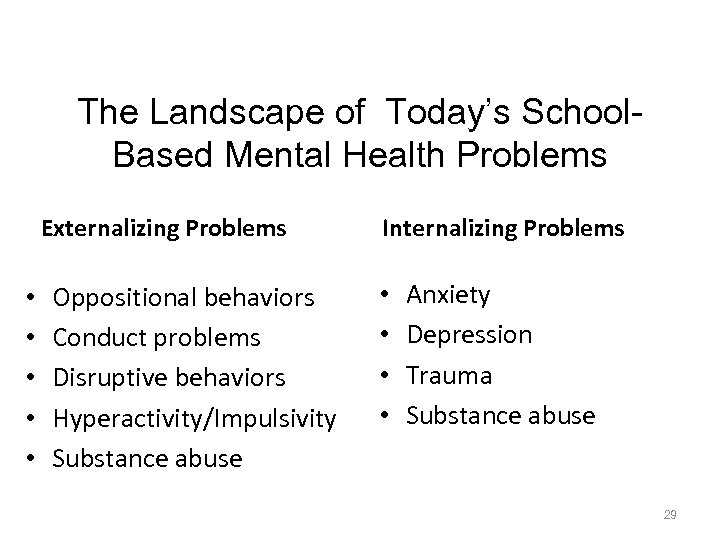
The Landscape of Today’s School. Based Mental Health Problems Externalizing Problems • • • Oppositional behaviors Conduct problems Disruptive behaviors Hyperactivity/Impulsivity Substance abuse Internalizing Problems • • Anxiety Depression Trauma Substance abuse 29
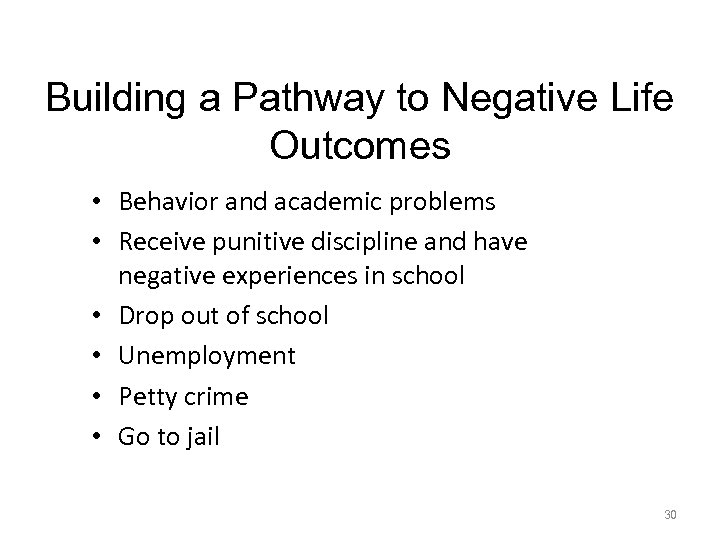
Building a Pathway to Negative Life Outcomes • Behavior and academic problems • Receive punitive discipline and have negative experiences in school • Drop out of school • Unemployment • Petty crime • Go to jail 30
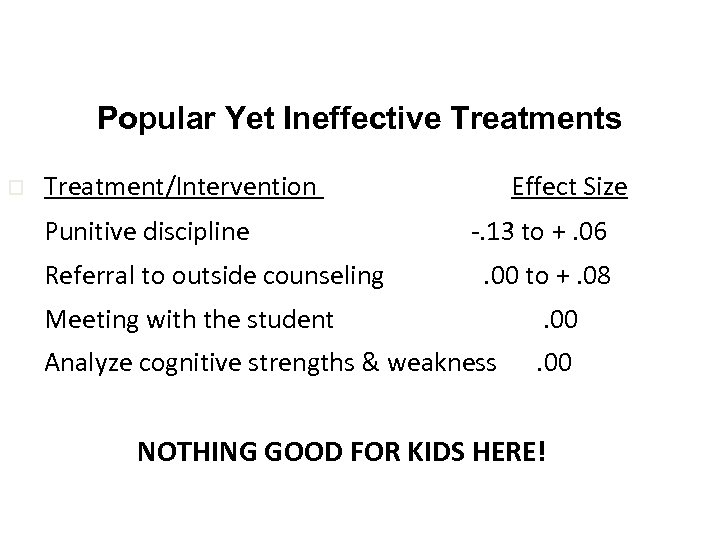
31 Popular Yet Ineffective Treatments o Treatment/Intervention Punitive discipline Referral to outside counseling Effect Size -. 13 to +. 06. 00 to +. 08 Meeting with the student . 00 Analyze cognitive strengths & weakness . 00 NOTHING GOOD FOR KIDS HERE!
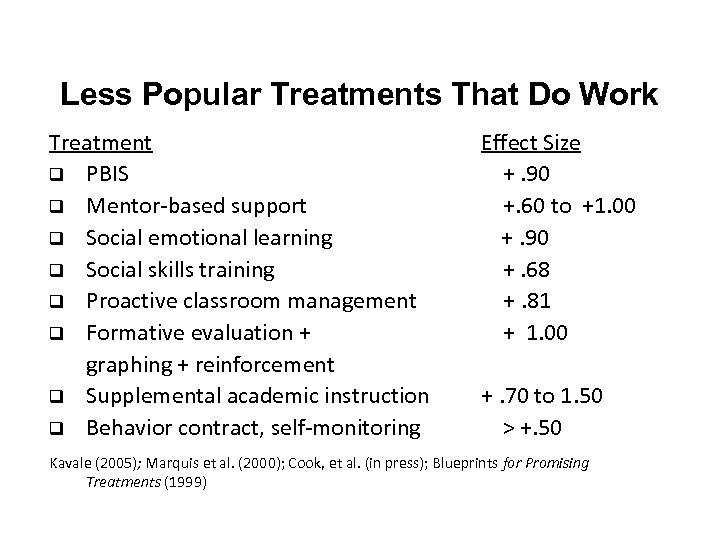
32 Less Popular Treatments That Do Work Treatment q PBIS q Mentor-based support q Social emotional learning q Social skills training q Proactive classroom management q Formative evaluation + graphing + reinforcement q Supplemental academic instruction q Behavior contract, self-monitoring Effect Size +. 90 +. 60 to +1. 00 +. 90 +. 68 +. 81 + 1. 00 +. 70 to 1. 50 > +. 50 Kavale (2005); Marquis et al. (2000); Cook, et al. (in press); Blueprints for Promising Treatments (1999)
33 So Why Do We Persist With Non-evidence. Based Approaches in Education? Isn’t that doing the same thing over and expecting a different result? - Albert Einstein If you always do what you always did, you will always get what you always got -Moms (Janet) Mabley
RTI Occurs at All Tiers • Process of documenting change in performance as a function of an intervention, and making decisions based on the child’s response 34
RTI Occurs at All Tiers • RTI is the practice of: – Serving ALL students through continuum of care – Proactively identifying students who are at-risk – Matching evidence-based interventions to student need – Frequently monitoring student progress to make decisions with regard to an intervention or goals – Collecting treatment integrity data to make legally sound and valid educational decisions 35
Response to Intervention • Is a service delivery system framework – Not a measurement system (e. g. , CBMDIBELS) – Not an intervention or series of interventions (e. g. , Read 180) – Not only reserved as a general education process • Does not cease once students are determined eligible for special education 36
37 The ‘ 7 Big Ideas’ 1. Multiple Tiers of Support § § Refers to the service delivery logic of providing a graduated sequence of intensifying interventions in order to match services to student need We are about to review Tier 2 default behavior interventions, but using them without a solid tier 1? Like balancing a mattress on a bottle of wine
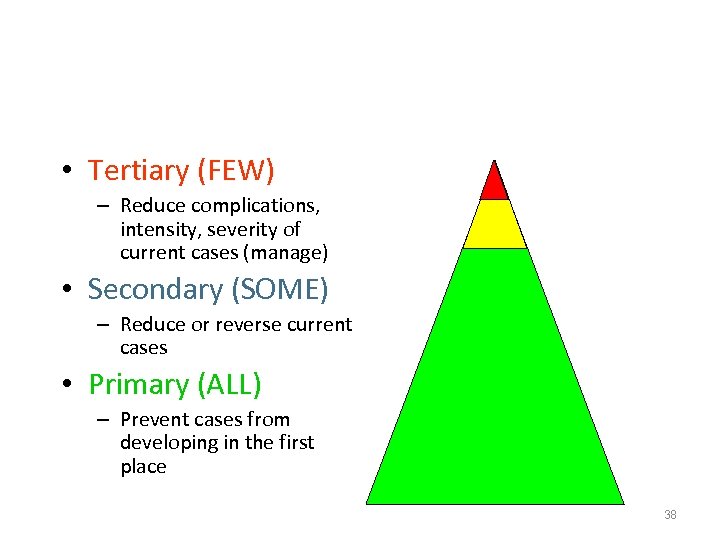
• Tertiary (FEW) – Reduce complications, intensity, severity of current cases (manage) • Secondary (SOME) – Reduce or reverse current cases • Primary (ALL) – Prevent cases from developing in the first place 38
Public Health Example Recommendations for all • Balanced diet (leafy greens, protein) • Exercise • Stress management 39
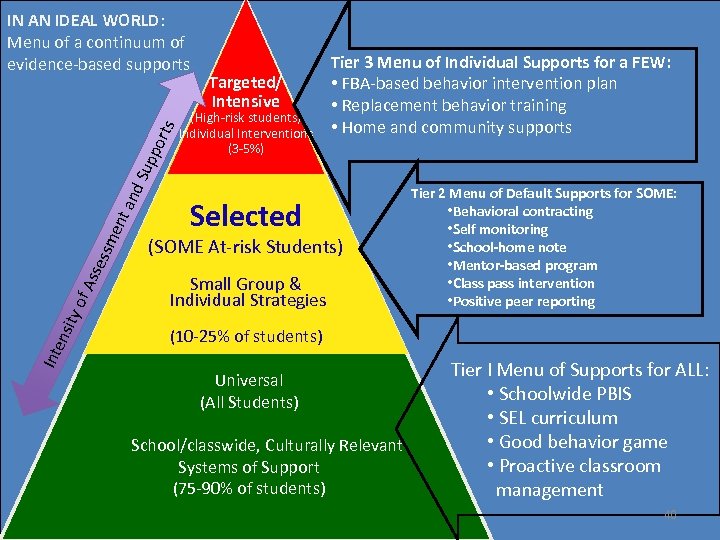
Inte nsi ty o f As ses sm ent a nd Sup por ts IN AN IDEAL WORLD: Menu of a continuum of evidence-based supports Targeted/ Intensive (High-risk students) Individual Interventions (3 -5%) Tier 3 Menu of Individual Supports for a FEW: • FBA-based behavior intervention plan • Replacement behavior training • Home and community supports Selected (SOME At-risk Students) Small Group & Individual Strategies Tier 2 Menu of Default Supports for SOME: • Behavioral contracting • Self monitoring • School-home note • Mentor-based program • Class pass intervention • Positive peer reporting (10 -25% of students) Universal (All Students) School/classwide, Culturally Relevant Systems of Support (75 -90% of students) Tier I Menu of Supports for ALL: • Schoolwide PBIS • SEL curriculum • Good behavior game • Proactive classroom management 40
41 The ‘ 7 Big Ideas’ 2. Evidence-based/scientifically validated interventions § Refers to idea that the interventions or supports implemented under an RTI model of behavior are supported by scientific research to improve student social and behavior functioning
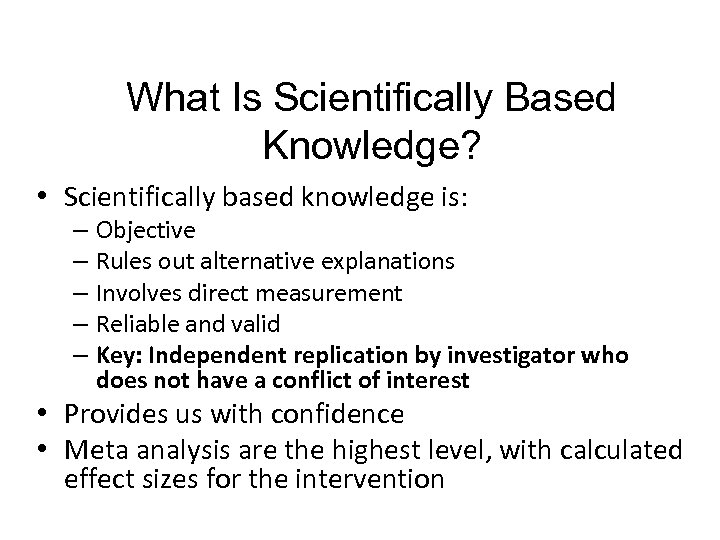
42 What Is Scientifically Based Knowledge? • Scientifically based knowledge is: – Objective – Rules out alternative explanations – Involves direct measurement – Reliable and valid – Key: Independent replication by investigator who does not have a conflict of interest • Provides us with confidence • Meta analysis are the highest level, with calculated effect sizes for the intervention
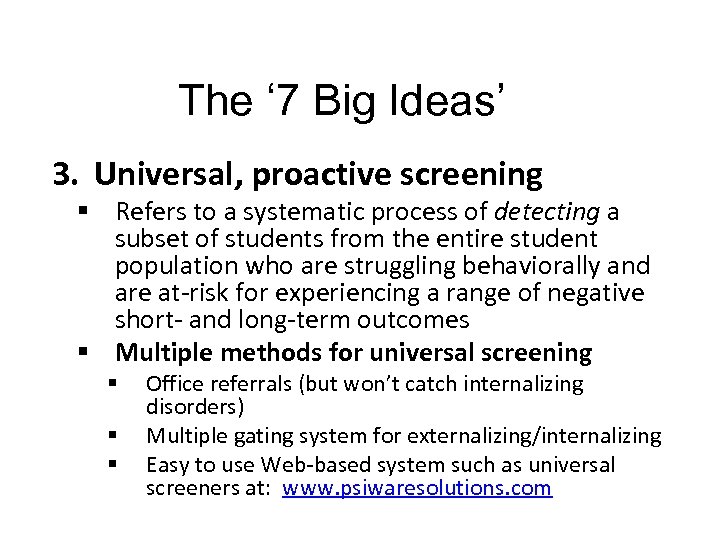
43 The ‘ 7 Big Ideas’ 3. Universal, proactive screening § Refers to a systematic process of detecting a subset of students from the entire student population who are struggling behaviorally and are at-risk for experiencing a range of negative short- and long-term outcomes § Multiple methods for universal screening § § § Office referrals (but won’t catch internalizing disorders) Multiple gating system for externalizing/internalizing Easy to use Web-based system such as universal screeners at: www. psiwaresolutions. com
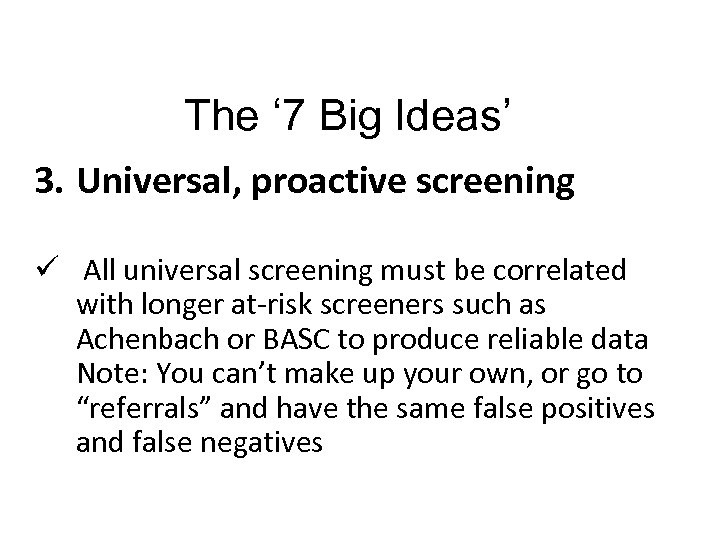
44 The ‘ 7 Big Ideas’ 3. Universal, proactive screening ü All universal screening must be correlated with longer at-risk screeners such as Achenbach or BASC to produce reliable data Note: You can’t make up your own, or go to “referrals” and have the same false positives and false negatives
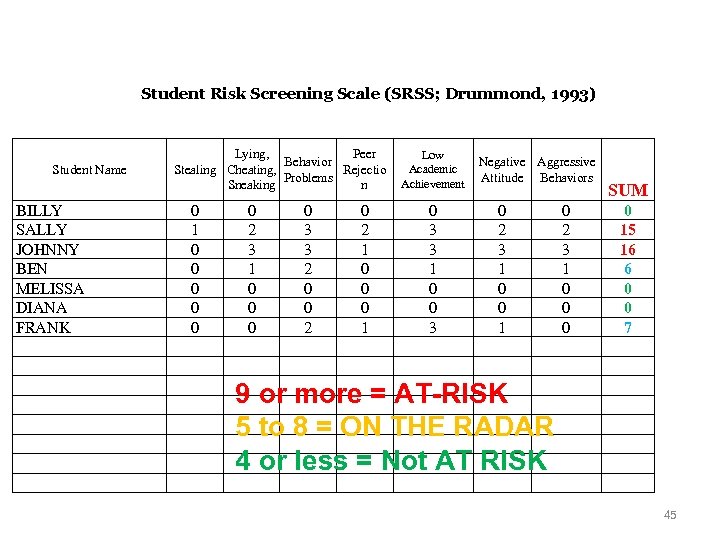
Student Risk Screening Scale (SRSS; Drummond, 1993) Student Name BILLY SALLY JOHNNY BEN MELISSA DIANA FRANK Lying, Peer Behavior Stealing Cheating, Rejectio Problems Sneaking n 0 1 0 0 0 2 3 1 0 0 3 3 2 0 0 2 1 0 0 0 1 Low Academic Achievement 0 3 3 1 0 0 3 Negative Aggressive Attitude Behaviors 0 2 3 1 0 0 1 0 2 3 1 0 0 0 SUM 0 15 16 6 0 0 7 9 or more = AT-RISK 5 to 8 = ON THE RADAR 4 or less = Not AT RISK 45
Why Universal Screening? • Who wants “wait-to-fail” model of service delivery? – Wait-to-die • E. g. , mammogram, cholesterol check • It is a prevention-oriented procedure • Gets good services in the hands of disadvantaged people (i. e. , those in need) • Evaluates quality of Tier I (universal system) 46
47 The ‘ 7 Big Ideas’ 4. Progress monitoring üRefers to the practice that is used to assess students’ academic or behavioral performance and evaluate the effectiveness of instruction Key Concept: All Tier 2 and Tier 3 interventions require 3 -4 weeks of implementation (4 data points) to evaluate the progress monitoring data to determine if the intervention should be maintained, modified, faded to Tier 1 or advanced to Tier 3
What Are We Looking for in a Progress Monitoring Tool? • General outcome measure – Predicts overall emotional/behavioral functioning • Feasible administration – Easy to implement in terms of time and cost • Reliable and valid – Confidence in the scores obtained from the measure • Repeated administration – Capable of being continually administered to track progress 48
49 The ‘ 7 Big Ideas’ 5. Treatment integrity (i. e. , fidelity) – Interventions or supports being implemented in an RTI model for behavior should be implemented as intended to enable appropriate and legally defensible decisionmaking – Key: You can’t say the student didn’t respond, if you did not implement with fidelity!
Importance of Treatment Integrity • Poorly implemented interventions compromises effectiveness • Failure to collect data on treatment integrity leads to invalid decision-making – Why did the student fail to respond • Poor intervention • Or a intervention implemented poorly • Consistency (every time) vs. accuracy (all components implemented) 50
The ‘ 7 Big Ideas’ 6. Data-based decision-making occurs – Refers to a critical element of the problemsolving process that entails consulting student response data in order to make decisions whether to intensify, keep in place, or remove particular interventions or supports 51
Data-based Decision-making 1. Intervention is implemented with fidelity – If no, do not make data-based decision – If so, make a data-based decision 2. Data-based decision – Maintain existing supports – Modify existing supports – Lower down a tier – Bump up a tier 52
The ‘ 7 Big Ideas’ 7. Problem-solving Refers to the dynamic and systematic process that guides the Behavior Support Team’s behavior in (a) identifying the problem, (b) analyzing the problem, (c) developing a plan of action, (d) implementing the plan, and (e) evaluating the outcomes of the plan. – 53
Caution • The following slides illustrate evidence-based tier 2 interventions • Implementing these without the 7 Big Ideas will not produce the change you had in mind, e. g. , fidelity will not likely occur, decisions will be as good as a coin toss • Use these interventions as default behavior interventions BEFORE the behavior plan 54
How Do Tier 2 Interventions Intersect With Special Education Law? • If no IEP: Child Find issues may apply – If student is non-responsive to well – implemented graduated sequence of – interventions through 3 tiers of interventions, evidence is there to suspect a possible underlying – disorder requiring comprehensive assessment – to determine if the student has a disability – under IDEA or 504 55
How Does This Intersect With Special Education Law? • If student has an IEP: “Behavior Impeding Learning of Student or Peers”? Not all students with at risk features from universal screening have impaired academic learning, But, all students with at risk features from universal screening have impaired social-emotional learning • Practice pointer: If behavior impedes learning, IEP team must specify strategies, including positive behavioral interventions strategies and supports 56
If IEP, and Established At-risk on Universal Screener: Determine if behavior impedes learning – Yes, Maybe, or No • If yes, specify Tier 2 supports in the IEP, establish monitoring frequency and write a goal (4 -week decision points!) • If maybe, discuss what would cause the behavior to rise to “impede learning” in IEP notes, write a goal • If no, (unlikely if picked up on the screener) remember to evaluate both academic AND social-emotional learning Key concept: For every need discussed in an IEP meeting, have a goal! 57
But Wait a Minute! • Doesn’t every behavior that impedes learning need a BIP? – Special education law specifically does not state a BIP is always required – A BIP is one method of documenting positive behavioral interventions strategies and supports (supplementary aids) have been implemented Tier 2 supports are also positive behavioral interventions strategies and supports 58
What About Students With More Than 10 Days of Suspension and Risk on the Universal Screener? • An FBA must occur for each suspension event if behavior was a “manifestation” • A BIP will likely have been developed, or a rationale for why one has not been developed will be in the IEP • A Tier 2 intervention can be included in the BIP if a BIP already is in place • If no BIP in place, conclusion of FBA can be recommendation of a Tier 2 intervention 59
Bear in Mind • Sometimes Tier 2 interventions work better than a BIP (Tier 3)! • All students are entitled to a graduated sequence of evidence based interventions, inclusive of students with IEPs and inclusive of students in restrictive settings for E/BD 60
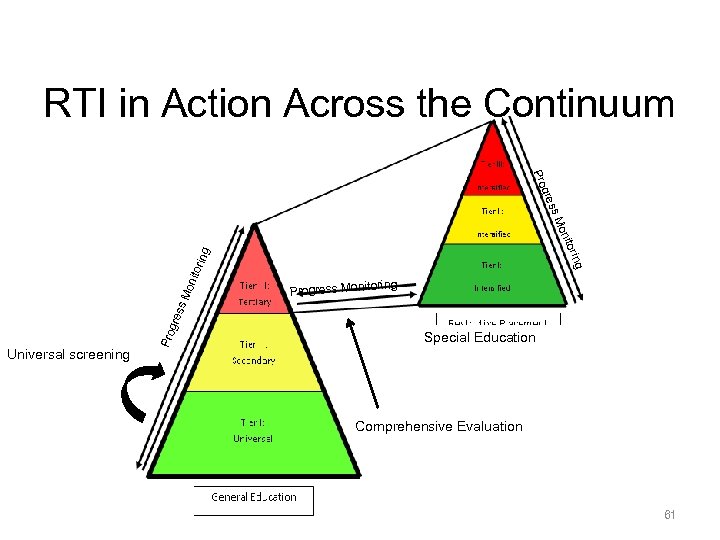
RTI in Action Across the Continuum s gre Pro oni s. M ss M gre Pro g oni tori ng n tori Universal screening Progress Monito ring Special Education Comprehensive Evaluation 61
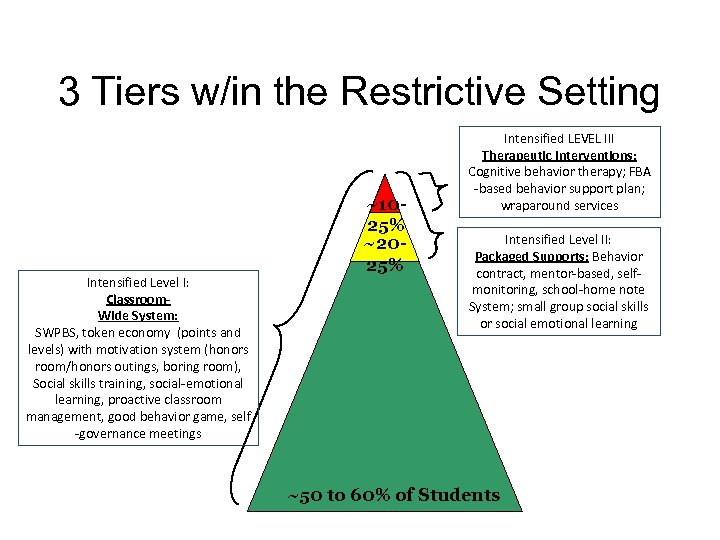
62 3 Tiers w/in the Restrictive Setting Intensified Level I: Classroom. Wide System: SWPBS, token economy (points and levels) with motivation system (honors room/honors outings, boring room), Social skills training, social-emotional learning, proactive classroom management, good behavior game, self -governance meetings ~1025% ~2025% Intensified LEVEL III Therapeutic Interventions: Cognitive behavior therapy; FBA -based behavior support plan; wraparound services Intensified Level II: Packaged Supports: Behavior contract, mentor-based, selfmonitoring, school-home note System; small group social skills or social emotional learning ~50 to 60% of Students
Myths about Interventions • The Silver Bullet • One Size Fits All • Interventions are found equally liked by all staff • Too little time and not enough staff 63
Purpose of Tier II Interventions • ~10 -20% of students who continue to experience emotional and behavioral problems despite the implementation of TIER I supports – Detected as at-risk by universal screening • Aim is secondary prevention, which is to reverse or reduce emotional and behavioral problems – Prevent harm or disrupt trajectory towards negative outcomes • Helps create more orderly and safe learning environments 64
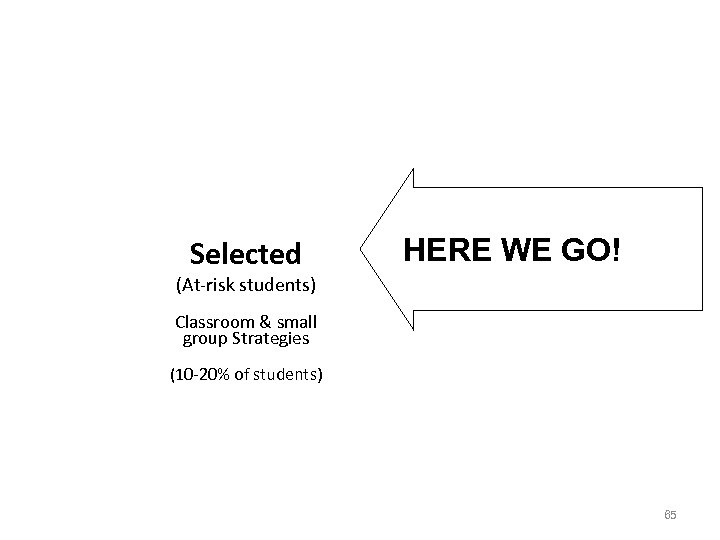
Selected HERE WE GO! (At-risk students) Classroom & small group Strategies (10 -20% of students) 65
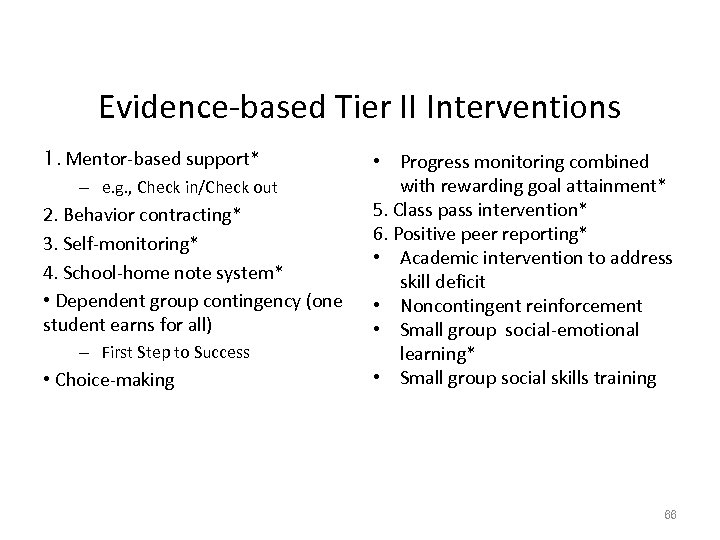
Evidence-based Tier II Interventions 1. Mentor-based support* – e. g. , Check in/Check out 2. Behavior contracting* 3. Self-monitoring* 4. School-home note system* • Dependent group contingency (one student earns for all) – First Step to Success • Choice-making • Progress monitoring combined with rewarding goal attainment* 5. Class pass intervention* 6. Positive peer reporting* • Academic intervention to address skill deficit • Noncontingent reinforcement • Small group social-emotional learning* • Small group social skills training 66
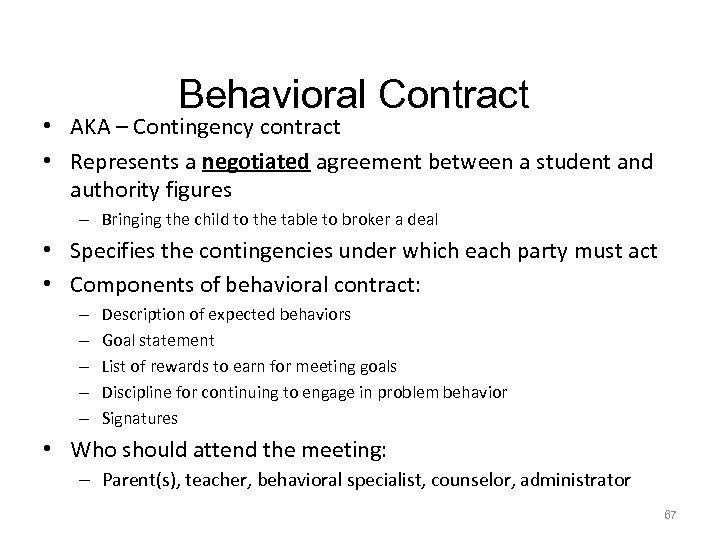
Behavioral Contract • AKA – Contingency contract • Represents a negotiated agreement between a student and authority figures – Bringing the child to the table to broker a deal • Specifies the contingencies under which each party must act • Components of behavioral contract: – – – Description of expected behaviors Goal statement List of rewards to earn for meeting goals Discipline for continuing to engage in problem behavior Signatures • Who should attend the meeting: – Parent(s), teacher, behavioral specialist, counselor, administrator 67
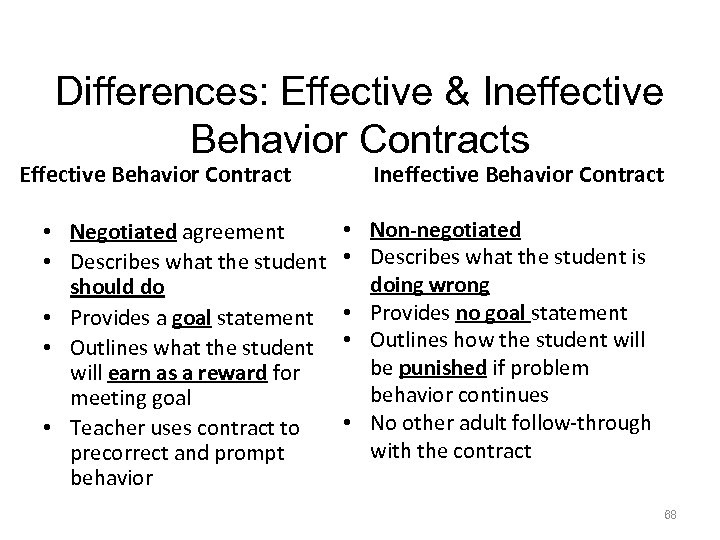
Differences: Effective & Ineffective Behavior Contracts Effective Behavior Contract • Negotiated agreement • Describes what the student should do • Provides a goal statement • Outlines what the student will earn as a reward for meeting goal • Teacher uses contract to precorrect and prompt behavior Ineffective Behavior Contract • Non-negotiated • Describes what the student is doing wrong • Provides no goal statement • Outlines how the student will be punished if problem behavior continues • No other adult follow-through with the contract 68
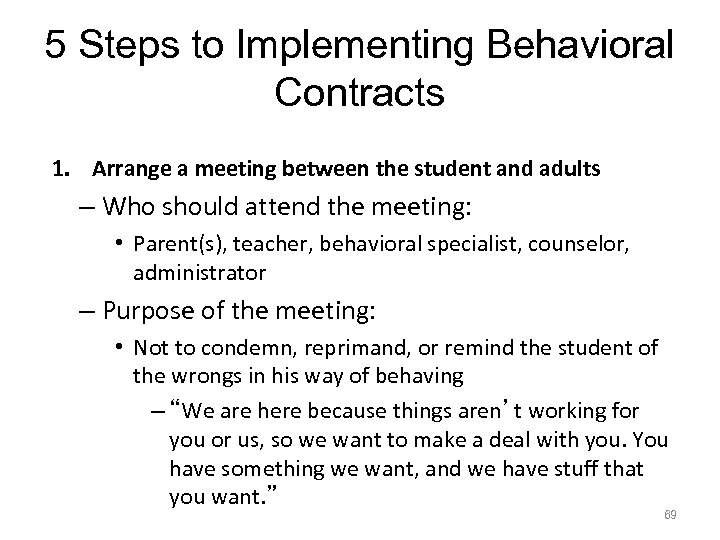
5 Steps to Implementing Behavioral Contracts 1. Arrange a meeting between the student and adults – Who should attend the meeting: • Parent(s), teacher, behavioral specialist, counselor, administrator – Purpose of the meeting: • Not to condemn, reprimand, or remind the student of the wrongs in his way of behaving – “We are here because things aren’t working for you or us, so we want to make a deal with you. You have something we want, and we have stuff that you want. ” 69
5 Steps to Implementing Behavioral Contracts 2. Holding the meeting to negotiate and develop the behavior contract Introductions and description of the meaning and purpose of a contract so – the student has a concept and understanding of what a contract entails • • – The introductions should not involve emphasizing what the student has done wrong, but rather that the current situation is not working for anyone and there is a need to work out a deal. The adults are willing to have the student have some say in what goes on instead of telling the student what to do It is important to make it a big deal. Describe how a contract is essentially a legally binding deal. ” Are you a person of your word? Do you keep your promises? I do!” Make sure to describe the contract in kid-friendly language so the student is able to comprehend 70
5 Steps to Implementing Behavioral Contracts Describe the alternative appropriate behaviors or social skills you would like to see, and gather the student’s input to get him to commit to engage in 7171 those behaviors – – – • • Make sure the student is actually capable of exhibiting the appropriate behaviors; therefore, the positive behavior or social skill is within the student’s repertoire and all that is needed is a motivational component that encourages the student to display the behaviors he already knows how to exhibit If the student can’t exhibit the appropriate behaviors or social skills because he has not learned them, then time will need to be devoted to teaching the student how to exhibit them using a tell-show-do instructional approach 71
5 Steps to Implementing Behavioral Contracts Help the student identify rewards, activities, or privileges to be earned if he is able to hold up his end of the bargain by meeting the goal – This should be student-driven in that the student selects preferred items, activities or rewards that he will earn based on good behavior An important consideration is how frequently should the reinforcer or reward be earned? • • – A good rule of thumb is to gauge how the long the student can actually delay gratification. This entails considering how the far the student can look into the future and wait. If the student can only think a day at a time, then he should be able to earn the reinforcer or reward on a daily basis. Generally, the younger the student, the more frequent they will need to be able to earn the reinforcer or reward. 72
5 Steps to Implementing Behavioral Contracts 3. Make copies of the behavior contract for all parties involved – Everyone, including the student, should have a copy of the behavior contract – Make extra copies of the behavior contract just in case the student loses his copy. If the student loses the behavior contract, there is no need to lecture the student and/or discipline him. Instead, simply provide him with another one and continue implementing the steps. 73
5 Steps to Implementing Behavioral Contracts 4. Teacher implementation of precorrection and prompting – Precorrection involves the teacher reminding the student of the expectations outlined in the behavior contract prior to class beginning or transitioning to other activities under which the student has a history of exhibiting emotional and/or behavior problems; these precorrection gestures or statements are best delivered immediately preceding the context in which the behavior is expected and provide students with a reminder to increase the probability of success 74
5 Steps to Implementing Behavioral Contracts 4. Teacher implementation of pre correction and prompting – The prompting tactic consists of responding to incidents of the student’s problem behavior by cueing him to engage in the appropriate behavior or social skill outlined on the contract and reminding him of the reward to be earned If the behavior problem continues despite providing a few prompts, then the teacher should carry out the typical progressive discipline plan (for example, removal of privileges, reprimands, in-class time-out, office referral) 75
5 Steps to Implementing Behavioral Contracts 5. Follow-up to ensure fidelity of implementation and troubleshoot any problems – Problems to troubleshoot: • Student isn’t interested in the reward – Experiment with other reinforcerss, ask the student to identify reinforcer, or have the student sample the reinforcer 76
5 Steps to Implementing Behavioral Contracts • Student has to wait too long to get access to reinforcer (pay off) – Allow the student to access reinforcers in shorter periods of time or deliver tokens that can be periodically given and exhcanged for desired items/privileges • Teacher does not implement precorrection and prompting – Performance-based feedback 77
Structured Mentor-Based Support • Mentor-based support • Check in/Check Out • Check, Connect, and Expect • Check and Connect • Assignment of adult mentor who provides unconditional positive regard and feedback • Multiple behavioral components: • Behavioral momentum • Precorrection • Performance feedback • Positive reinforcement • Goal specification and attainment 78
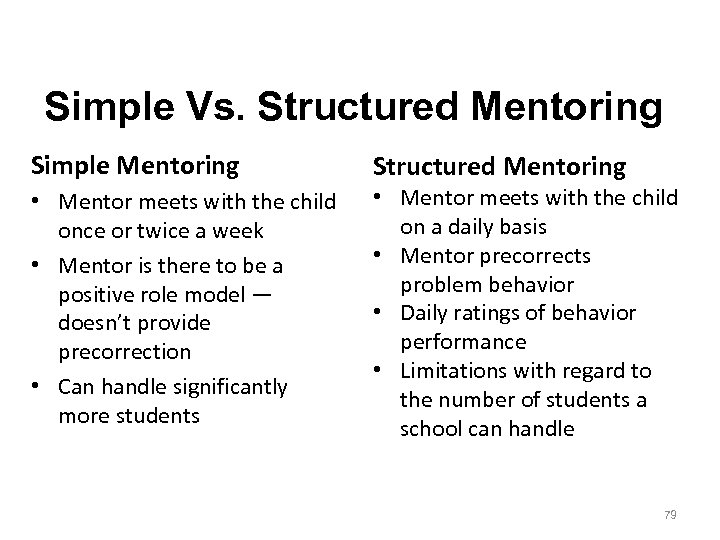
Simple Vs. Structured Mentoring Simple Mentoring • Mentor meets with the child once or twice a week • Mentor is there to be a positive role model — doesn’t provide precorrection • Can handle significantly more students Structured Mentoring • Mentor meets with the child on a daily basis • Mentor precorrects problem behavior • Daily ratings of behavior performance • Limitations with regard to the number of students a school can handle 79
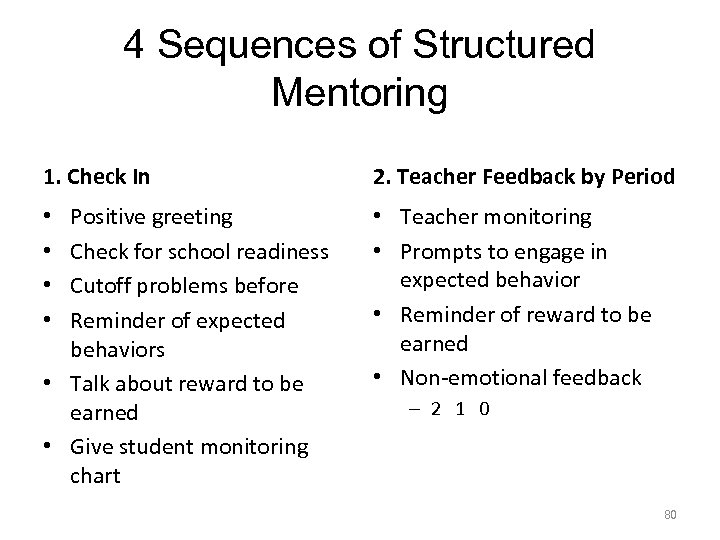
4 Sequences of Structured Mentoring 1. Check In 2. Teacher Feedback by Period Positive greeting Check for school readiness Cutoff problems before Reminder of expected behaviors • Talk about reward to be earned • Give student monitoring chart • Teacher monitoring • Prompts to engage in expected behavior • Reminder of reward to be earned • Non-emotional feedback • • – 2 1 0 80
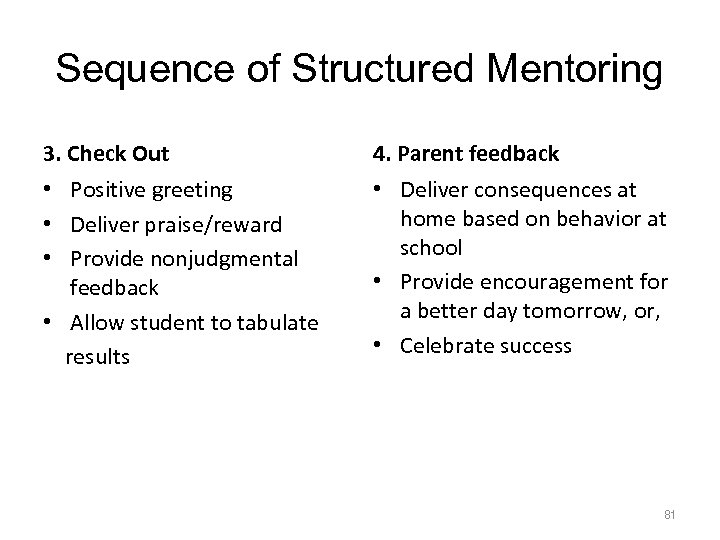
Sequence of Structured Mentoring 3. Check Out 4. Parent feedback • Positive greeting • Deliver praise/reward • Provide nonjudgmental feedback • Allow student to tabulate results • Deliver consequences at home based on behavior at school • Provide encouragement for a better day tomorrow, or, • Celebrate success 81
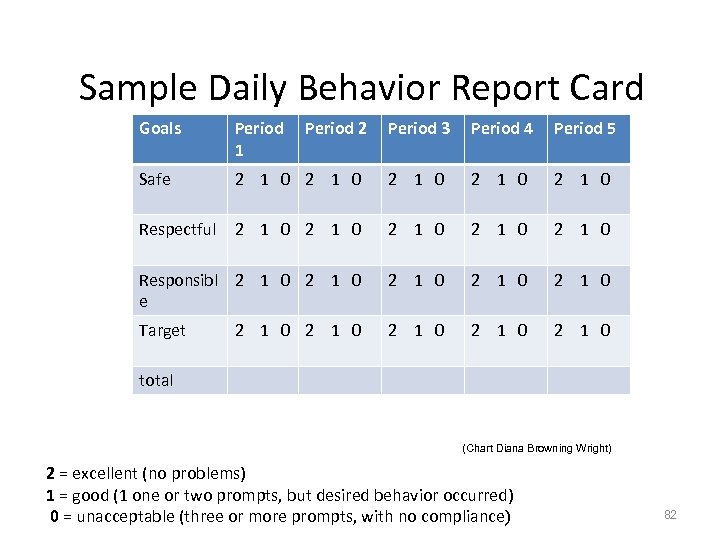
Sample Daily Behavior Report Card Goals Period 1 Safe Respectful Period 2 Period 3 Period 4 Period 5 2 1 0 2 1 0 2 1 0 Responsibl 2 1 0 e 2 1 0 Target 2 1 0 2 1 0 total (Chart Diana Browning Wright) 2 = excellent (no problems) 1 = good (1 one or two prompts, but desired behavior occurred) 0 = unacceptable (three or more prompts, with no compliance) 82
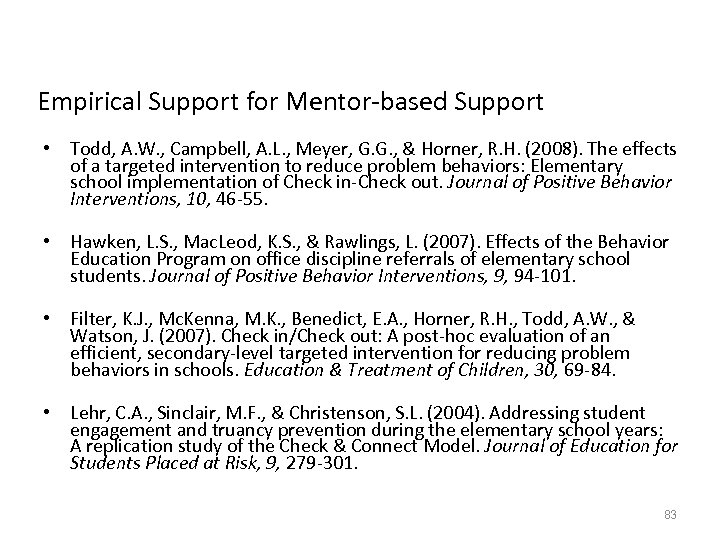
Empirical Support for Mentor-based Support • Todd, A. W. , Campbell, A. L. , Meyer, G. G. , & Horner, R. H. (2008). The effects of a targeted intervention to reduce problem behaviors: Elementary school implementation of Check in-Check out. Journal of Positive Behavior Interventions, 10, 46 -55. • Hawken, L. S. , Mac. Leod, K. S. , & Rawlings, L. (2007). Effects of the Behavior Education Program on office discipline referrals of elementary school students. Journal of Positive Behavior Interventions, 9, 94 -101. • Filter, K. J. , Mc. Kenna, M. K. , Benedict, E. A. , Horner, R. H. , Todd, A. W. , & Watson, J. (2007). Check in/Check out: A post-hoc evaluation of an efficient, secondary-level targeted intervention for reducing problem behaviors in schools. Education & Treatment of Children, 30, 69 -84. • Lehr, C. A. , Sinclair, M. F. , & Christenson, S. L. (2004). Addressing student engagement and truancy prevention during the elementary school years: A replication study of the Check & Connect Model. Journal of Education for Students Placed at Risk, 9, 279 -301. 83
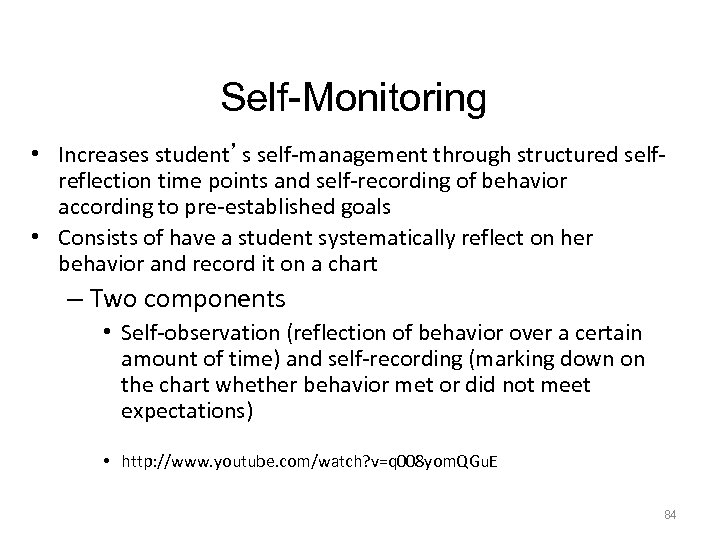
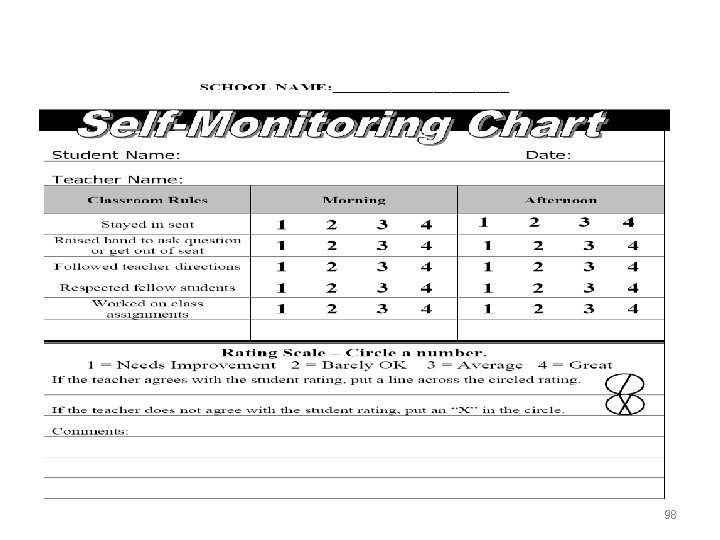
Self-Monitoring • Increases student’s self-management through structured selfreflection time points and self-recording of behavior according to pre-established goals • Consists of have a student systematically reflect on her behavior and record it on a chart – Two components • Self-observation (reflection of behavior over a certain amount of time) and self-recording (marking down on the chart whether behavior met or did not meet expectations) • http: //www. youtube. com/watch? v=q 008 yom. QGu. E 84
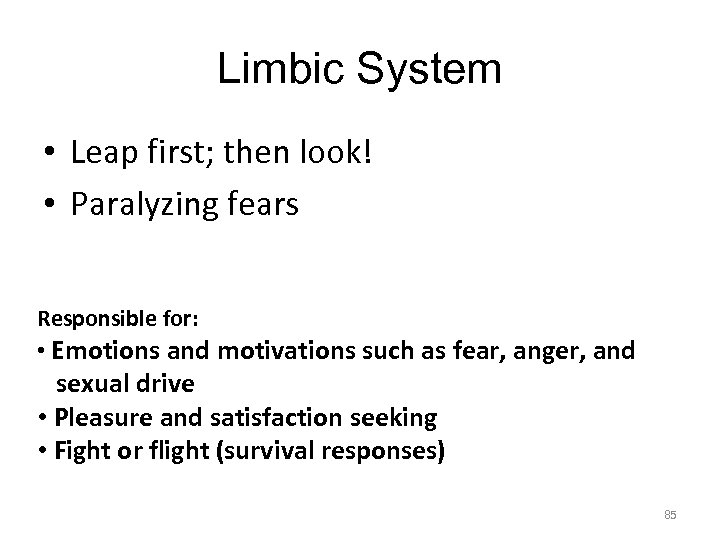
Limbic System • Leap first; then look! • Paralyzing fears Responsible for: • Emotions and motivations such as fear, anger, and sexual drive • Pleasure and satisfaction seeking • Fight or flight (survival responses) 85
Prefrontal Cortex • What every teacher dreams about! • At what age can we expect? Responsible for: • Stop to think before acting • Weighing the consequences • Self-regulation • Decision-making • Moderating correct social behavior • Orientation towards the future 86
Simple Examples • KYMS • Anxious Moments recording • Animal Actions recording 87
Why Self-Monitoring Works • Students with behavior problems have deficits in self -management • Embeds prompts and cues for self-reflection • Increases their awareness of their behaviors and the consequences associated with them • Enhances self-regulatory behaviors by activating pre-frontal cortex • Students are reinforced for engaging in expected behaviors, which allows them to learn and make the connection between appropriate behavior and positive outcomes 88
Making Self-Monitoring Work • Combined with a reward component for meeting a preset goal to increase selfregulation and self-control – Adds value or meaning to recording behavior of the chart • Use of technological device or natural breaks or transitions to prompt self-reflection and self-recording of behavior • The student must comprehend the selfmonitoring chart
Making Self-Monitoring Work • Rest assured that teachers find this intervention to be the most acceptable Tier 2 intervention – Enhances independence and self-reliance – Little teacher time – Viewed as more ethical and acceptable than other approaches 90
Candidate Students for a Self. Monitoring Intervention • Students with: – Behavior excesses (e. g. , blurting out answers, calling others names, getting out of seat) – Behavior deficits (e. g. , not participating in class, failure to initiate social interactions) – Externalizing behavior patterns (e. g. , oppositional defiance, aggression, impulsivity) – Internalizing behavior patterns (e. g. , withdrawn, somatic complaints) • Students whose problem behaviors occur with a certain degree of regularity 91
How to Do a Self-Monitoring Intervention • Step 1: – Identify what the student should be doing instead of the problem behaviors – Can be more than one thing: • e. g. , sitting in seat, keeping desk clean, respectful to others, following directions, participating in class, interacting with others etc. – Make sure that student understands and knows how to perform the behaviors that are expected of her – Link the behaviors to the specific performance goals
How to Do a Self-Monitoring Intervention • Step 2: – Determine how frequently the student will self-monitor and record her behaviors • Rule of thumb is the more times the problem behavior occurs, the more frequently students need to self-monitor • Can have student self-monitor once every five minutes, at every natural break during the day, or twice daily (e. g. , once before lunch and once at the end of the day) 93
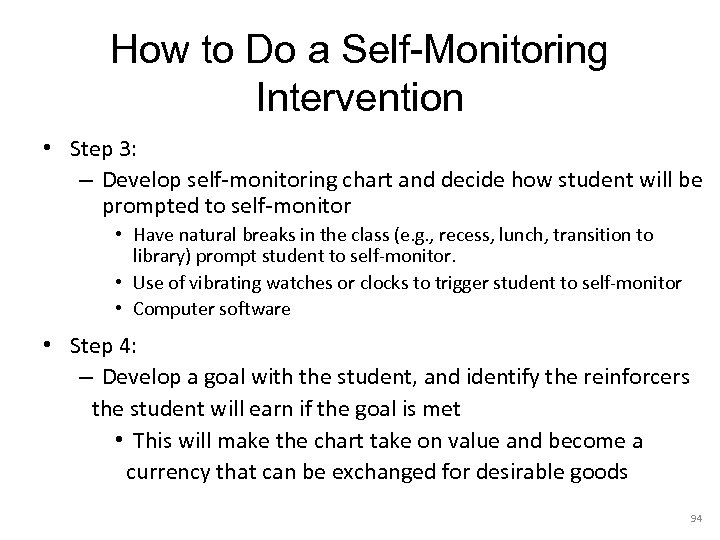
How to Do a Self-Monitoring Intervention • Step 3: – Develop self-monitoring chart and decide how student will be prompted to self-monitor • Have natural breaks in the class (e. g. , recess, lunch, transition to library) prompt student to self-monitor. • Use of vibrating watches or clocks to trigger student to self-monitor • Computer software • Step 4: – Develop a goal with the student, and identify the reinforcers the student will earn if the goal is met • This will make the chart take on value and become a currency that can be exchanged for desirable goods 94
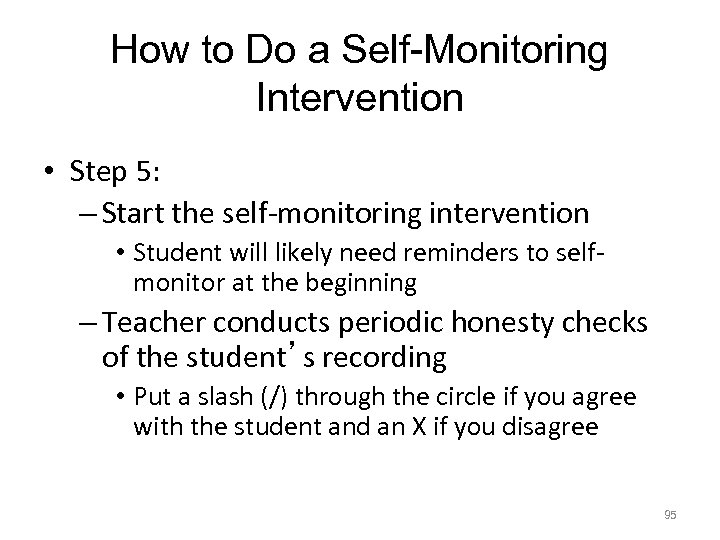
How to Do a Self-Monitoring Intervention • Step 5: – Start the self-monitoring intervention • Student will likely need reminders to selfmonitor at the beginning – Teacher conducts periodic honesty checks of the student’s recording • Put a slash (/) through the circle if you agree with the student and an X if you disagree 95
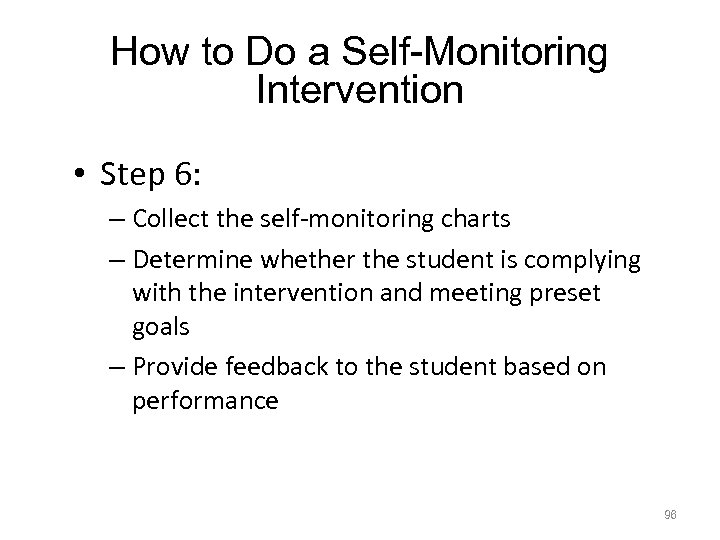
96 How to Do a Self-Monitoring Intervention • Step 6: – Collect the self-monitoring charts – Determine whether the student is complying with the intervention and meeting preset goals – Provide feedback to the student based on performance 96
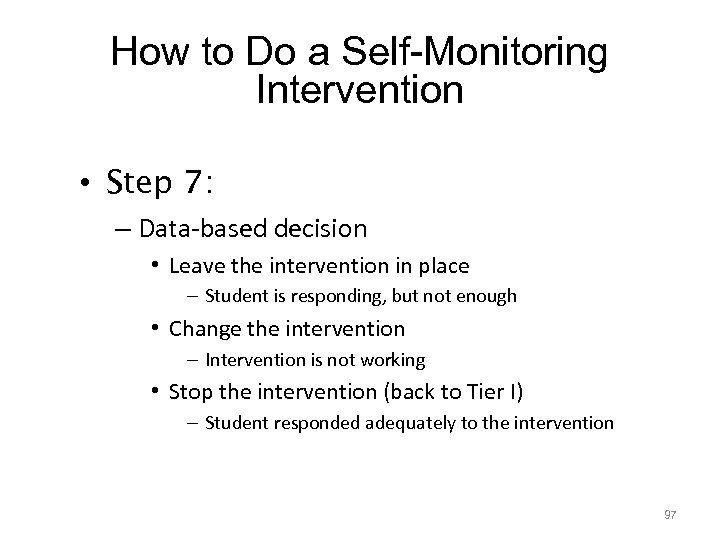
97 How to Do a Self-Monitoring Intervention • Step 7: – Data-based decision • Leave the intervention in place – Student is responding, but not enough • Change the intervention – Intervention is not working • Stop the intervention (back to Tier I) – Student responded adequately to the intervention 97
98
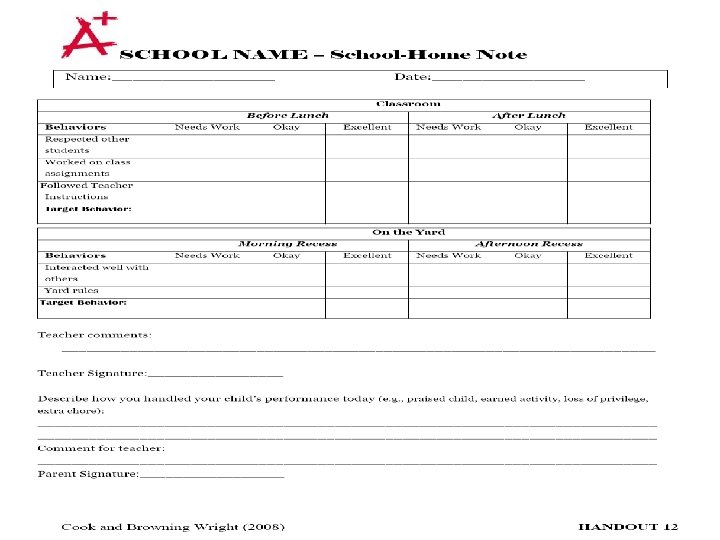
School-Home Note System • Establishes collaboration and consistency between school and home environments • Involves two-way communication regarding student performance – Teacher to parent and parent back to teacher • Encourages parents to deliver consequences at home based on the student’s behavior at school • Parent can share information with school about outside stressors that may be impacting student behavior at school
Candidate Students for School. Home Note • Students who are unaffected by typical school-based disciplinary consequences – Reprimands, office referral, & loss of privileges don’t work • Students whose parents are open and willing to collaborate with the school • Students whose parents could benefit from learning effective parenting strategies 100
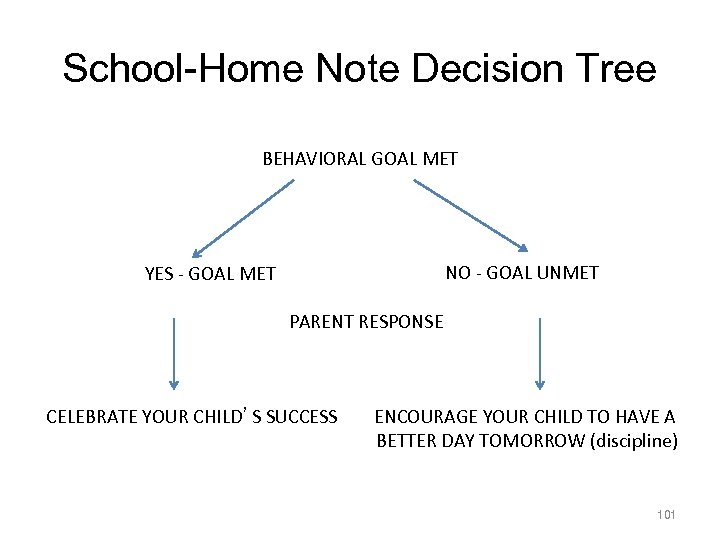
School-Home Note Decision Tree BEHAVIORAL GOAL MET NO - GOAL UNMET YES - GOAL MET PARENT RESPONSE CELEBRATE YOUR CHILD’S SUCCESS ENCOURAGE YOUR CHILD TO HAVE A BETTER DAY TOMORROW (discipline) 101
Consequences Delivered by Parents • Celebrating the child’s success (aim is to create positive contrast by making the child’s life more exciting, pleasurable, and/or fun) – Access to privileges • Computer time, video games, talking on the phone, • staying up later, hanging out with friends, TV time – Reward with item or activity • Buy-out of chore, money, invite friend over, play outside, • after-dinner dessert, playing with toys, etc. – Praise and positive recognition
Consequences Delivered by Parents • Encouraging a better day tomorrow (aim is to create negative contrast by making the child’s life boring, unpleasant, or introducing nothing) – Discuss what went wrong – Apply loss of privileges • Removal of TV time, computer, video games, playing outside, talking on the phone, or anything else that is considered to be fun – Task-based grounding • Have the child perform chores that are outside of typical responsibilities • Grounded until the chore or chores are completed 103
10 4
Class Pass Intervention • CPI is for students who engage disruptive classroom behavior – Work may be too difficult, views class as boring, or simply doesn’t like a subject • Allow students to escape/avoid academic tasks for a pre-determined amount of time by issuing class pass – Engage in a preferred activity for a certain amount of time 105
Class Pass Intervention • Incentivize students to not use class passes by holding onto them and exchanging them for something even more desirable than escape/break • It works because students: – Can exercise choice by requesting a break with class pass – Tolerance for academic work is increased – Are able to earn access to desired reward/activity based on staying in the presence of the difficult, boring, or frustrating academic task 106
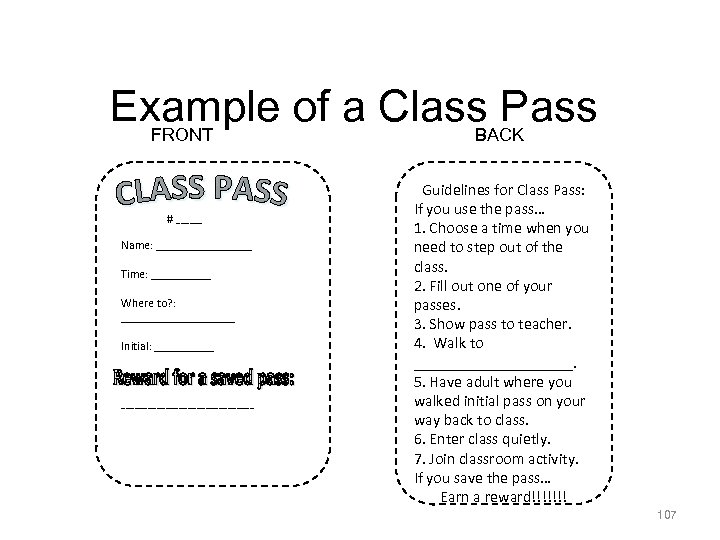
Example of a Class Pass FRONT BACK # ______ Name: ________ Time: _____ Where to? : __________ Initial: ____________________ Guidelines for Class Pass: If you use the pass… 1. Choose a time when you need to step out of the class. 2. Fill out one of your passes. 3. Show pass to teacher. 4. Walk to __________. 5. Have adult where you walked initial pass on your way back to class. 6. Enter class quietly. 7. Join classroom activity. If you save the pass… Earn a reward!!!!!!! 107
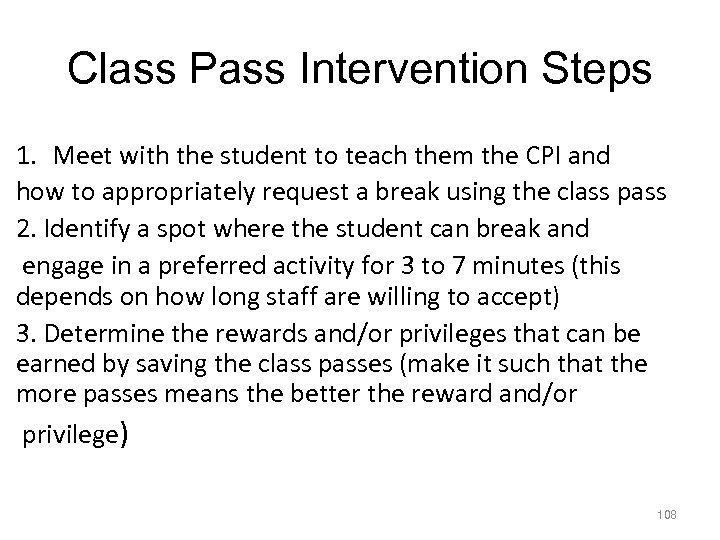
Class Pass Intervention Steps 1. Meet with the student to teach them the CPI and how to appropriately request a break using the class pass 2. Identify a spot where the student can break and engage in a preferred activity for 3 to 7 minutes (this depends on how long staff are willing to accept) 3. Determine the rewards and/or privileges that can be earned by saving the class passes (make it such that the more passes means the better the reward and/or privilege) 108
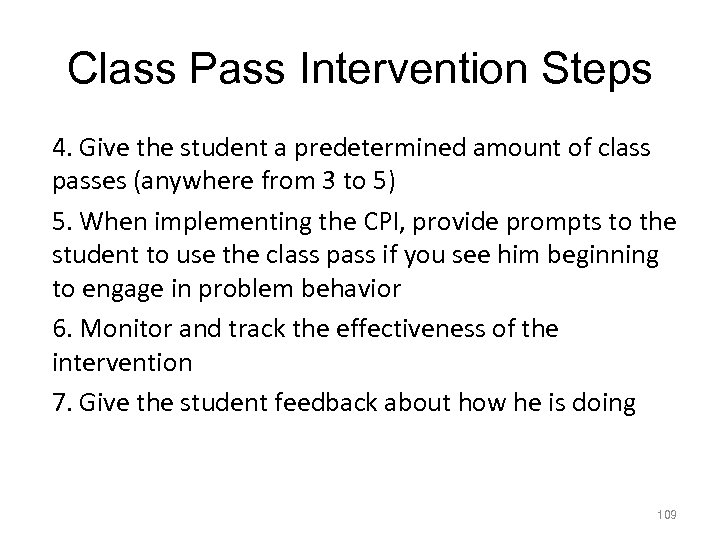
Class Pass Intervention Steps 4. Give the student a predetermined amount of class passes (anywhere from 3 to 5) 5. When implementing the CPI, provide prompts to the student to use the class pass if you see him beginning to engage in problem behavior 6. Monitor and track the effectiveness of the intervention 7. Give the student feedback about how he is doing 109
Positive Peer Reporting • Designed to enhance the social status and interaction skills of peer rejected or isolated youth – Can also be used to alter a negative peer ecology that is characterized by put downs, tattling, or aggressive behavior • The intervention rewards youth for providing genuine and specific positive peer reports about a target student who is peer rejected or isolated youth – The target youth is identified as the “MVP” 110
The MVP (Most Valuable Person) • MVP is the student in the class who is identified to be the recipient of positive peer reports – Rig it to make it look like the selection of the MVP was a random process (e. g. , pick name out of a hat) • The student will remain as the MVP for a minimum of two days to a maximum of a week • The teacher will select a new MVP each week • The name of the MVP should be prominently displayed in the class for the other students to see 111
Preparing for PPR • Must teach students how to give positive peer reports (compliments) – Positive peer reports consist of talking about what the MVP: • Did (behaviors) • Said (verbal interaction) • Achieved/earned • Positive reports can be done directly or anonymously – Secondhand compliments are often more powerful • Find a time to solicit positive peer reports – 5 to 15 minutes of class time • Identify the class rewards that can be earned and method of tracking progress toward goal attainment 112
Class-wide Systems to Cue, Shape, and Model Behavior: Strategies for Teachers “Pit Crews” as a PPR – Use peers to support student with problem behavior ? Source: www. pent. ca. gov. + 113
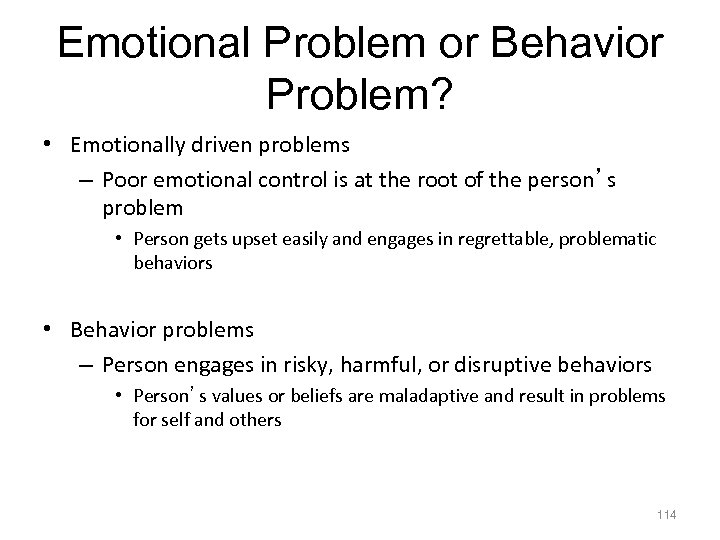
Emotional Problem or Behavior Problem? • Emotionally driven problems – Poor emotional control is at the root of the person’s problem • Person gets upset easily and engages in regrettable, problematic behaviors • Behavior problems – Person engages in risky, harmful, or disruptive behaviors • Person’s values or beliefs are maladaptive and result in problems for self and others 114
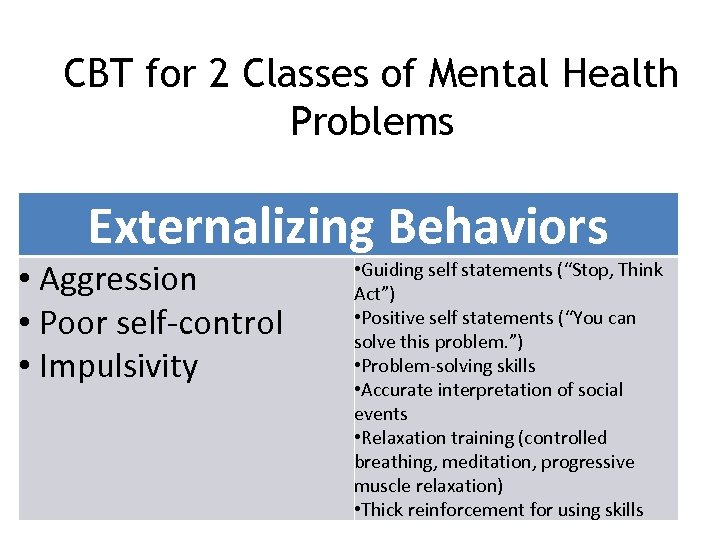
115 CBT for 2 Classes of Mental Health Problems Externalizing Behaviors • Aggression • Poor self-control • Impulsivity • Guiding self statements (“Stop, Think Act”) • Positive self statements (“You can solve this problem. ”) • Problem-solving skills • Accurate interpretation of social events • Relaxation training (controlled breathing, meditation, progressive muscle relaxation) • Thick reinforcement for using skills
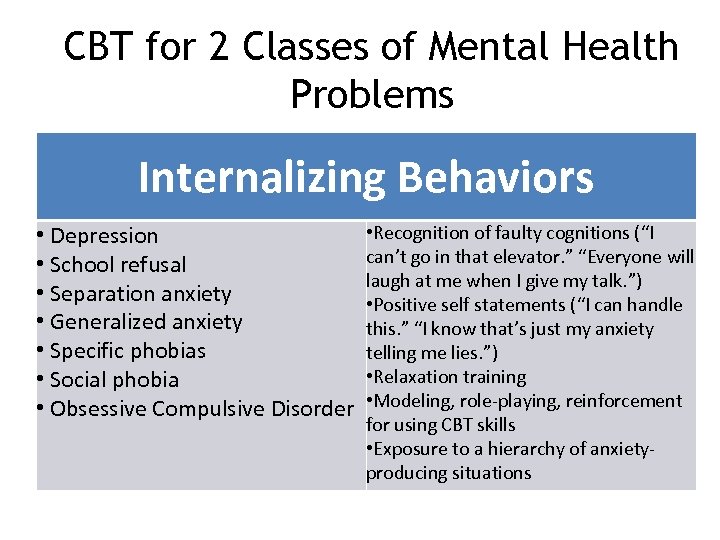
116 CBT for 2 Classes of Mental Health Problems Internalizing Behaviors • Depression • School refusal • Separation anxiety • Generalized anxiety • Specific phobias • Social phobia • Obsessive Compulsive Disorder • Recognition of faulty cognitions (“I can’t go in that elevator. ” “Everyone will laugh at me when I give my talk. ”) • Positive self statements (“I can handle this. ” “I know that’s just my anxiety telling me lies. ”) • Relaxation training • Modeling, role-playing, reinforcement for using CBT skills • Exposure to a hierarchy of anxietyproducing situations
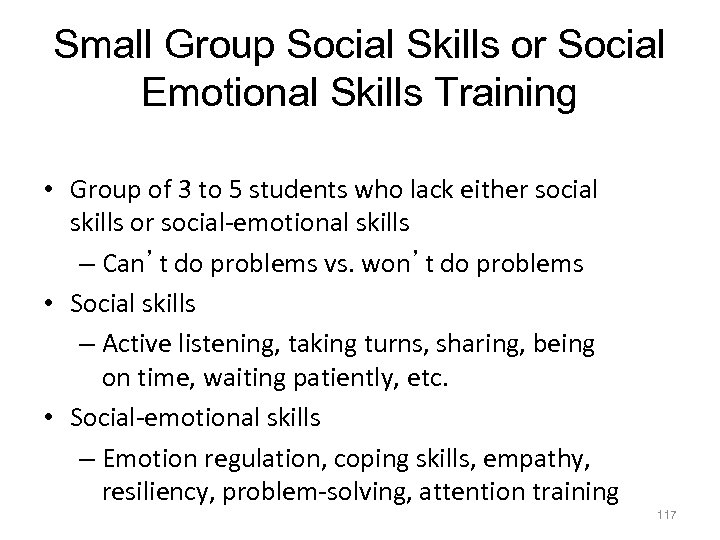
Small Group Social Skills or Social Emotional Skills Training • Group of 3 to 5 students who lack either social skills or social-emotional skills – Can’t do problems vs. won’t do problems • Social skills – Active listening, taking turns, sharing, being on time, waiting patiently, etc. • Social-emotional skills – Emotion regulation, coping skills, empathy, resiliency, problem-solving, attention training 117
Thank YOU for all you do for kids! Feel free to contact me if I can be of further assistance: Diana Browning Wright 626 -487 -9455 dbrowningw@gmail. com www. dianabrowningwright. com 118
Скачать презентацию Effective Evidence-based Tier II Supports Matching Student Needs
6ebd9fa81598aab8e02531f677ce45bf.ppt