 Скачать презентацию Effective Error Bounds for Euler Mac Laurin based
9e44f03d4bed321b77f650133e70ae0a.ppt
- Количество слайдов: 40



Effective Error Bounds for Euler. Mac. Laurin based Numerical Quadrature Jonathan Borwein, FRSC www. cs. dal. ca/~jborwein Canada Research Chair in Collaborative Technology Joint work with David Bailey, Lawrence Berkeley The purpose of computing is insight not numbers (Richard Hamming 1962) Revised 16/04/06
ABSTRACT ► We analyze the behavior of Euler-Maclaurinbased integration schemes with the intention of deriving accurate and economic estimations of the error ► These schemes typically provide very high-precision results (hundreds or thousands of digits), in reasonable run time, even when the integrand function has a blow-up singularity or infinite derivative at an endpoint ►Heretofore, researchers using these schemes have relied mostly on ad hoc error estimation schemes to project the estimated error of the present iteration ►In this paper, we seek to develop some more rigorous, yet highly usable schemes to estimate these errors
INTRODUCTION ► In the past few years, computation of definite integrals to high precision has become a key tool in experimental math. ►It is often possible to recognize an unknown definite integral if its numerical value is known to extremely high precision ►High precision is required since integer relation searches of n terms with d-digit coefficients require at least dn-digit precision for both input data and relation searching. ►Such computation often requires highly parallel implementation ►One computation below, required nearly one hour on 1024 cpus, and the PSLQ integer relation search in another required 44 hours on 32 cpus. Moreover, such extreme computations provide excellent tests of HPC systems ► for example, we identified a difficulty with differing processor speeds on the Virginia Tech system with these calculations
OUTLINE ► Experimental Mathematics ► Rationale ►Examples of need for quadrature etc ► Extreme Quadrature ►Theory ►Implementation ►Examples
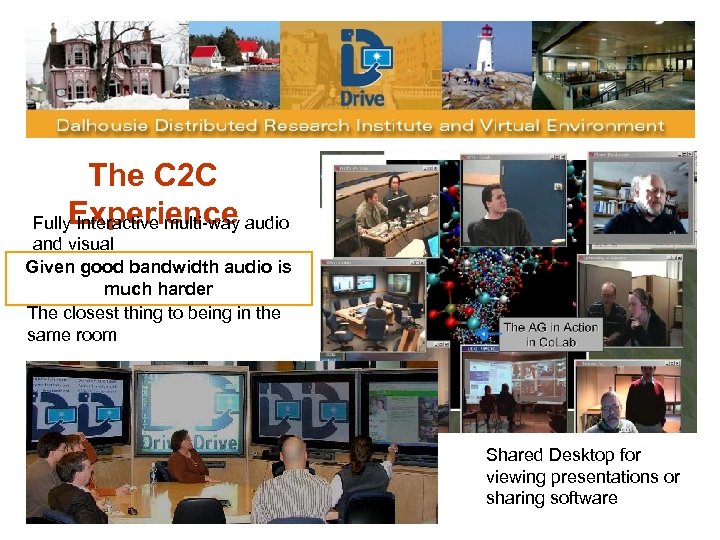
The C 2 C Fully. Experience audio Interactive multi-way and visual Given good bandwidth audio is much harder The closest thing to being in the same room Shared Desktop for viewing presentations or sharing software

Jonathan Borwein, Dalhousie University Mathematical Visualization High Quality Presentations Uwe Glaesser, Simon Fraser University Semantic Blueprints of Discrete Dynamic Systems Peter Borwein, IRMACS The Riemann Hypothesis Arvind Gupta, MITACS The Protein Folding Problem Jonathan Schaeffer, University of Edmonton Solving Checkers Przemyslaw Prusinkiewicz, University of Calgary Computational Biology of Plants Karl Dilcher, Dalhousie University Fermat Numbers, Wieferich and Wilson Primes
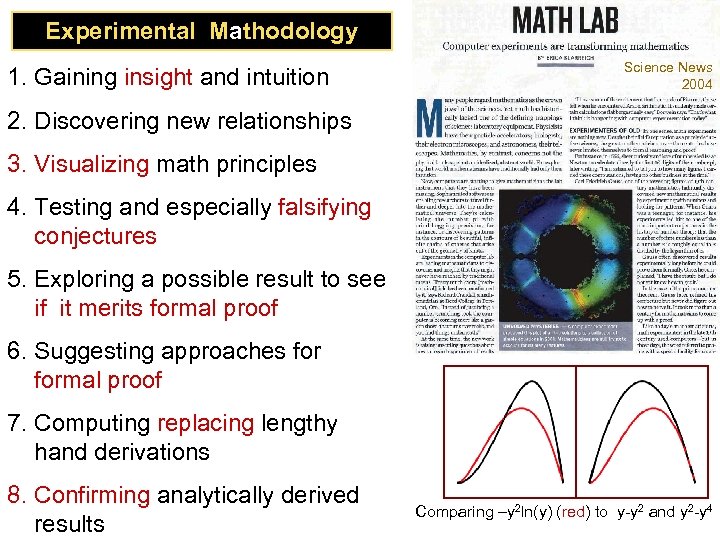
Experimental Mathodology 1. Gaining insight and intuition Science News 2004 2. Discovering new relationships “Computers are 3. useless, they principles Visualizing math can only give answers. ” 4. Testing and especially falsifying conjectures Picasso Pablo 5. Exploring a possible result to see if it merits formal proof 6. Suggesting approaches formal proof 7. Computing replacing lengthy hand derivations 8. Confirming analytically derived results Comparing –y 2 ln(y) (red) to y-y 2 and y 2 -y 4
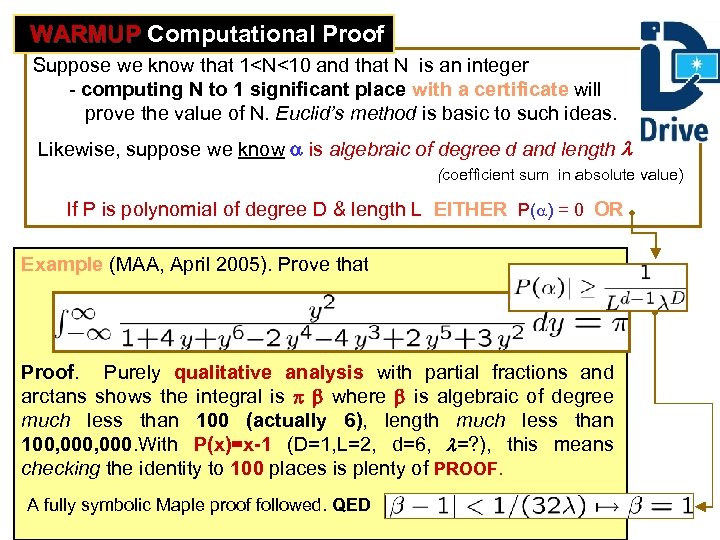
WARMUP Computational Proof Suppose we know that 1<N<10 and that N is an integer - computing N to 1 significant place with a certificate will prove the value of N. Euclid’s method is basic to such ideas. Likewise, suppose we know a is algebraic of degree d and length (coefficient sum in absolute value) If P is polynomial of degree D & length L EITHER P(a) = 0 OR Example (MAA, April 2005). Prove that Proof. Purely qualitative analysis with partial fractions and arctans shows the integral is b where b is algebraic of degree much less than 100 (actually 6), length much less than 100, 000. With P(x)=x-1 (D=1, L=2, d=6, =? ), this means checking the identity to 100 places is plenty of PROOF. A fully symbolic Maple proof followed. QED
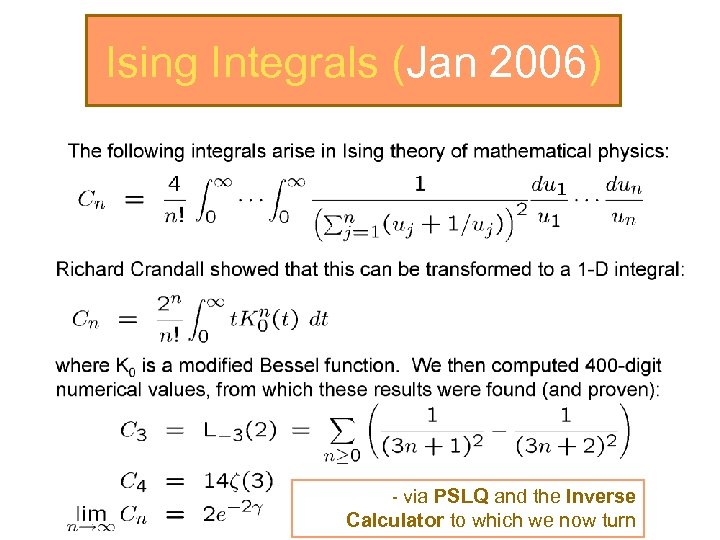
Ising Integrals (Jan 2006) - via PSLQ and the Inverse Calculator to which we now turn
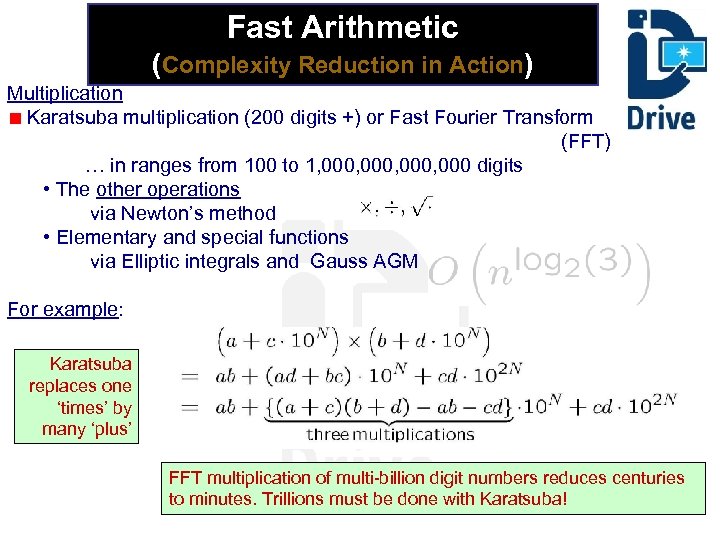
Fast Arithmetic (Complexity Reduction in Action) Multiplication Karatsuba multiplication (200 digits +) or Fast Fourier Transform (FFT) … in ranges from 100 to 1, 000, 000 digits • The other operations via Newton’s method • Elementary and special functions via Elliptic integrals and Gauss AGM For example: Karatsuba replaces one ‘times’ by many ‘plus’ FFT multiplication of multi-billion digit numbers reduces centuries to minutes. Trillions must be done with Karatsuba!
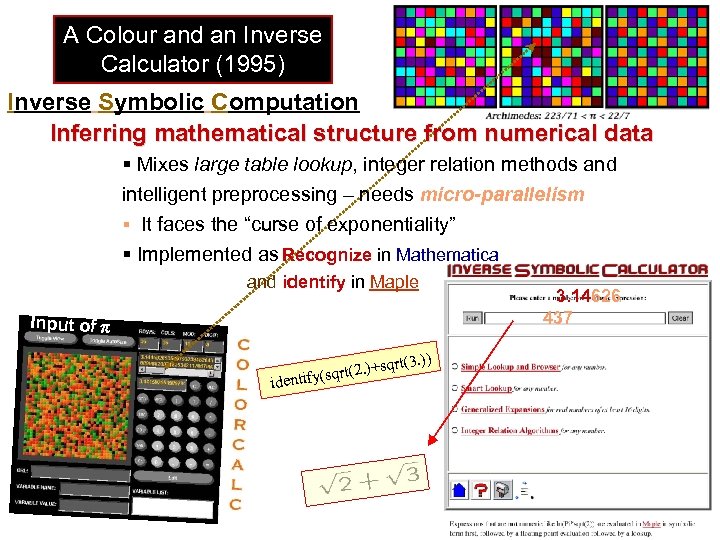
A Colour and an Inverse Calculator (1995) Inverse Symbolic Computation Inferring mathematical structure from numerical data § Mixes large table lookup, integer relation methods and intelligent preprocessing – needs micro-parallelism § It faces the “curse of exponentiality” § Implemented as Recognize in Mathematica and identify in Maple Input of 3. )) sqrt(2. )+ identify( 3. 14626 437
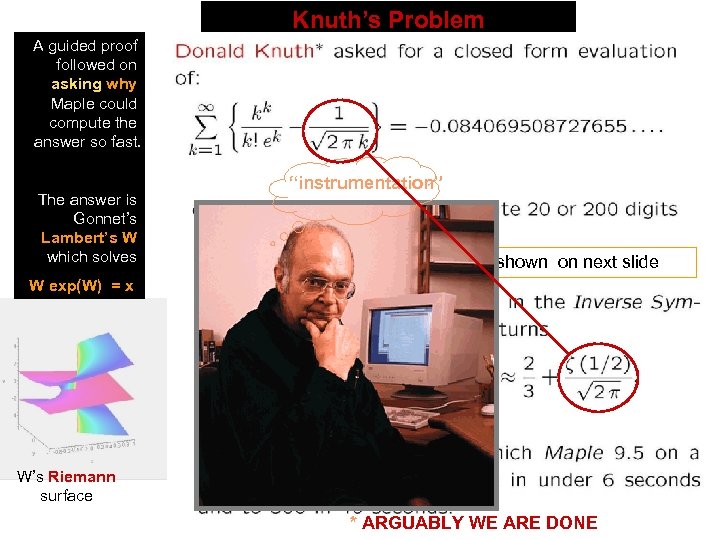
A guided proof followed on asking why Maple could compute the answer so fast. The answer is Gonnet’s Lambert’s W which solves Knuth’s Problem We can know the answer first “instrumentation” ISC is shown on next slide W exp(W) = x W’s Riemann surface * ARGUABLY WE ARE DONE
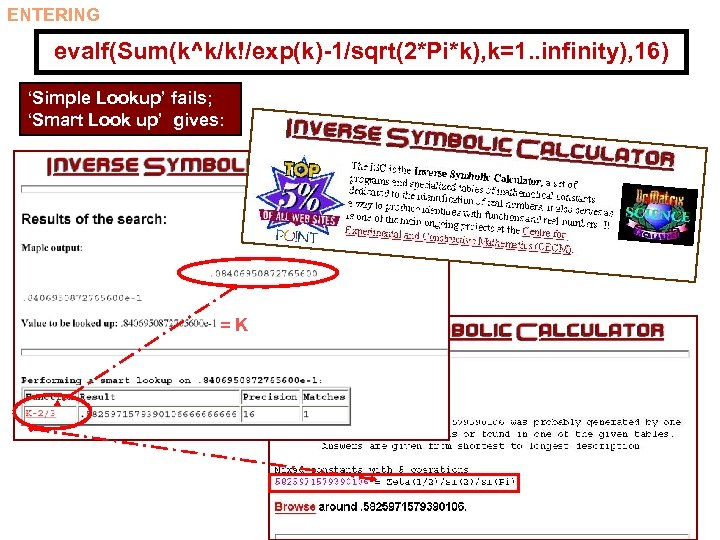
ENTERING evalf(Sum(k^k/k!/exp(k)-1/sqrt(2*Pi*k), k=1. . infinity), 16) ‘Simple Lookup’ fails; ‘Smart Look up’ gives: =K
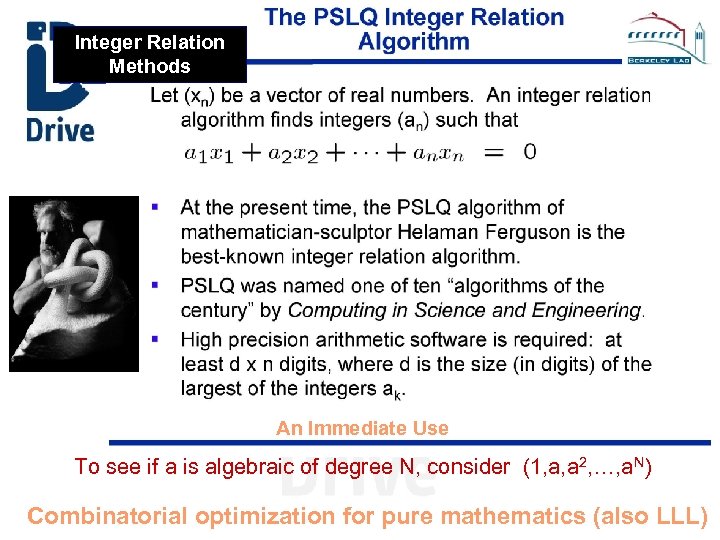
Integer Relation Methods An Immediate Use To see if a is algebraic of degree N, consider (1, a, a 2, …, a. N) Combinatorial optimization for pure mathematics (also LLL)
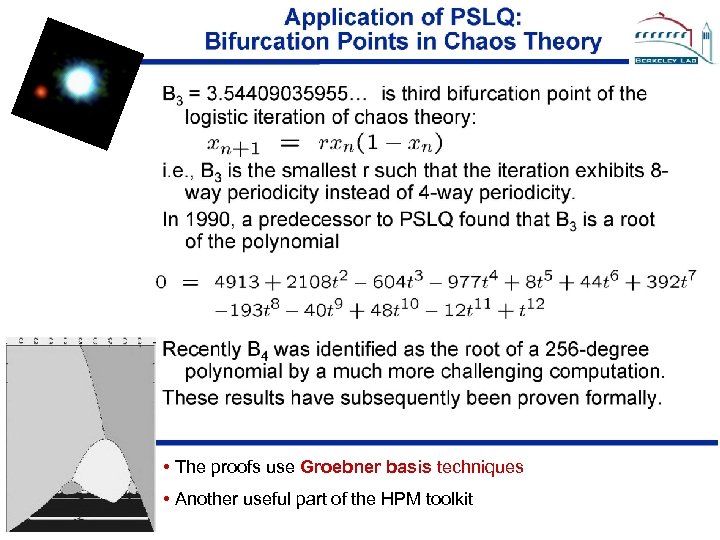
• The proofs use Groebner basis techniques • Another useful part of the HPM toolkit
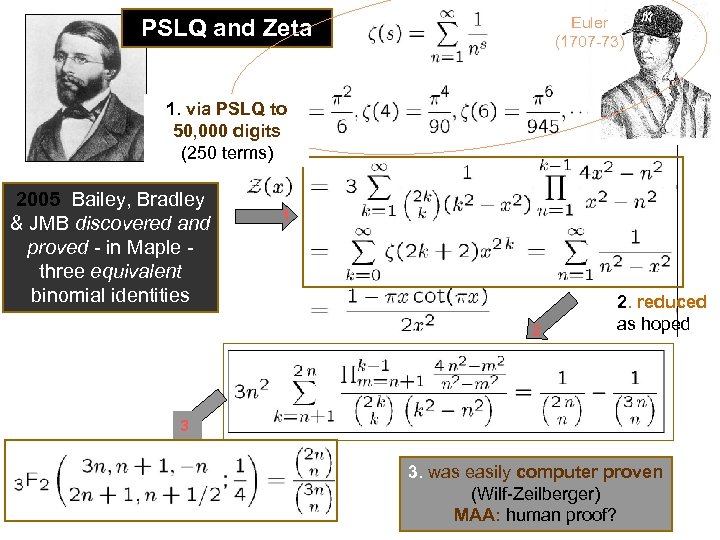
Euler (1707 -73) PSLQ and Zeta 1. via PSLQ to Riemann digits 50, 000 (1826 -66) terms) (250 2005 Bailey, Bradley & JMB discovered and proved - in Maple three equivalent binomial identities 1 2 2. reduced as hoped 3 3. was easily computer proven (Wilf-Zeilberger) MAA: human proof?
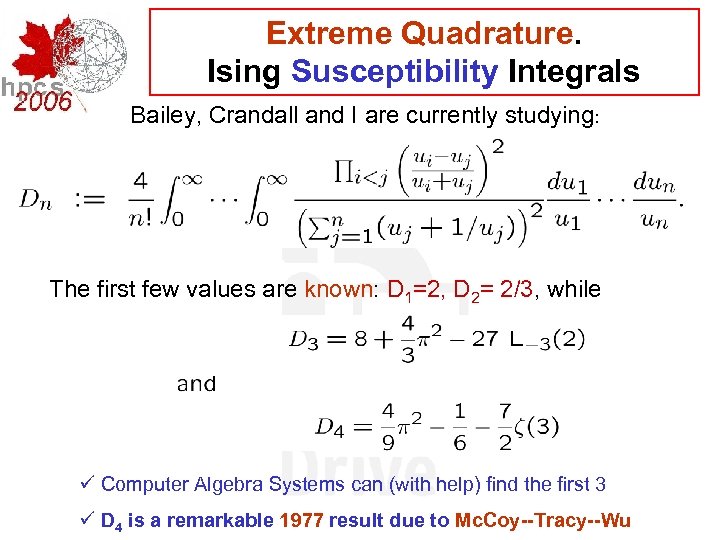
Extreme Quadrature. Ising Susceptibility Integrals Bailey, Crandall and I are currently studying: The first few values are known: D 1=2, D 2= 2/3, while ü Computer Algebra Systems can (with help) find the first 3 ü D 4 is a remarkable 1977 result due to Mc. Coy--Tracy--Wu
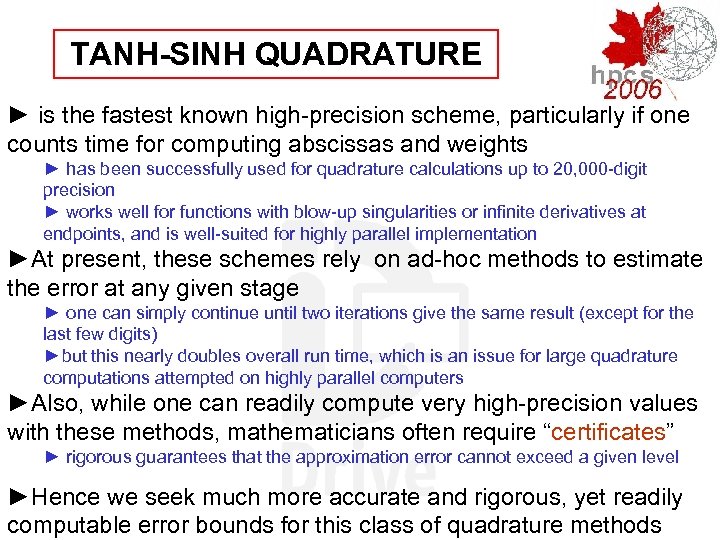
TANH-SINH QUADRATURE ► is the fastest known high-precision scheme, particularly if one counts time for computing abscissas and weights ► has been successfully used for quadrature calculations up to 20, 000 -digit precision ► works well for functions with blow-up singularities or infinite derivatives at endpoints, and is well-suited for highly parallel implementation ►At present, these schemes rely on ad-hoc methods to estimate the error at any given stage ► one can simply continue until two iterations give the same result (except for the last few digits) ►but this nearly doubles overall run time, which is an issue for large quadrature computations attempted on highly parallel computers ►Also, while one can readily compute very high-precision values with these methods, mathematicians often require “certificates” ► rigorous guarantees that the approximation error cannot exceed a given level ►Hence we seek much more accurate and rigorous, yet readily computable error bounds for this class of quadrature methods
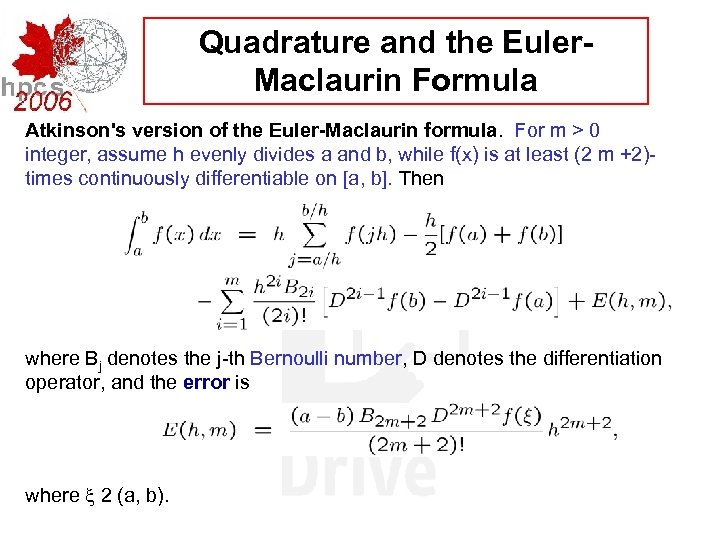
Quadrature and the Euler. Maclaurin Formula Atkinson's version of the Euler-Maclaurin formula. For m > 0 integer, assume h evenly divides a and b, while f(x) is at least (2 m +2)times continuously differentiable on [a, b]. Then where Bj denotes the j-th Bernoulli number, D denotes the differentiation operator, and the error is where 2 (a, b).
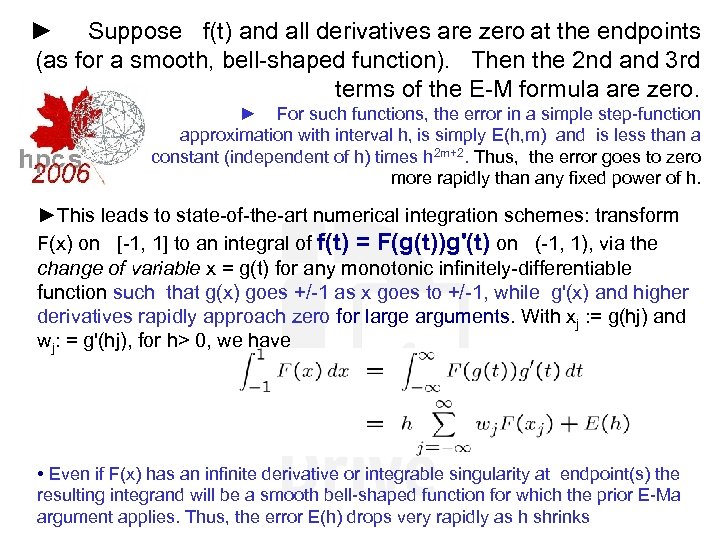
► Suppose f(t) and all derivatives are zero at the endpoints (as for a smooth, bell-shaped function). Then the 2 nd and 3 rd terms of the E-M formula are zero. ► For such functions, the error in a simple step-function approximation with interval h, is simply E(h, m) and is less than a constant (independent of h) times h 2 m+2. Thus, the error goes to zero more rapidly than any fixed power of h. ►This leads to state-of-the-art numerical integration schemes: transform F(x) on [-1, 1] to an integral of f(t) = F(g(t))g'(t) on (-1, 1), via the change of variable x = g(t) for any monotonic infinitely-differentiable function such that g(x) goes +/-1 as x goes to +/-1, while g'(x) and higher derivatives rapidly approach zero for large arguments. With xj : = g(hj) and wj: = g'(hj), for h> 0, we have • Even if F(x) has an infinite derivative or integrable singularity at endpoint(s) the resulting integrand will be a smooth bell-shaped function for which the prior E-Ma argument applies. Thus, the error E(h) drops very rapidly as h shrinks
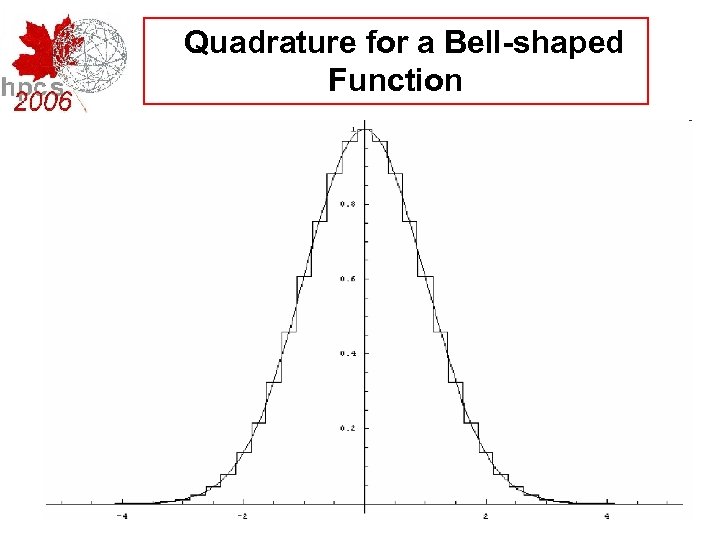
Quadrature for a Bell-shaped Function
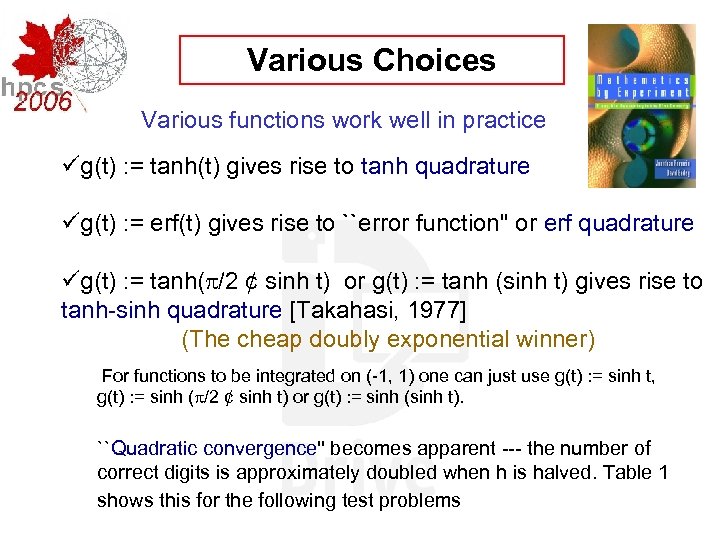
Various Choices Various functions work well in practice üg(t) : = tanh(t) gives rise to tanh quadrature üg(t) : = erf(t) gives rise to ``error function'' or erf quadrature üg(t) : = tanh( /2 ¢ sinh t) or g(t) : = tanh (sinh t) gives rise to tanh-sinh quadrature [Takahasi, 1977] (The cheap doubly exponential winner) For functions to be integrated on (-1, 1) one can just use g(t) : = sinh t, g(t) : = sinh ( /2 ¢ sinh t) or g(t) : = sinh (sinh t). ``Quadratic convergence'' becomes apparent --- the number of correct digits is approximately doubled when h is halved. Table 1 shows this for the following test problems
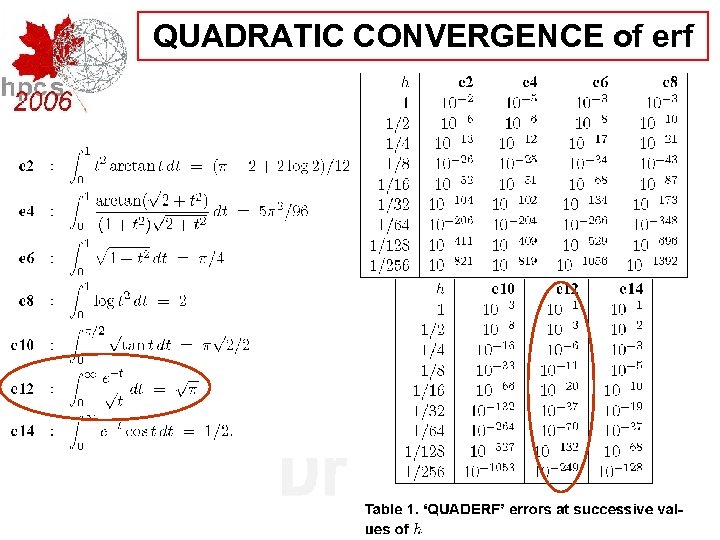
QUADRATIC CONVERGENCE of erf
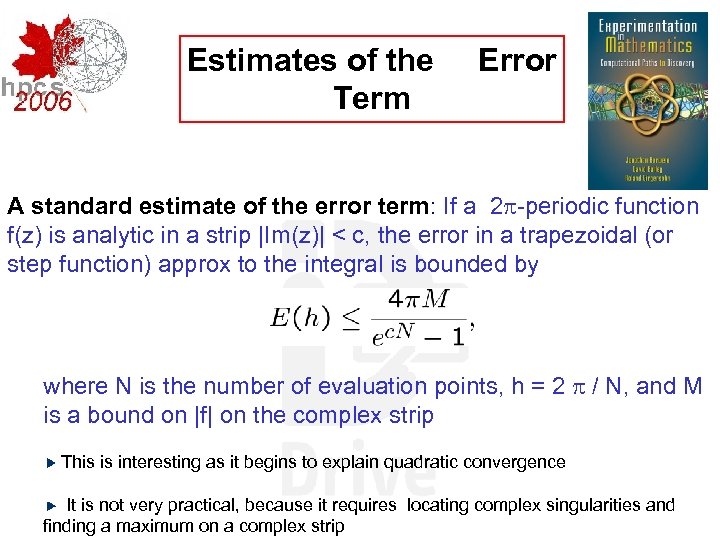
Estimates of the Term Error A standard estimate of the error term: If a 2 -periodic function f(z) is analytic in a strip |Im(z)| < c, the error in a trapezoidal (or step function) approx to the integral is bounded by where N is the number of evaluation points, h = 2 / N, and M is a bound on |f| on the complex strip This is interesting as it begins to explain quadratic convergence It is not very practical, because it requires locating complex singularities and finding a maximum on a complex strip
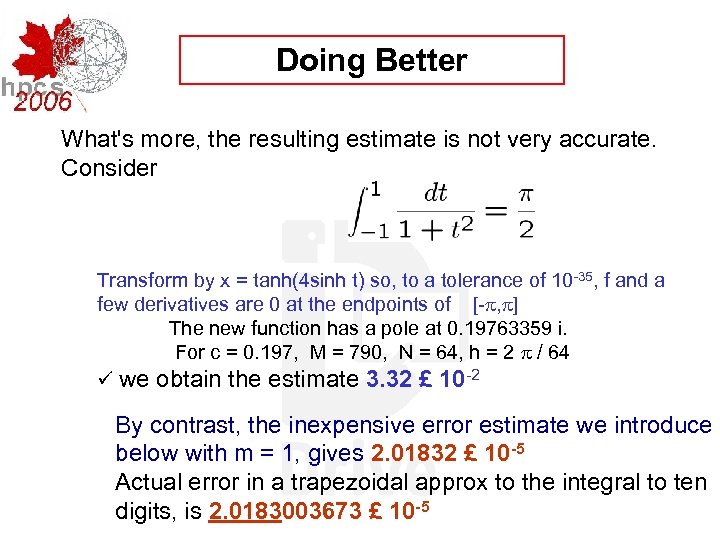
Doing Better What's more, the resulting estimate is not very accurate. Consider Transform by x = tanh(4 sinh t) so, to a tolerance of 10 -35, f and a few derivatives are 0 at the endpoints of [- , ] The new function has a pole at 0. 19763359 i. For c = 0. 197, M = 790, N = 64, h = 2 / 64 ü we obtain the estimate 3. 32 £ 10 -2 By contrast, the inexpensive error estimate we introduce below with m = 1, gives 2. 01832 £ 10 -5 Actual error in a trapezoidal approx to the integral to ten digits, is 2. 0183003673 £ 10 -5
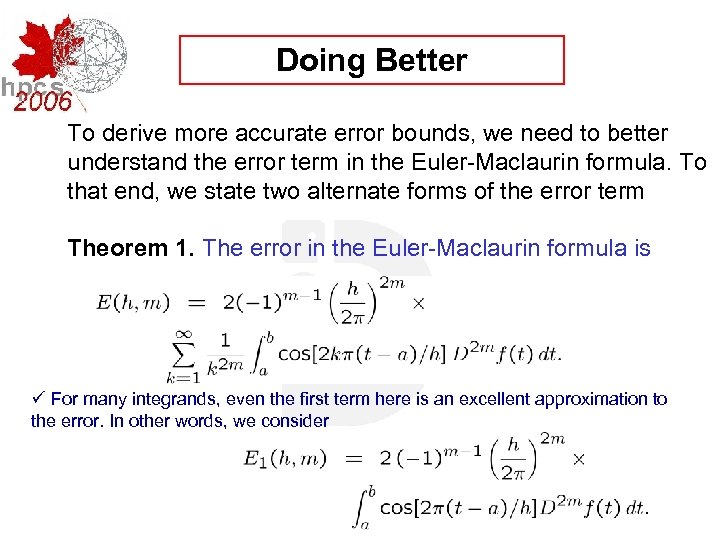
Doing Better To derive more accurate error bounds, we need to better understand the error term in the Euler-Maclaurin formula. To that end, we state two alternate forms of the error term Theorem 1. The error in the Euler-Maclaurin formula is ü For many integrands, even the first term here is an excellent approximation to the error. In other words, we consider
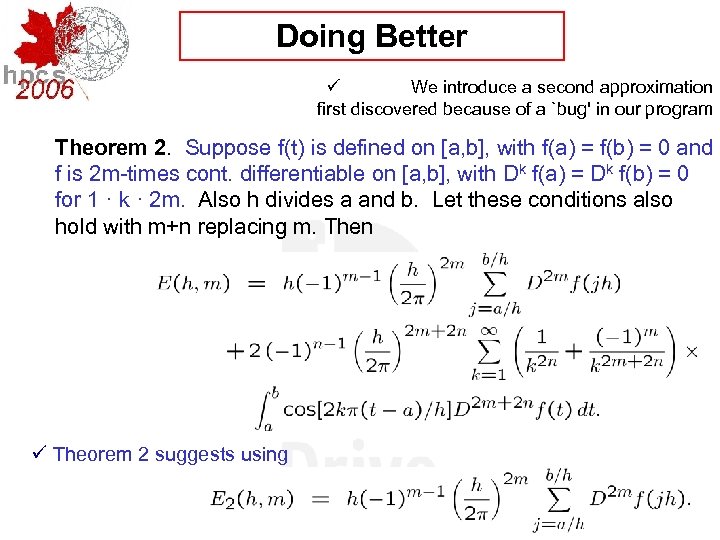
Doing Better ü We introduce a second approximation first discovered because of a `bug' in our program Theorem 2. Suppose f(t) is defined on [a, b], with f(a) = f(b) = 0 and f is 2 m-times cont. differentiable on [a, b], with Dk f(a) = Dk f(b) = 0 for 1 · k · 2 m. Also h divides a and b. Let these conditions also hold with m+n replacing m. Then ü Theorem 2 suggests using
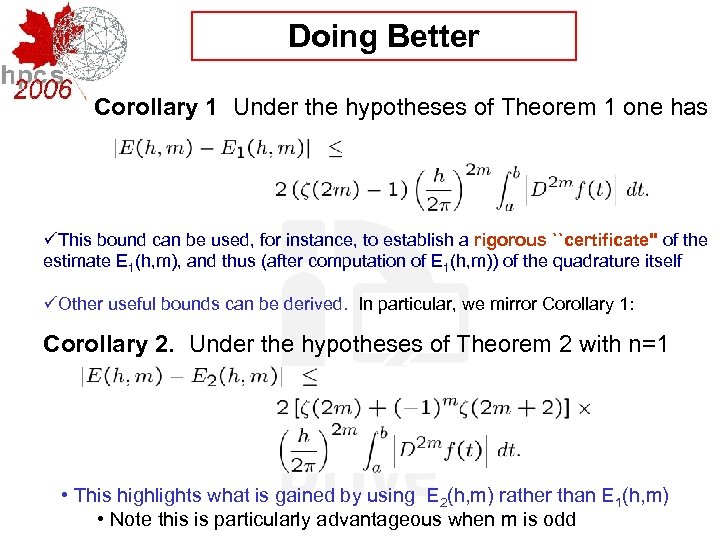
Doing Better Corollary 1 Under the hypotheses of Theorem 1 one has üThis bound can be used, for instance, to establish a rigorous ``certificate'' of the estimate E 1(h, m), and thus (after computation of E 1(h, m)) of the quadrature itself üOther useful bounds can be derived. In particular, we mirror Corollary 1: Corollary 2. Under the hypotheses of Theorem 2 with n=1 • This highlights what is gained by using E 2(h, m) rather than E 1(h, m) • Note this is particularly advantageous when m is odd
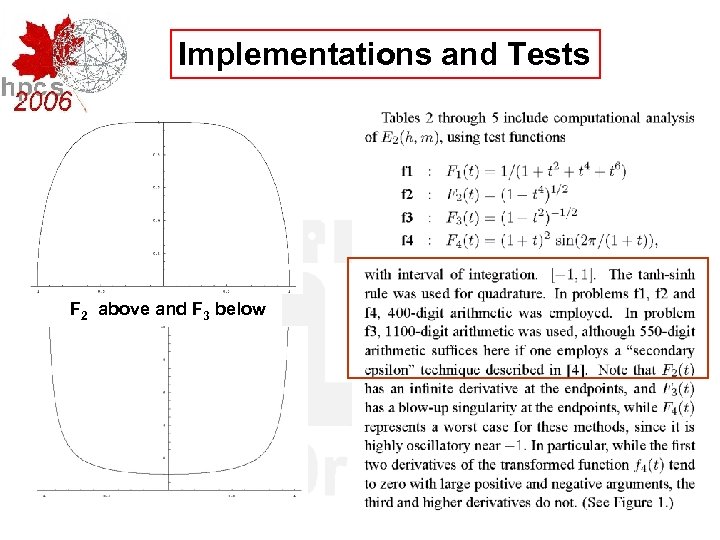
Implementations and Tests F 2 above and F 3 below
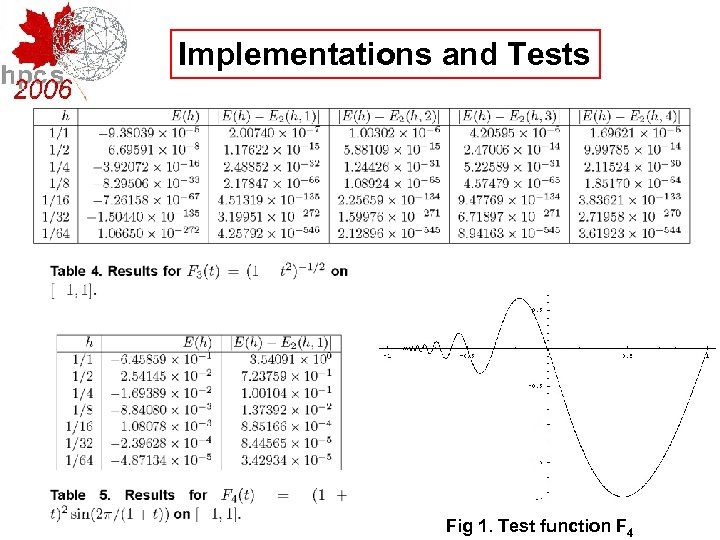
Implementations and Tests Fig 1. Test function F 4
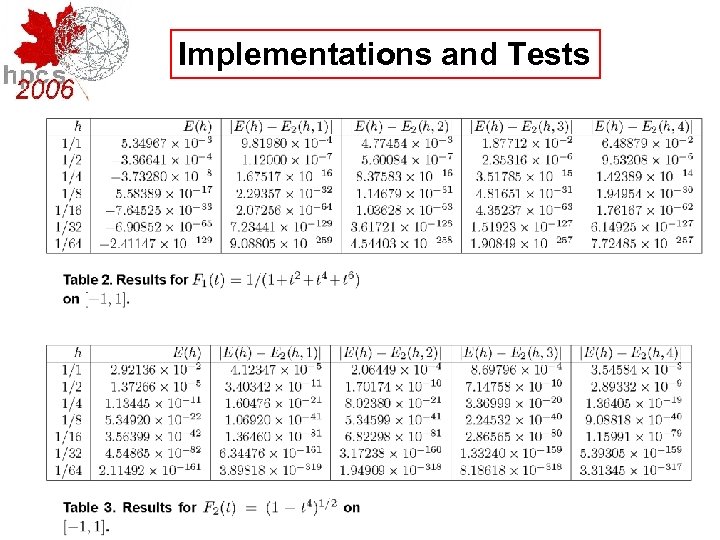
Implementations and Tests
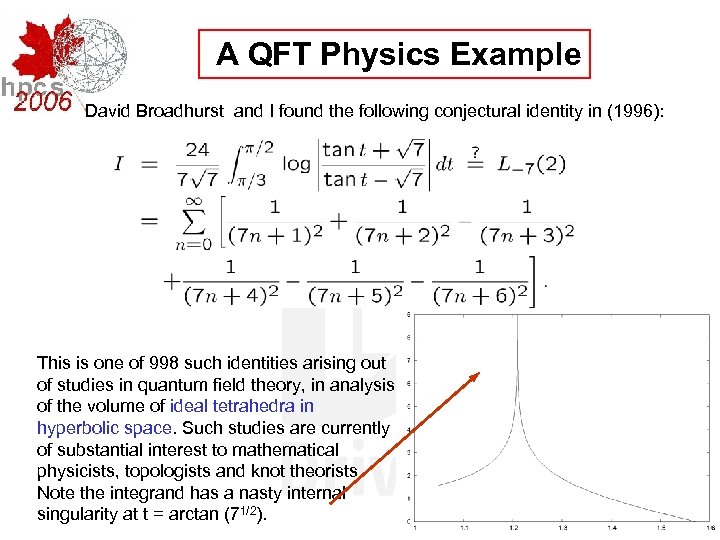
A QFT Physics Example David Broadhurst and I found the following conjectural identity in (1996): This is one of 998 such identities arising out of studies in quantum field theory, in analysis of the volume of ideal tetrahedra in hyperbolic space. Such studies are currently of substantial interest to mathematical physicists, topologists and knot theorists. Note the integrand has a nasty internal singularity at t = arctan (71/2).
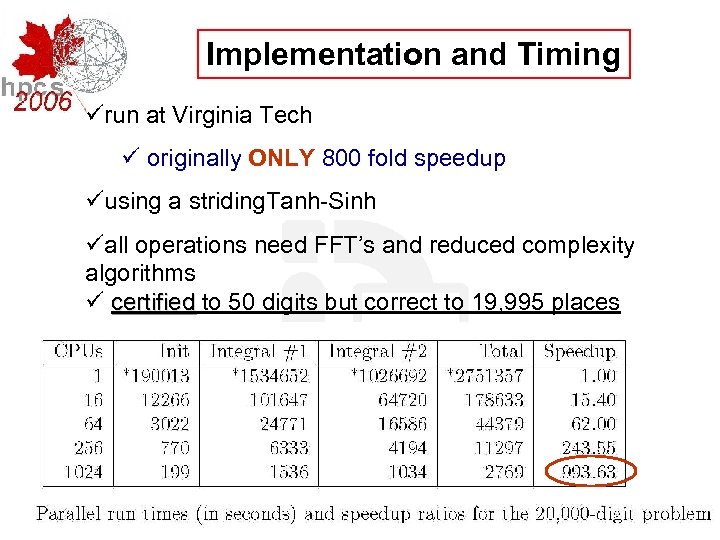
Implementation and Timing ürun at Virginia Tech ü originally ONLY 800 fold speedup üusing a striding. Tanh-Sinh üall operations need FFT’s and reduced complexity algorithms ü certified to 50 digits but correct to 19, 995 places
4 b. An Ising Integral Bailey, Crandall and I are currently studying:
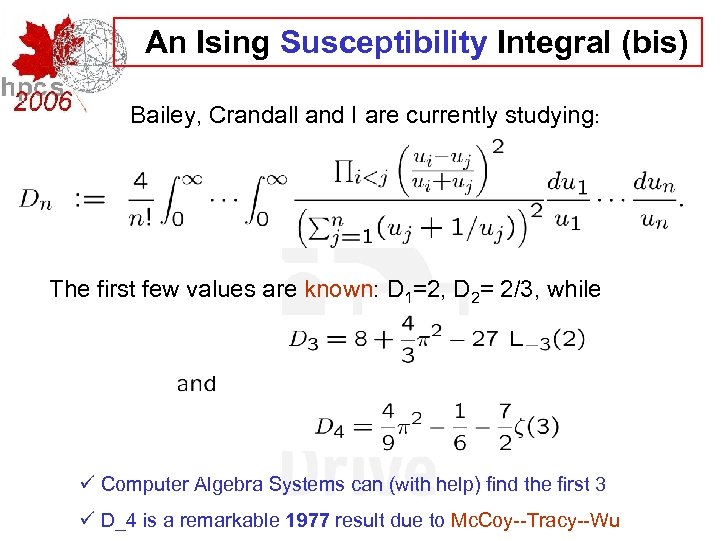
An Ising Susceptibility Integral (bis) Bailey, Crandall and I are currently studying: The first few values are known: D 1=2, D 2= 2/3, while ü Computer Algebra Systems can (with help) find the first 3 ü D_4 is a remarkable 1977 result due to Mc. Coy--Tracy--Wu
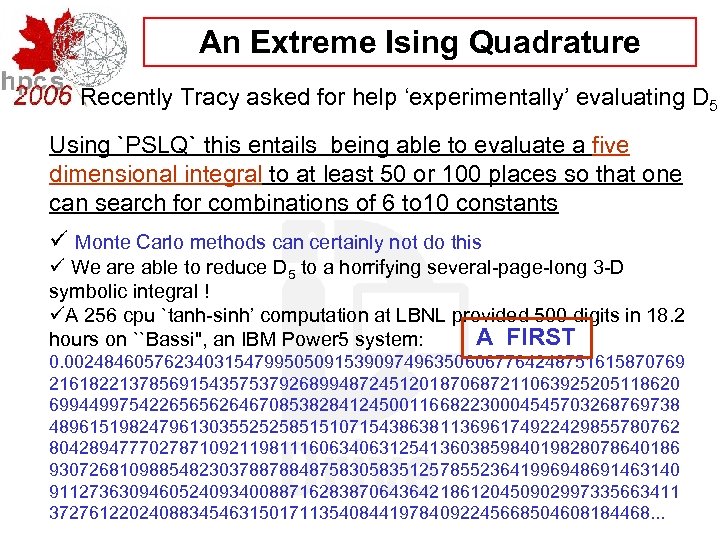
An Extreme Ising Quadrature Recently Tracy asked for help ‘experimentally’ evaluating D 5 Using `PSLQ` this entails being able to evaluate a five dimensional integral to at least 50 or 100 places so that one can search for combinations of 6 to 10 constants ü Monte Carlo methods can certainly not do this ü We are able to reduce D 5 to a horrifying several-page-long 3 -D symbolic integral ! üA 256 cpu `tanh-sinh’ computation at LBNL provided 500 digits in 18. 2 A FIRST hours on ``Bassi", an IBM Power 5 system: 0. 00248460576234031547995050915390974963506067764248751615870769 216182213785691543575379268994872451201870687211063925205118620 699449975422656562646708538284124500116682230004545703268769738 489615198247961303552525851510715438638113696174922429855780762 804289477702787109211981116063406312541360385984019828078640186 930726810988548230378878848758305835125785523641996948691463140 911273630946052409340088716283870643642186120450902997335663411 372761220240883454631501711354084419784092245668504608184468. . .
Conclusions We have derived two estimates of the error in Euler. Maclaurin-based quadrature, one of which is particularly simple to implement, since it only involves summation of derivatives of the transformed function, at the same abscissas as the quadrature calculation itself. It appears, from our results in several test problems, that the simplest instance of these estimates, namely E 2(h, 1), is not only adequate, but in fact very accurate once h is even modestly small. What is more, the difference between this estimate and the actual error can be bounded with an easily computed formula, thus permitting some ``certificates'' of quadrature values computed using Euler-Maclaurin-based schemes.
REFERENCES 1. David H. Bailey and Jonathan M. Borwein, ``Effective Error Bounds for Euler-Maclaurin-Based Quadrature Schemes, " HPCS 06 IEEE Proceedings, 2006, in press. 2. D. H. Bailey, J. M. Borwein and R. E. Crandall, ``Integrals of the Ising Class, " submitted May 2006. 3. J. M. Borwein, D. H. Bailey and R. Girgensohn, with the assistance of M. Macklem, Experiments in Mathematics CD, A. K. Peters Ltd, 2006. Interactive version of Mathematics by Experiment: Plausible Reasoning in the 21 st Century and Experimentation in Mathematics: Computational Paths to Discovery, AKP, 2003/4. (See www. experimentalmath. info) 4. David Bailey and Jonathan Borwein, ``Highly parallel, high precision integration, " submitted July 2005. [D-drive Preprint 294]
Скачать презентацию Effective Error Bounds for Euler Mac Laurin based
9e44f03d4bed321b77f650133e70ae0a.ppt