 Скачать презентацию Effective employment based training models Presenter Kaye Bowman
f6fcbd38abe767671b9f5c2d44c7253c.ppt
- Количество слайдов: 18



Effective employment based training models Presenter: Kaye Bowman Team: Sarojni Choy, Kaye Bowman, Stephen Billet, Louise Wignall and Sandra Haukka NSW ICVET Conference 10 August 2007 Concurrent Session 1
Acknowledgements • DEST for funding • National Centre for Vocational and Education Research for commissioning • Process manufacturing and • Child care representatives for input to case studies
Research goals • Examine existing and emerging EBT models • Determine their effectiveness in selected occupations in two industries • Identify effective EBT models, that could have wide application • Identify issues to be addressed in implementation
Overview • EBT at Certificate level III and above • Five effective EBT models • Implementation Issues • Messages-----for TAFE
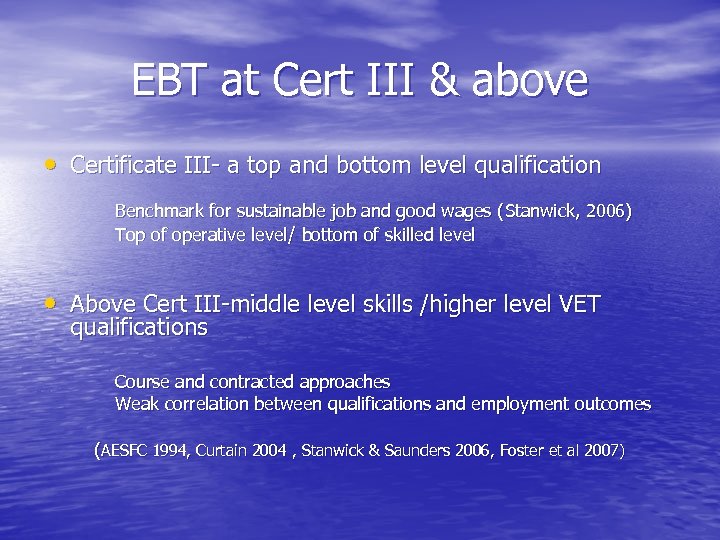
EBT at Cert III & above • Certificate III- a top and bottom level qualification Benchmark for sustainable job and good wages (Stanwick, 2006) Top of operative level/ bottom of skilled level • Above Cert III-middle level skills /higher level VET qualifications Course and contracted approaches Weak correlation between qualifications and employment outcomes (AESFC 1994, Curtain 2004 , Stanwick & Saunders 2006, Foster et al 2007)
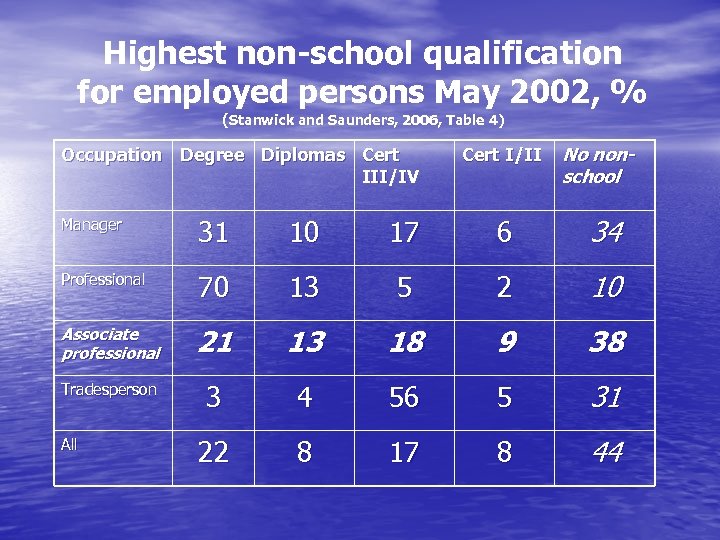
Highest non-school qualification for employed persons May 2002, % (Stanwick and Saunders, 2006, Table 4) Occupation Degree Diplomas Cert III/IV Cert I/II No nonschool Manager 31 10 17 6 34 Professional 70 13 5 2 10 Associate professional 21 13 18 9 38 Tradesperson 3 4 56 5 31 22 8 17 8 44 All
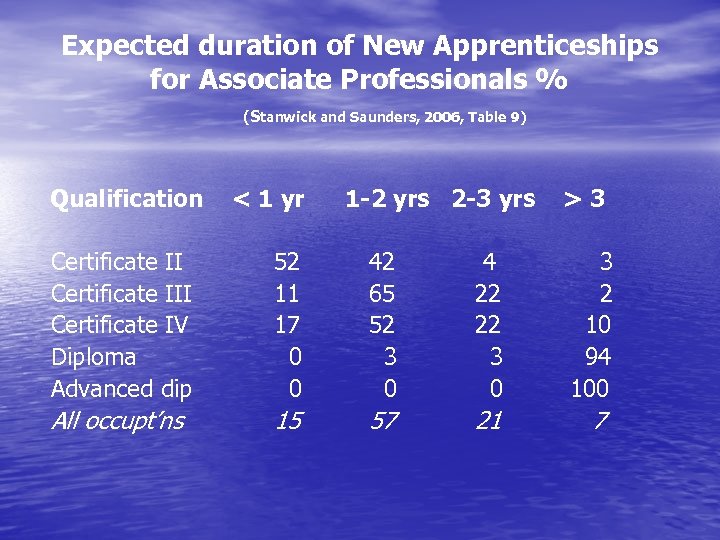
Expected duration of New Apprenticeships for Associate Professionals % (Stanwick and Saunders, 2006, Table 9) Qualification < 1 yr 1 -2 yrs 2 -3 yrs Certificate III Certificate IV Diploma Advanced dip 52 11 17 0 0 42 65 52 3 0 4 22 22 3 0 All occupt’ns 15 57 21 >3 3 2 10 94 100 7
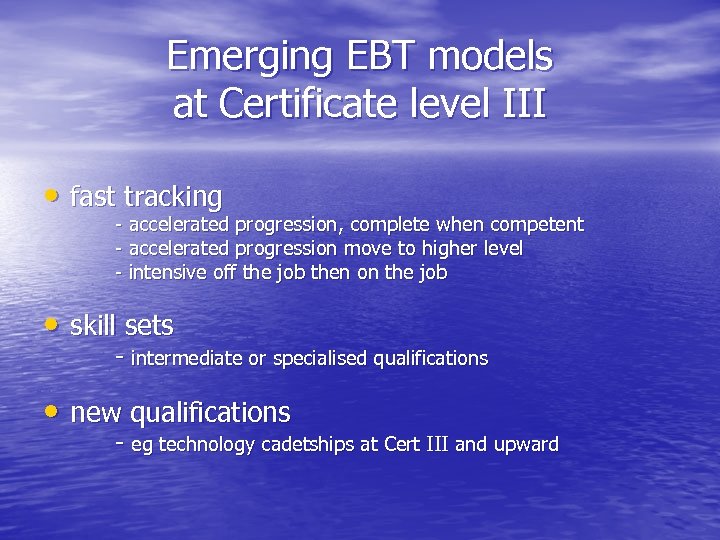
Emerging EBT models at Certificate level III • fast tracking - accelerated progression, complete when competent - accelerated progression move to higher level - intensive off the job then on the job • skill sets - intermediate or specialised qualifications • new qualifications - eg technology cadetships at Cert III and upward
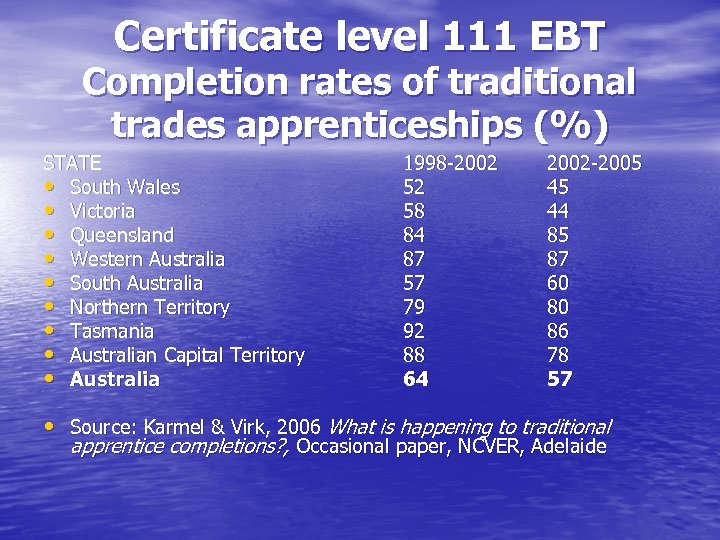
Certificate level 111 EBT Completion rates of traditional trades apprenticeships (%) STATE • South Wales • Victoria • Queensland • Western Australia • South Australia • Northern Territory • Tasmania • Australian Capital Territory • Australia 1998 -2002 52 58 84 87 57 79 92 88 64 2002 -2005 45 44 85 87 60 80 86 78 57 • Source: Karmel & Virk, 2006 What is happening to traditional apprentice completions? , Occasional paper, NCVER, Adelaide
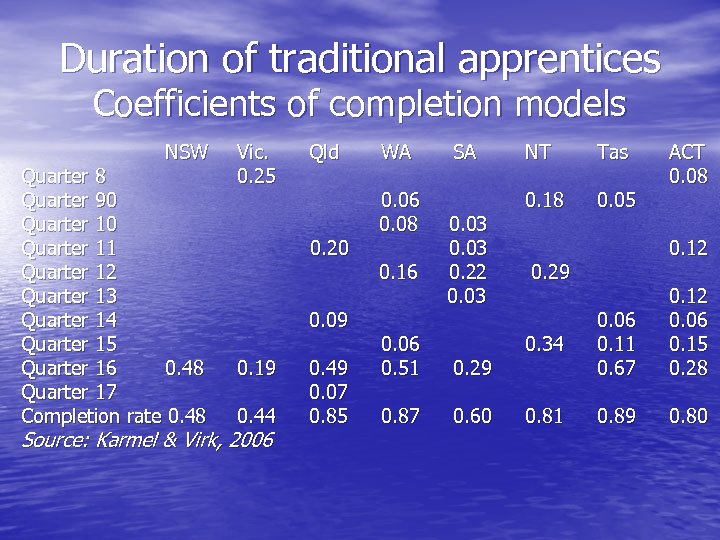
Duration of traditional apprentices Coefficients of completion models NSW Quarter 8 Quarter 90 Quarter 11 Quarter 12 Quarter 13 Quarter 14 Quarter 15 Quarter 16 0. 48 Quarter 17 Completion rate 0. 48 Vic. 0. 25 Qld 0. 20 0. 09 0. 19 0. 44 Source: Karmel & Virk, 2006 0. 49 0. 07 0. 85 WA 0. 06 0. 08 0. 16 SA 0. 03 0. 22 0. 03 0. 06 0. 51 0. 29 0. 87 0. 60 NT Tas 0. 18 0. 05 ACT 0. 08 0. 12 0. 29 0. 34 0. 06 0. 11 0. 67 0. 12 0. 06 0. 15 0. 28 0. 81 0. 89 0. 80
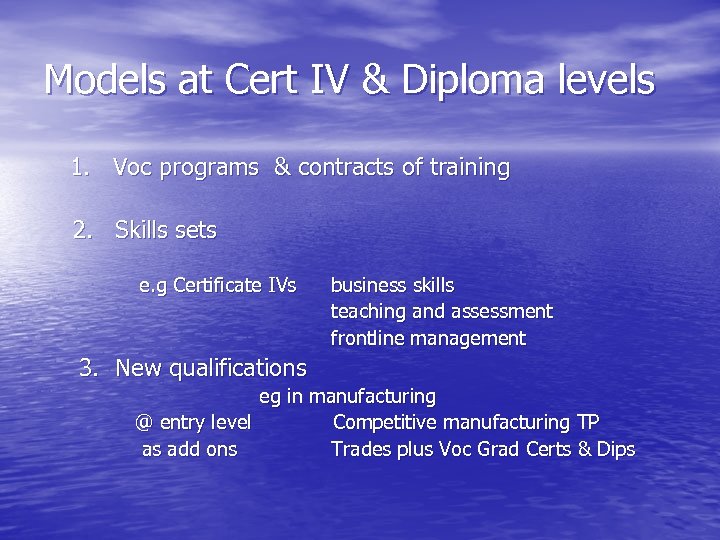
Models at Cert IV & Diploma levels 1. Voc programs & contracts of training 2. Skills sets e. g Certificate IVs business skills teaching and assessment frontline management 3. New qualifications eg in manufacturing @ entry level Competitive manufacturing TP as add ons Trades plus Voc Grad Certs & Dips
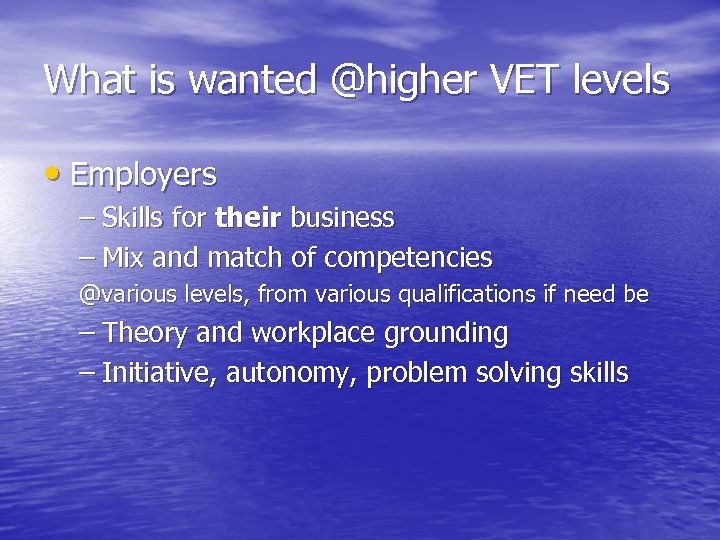
What is wanted @higher VET levels • Employers – Skills for their business – Mix and match of competencies @various levels, from various qualifications if need be – Theory and workplace grounding – Initiative, autonomy, problem solving skills

What is wanted @higher VET levels • Employees – Across the industry perspectives – Theory and practical components – To be self-directed learners/manage their learning
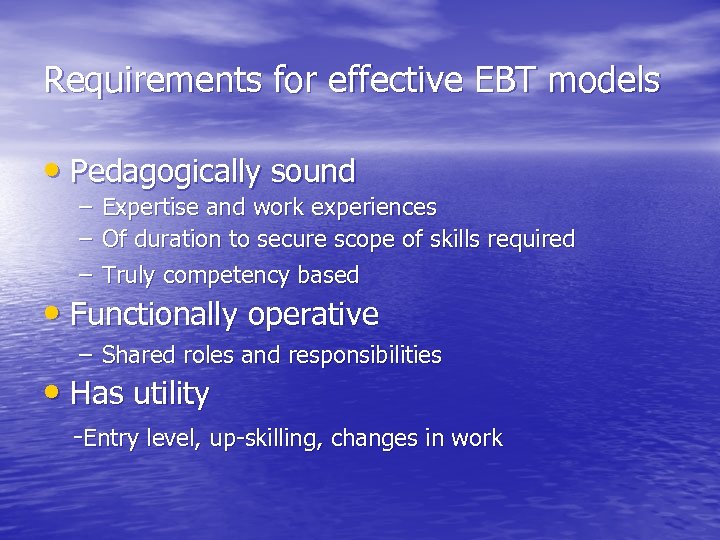
Requirements for effective EBT models • Pedagogically sound – – – Expertise and work experiences Of duration to secure scope of skills required Truly competency based • Functionally operative – Shared roles and responsibilities • Has utility -Entry level, up-skilling, changes in work
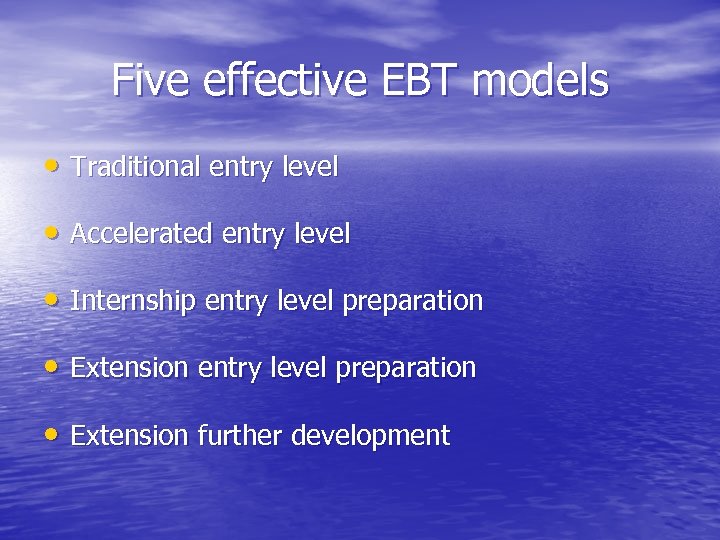
Five effective EBT models • Traditional entry level • Accelerated entry level • Internship entry level preparation • Extension further development
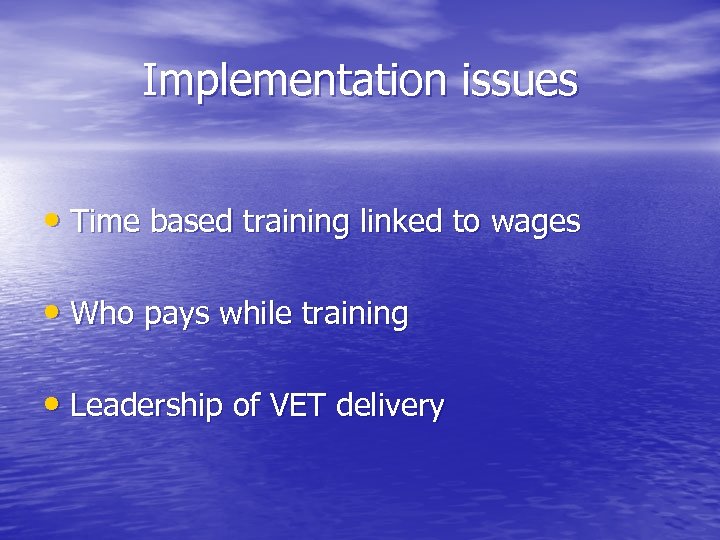
Implementation issues • Time based training linked to wages • Who pays while training • Leadership of VET delivery
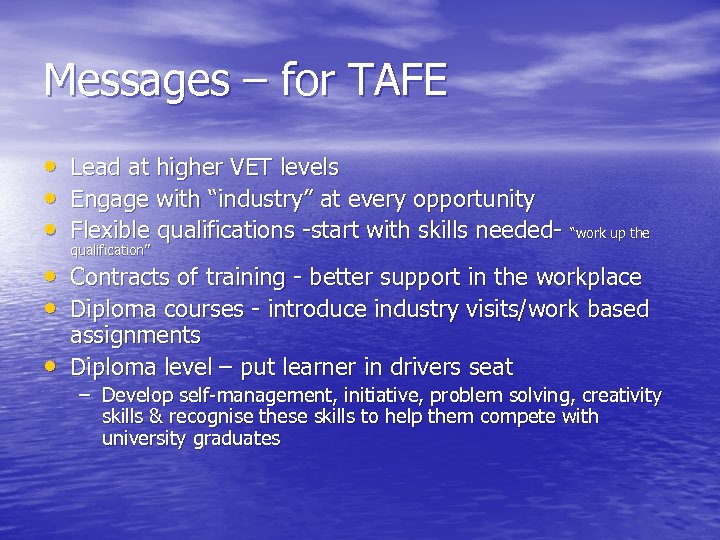
Messages – for TAFE • • • Lead at higher VET levels Engage with “industry” at every opportunity Flexible qualifications -start with skills needed- “work up the qualification” • Contracts of training - better support in the workplace • Diploma courses - introduce industry visits/work based • assignments Diploma level – put learner in drivers seat – Develop self-management, initiative, problem solving, creativity skills & recognise these skills to help them compete with university graduates

Additional Messages – NSW TAFE • Trades completion rates are low compared to other parts of Australia • Trades, times to complete, are high compared to other parts of Australia (Karmel & Virk, 2006, What is happening to traditional apprentice completions? Occasional paper, NCVER
Скачать презентацию Effective employment based training models Presenter Kaye Bowman
f6fcbd38abe767671b9f5c2d44c7253c.ppt