 Скачать презентацию Effective Collaboration Utilizing Partnerships Lessons from the Turning
66815a2c98740a70385aa958b4471462.ppt
- Количество слайдов: 39



Effective Collaboration Utilizing Partnerships: Lessons from the Turning Point Initiative Bobbie Berkowitz, Ph. D, RN, FAAN Professor and Department Chair University of Washington Turning Point
Do Collaborative Partnerships Make a Difference? An Oklahoma Story or Two Turning Point
Challenges to Public Health Infrastructure Ø Ø Limitations in public health information technology Need performance measures for the public health system Need to develop strategic public health leaders Limited integration across healthcare and public health Health status ratings of the US Ø The US ranks 25 th in the health status compared to other countries; trailing most European countries Ø Despite healthcare spending and advances, the US moved from 13 th in 1960 to 25 th in 2000 Ø Need for stable and predictable public health funding Turning Point
National Perspectives on Public Health Institute of Medicine 2002 Recommendations Ø State public health law reform Ø Support public health worker competency Ø Prioritize leadership training with government public health agencies and academic institutions Ø Broad-based national dialogue to explore perspectives on workforce credentialing Ø Regularly assess the state of the nation’s public health system and its capacity Turning Point
Turning Point: A Framework for Change Ø Improve and transform public health infrastructure through collaborative models Ø Build relationships and create an environment for public health improvement Ø Improve public health accountability Ø Improve population health outcomes Ø Impact health policy Ø Increase public health technology effectiveness Ø Build the public health research base Ø Enhance the public health workforce and leadership Turning Point
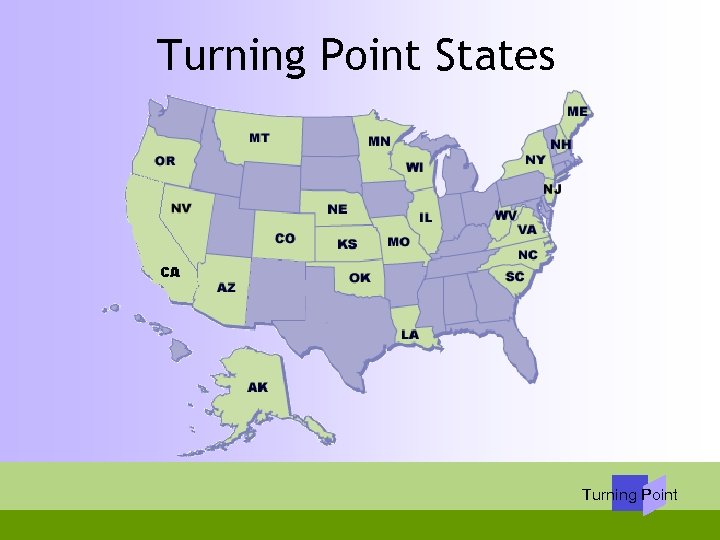
Turning Point States Turning Point
A Little Background on Collaboration Turning Point
Collaboration A method used by members of communities when developing coalitions, by organizations when doing strategic planning, and by researchers who desire the partnership of those being studied. Berkowitz, B. 2000 Journal of Public Health Management and Practice Turning Point
Key Factors Creating Success Ø Clear Vision/Mission Ø Action Planning Ø Leadership Ø Resources for Mobilizing Ø Documentation and Feedback on Intermediate Outcomes Ø Technical Assistance Ø Making Outcome Matter (incentives) Fawcett, S et al. 1999 Public Health Reports Turning Point
Expectations Ø Realistic Ø Info exchange Ø Common goal Ø Promote collaboration Ø Legitimize issue Ø Unrealistic Ø Program implementation Ø Influence organizational or systems change in a community Ø Influence health outcomes Ø Realistic with Reservations Ø Program planning Ø Influence policy Ø Influence resource allocation Kreuter et al. 2000. Health Promotion Practice Turning Point
Example of National Level Collaboration Turning Point
Turning Point National Excellence Collaboratives Ø Initiated in 2000 Ø Infrastructure themes common to many states Ø Five National Excellence Collaboratives Ø States, National partners, invited experts, and others Turning Point
National Excellence Collaboratives Ø Performance Management Ø Information Technology Ø Leadership Development Ø Public Health Statute Modernization Ø Social Marketing to Improve Population Health Outcomes Turning Point
New Tools & Products Ø A suite of products designed to increase effectiveness, improve the quality of practice, and advance national priorities. Ø CDCynergy-SOC Ø Model public health law Ø Performance management model Ø Collaborative leadership curriculum Ø Information technology gateway Turning Point
A Little Background on Partnerships Ø Mostly community level and health promotion Ø Major reviews: Ø Kreuter, Lezin, & Young (2000) Ø Roussos & Fawcett (2000) Ø Foster-Fishman et al (2001) Ø Israel, Schulz, et al (1998) Ø Lasker & Weiss (2003), Lasker (1998) Turning Point

State Level Partnerships Ø What themes and key elements are associated with state-level partnerships? Ø How do these compare with partnerships in the literature? Turning Point
Structure & Process Ø Hard work, long time Ø Formal structure & decision-making Ø Interpersonal relationships & material support Ø Choosing projects wisely Ø Local context and variability Turning Point
Working in & across Existing Systems Ø Categorical funding – “silos” Ø Relationships between state and local agencies Ø Proximity to power & political ‘transitions’ Turning Point
Leveraging Change Ø Importance of high-level support Ø Collaborative leadership Turning Point
Sustaining Collaborative Partnerships What are the strategies in use by Turning Point partnerships to sustain their innovations for change? Turning Point
Sustainability Ø Sustaining programs & systems Ø Transitions from grants to more “permanent” funding Ø Finding replacement or successor grants Ø Sustaining principles and values Ø Incorporation into continuing programs & policies Turning Point
Integration within Government Ø Institutionalizing specific initiatives Ø Linking with other programs Ø Diffusion and incorporation Turning Point
Outside Government: Alternative Structures Ø Setting up new structures (e. g. 501 c 3 agencies), or linking with pre-existing ones Ø Collaboration, not competition, with state agencies Turning Point
How Does Sustainability Happen? ØIntentional relationships ØCommunication & visibility ØContext-driven decisions Turning Point
The Impact of Collaborative Partnerships: Some Examples Turning Point
Turning Point Partnerships Impact Public Health Ø Working to eliminate health disparities Ø Colorado creates a Minority Health Surveillance System, an Office of Minority Health, and increases grants received by community-based organizations with health disparities programs Ø Oklahoma coordinates a legislative taskforce to eliminate health disparities Ø Minnesota supports development of an “Unequal Treatment” report, participates in the creation of the Minnesota’s Health Disparities Initiative, and brings health care system executives together to help resolve health disparities. Turning Point
More Impacts Ø Promoting a collaborative model and resources for community-based programs Ø Louisiana enhances the capacity of local public health programs by providing technical assistance, modest funding, facilitation, and training. Ø North Carolina’s Healthy Carolinians links community assessment, the 2010 Health Objectives, and community level health improvement efforts for 90% of the state. Turning Point
More Impacts Ø Building infrastructure in public health Ø Nebraska covers the state with local health departments Ø South Carolina serves as a catalyst for community engagement planning using MAPP and institutes a performance management system based on Silos to Systems performance management tool and creates benchmarks for improved public health performance Ø Oklahoma creates community-based Turning Point coalitions Turning Point
More Impacts Ø Promoting innovative use of resources ØNew Hampshire establishes the Public Health Network to leverage people, training, knowledge, and resources to ensure a public health system accessible to 60% of the state’s population ØOklahoma finds ways to use categorical state and local funds (WIC, tobacco, immunization) to support needed infrastructure improvements Turning Point
More Impacts Ø Louisiana creates the National Network of Public Health Institutes bringing non-governmental public health entities together to respond to the challenges facing public health Ø Virginia pioneers engaging the business community in health issues through business roundtables and meetings with chambers of commerce, designs workplace-based health intervention programs together with business community, and creates an online health data atlas to promote informed decision making. Turning Point
More Impacts Ø Developing a stronger public health workforce Ø New York leverages resources to acquire funds for workforce development and training, develops a nationally broadcast, monthly satellite training series “Third Thursday Breakfast Broadcast” (T 2 B 2), and develops an online nursing curriculum Ø Minnesota establishes the Emerging Leaders Network to develop future public health leaders and provide support training, and networking opportunities. Ø Illinois receives legislative approval for the State Health Improvement Plan Act Turning Point

Lessons to Carry Forward Turning Point
Partnerships are Essential Ø Expansion of partnership model to state level systems change has been critical to success Ø Challenge in creating new systems and new relationships Ø Selecting goals that are big enough to matter but not so big the partnership loses interest Ø Require high level support Turning Point
Strategies for Sustainability Ø Within government: institutionalization of system changes Ø Outside government: new or pre-existing structures Ø Changes spun off and sustained by other organizations and systems Turning Point
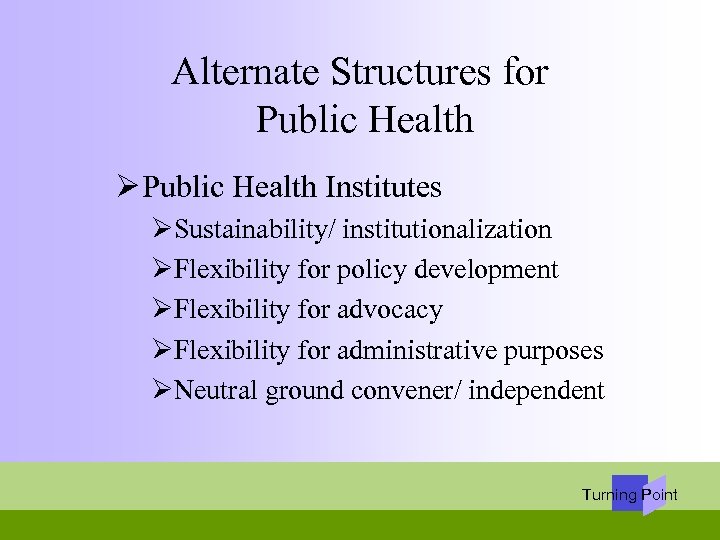
Alternate Structures for Public Health Ø Public Health Institutes ØSustainability/ institutionalization ØFlexibility for policy development ØFlexibility for advocacy ØFlexibility for administrative purposes ØNeutral ground convener/ independent Turning Point
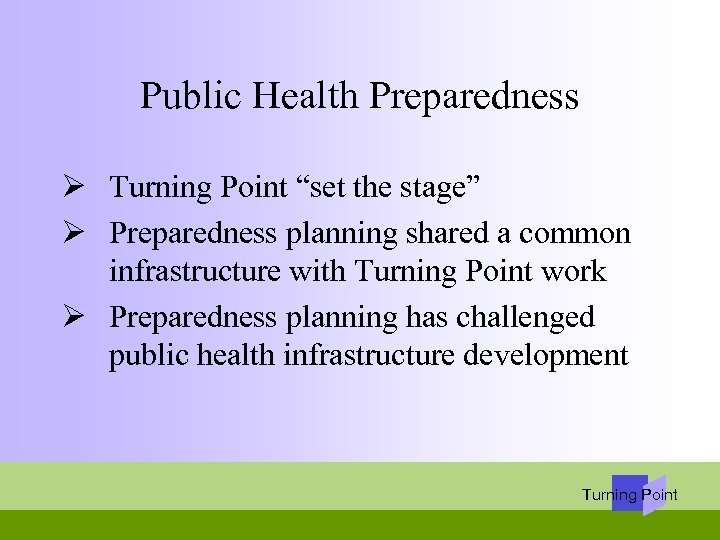
Public Health Preparedness Ø Turning Point “set the stage” Ø Preparedness planning shared a common infrastructure with Turning Point work Ø Preparedness planning has challenged public health infrastructure development Turning Point

Questions? Comments? Turning Point
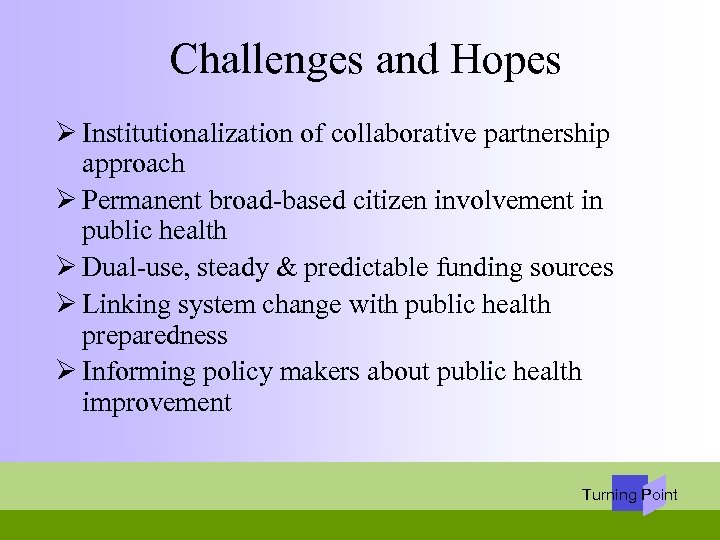
Challenges and Hopes Ø Institutionalization of collaborative partnership approach Ø Permanent broad-based citizen involvement in public health Ø Dual-use, steady & predictable funding sources Ø Linking system change with public health preparedness Ø Informing policy makers about public health improvement Turning Point
• http: //www. turningpointprogram. org/ Turning Point
Скачать презентацию Effective Collaboration Utilizing Partnerships Lessons from the Turning
66815a2c98740a70385aa958b4471462.ppt