 Скачать презентацию Effect of Support Distribution l Many real data
ea14709fb17e3335c6ade6f8164cfa80.ppt
- Количество слайдов: 37



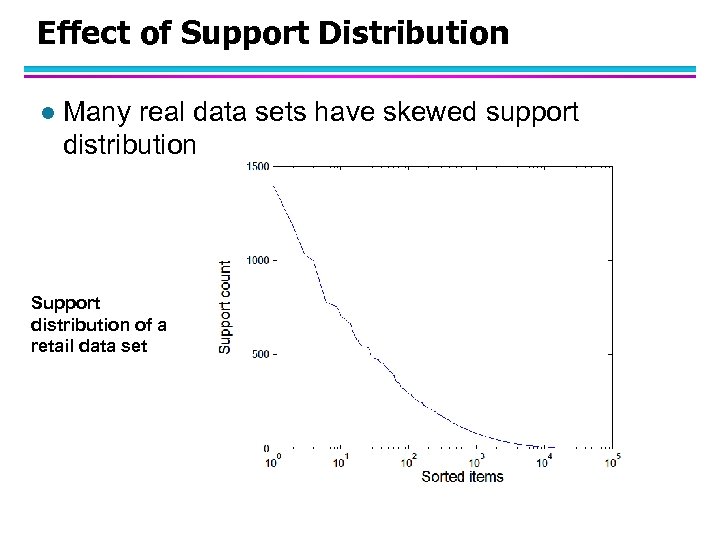
Effect of Support Distribution l Many real data sets have skewed support distribution Support distribution of a retail data set
Effect of Support Distribution l How to set the appropriate minsup threshold? – If minsup is set too high, we could miss itemsets involving interesting rare items (e. g. , expensive products) – If minsup is set too low, it is computationally expensive and the number of itemsets is very large l Using a single minimum support threshold may not be effective
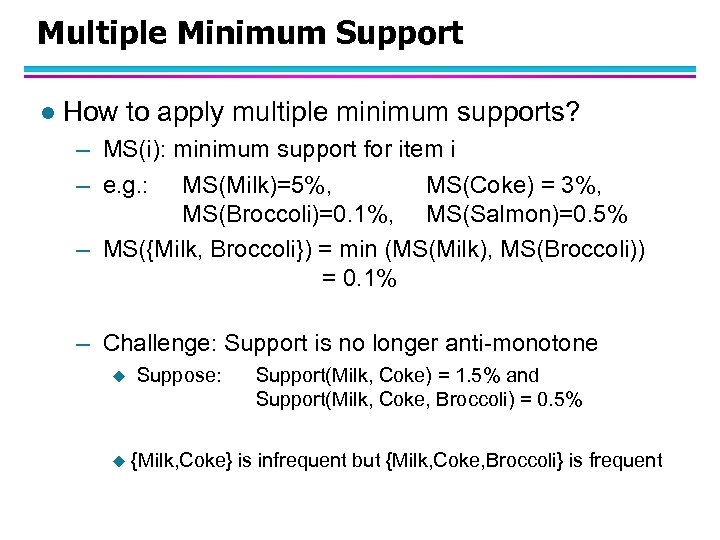
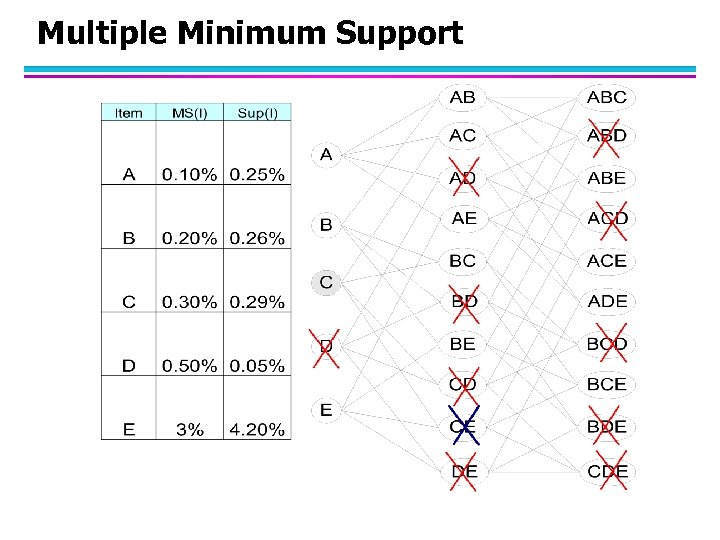
Multiple Minimum Support l How to apply multiple minimum supports? – MS(i): minimum support for item i – e. g. : MS(Milk)=5%, MS(Coke) = 3%, MS(Broccoli)=0. 1%, MS(Salmon)=0. 5% – MS({Milk, Broccoli}) = min (MS(Milk), MS(Broccoli)) = 0. 1% – Challenge: Support is no longer anti-monotone u u Suppose: Support(Milk, Coke) = 1. 5% and Support(Milk, Coke, Broccoli) = 0. 5% {Milk, Coke} is infrequent but {Milk, Coke, Broccoli} is frequent
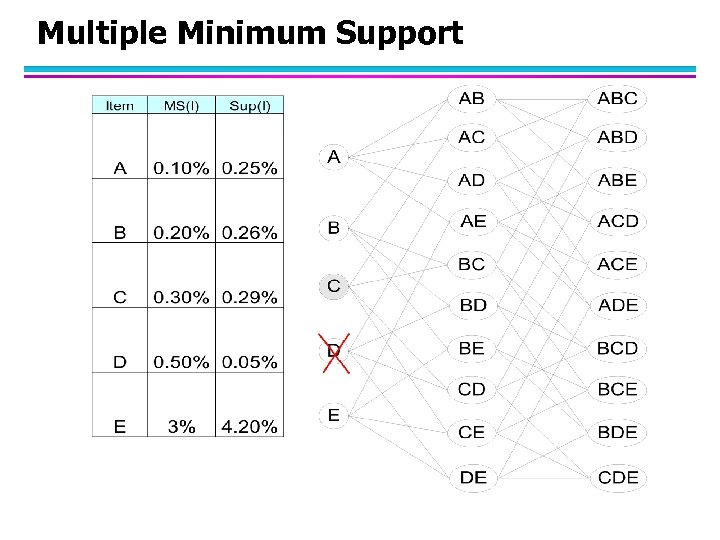
Multiple Minimum Support
Multiple Minimum Support
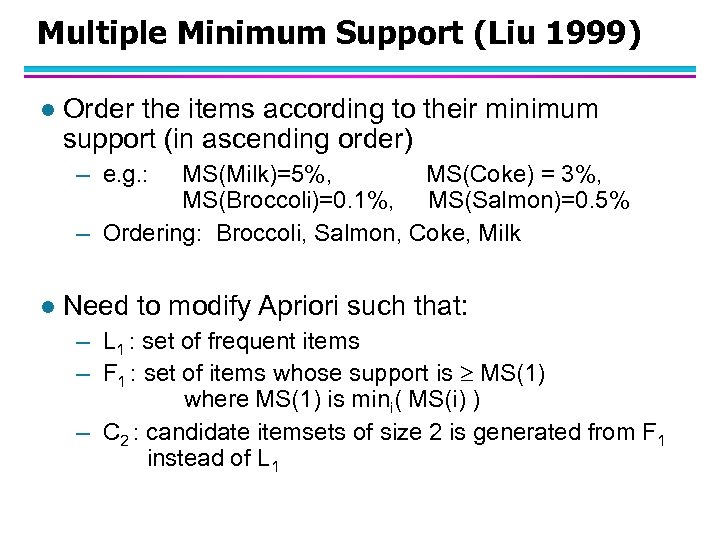
Multiple Minimum Support (Liu 1999) l Order the items according to their minimum support (in ascending order) – e. g. : MS(Milk)=5%, MS(Coke) = 3%, MS(Broccoli)=0. 1%, MS(Salmon)=0. 5% – Ordering: Broccoli, Salmon, Coke, Milk l Need to modify Apriori such that: – L 1 : set of frequent items – F 1 : set of items whose support is MS(1) where MS(1) is mini( MS(i) ) – C 2 : candidate itemsets of size 2 is generated from F 1 instead of L 1
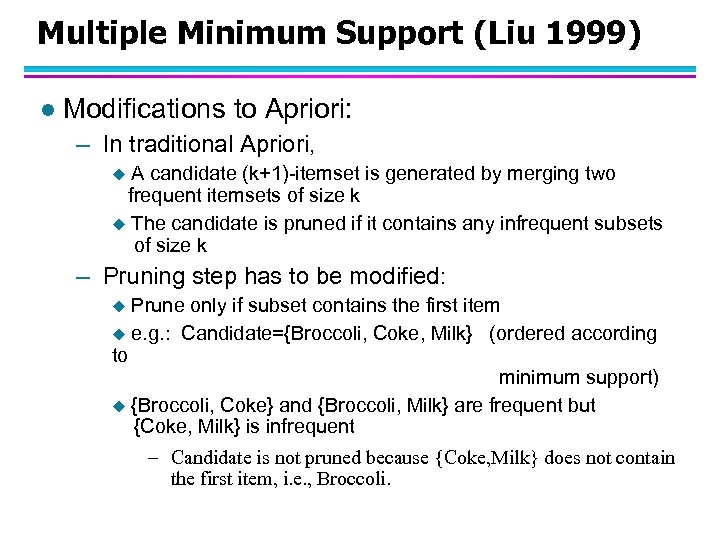
Multiple Minimum Support (Liu 1999) l Modifications to Apriori: – In traditional Apriori, A candidate (k+1)-itemset is generated by merging two frequent itemsets of size k u The candidate is pruned if it contains any infrequent subsets of size k u – Pruning step has to be modified: Prune only if subset contains the first item u e. g. : Candidate={Broccoli, Coke, Milk} (ordered according to minimum support) u {Broccoli, Coke} and {Broccoli, Milk} are frequent but {Coke, Milk} is infrequent u – Candidate is not pruned because {Coke, Milk} does not contain the first item, i. e. , Broccoli.
Mining Various Kinds of Association Rules l Mining multilevel association l Miming multidimensional association l Mining quantitative association l Mining interesting correlation patterns
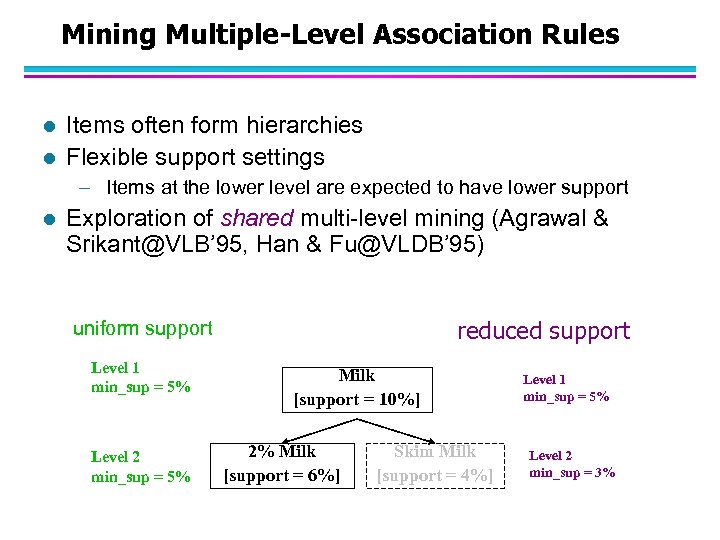
Mining Multiple-Level Association Rules l l Items often form hierarchies Flexible support settings – Items at the lower level are expected to have lower support l Exploration of shared multi-level mining (Agrawal & Srikant@VLB’ 95, Han & Fu@VLDB’ 95) reduced support uniform support Level 1 min_sup = 5% Level 2 min_sup = 5% Milk [support = 10%] 2% Milk [support = 6%] Skim Milk [support = 4%] Level 1 min_sup = 5% Level 2 min_sup = 3%
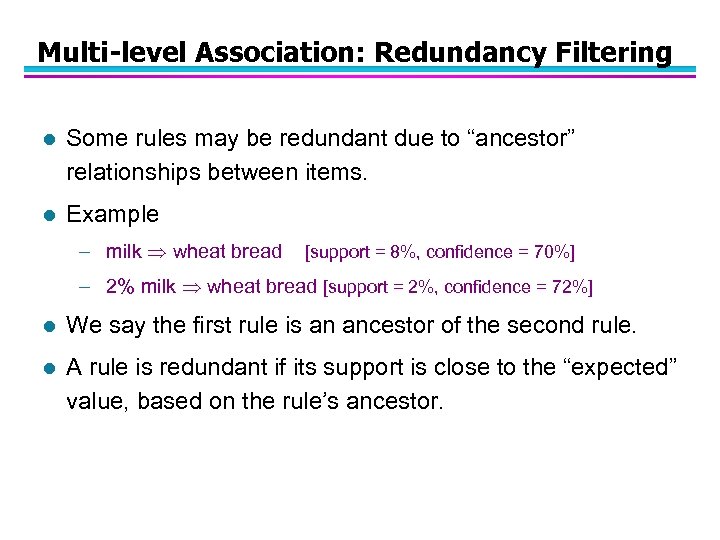
Multi-level Association: Redundancy Filtering l Some rules may be redundant due to “ancestor” relationships between items. l Example – milk wheat bread [support = 8%, confidence = 70%] – 2% milk wheat bread [support = 2%, confidence = 72%] l We say the first rule is an ancestor of the second rule. l A rule is redundant if its support is close to the “expected” value, based on the rule’s ancestor.
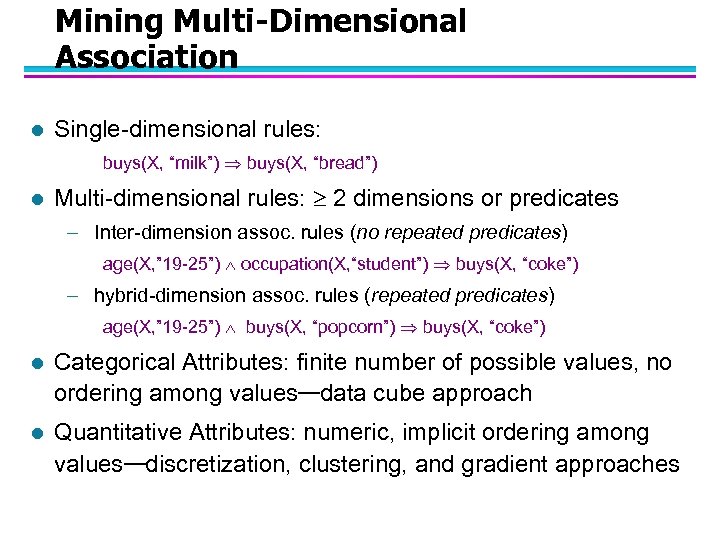
Mining Multi-Dimensional Association l Single-dimensional rules: buys(X, “milk”) buys(X, “bread”) l Multi-dimensional rules: 2 dimensions or predicates – Inter-dimension assoc. rules (no repeated predicates) age(X, ” 19 -25”) occupation(X, “student”) buys(X, “coke”) – hybrid-dimension assoc. rules (repeated predicates) age(X, ” 19 -25”) buys(X, “popcorn”) buys(X, “coke”) l Categorical Attributes: finite number of possible values, no ordering among values—data cube approach l Quantitative Attributes: numeric, implicit ordering among values—discretization, clustering, and gradient approaches
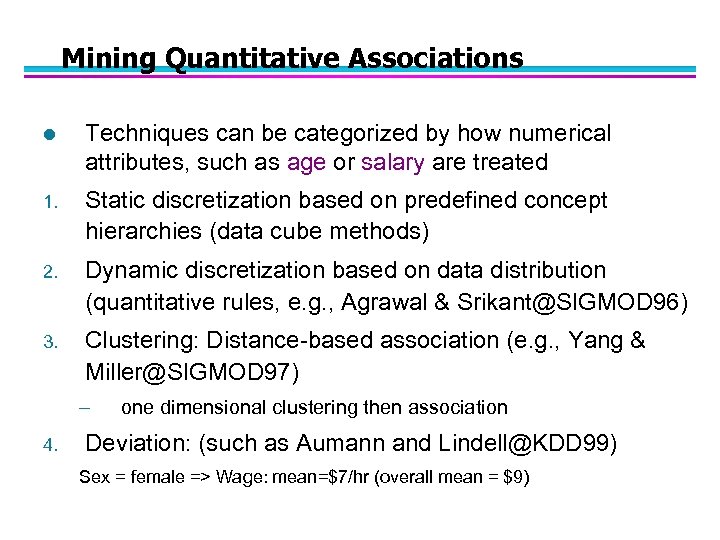
Mining Quantitative Associations l Techniques can be categorized by how numerical attributes, such as age or salary are treated 1. Static discretization based on predefined concept hierarchies (data cube methods) 2. Dynamic discretization based on data distribution (quantitative rules, e. g. , Agrawal & Srikant@SIGMOD 96) 3. Clustering: Distance-based association (e. g. , Yang & Miller@SIGMOD 97) – 4. one dimensional clustering then association Deviation: (such as Aumann and Lindell@KDD 99) Sex = female => Wage: mean=$7/hr (overall mean = $9)
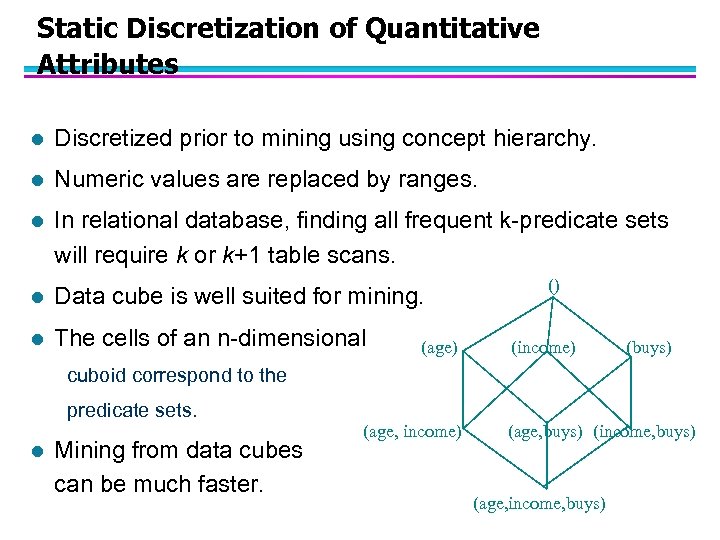
Static Discretization of Quantitative Attributes l Discretized prior to mining using concept hierarchy. l Numeric values are replaced by ranges. l In relational database, finding all frequent k-predicate sets will require k or k+1 table scans. l Data cube is well suited for mining. l The cells of an n-dimensional (age) () (income) (buys) cuboid correspond to the predicate sets. l Mining from data cubes can be much faster. (age, income) (age, buys) (income, buys) (age, income, buys)
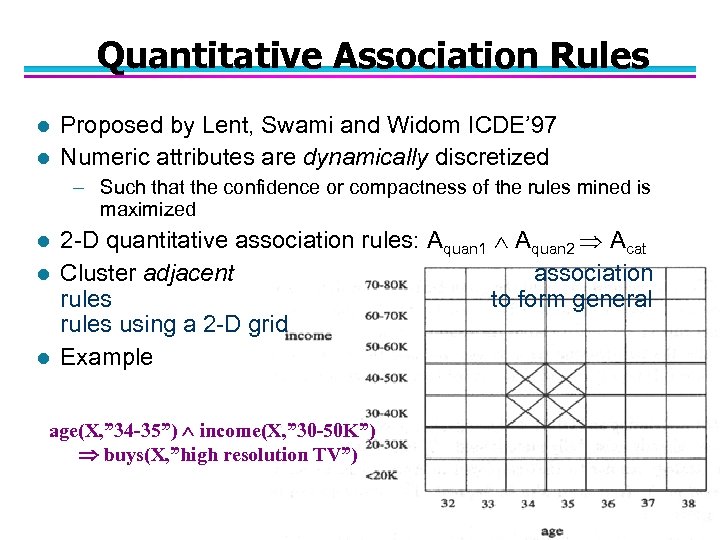
Quantitative Association Rules l l Proposed by Lent, Swami and Widom ICDE’ 97 Numeric attributes are dynamically discretized – Such that the confidence or compactness of the rules mined is maximized l l l 2 -D quantitative association rules: Aquan 1 Aquan 2 Acat Cluster adjacent association rules to form general rules using a 2 -D grid Example age(X, ” 34 -35”) income(X, ” 30 -50 K”) buys(X, ”high resolution TV”)
Mining Other Interesting Patterns l Flexible support constraints (Wang et al. @ VLDB’ 02) – Some items (e. g. , diamond) may occur rarely but are valuable – Customized supmin specification and application l Top-K closed frequent patterns (Han, et al. @ ICDM’ 02) – Hard to specify supmin, but top-k with lengthmin is more desirable – Dynamically raise supmin in FP-tree construction and mining, and select most promising path to mine
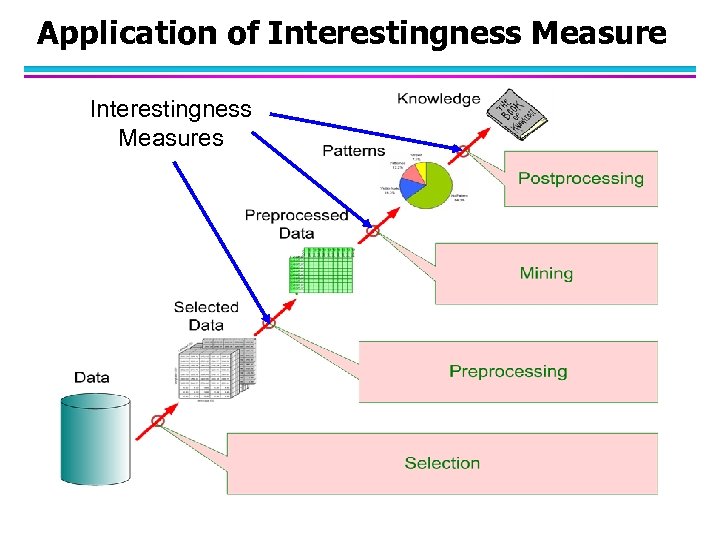
Pattern Evaluation l Association rule algorithms tend to produce too many rules – many of them are uninteresting or redundant – Redundant if {A, B, C} {D} and {A, B} {D} have same support & confidence l Interestingness measures can be used to prune/rank the derived patterns l In the original formulation of association rules, support & confidence are the only measures used
Application of Interestingness Measures
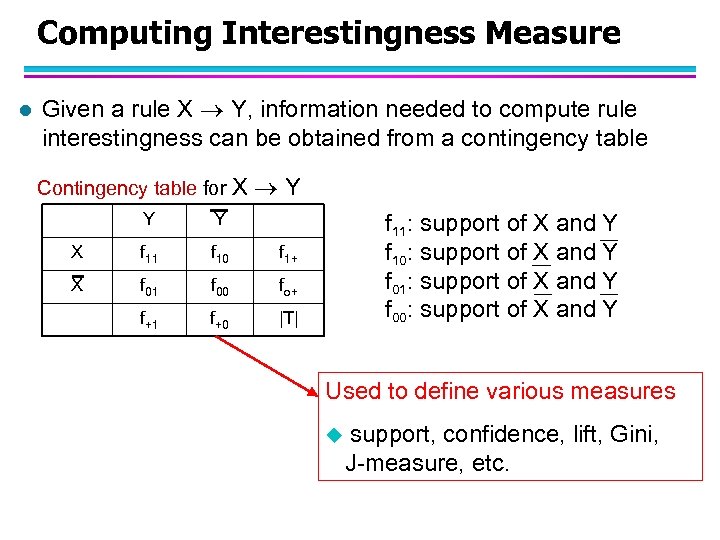
Computing Interestingness Measure l Given a rule X Y, information needed to compute rule interestingness can be obtained from a contingency table Contingency table for X Y Y Y X f 11 f 10 f 1+ X f 01 f 00 fo+ f+1 f+0 |T| f 11: support of X and Y f 10: support of X and Y f 01: support of X and Y f 00: support of X and Y Used to define various measures u support, confidence, lift, Gini, J-measure, etc.
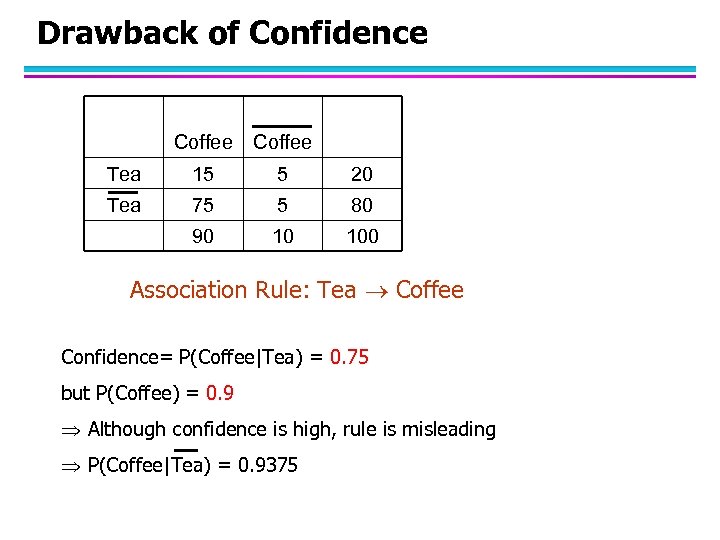
Drawback of Confidence Coffee Tea 15 5 20 Tea 75 5 80 90 10 100 Association Rule: Tea Coffee Confidence= P(Coffee|Tea) = 0. 75 but P(Coffee) = 0. 9 Although confidence is high, rule is misleading P(Coffee|Tea) = 0. 9375
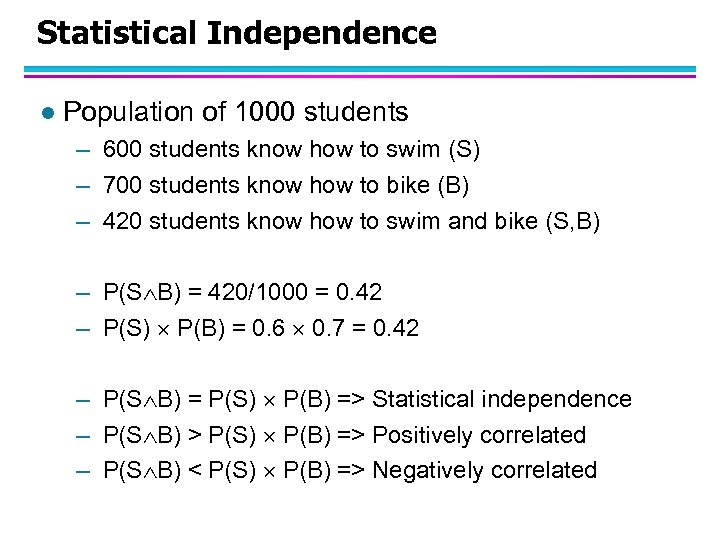
Statistical Independence l Population of 1000 students – 600 students know how to swim (S) – 700 students know how to bike (B) – 420 students know how to swim and bike (S, B) – P(S B) = 420/1000 = 0. 42 – P(S) P(B) = 0. 6 0. 7 = 0. 42 – P(S B) = P(S) P(B) => Statistical independence – P(S B) > P(S) P(B) => Positively correlated – P(S B) < P(S) P(B) => Negatively correlated
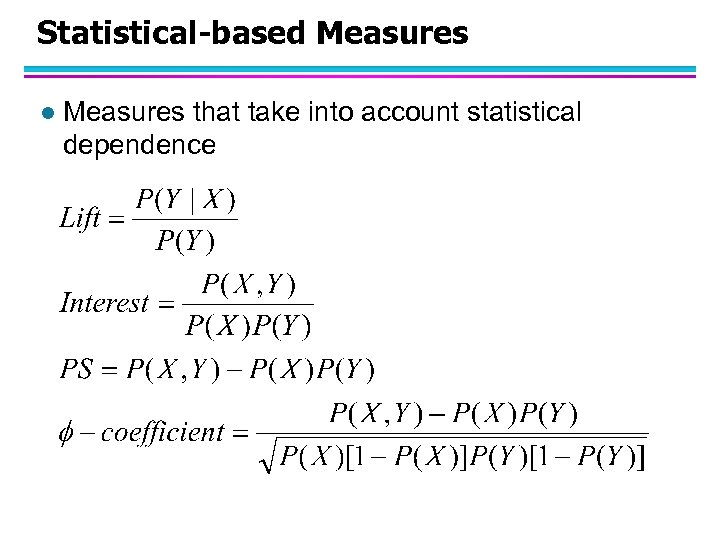
Statistical-based Measures l Measures that take into account statistical dependence
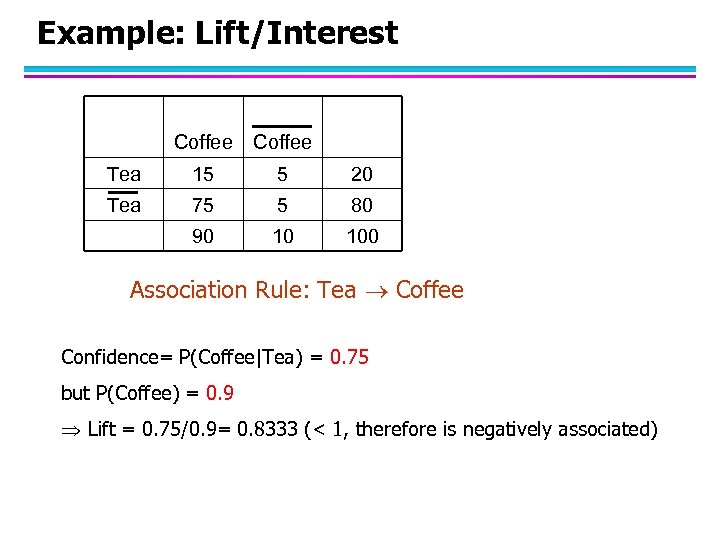
Example: Lift/Interest Coffee Tea 15 5 20 Tea 75 5 80 90 10 100 Association Rule: Tea Coffee Confidence= P(Coffee|Tea) = 0. 75 but P(Coffee) = 0. 9 Lift = 0. 75/0. 9= 0. 8333 (< 1, therefore is negatively associated)
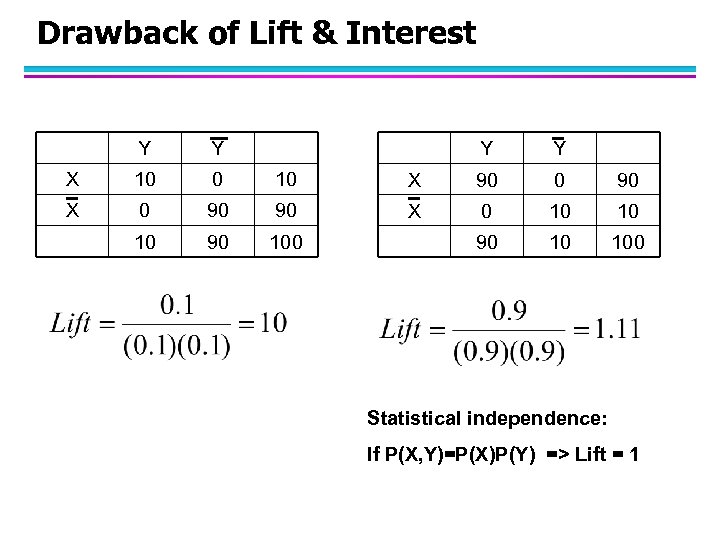
Drawback of Lift & Interest Y Y Y X 10 0 10 X 0 90 90 100 Y X 90 0 90 X 0 10 10 90 10 100 Statistical independence: If P(X, Y)=P(X)P(Y) => Lift = 1
![Interestingness Measure: Correlations (Lift) l play basketball eat cereal [40%, 66. 7%] is misleading](https://present5.com/presentation/ea14709fb17e3335c6ade6f8164cfa80/image-24.jpg "Interestingness Measure: Correlations (Lift) l play basketball eat cereal [40%, 66. 7%] is misleading")
Interestingness Measure: Correlations (Lift) l play basketball eat cereal [40%, 66. 7%] is misleading – The overall % of students eating cereal is 75% > 66. 7%. l play basketball not eat cereal [20%, 33. 3%] is more accurate, although with lower support and confidence l Measure of dependent/correlated events: lift Basketball Not basketball Sum (row) Cereal 2000 1750 3750 Not cereal 1000 250 1250 Sum(col. ) 3000 2000 5000
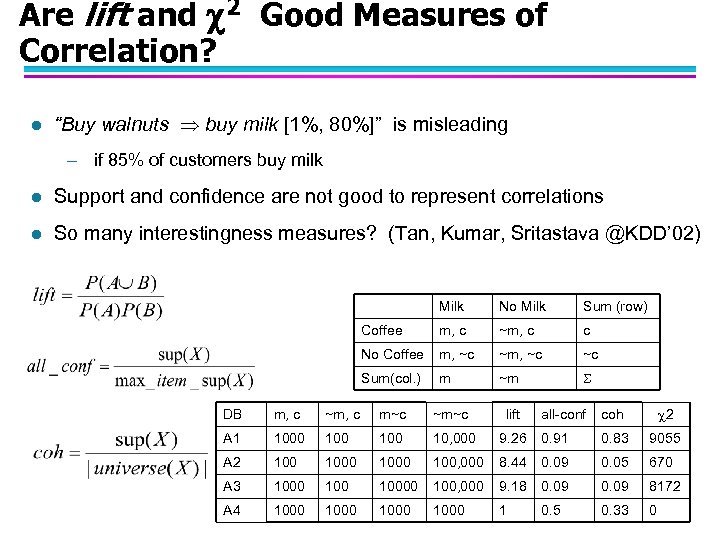
Are lift and 2 Good Measures of Correlation? l “Buy walnuts buy milk [1%, 80%]” is misleading – if 85% of customers buy milk l Support and confidence are not good to represent correlations l So many interestingness measures? (Tan, Kumar, Sritastava @KDD’ 02) Milk No Milk Sum (row) Coffee m, c ~m, c c No Coffee m, ~c ~c Sum(col. ) m ~m all-conf coh 2 9. 26 0. 91 0. 83 9055 100, 000 8. 44 0. 09 0. 05 670 10000 100, 000 9. 18 0. 09 8172 1000 1 0. 5 0. 33 0 DB m, c ~m, c m~c ~m~c lift A 1 1000 100 10, 000 A 2 1000 A 3 1000 100 A 4 1000
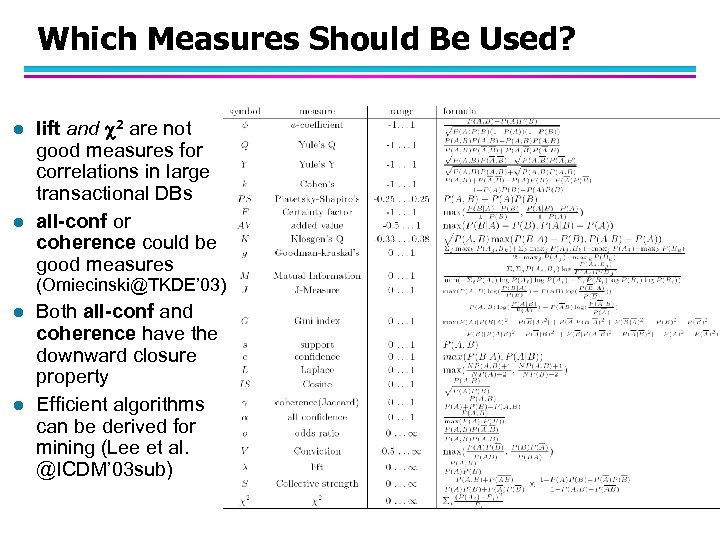
Which Measures Should Be Used? l l lift and 2 are not good measures for correlations in large transactional DBs all-conf or coherence could be good measures (Omiecinski@TKDE’ 03) l l Both all-conf and coherence have the downward closure property Efficient algorithms can be derived for mining (Lee et al. @ICDM’ 03 sub)
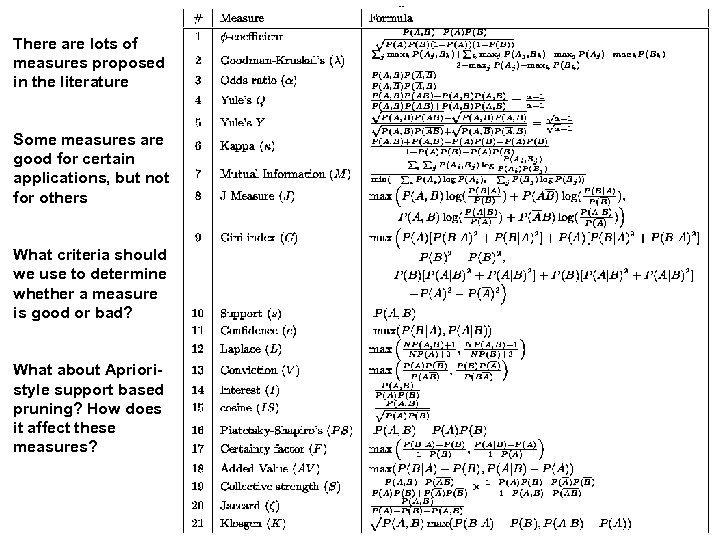
There are lots of measures proposed in the literature Some measures are good for certain applications, but not for others What criteria should we use to determine whether a measure is good or bad? What about Aprioristyle support based pruning? How does it affect these measures?
Support-based Pruning l Most of the association rule mining algorithms use support measure to prune rules and itemsets l Study effect of support pruning on correlation of itemsets – Generate 10000 random contingency tables – Compute support and pairwise correlation for each table – Apply support-based pruning and examine the tables that are removed
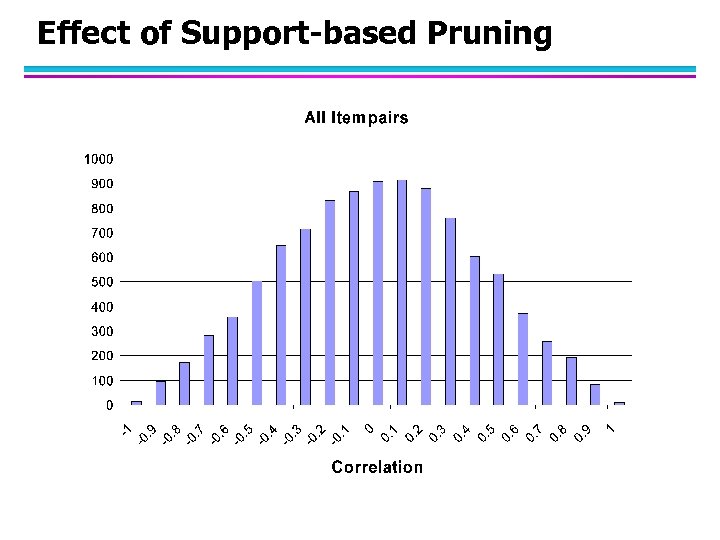
Effect of Support-based Pruning
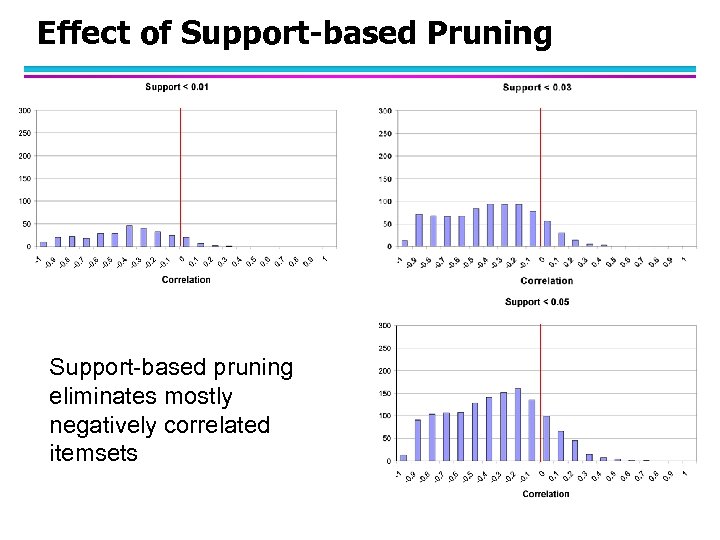
Effect of Support-based Pruning Support-based pruning eliminates mostly negatively correlated itemsets
Effect of Support-based Pruning l Investigate how support-based pruning affects other measures l Steps: – Generate 10000 contingency tables – Rank each table according to the different measures – Compute the pair-wise correlation between the measures
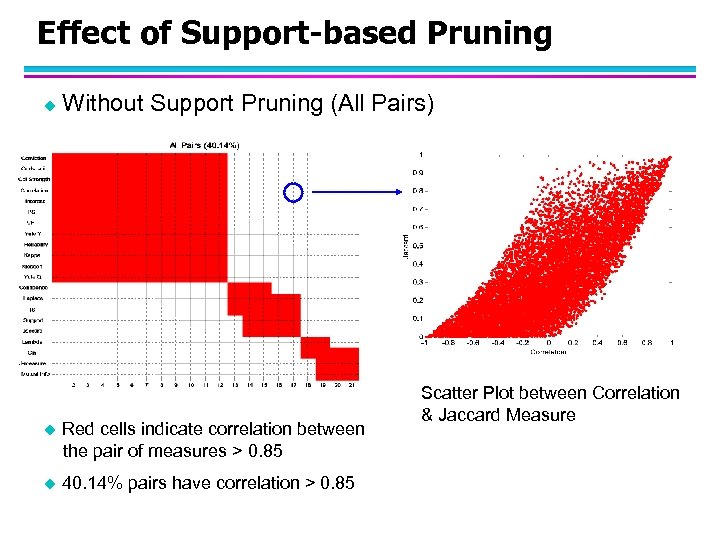
Effect of Support-based Pruning u Without Support Pruning (All Pairs) u Red cells indicate correlation between the pair of measures > 0. 85 u 40. 14% pairs have correlation > 0. 85 Scatter Plot between Correlation & Jaccard Measure
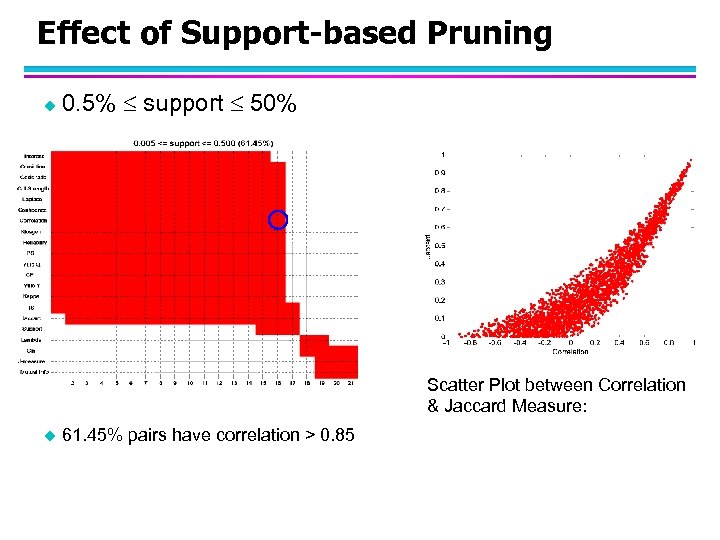
Effect of Support-based Pruning u 0. 5% support 50% Scatter Plot between Correlation & Jaccard Measure: u 61. 45% pairs have correlation > 0. 85
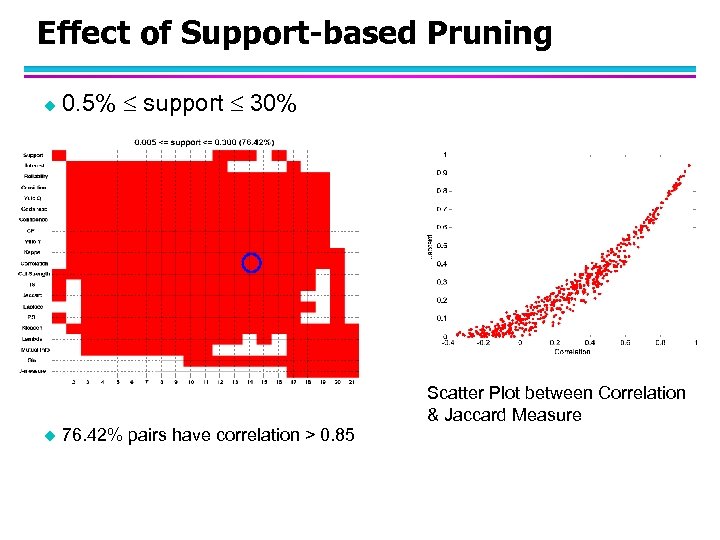
Effect of Support-based Pruning u 0. 5% support 30% Scatter Plot between Correlation & Jaccard Measure u 76. 42% pairs have correlation > 0. 85
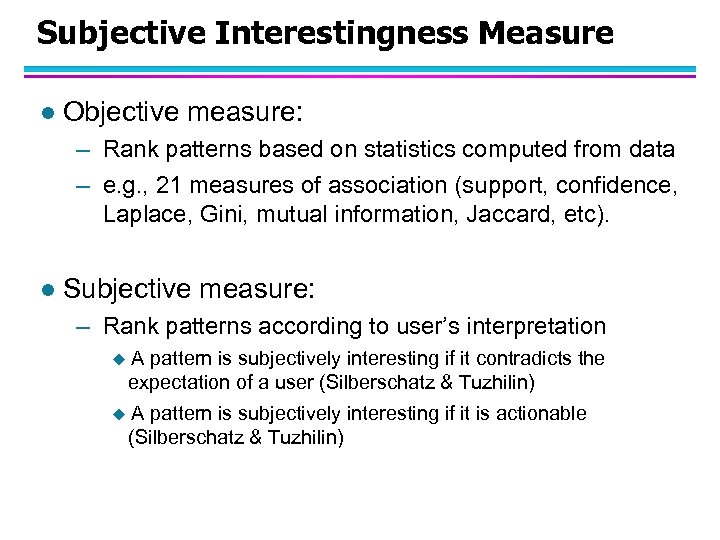
Subjective Interestingness Measure l Objective measure: – Rank patterns based on statistics computed from data – e. g. , 21 measures of association (support, confidence, Laplace, Gini, mutual information, Jaccard, etc). l Subjective measure: – Rank patterns according to user’s interpretation u A pattern is subjectively interesting if it contradicts the expectation of a user (Silberschatz & Tuzhilin) u A pattern is subjectively interesting if it is actionable (Silberschatz & Tuzhilin)
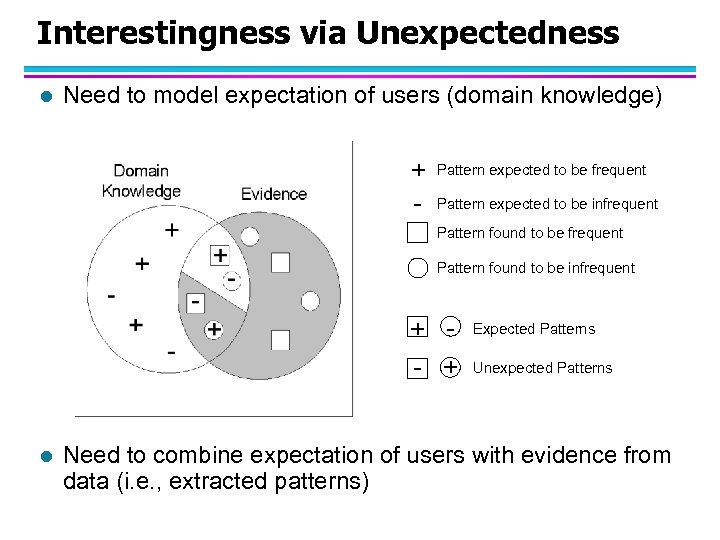
Interestingness via Unexpectedness l Need to model expectation of users (domain knowledge) + - Pattern expected to be frequent Pattern expected to be infrequent Pattern found to be infrequent + - + l Expected Patterns Unexpected Patterns Need to combine expectation of users with evidence from data (i. e. , extracted patterns)
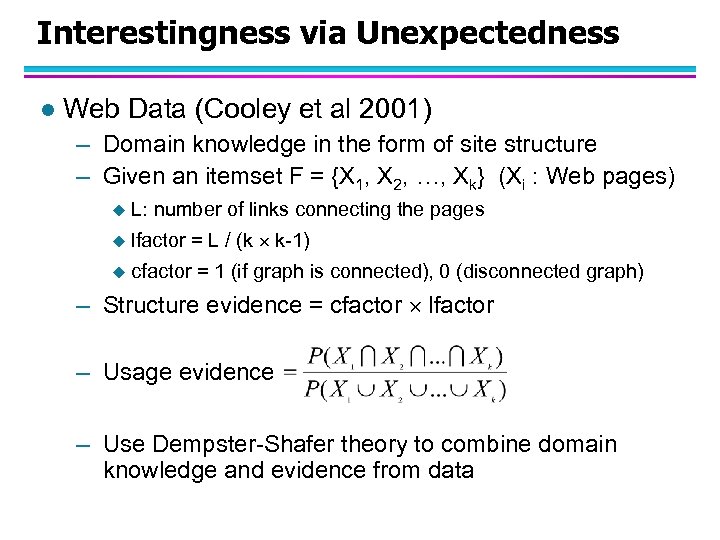
Interestingness via Unexpectedness l Web Data (Cooley et al 2001) – Domain knowledge in the form of site structure – Given an itemset F = {X 1, X 2, …, Xk} (Xi : Web pages) u L: number of links connecting the pages u lfactor = L / (k k-1) u cfactor = 1 (if graph is connected), 0 (disconnected graph) – Structure evidence = cfactor lfactor – Usage evidence – Use Dempster-Shafer theory to combine domain knowledge and evidence from data
Скачать презентацию Effect of Support Distribution l Many real data
ea14709fb17e3335c6ade6f8164cfa80.ppt