


 Скачать презентацию Effect and artifact in the perception of stress
700b8b062ef87d2cbff2950025296033.ppt
- Количество слайдов: 105
 Effect and artifact in the perception of stress; a cross-linguistic view Vincent J. van Heuven 30 April 2008 Stress UAB
 Introduction, terminology 30 April 2008 Stress UAB
 Introduction: terms w Stress n n n Abstract linguistic property of a word Position of strongest syllable in word Only one head: culminative property w Accent n Phonetic realisation of a stressed syllable 30 April 2008 Stress UAB 3
 Introduction: terms w Typically, inventory of stressed syllables is larger than that of unstressed syllables w Identity of word is mainly determined by make-up of stressed syllable w Listeners pay more attention when they expect a stress w Word recognition waits for stressed syll. 30 April 2008 Stress UAB 4
 Introduction: terms w Stress is realised by n n n More careful (‘clear’, ‘hyper’) articulation More expanded vowel space Longer duration More intensity (decibels) Flatter spectral tilt (faster adduction) Resistance to assimilation and coarticulation 30 April 2008 Stress UAB 5
 Introduction: terms w When word is important in sentence n n Stress is additionally signalled by conspicuous pitch movement Movement is associated (‘aligned’) with the stressed syllable w Sentence stress n n is sometimes called ‘pitch accent’ [not to be confused with Tokyo Japanese] 30 April 2008 Stress UAB 6
 Production ~ Perception w Perception n Sentence stress is more prominent than just word stress l n But is not always present l n A well-aligned pitch movement is always heard as a stress: strongest cue by far Absent when word has no sentence stress Therefore: pitch is strong but inconsistent cue 30 April 2008 Stress UAB 7
 Production ~ Perception w Production n n Most consistent cue is relative duration of rhyme portion in syllable Ratio between stressed and unstressed version of rhyme (in paradigmatic comparison) is the same, whether pitch movement is present or not 30 April 2008 Stress UAB 8
 Aside w Paradigmatic ~ syntagmatic comparison n n (the) IMport ~ (to) im. PORT Do not compare first syll with second syll You will find that unstressed port is longer and louder (d. B) than stressed IM Compare stressed IM with unstressed im, and stressed PORT with unstressed port 30 April 2008 Stress UAB 9
 Functional load hypothesis 30 April 2008 Stress UAB
 Functional load hypothesis w Classical order of importance of stress cues (Fry 1955, 1958, 1965) n n Pitch (movement) Duration Intensity Spectral expansion w Based mainly on English stress 30 April 2008 Stress UAB 11
 Functional load hypothesis w Berinstein (1979) n n n You can spend your money only once If language uses a parameter for segmental contrast, it cannot use the same parameter as a stress cue E. g. , if a language has long ~ short vowels, duration is no longer an effective stress cue 30 April 2008 Stress UAB 12
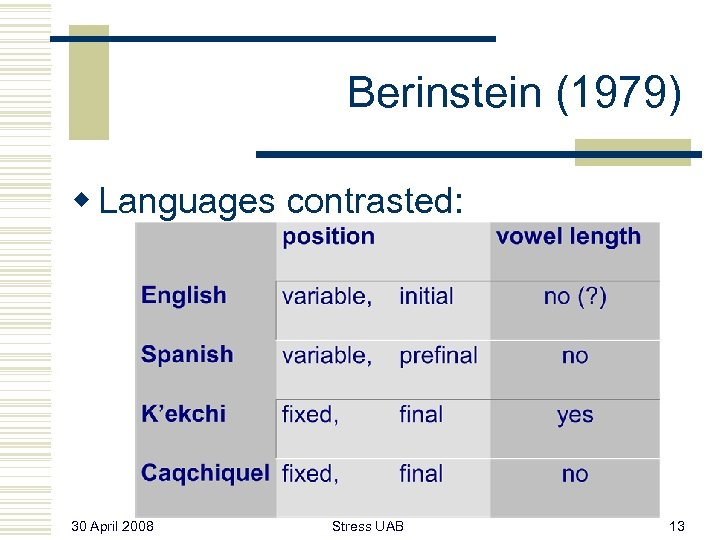 Berinstein (1979) w Languages contrasted: 30 April 2008 Stress UAB 13
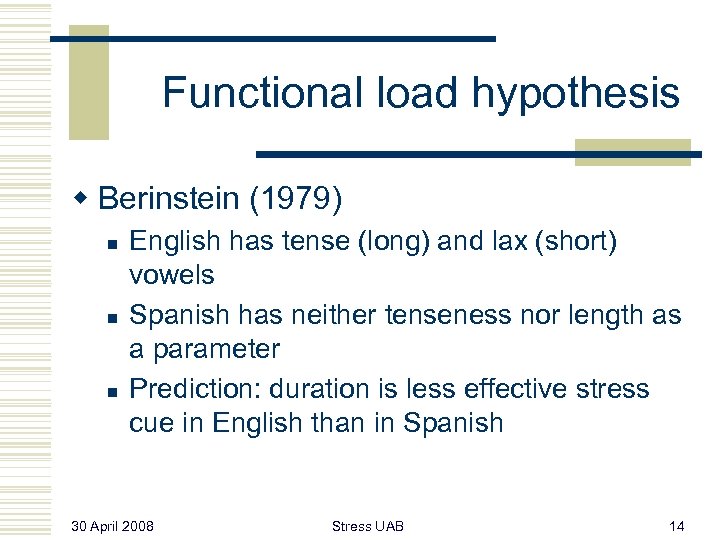 Functional load hypothesis w Berinstein (1979) n n n English has tense (long) and lax (short) vowels Spanish has neither tenseness nor length as a parameter Prediction: duration is less effective stress cue in English than in Spanish 30 April 2008 Stress UAB 14
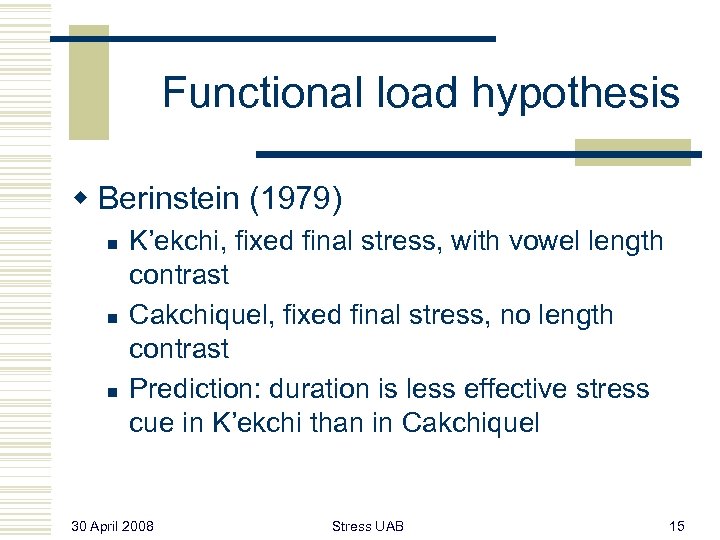 Functional load hypothesis w Berinstein (1979) n n n K’ekchi, fixed final stress, with vowel length contrast Cakchiquel, fixed final stress, no length contrast Prediction: duration is less effective stress cue in K’ekchi than in Cakchiquel 30 April 2008 Stress UAB 15
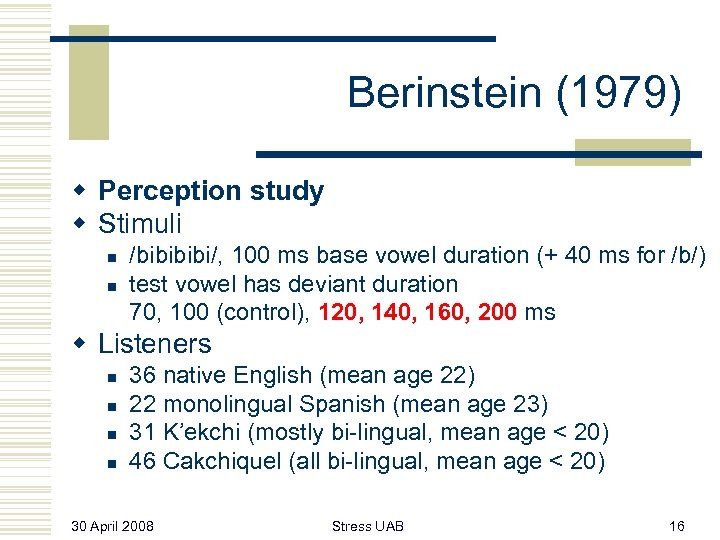 Berinstein (1979) w Perception study w Stimuli n n /bibi/, 100 ms base vowel duration (+ 40 ms for /b/) test vowel has deviant duration 70, 100 (control), 120, 140, 160, 200 ms w Listeners n n 36 native English (mean age 22) 22 monolingual Spanish (mean age 23) 31 K’ekchi (mostly bi-lingual, mean age < 20) 46 Cakchiquel (all bi-lingual, mean age < 20) 30 April 2008 Stress UAB 16
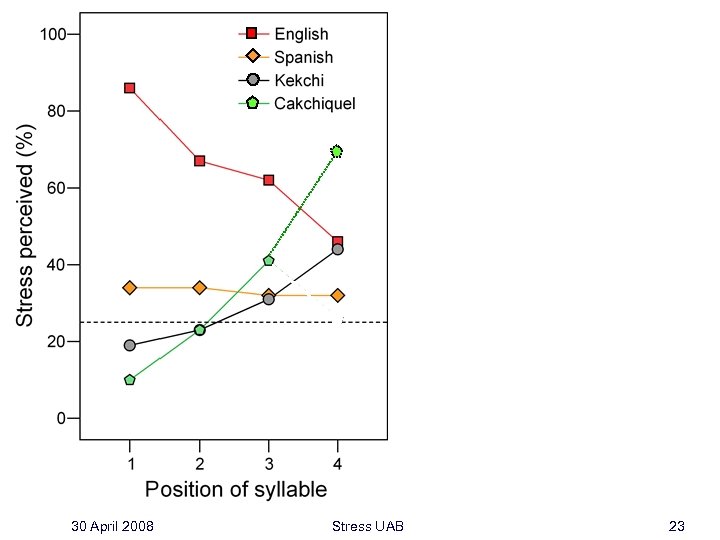
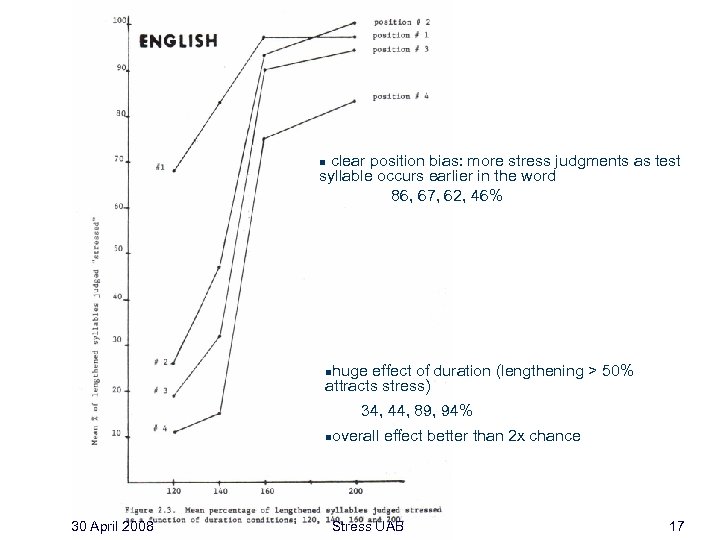 clear position bias: more stress judgments as test syllable occurs earlier in the word 86, 67, 62, 46% n huge effect of duration (lengthening > 50% attracts stress) n 34, 44, 89, 94% n 30 April 2008 overall effect better than 2 x chance Stress UAB 17
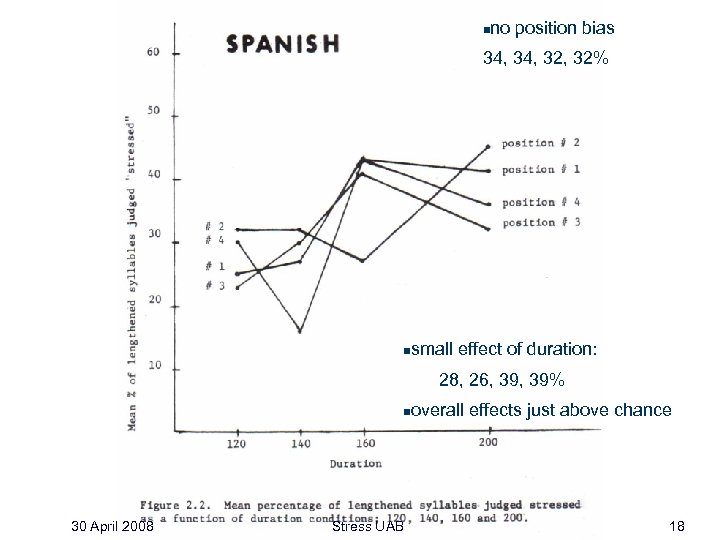 no position bias n 34, 32, 32% small effect of duration: n 28, 26, 39% overall effects just above chance n 30 April 2008 Stress UAB 18
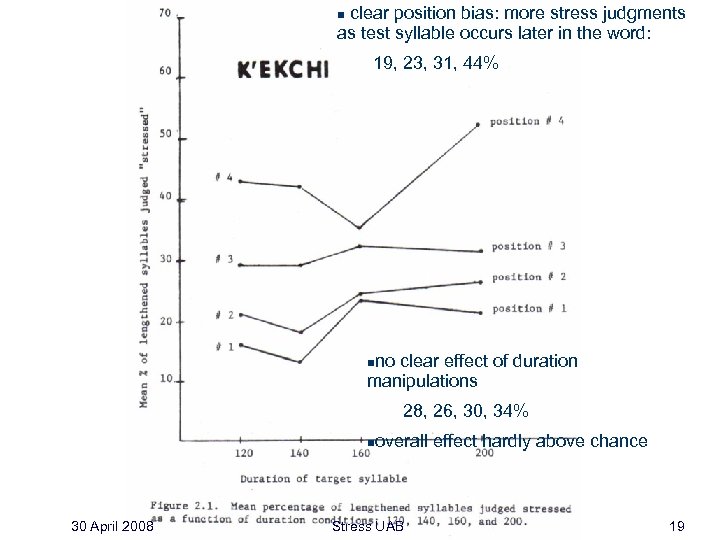 clear position bias: more stress judgments as test syllable occurs later in the word: n 19, 23, 31, 44% no clear effect of duration manipulations n 28, 26, 30, 34% overall effect hardly above chance n 30 April 2008 Stress UAB 19
 Berinstein (1979) w Results of perception test (cont. ) w English n n n clear position bias: more stress judgments as test syllable occurs earlier in the word huge effect of duration (lengthening > 50% attracts stress) overall effect better than 2 x chance w Note n n I replicated the experiment with Dutch listeners results identical to English 30 April 2008 Stress UAB 20
 Berinstein (1979) w Results of perception test w K’ekchi n n n clear position bias: more stress judgments as test syllable occurs later in the word no clear effect of duration manipulations overall effect hardly above chance w Spanish n no position bias small effect of duration overall effects just above chance 30 April 2008 Stress UAB 21
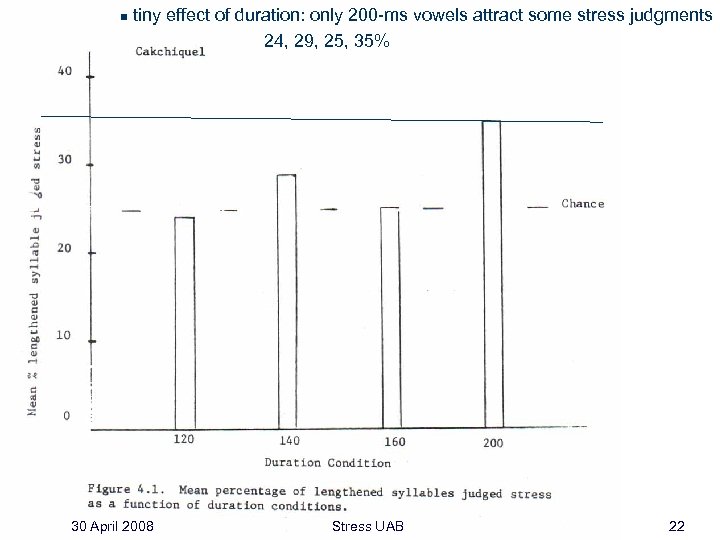 n tiny effect of duration: only 200 -ms vowels attract some stress judgments 24, 29, 25, 35% 30 April 2008 Stress UAB 22
 30 April 2008 Stress UAB 23
 Berinstein (1979) w Summary of observations re. duration n Large effect in English l n Small effect in Spanish l n Even though Spanish has no length contrast Small effect in Kekchi l n But English also has length contrast Even though Kekchi has vowel length contrast Same small effect in Cakchiquel l 30 April 2008 Even though Cakchiquel has no length contrast Stress UAB 24
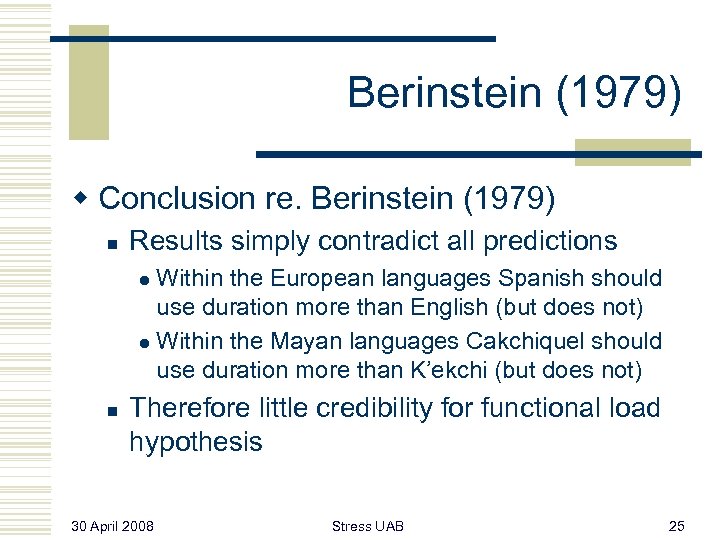 Berinstein (1979) w Conclusion re. Berinstein (1979) n Results simply contradict all predictions Within the European languages Spanish should use duration more than English (but does not) l Within the Mayan languages Cakchiquel should use duration more than K’ekchi (but does not) l n Therefore little credibility for functional load hypothesis 30 April 2008 Stress UAB 25
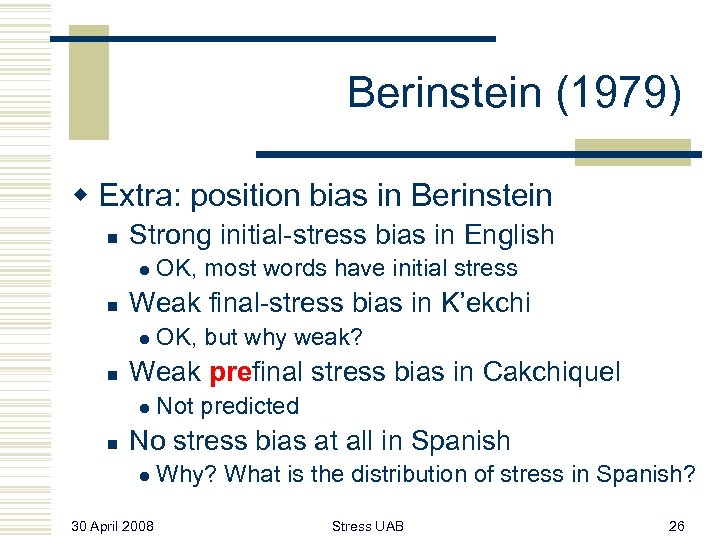 Berinstein (1979) w Extra: position bias in Berinstein n Strong initial-stress bias in English l n Weak final-stress bias in K’ekchi l n OK, but why weak? Weak prefinal stress bias in Cakchiquel l n OK, most words have initial stress Not predicted No stress bias at all in Spanish l 30 April 2008 Why? What is the distribution of stress in Spanish? Stress UAB 26
 Functional load hypothesis w Posituk, Gandour & Harper (1996) n Thai has five lexical tones l n Prediction: pitch cannot be an effective stress cue Thai contrasts long short vowels l Prediction: duration cannot be an effective stress cue w Acoustic correlates were measured n i. e. NOT a perception study 30 April 2008 Stress UAB 27
 Potisuk et al. (1996) w Method two male, three female speakers (read -out speech) n 25 sentences with minimal stress pairs (20 with long vowels, 5 with short vowels) n full 5 x 5 matrix of two-tone sequences n 30 April 2008 Stress UAB 28
 Potisuk et al. (1996) w Note: stress pairs are not really minimal n n one is a two-word sequence (N-V) the other is a two-syllable compound w Measurements n n only initial syllables were measured (paradigmatic) F 0 curve, in ERB + Z-transform, time-normalised (reduction to mean and SD) Rhyme duration (re. sentence duration, withinspeaker normalisation for inherent segment duration) Intensity curve (normalised within speakers, reduction to mean and SD (through Z-transform) 30 April 2008 Stress UAB 29
![five-member lexical tone contrast is fully maintained in [–stress], even though F 0 curves](https://present5.com/presentation/700b8b062ef87d2cbff2950025296033/image-30.jpg "five-member lexical tone contrast is fully maintained in [–stress], even though F 0 curves") five-member lexical tone contrast is fully maintained in [–stress], even though F 0 curves are flattened considerably n 30 April 2008 Stress UAB 30
five-member lexical tone contrast is fully maintained in [–stress], even though F 0 curves are flattened considerably n 30 April 2008 Stress UAB 30
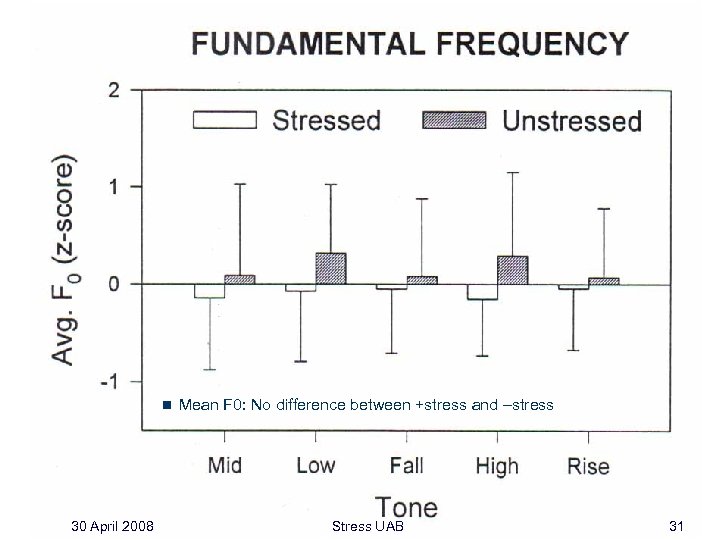 n Mean F 0: No difference between +stress and –stress 30 April 2008 Stress UAB 31
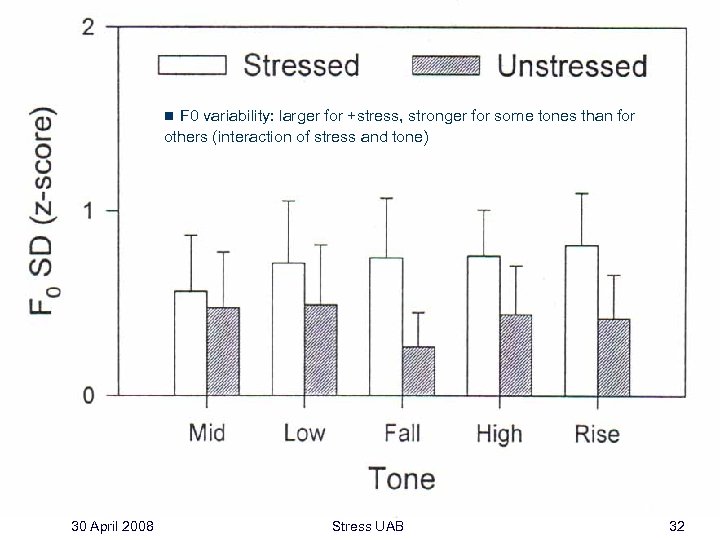 n F 0 variability: larger for +stress, stronger for some tones than for others (interaction of stress and tone) 30 April 2008 Stress UAB 32
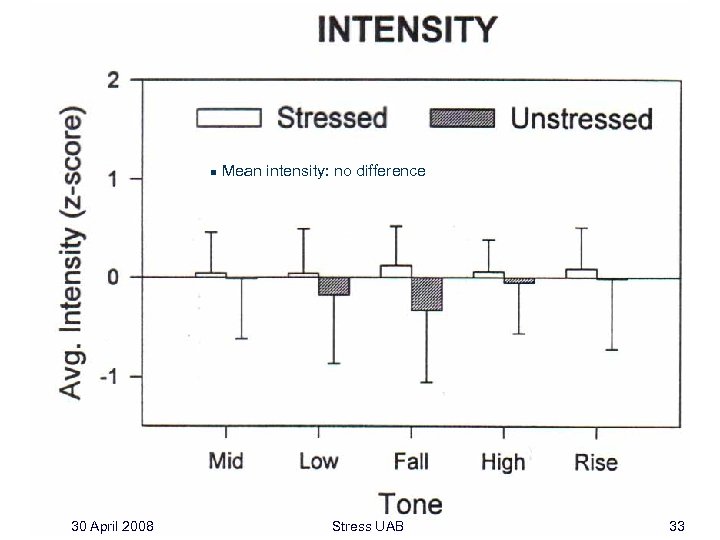 n 30 April 2008 Mean intensity: no difference Stress UAB 33
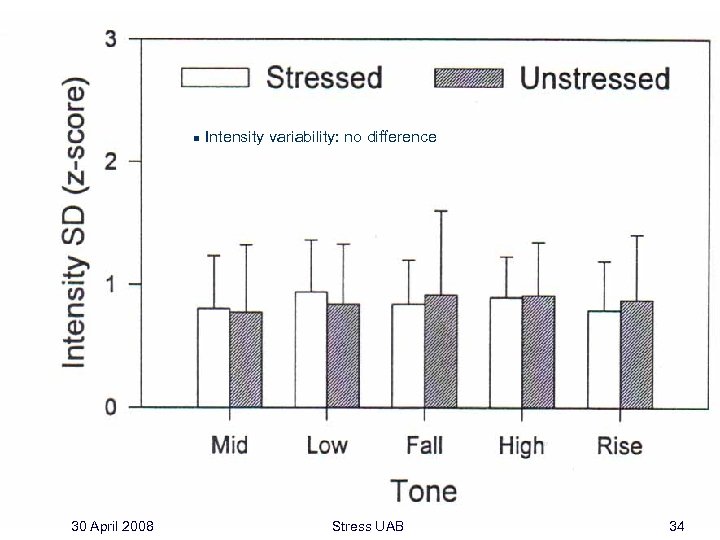 n 30 April 2008 Intensity variability: no difference Stress UAB 34
![Duration: [+stress] much longer than [–stress], for all lexical tones n (i. e. no](https://present5.com/presentation/700b8b062ef87d2cbff2950025296033/image-35.jpg "Duration: [+stress] much longer than [–stress], for all lexical tones n (i. e. no") Duration: [+stress] much longer than [–stress], for all lexical tones n (i. e. no stress x tone interaction) n 30 April 2008 Stress UAB 35
Duration: [+stress] much longer than [–stress], for all lexical tones n (i. e. no stress x tone interaction) n 30 April 2008 Stress UAB 35
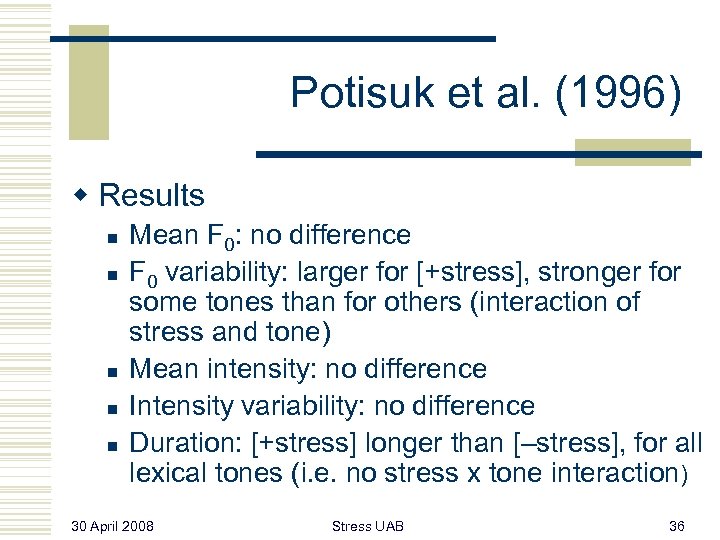 Potisuk et al. (1996) w Results n n n Mean F 0: no difference F 0 variability: larger for [+stress], stronger for some tones than for others (interaction of stress and tone) Mean intensity: no difference Intensity variability: no difference Duration: [+stress] longer than [–stress], for all lexical tones (i. e. no stress x tone interaction) 30 April 2008 Stress UAB 36
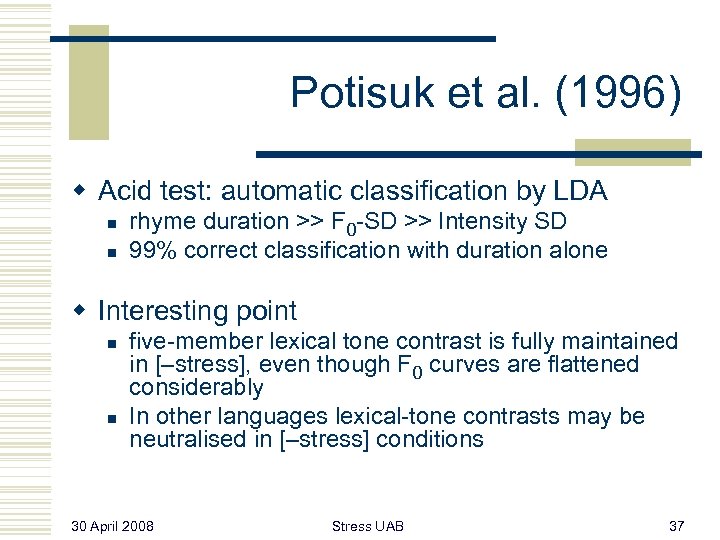 Potisuk et al. (1996) w Acid test: automatic classification by LDA n n rhyme duration >> F 0 -SD >> Intensity SD 99% correct classification with duration alone w Interesting point n n five-member lexical tone contrast is fully maintained in [–stress], even though F 0 curves are flattened considerably In other languages lexical-tone contrasts may be neutralised in [–stress] conditions 30 April 2008 Stress UAB 37
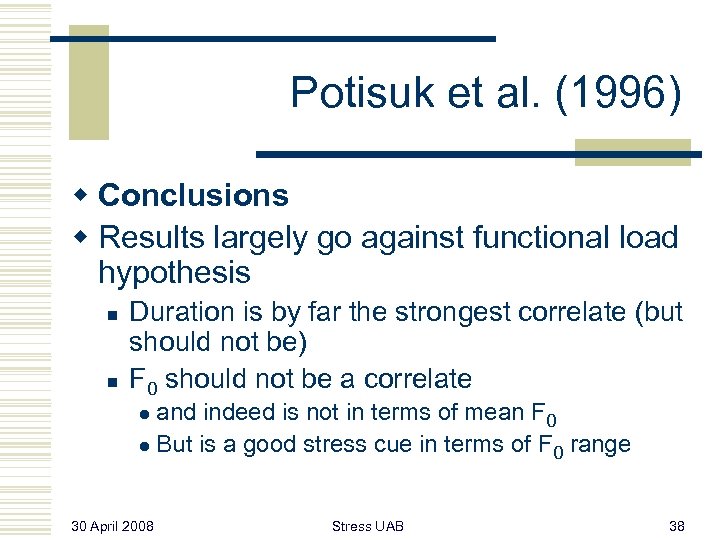 Potisuk et al. (1996) w Conclusions w Results largely go against functional load hypothesis n n Duration is by far the strongest correlate (but should not be) F 0 should not be a correlate and indeed is not in terms of mean F 0 l But is a good stress cue in terms of F 0 range l 30 April 2008 Stress UAB 38
 Multiple sources of variability w Vowel duration is longer (e. g. Klatt, 1974) n n n in [+long] vowels before deeper prosodic breaks in syllables with word stress in words with sentence stress in slow speech before voiced (and esp. ) sonorant consonants 30 April 2008 Stress UAB 39
 Multiple sources of variability w Listeners are able to decompose different sources of variability in a parameter n E. g. Nooteboom (1979) shows that Dutch listeners use duration effectively to make multiple simultaneous contrasts Long ~ short vowels l Depth of prosodic break l n They adjust the long ~ short boundary depending on the depth of the break 30 April 2008 Stress UAB 40
 Functional load hypothesis w Since simultaneous effects are perceptually decomposed, the functional load hypothesis seems too simple n n Results indicate that we can both have our cake and eat it ‘Get two for the price of one’ w Original hierarchy still stands 30 April 2008 Stress UAB 41
 Duration as a stress cue in English 30 April 2008 Stress UAB
 Postnuclear stress contrast? w Beckman & Edwards (1994) w Simple prominence hierarchy in English w Four degrees of prominence n n n Full vowel > reduction vowel (schwa) Pitch movement > no pitch accent Last accent > earlier accents 30 April 2008 Stress UAB 43
 Postnuclear stress contrast? w Beckman & Edwards (1994) w Predictions n n Schwa cannot be stressed unless it is transformed to a full vowel first No contrast between initial and final stress in postnuclear words with full vowels (Scott 1939, Huss 1978). 30 April 2008 Stress UAB 44
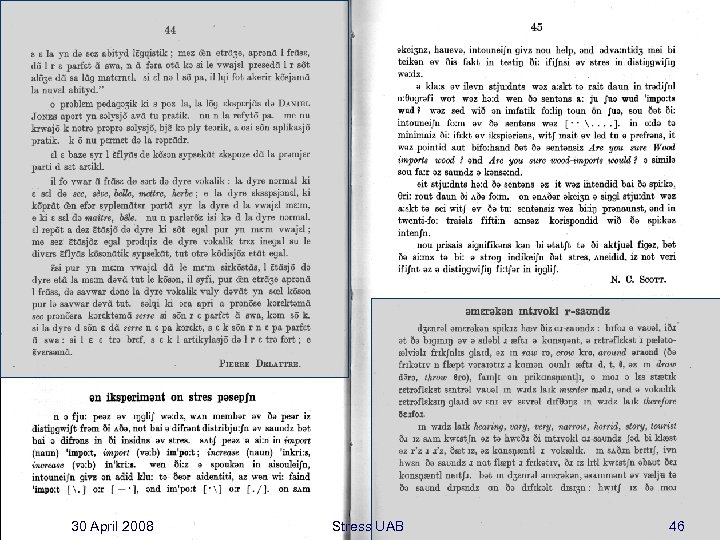
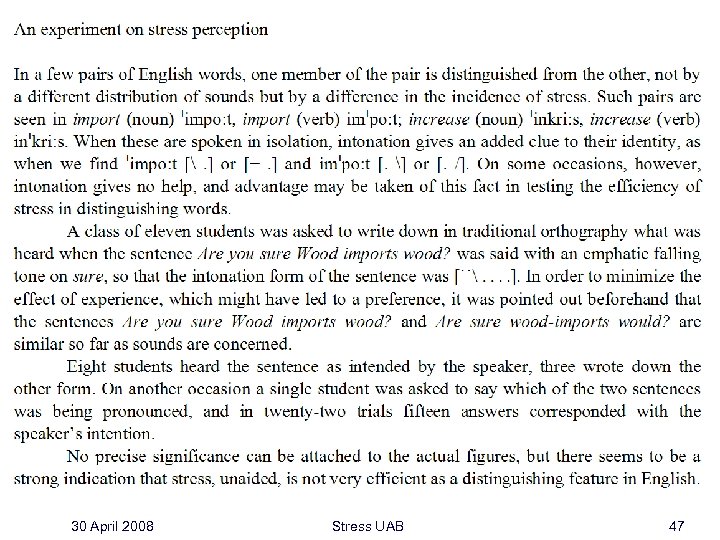
 Postnuclear stress contrast? w Scott (1939) n n n One sentence, initial stress only Noun ~ verb minimal stress pair 11 listeners, forced choice Response distribution towards initial stress But not significantly so 30 April 2008 Stress UAB 45
 30 April 2008 Stress UAB 46
 30 April 2008 Stress UAB 47
 Postnuclear stress contrast? w Pilch (1970) n n n Difference between import ~ import is exclusively a matter of intonation Not carried by stress If intonation cues are removed (by embedding target in postnuclear position) no difference between noun and verb reading should remain 30 April 2008 Stress UAB 48
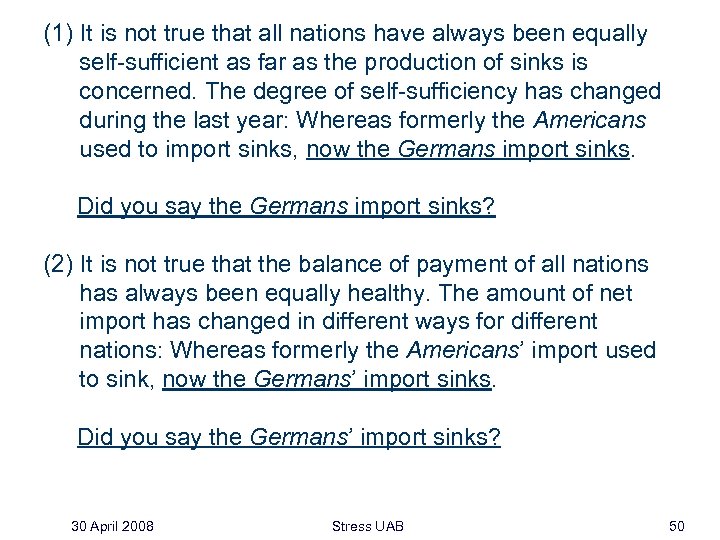
 Postnuclear stress contrast? w Huss (1978) w Used same clever sentences as Scott n Actually, even cleverer w Identical word sequences with different stress pattern on noun~verb pairs in postnuclear position w See examples 30 April 2008 Stress UAB 49
 (1) It is not true that all nations have always been equally self-sufficient as far as the production of sinks is concerned. The degree of self-sufficiency has changed during the last year: Whereas formerly the Americans used to import sinks, now the Germans import sinks. Did you say the Germans import sinks? (2) It is not true that the balance of payment of all nations has always been equally healthy. The amount of net import has changed in different ways for different nations: Whereas formerly the Americans’ import used to sink, now the Germans’ import sinks. Did you say the Germans’ import sinks? 30 April 2008 Stress UAB 50
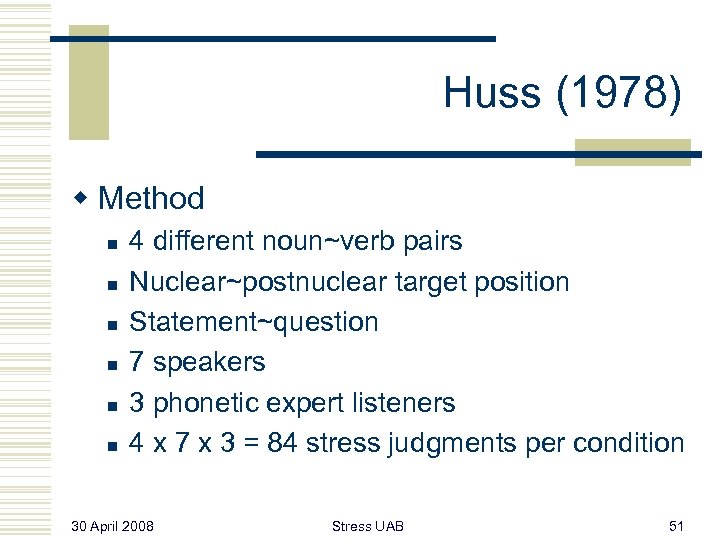 Huss (1978) w Method n n n 4 different noun~verb pairs Nuclear~postnuclear target position Statement~question 7 speakers 3 phonetic expert listeners 4 x 7 x 3 = 84 stress judgments per condition 30 April 2008 Stress UAB 51
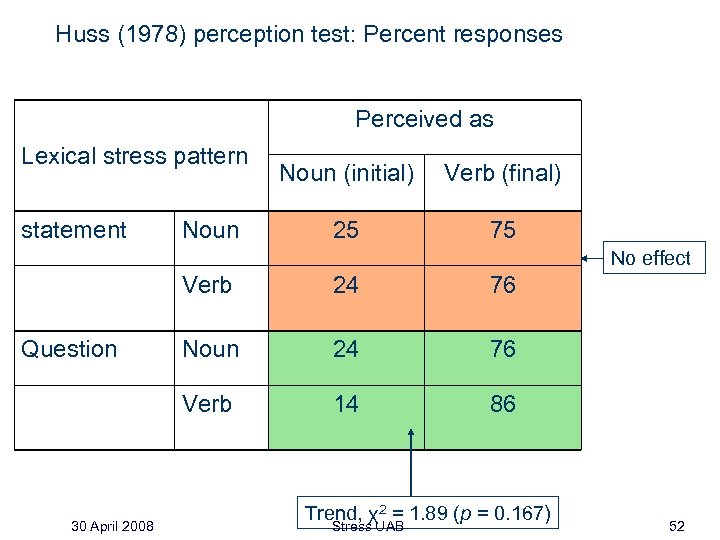 Huss (1978) perception test: Percent responses Perceived as Lexical stress pattern statement Noun (initial) Verb (final) 25 75 No effect Verb 30 April 2008 76 Noun 24 76 Verb Question 24 14 86 Trend, χ2 = 1. 89 (p = 0. 167) Stress UAB 52
![w (1) [the GERmans] [import sinks] No lengthening of stressed syll. w (2) [the](https://present5.com/presentation/700b8b062ef87d2cbff2950025296033/image-53.jpg "w (1) [the GERmans] [import sinks] No lengthening of stressed syll. w (2) [the") w (1) [the GERmans] [import sinks] No lengthening of stressed syll. w (2) [the GERmans’ import] [sinks] Final lengthening of unstressed syll. 30 April 2008 Stress UAB 53
w (1) [the GERmans] [import sinks] No lengthening of stressed syll. w (2) [the GERmans’ import] [sinks] Final lengthening of unstressed syll. 30 April 2008 Stress UAB 53
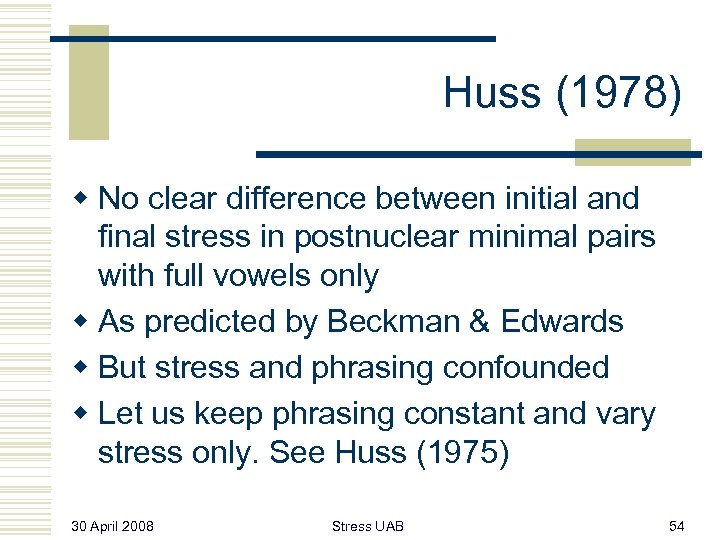 Huss (1978) w No clear difference between initial and final stress in postnuclear minimal pairs with full vowels only w As predicted by Beckman & Edwards w But stress and phrasing confounded w Let us keep phrasing constant and vary stress only. See Huss (1975) 30 April 2008 Stress UAB 54
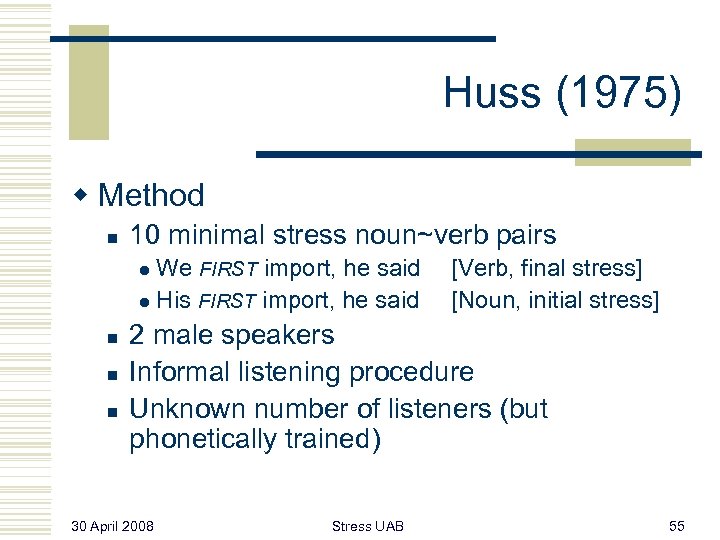 Huss (1975) w Method n 10 minimal stress noun~verb pairs We FIRST import, he said l His FIRST import, he said l n n n [Verb, final stress] [Noun, initial stress] 2 male speakers Informal listening procedure Unknown number of listeners (but phonetically trained) 30 April 2008 Stress UAB 55
 Huss (1975) w Perceptual results n n n One group of words with stress perceived in conformity with noun~verb contrast, high agreement among listeners In ‘a few words’ listeners did not agree In ‘some other words’ listeners did agree but reported stress the wrong way around w Unfortunately no quantitative data 30 April 2008 Stress UAB 56
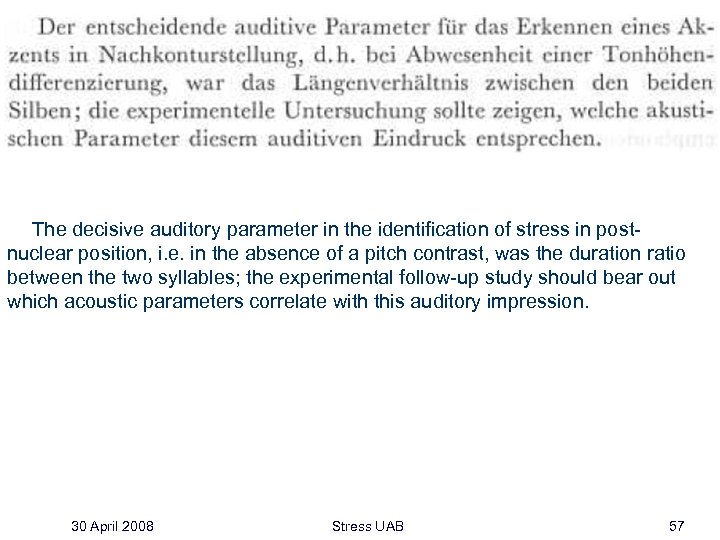 The decisive auditory parameter in the identification of stress in postnuclear position, i. e. in the absence of a pitch contrast, was the duration ratio between the two syllables; the experimental follow-up study should bear out which acoustic parameters correlate with this auditory impression. 30 April 2008 Stress UAB 57
 Huss (1975) w Perceptual results n In pairwise comparison of noun~verb pairs vowel duration seemed the clearest correlate w Acoustic measurements of one speaker presented (better speaker) w Second speaker had more perceptual ambiguities (and reversals) n No quantitative data 30 April 2008 Stress UAB 58
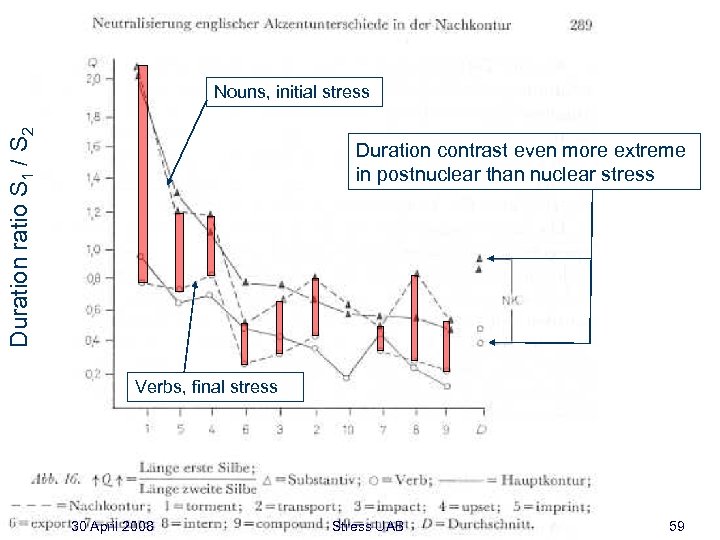 Duration ratio S 1 / S 2 Nouns, initial stress Duration contrast even more extreme in postnuclear than nuclear stress Verbs, final stress 30 April 2008 Stress UAB 59
 Huss (1975) w Conclusion n At least some speakers produce a very reliable contrast between initial and final stress in postnuclear position in words with full vowels only The correlate is syllable duration The contrast, when made, is adequately perceived 30 April 2008 Stress UAB 60
 Postnuclear stress contrast? w Beckman & Edwards seem wrong n n n English speakers tend to preserve stress contrast in postnuclear position English listeners are sensitive to the contrast even when there is no pitch movement (duration is effective cue) Same effects were found for Dutch l 30 April 2008 Nooteboom (1972), van Katwijk (1974), Sluijter & van Heuven (1996) Stress UAB 61
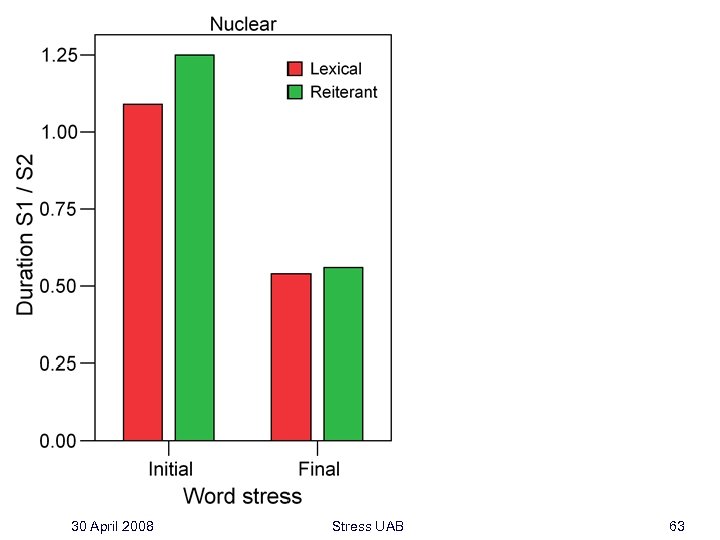
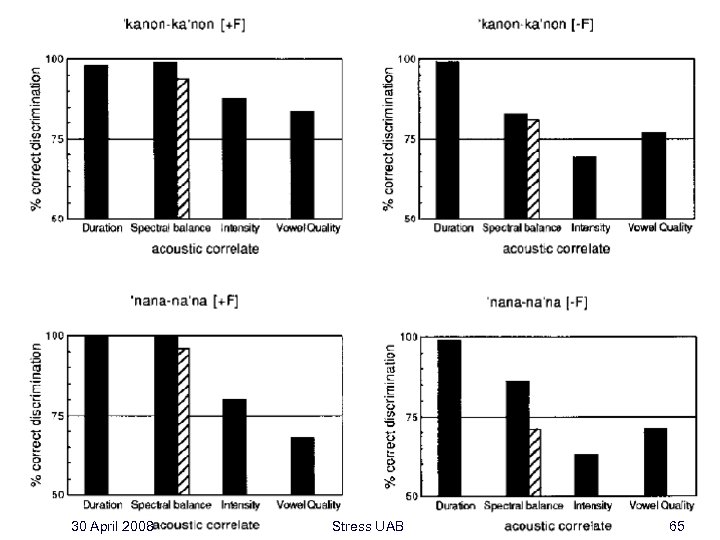
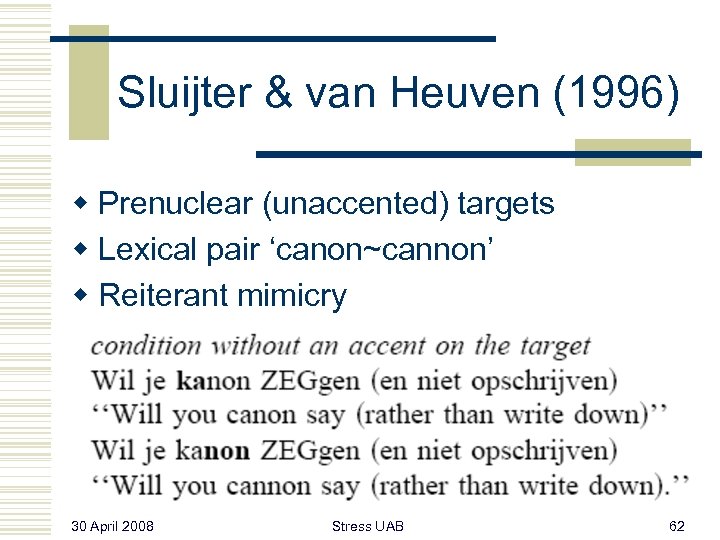 Sluijter & van Heuven (1996) w Prenuclear (unaccented) targets w Lexical pair ‘canon~cannon’ w Reiterant mimicry 30 April 2008 Stress UAB 62
 30 April 2008 Stress UAB 63
 Sluijter & van Heuven (1996) w Results n n n Duration (ratio S 1/S 2) very strong stress cue Equally effective in nuclear and non-nuclear position Affords 100% stress decisions in LDA Linear Discriminant Analysis l Automatic classification algorithm l 30 April 2008 Stress UAB 64
 30 April 2008 Stress UAB 65
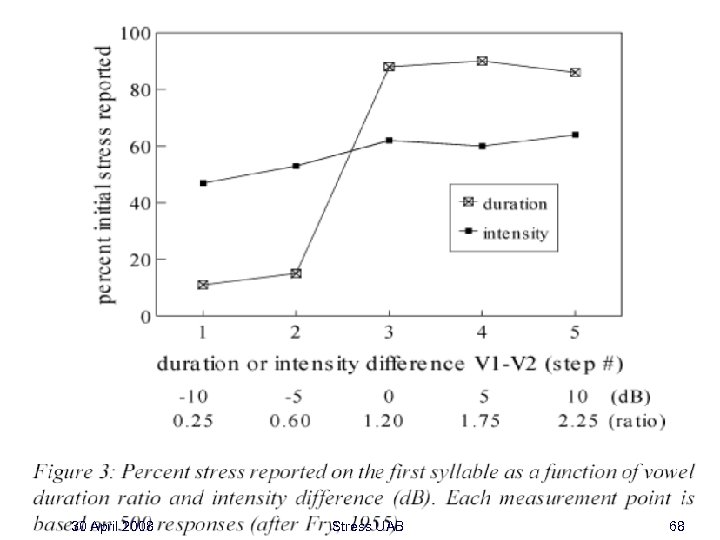
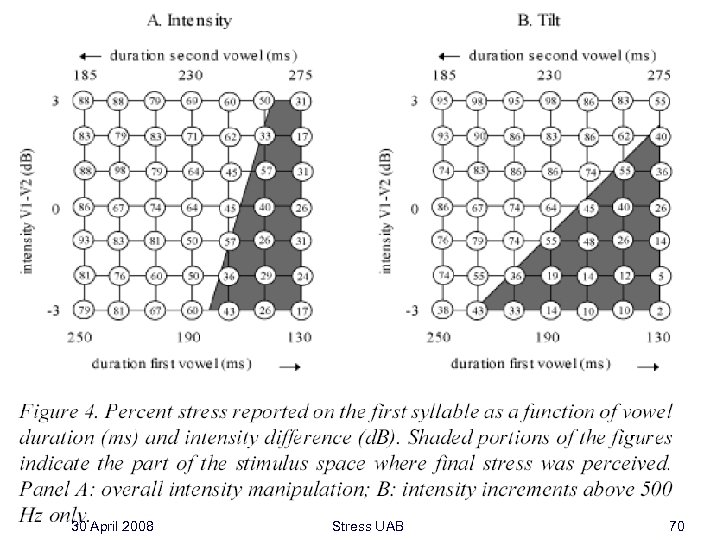
 Sluijter et al. (1997) w Duration, intensity and loudness as perceptual cues in stress perception in non-nuclear position w Overall result: n n n Duration is strongest cue Loudness (intensity > 500 Hz) is second Intensity is weak cue 30 April 2008 Stress UAB 66
 Aside: strength of cues w Standard plots n % stress as a function of X but averaged over all Y steps l Y but averaged over all X steps l n n Observe difference in psychometric function Obscures interaction between X and Y w Alternative: quasi 3 D plots 30 April 2008 Stress UAB 67
 30 April 2008 Stress UAB 68
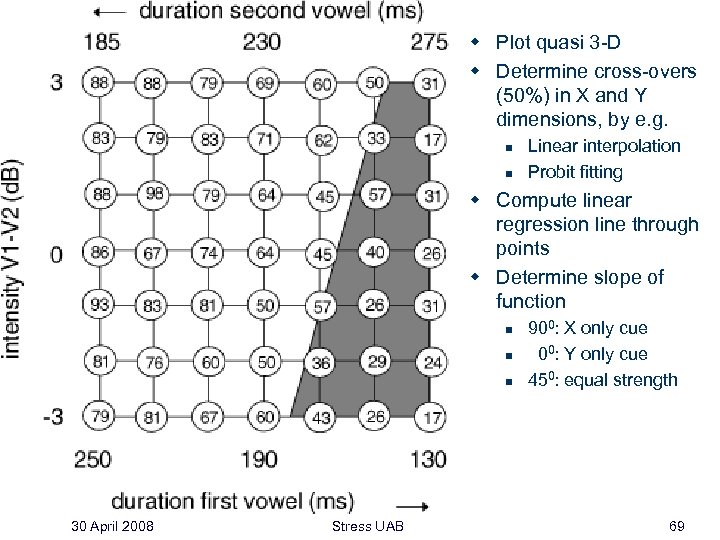 w Plot quasi 3 -D w Determine cross-overs (50%) in X and Y dimensions, by e. g. n n Linear interpolation Probit fitting w Compute linear regression line through points w Determine slope of function n 30 April 2008 Stress UAB 900: X only cue 00: Y only cue 450: equal strength 69
 30 April 2008 Stress UAB 70
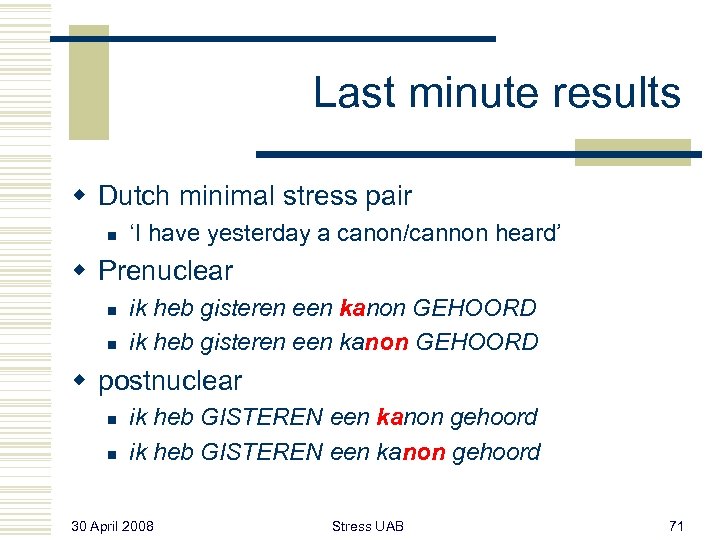 Last minute results w Dutch minimal stress pair n ‘I have yesterday a canon/cannon heard’ w Prenuclear n n ik heb gisteren een kanon GEHOORD w postnuclear n n ik heb GISTEREN een kanon gehoord 30 April 2008 Stress UAB 71
 Last minute results w Starting from each natural base stimulus w 7 manipulations of syllable duration ratio (using Praat PSOLA) w 4 repetitions of each type w 20 native Dutch listeners w 80 responses per data point 30 April 2008 Stress UAB 72
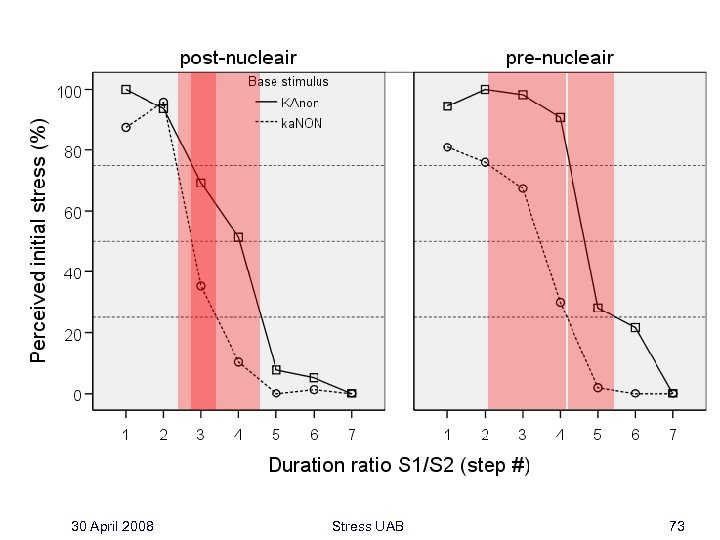 30 April 2008 Stress UAB 73
 Last minute results w Duration is very effective stress cue in Dutch w Also (smaller) effect of base stimulus w Same effects before and after nuclear accent w Same effects are expected for English 30 April 2008 Stress UAB 74
 Summing up w Duration is very effective stress cue in Dutch, even in non-nuclear position w It should also be so in English w Work in progress at Leiden University n n Production and perception of stress in preand postnuclear position in Dutch and English. No results for English at this stage. 30 April 2008 Stress UAB 75
 Stress bias 30 April 2008 Stress UAB
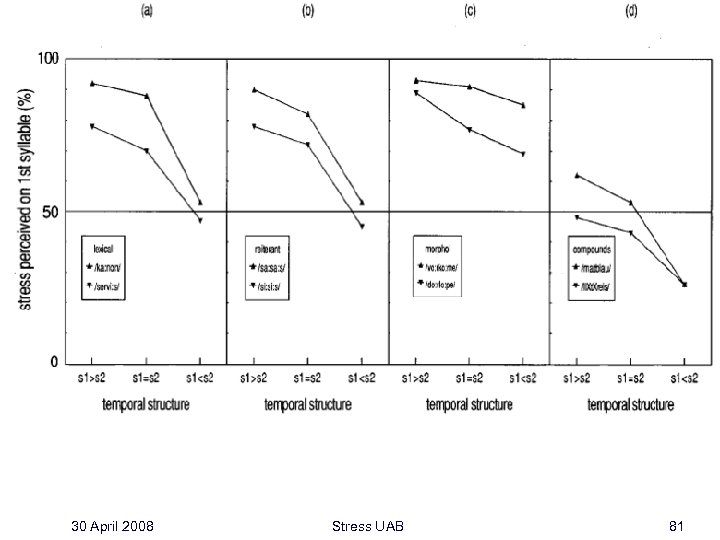
 Van Heuven & Menert (1996) w Strange difference n n Strong initial bias for English (but no fixed initial stress) Weaker final bias for K’ekchi (although exceptionless fixed stress) w Why the difference? w Bias is partly the result of artifact 30 April 2008 Stress UAB 77
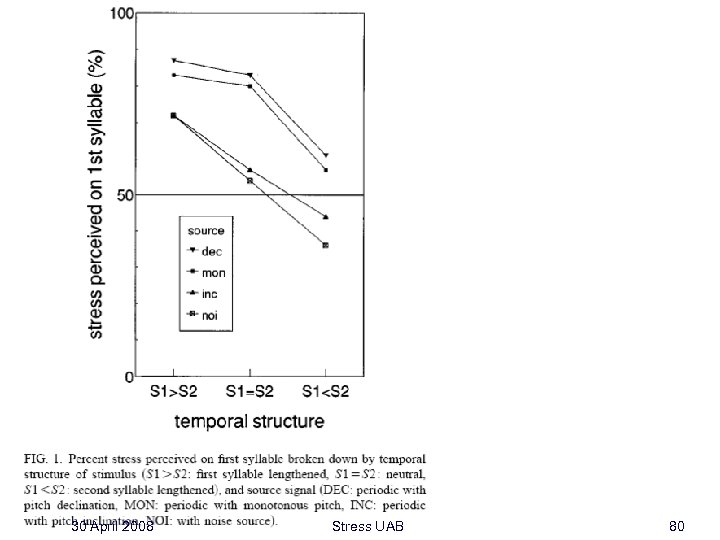
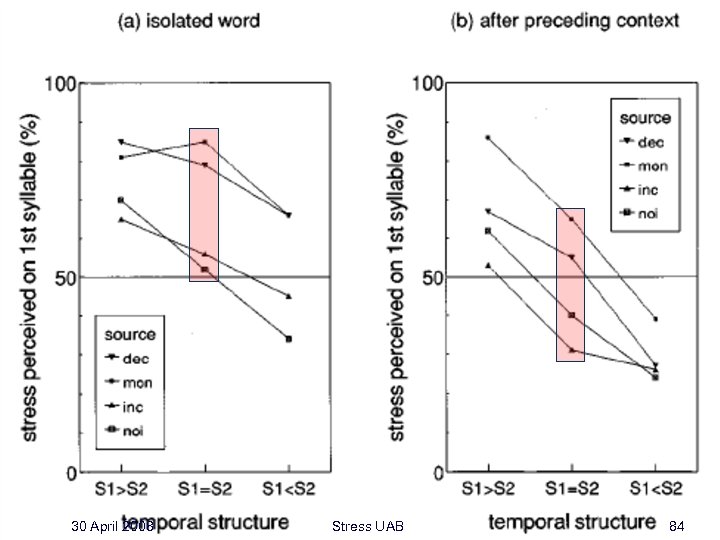
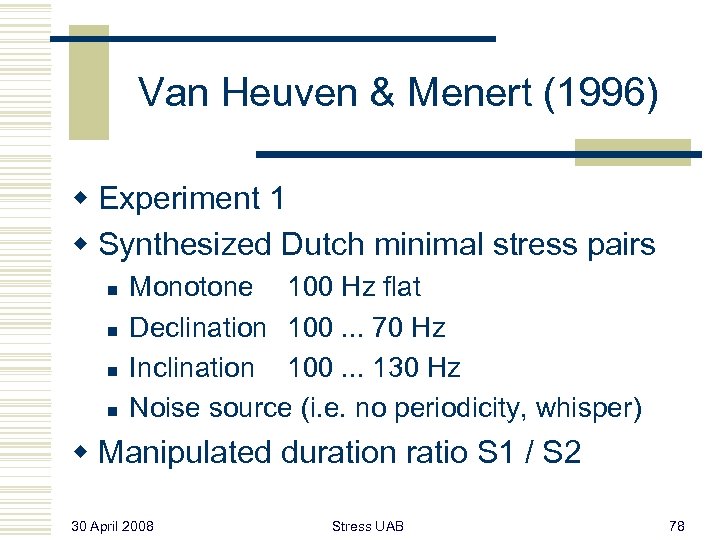 Van Heuven & Menert (1996) w Experiment 1 w Synthesized Dutch minimal stress pairs n n Monotone 100 Hz flat Declination 100. . . 70 Hz Inclination 100. . . 130 Hz Noise source (i. e. no periodicity, whisper) w Manipulated duration ratio S 1 / S 2 30 April 2008 Stress UAB 78
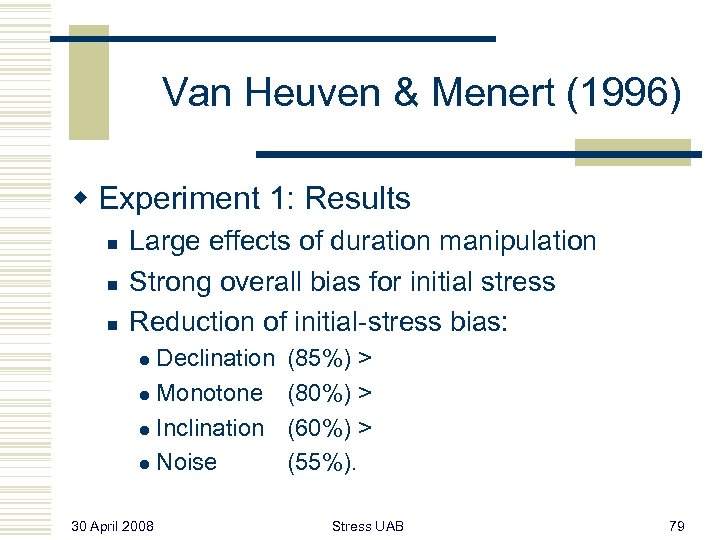 Van Heuven & Menert (1996) w Experiment 1: Results n n n Large effects of duration manipulation Strong overall bias for initial stress Reduction of initial-stress bias: Declination l Monotone l Inclination l Noise l 30 April 2008 (85%) > (80%) > (60%) > (55%). Stress UAB 79
 30 April 2008 Stress UAB 80
 30 April 2008 Stress UAB 81
 Van Heuven & Menert (1996) w Experiment 2: Effect of context w Same stimuli & manipulations as before w Also preceded by short carrier, so that first syllable of target does not appear out of the blue 30 April 2008 Stress UAB 82
 Van Heuven & Menert (1996) w Experiment 2: Results w Isolated targets: Replicates exp 1. w Preceding context: n Bias for initial stress completely gone 30 April 2008 Stress UAB 83
 30 April 2008 Stress UAB 84
 Van Heuven & Menert (1996) w Apparently: bias is not inherent but induced by n n Presence/absence of a preceding context Whether (first syllable of) target has pitch w Suggestion: n Bias is induced by virtual pitch jump from assumed/inferred F 0 baseline 30 April 2008 Stress UAB 85
 Van Heuven & Menert (1996) w Inferred baseline is speaker’s bottom pitch (roughly 70 Hz) w Prediction n n The higher the level pitch of an isolated target, the larger the virtual F 0 jump, the stronger the initial stress bias No bias when target has 70 Hz pitch 30 April 2008 Stress UAB 86
 Van Heuven & Menert (1996) w Experiment 3 n n n Same reiterant stimuli Synthesized at 70, 100, 130 and 160 Hz We also manipulated formant settings l +20%, – 15%, 0% (neutral) w If virtual pitch jump, then initial stress bias should increase with onset F 0 30 April 2008 Stress UAB 87
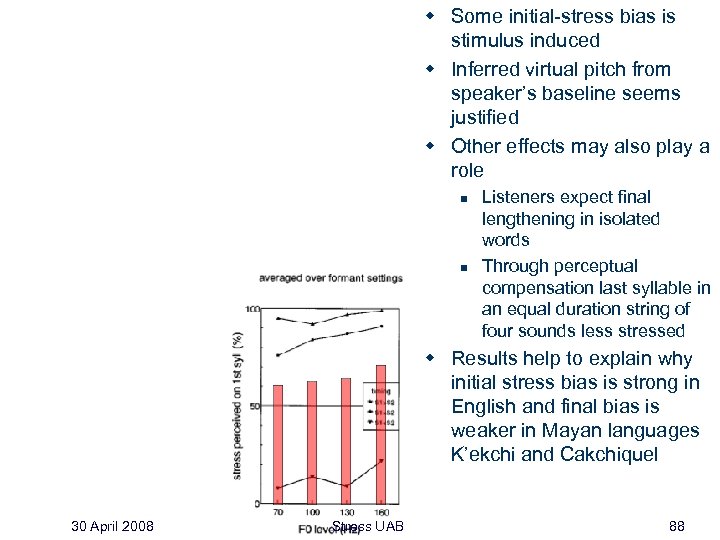 w Some initial-stress bias is stimulus induced w Inferred virtual pitch from speaker’s baseline seems justified w Other effects may also play a role n n Listeners expect final lengthening in isolated words Through perceptual compensation last syllable in an equal duration string of four sounds less stressed w Results help to explain why initial stress bias is strong in English and final bias is weaker in Mayan languages K’ekchi and Cakchiquel 30 April 2008 Stress UAB 88
 Vowel reduction as a stress cue 30 April 2008 Stress UAB
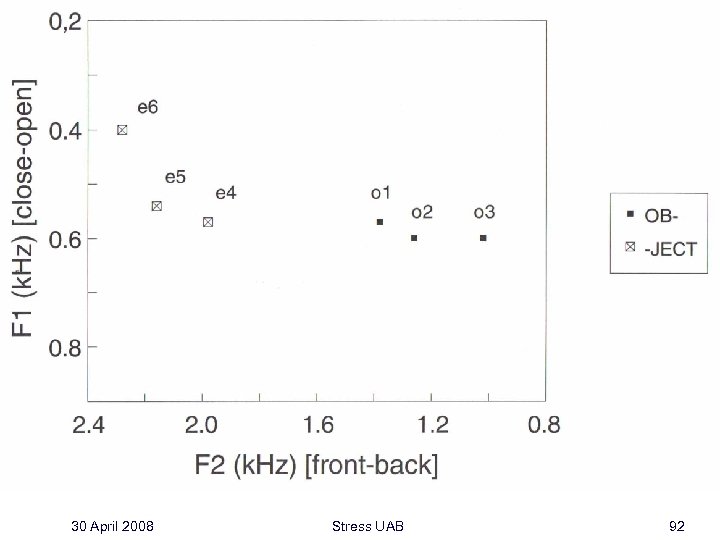
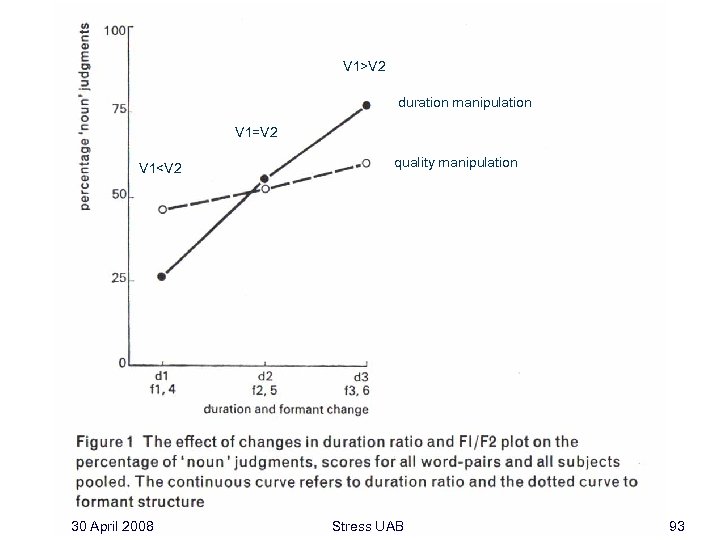
 FRY (1965): DURATION vs. SPECTRAL REDUCTION w 4 Minimal stress pairs (noun vs. verb) CONtract SUBject Digest Object ~ ~ con. TRACT sub. JECT di. GEST ob. JECT w 3 duration steps (smaller range than in Fry 1955, 1958) 30 April 2008 Stress UAB 90
 DURATION vs. SPECTRAL REDUCTION w 3 degrees of vowel reduction/expansion n for V 1 while keeping V 2 constant (mid value): f 1, f 2, f 3 for V 2 while keeping V 1 constant (f 4, f 5, f 6) Note: reduction of diphthong /ai/ by reduction of glide trajectory (full, halfway, none= endpoint only) 30 April 2008 Stress UAB 91
 30 April 2008 Stress UAB 92
 V 1>V 2 duration manipulation V 1=V 2 V 1
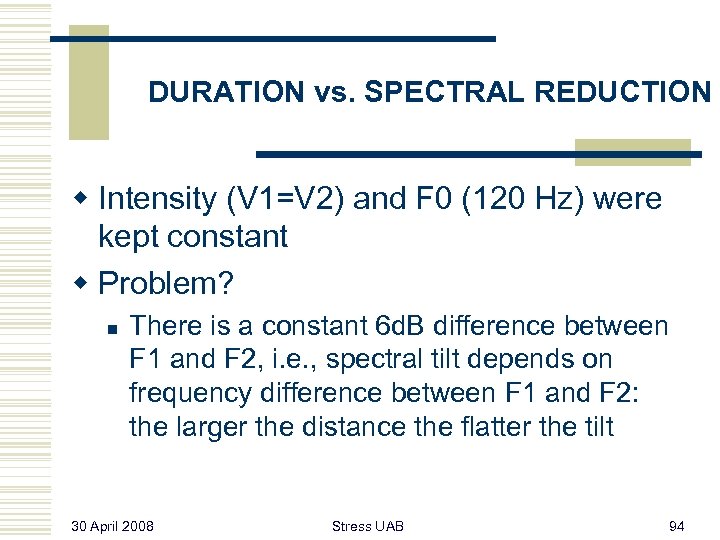 DURATION vs. SPECTRAL REDUCTION w Intensity (V 1=V 2) and F 0 (120 Hz) were kept constant w Problem? n There is a constant 6 d. B difference between F 1 and F 2, i. e. , spectral tilt depends on frequency difference between F 1 and F 2: the larger the distance the flatter the tilt 30 April 2008 Stress UAB 94
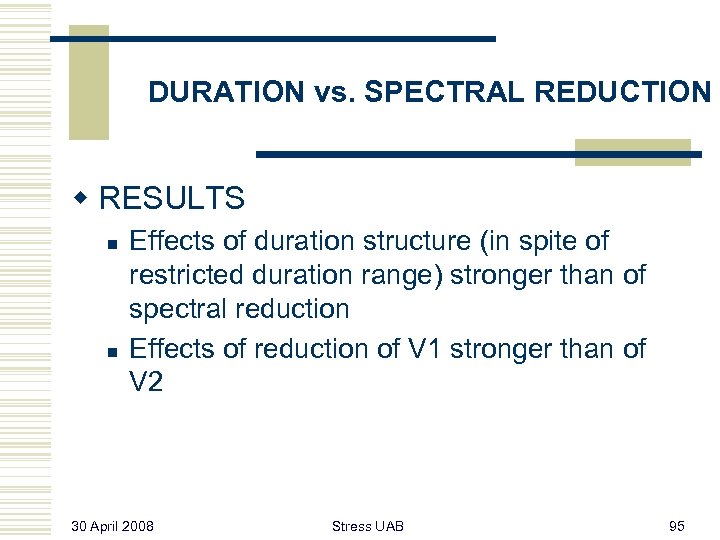 DURATION vs. SPECTRAL REDUCTION w RESULTS n n Effects of duration structure (in spite of restricted duration range) stronger than of spectral reduction Effects of reduction of V 1 stronger than of V 2 30 April 2008 Stress UAB 95
 Van Bergem (1993) w Spectral reduction in Dutch w Production study n n Measurement of F 1 and F 2 at most stable portion during vowel (least spectral change) Systematic manipulation of stress, focus, and lexical status of words w Manipulation of focus through question/answer pairs: 30 April 2008 Stress UAB 96
![Test syllable: can (What did you buy for your mother? I bought [CANdy]+F for](https://present5.com/presentation/700b8b062ef87d2cbff2950025296033/image-97.jpg "Test syllable: can (What did you buy for your mother? I bought [CANdy]+F for") Test syllable: can (What did you buy for your mother? I bought [CANdy]+F for my mother +C +A +S (For whom did you buy candy? ) I bought [CANdy]-F for my mother +C -A +S (Where do they sell beer? ) In our [can. TEEN]+F they sell beer +C +A -S (What do they sell in our canteen? ) In our [can. TEEN]-F they sell beer +C -A -S (What can your sister do for hours? ) My sister can [TALK]+F for hours -C +A (How long can your sister talk? ) My sister can [TALK]-F for hours -C -A [CAN]+F (spoken in isolation) ISO 30 April 2008 Stress UAB 97
Test syllable: can (What did you buy for your mother? I bought [CANdy]+F for my mother +C +A +S (For whom did you buy candy? ) I bought [CANdy]-F for my mother +C -A +S (Where do they sell beer? ) In our [can. TEEN]+F they sell beer +C +A -S (What do they sell in our canteen? ) In our [can. TEEN]-F they sell beer +C -A -S (What can your sister do for hours? ) My sister can [TALK]+F for hours -C +A (How long can your sister talk? ) My sister can [TALK]-F for hours -C -A [CAN]+F (spoken in isolation) ISO 30 April 2008 Stress UAB 97
 Van Bergem (1993) w Experimental set-up 15 (male) speakers n 7 stress/accent/status conditions n 33 test syllables n w yielding 3465 vowel tokens 30 April 2008 Stress UAB 98
 Van Bergem (1993) w Selected results n n n n For test syllables with /e: /, /o: / and /a: / only No function words Spectrally most expanded tokens for isolated words marginal reduction for +A+S Appreciable reduction for -A Appreciable reduction for -S Effects of A and S are equal and additive 30 April 2008 Stress UAB 99
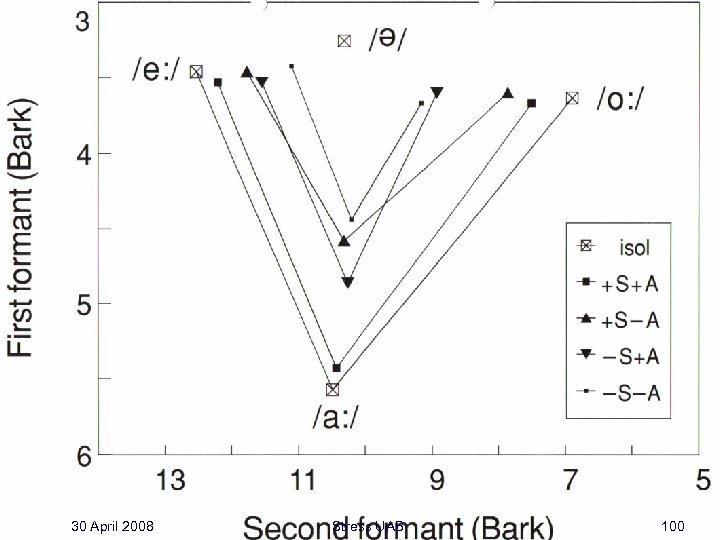 30 April 2008 Stress UAB 100
 Van Bergem (1993) w Notes These are acoustic effects n Proper studies of the cue value of spectral reduction for stress/accent perception have to be carried out yet (for any language whatsoever) n …preferably in relationship with cues to domain-final lenthening n 30 April 2008 Stress UAB 101
 Unified view 30 April 2008 Stress UAB
 Unified view w There is no unified view w I would like to assume that all languages use stress parameters in the same way n n Not necessarily in speech production but certainly in speech perception Although the use of pitch for the marking of sentence stress may differ 30 April 2008 Stress UAB 103
 Unified view w No room for a functional load hypothesis w Unclear why duration is such a weak cue for Spanish in Berinstein (1979) w But strong cue in Catalan in recent work at UAB n Also in Spanish? w (Much) more research needed 30 April 2008 Stress UAB 104
 Thanks for bearing with me 30 April 2008 Stress UAB