


 Скачать презентацию EFA and SFA funding reform update for 2013 14
95d49fb875a71e08a498346ae6acb8db.ppt
- Количество слайдов: 14
 EFA and SFA funding reform update for 2013/14 30 January 2013 Nick Linford Managing Director of Lsect Managing Editor of FE Week
 The 16 -19 Funding Formula (EFA) http: //www. education. gov. uk/aboutdfe/executiveagencies/efa/a 00210682/funding-formula-review
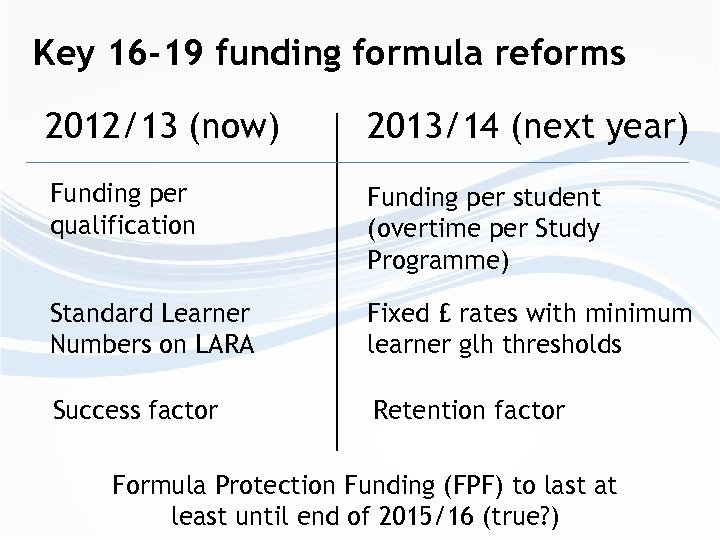 Key 16 -19 funding formula reforms 2012/13 (now) 2013/14 (next year) Funding per qualification Funding per student (overtime per Study Programme) Standard Learner Numbers on LARA Fixed £ rates with minimum learner glh thresholds Success factor Retention factor Formula Protection Funding (FPF) to last at least until end of 2015/16 (true? )
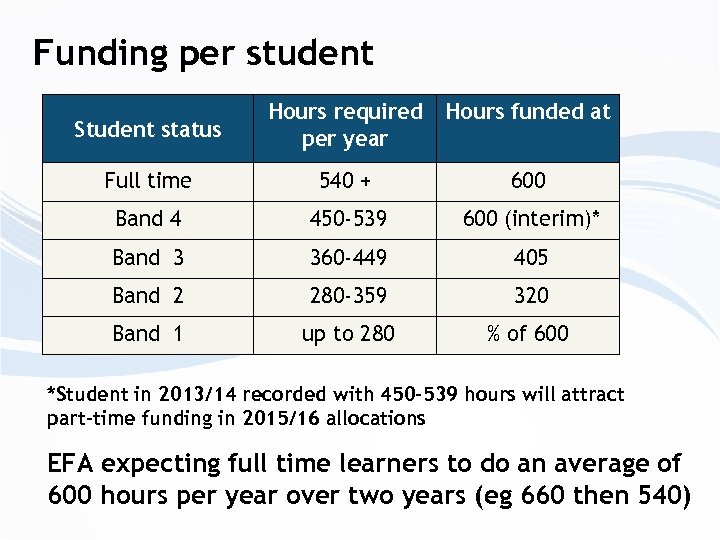 Funding per student Student status Hours required per year Hours funded at Full time 540 + 600 Band 4 450 -539 600 (interim)* Band 3 360 -449 405 Band 2 280 -359 320 Band 1 up to 280 % of 600 *Student in 2013/14 recorded with 450 -539 hours will attract part-time funding in 2015/16 allocations EFA expecting full time learners to do an average of 600 hours per year over two years (eg 660 then 540)
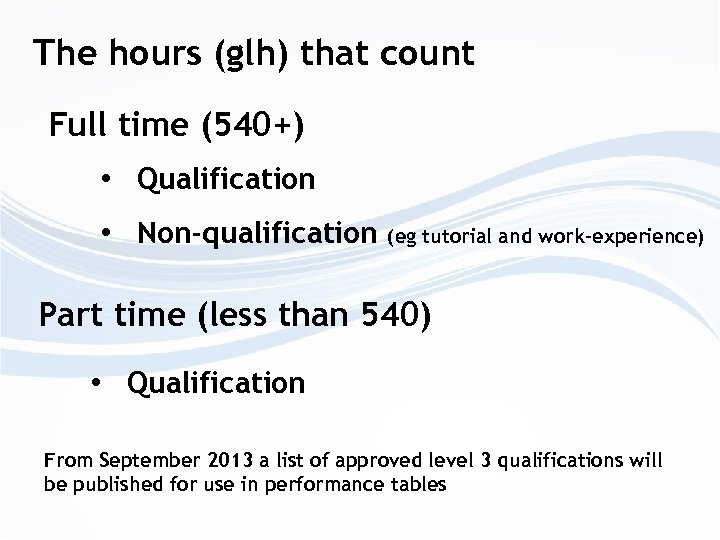 The hours (glh) that count Full time (540+) • Qualification • Non-qualification (eg tutorial and work-experience) Part time (less than 540) • Qualification From September 2013 a list of approved level 3 qualifications will be published for use in performance tables
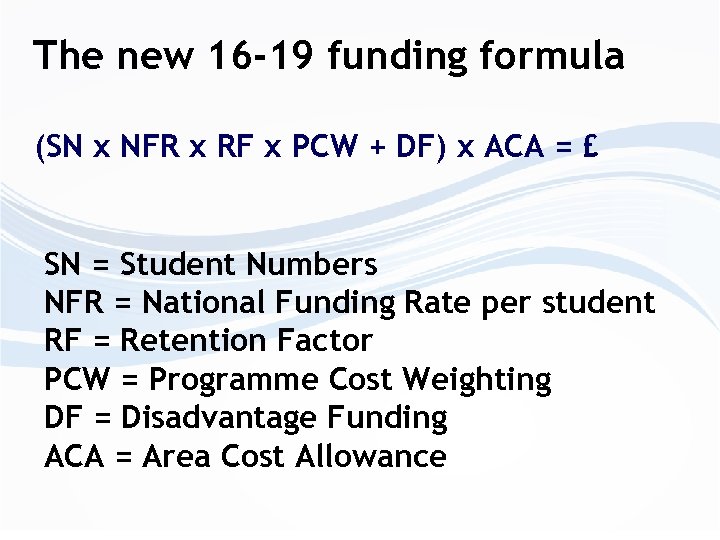 The new 16 -19 funding formula (SN x NFR x RF x PCW + DF) x ACA = £ SN = Student Numbers NFR = National Funding Rate per student RF = Retention Factor PCW = Programme Cost Weighting DF = Disadvantage Funding ACA = Area Cost Allowance
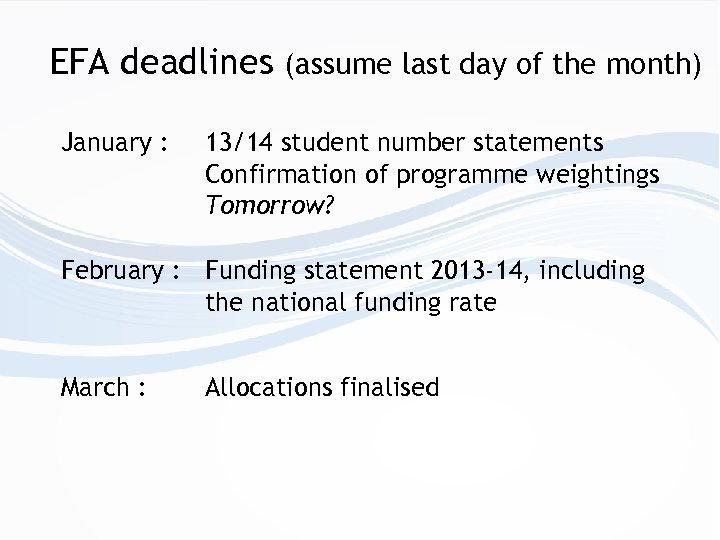 EFA deadlines (assume last day of the month) January : 13/14 student number statements Confirmation of programme weightings Tomorrow? February : Funding statement 2013 -14, including the national funding rate March : Allocations finalised
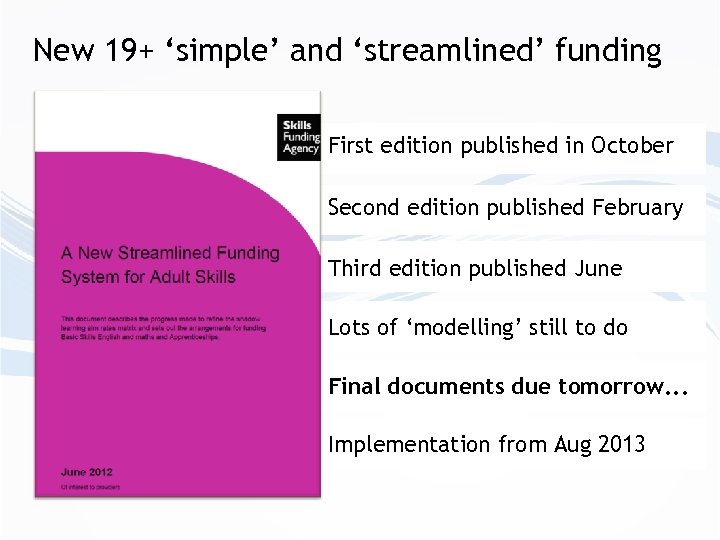 New 19+ ‘simple’ and ‘streamlined’ funding First edition published in October Second edition published February Third edition published June Lots of ‘modelling’ still to do Final documents due tomorrow. . . Implementation from Aug 2013
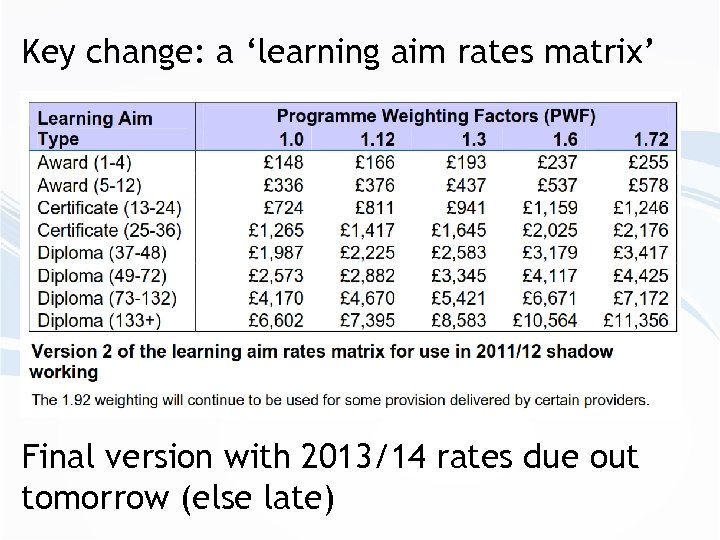 Key change: a ‘learning aim rates matrix’ Final version with 2013/14 rates due out tomorrow (else late)
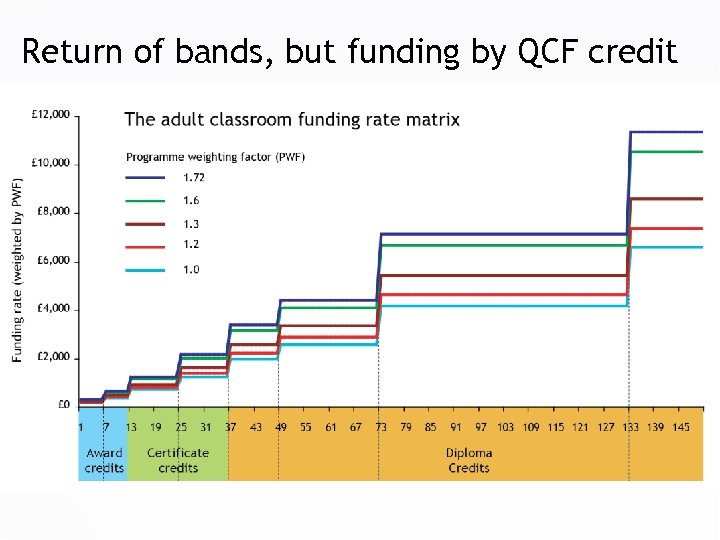 Return of bands, but funding by QCF credit
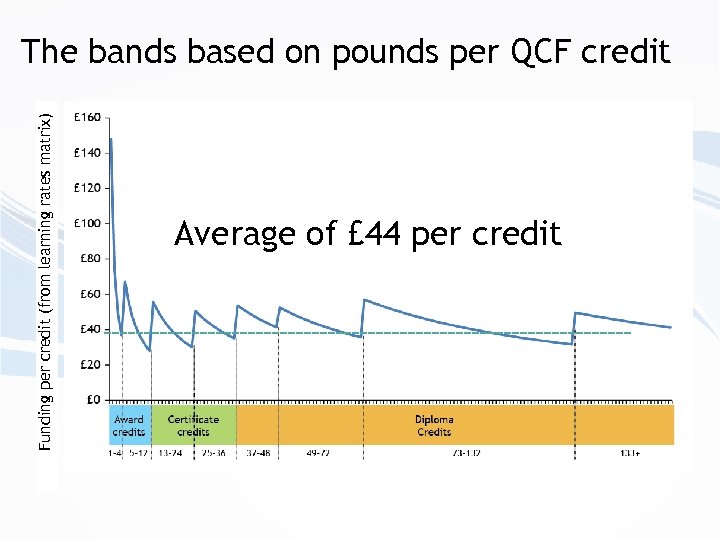 Funding per credit (from learning rates matrix) The bands based on pounds per QCF credit Average of £ 44 per credit
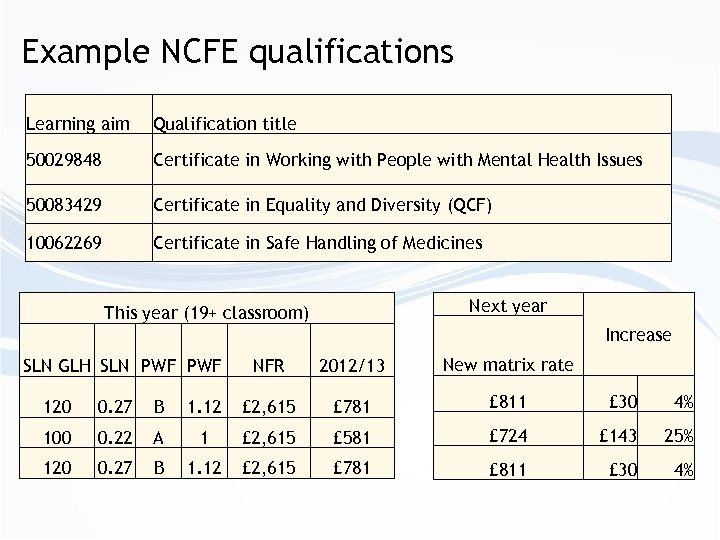 Example NCFE qualifications Learning aim Qualification title 50029848 Certificate in Working with People with Mental Health Issues 50083429 Certificate in Equality and Diversity (QCF) 10062269 Certificate in Safe Handling of Medicines Next year This year (19+ classroom) Increase SLN GLH SLN PWF NFR 2012/13 New matrix rate 120 0. 27 B 1. 12 £ 2, 615 £ 781 £ 811 £ 30 4% 100 0. 22 A 1 £ 2, 615 £ 581 £ 724 £ 143 25% 120 0. 27 B 1. 12 £ 2, 615 £ 781 £ 811 £ 30 4%
 Apprenticeships “Given the major change in the longer term, it as been decided not to proceed in 2013/14 AY with applying the simplified approach to setting Apprenticeships rates to existing frameworks that is being adopted for wider FE qualifications. This approach will, however, be applied for new Apprenticeship frameworks where these are developed. This will ensure that all new funding rates will in future link more transparently to the cost of the component qualifications, with account taken of the additional activities involved in Apprenticeship delivery. All other simplification changes to the system will continue to be made. ” Skills Funding Statement Dec 2011
 Q&A
Q&A