


 Скачать презентацию EEG ECG Measurement and Data Analysis Carlo Lucignoli
7cb44ea6ea1de67b4bc7622ab957aa94.ppt
- Количество слайдов: 31

 EEG, ECG Measurement and Data Analysis Carlo Lucignoli ATSi. P Teesside 2006
 What are we trying to achieve ? The psychologists wish to measure patients’ anxiety. The measurement is shown to patients so they can see their anxiety before they feel it. This enables patients to learn how to monitor and control anxiety when it is still in the early stages. Thus, anxious patients can learn to manage their anxiety before it becomes a problem.
 The Research Experiment • Study brain activity associated with rumination and anxiety. • Alpha brain waves are a good measure of anxiety. • The subject responds to audio and visual cues. • We take psycho-physiological readings such as ECG and EEG while the subject performs the task. • We synchronise the experimental events to the data, so we know when and which thought processes occur. • Readings are manipulated to generate data for statistical analysis
 What do we need to do? • Measurements – Electroencephalograph (EEG) for Alpha-wave brain activity – Electrocardiogram (ECG) for stress level – Skin Conductance Response (SCR) arousal level • Health & Safety – The tester or the participant should not be at risk at any time – Good hygiene, avoid cross contamination – Electrical protection eg. isolation • Participants – Gather participants that meet the required criteria
 The Solution • Choose equipment which will make the task as easy as possible. • EEG is obtained using a Bio. Semi 128 channel Active Electrode system, recorded with Acti. View program. • ECG and SCR recorded using Cambridge Electronic Design (CED) equipment and Spike program. • Data analysis handled by BESA program. • Timing and control is handled by E-Prime program.
 The Participants Criteria • No age restrictions
 The Participants Criteria • No age restrictions • University students
 The Participants Criteria • No age restrictions • University students
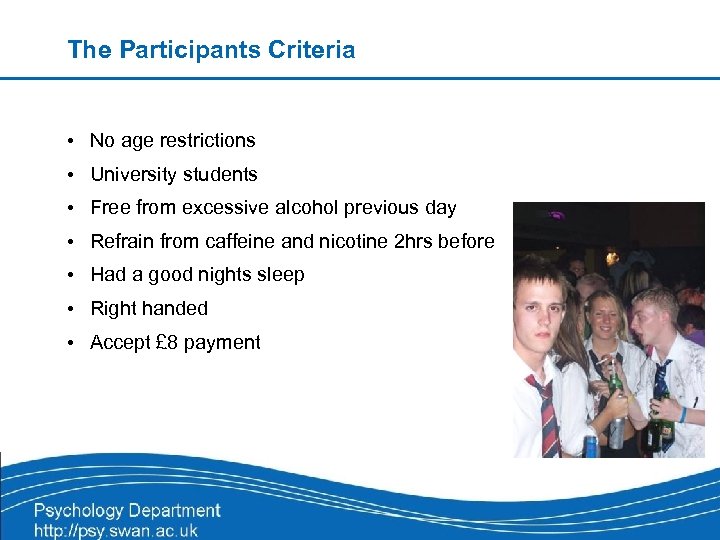 The Participants Criteria • No age restrictions • University students • Free from excessive alcohol previous day • Refrain from caffeine and nicotine 2 hrs before • Had a good nights sleep • Right handed • Accept £ 8 payment
 The Participants Criteria • No age restrictions • University students • Free from excessive alcohol previous day • Refrain from caffeine and nicotine 2 hrs before • Had a good nights sleep • Right handed • Accept £ 8 payment
 Health and Safety • Electrical Safety and Shock Prevention for medical research – Extra Low Voltage (battery) for the EEG System – Bio. Semi Active Electrodes have built in current limit system with auto shutoff – Remaining electrodes have electrical isolation from their amplifiers – Amplifiers are powered by Isolated Power Supply Units • Cross Contamination – Traditionally, electrodes required skin to be scratched to create better electrical contact. This can lead to cross infection – The Bio. Semi Active Electrodes require no skin preparation, making things safer and quicker – Separate washing area was needed to ensure electrodes were kept away from food preparation areas – Disposable electrode pads were used for the remaining signals
 Synchronisation • The experiment is controlled by the PC running E-Prime. • E-Prime presents a series of visual and audible cues to the participant. • In synchrony to these cues, triggers are sent to Bio. Semi (EEG) and CED (ECG and SCR). • Triggers are sent out of the printer port using its 8 data channels. • These may appear as binary, levels, or as a number. • Trigger information contains Record/Pause command task identification • In this way the data indicates exactly where tasks begins and end
 Speed • Commissioning Speed – Plan ahead: Consider how many PCs, monitors, key-boards, amps, etc. there will be, and where will they go. Is there sufficient access to prepare and connect up the participant? – This experiment requires the participant be in a separate room – 3 PCs, two fitted with a pair of monitors, keyboards and mice, speakers – Assembly: Hole through wall, are cables long enough? – Setup correct settings before you start – Read the instruction manual before you start no matter how unnatural it may seem
 Speed • For those of you who’ve never seen one, here is an example.
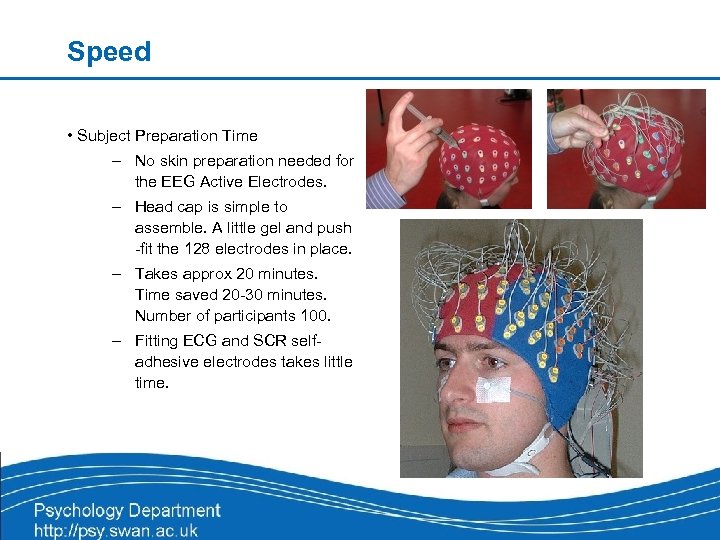 Speed • Subject Preparation Time – No skin preparation needed for the EEG Active Electrodes. – Head cap is simple to assemble. A little gel and push -fit the 128 electrodes in place. – Takes approx 20 minutes. Time saved 20 -30 minutes. Number of participants 100. – Fitting ECG and SCR selfadhesive electrodes takes little time.
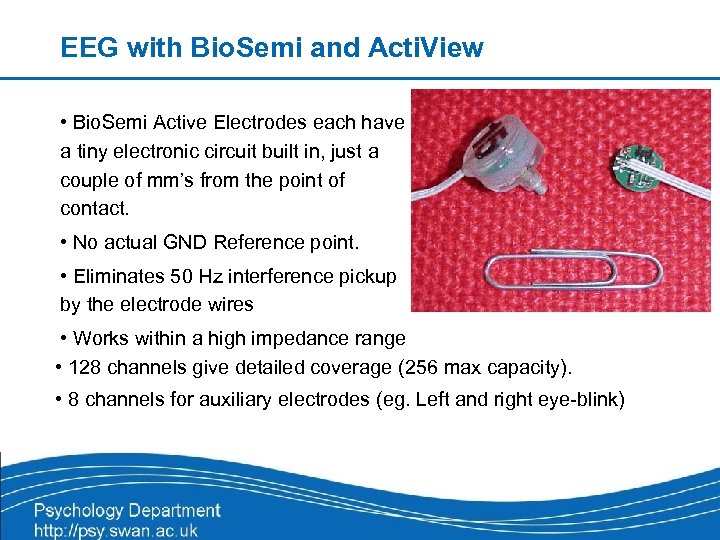 EEG with Bio. Semi and Acti. View • Bio. Semi Active Electrodes each have a tiny electronic circuit built in, just a couple of mm’s from the point of contact. • No actual GND Reference point. • Eliminates 50 Hz interference pickup by the electrode wires • Works within a high impedance range • 128 channels give detailed coverage (256 max capacity). • 8 channels for auxiliary electrodes (eg. Left and right eye-blink)
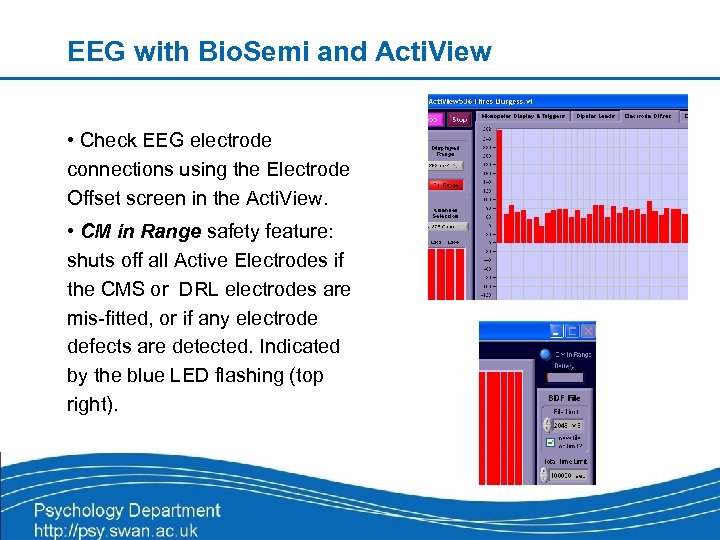 EEG with Bio. Semi and Acti. View • Check EEG electrode connections using the Electrode Offset screen in the Acti. View. • CM in Range safety feature: shuts off all Active Electrodes if the CMS or DRL electrodes are mis-fitted, or if any electrode defects are detected. Indicated by the blue LED flashing (top right).
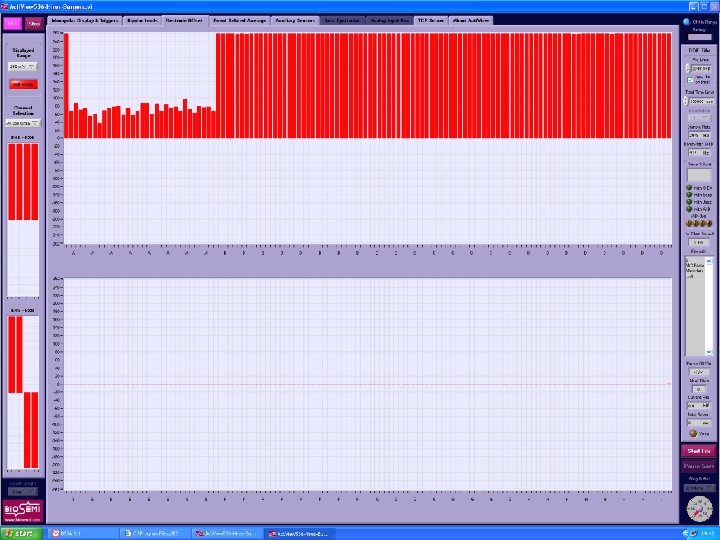 EEG with Bio. Semi and Acti. View • Check EEG electrode connections using the Electrode Offset screen
 EEG with Bio. Semi and Acti. View • Record EEG with Acti. View. • Simple and straightforward to use. • Data is sent to the PC via a fibre optic cable (electrically isolated). • Settings can be stored in a configuration file (. cfg) and loaded each time Acti. View is run. • Other uses of the configuration file include: – Enables the remote record function ‘pause save’. – Stores the file location where data file will be stored.
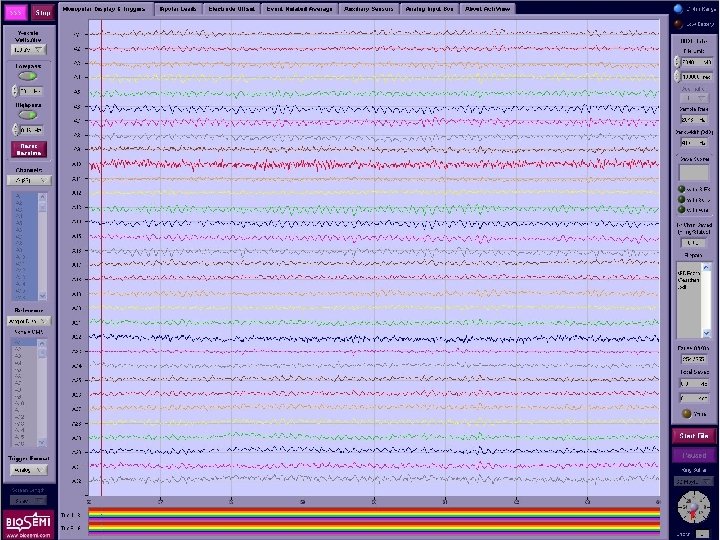 EEG with Bio. Semi and Acti. View • Record EEG signals with Acti. View Program • Simple and straight forward to use • The settings for your particular experiment can be stored in a configuration file (. cfg) and loaded each time you open Acti. View through a desktop shortcut • Other uses of the configuration file – Enables the remote record function ‘pause save’ – Holds the file path name to where BDF data file will be stored
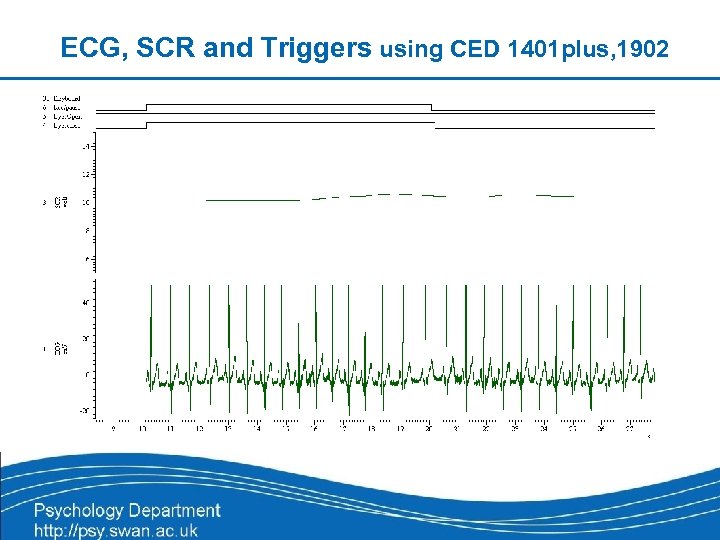 ECG, SCR and Triggers using CED 1401 plus, 1902
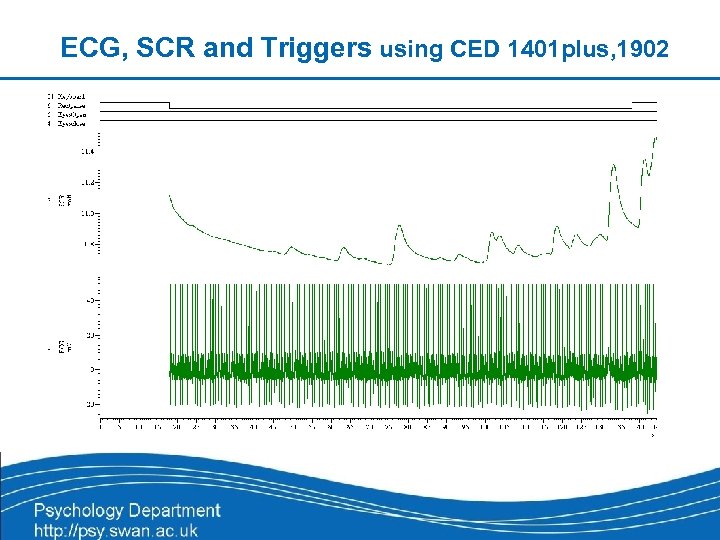 ECG, SCR and Triggers using CED 1401 plus, 1902
 Data Analysis BESA Software: • BESA is a highly versatile and user-friendly program • Widely used for source analysis in EEG research • 2 D and 3 D images • Supports scripts for automating repetitive tasks • What does it look like?
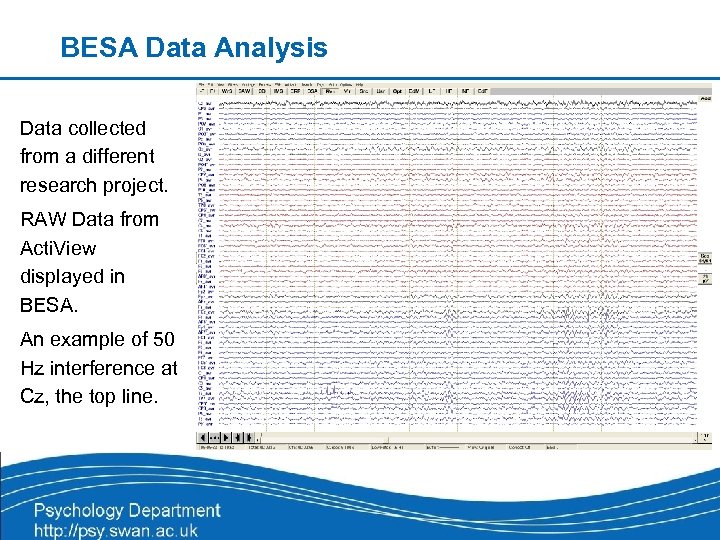 BESA Data Analysis Data collected from a different research project. RAW Data from Acti. View displayed in BESA. An example of 50 Hz interference at Cz, the top line.
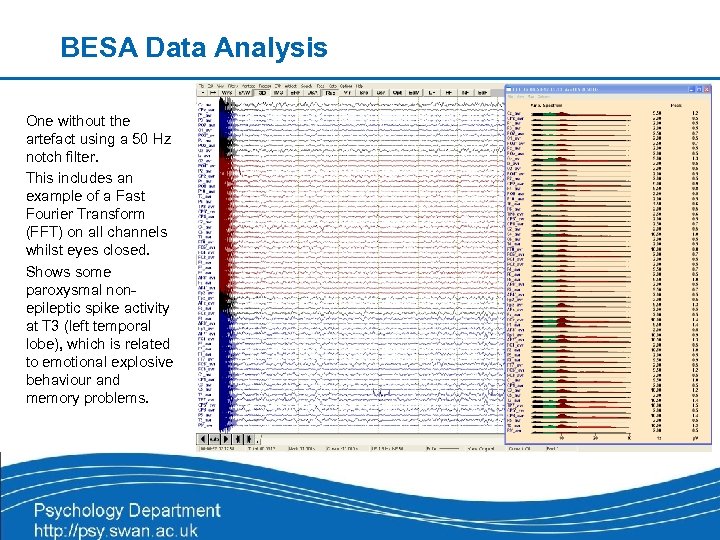 BESA Data Analysis One without the artefact using a 50 Hz notch filter. This includes an example of a Fast Fourier Transform (FFT) on all channels whilst eyes closed. Shows some paroxysmal nonepileptic spike activity at T 3 (left temporal lobe), which is related to emotional explosive behaviour and memory problems.
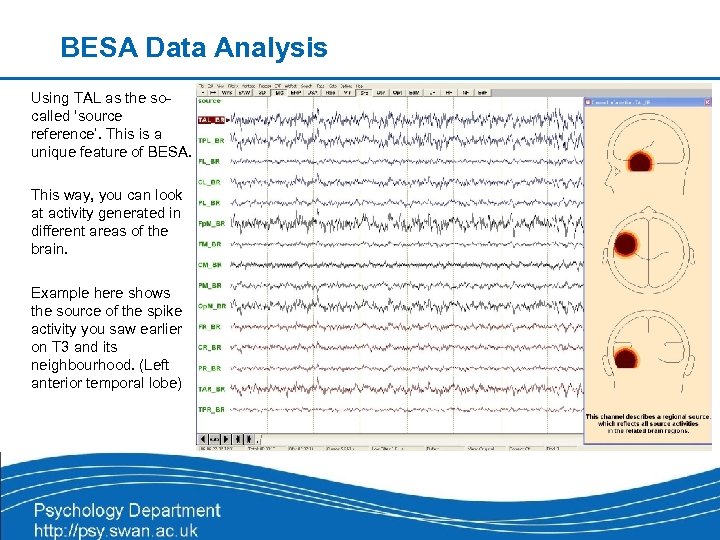 BESA Data Analysis Using TAL as the socalled ‘source reference’. This is a unique feature of BESA. This way, you can look at activity generated in different areas of the brain. Example here shows the source of the spike activity you saw earlier on T 3 and its neighbourhood. (Left anterior temporal lobe)
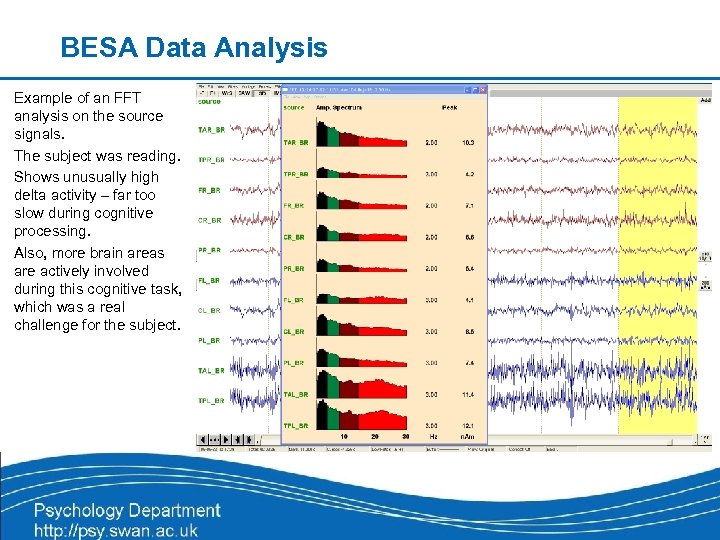 BESA Data Analysis Example of an FFT analysis on the source signals. The subject was reading. Shows unusually high delta activity – far too slow during cognitive processing. Also, more brain areas are actively involved during this cognitive task, which was a real challenge for the subject.
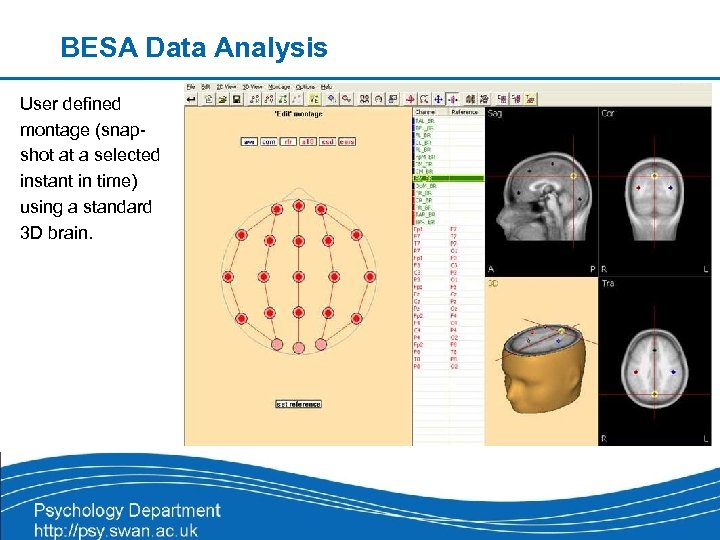 BESA Data Analysis User defined montage (snapshot at a selected instant in time) using a standard 3 D brain.
 Summary What did we do? • Stayed safe electrically and medically • Gathered approximately 100 participants • Used two rooms • Recorded EEG on PC 1 with Bio. Semi Active Electrode equipment • Analysed EEG on PC 1 with BESA • Recorded & analysed ECG and SCR data on PC 2 with CED hardware and Spike • Controlled the experiment on PC 3 with E-Prime and connected it to the other two PCs • Connect systems between both rooms using 5 monitors, 4 keyboards and mice etc. • Benefits of using Bio. Semi Active Electrodes: – Low noise levels due to first amplifier stage being in the electrode – Saves approx 30 minutes as there is no need to prepare the skin surface – Almost no risk of infection • Experiment documented for future reference
 Thank you all for listening THE END Some images from Acti. View, BESA and CED