 Скачать презентацию EEG and Event Related Potentials in Psychiatry October
4440f55837f60944350be8664dec75a0.ppt
- Количество слайдов: 46




EEG and Event Related Potentials in Psychiatry October 16, 2013 Pál Czobor, Ph. D. Semmelweis Universtity, Department of Psychiatry and Psychotherapy, Budapest
Presentation Outline • Classification of bioelectric signals • Spontaneous/resting EEG (Intro) • Event Related Potentials (ERP, Intro) • improving signal-to-noise ratio (artifact rejection) • improving signal-to-noise (averaging) • 3 -dimensional EEG/ERP tomography • Illustration of types of ERP, with examples of psychiatric applications
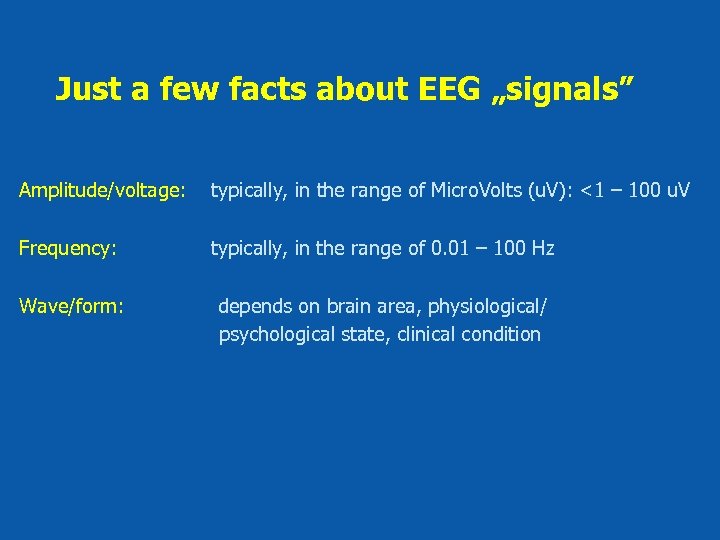
Just a few facts about EEG „signals” Amplitude/voltage: typically, in the range of Micro. Volts (u. V): <1 – 100 u. V Frequency: typically, in the range of 0. 01 – 100 Hz Wave/form: depends on brain area, physiological/ psychological state, clinical condition
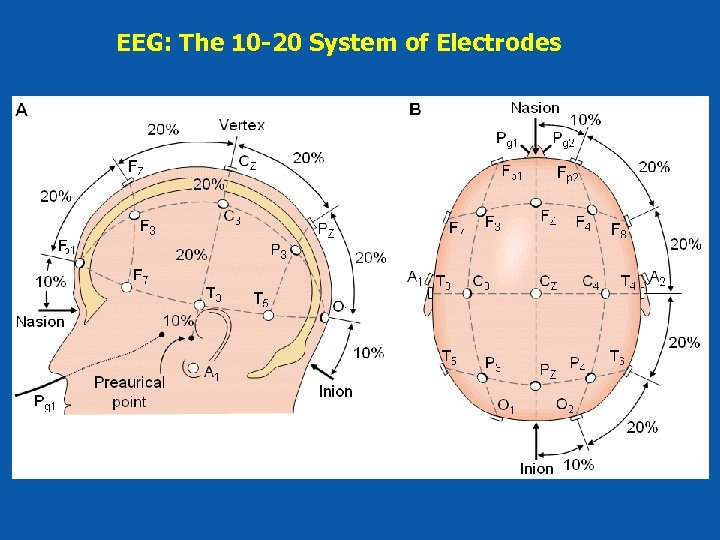
EEG: The 10 -20 System of Electrodes
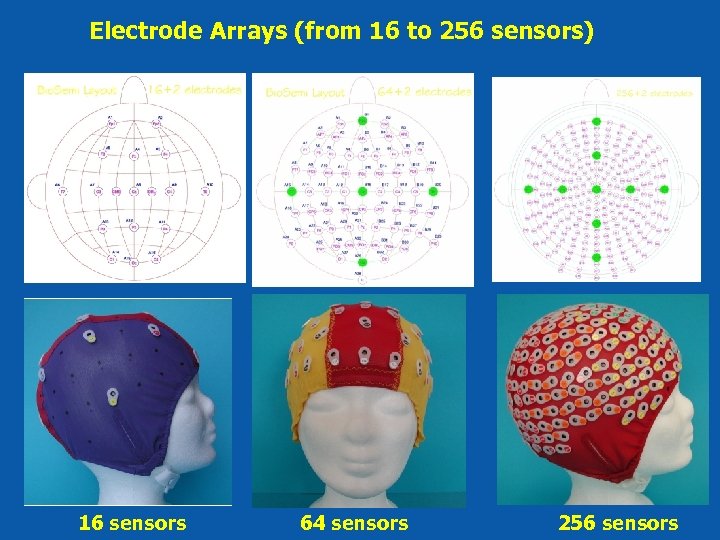
Electrode Arrays (from 16 to 256 sensors) 16 sensors 64 sensors 256 sensors
Bioelectric Signals of the Brain 2 major groups Spontaneous EEG: „spontaneous” electrical activity of the billions of neurons of the brain. It is „always there” in the brain, and in general in the clinical routine it is recorded from the scalp. The best way to picture it as a voltage fluctuation that changes as a function of time. 3 important measures can be used for its description: - its magnitude, i. e. , amplitude (in microvolts, u. V) - frequency (Hz, vagy cycles/s), i. e. , how many times the signal crosses the baseline - waveform/shape (e. g. , „sharp waves”) Even Related Potentials: changes in the EEG signals in relation to specific events such as internal or external stimuli, events, or movement
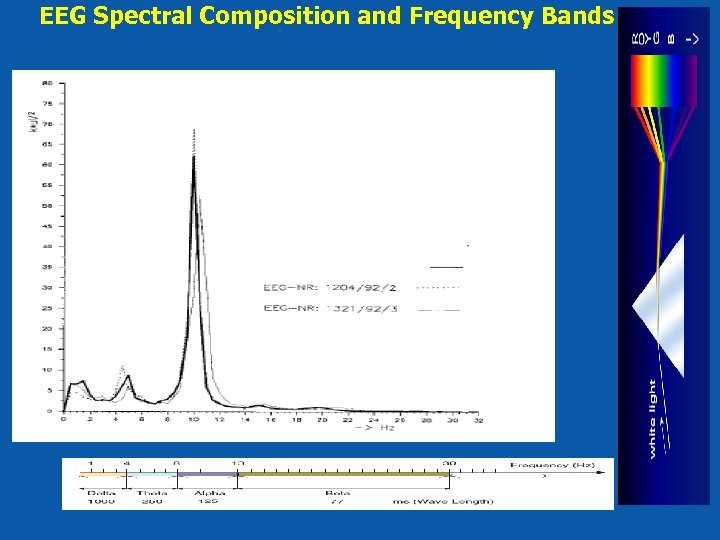
EEG Spectral Composition and Frequency Bands
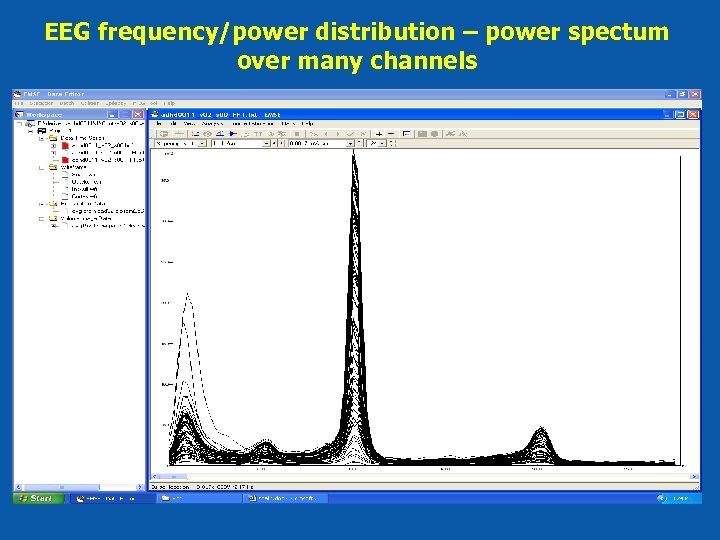
EEG frequency/power distribution – power spectum over many channels
Event Related Potentials - If a stimulus is presented to a person – e. g. , a flash of light or tone burst – then the spontaneous ongoing EEG activity changes: a series of transient waves occurs. This series of waves is called ERP. - The number of peaks and troughs in the ERP waveform is a function of the complexity of the stimuli. In case of simple stimuli this means only 3 -4 waves. In case of complex psychological stimuli (e. g. , name of the person) 5 -8 waves are generated. - One basic problem: the amplitude of the ERP „waves” is much smaller than the backgroung EEG. Therefore, the Signal -to-Noise Ratio (SNR) needs to be improved.
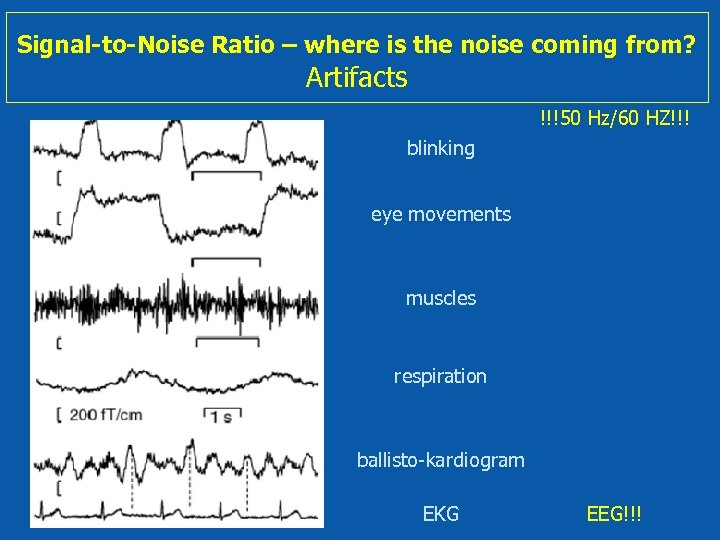
Signal-to-Noise Ratio – where is the noise coming from? Artifacts !!!50 Hz/60 HZ!!! blinking eye movements muscles respiration ballisto-kardiogram EKG EEG!!!
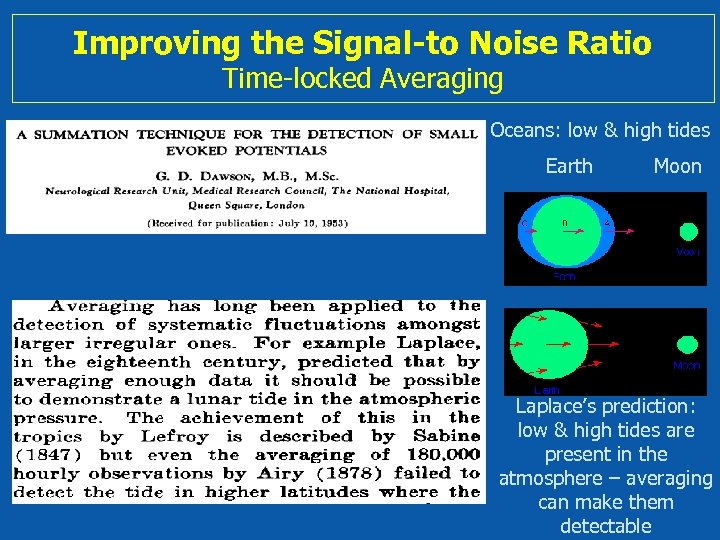
Improving the Signal-to Noise Ratio Time-locked Averaging Oceans: low & high tides Earth Moon Laplace’s prediction: low & high tides are present in the atmosphere – averaging can make them detectable
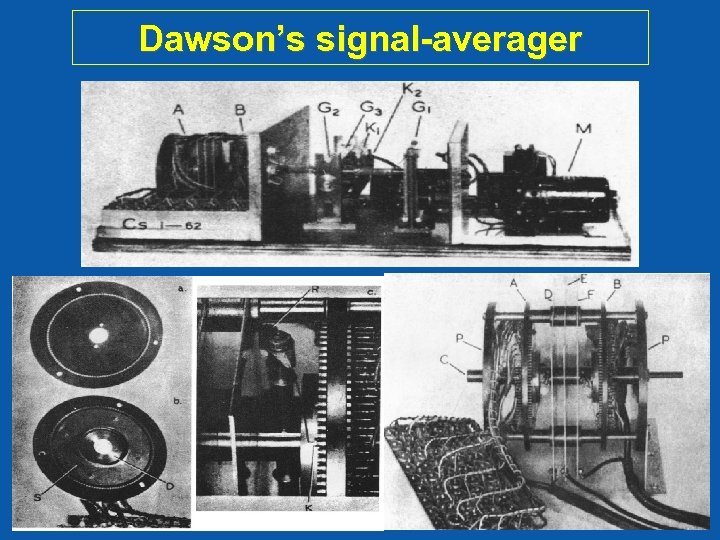
Dawson’s signal-averager
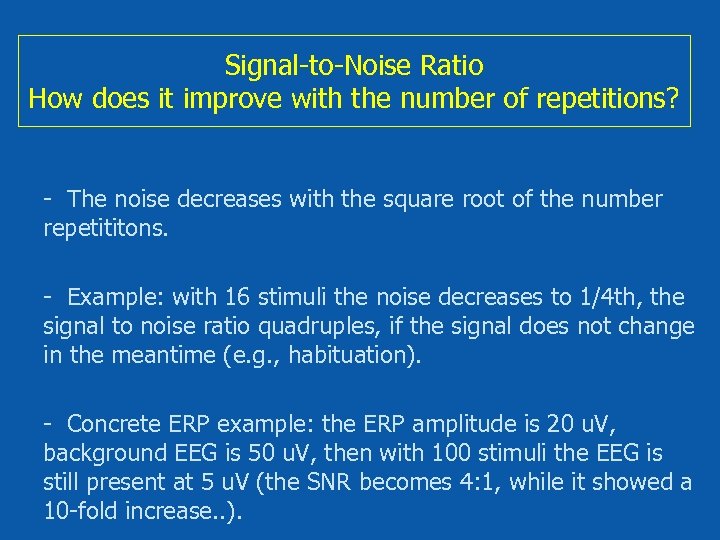
Signal-to-Noise Ratio How does it improve with the number of repetitions? - The noise decreases with the square root of the number repetititons. - Example: with 16 stimuli the noise decreases to 1/4 th, the signal to noise ratio quadruples, if the signal does not change in the meantime (e. g. , habituation). - Concrete ERP example: the ERP amplitude is 20 u. V, background EEG is 50 u. V, then with 100 stimuli the EEG is still present at 5 u. V (the SNR becomes 4: 1, while it showed a 10 -fold increase. . ).
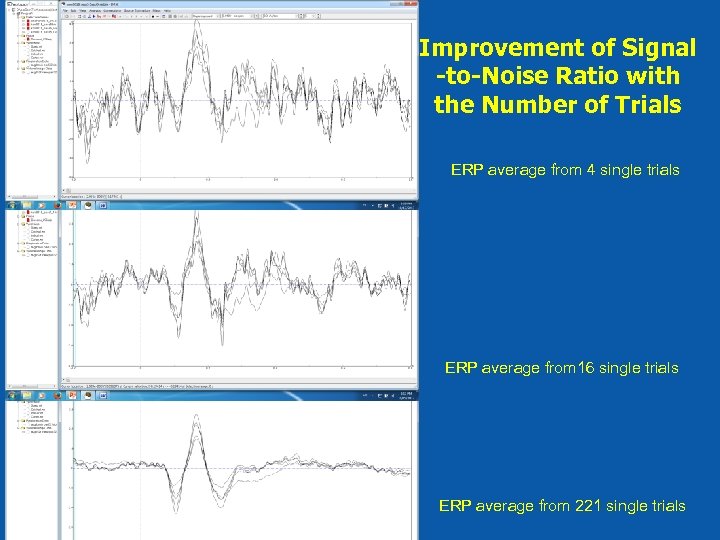
Improvement of Signal -to-Noise Ratio with the Number of Trials ERP average from 4 single trials ERP average from 16 single trials ERP average from 221 single trials
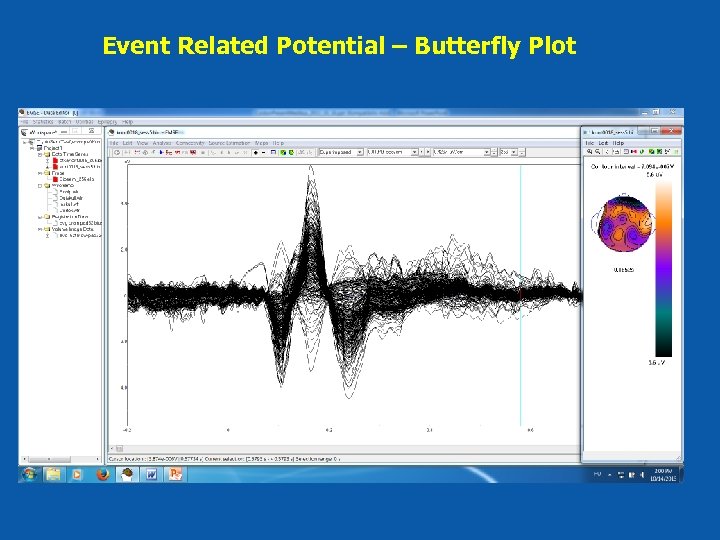
Event Related Potential – Butterfly Plot
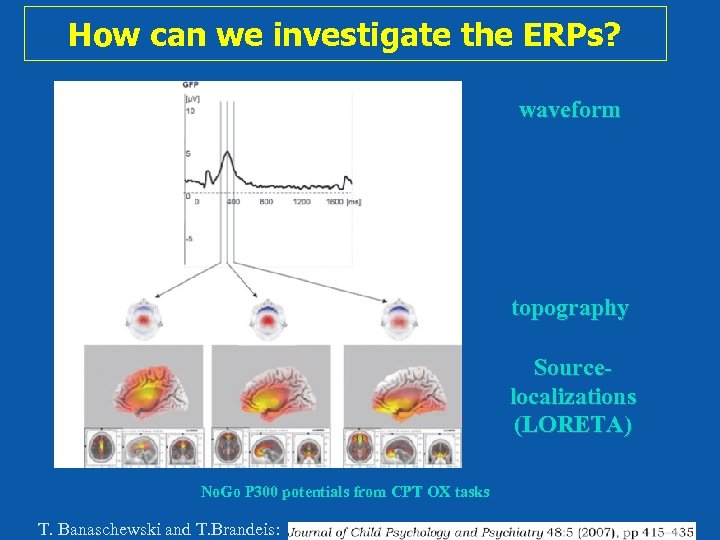
How can we investigate the ERPs? waveform topography Sourcelocalizations (LORETA) No. Go P 300 potentials from CPT OX tasks T. Banaschewski and T. Brandeis:
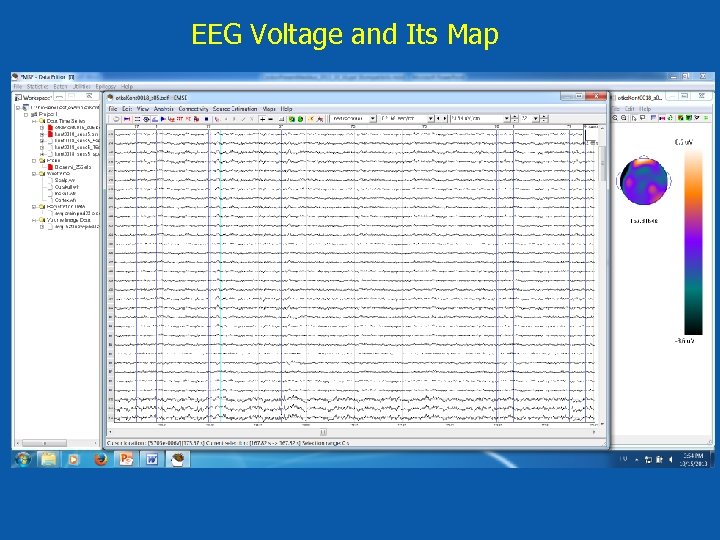
EEG Voltage and Its Map
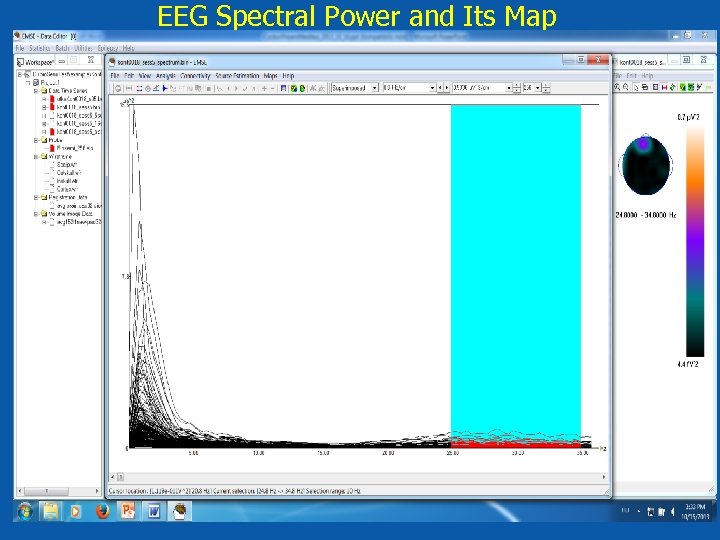
EEG Spectral Power and Its Map EEG power distribution in time and frequency during voluntary finger movement (onset time=0) for electrode above sensorimotor cortex. Desynchronization (amplitude reduction) is visible for alpha and beta before the movement and their synchronization is present after the movement.
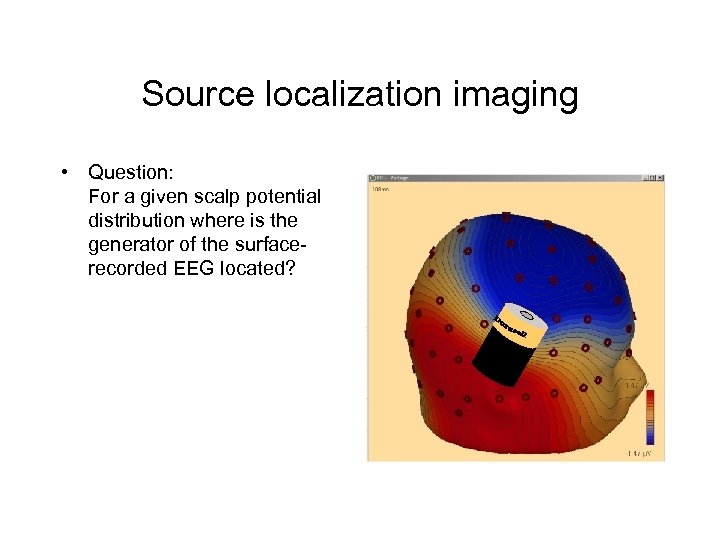
Source localization imaging • Question: For a given scalp potential distribution where is the generator of the surfacerecorded EEG located?
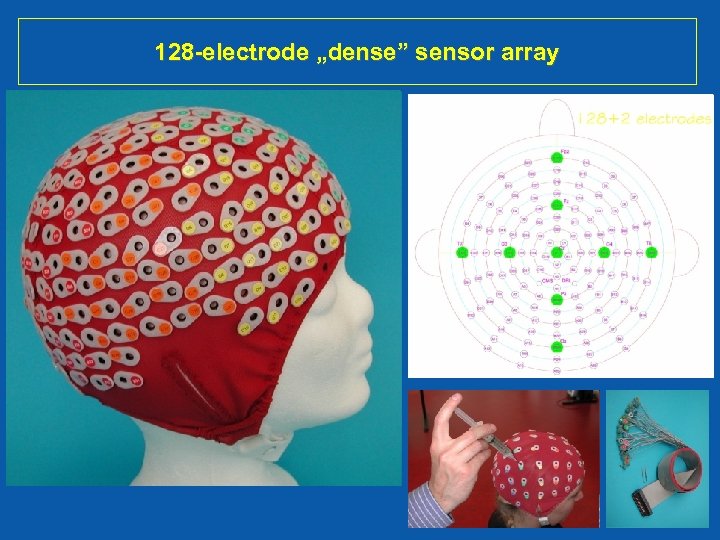
128 -electrode „dense” sensor array
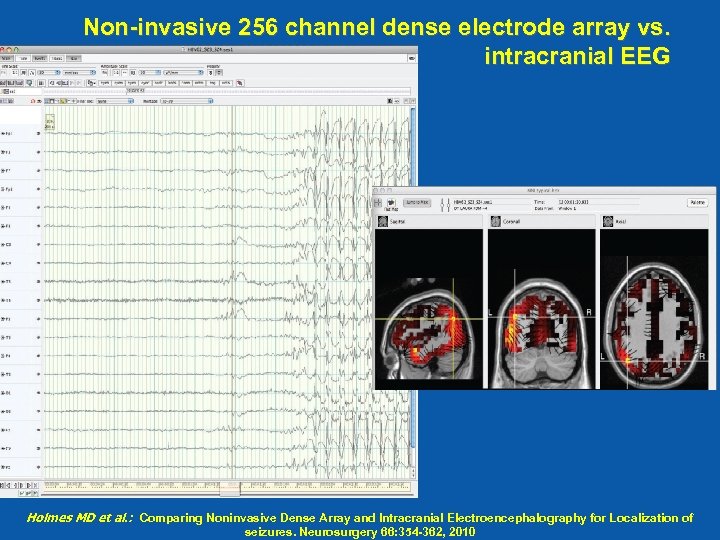
Non-invasive 256 channel dense electrode array vs. intracranial EEG Holmes MD et al. : Comparing Noninvasive Dense Array and Intracranial Electroencephalography for Localization of seizures. Neurosurgery 66: 354 -362, 2010
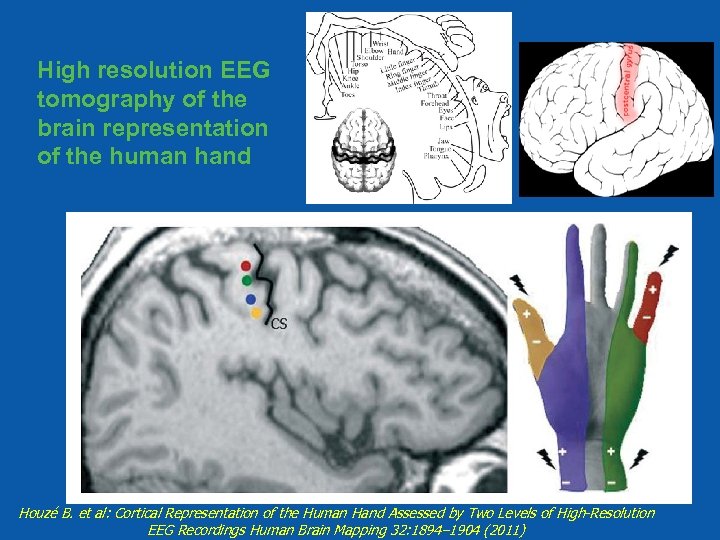
High resolution EEG tomography of the brain representation of the human hand Houzé B. et al: Cortical Representation of the Human Hand Assessed by Two Levels of High-Resolution EEG Recordings Human Brain Mapping 32: 1894– 1904 (2011)
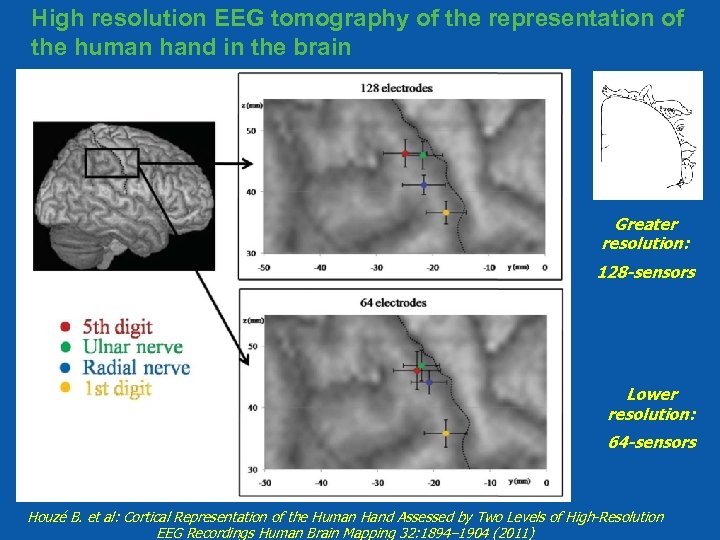
High resolution EEG tomography of the representation of the human hand in the brain Greater resolution: 128 -sensors Lower resolution: 64 -sensors Houzé B. et al: Cortical Representation of the Human Hand Assessed by Two Levels of High-Resolution EEG Recordings Human Brain Mapping 32: 1894– 1904 (2011)
Exogenous & endogenous ERP components - The earliest components from the primary sensory brain areas – they are called „exogeneous” ERPs, since they represent sensory information. - Often they are called (Stimulus-) Evoked Potentials (EPs). Earlier EP was used as an umbrella term for all time-locked EEG events, but after the description of endogenous and motor potentials, Herbert Vaughn introduced the more general ERP term. - „Endogenous” ERPs: late components of the ERP, which represent psychological responses to external stimuli.
An Endogenous ERP – the P 300: a positive amplitude component which is generated for rare and „meaningful” stimuli (<40% probability) P 300 was described by Sutton et al. in 1965: high and low pitch tones were presented in random order at 8: 2 ratio, subjects were told to count the stimuli. The rare tones were followed by P 300 (regardless whether the low or high tone served for rare). ODDBALL PARADIGM. The stimuli were simple „clicks” - the latency of P 300 was cca. 250 -300 msec. Complex stimuli may result in latencies in the range of 400 -800 msec. P 300 latency indicates stimulus complexity and processing time.
Endogeneous ERPs – P 300 - The scalp distribution of P 300 helps its identification: typically it is maximal at the Pz electrode. - The amplitude of P 300 is proportional with how rare and „meaningful” the stimulus is. - A stimulus can be made meaningful by linking it to a task (e. g. , counting). Other stimuli are meaningful in and of themselves, e. g. , infos relating to ourselves, names, birth dates, phone numbers, or details pertaining to a crime. . ).
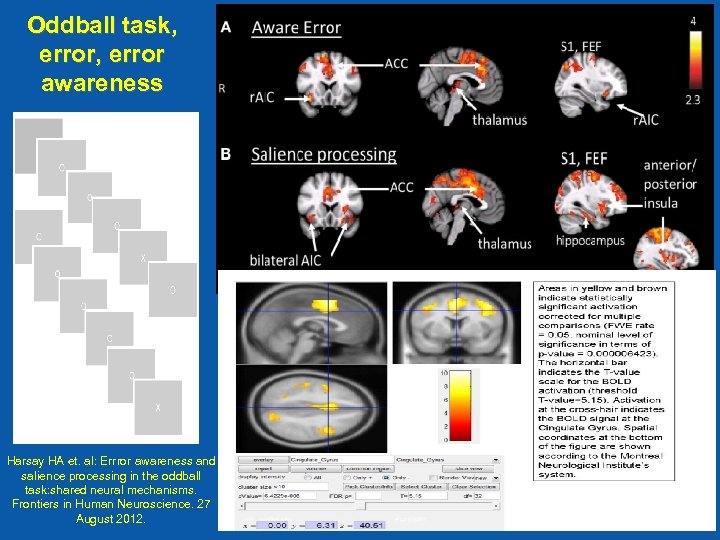
Oddball task, error awareness Harsay HA et. al: Errror awareness and salience processing in the oddball task: shared neural mechanisms. Frontiers in Human Neuroscience. 27 August 2012.
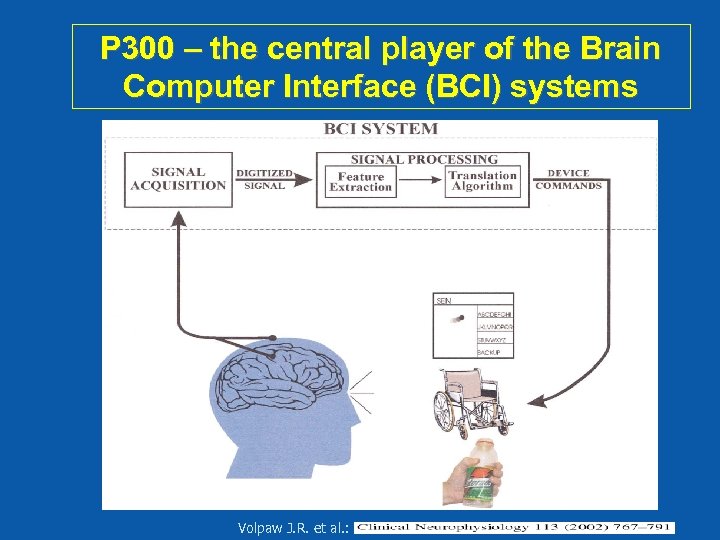
P 300 – the central player of the Brain Computer Interface (BCI) systems Volpaw J. R. et al. :
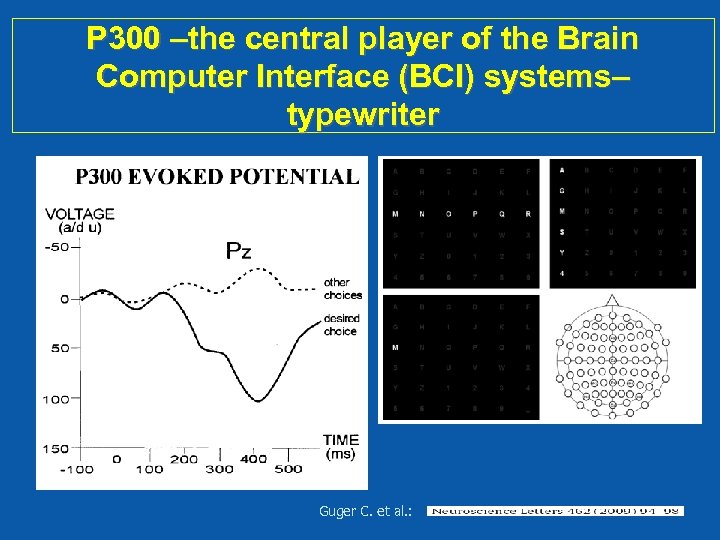
P 300 –the central player of the Brain Computer Interface (BCI) systems– typewriter Guger C. et al. :
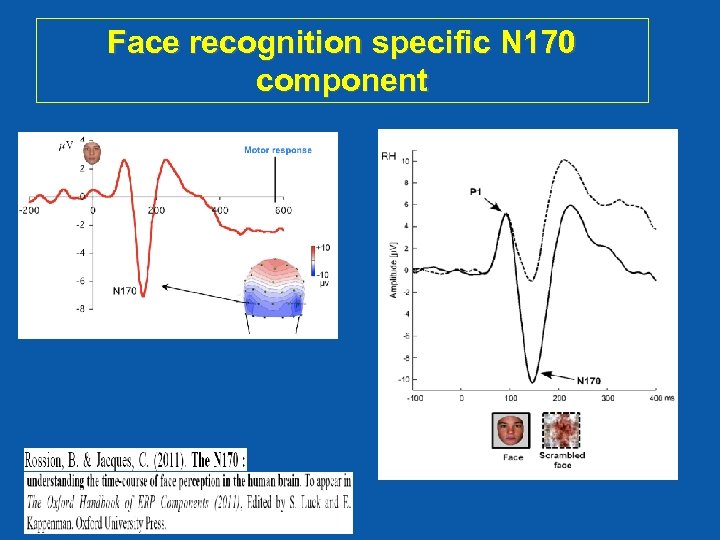
Face recognition specific N 170 component
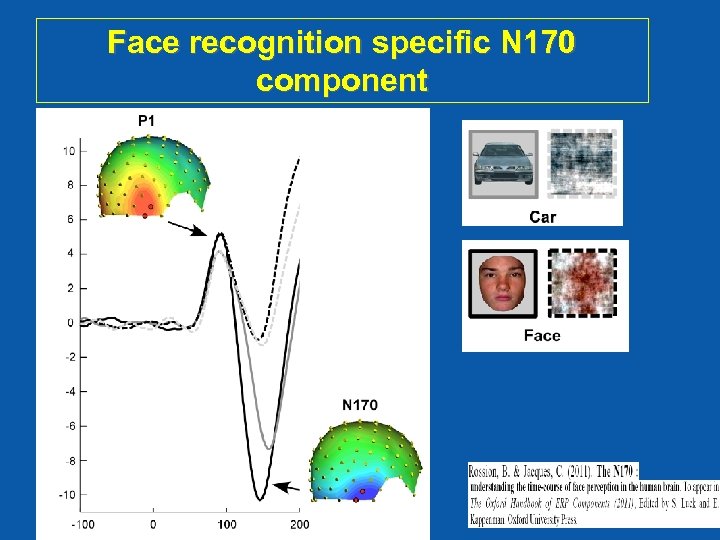
Face recognition specific N 170 component
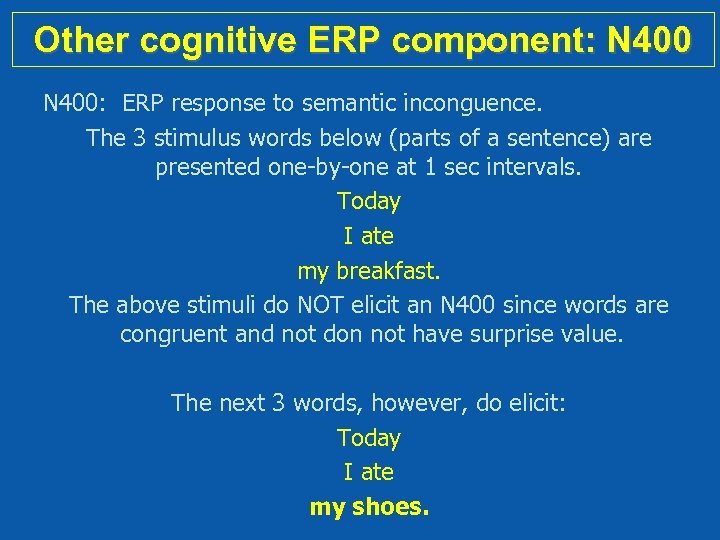
Other cognitive ERP component: N 400: ERP response to semantic inconguence. The 3 stimulus words below (parts of a sentence) are presented one-by-one at 1 sec intervals. Today I ate my breakfast. The above stimuli do NOT elicit an N 400 since words are congruent and not don not have surprise value. The next 3 words, however, do elicit: Today I ate my shoes.
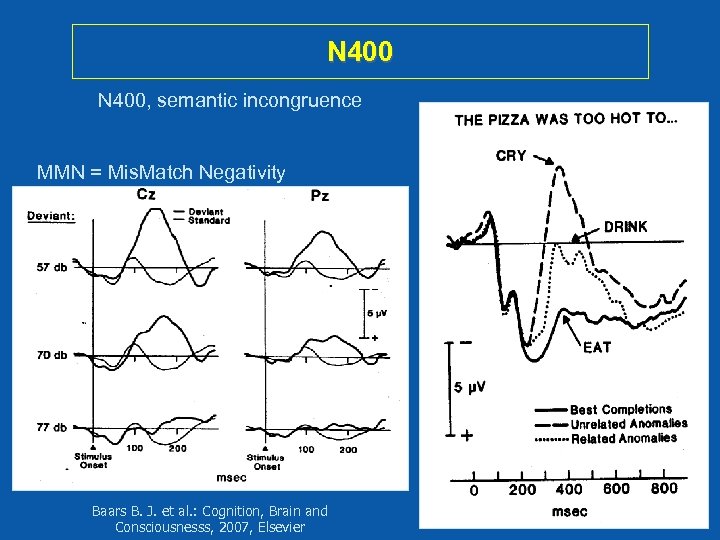
N 400, semantic incongruence MMN = Mis. Match Negativity Baars B. J. et al. : Cognition, Brain and Consciousnesss, 2007, Elsevier
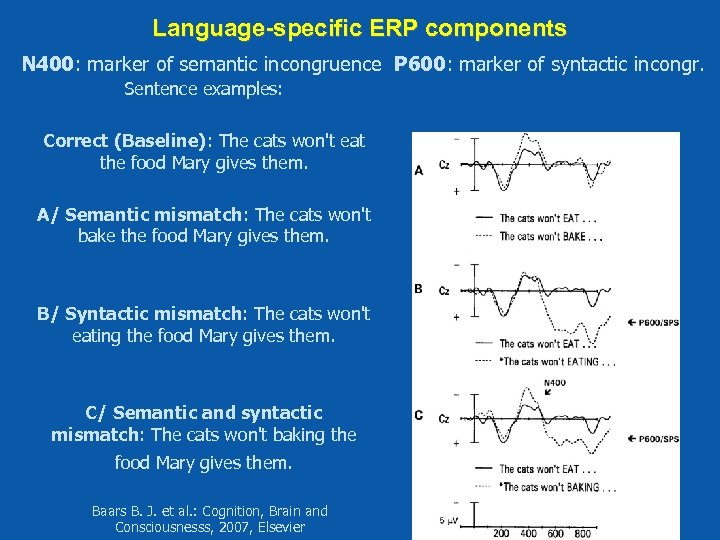
Language-specific ERP components N 400: marker of semantic incongruence P 600: marker of syntactic incongr. Sentence examples: Correct (Baseline): The cats won't eat the food Mary gives them. A/ Semantic mismatch: The cats won't bake the food Mary gives them. B/ Syntactic mismatch: The cats won't eating the food Mary gives them. C/ Semantic and syntactic mismatch: The cats won't baking the food Mary gives them. Baars B. J. et al. : Cognition, Brain and Consciousnesss, 2007, Elsevier
Motor ERP components: They appear in those motor areas that initiate and execute movements. They reflect the sychronized and summed synaptic activity of pyramidal neurons.
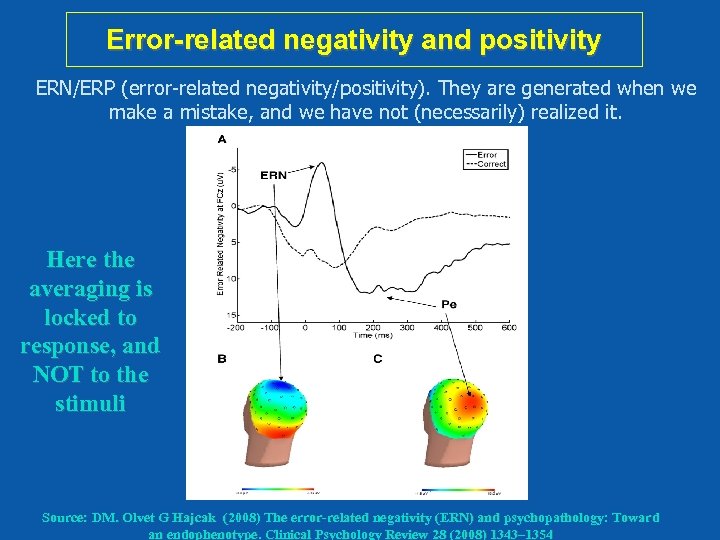
Error-related negativity and positivity ERN/ERP (error-related negativity/positivity). They are generated when we make a mistake, and we have not (necessarily) realized it. Here the averaging is locked to response, and NOT to the stimuli Source: DM. Olvet G Hajcak (2008) The error-related negativity (ERN) and psychopathology: Toward an endophenotype. Clinical Psychology Review 28 (2008) 1343– 1354
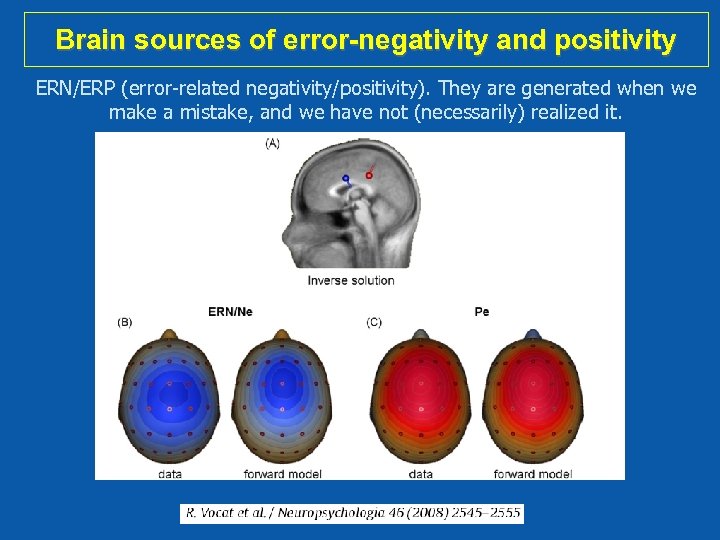
Brain sources of error-negativity and positivity ERN/ERP (error-related negativity/positivity). They are generated when we make a mistake, and we have not (necessarily) realized it.
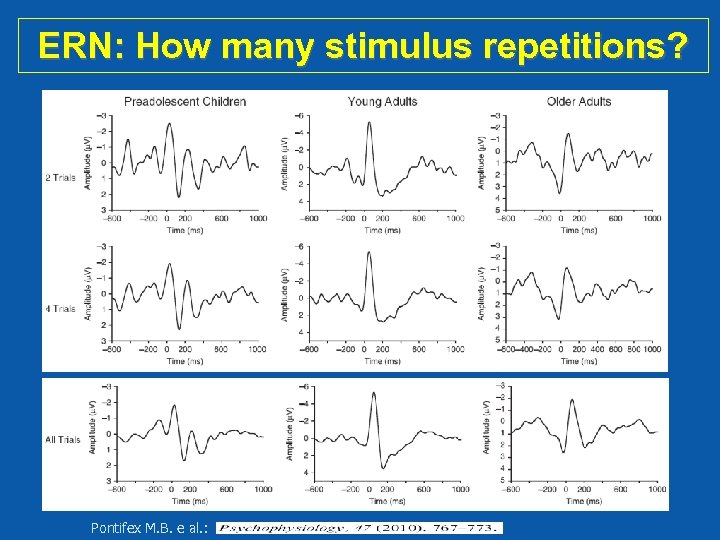
ERN: How many stimulus repetitions? Pontifex M. B. e al. :
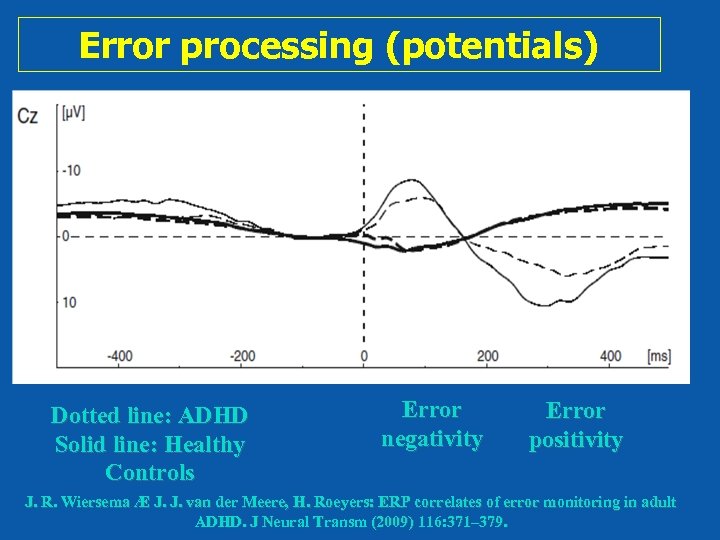
Error processing (potentials) Dotted line: ADHD Solid line: Healthy Controls Error negativity Error positivity J. R. Wiersema Æ J. J. van der Meere, H. Roeyers: ERP correlates of error monitoring in adult ADHD. J Neural Transm (2009) 116: 371– 379.
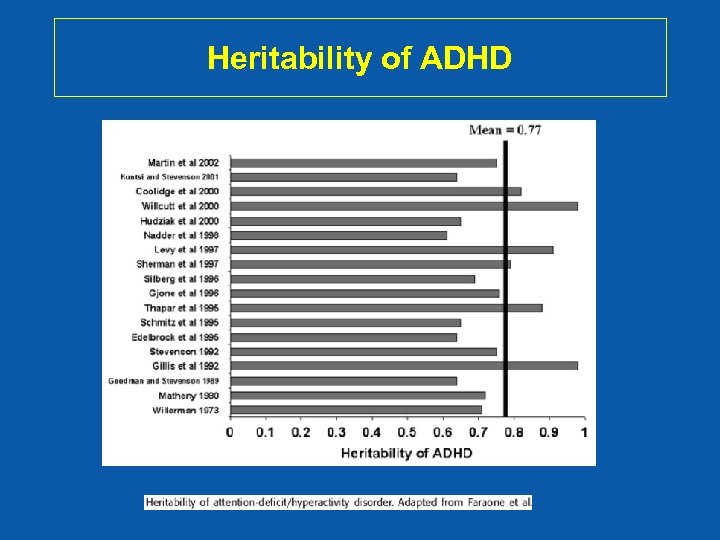
Heritability of ADHD
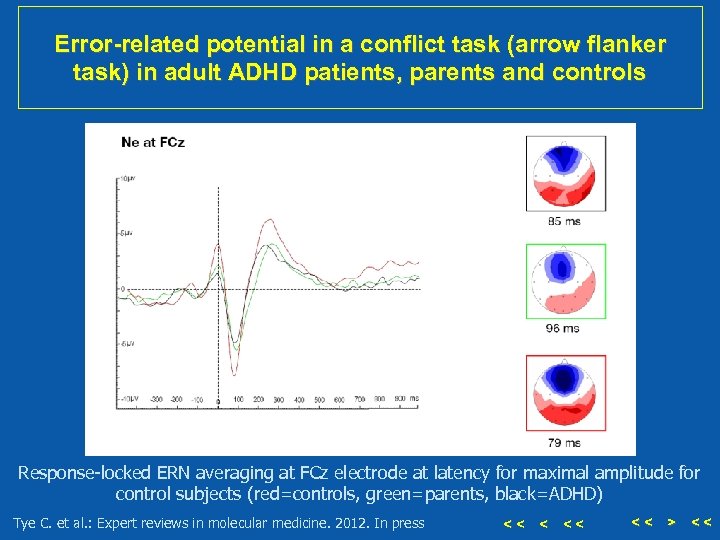
Error-related potential in a conflict task (arrow flanker task) in adult ADHD patients, parents and controls Response-locked ERN averaging at FCz electrode at latency for maximal amplitude for control subjects (red=controls, green=parents, black=ADHD) Tye C. et al. : Expert reviews in molecular medicine. 2012. In press << << > <<
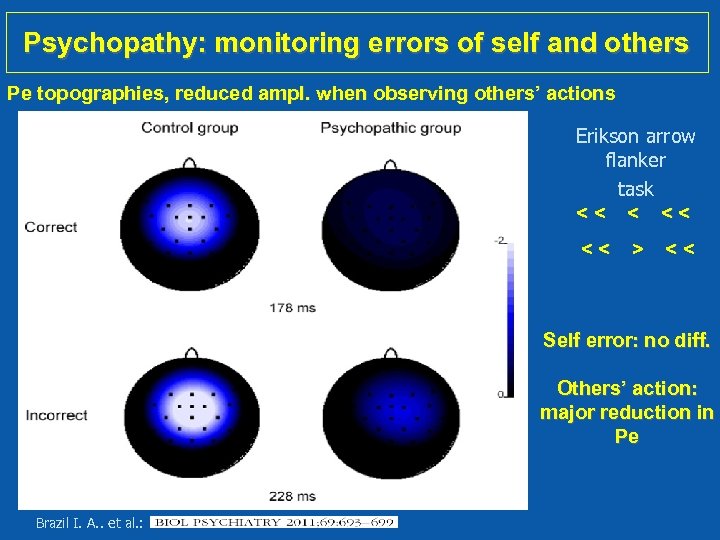
Psychopathy: monitoring errors of self and others Pe topographies, reduced ampl. when observing others’ actions Erikson arrow flanker task << << > << Self error: no diff. Others’ action: major reduction in Pe Brazil I. A. . et al. :
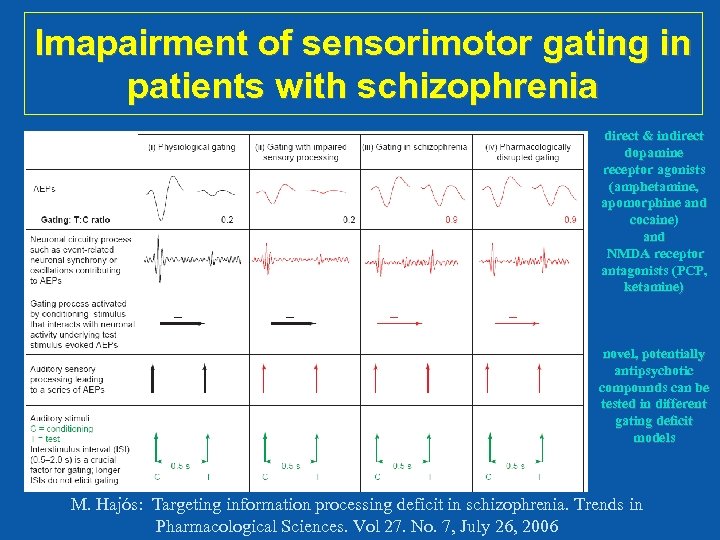
Imapairment of sensorimotor gating in patients with schizophrenia direct & indirect dopamine receptor agonists (amphetamine, apomorphine and cocaine) and NMDA receptor antagonists (PCP, ketamine) novel, potentially antipsychotic compounds can be tested in different gating deficit models M. Hajós: Targeting information processing deficit in schizophrenia. Trends in Pharmacological Sciences. Vol 27. No. 7, July 26, 2006
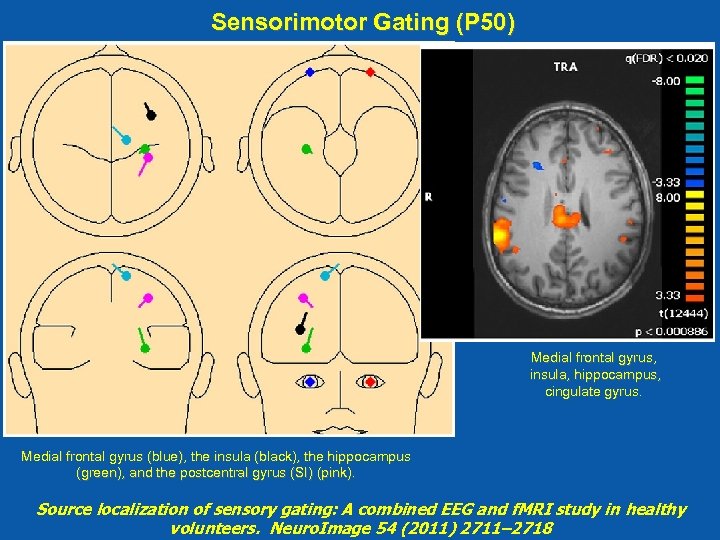
Sensorimotor Gating (P 50) Medial frontal gyrus, insula, hippocampus, cingulate gyrus. Medial frontal gyrus (blue), the insula (black), the hippocampus (green), and the postcentral gyrus (SI) (pink). Source localization of sensory gating: A combined EEG and f. MRI study in healthy volunteers. Neuro. Image 54 (2011) 2711– 2718
ERPs as Biomarkers See Luck et al. (2011, Biological Psychiatry) • ERPs are tightly tied to neurotransmission - MMN may reflect current flow through NMDA receptors - A change in ERPs reflects a change in PSPs (not mediated through hemodynamic response) • Rodent/primate models available for some components - Potentially useful as an assay in drug discovery • • • Easily tolerated by patients Some paradigms have excellent stability, reliability Relatively inexpensive, feasible for large-N studies May be able to predict which patients will respond to a given treatment Potential roadblocks - Individual differences, lack of quality assurance standards © S. J. Luck. All Rights Reserved.
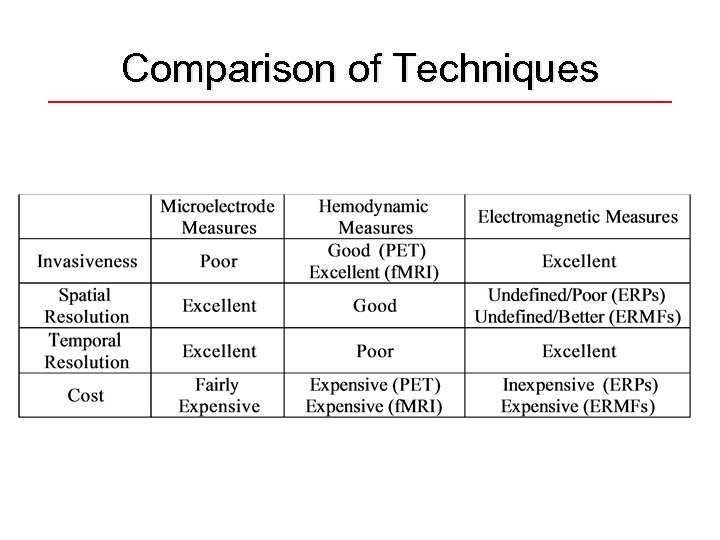
Comparison of Techniques
Скачать презентацию EEG and Event Related Potentials in Psychiatry October
4440f55837f60944350be8664dec75a0.ppt