


 Скачать презентацию EEC FY 2007 Information Technology Strategic Plan Strategic
ff957723eebcc011a03854905bbed92e.ppt
- Количество слайдов: 149
 EEC FY 2007 Information Technology Strategic Plan Strategic Business Requirements and IT Baseline, IT Vision, and IT Implementation Approach and Roadmap Draft 4/5/2007 EEC IT Strategic Plan Deliverable #1
 Contents Project Approach Page 3 Strategic Business Requirements and IT Baseline External Drivers 9 Current Business State 14 Current Technology State 27 Fusion Tree – Business Requirements 37 Fusion Tree – IT Requirements 58 IT Vision – Initial Options For Data Integration 72 IT Vision EEC business vision and benefits 80 Vision for future state of EEC IT architecture 90 Applications and data 93 IT infrastructure 109 IT organization and governance 114 IT implementation approach and roadmap Proposed implementation strategy 122 Implementation projects 130 Implementation scenarios 138 Proposed implementation organization 149 1 3/16/2018 4: 01 PM EEC IT Strategic Plan Report
 Contents (Cont’d) Page Appendices Appendix 1 – Business and technical requirements for IT architecture 153 Appendix 2 – Results from Workshop 1 164 Appendix 3 – One-page descriptions of implementation project releases 176 Appendix 4 – Business and IT requirements allocated to implementation projects 205 2 3/16/2018 4: 01 PM EEC IT Strategic Plan Report
 Project Approach Key Project Goals The purpose of this project is to formulate a long term vision for IT and an implementation roadmap to support EEC’s mission. Specific objectives are to: – Formalize a vision for IT, building on the work already done and documented in the previously issued RFQ for a single financial system for child care – Evaluate EEC current technical and organizational capabilities and identify gaps between these capabilities and the vision for IT – Provide architecture recommendations – Formulate a three-year implementation roadmap and budget 3 3/16/2018 4: 01 PM EEC IT Strategic Plan Report
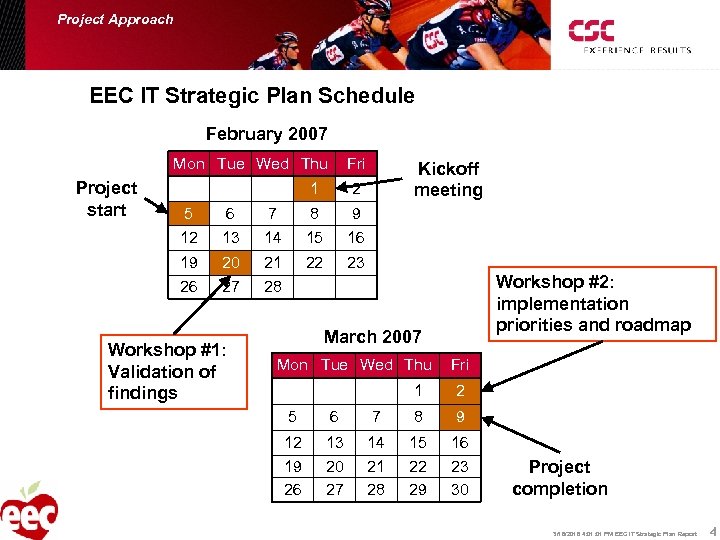 Project Approach EEC IT Strategic Plan Schedule February 2007 Mon Tue Wed Thu Project start Fri 1 Kickoff meeting 2 5 6 7 8 9 12 13 14 15 16 19 20 21 22 23 26 27 28 Workshop #1: Validation of findings Workshop #2: implementation priorities and roadmap March 2007 Mon Tue Wed Thu Fri 1 2 5 6 7 8 9 12 19 26 13 20 27 14 21 28 15 22 29 16 23 30 Project completion 4 3/16/2018 4: 01 PM EEC IT Strategic Plan Report
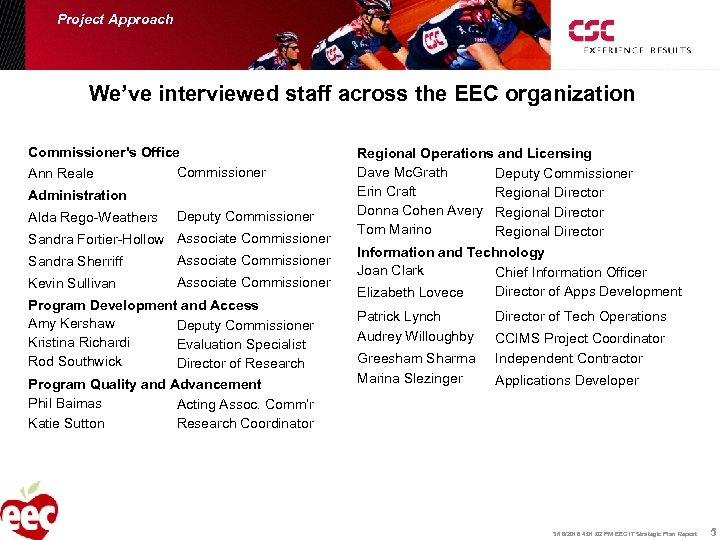 Project Approach We’ve interviewed staff across the EEC organization Commissioner's Office Commissioner Ann Reale Administration Alda Rego-Weathers Deputy Commissioner Sandra Fortier-Hollow Associate Commissioner Sandra Sherriff Associate Commissioner Kevin Sullivan Associate Commissioner Program Development and Access Amy Kershaw Deputy Commissioner Kristina Richardi Evaluation Specialist Rod Southwick Director of Research Program Quality and Advancement Phil Baimas Acting Assoc. Comm’r Katie Sutton Research Coordinator Regional Operations and Licensing Dave Mc. Grath Deputy Commissioner Erin Craft Regional Director Donna Cohen Avery Regional Director Tom Marino Regional Director Information and Technology Joan Clark Chief Information Officer Director of Apps Development Elizabeth Lovece Patrick Lynch Audrey Willoughby Greesham Sharma Marina Slezinger Director of Tech Operations CCIMS Project Coordinator Independent Contractor Applications Developer 5 3/16/2018 4: 01: 02 PM EEC IT Strategic Plan Report
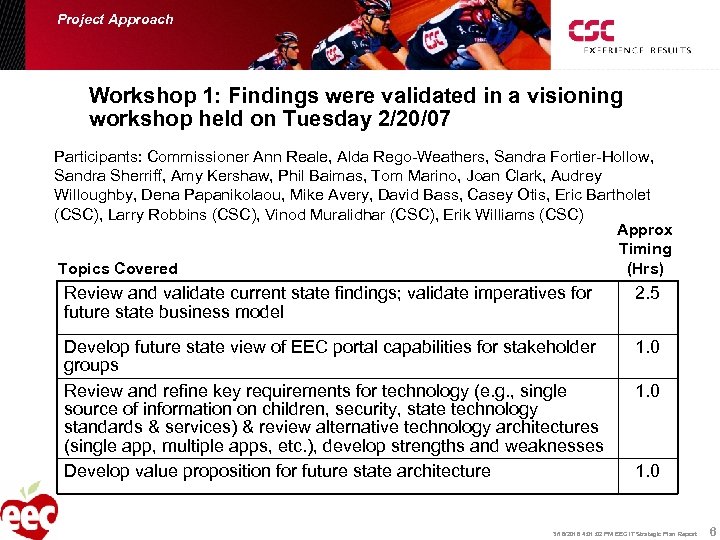 Project Approach Workshop 1: Findings were validated in a visioning workshop held on Tuesday 2/20/07 Participants: Commissioner Ann Reale, Alda Rego-Weathers, Sandra Fortier-Hollow, Sandra Sherriff, Amy Kershaw, Phil Baimas, Tom Marino, Joan Clark, Audrey Willoughby, Dena Papanikolaou, Mike Avery, David Bass, Casey Otis, Eric Bartholet (CSC), Larry Robbins (CSC), Vinod Muralidhar (CSC), Erik Williams (CSC) Approx Timing (Hrs) Topics Covered Review and validate current state findings; validate imperatives for future state business model 2. 5 Develop future state view of EEC portal capabilities for stakeholder groups Review and refine key requirements for technology (e. g. , single source of information on children, security, state technology standards & services) & review alternative technology architectures (single app, multiple apps, etc. ), develop strengths and weaknesses Develop value proposition for future state architecture 1. 0 6 3/16/2018 4: 01: 02 PM EEC IT Strategic Plan Report
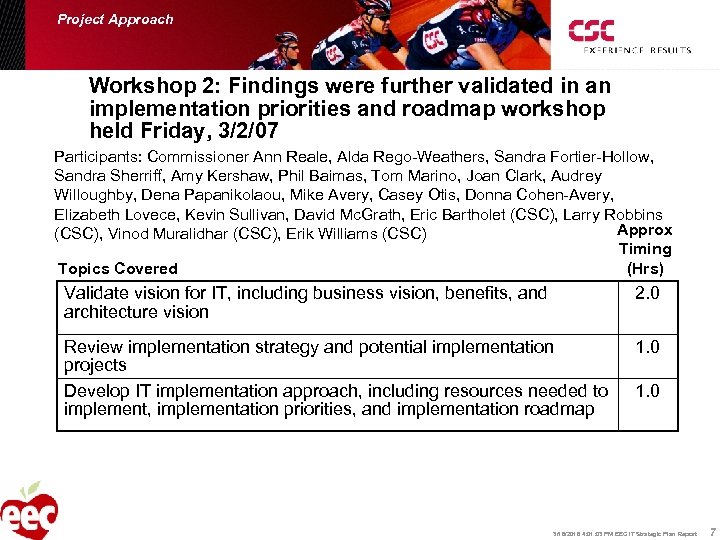 Project Approach Workshop 2: Findings were further validated in an implementation priorities and roadmap workshop held Friday, 3/2/07 Participants: Commissioner Ann Reale, Alda Rego-Weathers, Sandra Fortier-Hollow, Sandra Sherriff, Amy Kershaw, Phil Baimas, Tom Marino, Joan Clark, Audrey Willoughby, Dena Papanikolaou, Mike Avery, Casey Otis, Donna Cohen-Avery, Elizabeth Lovece, Kevin Sullivan, David Mc. Grath, Eric Bartholet (CSC), Larry Robbins Approx (CSC), Vinod Muralidhar (CSC), Erik Williams (CSC) Timing (Hrs) Topics Covered Validate vision for IT, including business vision, benefits, and architecture vision 2. 0 Review implementation strategy and potential implementation projects Develop IT implementation approach, including resources needed to implement, implementation priorities, and implementation roadmap 1. 0 7 3/16/2018 4: 01: 03 PM EEC IT Strategic Plan Report
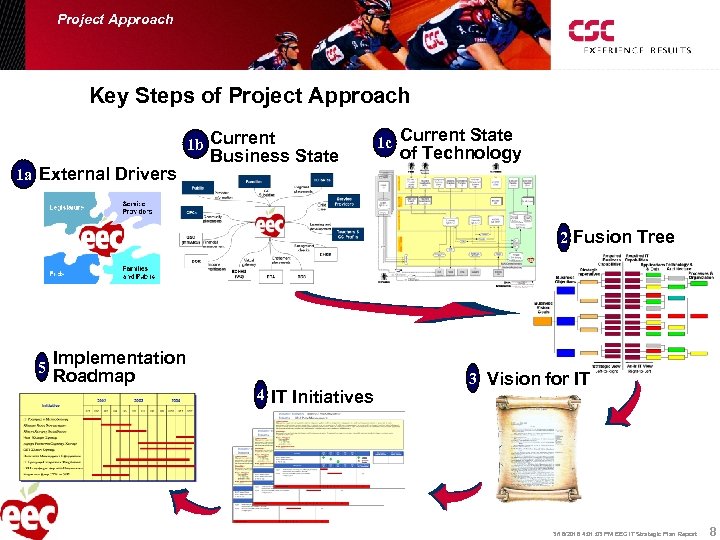 Project Approach Key Steps of Project Approach 1 b Current 1 a External Drivers Business State 1 c Current State of Technology 2 Fusion Tree 5 Implementation Roadmap 4 IT Initiatives 3 Vision for IT 8 3/16/2018 4: 01: 03 PM EEC IT Strategic Plan Report
 Contents Project Approach Strategic Business Requirements and IT Baseline External Drivers Current Business State Current Technology State Fusion Tree – Business Requirements Fusion Tree – IT Requirements IT Vision – Initial Options For Data Integration IT Vision EEC business vision and benefits Vision for future state of EEC IT architecture Applications and data IT infrastructure IT organization and governance IT implementation approach and roadmap Proposed implementation strategy Implementation projects Implementation scenarios Proposed implementation organization 9 3/16/2018 4: 01: 06 PM EEC IT Strategic Plan Report
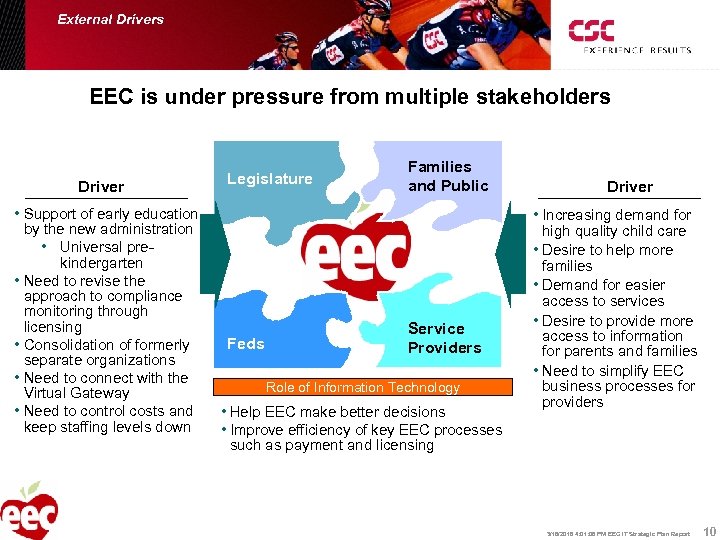 External Drivers EEC is under pressure from multiple stakeholders Driver • Support of early education by the new administration • Universal prekindergarten • Need to revise the approach to compliance monitoring through licensing • Consolidation of formerly separate organizations • Need to connect with the Virtual Gateway • Need to control costs and keep staffing levels down Legislature Feds Families and Public Service Providers Role of Information Technology • Help EEC make better decisions • Improve efficiency of key EEC processes such as payment and licensing Driver • Increasing demand for high quality child care • Desire to help more families • Demand for easier access to services • Desire to provide more access to information for parents and families • Need to simplify EEC business processes for providers 10 3/16/2018 4: 01: 06 PM EEC IT Strategic Plan Report
 External Drivers In response, EEC needs to build its business capabilities • Increase efficiency, consistency, and speed of rate setting, billing and payment • Track children and families as unique entities throughout their participation in EEC programs – Outcomes measurement – Eligibility determination and re-determination • Know about all child care providers and practitioners in the Commonwealth • Help clients and the public make informed early education and care decisions • Respond quickly and accurately to questions from the legislature and others • From observation and study, be able to develop curricula and methodologies to assist providers in improving quality 11 3/16/2018 4: 01: 07 PM EEC IT Strategic Plan Report
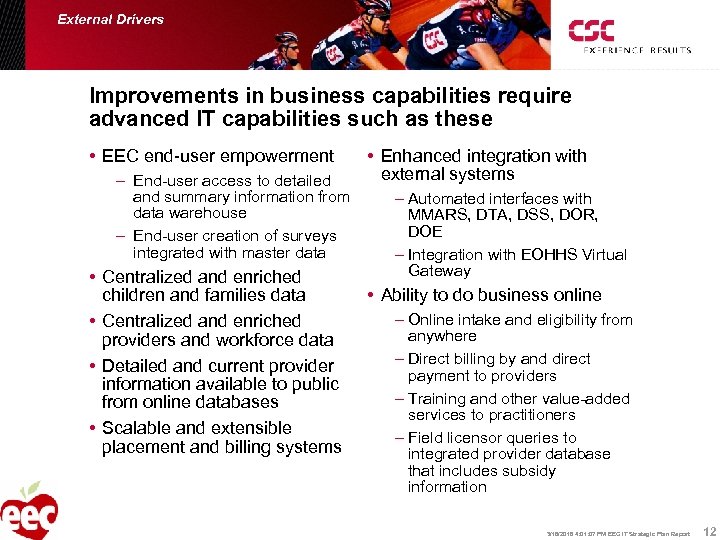 External Drivers Improvements in business capabilities require advanced IT capabilities such as these • EEC end-user empowerment – End-user access to detailed and summary information from data warehouse – End-user creation of surveys integrated with master data • Centralized and enriched children and families data • Centralized and enriched providers and workforce data • Detailed and current provider information available to public from online databases • Scalable and extensible placement and billing systems • Enhanced integration with external systems – Automated interfaces with MMARS, DTA, DSS, DOR, DOE – Integration with EOHHS Virtual Gateway • Ability to do business online – Online intake and eligibility from anywhere – Direct billing by and direct payment to providers – Training and other value-added services to practitioners – Field licensor queries to integrated provider database that includes subsidy information 12 3/16/2018 4: 01: 07 PM EEC IT Strategic Plan Report
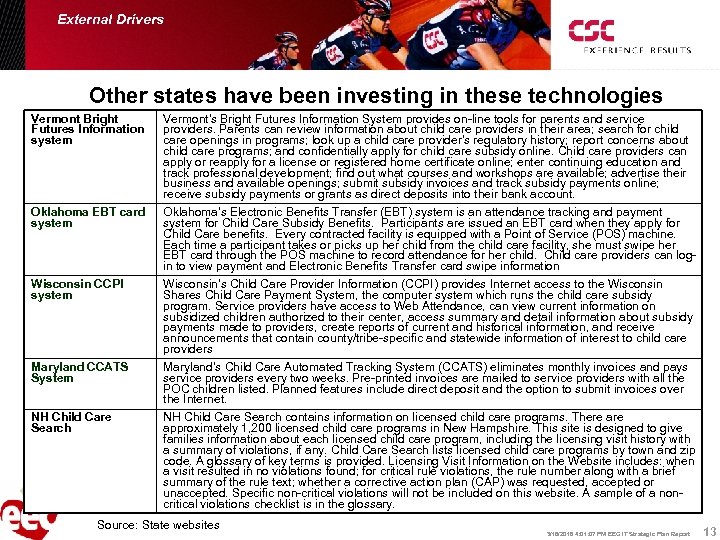 External Drivers Other states have been investing in these technologies Vermont Bright Futures Information system Oklahoma EBT card system Wisconsin CCPI system Maryland CCATS System NH Child Care Search Vermont’s Bright Futures Information System provides on-line tools for parents and service providers. Parents can review information about child care providers in their area; search for child care openings in programs; look up a child care provider's regulatory history; report concerns about child care programs; and confidentially apply for child care subsidy online. Child care providers can apply or reapply for a license or registered home certificate online; enter continuing education and track professional development; find out what courses and workshops are available; advertise their business and available openings; submit subsidy invoices and track subsidy payments online; receive subsidy payments or grants as direct deposits into their bank account. Oklahoma’s Electronic Benefits Transfer (EBT) system is an attendance tracking and payment system for Child Care Subsidy Benefits. Participants are issued an EBT card when they apply for Child Care benefits. Every contracted facility is equipped with a Point of Service (POS) machine. Each time a participant takes or picks up her child from the child care facility, she must swipe her EBT card through the POS machine to record attendance for her child. Child care providers can login to view payment and Electronic Benefits Transfer card swipe information Wisconsin’s Child Care Provider Information (CCPI) provides Internet access to the Wisconsin Shares Child Care Payment System, the computer system which runs the child care subsidy program. Service providers have access to Web Attendance, can view current information on subsidized children authorized to their center, access summary and detail information about subsidy payments made to providers, create reports of current and historical information, and receive announcements that contain county/tribe-specific and statewide information of interest to child care providers Maryland’s Child Care Automated Tracking System (CCATS) eliminates monthly invoices and pays service providers every two weeks. Pre-printed invoices are mailed to service providers with all the POC children listed. Planned features include direct deposit and the option to submit invoices over the Internet. NH Child Care Search contains information on licensed child care programs. There approximately 1, 200 licensed child care programs in New Hampshire. This site is designed to give families information about each licensed child care program, including the licensing visit history with a summary of violations, if any. Child Care Search lists licensed child care programs by town and zip code. A glossary of key terms is provided. Licensing Visit Information on the Website includes: when a visit resulted in no violations found; for critical rule violations, the rule number along with a brief summary of the rule text; whether a corrective action plan (CAP) was requested, accepted or unaccepted. Specific non-critical violations will not be included on this website. A sample of a noncritical violations checklist is in the glossary. Source: State websites 13 3/16/2018 4: 01: 07 PM EEC IT Strategic Plan Report
 Contents Project Approach Strategic Business Requirements and IT Baseline External Drivers Current Business State Current Technology State Fusion Tree – Business Requirements Fusion Tree – IT Requirements IT Vision – Initial Options For Data Integration IT Vision EEC business vision and benefits Vision for future state of EEC IT architecture Applications and data IT infrastructure IT organization and governance IT implementation approach and roadmap Proposed implementation strategy Implementation projects Implementation scenarios Proposed implementation organization 14 3/16/2018 4: 01: 07 PM EEC IT Strategic Plan Report
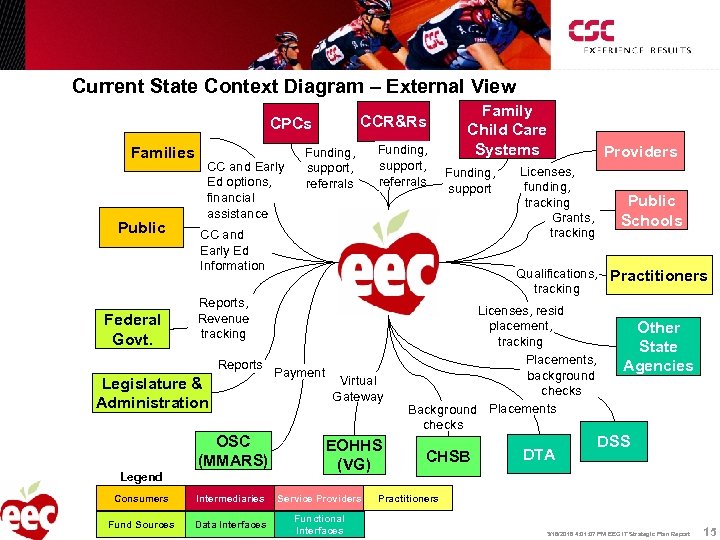 Current State Context Diagram – External View CCR&Rs CPCs Families Public Federal Govt. CC and Early Ed options, financial assistance Funding, support, referrals Family Child Care Systems Funding, support CC and Early Ed Information Legislature & Administration OSC (MMARS) Legend Licenses, funding, tracking Grants, tracking Qualifications, tracking Reports, Revenue tracking Reports Providers Payment Virtual Gateway EOHHS (VG) Consumers Intermediaries Service Providers Fund Sources Data Interfaces Functional Interfaces Licenses, resid placement, tracking Placements, background checks Background Placements checks CHSB DTA Public Schools Practitioners Other State Agencies DSS Practitioners 15 3/16/2018 4: 01: 07 PM EEC IT Strategic Plan Report
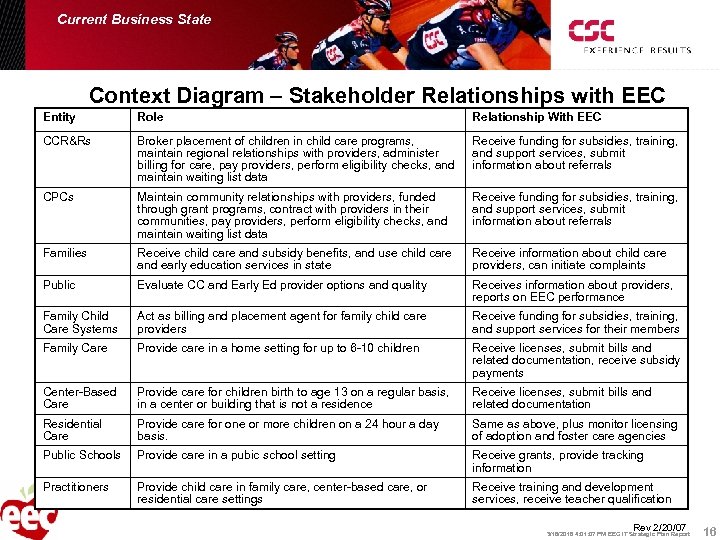 Current Business State Context Diagram – Stakeholder Relationships with EEC Entity Role Relationship With EEC CCR&Rs Broker placement of children in child care programs, maintain regional relationships with providers, administer billing for care, pay providers, perform eligibility checks, and maintain waiting list data Receive funding for subsidies, training, and support services, submit information about referrals CPCs Maintain community relationships with providers, funded through grant programs, contract with providers in their communities, pay providers, perform eligibility checks, and maintain waiting list data Receive funding for subsidies, training, and support services, submit information about referrals Families Receive child care and subsidy benefits, and use child care and early education services in state Receive information about child care providers, can initiate complaints Public Evaluate CC and Early Ed provider options and quality Receives information about providers, reports on EEC performance Family Child Care Systems Act as billing and placement agent for family child care providers Receive funding for subsidies, training, and support services for their members Family Care Provide care in a home setting for up to 6 -10 children Receive licenses, submit bills and related documentation, receive subsidy payments Center-Based Care Provide care for children birth to age 13 on a regular basis, in a center or building that is not a residence Receive licenses, submit bills and related documentation Residential Care Provide care for one or more children on a 24 hour a day basis. Same as above, plus monitor licensing of adoption and foster care agencies Public Schools Provide care in a pubic school setting Receive grants, provide tracking information Practitioners Provide child care in family care, center-based care, or residential care settings Receive training and development services, receive teacher qualification Rev 2/20/07 16 3/16/2018 4: 01: 07 PM EEC IT Strategic Plan Report
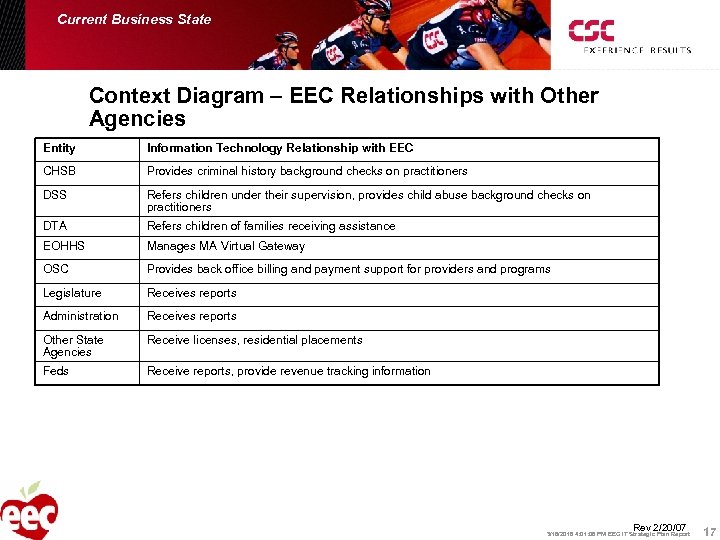 Current Business State Context Diagram – EEC Relationships with Other Agencies Entity Information Technology Relationship with EEC CHSB Provides criminal history background checks on practitioners DSS Refers children under their supervision, provides child abuse background checks on practitioners DTA Refers children of families receiving assistance EOHHS Manages MA Virtual Gateway OSC Provides back office billing and payment support for providers and programs Legislature Receives reports Administration Receives reports Other State Agencies Receive licenses, residential placements Feds Receive reports, provide revenue tracking information Rev 2/20/07 17 3/16/2018 4: 01: 08 PM EEC IT Strategic Plan Report
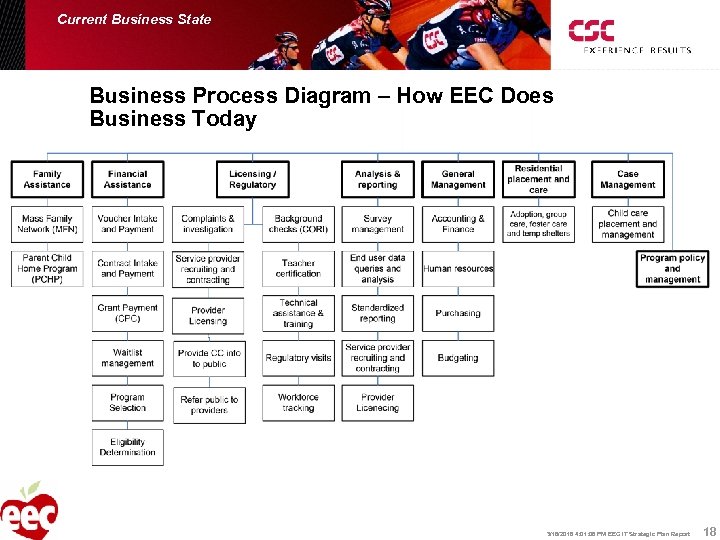 Current Business State Business Process Diagram – How EEC Does Business Today 18 3/16/2018 4: 01: 08 PM EEC IT Strategic Plan Report
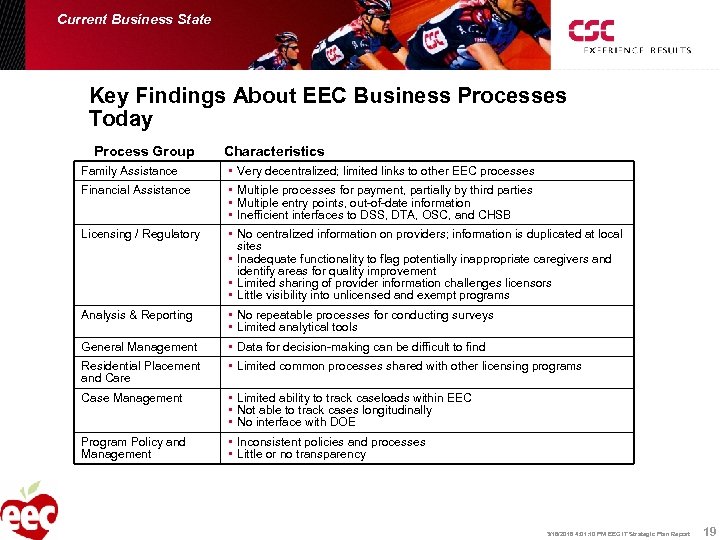 Current Business State Key Findings About EEC Business Processes Today Process Group Characteristics Family Assistance • Very decentralized; limited links to other EEC processes Financial Assistance • Multiple processes for payment, partially by third parties • Multiple entry points, out-of-date information • Inefficient interfaces to DSS, DTA, OSC, and CHSB Licensing / Regulatory • No centralized information on providers; information is duplicated at local sites • Inadequate functionality to flag potentially inappropriate caregivers and identify areas for quality improvement • Limited sharing of provider information challenges licensors • Little visibility into unlicensed and exempt programs Analysis & Reporting • No repeatable processes for conducting surveys • Limited analytical tools General Management • Data for decision-making can be difficult to find Residential Placement and Care • Limited common processes shared with other licensing programs Case Management • Limited ability to track caseloads within EEC • Not able to track cases longitudinally • No interface with DOE Program Policy and Management • Inconsistent policies and processes • Little or no transparency 19 3/16/2018 4: 01: 10 PM EEC IT Strategic Plan Report
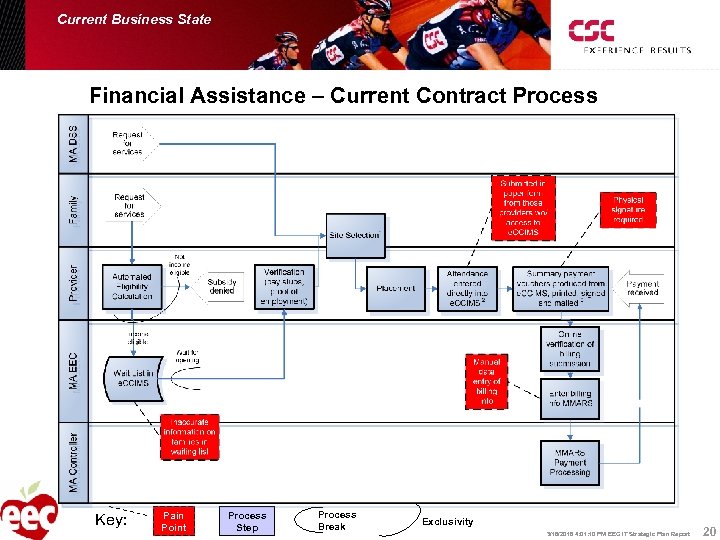 Current Business State Financial Assistance – Current Contract Process Key: Pain Point Process Step Process Break Exclusivity 20 3/16/2018 4: 01: 10 PM EEC IT Strategic Plan Report
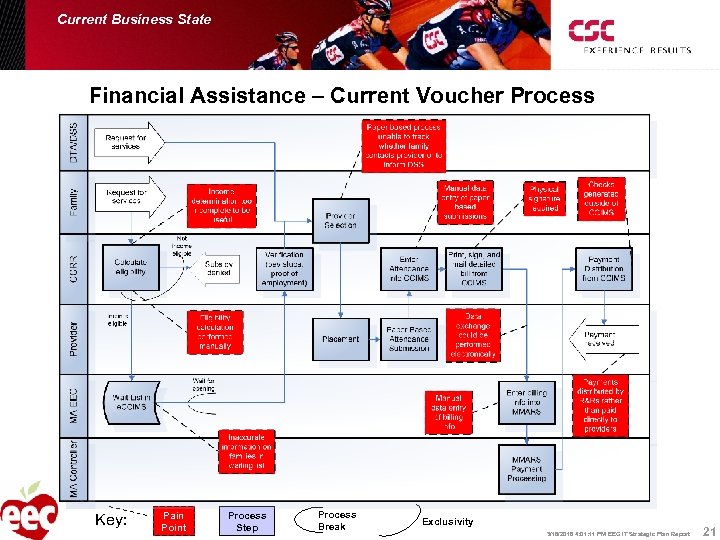 Current Business State Financial Assistance – Current Voucher Process Key: Pain Point Process Step Process Break Exclusivity 21 3/16/2018 4: 01: 11 PM EEC IT Strategic Plan Report
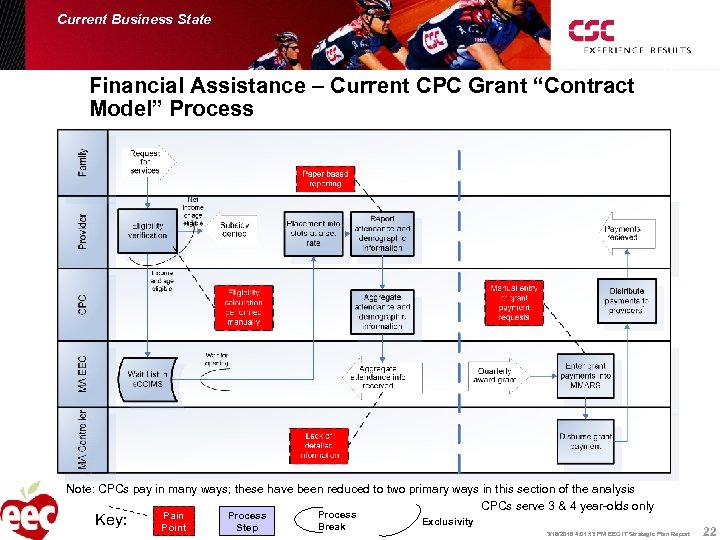 Current Business State Financial Assistance – Current CPC Grant “Contract Model” Process Note: CPCs pay in many ways; these have been reduced to two primary ways in this section of the analysis CPCs serve 3 & 4 year-olds only Key: Pain Point Process Step Process Break Exclusivity 22 3/16/2018 4: 01: 13 PM EEC IT Strategic Plan Report
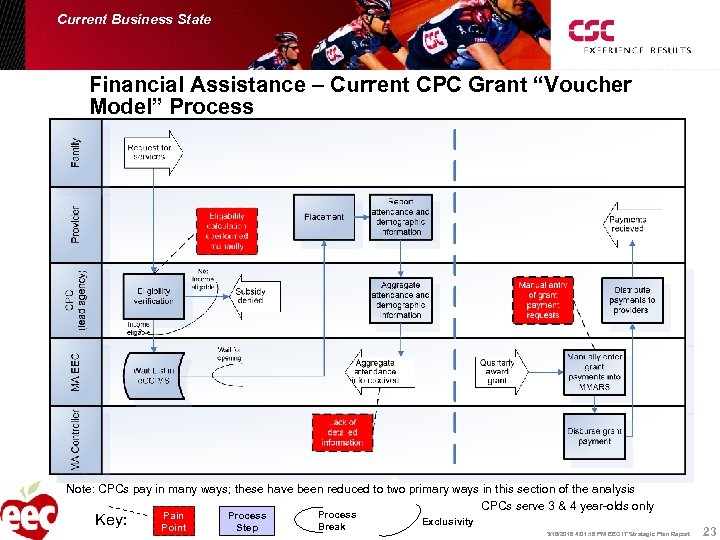 Current Business State Financial Assistance – Current CPC Grant “Voucher Model” Process Note: CPCs pay in many ways; these have been reduced to two primary ways in this section of the analysis CPCs serve 3 & 4 year-olds only Key: Pain Point Process Step Process Break Exclusivity 23 3/16/2018 4: 01: 16 PM EEC IT Strategic Plan Report
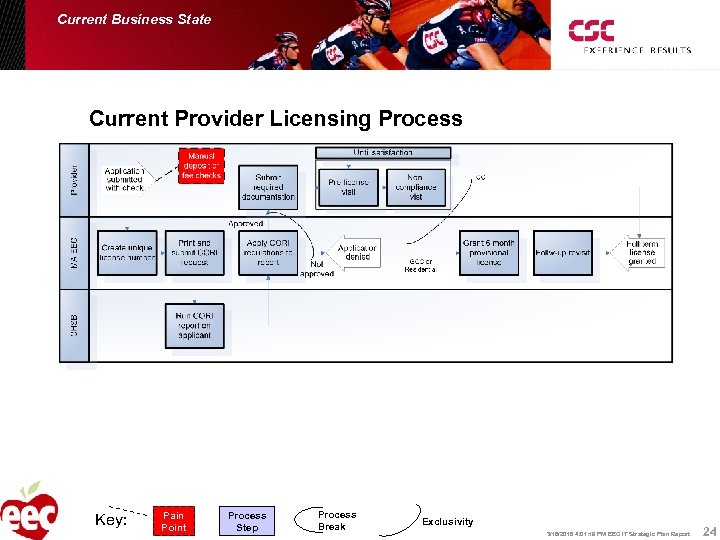 Current Business State Current Provider Licensing Process Key: Pain Point Process Step Process Break Exclusivity 24 3/16/2018 4: 01: 19 PM EEC IT Strategic Plan Report
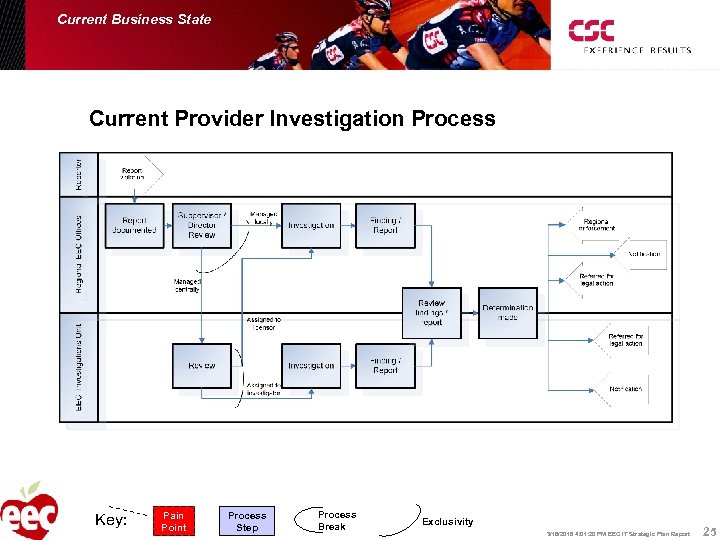 Current Business State Current Provider Investigation Process Key: Pain Point Process Step Process Break Exclusivity 25 3/16/2018 4: 01: 20 PM EEC IT Strategic Plan Report
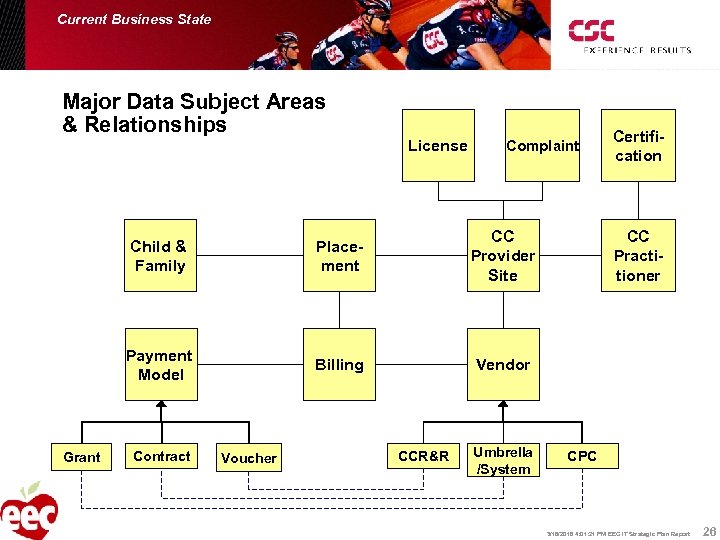 Current Business State Major Data Subject Areas & Relationships License Complaint Child & Family CC Provider Site Payment Model Grant Placement Billing Certification Vendor Contract Voucher CCR&R Umbrella /System CC Practitioner CPC 26 3/16/2018 4: 01: 21 PM EEC IT Strategic Plan Report
 Contents Project Approach Strategic Business Requirements and IT Baseline External Drivers Current Business State Current Technology State Fusion Tree – Business Requirements Fusion Tree – IT Requirements IT Vision – Initial Options For Data Integration IT Vision EEC business vision and benefits Vision for future state of EEC IT architecture Applications and data IT infrastructure IT organization and governance IT implementation approach and roadmap Proposed implementation strategy Implementation projects Implementation scenarios Proposed implementation organization 27 3/16/2018 4: 01: 22 PM EEC IT Strategic Plan Report
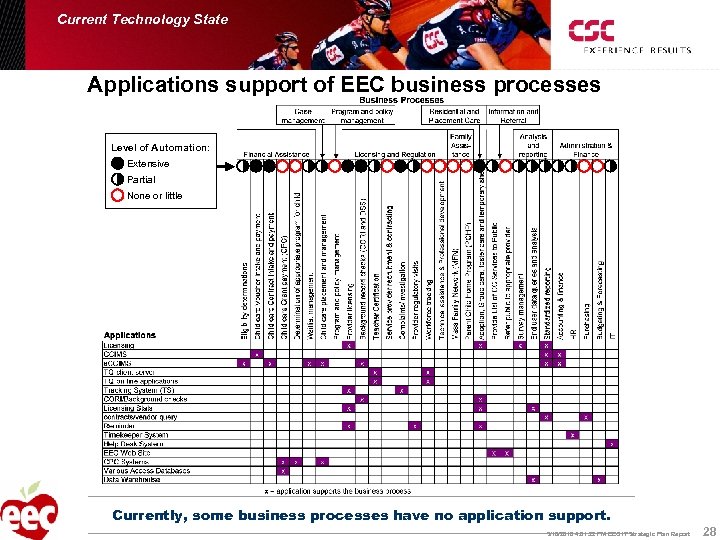 Current Technology State Applications support of EEC business processes Level of Automation: Extensive Partial None or little Currently, some business processes have no application support. 28 3/16/2018 4: 01: 22 PM EEC IT Strategic Plan Report
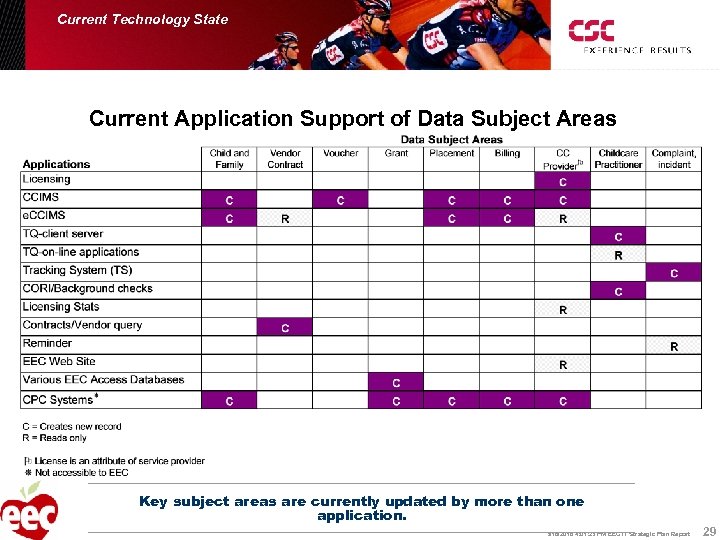 Current Technology State Current Application Support of Data Subject Areas Key subject areas are currently updated by more than one application. 29 3/16/2018 4: 01: 23 PM EEC IT Strategic Plan Report
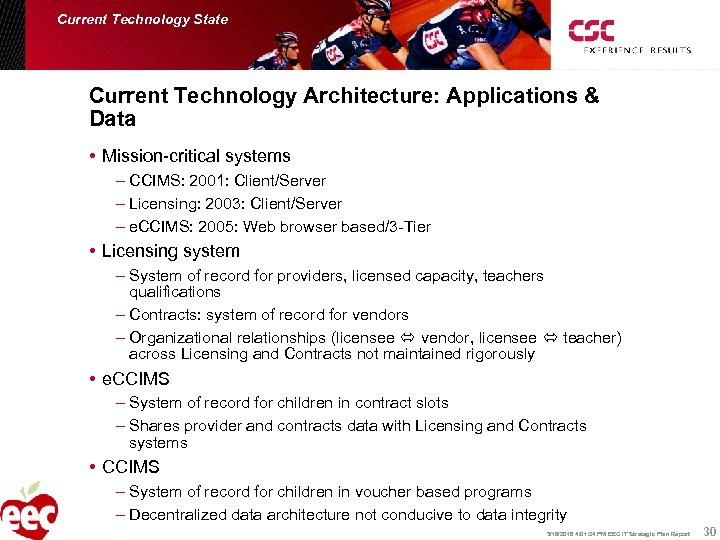 Current Technology State Current Technology Architecture: Applications & Data • Mission-critical systems – CCIMS: 2001: Client/Server – Licensing: 2003: Client/Server – e. CCIMS: 2005: Web browser based/3 -Tier • Licensing system – System of record for providers, licensed capacity, teachers qualifications – Contracts: system of record for vendors – Organizational relationships (licensee vendor, licensee teacher) across Licensing and Contracts not maintained rigorously • e. CCIMS – System of record for children in contract slots – Shares provider and contracts data with Licensing and Contracts systems • CCIMS – System of record for children in voucher based programs – Decentralized data architecture not conducive to data integrity 30 3/16/2018 4: 01: 24 PM EEC IT Strategic Plan Report
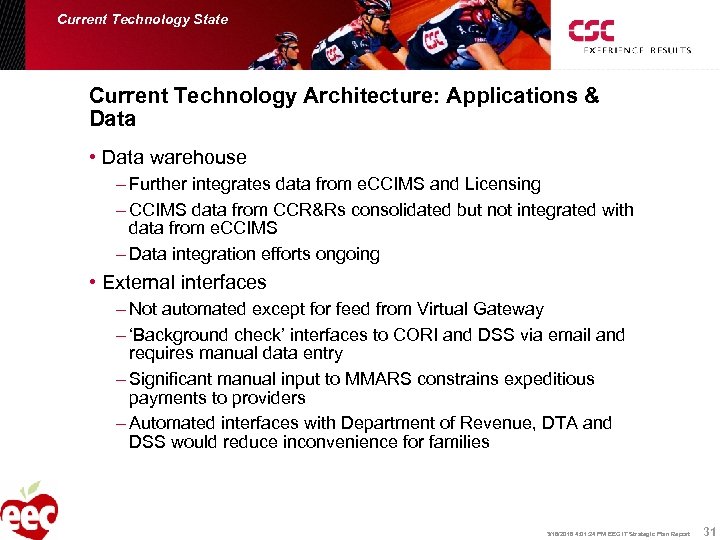 Current Technology State Current Technology Architecture: Applications & Data • Data warehouse – Further integrates data from e. CCIMS and Licensing – CCIMS data from CCR&Rs consolidated but not integrated with data from e. CCIMS – Data integration efforts ongoing • External interfaces – Not automated except for feed from Virtual Gateway – ‘Background check’ interfaces to CORI and DSS via email and requires manual data entry – Significant manual input to MMARS constrains expeditious payments to providers – Automated interfaces with Department of Revenue, DTA and DSS would reduce inconvenience for families 31 3/16/2018 4: 01: 24 PM EEC IT Strategic Plan Report
 Current Technology State Current Technology Architecture: Infrastructure • Microsoft Windows Server shop – Consistent ‘Standard Operating Environment’ on commodity servers • Facilitates operational support and systems management – ITD push to ‘Open Source’ platforms • Business case based on license costs vs. operational efficiencies not clear • Data integration capability not a factor: Web service / XML based integration obviates platform differences • Readiness to host CCR&R and CPC processes – Capacity not seen as issue – Redundancy and failover strategies may need beefing up • Server consolidation / virtualization potential – Longer term considerations 32 3/16/2018 4: 01: 25 PM EEC IT Strategic Plan Report
 Current Technology State Current Technology Architecture: Process and People • Lean IT operations – Applications development resources: 3 internal FTEs – Training has not kept pace with skills upgrading requirements • Structured system development methodologies – Would enhance quality of development and long-term savings – But would require initial investment in time and resources by both IT and business – Architecture patterns and documentation would enable contract resources to be deployed efficiently • End-user empowerment – Would reduce diversion of IT staff from strategic work to ad hoc (urgent) information retrieval work – Technologies exist for end-user reporting and analysis • Beginnings made in-house with SQL Server Analysis Services – Data cleansing and harmonization is a pre-requisite to gain trust of business in systems 33 3/16/2018 4: 01: 25 PM EEC IT Strategic Plan Report
 Current Technology State Current Technology Architecture: Analytical Approach • Develop high level applications map showing internal and external interfaces • Overlay framework for analysis within which future state architecture can be developed • Distribute Data in Layers across Enterprise – Operational / Transactional • Frequently updated, atomic • Tuned for transactional applications’ input/output processing – Informational and Analytical • Historical and time invariant • Data sourced from multiple operational systems, cleansed and integrated for holistic business view • Tuned for information analysis and end-user queries 34 3/16/2018 4: 01: 25 PM EEC IT Strategic Plan Report
 Current Technology State Current Technology Architecture: Analytical Approach • Benefits in designing applications as components categorized into logical chunks called ‘tiers’ – Scalability – Reusability – Maintainability … • We can view our current application portfolio as a set of tiered components, roughly grouped into categories: – Presentation • User Interfaces – Business Logic • Includes application services such as security and systems management – Data • Databases, documents and file repositories – Integration • Internal and external data interfaces 35 3/16/2018 4: 01: 25 PM EEC IT Strategic Plan Report
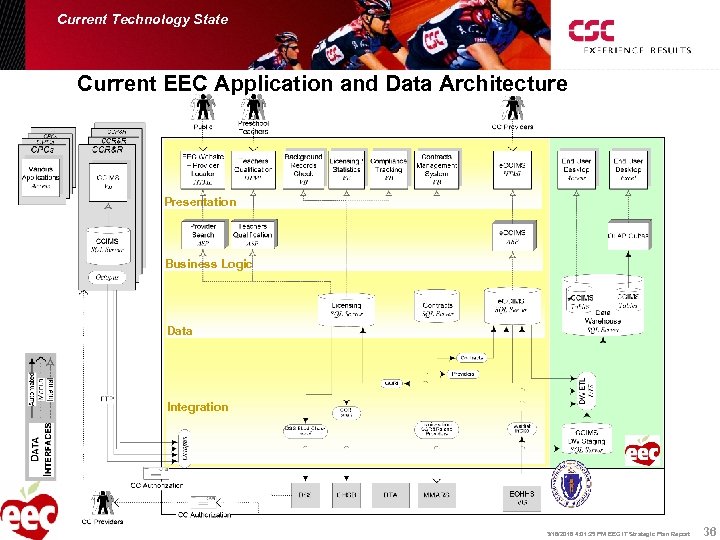 Current Technology State Current EEC Application and Data Architecture Presentation Business Logic Data Integration 36 3/16/2018 4: 01: 25 PM EEC IT Strategic Plan Report
 Contents Project Approach Strategic Business Requirements and IT Baseline External Drivers Current Business State Current Technology State Fusion Tree – Business Requirements Fusion Tree – IT Requirements IT Vision – Initial Options For Data Integration IT Vision EEC business vision and benefits Vision for future state of EEC IT architecture Applications and data IT infrastructure IT organization and governance IT implementation approach and roadmap Proposed implementation strategy Implementation projects Implementation scenarios Proposed implementation organization 37 3/16/2018 4: 01: 26 PM EEC IT Strategic Plan Report
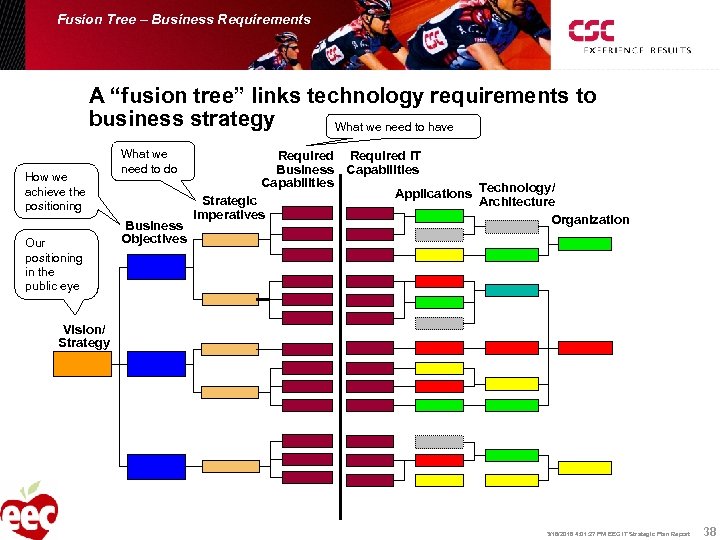 Fusion Tree – Business Requirements A “fusion tree” links technology requirements to business strategy What we need to have How we achieve the positioning Our positioning in the public eye What we need to do Required IT Business Capabilities Applications Technology/ Strategic Architecture Imperatives Organization Business Objectives Vision/ Strategy 38 3/16/2018 4: 01: 27 PM EEC IT Strategic Plan Report
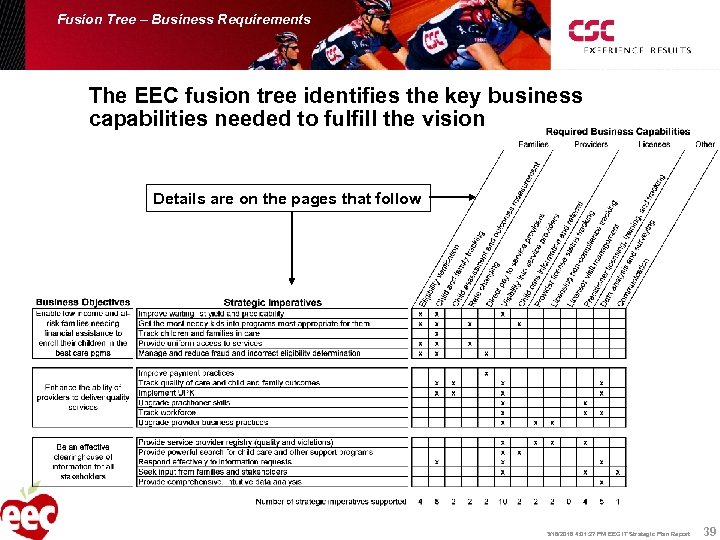 Fusion Tree – Business Requirements The EEC fusion tree identifies the key business capabilities needed to fulfill the vision Details are on the pages that follow 39 3/16/2018 4: 01: 27 PM EEC IT Strategic Plan Report
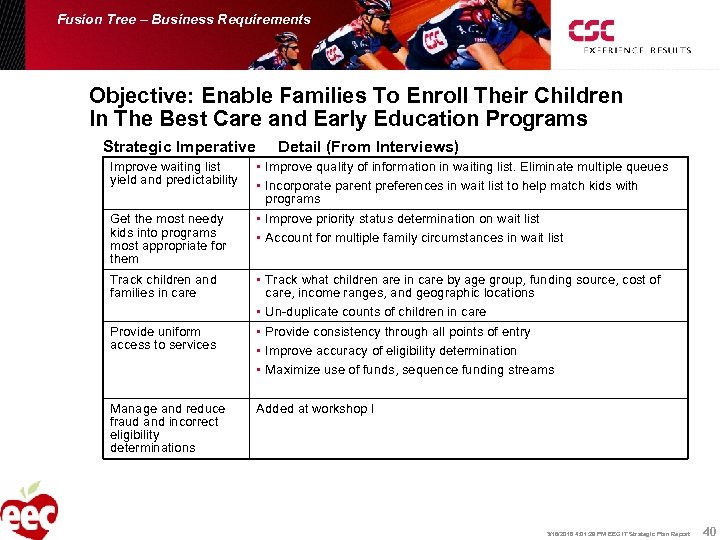 Fusion Tree – Business Requirements Objective: Enable Families To Enroll Their Children In The Best Care and Early Education Programs Strategic Imperative Detail (From Interviews) Improve waiting list yield and predictability • Improve quality of information in waiting list. Eliminate multiple queues • Incorporate parent preferences in wait list to help match kids with programs Get the most needy kids into programs most appropriate for them • Improve priority status determination on wait list • Account for multiple family circumstances in wait list Track children and families in care • Track what children are in care by age group, funding source, cost of care, income ranges, and geographic locations • Un-duplicate counts of children in care Provide uniform access to services • Provide consistency through all points of entry • Improve accuracy of eligibility determination • Maximize use of funds, sequence funding streams Manage and reduce fraud and incorrect eligibility determinations Added at workshop I 40 3/16/2018 4: 01: 29 PM EEC IT Strategic Plan Report
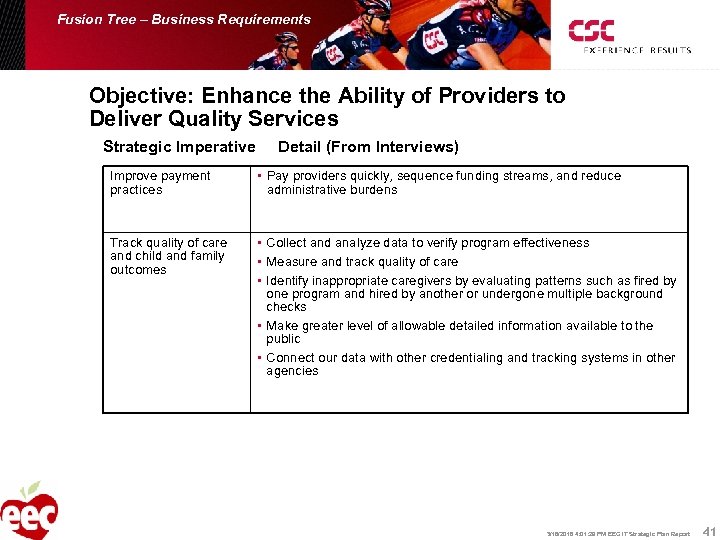 Fusion Tree – Business Requirements Objective: Enhance the Ability of Providers to Deliver Quality Services Strategic Imperative Detail (From Interviews) Improve payment practices • Pay providers quickly, sequence funding streams, and reduce administrative burdens Track quality of care and child and family outcomes • Collect and analyze data to verify program effectiveness • Measure and track quality of care • Identify inappropriate caregivers by evaluating patterns such as fired by one program and hired by another or undergone multiple background checks • Make greater level of allowable detailed information available to the public • Connect our data with other credentialing and tracking systems in other agencies 41 3/16/2018 4: 01: 29 PM EEC IT Strategic Plan Report
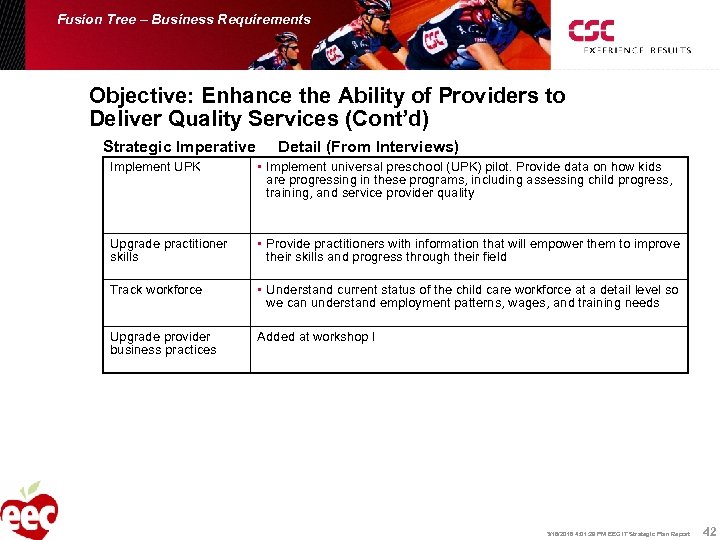 Fusion Tree – Business Requirements Objective: Enhance the Ability of Providers to Deliver Quality Services (Cont’d) Strategic Imperative Detail (From Interviews) Implement UPK • Implement universal preschool (UPK) pilot. Provide data on how kids are progressing in these programs, including assessing child progress, training, and service provider quality Upgrade practitioner skills • Provide practitioners with information that will empower them to improve their skills and progress through their field Track workforce • Understand current status of the child care workforce at a detail level so we can understand employment patterns, wages, and training needs Upgrade provider business practices Added at workshop I 42 3/16/2018 4: 01: 29 PM EEC IT Strategic Plan Report
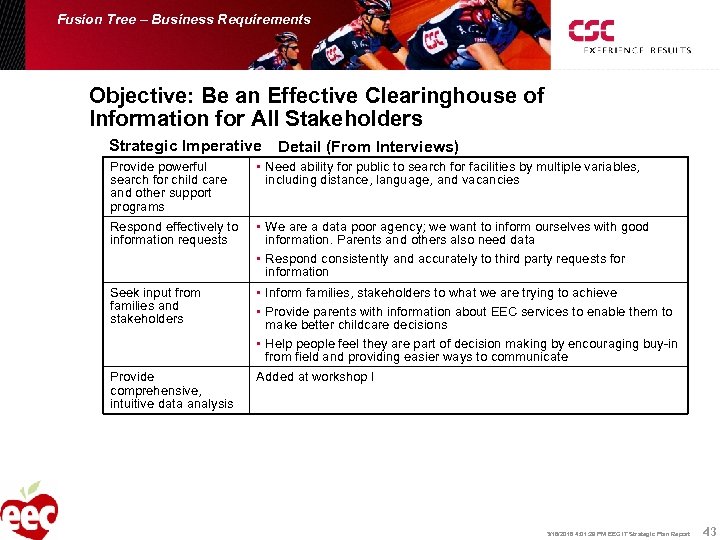 Fusion Tree – Business Requirements Objective: Be an Effective Clearinghouse of Information for All Stakeholders Strategic Imperative Detail (From Interviews) Provide powerful search for child care and other support programs • Need ability for public to search for facilities by multiple variables, including distance, language, and vacancies Respond effectively to information requests • We are a data poor agency; we want to inform ourselves with good information. Parents and others also need data • Respond consistently and accurately to third party requests for information Seek input from families and stakeholders • Inform families, stakeholders to what we are trying to achieve • Provide parents with information about EEC services to enable them to make better childcare decisions • Help people feel they are part of decision making by encouraging buy-in from field and providing easier ways to communicate Provide comprehensive, intuitive data analysis Added at workshop I 43 3/16/2018 4: 01: 29 PM EEC IT Strategic Plan Report
 Fusion Tree – Business Requirements Required Business Capability: Eligibility Verification Current State • We compute eligibility in various ways. For example, e. CCIMS computes eligibility, but CCIMS does not, leaving CCIMS users to calculate eligibility manually • Our different subsidy systems vary in restrictiveness toward parents. For example, if a child comes in through certain channels, he or she is not guaranteed continued eligibility. • We only do limited eligibility determination on a child entering the wait list. The list is too long to make upfront determinations worthwhile • Child care placements are tedious for parents because of paper referrals from DTA and DSS. Families have to go through double verification Future State • A single process handles all eligibility determinations • Eligibility rules are uniform and used to make all eligibility determinations • Family income status is verified through DOR and the Department of Unemployment and Training • Families are screened for eligibility at time of wait listing and periodically thereafter • The funding stream is optimized by assigning each child to the best funding source • Eligibility verification is coordinated with DSS and DTA to avoid families having to be double-verified • The family is informed of an accurately calculated wait time 44 3/16/2018 4: 01: 29 PM EEC IT Strategic Plan Report
 Fusion Tree – Business Requirements Required Business Capability: Child and Family Tracking Current State • We don’t know all the characteristics of the child and the family. We code them differently in our different systems. We are unable to look at kids in the broadest way • All children are not tracked. For example, tracking kids and siblings for continuity of care vouchers is difficult. We don’t record children’s experiences through the different funding streams • We are not able to track parents over time. For example, if a parent moves from teen parent status to school status, it looks in the system like a new parent is entering the system Future State • ECC has full information, including special needs, on all kids and families, including those handled by CCR&Rs, CPCs, exempt programs, and public schools • Kids and families are tracked as they progress through the system and beyond, from wait listing to placement to transition out of the system to school • DOE student IDs are assigned upon entry into care and are used to track kids all the way through school. This requires connections with the Dept of Ed, the Board of Higher Ed • Multiple and special family circumstances are known and taken into account in eligibility determination and placement 45 3/16/2018 4: 01: 29 PM EEC IT Strategic Plan Report
 Fusion Tree – Business Requirements Required Business Capability: Child and Family Tracking – Waiting List Current State • We don’t have visibility into our waiting list. • We now don't know the “yield” rate. We can’t estimate how many kids we have to take off the wait list to fill one slot • Eligibility for access to the waitlist is based on parents self -identify with no opportunity to update information Future State • A single virtual intake system is in place. The list: – Tracks events such as appointments for placement, steps in the enrollment process, and terminations from the wait list and care – Eliminates child and family duplication, and includes children served through all funding streams – Places children into care in the most fundingfriendly way • Wait list system knows more characteristics of the child and the family, including parents’ placement preferences, so kids can be placed in the best program for them • The system estimates expected wait times based on knowledge of children in care 46 3/16/2018 4: 01: 30 PM EEC IT Strategic Plan Report
 Fusion Tree – Business Requirements Required Business Capability: Child Assessment and Outcomes Measurement Current State • No system-wide approach to measuring child outcomes Future State • To be determined; policy is under development 47 3/16/2018 4: 01: 30 PM EEC IT Strategic Plan Report
 Fusion Tree – Business Requirements Required Business Capability: Rate Changing Current State • Our rate structure is complex, with many different rates • Rates vary among and within providers • Market rates are difficult to measure Future State • Rate changing is uniform and based on reliable, well researched methodologies • Rates are verifiably appropriate to the services provided 48 3/16/2018 4: 01: 30 PM EEC IT Strategic Plan Report
 Fusion Tree – Business Requirements Required Business Capability: Direct Pay to Service Providers Current State • The billing and payment process is paperbased, cumbersome, and inconsistent: – Multiple subsidy processes are used – Various systems are used by the provider community – Data is in separate systems, so that individual families could theoretically be getting multiple grants – Payment rules differ among the different programs • We do not pay some providers quickly enough Future State • A single payment system handles all types of child care (contracts, vouchers, grants), and handles workflow from enrollment to attendance and remittance by the Comptroller • Providers experience a single billing and payment process • Cash flow is optimized for providers • Provider financial stability is improved • Providers’ administrative burden is reduced 49 3/16/2018 4: 01: 30 PM EEC IT Strategic Plan Report
 Fusion Tree – Business Requirements Required Business Capability: Visibility Into Service Providers Current State • Information about providers is not readily available to EEC or to parents Future State • EEC tracks all service providers, including they are licensed or licensed-exempt – Information about providers is scattered throughout various systems and in many cases • EEC tracks known providers of is duplicated and inconsistent unlicensed care – Key information such as compliance data is • EEC has a single access point for available only on paper complete and consistent • We are able to track only some programs. information about providers, such Those that are unlicensed or exempt are not as level of state funding, open consistently tracked. slots, children enrolled, license status, practitioners present, • We don’t have current data on which quality of business processes, practitioners work for a specific provider and risk • EEC provides current, detailed information to the public on child care providers, such as license status, program quality, and noncompliance information • A workforce registry tracks where practitioners are working 50 3/16/2018 4: 01: 31 PM EEC IT Strategic Plan Report
 Fusion Tree – Business Requirements Required Business Capability: Child Care Information and Referral Current State • We do not provide a comprehensive tool for the public to search for child care providers or family and parenting resources • Families spend excessive time and energy locating the right information to choose early education and care services for their children, when there is considerable information in EEC databases that would help them in this process Future State • EEC offers an on-line search and referral system to the public. The search capability is powerful, offering multiple variables as driving distance, language, and space availability • EEC provides referrals to a variety of resources such as financial assistance, parental support programs and parent development resources • EEC provides capabilities to the public that are packaged and interoperate, such as provider referral, slot availability, an eligibility wizard, wait list placement, and referral to other State services 51 3/16/2018 4: 01: 31 PM EEC IT Strategic Plan Report
 Fusion Tree – Business Requirements Required Business Capability: Provider License Status Tracking Current State • Licensing is a paper- and phone-based process. Licensees cannot easily check on the issuance or renewal status of their license applications. • Variance determination and logging is paper based; tracking patterns of continued variance allowance is difficult • We don’t know about many license exempt child care sites. They are not in the Licensing database unless they are doing business with us Future State • Licensees can easily track the status of license applications, renewals, and variances • Licensors, referrers, and others have easy access to license-related information such as background checks, licensor visit notations, complaint status, licensing history, variance status, quality ratings for programs, and practitioner qualifications • EEC knows about and tracks all exempt programs. EEC periodically conducts exemption re-determinations. EEC staff can access results of all exemption determinations from any office location, the reasons for exemptions and who approved them 52 3/16/2018 4: 01: 32 PM EEC IT Strategic Plan Report
 Fusion Tree – Business Requirements Required Business Capability: Licensing Non-Compliance Tracking Current State • Non-compliance tracking is a manual, paper-based process. This causes difficulties in: – Sharing licensing data across regions – Accessing past incident data, needed to assess risk – Quickly informing referring organizations and others that a program has lost its license • Legal referral and tracking of pending legal actions are done largely on paper • We don’t track positive feedback. We aren’t able to convey information about positive comments to families and others Future State • Licenses are tracked and tagged throughout their life cycle of regulatory compliance including legal proceedings such as license suspensions, revocations, and enrollment freezes. License status changes are quickly communicated throughout the EEC system • EEC evaluates program risks levels. Evaluators access all relevant information including license and variance status, licensor visits, non-compliance actions, and comments from families • Parents submit feedback on their experiences with providers 53 3/16/2018 4: 01: 32 PM EEC IT Strategic Plan Report
 Fusion Tree – Business Requirements Required Business Capability: Licensor Visit Management Current State • We cannot easily determine how often a provider should be visited based on criteria such as risk and which providers are consuming the most resources • Visits to providers are tracked, but manual aspects make prior visit information hard to access. The system has little flexibility to add visit data Future State • Visit planning and scheduling processes get the licensors to the right providers based on established criteria • The licensor has full access to current and past information about the program at the time of visit. 54 3/16/2018 4: 01: 32 PM EEC IT Strategic Plan Report
 Fusion Tree – Business Requirements Required Business Capability: Practitioner Licensing, Training, and Tracking Current State Future State • We do not have current, • All practitioners are tracked comprehensive certification information throughout their careers and about practitioners. Specifically: included in a practitioner – Teacher qualification information on the registry 56, 000 practitioners we track is not kept • EEC manages a coordinated up-to-date process of issuing new and • Many providers’ qualifications are not renewal practitioner recorded at all. certifications, logging training – Teacher certification is not linked to participation, and initiating CORI background checks – We do not track practitioner • Practitioner training is development after the initial one-time encouraged, tracked, and certification linked directly to practitioner – We can’t derive meaningful workforce qualification criteria data, such as number of staff, amount of training, retention, need for courses, and • EEC is a clearinghouse for need for training, provides information • Training is now not coordinated across on course availability, and tracks course attendance the system; we do not know where training occurs and how well it works 55 3/16/2018 4: 01: 32 PM EEC IT Strategic Plan Report
 Fusion Tree – Business Requirements Required Business Capability: Data Analysis and Surveying Current State • We can’t respond quickly to even the most reasonable information requests from the Legislature or others. Examples of information we cannot easily provide include: – How many children are in care – How many programs we support – Where our practitioners are working and what qualifications they have • Our survey activity is mostly one-off Future State • We are able to do data queries and ad-hoc reports for information that is presented in an easy to understand format • Information is readily accessible, up to date • Strong data analytical capabilities are in place. We are able to do meaningful forecasting of demand • We can design and implement surveys 56 3/16/2018 4: 01: 33 PM EEC IT Strategic Plan Report
 Contents Project Approach Strategic Business Requirements and IT Baseline External Drivers Current Business State Current Technology State Fusion Tree – Business Requirements Fusion Tree – IT Requirements IT Vision – Initial Options For Data Integration IT Vision EEC business vision and benefits Vision for future state of EEC IT architecture Applications and data IT infrastructure IT organization and governance IT implementation approach and roadmap Proposed implementation strategy Implementation projects Implementation scenarios Proposed implementation organization 57 3/16/2018 4: 01: 33 PM EEC IT Strategic Plan Report
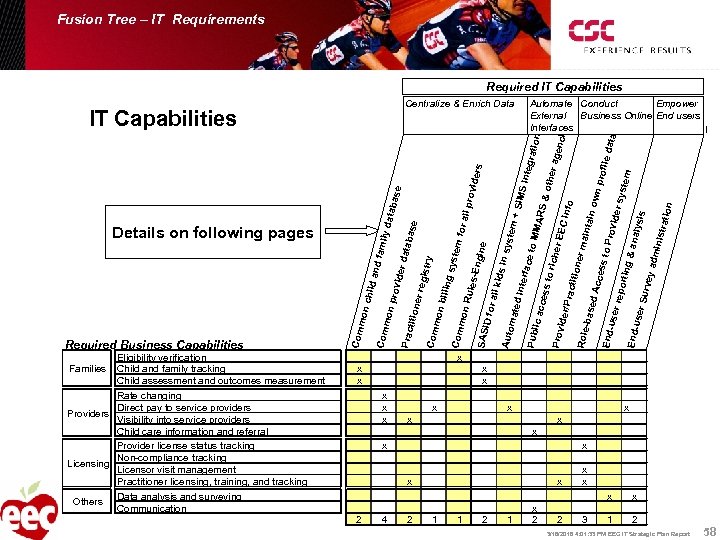 Fusion Tree – IT Requirements Required IT Capabilities Centralize & Enrich Data Automate Conduct Empower External Business Online End users Interfaces Consolidate / Enrich Data Other Agencies Business. Online Internal ata alys End- user Sur vey & an rting repo user End- is adm inist ratio n stem file d er sy n ow s to P cces ed A -bas Role Prov ider/ Prac ti tione r ma intai info cher EEC to ri cess ic ac Publ rovid n pro r age othe MMA e to erfac d int Auto mate SAS ID fo r all kids in s yste m + m fo r all s-En gine mon ng s Com billi Rule yste y gistr mon er re Com tition RS & SIMS Inte iders prov se Prac mon prov ider data base ily d a taba Eligibility verification Child and family tracking Child assessment and outcomes measurement Rate changing Direct pay to service providers Providers Visibility into service providers Child care information and referral Provider license status tracking Non-compliance tracking Licensor visit management Practitioner licensing, training, and tracking Data analysis and surveying Others Communication Families Com Required Business Capabilities Com mon chil d an d fam Details on following pages grati on ncie s IT Capabilities x x x x x x 2 4 2 1 1 2 1 x 2 2 3 x 1 2 58 3/16/2018 4: 01: 33 PM EEC IT Strategic Plan Report
 Fusion Tree – IT Requirements Required IT Capability: Common Child and Families Database Current State • Information exists across at least two databases with inconsistent data models • No visibility into CPC funded children at all • There is potential duplication of information Future State • One database contains child and family data • Used by all applications that need child and family data; all access to child and family data is logged and auditable per HIPAA • All information collected on child linked to record in this database; external information such as economic background data from DTA can be added • We are able to link a child to providers’ license and complaint data; i. e. when the source of complaint is a family 59 3/16/2018 4: 01: 33 PM EEC IT Strategic Plan Report
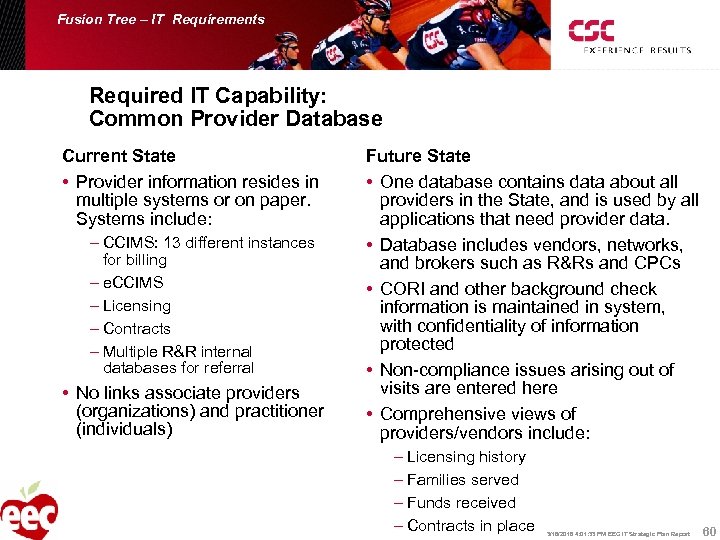 Fusion Tree – IT Requirements Required IT Capability: Common Provider Database Current State • Provider information resides in multiple systems or on paper. Systems include: – CCIMS: 13 different instances for billing – e. CCIMS – Licensing – Contracts – Multiple R&R internal databases for referral • No links associate providers (organizations) and practitioner (individuals) Future State • One database contains data about all providers in the State, and is used by all applications that need provider data. • Database includes vendors, networks, and brokers such as R&Rs and CPCs • CORI and other background check information is maintained in system, with confidentiality of information protected • Non-compliance issues arising out of visits are entered here • Comprehensive views of providers/vendors include: – Licensing history – Families served – Funds received – Contracts in place 60 3/16/2018 4: 01: 33 PM EEC IT Strategic Plan Report
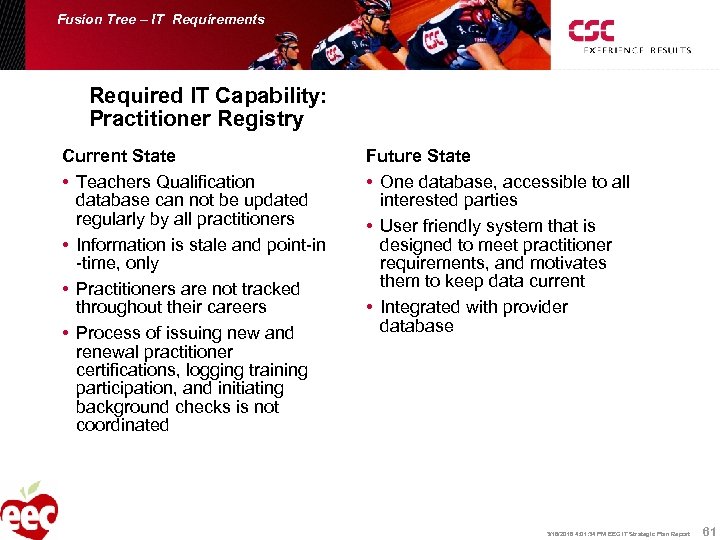 Fusion Tree – IT Requirements Required IT Capability: Practitioner Registry Current State • Teachers Qualification database can not be updated regularly by all practitioners • Information is stale and point-in -time, only • Practitioners are not tracked throughout their careers • Process of issuing new and renewal practitioner certifications, logging training participation, and initiating background checks is not coordinated Future State • One database, accessible to all interested parties • User friendly system that is designed to meet practitioner requirements, and motivates them to keep data current • Integrated with provider database 61 3/16/2018 4: 01: 34 PM EEC IT Strategic Plan Report
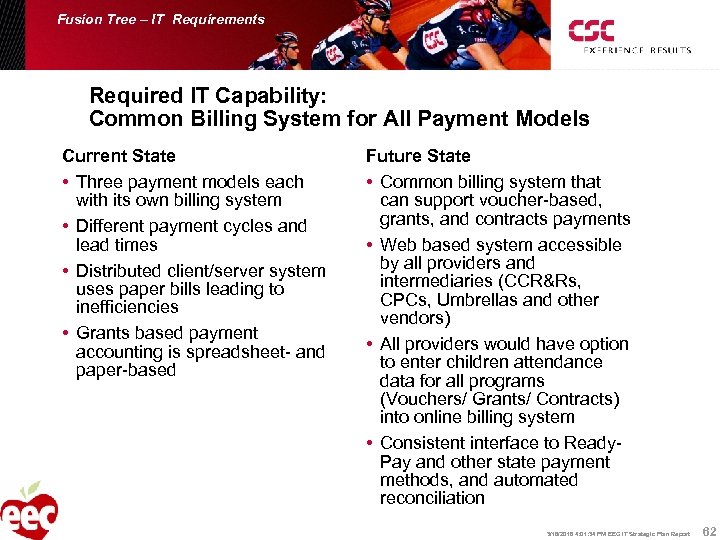 Fusion Tree – IT Requirements Required IT Capability: Common Billing System for All Payment Models Current State • Three payment models each with its own billing system • Different payment cycles and lead times • Distributed client/server system uses paper bills leading to inefficiencies • Grants based payment accounting is spreadsheet- and paper-based Future State • Common billing system that can support voucher-based, grants, and contracts payments • Web based system accessible by all providers and intermediaries (CCR&Rs, CPCs, Umbrellas and other vendors) • All providers would have option to enter children attendance data for all programs (Vouchers/ Grants/ Contracts) into online billing system • Consistent interface to Ready. Pay and other state payment methods, and automated reconciliation 62 3/16/2018 4: 01: 34 PM EEC IT Strategic Plan Report
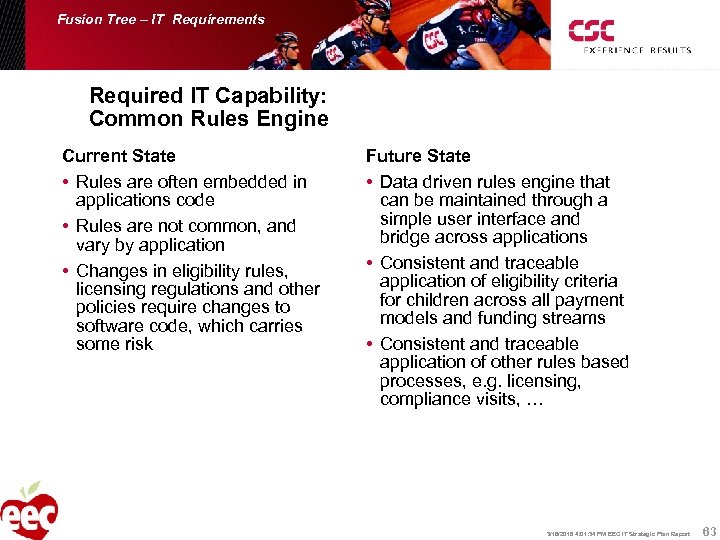 Fusion Tree – IT Requirements Required IT Capability: Common Rules Engine Current State • Rules are often embedded in applications code • Rules are not common, and vary by application • Changes in eligibility rules, licensing regulations and other policies require changes to software code, which carries some risk Future State • Data driven rules engine that can be maintained through a simple user interface and bridge across applications • Consistent and traceable application of eligibility criteria for children across all payment models and funding streams • Consistent and traceable application of other rules based processes, e. g. licensing, compliance visits, … 63 3/16/2018 4: 01: 34 PM EEC IT Strategic Plan Report
 Fusion Tree – IT Requirements Required IT Capability: SASID for all kids in System Current State • Internal identifiers are used in CCIMS and e. CCIMS, but not State-wide • Child level data not available though CPC funded programs • No integration between each other or with other state databases with children’s data Future State • Add DOE State Assigned Student Identifier to all children in the child/family database • Enable integration with DOE SIMS database that stores all scholastic K-12 data • Enable longitudinal tracking of children from pre Kindergarten through college 64 3/16/2018 4: 01: 35 PM EEC IT Strategic Plan Report
 Fusion Tree – IT Requirements Required IT Capability: Automated Interfaces to MMARS and other agencies Current State • Contracts encumbrance and billing data manually keyed into MMARS • Inefficiencies and delays in payments • Potential for error Future State • Invoice interface from common billing system to MMARS, potentially via EIM • Payments interface back from MMARS enables closed loop reconciliation • Electronic signatures appended to Invoices and Payment Vouchers (based on when State e-signature policies are defined) 65 3/16/2018 4: 01: 35 PM EEC IT Strategic Plan Report
 Fusion Tree – IT Requirements Required IT Capability: Public Access to Richer Information from EEC Current State • Mostly static information on EEC website • Lookup for childcare providers within given zip code Future State • Public can access detailed provider data using flexible search criteria (e. g. size of center, special facilities availability, etc. ) • Information is structured to enable easy navigation and information retrieval making this the single point of access for all early education and child care related information in the Commonwealth 66 3/16/2018 4: 01: 35 PM EEC IT Strategic Plan Report
 Fusion Tree – IT Requirements Required IT Capability: Provider / Practitioner Maintain own data Current State • Providers do not have access to their own profile information. We maintain and verify provider information in e. CCIMS and Licensing Manager. CCR&Rs maintain information in CCIMS • Licensees often don’t call in to have their information updated because the process takes too much time • Practitioners can enter and view qualifications data online • No links between teachers and provider organizations Future State • Providers and practitioners maintain aspects of their own (profile) data. Self-maintained information is integrated with licensing and visit data • Practitioners interact with the system to update their profile, enter training and skills development information, and search and enroll in courses provided by the Board of Higher Ed • EEC would verify all selfmaintained data as appropriate • Open standards-based user interfaces enable access from multiple client platforms (e. g. , Mac OS) 67 3/16/2018 4: 01: 35 PM EEC IT Strategic Plan Report
 Fusion Tree – IT Requirements Required IT Capability: End-user Reporting and Analysis Current State • Limited end-user reporting tools are in place. These include – Use by business users of data warehouse queries using MS Access front-end – Limited use by power users of MS Excel access to SQL Server ‘OLAP Cubes’ • Data requests are paperbased, and is considered a pain point for the business Future State • Integrated data warehouse that leverages common family and provider ‘dimensions’ created through single child/family, provider, and practitioner databases • Easy-to-understand, business oriented ‘dimensional’ data model that enables roll-up / drill -down of placement and billing information across providers and children • Library of standard queries and reports that can be tailored for custom requirements, combined with a front-end dashboard and standard reports 68 3/16/2018 4: 01: 36 PM EEC IT Strategic Plan Report
 Fusion Tree – IT Requirements Required IT Capability: End-user Survey and Data Collection Administration and Integration Current State • Custom built one-off surveys built for specific information gathering projects, and can be integrated with backend databases • Survey. Monkey based surveys for specific information gathering projects – responses cannot be integrated with provider / child data • Some surveys are paper-based Future State • Flexible Web-browser and email based survey tool that can be customized to fit multiple information gathering projects and targeted to specific populations derived from family and provider databases • Survey responses can be integrated with family and providers data to enrich the analysis of response data 69 3/16/2018 4: 01: 36 PM EEC IT Strategic Plan Report
 Contents Project Approach Strategic Business Requirements and IT Baseline External Drivers Current Business State Current Technology State Fusion Tree – Business Requirements Fusion Tree – IT Requirements IT Vision – Initial Options For Data Integration IT Vision EEC business vision and benefits Vision for future state of EEC IT architecture Applications and data IT infrastructure IT organization and governance IT implementation approach and roadmap Proposed implementation strategy Implementation projects Implementation scenarios Proposed implementation organization 70 3/16/2018 4: 01: 36 PM EEC IT Strategic Plan Report
 Vision for IT IT Architecture Directions • Data integration imperative – Two key ‘master data’ services • Children and Families • Providers and Practitioners • Agile and flexible architectures – Support new early education and care mandates and programs introduced at State and Federal level • Integrate with other Massachusetts citizen services • Enable full and ready access to all transactional data by internal users • Facilitate and encourage access by external stakeholders to reduce manual interactions – Providers, CCR&Rs, CPCs, Family Child Care Systems • Extensive information sharing with public 71 3/16/2018 4: 01: 36 PM EEC IT Strategic Plan Report
 Vision for IT Data Integration Architecture Options 1. Continue operating e. CCIMS and CCIMS with integrated Data Warehouse 2. Continue operating CCIMS and e. CCIMS with data interfaces between them to synchronize ‘child/family’ and ‘provider/workforce’ 3. Enhance e. CCIMS to enable voucher based and grants based billing and reporting 4. Migrate to Child/Family and Provider/Workforce master data service oriented architecture 5. Migrate to COTS system, such as used in other states 72 3/16/2018 4: 01: 36 PM EEC IT Strategic Plan Report
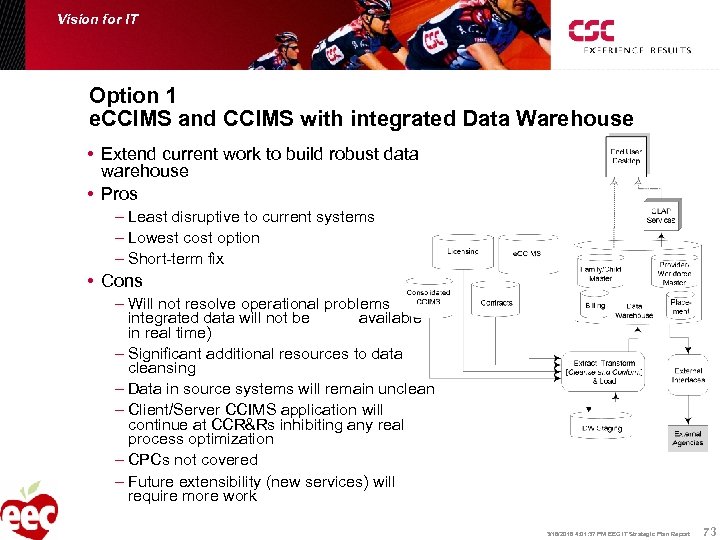 Vision for IT Option 1 e. CCIMS and CCIMS with integrated Data Warehouse • Extend current work to build robust data warehouse • Pros – Least disruptive to current systems – Lowest cost option – Short-term fix • Cons – Will not resolve operational problems (i. e. integrated data will not be available in real time) – Significant additional resources to data cleansing – Data in source systems will remain unclean – Client/Server CCIMS application will continue at CCR&Rs inhibiting any real process optimization – CPCs not covered – Future extensibility (new services) will require more work 73 3/16/2018 4: 01: 37 PM EEC IT Strategic Plan Report
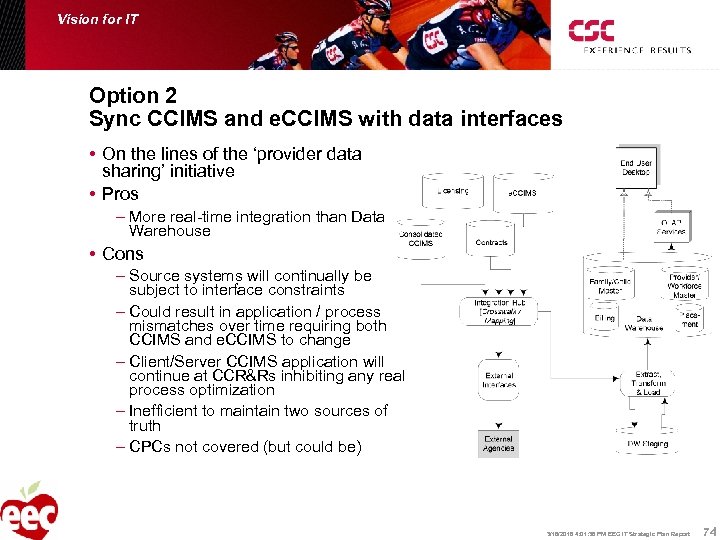 Vision for IT Option 2 Sync CCIMS and e. CCIMS with data interfaces • On the lines of the ‘provider data sharing’ initiative • Pros – More real-time integration than Data Warehouse • Cons – Source systems will continually be subject to interface constraints – Could result in application / process mismatches over time requiring both CCIMS and e. CCIMS to change – Client/Server CCIMS application will continue at CCR&Rs inhibiting any real process optimization – Inefficient to maintain two sources of truth – CPCs not covered (but could be) 74 3/16/2018 4: 01: 38 PM EEC IT Strategic Plan Report
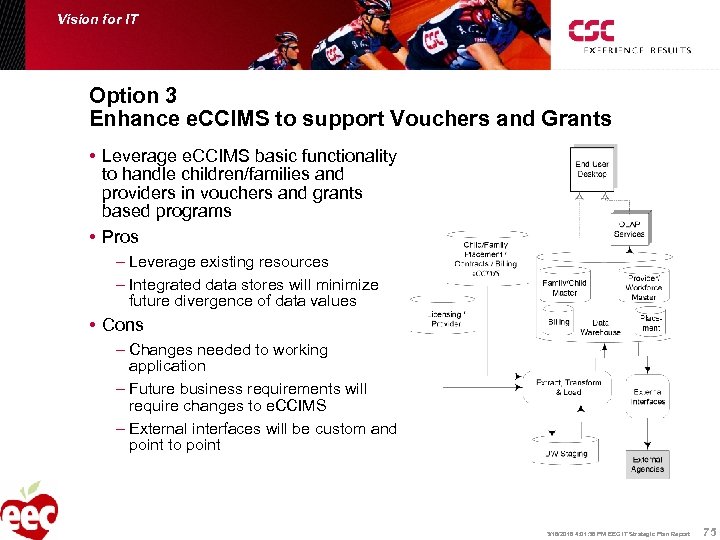 Vision for IT Option 3 Enhance e. CCIMS to support Vouchers and Grants • Leverage e. CCIMS basic functionality to handle children/families and providers in vouchers and grants based programs • Pros – Leverage existing resources – Integrated data stores will minimize future divergence of data values • Cons – Changes needed to working application – Future business requirements will require changes to e. CCIMS – External interfaces will be custom and point to point 75 3/16/2018 4: 01: 38 PM EEC IT Strategic Plan Report
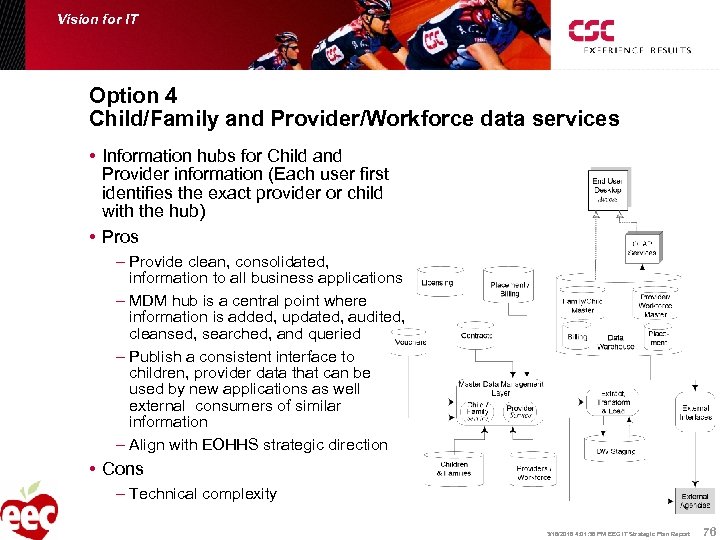 Vision for IT Option 4 Child/Family and Provider/Workforce data services • Information hubs for Child and Provider information (Each user first identifies the exact provider or child with the hub) • Pros – Provide clean, consolidated, information to all business applications – MDM hub is a central point where information is added, updated, audited, cleansed, searched, and queried – Publish a consistent interface to children, provider data that can be used by new applications as well external consumers of similar information – Align with EOHHS strategic direction • Cons – Technical complexity 76 3/16/2018 4: 01: 38 PM EEC IT Strategic Plan Report
 Vision for IT Option 5 Commercial Off-the-Shelf System • Use commercial package system installed and operational at other state • Pros – Out of the box functionality – Presumably shorter time-to-market – Vendor application support • Cons – One-size fits all – reduced flexibility – Dependence on vendor for new functionality – Stable versions often saddled with legacy architecture 77 3/16/2018 4: 01: 39 PM EEC IT Strategic Plan Report
 Contents Project Approach Strategic Business Requirements and IT Baseline External Drivers Current Business State Current Technology State Fusion Tree – Business Requirements Fusion Tree – IT Requirements IT Vision – Initial Options For Data Integration IT Vision EEC business vision and benefits Vision for future state of EEC IT architecture Applications and data IT infrastructure IT organization and governance IT implementation approach and roadmap Proposed implementation strategy Implementation projects Implementation scenarios Proposed implementation organization 78 3/16/2018 4: 01: 39 PM EEC IT Strategic Plan Report
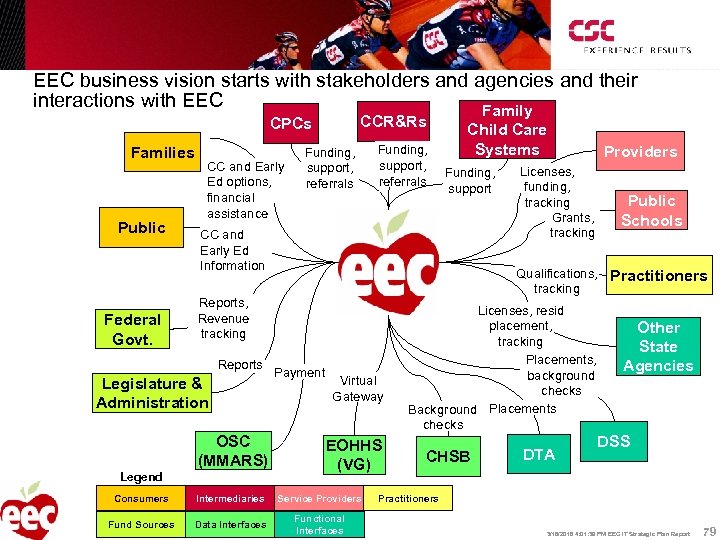 EEC business vision starts with stakeholders and agencies and their interactions with EEC Family CCR&Rs CPCs Families Public Federal Govt. CC and Early Ed options, financial assistance Funding, support, referrals Child Care Systems Funding, support CC and Early Ed Information Legislature & Administration OSC (MMARS) Legend Licenses, funding, tracking Grants, tracking Qualifications, tracking Reports, Revenue tracking Reports Providers Payment Virtual Gateway EOHHS (VG) Consumers Intermediaries Service Providers Fund Sources Data Interfaces Functional Interfaces Licenses, resid placement, tracking Placements, background checks Background Placements checks CHSB DTA Public Schools Practitioners Other State Agencies DSS Practitioners 79 3/16/2018 4: 01: 39 PM EEC IT Strategic Plan Report
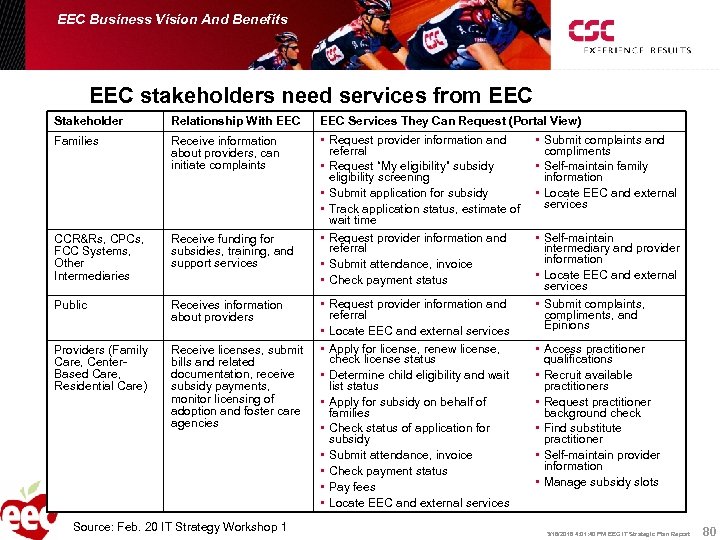 EEC Business Vision And Benefits EEC stakeholders need services from EEC Stakeholder Relationship With EEC Services They Can Request (Portal View) Families Receive information about providers, can initiate complaints CCR&Rs, CPCs, FCC Systems, Other Intermediaries Receive funding for subsidies, training, and support services • Request provider information and referral • Request “My eligibility” subsidy eligibility screening • Submit application for subsidy • Track application status, estimate of wait time • Request provider information and referral • Submit attendance, invoice • Check payment status Public Receives information about providers Providers (Family Care, Center. Based Care, Residential Care) Receive licenses, submit bills and related documentation, receive subsidy payments, monitor licensing of adoption and foster care agencies Source: Feb. 20 IT Strategy Workshop 1 • Request provider information and referral • Locate EEC and external services • Apply for license, renew license, check license status • Determine child eligibility and wait list status • Apply for subsidy on behalf of families • Check status of application for subsidy • Submit attendance, invoice • Check payment status • Pay fees • Locate EEC and external services • Submit complaints and compliments • Self-maintain family information • Locate EEC and external services • Self-maintain intermediary and provider information • Locate EEC and external services • Submit complaints, compliments, and Epinions • Access practitioner qualifications • Recruit available practitioners • Request practitioner background check • Find substitute practitioner • Self-maintain provider information • Manage subsidy slots 80 3/16/2018 4: 01: 40 PM EEC IT Strategic Plan Report
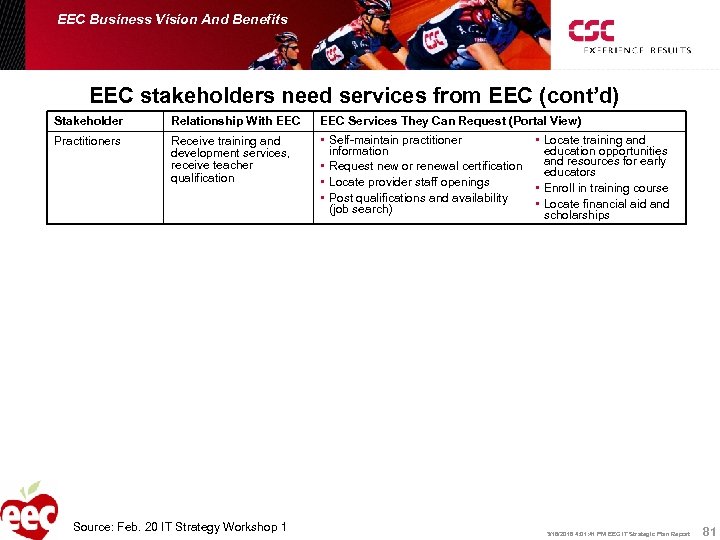 EEC Business Vision And Benefits EEC stakeholders need services from EEC (cont’d) Stakeholder Relationship With EEC Services They Can Request (Portal View) Practitioners Receive training and development services, receive teacher qualification • Self-maintain practitioner information • Request new or renewal certification • Locate provider staff openings • Post qualifications and availability (job search) Source: Feb. 20 IT Strategy Workshop 1 • Locate training and education opportunities and resources for early educators • Enroll in training course • Locate financial aid and scholarships 81 3/16/2018 4: 01: 41 PM EEC IT Strategic Plan Report
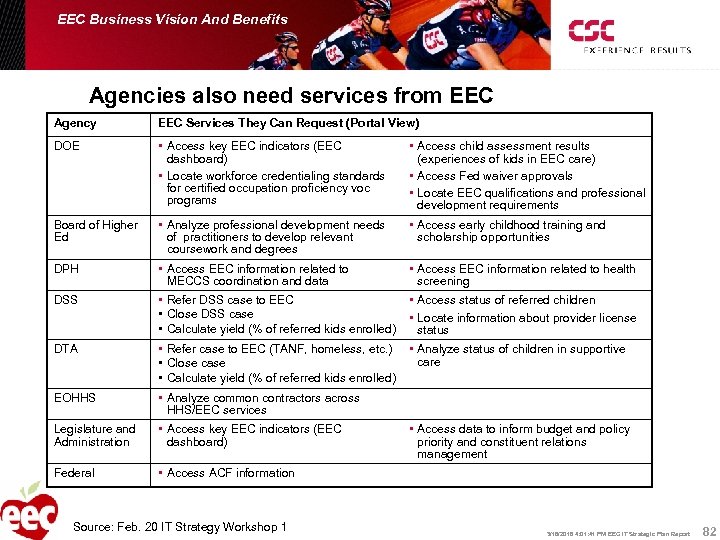 EEC Business Vision And Benefits Agencies also need services from EEC Agency EEC Services They Can Request (Portal View) DOE • Access key EEC indicators (EEC dashboard) • Locate workforce credentialing standards for certified occupation proficiency voc programs • Access child assessment results (experiences of kids in EEC care) • Access Fed waiver approvals • Locate EEC qualifications and professional development requirements Board of Higher Ed • Analyze professional development needs of practitioners to develop relevant coursework and degrees • Access early childhood training and scholarship opportunities DPH • Access EEC information related to MECCS coordination and data • Access EEC information related to health screening DSS • Refer DSS case to EEC • Close DSS case • Calculate yield (% of referred kids enrolled) • Access status of referred children • Locate information about provider license status DTA • Refer case to EEC (TANF, homeless, etc. ) • Close case • Calculate yield (% of referred kids enrolled) • Analyze status of children in supportive care EOHHS • Analyze common contractors across HHS/EEC services Legislature and Administration • Access key EEC indicators (EEC dashboard) Federal • Access ACF information Source: Feb. 20 IT Strategy Workshop 1 • Access data to inform budget and policy priority and constituent relations management 82 3/16/2018 4: 01: 41 PM EEC IT Strategic Plan Report
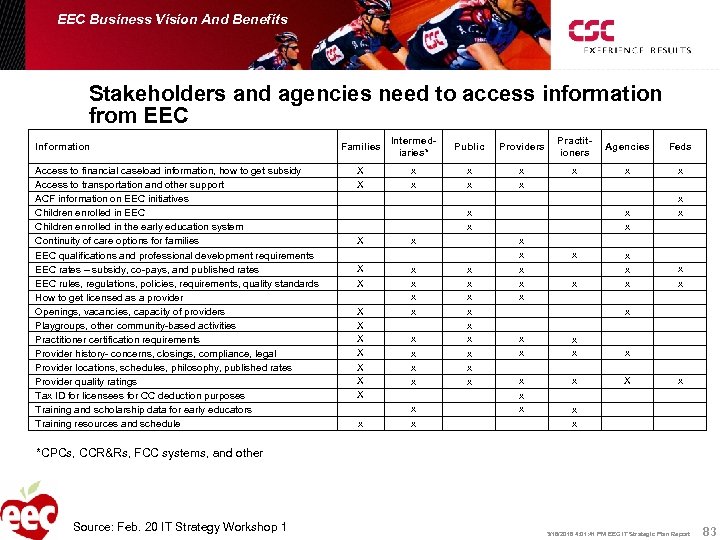 EEC Business Vision And Benefits Stakeholders and agencies need to access information from EEC Information Access to financial caseload information, how to get subsidy Access to transportation and other support ACF information on EEC initiatives Children enrolled in EEC Children enrolled in the early education system Continuity of care options for families EEC qualifications and professional development requirements EEC rates – subsidy, co-pays, and published rates EEC rules, regulations, policies, requirements, quality standards How to get licensed as a provider Openings, vacancies, capacity of providers Playgroups, other community-based activities Practitioner certification requirements Provider history- concerns, closings, compliance, legal Provider locations, schedules, philosophy, published rates Provider quality ratings Tax ID for licensees for CC deduction purposes Training and scholarship data for early educators Training resources and schedule Families Intermediaries* Public Providers X X x x x Practitioners Agencies Feds x x x X X X X X x x x x x x x x x x x x X x x x *CPCs, CCR&Rs, FCC systems, and other Source: Feb. 20 IT Strategy Workshop 1 83 3/16/2018 4: 01: 41 PM EEC IT Strategic Plan Report
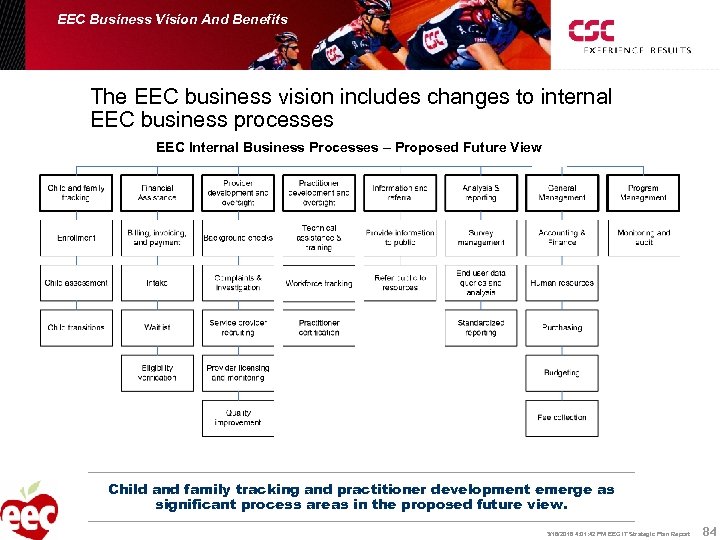 EEC Business Vision And Benefits The EEC business vision includes changes to internal EEC business processes EEC Internal Business Processes – Proposed Future View Child and family tracking and practitioner development emerge as significant process areas in the proposed future view. 84 3/16/2018 4: 01: 42 PM EEC IT Strategic Plan Report
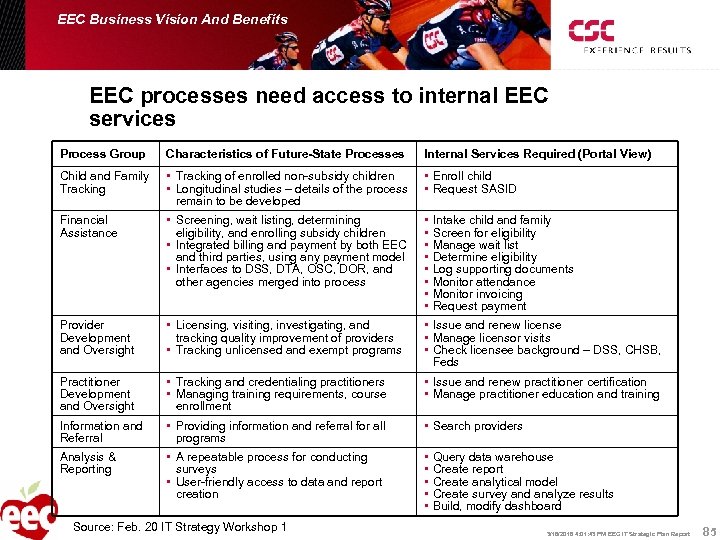 EEC Business Vision And Benefits EEC processes need access to internal EEC services Process Group Characteristics of Future-State Processes Child and Family Tracking • Tracking of enrolled non-subsidy children • Enroll child • Longitudinal studies – details of the process • Request SASID remain to be developed Financial Assistance • Screening, wait listing, determining eligibility, and enrolling subsidy children • Integrated billing and payment by both EEC and third parties, using any payment model • Interfaces to DSS, DTA, OSC, DOR, and other agencies merged into process • • Provider Development and Oversight • Licensing, visiting, investigating, and tracking quality improvement of providers • Tracking unlicensed and exempt programs • Issue and renew license • Manage licensor visits • Check licensee background – DSS, CHSB, Feds Practitioner Development and Oversight • Tracking and credentialing practitioners • Managing training requirements, course enrollment • Issue and renew practitioner certification • Manage practitioner education and training Information and Referral • Providing information and referral for all programs • Search providers Analysis & Reporting • A repeatable process for conducting surveys • User-friendly access to data and report creation • • • Source: Feb. 20 IT Strategy Workshop 1 Internal Services Required (Portal View) Intake child and family Screen for eligibility Manage wait list Determine eligibility Log supporting documents Monitor attendance Monitor invoicing Request payment Query data warehouse Create report Create analytical model Create survey and analyze results Build, modify dashboard 85 3/16/2018 4: 01: 43 PM EEC IT Strategic Plan Report
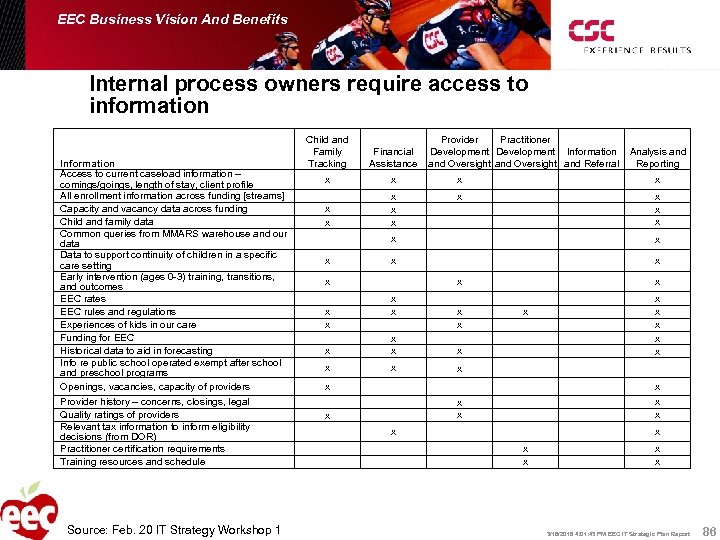 EEC Business Vision And Benefits Internal process owners require access to information Information Access to current caseload information – comings/goings, length of stay, client profile All enrollment information across funding [streams] Capacity and vacancy data across funding Child and family data Common queries from MMARS warehouse and our data Data to support continuity of children in a specific care setting Early intervention (ages 0 -3) training, transitions, and outcomes EEC rates EEC rules and regulations Experiences of kids in our care Funding for EEC Historical data to aid in forecasting Info re public school operated exempt after school and preschool programs Openings, vacancies, capacity of providers Provider history – concerns, closings, legal Quality ratings of providers Relevant tax information to inform eligibility decisions (from DOR) Practitioner certification requirements Training resources and schedule Source: Feb. 20 IT Strategy Workshop 1 Child and Family Tracking Financial Assistance Provider Practitioner Development Information and Oversight and Referral x x x x Analysis and Reporting x x x x x x x x x x 86 3/16/2018 4: 01: 43 PM EEC IT Strategic Plan Report
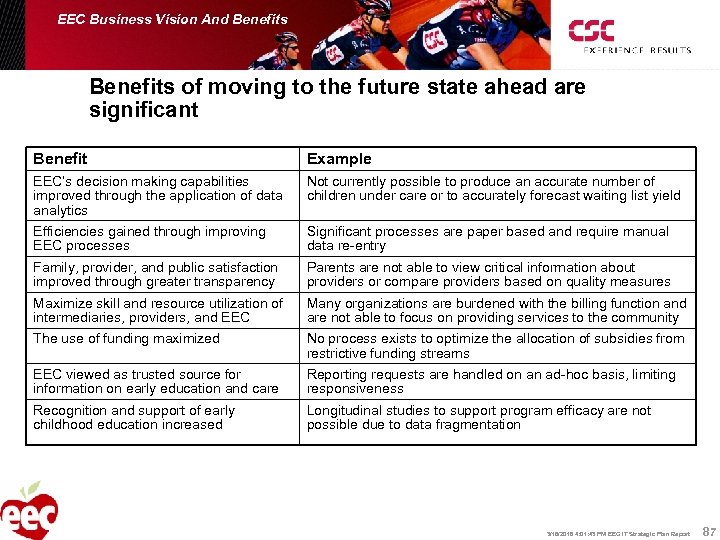 EEC Business Vision And Benefits of moving to the future state ahead are significant Benefit Example EEC’s decision making capabilities improved through the application of data analytics Not currently possible to produce an accurate number of children under care or to accurately forecast waiting list yield Efficiencies gained through improving EEC processes Significant processes are paper based and require manual data re-entry Family, provider, and public satisfaction improved through greater transparency Parents are not able to view critical information about providers or compare providers based on quality measures Maximize skill and resource utilization of intermediaries, providers, and EEC Many organizations are burdened with the billing function and are not able to focus on providing services to the community The use of funding maximized No process exists to optimize the allocation of subsidies from restrictive funding streams EEC viewed as trusted source for information on early education and care Reporting requests are handled on an ad-hoc basis, limiting responsiveness Recognition and support of early childhood education increased Longitudinal studies to support program efficacy are not possible due to data fragmentation 87 3/16/2018 4: 01: 43 PM EEC IT Strategic Plan Report
 Contents Project Approach Strategic Business Requirements and IT Baseline External Drivers Current Business State Current Technology State Fusion Tree – Business Requirements Fusion Tree – IT Requirements IT Vision – Initial Options For Data Integration IT Vision EEC business vision and benefits Vision for future state of EEC IT architecture Applications and data IT infrastructure IT organization and governance IT implementation approach and roadmap Proposed implementation strategy Implementation projects Implementation scenarios Proposed implementation organization 88 3/16/2018 4: 01: 43 PM EEC IT Strategic Plan Report
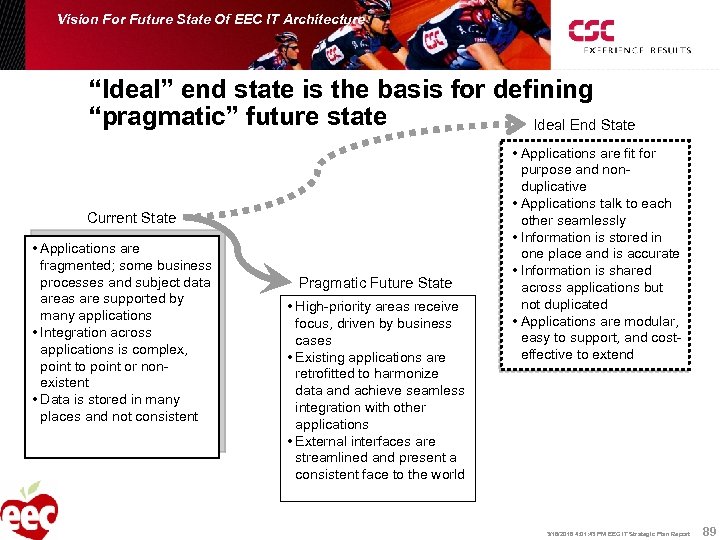 Vision For Future State Of EEC IT Architecture “Ideal” end state is the basis for defining “pragmatic” future state Ideal End State Current State • Applications are fragmented; some business processes and subject data areas are supported by many applications • Integration across applications is complex, point to point or nonexistent • Data is stored in many places and not consistent Pragmatic Future State • High-priority areas receive focus, driven by business cases • Existing applications are retrofitted to harmonize data and achieve seamless integration with other applications • External interfaces are streamlined and present a consistent face to the world • Applications are fit for purpose and nonduplicative • Applications talk to each other seamlessly • Information is stored in one place and is accurate • Information is shared across applications but not duplicated • Applications are modular, easy to support, and costeffective to extend 89 3/16/2018 4: 01: 43 PM EEC IT Strategic Plan Report
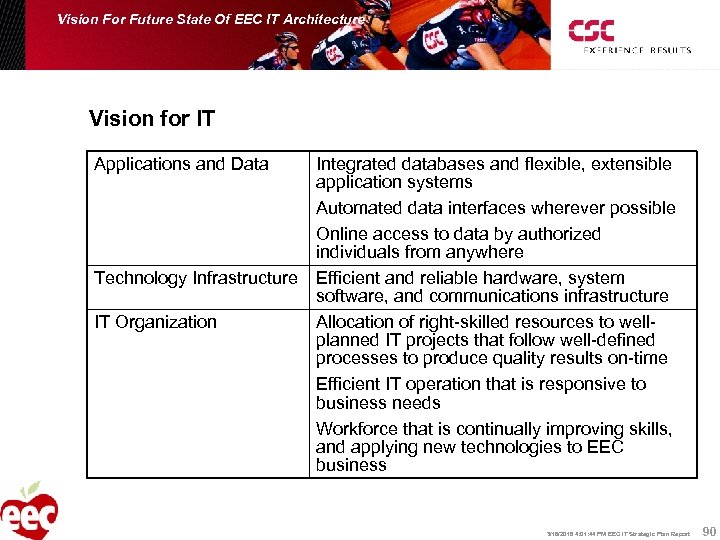 Vision For Future State Of EEC IT Architecture Vision for IT Applications and Data Technology Infrastructure IT Organization Integrated databases and flexible, extensible application systems Automated data interfaces wherever possible Online access to data by authorized individuals from anywhere Efficient and reliable hardware, system software, and communications infrastructure Allocation of right-skilled resources to wellplanned IT projects that follow well-defined processes to produce quality results on-time Efficient IT operation that is responsive to business needs Workforce that is continually improving skills, and applying new technologies to EEC business 90 3/16/2018 4: 01: 44 PM EEC IT Strategic Plan Report
 Contents Project Approach Strategic Business Requirements and IT Baseline External Drivers Current Business State Current Technology State Fusion Tree – Business Requirements Fusion Tree – IT Requirements IT Vision – Initial Options For Data Integration IT Vision EEC business vision and benefits Vision for future state of EEC IT architecture Applications and data IT infrastructure IT organization and governance IT implementation approach and roadmap Proposed implementation strategy Implementation projects Implementation scenarios Proposed implementation organization 91 3/16/2018 4: 01: 44 PM EEC IT Strategic Plan Report
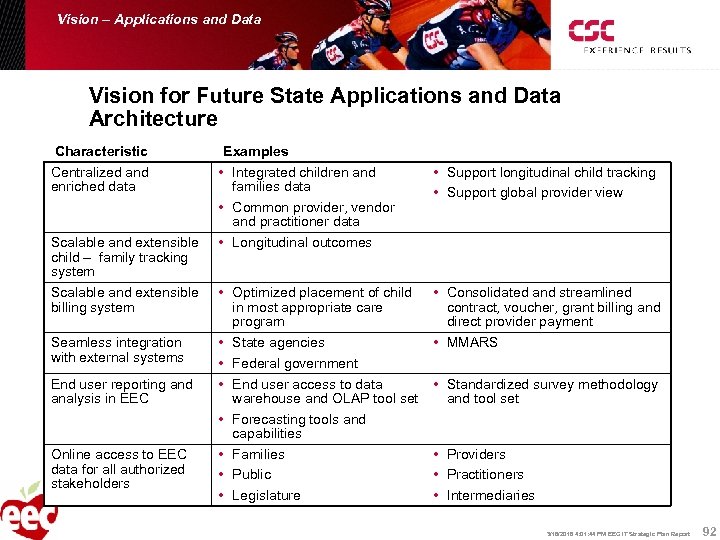 Vision – Applications and Data Vision for Future State Applications and Data Architecture Characteristic Centralized and enriched data Scalable and extensible child – family tracking system Scalable and extensible billing system Seamless integration with external systems End user reporting and analysis in EEC Online access to EEC data for all authorized stakeholders Examples • Integrated children and families data • Common provider, vendor and practitioner data • Longitudinal outcomes • Support longitudinal child tracking • Support global provider view • Optimized placement of child in most appropriate care program • State agencies • Federal government • End user access to data warehouse and OLAP tool set • Forecasting tools and capabilities • Families • Public • Legislature • Consolidated and streamlined contract, voucher, grant billing and direct provider payment • MMARS • Standardized survey methodology and tool set • Providers • Practitioners • Intermediaries 92 3/16/2018 4: 01: 44 PM EEC IT Strategic Plan Report
 Vision – Applications and Data Vision for Application Services • Business requirements for IT capabilities indicate that enterprise systems are required to manage data on: – Children and families – Providers and vendors – Practitioners – Billing • Monolithic applications are impractical to build and maintain – Large and diverse user communities lead to lengthy development cycles – Process dependencies make system changes risky, reducing agility and responsiveness to new requirements • Service orientation offers a way forward – Develop “application services” not “applications” – Application services with standards-based, platform-neutral interfaces (e. g. XML) allow flexibility and reuse, and easier internal and external integration 93 3/16/2018 4: 01: 44 PM EEC IT Strategic Plan Report
 Vision – Applications and Data Vision for Service Oriented Architecture (SOA) • Service: A self-contained software entity that interacts with applications and other services through well defined messages (interfaces) • Enterprise application architecture is a mesh of looselycoupled, collaborating services – Business processes are enabled by calling these services in defined sequences – “Service buses” are used to mediate the interplay of services • Application systems are composed of services – Services provide unique functionality and request common functionality from other services – Services encapsulate business rules into discrete software units that are invoked each time the functionality is required • Candidate application services may be derived based on the major process groups and data subject areas 94 3/16/2018 4: 01: 44 PM EEC IT Strategic Plan Report
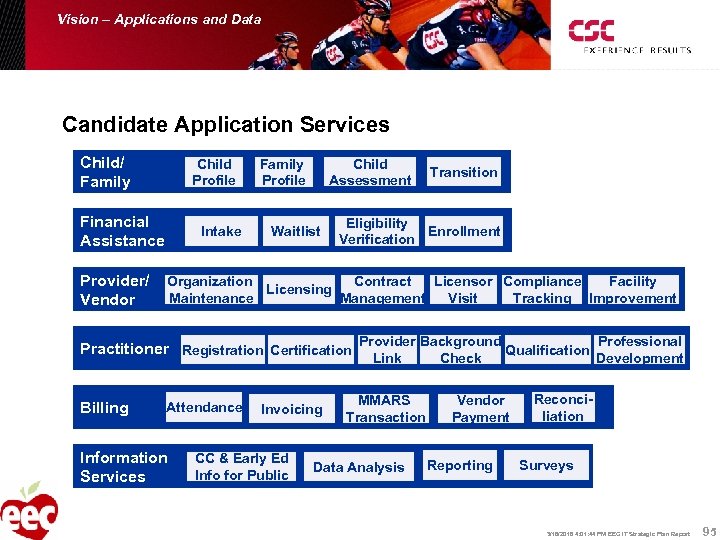 Vision – Applications and Data Candidate Application Services Child/ Family Child Profile Financial Assistance Provider/ Vendor Intake Child Assessment Family Profile Waitlist Eligibility Enrollment Verification Organization Contract Licensor Compliance Facility Licensing Maintenance Management Visit Tracking Improvement Practitioner Registration Certification Billing Transition Attendance Information Services Invoicing CC & Early Ed Info for Public Professional Provider Background Qualification Development Link Check MMARS Transaction Data Analysis Vendor Payment Reporting Reconciliation Surveys 95 3/16/2018 4: 01: 44 PM EEC IT Strategic Plan Report
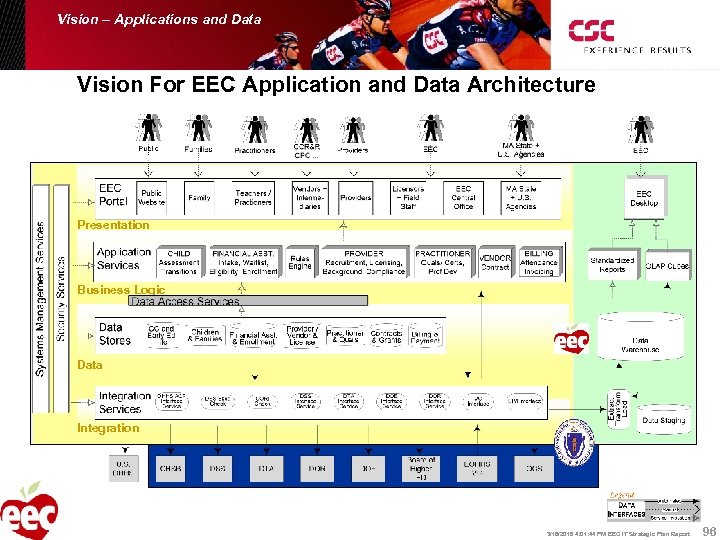 Vision – Applications and Data Vision For EEC Application and Data Architecture Presentation Business Logic Data Integration 96 3/16/2018 4: 01: 44 PM EEC IT Strategic Plan Report
 Vision – Applications and Data Service Oriented Architecture Key Benefits • Ability to adapt to new requirements • Speed to develop new applications • Ease of data integration • Reuse of existing assets • Use of Industry standards • Incremental migration path from legacy environment 97 3/16/2018 4: 01: 45 PM EEC IT Strategic Plan Report
 Vision – Applications and Data SOA Application and Data Architecture Principles • Services are large-grained components that can change internally without changing existing interfaces – Changes to one application does not ripple through all others – Applications share common services rather than maintain their own data • Promote reuse of components and services – Build around a standard component framework – Use a common data model for all service interfaces so that messages can be exchanged efficiently, and interoperability maximized – Data and message standards are key to stable interfaces • Enterprise data model and data standards promote the development of reusable services 98 3/16/2018 4: 01: 46 PM EEC IT Strategic Plan Report
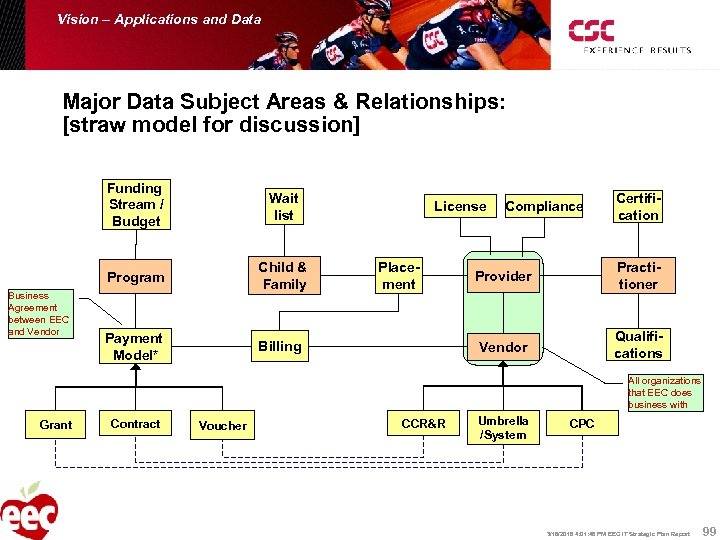 Vision – Applications and Data Major Data Subject Areas & Relationships: [straw model for discussion] Funding Stream / Budget Program Business Agreement between EEC and Vendor Wait list Child & Family Payment Model* Billing License Placement Compliance Certification Provider Practitioner Vendor Qualifications All organizations that EEC does business with Grant Contract Voucher CCR&R Umbrella /System CPC 99 3/16/2018 4: 01: 46 PM EEC IT Strategic Plan Report
 Vision – Applications and Data Enterprise Data Standards • Common data standards are essential pre-requisite to new enterprise systems (services) implementation • Enterprise data model serves as the reference for all data standards – Data model establishes common principles for data naming – Data model documents business rules that drive information structures and relationships; e. g. “a provider may be linked to one vendor at a time” – Single data administrator owns data model and ensured consistent use by different application development teams • Applications implemented at different points in time and space would all be designed based on common data model • Packaged (COTS) applications would be required to develop interfaces that conform to the data model standards 100 3/16/2018 4: 01: 47 PM EEC IT Strategic Plan Report
 Vision – Applications and Data Exchange Standards • EEC data model would be basis for all internal interfaces between systems and services • External data integration facilitated by Enterprise Data Standards, but dependency on external party remains – XML Schema based approach makes mapping to other data and message formats easier and should be adopted • External data exchange standards may be a moving target for some time – EOHHS messaging standards are advanced – U. S. DHHS Administration of Children and Families (ACF) standards for population and case level data [non-XML] – HL 7 data standards for healthcare applications [various versions; most widespread implementations are complex and inconsistently applied] – Other U. S. data standards (e. g. Global Justice XML Data Model) published for law and criminal justice applications 101 3/16/2018 4: 01: 47 PM EEC IT Strategic Plan Report
 Vision – Applications and Data Interfaces to Virtual Gateway and Other State Assets • Virtual Gateway represents > 3 years of SOA effort in EOHHS – Ideal for reuse by other state agencies – Maturity and timing issues need to be worked through • Common Intake portal for pre-screening families for child care and intake into waiting list – Waiting lists also populated by e. CCIMS – More intake portals may be added by using a standard interface into the ‘Waiting List Service’ • Enterprise Invoice Management (EIM) service offers smoother channel than direct MMARS interfaces – Enterprise Services Management used for billing services for DPH – Attendance entry by providers into ESM needs further analysis; need for child-level information may be burdensome • EOHHS has leverageable subject-matter expertise in SOA and XML data interfaces – Have offer of help with child/family interfaces to DSS and DTA 102 3/16/2018 4: 01: 47 PM EEC IT Strategic Plan Report
 Vision – Applications and Data Vision for Security Architecture • End-to-end solution that provides security in depth while not impeding users with right of access to information – External user population (providers, vendors, practitioners) presents significant technological hurdle • Role-based access control (RBAC) reduces maintenance load – Current EEC applications do not share enterprise level role definitions – Single Sign-On is desirable • EOHHS has implemented enterprise security service – Based on best practices in • Identity management: includes the administration of user credentials across a large population of providers and their employees • 16, 000 users currently in directory – expect to scale to 30, 000 by end of 2007 • Role and rule-based access control using application level policy file – Single Sign-On using Sun ‘agents’ • Supports Java/Open Source as well as Microsoft. NET applications • Implementing an equivalent security architecture for EEC will need significant investment – Recommend EEC pursue integration with EOHHS security services 103 3/16/2018 4: 01: 47 PM EEC IT Strategic Plan Report
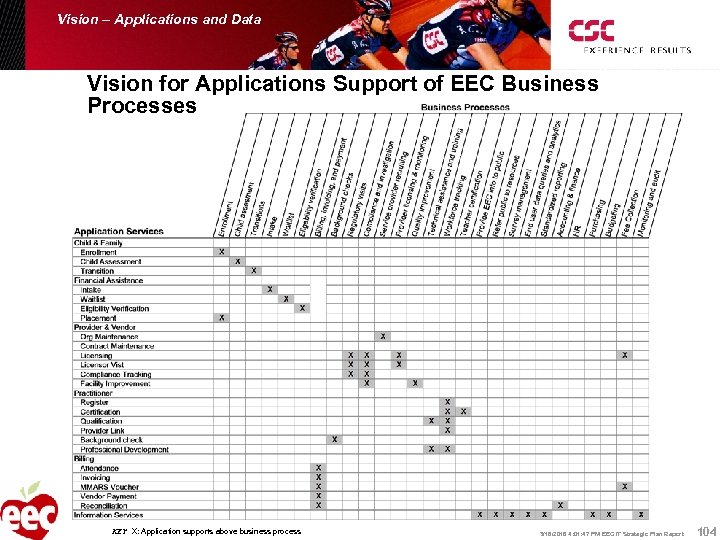 Vision – Applications and Data Vision for Applications Support of EEC Business Processes KEY X: Application supports above business process 104 3/16/2018 4: 01: 47 PM EEC IT Strategic Plan Report
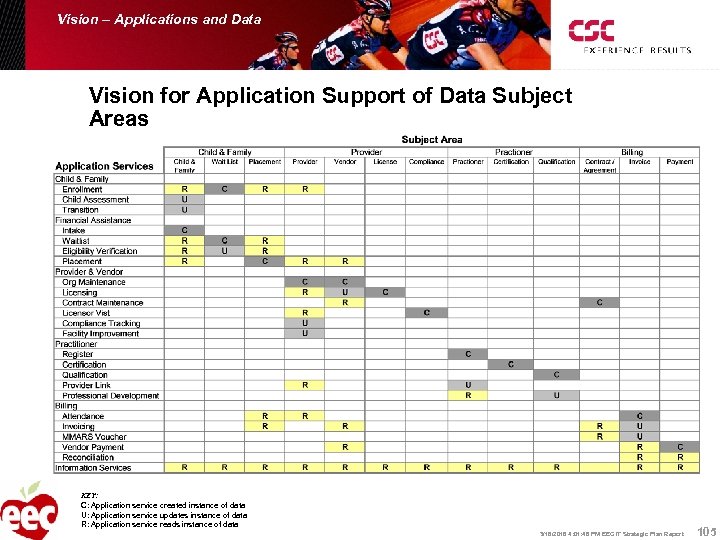 Vision – Applications and Data Vision for Application Support of Data Subject Areas KEY: C: Application service created instance of data U: Application service updates instance of data R: Application service reads instance of data 105 3/16/2018 4: 01: 48 PM EEC IT Strategic Plan Report
 Contents Project Approach Strategic Business Requirements and IT Baseline External Drivers Current Business State Current Technology State Fusion Tree – Business Requirements Fusion Tree – IT Requirements IT Vision – Initial Options For Data Integration IT Vision EEC business vision and benefits Vision for future state of EEC IT architecture Applications and data IT infrastructure IT organization and governance IT implementation approach and roadmap Proposed implementation strategy Implementation projects Implementation scenarios Proposed implementation organization 106 3/16/2018 4: 01: 49 PM EEC IT Strategic Plan Report
 Vision – IT Infrastructure Vision for SOA Infrastructure • SOA implementations are infrastructure agnostic; platform choices include – Microsoft. NET – Java 2 Enterprise Edition API based – Open Source (LAMP) • Current EEC IT infrastructure (and skills) based on Microsoft operating system and DBMS platforms – Web-based ‘online’ applications can be extended to Microsoft SOA platform: ASP. NET – Future state IT architecture should leverage current application and infrastructure portfolio and available skills – Avoid lock-in to proprietary technologies by use of open standards and vanilla VB. NET / C# and. NET framework – Emphasize interfaces with EOHHS / ITD services, where appropriate, using SOAP/WSDL/SAML – Design autonomous application services that can be replatformed without breaking the interfaces that other applications / services consume 107 3/16/2018 4: 01: 50 PM EEC IT Strategic Plan Report
 Vision – IT Infrastructure Vision for Technology Infrastructure • Stay current with hardware and systems software technology to take advantage of Moore’s law – Computer power doubles every 18 month, while prices halves – Develop upgrade cycle to port applications to new versions of application platforms (e. g. SQL Server 2005) • Current 12 Windows Server environments will increase with centralization of data and applications – Best practice calls for three environments (test / stage / production) controlled through configuration management – Multiple application environments will generate overhead, calling for increased systems management automation • EEC data center becomes more mission critical for distributed population – Review and update business continuity and disaster recovery plans • Expand use of SAN (‘Storage Array Network’) for enterprise storage – Consider lower-cost storage for ‘write-once read-many times’ (WORM) data: e. g. teacher qualifications (apply Information Lifecycle Mgmt) 108 3/16/2018 4: 01: 50 PM EEC IT Strategic Plan Report
 Vision – IT Infrastructure Vision for Server Consolidation and Virtualization • Consolidate numerous small servers onto one large server where applications may coexist on same hardware – Suitable for homogenous work loads – similar application and database platforms • Reduce footprint of servers in Data Center – Use rack dense servers / blades – Reduce power and cooling costs – Reduce OS images in use • Next lease renewal point may present opportunity to consolidate further • Goes hand-in-hand with virtualization (see next page) 109 3/16/2018 4: 01: 50 PM EEC IT Strategic Plan Report
 Vision – IT Infrastructure Vision for Server Consolidation and Virtualization (Cont’d) • Reduce the number of physical servers (machines and appliances) – Deploy the same number of Operating Systems – Don’t add new server(s) for each new application – Provision new servers directly on the disk – Right-size servers for new applications without need to design spare capacity into each server – Reduce data center floor space, cooling and power consumption requirements • Provision new servers rapidly • Backup and restore whole servers as disk files 110 3/16/2018 4: 01: 50 PM EEC IT Strategic Plan Report
 Contents Project Approach Strategic Business Requirements and IT Baseline External Drivers Current Business State Current Technology State Fusion Tree – Business Requirements Fusion Tree – IT Requirements IT Vision – Initial Options For Data Integration IT Vision EEC business vision and benefits Vision for future state of EEC IT architecture Applications and data IT infrastructure IT organization and governance IT implementation approach and roadmap Proposed implementation strategy Implementation projects Implementation scenarios Proposed implementation organization 111 3/16/2018 4: 01: 51 PM EEC IT Strategic Plan Report
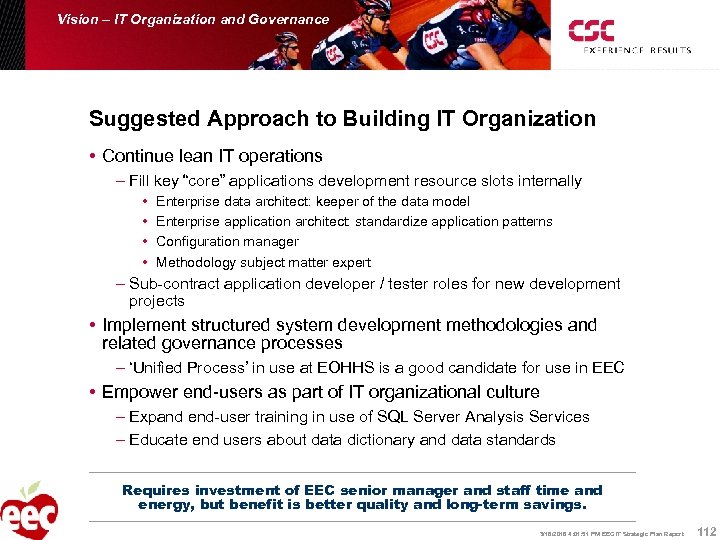 Vision – IT Organization and Governance Suggested Approach to Building IT Organization • Continue lean IT operations – Fill key “core” applications development resource slots internally • • Enterprise data architect: keeper of the data model Enterprise application architect: standardize application patterns Configuration manager Methodology subject matter expert – Sub-contract application developer / tester roles for new development projects • Implement structured system development methodologies and related governance processes – ‘Unified Process’ in use at EOHHS is a good candidate for use in EEC • Empower end-users as part of IT organizational culture – Expand end-user training in use of SQL Server Analysis Services – Educate end users about data dictionary and data standards Requires investment of EEC senior manager and staff time and energy, but benefit is better quality and long-term savings. 112 3/16/2018 4: 01: 51 PM EEC IT Strategic Plan Report
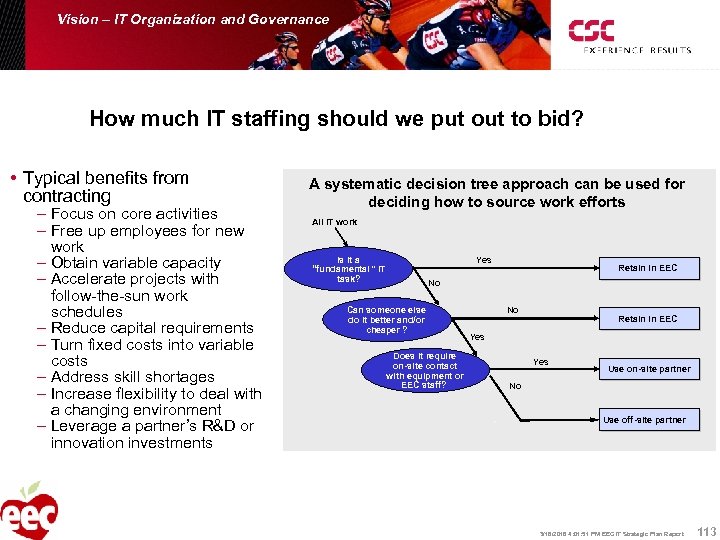 Vision – IT Organization and Governance How much IT staffing should we put out to bid? • Typical benefits from contracting – Focus on core activities – Free up employees for new work – Obtain variable capacity – Accelerate projects with follow-the-sun work schedules – Reduce capital requirements – Turn fixed costs into variable costs – Address skill shortages – Increase flexibility to deal with a changing environment – Leverage a partner’s R&D or innovation investments A systematic decision tree approach can be used for deciding how to source work efforts All IT work Is it a “fundamental ” IT task? Yes Retain in EEC Retain in M&R No Can someone else do it better and/or cheaper ? No Retain in EEC Retain in M&R Yes Does it require on-site contact with equipment or EEC staff? Yes Use on-site partner No - Use off-site partner Use off-shore partner 113 3/16/2018 4: 01: 51 PM EEC IT Strategic Plan Report
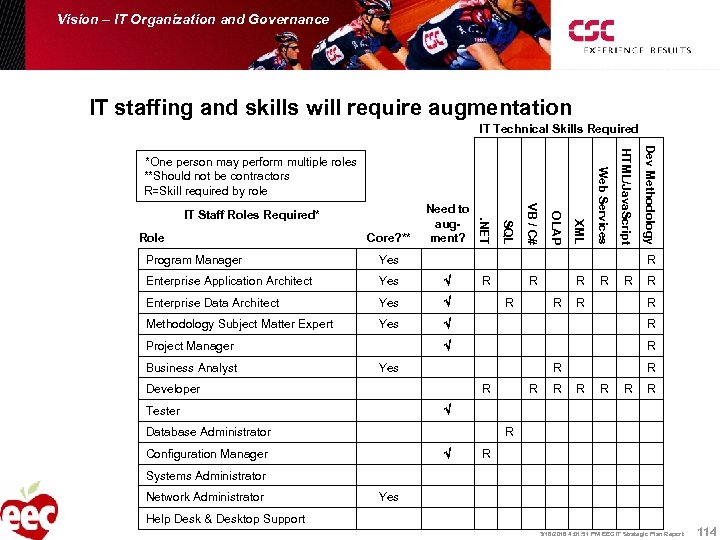 Vision – IT Organization and Governance IT staffing and skills will require augmentation IT Technical Skills Required Dev Methodology HTML/Java. Script XML OLAP VB / C# Core? ** SQL Role Need to augment? . NET IT Staff Roles Required* Web Services *One person may perform multiple roles **Should not be contractors R=Skill required by role Program Manager Yes Enterprise Application Architect Yes Ö Enterprise Data Architect Yes Ö Methodology Subject Matter Expert Yes Ö R Project Manager Business Analyst R R R Yes R R R Developer R R R R R Ö Tester Database Administrator R Ö Configuration Manager R Systems Administrator Network Administrator Help Desk & Desktop Support Yes 114 3/16/2018 4: 01: 51 PM EEC IT Strategic Plan Report
 Vision – IT Organization and Governance Proposed Roles: Enterprise Architecture • Data Architect: Build and maintain enterprise data model, to support consistent use and interpretation of data in current and new systems – Data warehouse should be supported with data dictionary and end-user oriented ‘metadata’ layer – End-user input to data model will help institutionalize data dictionary and help reduce semantic clutter in the organization • Application Architect: Document services, to support reuse and avoid proliferation of redundant services providing similar services – Current and online architecture documentation enables organization to weather staff & contractor turnover – Contractors with desired technology skills take significantly longer getting up to speed with EEC business and technology assets – Lost productivity translates directly to higher costs 115 3/16/2018 4: 01: 52 PM EEC IT Strategic Plan Report
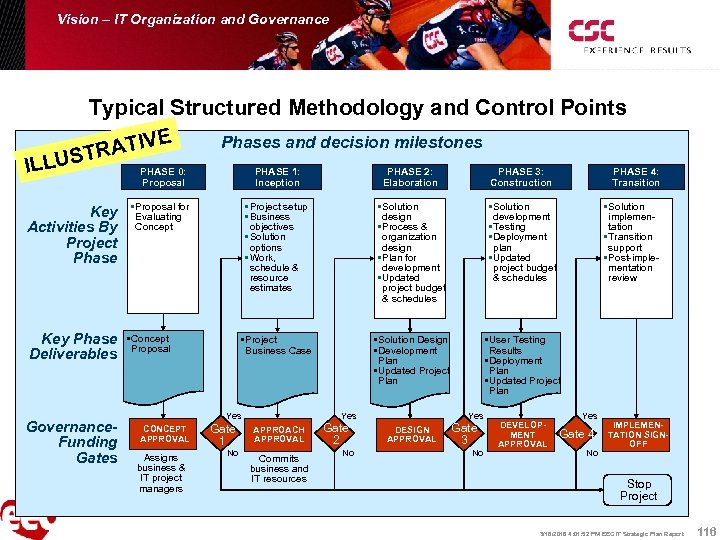 Vision – IT Organization and Governance IL Typical Structured Methodology and Control Points E Phases and decision milestones RATIV ST LU Key Activities By Project Phase Key Phase Deliverables Governance. Funding Gates PHASE 0: Proposal PHASE 1: Inception PHASE 2: Elaboration • Project setup • Business objectives • Solution options • Work, schedule & resource estimates • Solution design • Process & organization design • Plan for development • Updated project budget & schedules • Solution development • Testing • Deployment plan • Updated project budget & schedules • Project Business Case • Solution Design • Development Plan • Updated Project Plan • User Testing Results • Deployment Plan • Updated Project Plan • Proposal for Evaluating Concept • Concept Proposal Yes CONCEPT APPROVAL Gate 1 Assigns business & IT project managers No Yes APPROACH APPROVAL Commits business and IT resources Gate 2 No PHASE 3: Construction Yes DESIGN APPROVAL Gate 3 No DEVELOPMENT APPROVAL PHASE 4: Transition • Solution implementation • Transition support • Post-implementation review Yes Gate 4 No IMPLEMENTATION SIGNOFF Stop Project 116 3/16/2018 4: 01: 52 PM EEC IT Strategic Plan Report
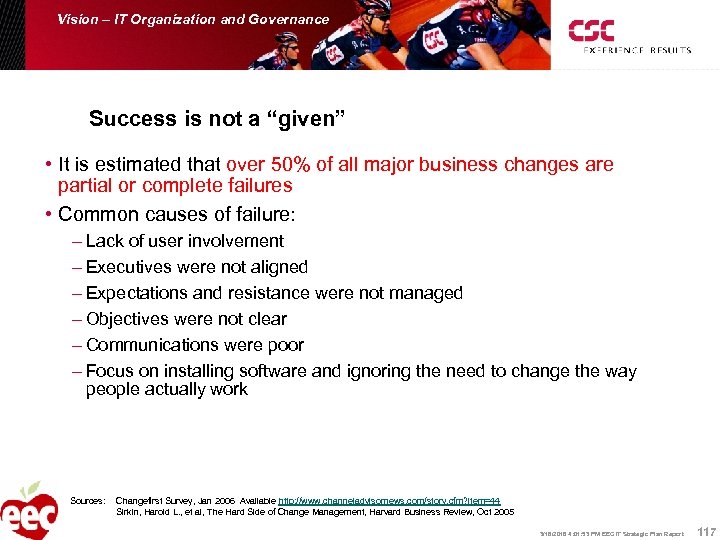 Vision – IT Organization and Governance Success is not a “given” • It is estimated that over 50% of all major business changes are partial or complete failures • Common causes of failure: – Lack of user involvement – Executives were not aligned – Expectations and resistance were not managed – Objectives were not clear – Communications were poor – Focus on installing software and ignoring the need to change the way people actually work Sources: Changefirst Survey, Jan 2006 Available http: //www. channeladvisornews. com/story. cfm? item=44 Sirkin, Harold L. , et al, The Hard Side of Change Management, Harvard Business Review, Oct 2005 117 3/16/2018 4: 01: 53 PM EEC IT Strategic Plan Report
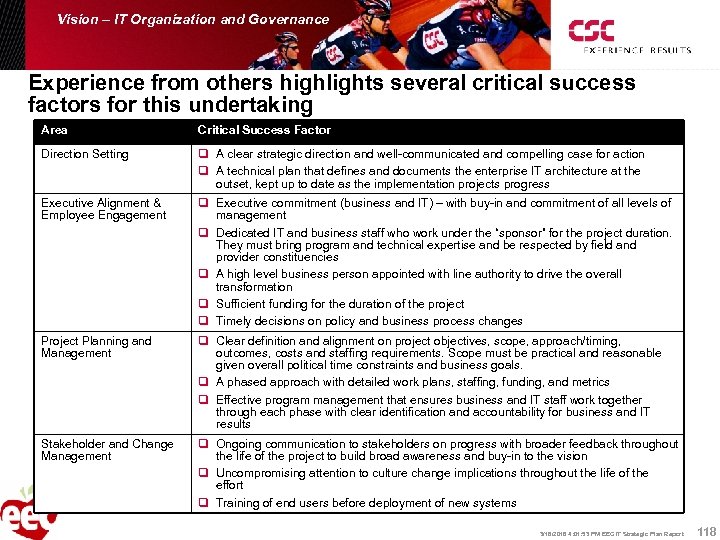 Vision – IT Organization and Governance Experience from others highlights several critical success factors for this undertaking Area Critical Success Factor Direction Setting q A clear strategic direction and well-communicated and compelling case for action q A technical plan that defines and documents the enterprise IT architecture at the outset, kept up to date as the implementation projects progress Executive Alignment & Employee Engagement q Executive commitment (business and IT) – with buy-in and commitment of all levels of management q Dedicated IT and business staff who work under the “sponsor” for the project duration. They must bring program and technical expertise and be respected by field and provider constituencies q A high level business person appointed with line authority to drive the overall transformation q Sufficient funding for the duration of the project q Timely decisions on policy and business process changes Project Planning and Management q Clear definition and alignment on project objectives, scope, approach/timing, outcomes, costs and staffing requirements. Scope must be practical and reasonable given overall political time constraints and business goals. q A phased approach with detailed work plans, staffing, funding, and metrics q Effective program management that ensures business and IT staff work together through each phase with clear identification and accountability for business and IT results Stakeholder and Change Management q Ongoing communication to stakeholders on progress with broader feedback throughout the life of the project to build broad awareness and buy-in to the vision q Uncompromising attention to culture change implications throughout the life of the effort q Training of end users before deployment of new systems 118 3/16/2018 4: 01: 53 PM EEC IT Strategic Plan Report
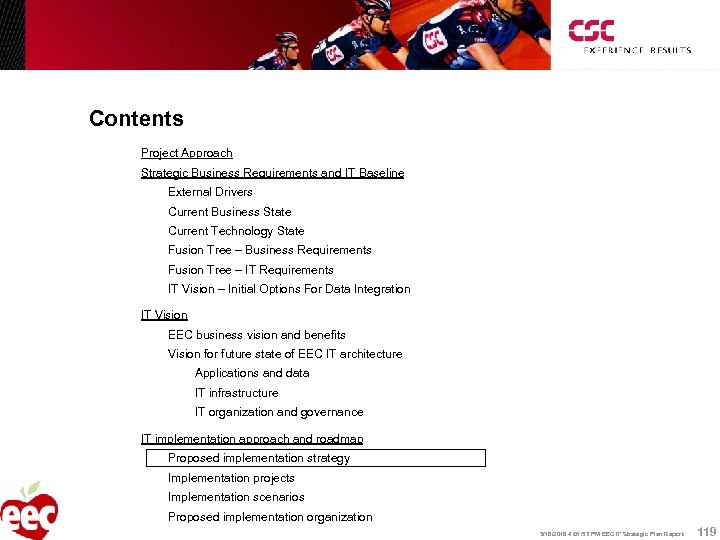 Contents Project Approach Strategic Business Requirements and IT Baseline External Drivers Current Business State Current Technology State Fusion Tree – Business Requirements Fusion Tree – IT Requirements IT Vision – Initial Options For Data Integration IT Vision EEC business vision and benefits Vision for future state of EEC IT architecture Applications and data IT infrastructure IT organization and governance IT implementation approach and roadmap Proposed implementation strategy Implementation projects Implementation scenarios Proposed implementation organization 119 3/16/2018 4: 01: 53 PM EEC IT Strategic Plan Report
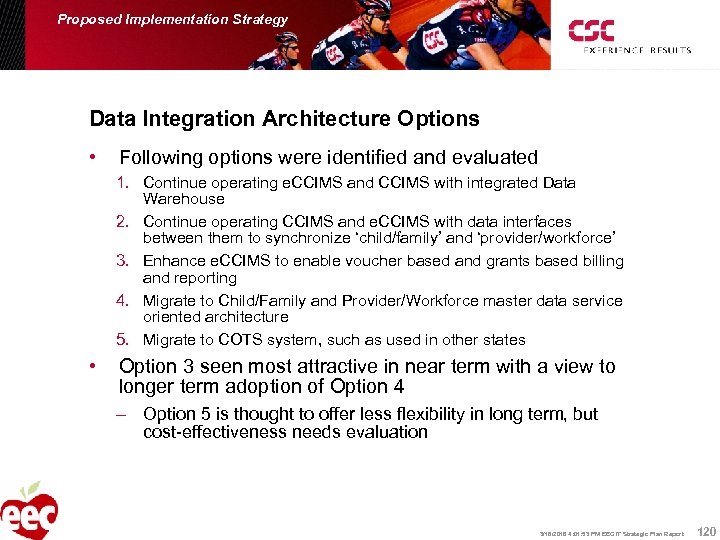 Proposed Implementation Strategy Data Integration Architecture Options • Following options were identified and evaluated 1. Continue operating e. CCIMS and CCIMS with integrated Data Warehouse 2. Continue operating CCIMS and e. CCIMS with data interfaces between them to synchronize ‘child/family’ and ‘provider/workforce’ 3. Enhance e. CCIMS to enable voucher based and grants based billing and reporting 4. Migrate to Child/Family and Provider/Workforce master data service oriented architecture 5. Migrate to COTS system, such as used in other states • Option 3 seen most attractive in near term with a view to longer term adoption of Option 4 – Option 5 is thought to offer less flexibility in long term, but cost-effectiveness needs evaluation 120 3/16/2018 4: 01: 53 PM EEC IT Strategic Plan Report
 Proposed Implementation Strategy Proposed Overall Implementation Approach - Migrate to a Service Oriented Enterprise • Enterprise SOA should leverage current application portfolio – Existing investment in legacy systems makes development of SOA-based enterprise applications from scratch unattractive – Legacy systems may be SOA-enabled through message interface or adaptors that provide a ‘service-wrapper’ to an existing application – Size and diversity of application portfolio may complicate enterprise wide migration • Migration should be incremental – Introduce service orientation to new business system development or reengineering projects – Start with a small application – aim for ‘snowball’ effect • Applications reengineering should use opportunity to better support business processes and streamline interfaces – Choose candidate projects based on business value of data integration and service reuse 121 3/16/2018 4: 01: 54 PM EEC IT Strategic Plan Report
 Proposed Implementation Strategy Proposed Overall Implementation Approach – Empowered Users and Self-Service over the Internet • EEC end-users have direct access to integrated information – All transactional systems feed data into the EEC data warehouse, which is designed for ease of end-user access and data analysis – Power users are identified and given additional training on use of online analytical and reporting tools to support self-serve reporting • Web-browser based user interfaces reduce training needs for all users – All new systems are deployed over the Internet – Providers, practitioners and vendors are given personalized access to systems – New systems have detailed help pages, online tutorials, FAQ, and discussion boards for remote support and minimal instructor-led training 122 3/16/2018 4: 01: 54 PM EEC IT Strategic Plan Report
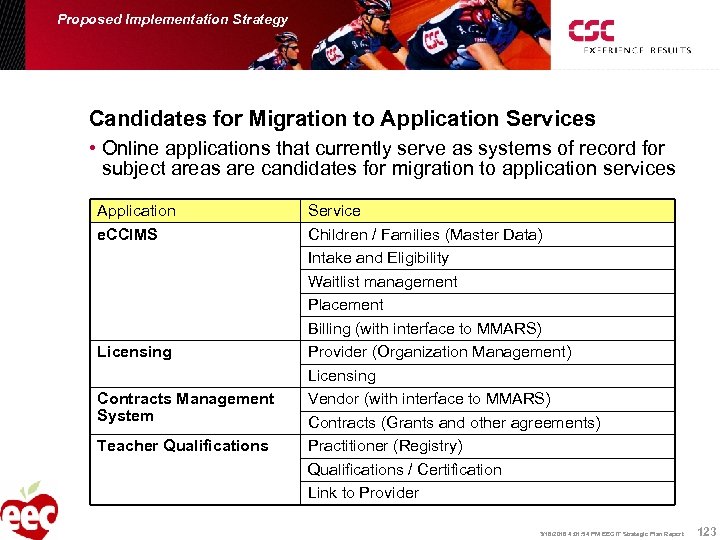 Proposed Implementation Strategy Candidates for Migration to Application Services • Online applications that currently serve as systems of record for subject areas are candidates for migration to application services Application e. CCIMS Licensing Contracts Management System Teacher Qualifications Service Children / Families (Master Data) Intake and Eligibility Waitlist management Placement Billing (with interface to MMARS) Provider (Organization Management) Licensing Vendor (with interface to MMARS) Contracts (Grants and other agreements) Practitioner (Registry) Qualifications / Certification Link to Provider 123 3/16/2018 4: 01: 54 PM EEC IT Strategic Plan Report
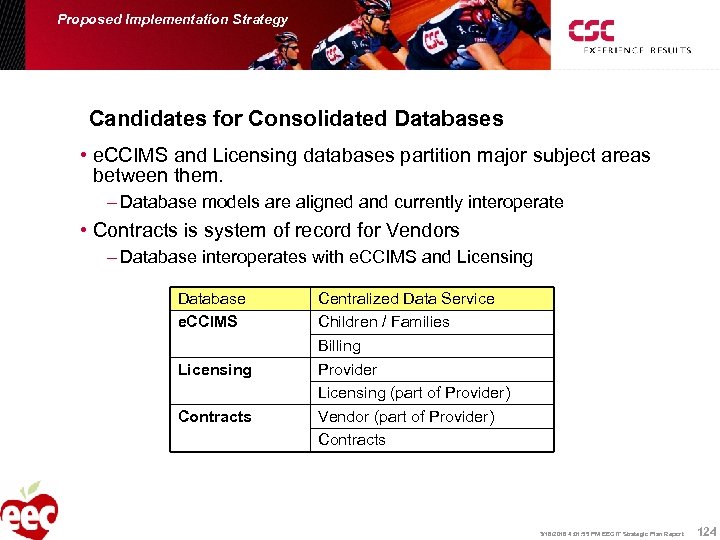 Proposed Implementation Strategy Candidates for Consolidated Databases • e. CCIMS and Licensing databases partition major subject areas between them. – Database models are aligned and currently interoperate • Contracts is system of record for Vendors – Database interoperates with e. CCIMS and Licensing Database e. CCIMS Licensing Contracts Centralized Data Service Children / Families Billing Provider Licensing (part of Provider) Vendor (part of Provider) Contracts 124 3/16/2018 4: 01: 55 PM EEC IT Strategic Plan Report
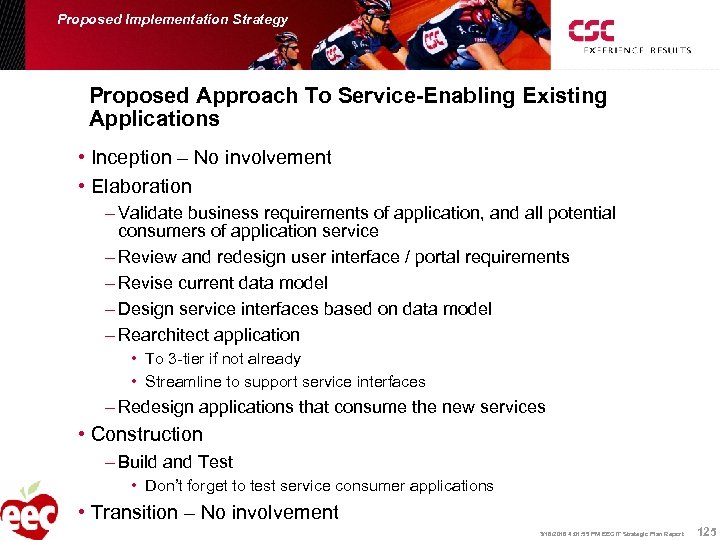 Proposed Implementation Strategy Proposed Approach To Service-Enabling Existing Applications • Inception – No involvement • Elaboration – Validate business requirements of application, and all potential consumers of application service – Review and redesign user interface / portal requirements – Revise current data model – Design service interfaces based on data model – Rearchitect application • To 3 -tier if not already • Streamline to support service interfaces – Redesign applications that consume the new services • Construction – Build and Test • Don’t forget to test service consumer applications • Transition – No involvement 125 3/16/2018 4: 01: 55 PM EEC IT Strategic Plan Report
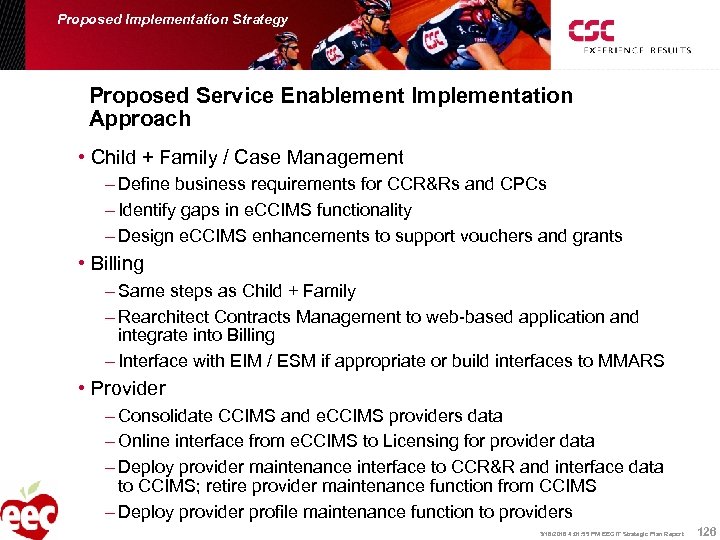 Proposed Implementation Strategy Proposed Service Enablement Implementation Approach • Child + Family / Case Management – Define business requirements for CCR&Rs and CPCs – Identify gaps in e. CCIMS functionality – Design e. CCIMS enhancements to support vouchers and grants • Billing – Same steps as Child + Family – Rearchitect Contracts Management to web-based application and integrate into Billing – Interface with EIM / ESM if appropriate or build interfaces to MMARS • Provider – Consolidate CCIMS and e. CCIMS providers data – Online interface from e. CCIMS to Licensing for provider data – Deploy provider maintenance interface to CCR&R and interface data to CCIMS; retire provider maintenance function from CCIMS – Deploy provider profile maintenance function to providers 126 3/16/2018 4: 01: 55 PM EEC IT Strategic Plan Report
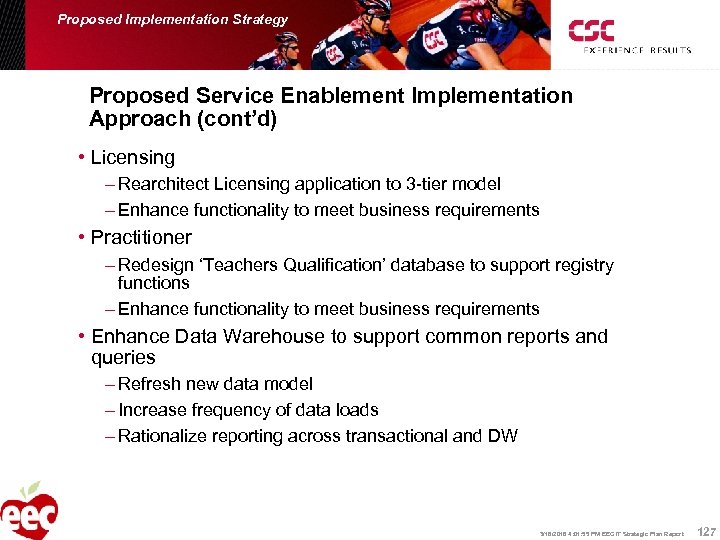 Proposed Implementation Strategy Proposed Service Enablement Implementation Approach (cont’d) • Licensing – Rearchitect Licensing application to 3 -tier model – Enhance functionality to meet business requirements • Practitioner – Redesign ‘Teachers Qualification’ database to support registry functions – Enhance functionality to meet business requirements • Enhance Data Warehouse to support common reports and queries – Refresh new data model – Increase frequency of data loads – Rationalize reporting across transactional and DW 127 3/16/2018 4: 01: 55 PM EEC IT Strategic Plan Report
 Contents Project Approach Strategic Business Requirements and IT Baseline External Drivers Current Business State Current Technology State Fusion Tree – Business Requirements Fusion Tree – IT Requirements IT Vision – Initial Options For Data Integration IT Vision EEC business vision and benefits Vision for future state of EEC IT architecture Applications and data IT infrastructure IT organization and governance IT implementation approach and roadmap Proposed implementation strategy Implementation projects Implementation scenarios Proposed implementation organization 128 3/16/2018 4: 01: 56 PM EEC IT Strategic Plan Report
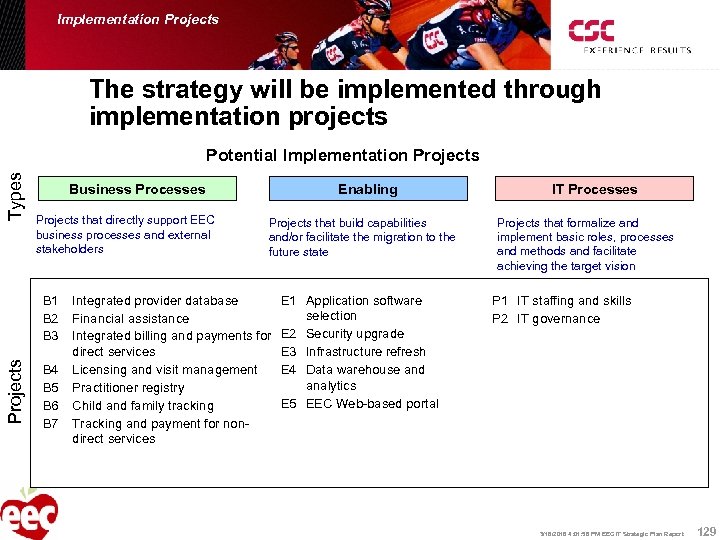 Implementation Projects The strategy will be implemented through implementation projects Types Potential Implementation Projects Business Processes Projects that directly support EEC business processes and external stakeholders Projects B 1 B 2 B 3 B 4 B 5 B 6 B 7 Enabling Projects that build capabilities and/or facilitate the migration to the future state Integrated provider database Financial assistance Integrated billing and payments for direct services Licensing and visit management Practitioner registry Child and family tracking Tracking and payment for nondirect services E 1 Application software selection E 2 Security upgrade E 3 Infrastructure refresh E 4 Data warehouse and analytics E 5 EEC Web-based portal IT Processes Projects that formalize and implement basic roles, processes and methods and facilitate achieving the target vision P 1 IT staffing and skills P 2 IT governance 129 3/16/2018 4: 01: 56 PM EEC IT Strategic Plan Report
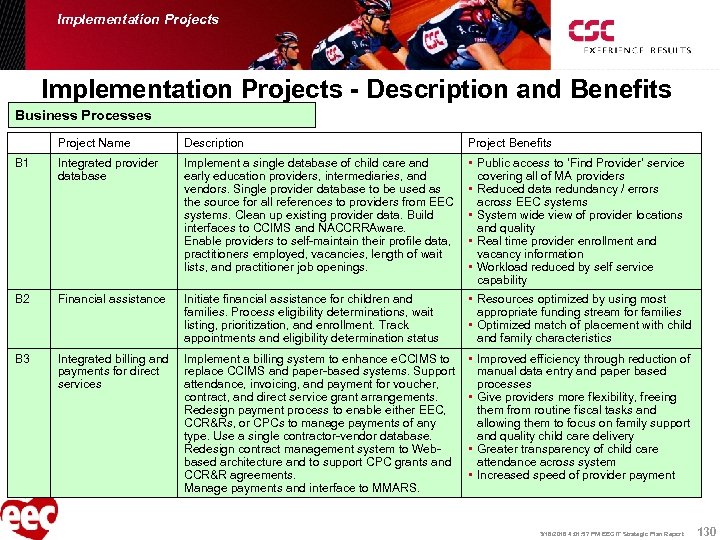 Implementation Projects - Description and Benefits Business Processes Project Name Description Project Benefits B 1 Integrated provider database Implement a single database of child care and early education providers, intermediaries, and vendors. Single provider database to be used as the source for all references to providers from EEC systems. Clean up existing provider data. Build interfaces to CCIMS and NACCRRAware. Enable providers to self-maintain their profile data, practitioners employed, vacancies, length of wait lists, and practitioner job openings. • Public access to ‘Find Provider’ service covering all of MA providers • Reduced data redundancy / errors across EEC systems • System wide view of provider locations and quality • Real time provider enrollment and vacancy information • Workload reduced by self service capability B 2 Financial assistance Initiate financial assistance for children and families. Process eligibility determinations, wait listing, prioritization, and enrollment. Track appointments and eligibility determination status • Resources optimized by using most appropriate funding stream for families • Optimized match of placement with child and family characteristics B 3 Integrated billing and Implement a billing system to enhance e. CCIMS to payments for direct replace CCIMS and paper-based systems. Support services attendance, invoicing, and payment for voucher, contract, and direct service grant arrangements. Redesign payment process to enable either EEC, CCR&Rs, or CPCs to manage payments of any type. Use a single contractor-vendor database. Redesign contract management system to Webbased architecture and to support CPC grants and CCR&R agreements. Manage payments and interface to MMARS. • Improved efficiency through reduction of manual data entry and paper based processes • Give providers more flexibility, freeing them from routine fiscal tasks and allowing them to focus on family support and quality child care delivery • Greater transparency of child care attendance across system • Increased speed of provider payment 130 3/16/2018 4: 01: 57 PM EEC IT Strategic Plan Report
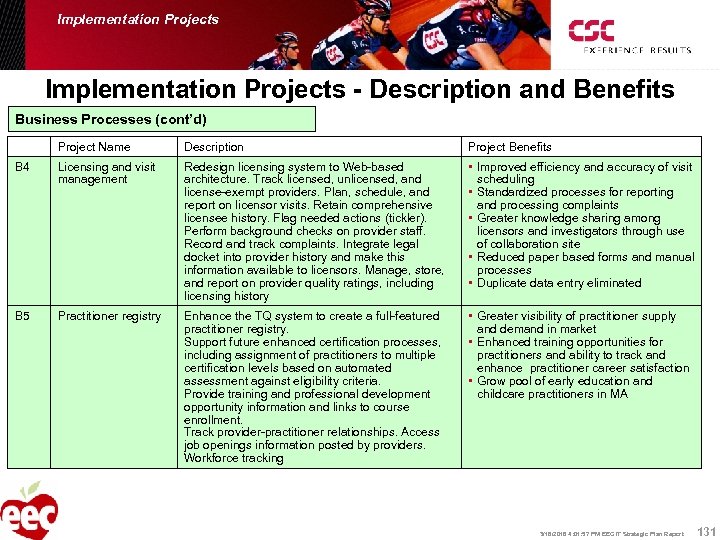 Implementation Projects - Description and Benefits Business Processes (cont’d) Project Name Description Project Benefits B 4 Licensing and visit management Redesign licensing system to Web-based architecture. Track licensed, unlicensed, and license-exempt providers. Plan, schedule, and report on licensor visits. Retain comprehensive licensee history. Flag needed actions (tickler). Perform background checks on provider staff. Record and track complaints. Integrate legal docket into provider history and make this information available to licensors. Manage, store, and report on provider quality ratings, including licensing history • Improved efficiency and accuracy of visit scheduling • Standardized processes for reporting and processing complaints • Greater knowledge sharing among licensors and investigators through use of collaboration site • Reduced paper based forms and manual processes • Duplicate data entry eliminated B 5 Practitioner registry Enhance the TQ system to create a full-featured practitioner registry. Support future enhanced certification processes, including assignment of practitioners to multiple certification levels based on automated assessment against eligibility criteria. Provide training and professional development opportunity information and links to course enrollment. Track provider-practitioner relationships. Access job openings information posted by providers. Workforce tracking • Greater visibility of practitioner supply and demand in market • Enhanced training opportunities for practitioners and ability to track and enhance practitioner career satisfaction • Grow pool of early education and childcare practitioners in MA 131 3/16/2018 4: 01: 57 PM EEC IT Strategic Plan Report
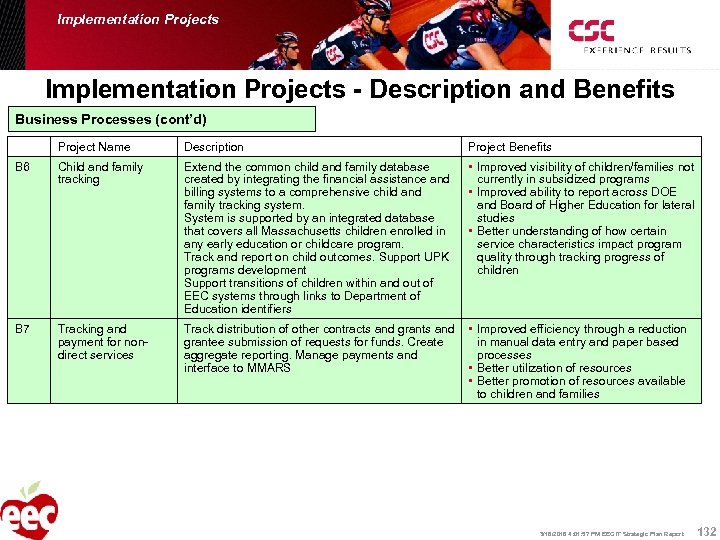 Implementation Projects - Description and Benefits Business Processes (cont’d) Project Name Description Project Benefits B 6 Child and family tracking Extend the common child and family database created by integrating the financial assistance and billing systems to a comprehensive child and family tracking system. System is supported by an integrated database that covers all Massachusetts children enrolled in any early education or childcare program. Track and report on child outcomes. Support UPK programs development Support transitions of children within and out of EEC systems through links to Department of Education identifiers • Improved visibility of children/families not currently in subsidized programs • Improved ability to report across DOE and Board of Higher Education for lateral studies • Better understanding of how certain service characteristics impact program quality through tracking progress of children B 7 Tracking and payment for nondirect services Track distribution of other contracts and grants and • Improved efficiency through a reduction grantee submission of requests for funds. Create in manual data entry and paper based aggregate reporting. Manage payments and processes interface to MMARS • Better utilization of resources • Better promotion of resources available to children and families 132 3/16/2018 4: 01: 57 PM EEC IT Strategic Plan Report
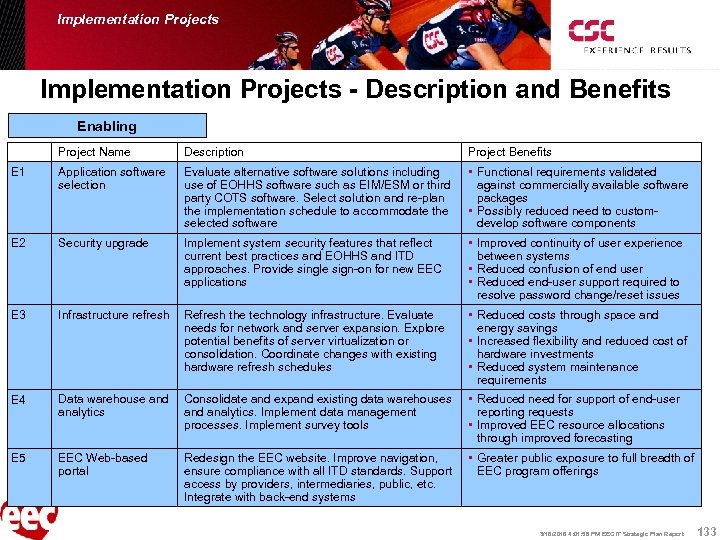 Implementation Projects - Description and Benefits Enabling Project Name Description Project Benefits E 1 Application software selection Evaluate alternative software solutions including use of EOHHS software such as EIM/ESM or third party COTS software. Select solution and re-plan the implementation schedule to accommodate the selected software • Functional requirements validated against commercially available software packages • Possibly reduced need to customdevelop software components E 2 Security upgrade Implement system security features that reflect current best practices and EOHHS and ITD approaches. Provide single sign-on for new EEC applications • Improved continuity of user experience between systems • Reduced confusion of end user • Reduced end-user support required to resolve password change/reset issues E 3 Infrastructure refresh Refresh the technology infrastructure. Evaluate needs for network and server expansion. Explore potential benefits of server virtualization or consolidation. Coordinate changes with existing hardware refresh schedules • Reduced costs through space and energy savings • Increased flexibility and reduced cost of hardware investments • Reduced system maintenance requirements E 4 Data warehouse and Consolidate and expand existing data warehouses analytics and analytics. Implement data management processes. Implement survey tools • Reduced need for support of end-user reporting requests • Improved EEC resource allocations through improved forecasting E 5 EEC Web-based portal • Greater public exposure to full breadth of EEC program offerings Redesign the EEC website. Improve navigation, ensure compliance with all ITD standards. Support access by providers, intermediaries, public, etc. Integrate with back-end systems 133 3/16/2018 4: 01: 58 PM EEC IT Strategic Plan Report
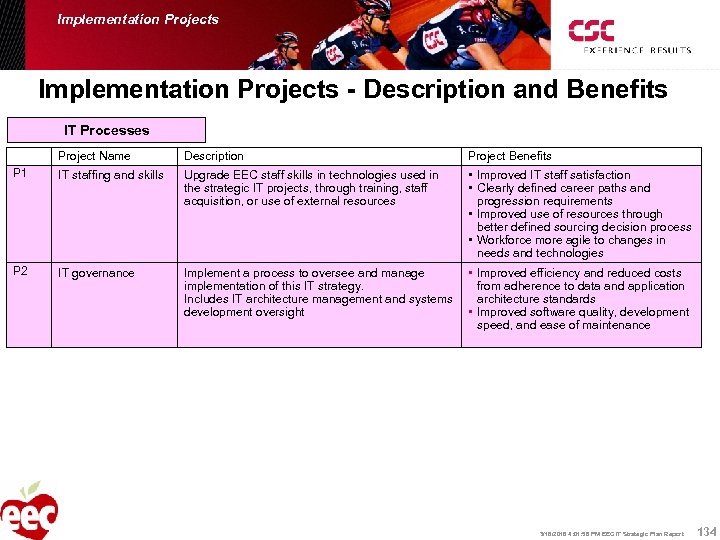 Implementation Projects - Description and Benefits IT Processes Project Name Description Project Benefits P 1 IT staffing and skills Upgrade EEC staff skills in technologies used in the strategic IT projects, through training, staff acquisition, or use of external resources • Improved IT staff satisfaction • Clearly defined career paths and progression requirements • Improved use of resources through better defined sourcing decision process • Workforce more agile to changes in needs and technologies P 2 IT governance Implement a process to oversee and manage • Improved efficiency and reduced costs implementation of this IT strategy. from adherence to data and application Includes IT architecture management and systems architecture standards development oversight • Improved software quality, development speed, and ease of maintenance 134 3/16/2018 4: 01: 58 PM EEC IT Strategic Plan Report
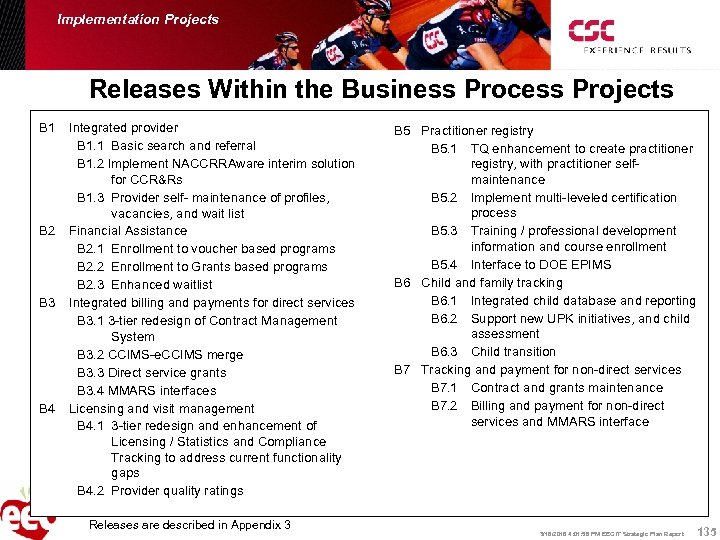 Implementation Projects Releases Within the Business Process Projects B 1 B 2 B 3 B 4 Integrated provider B 1. 1 Basic search and referral B 1. 2 Implement NACCRRAware interim solution for CCR&Rs B 1. 3 Provider self- maintenance of profiles, vacancies, and wait list Financial Assistance B 2. 1 Enrollment to voucher based programs B 2. 2 Enrollment to Grants based programs B 2. 3 Enhanced waitlist Integrated billing and payments for direct services B 3. 1 3 -tier redesign of Contract Management System B 3. 2 CCIMS-e. CCIMS merge B 3. 3 Direct service grants B 3. 4 MMARS interfaces Licensing and visit management B 4. 1 3 -tier redesign and enhancement of Licensing / Statistics and Compliance Tracking to address current functionality gaps B 4. 2 Provider quality ratings Releases are described in Appendix 3 B 5 Practitioner registry B 5. 1 TQ enhancement to create practitioner registry, with practitioner selfmaintenance B 5. 2 Implement multi-leveled certification process B 5. 3 Training / professional development information and course enrollment B 5. 4 Interface to DOE EPIMS B 6 Child and family tracking B 6. 1 Integrated child database and reporting B 6. 2 Support new UPK initiatives, and child assessment B 6. 3 Child transition B 7 Tracking and payment for non-direct services B 7. 1 Contract and grants maintenance B 7. 2 Billing and payment for non-direct services and MMARS interface 135 3/16/2018 4: 01: 58 PM EEC IT Strategic Plan Report
 Contents Project Approach Strategic Business Requirements and IT Baseline External Drivers Current Business State Current Technology State Fusion Tree – Business Requirements Fusion Tree – IT Requirements IT Vision – Initial Options For Data Integration IT Vision EEC business vision and benefits Vision for future state of EEC IT architecture Applications and data IT infrastructure IT organization and governance IT implementation approach and roadmap Proposed implementation strategy Implementation projects Implementation scenarios Proposed implementation organization 136 3/16/2018 4: 01: 58 PM EEC IT Strategic Plan Report
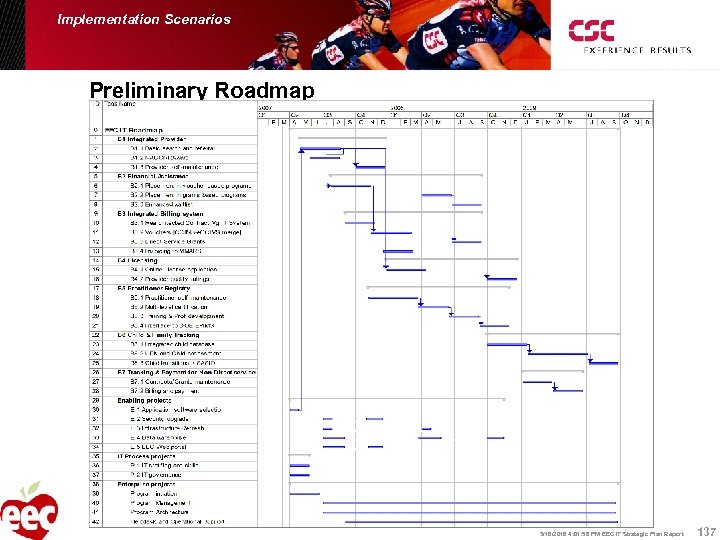 Implementation Scenarios Preliminary Roadmap 137 3/16/2018 4: 01: 58 PM EEC IT Strategic Plan Report
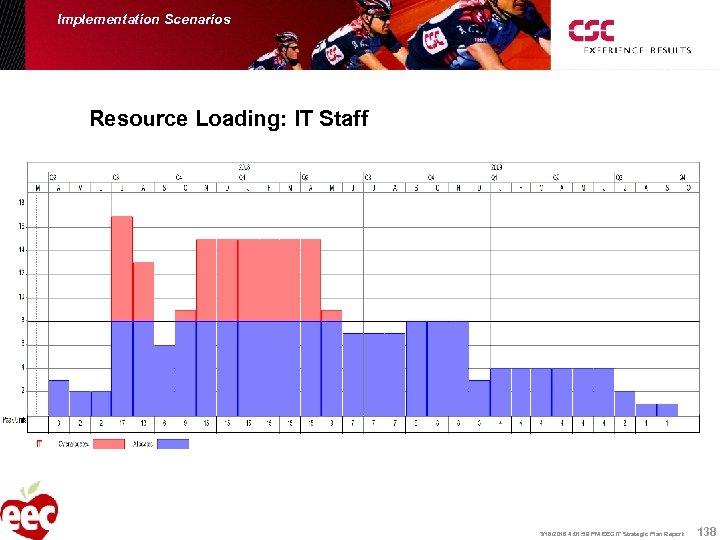 Implementation Scenarios Resource Loading: IT Staff 138 3/16/2018 4: 01: 59 PM EEC IT Strategic Plan Report
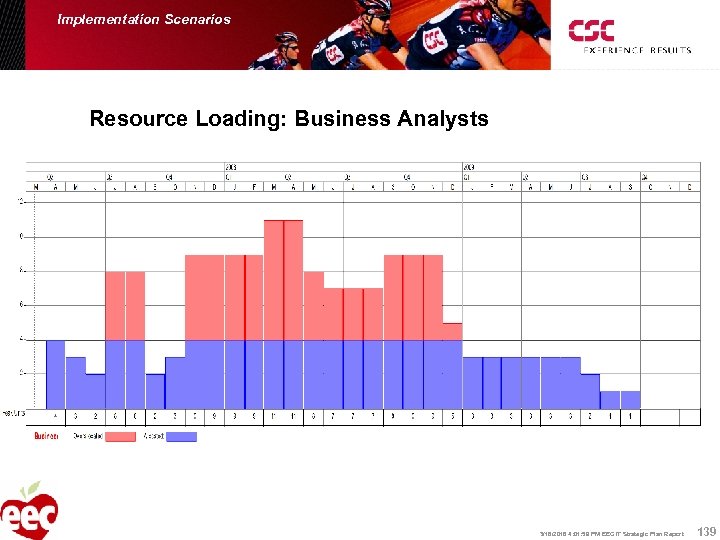 Implementation Scenarios Resource Loading: Business Analysts 139 3/16/2018 4: 01: 59 PM EEC IT Strategic Plan Report
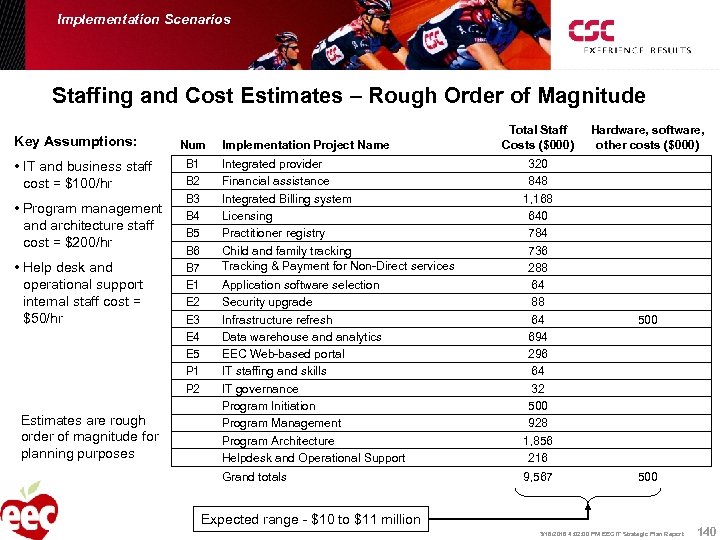 Implementation Scenarios Staffing and Cost Estimates – Rough Order of Magnitude Key Assumptions: • IT and business staff cost = $100/hr • Program management and architecture staff cost = $200/hr • Help desk and operational support internal staff cost = $50/hr Estimates are rough order of magnitude for planning purposes Num B 1 B 2 B 3 B 4 B 5 B 6 B 7 E 1 E 2 E 3 E 4 E 5 P 1 P 2 Implementation Project Name Integrated provider Financial assistance Integrated Billing system Licensing Practitioner registry Child and family tracking Tracking & Payment for Non-Direct services Total Staff Costs ($000) Application software selection Security upgrade Infrastructure refresh Data warehouse and analytics EEC Web-based portal IT staffing and skills IT governance Program Initiation Program Management Program Architecture Helpdesk and Operational Support 320 848 1, 168 640 784 736 288 64 694 296 64 32 500 928 1, 856 216 Grand totals 9, 567 Expected range - $10 to $11 million Hardware, software, other costs ($000) 500 500 140 3/16/2018 4: 02: 00 PM EEC IT Strategic Plan Report
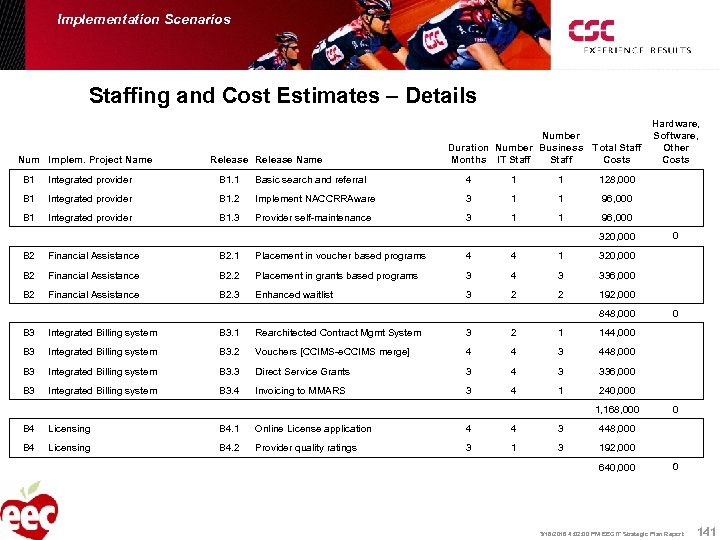 Implementation Scenarios Staffing and Cost Estimates – Details Num Implem. Project Name Release Name Hardware, Number Software, Duration Number Business Total Staff Other Months IT Staff Costs B 1 Integrated provider B 1. 1 Basic search and referral 4 1 1 128, 000 B 1 Integrated provider B 1. 2 Implement NACCRRAware 3 1 1 96, 000 B 1 Integrated provider B 1. 3 Provider self-maintenance 3 1 1 96, 000 320, 000 0 B 2 Financial Assistance B 2. 1 Placement in voucher based programs 4 4 1 320, 000 B 2 Financial Assistance B 2. 2 Placement in grants based programs 3 4 3 336, 000 B 2 Financial Assistance B 2. 3 Enhanced waitlist 3 2 2 192, 000 848, 000 0 B 3 Integrated Billing system B 3. 1 Rearchitected Contract Mgmt System 3 2 1 144, 000 B 3 Integrated Billing system B 3. 2 Vouchers [CCIMS-e. CCIMS merge] 4 4 3 448, 000 B 3 Integrated Billing system B 3. 3 Direct Service Grants 3 4 3 336, 000 B 3 Integrated Billing system B 3. 4 Invoicing to MMARS 3 4 1 240, 000 1, 168, 000 0 B 4 Licensing B 4. 1 Online License application 4 4 3 448, 000 B 4 Licensing B 4. 2 Provider quality ratings 3 192, 000 640, 000 0 141 3/16/2018 4: 02: 00 PM EEC IT Strategic Plan Report
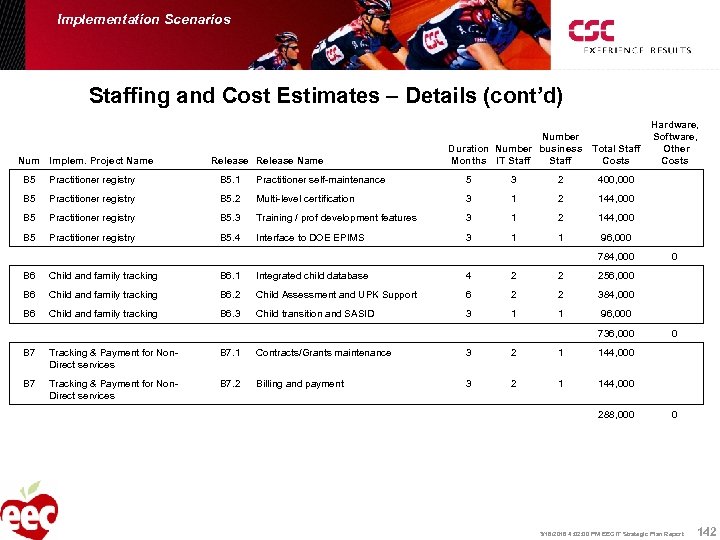 Implementation Scenarios Staffing and Cost Estimates – Details (cont’d) Num Implem. Project Name Release Name Hardware, Number Software, Duration Number business Total Staff Other Months IT Staff Costs B 5 Practitioner registry B 5. 1 Practitioner self-maintenance 5 3 2 400, 000 B 5 Practitioner registry B 5. 2 Multi-level certification 3 1 2 144, 000 B 5 Practitioner registry B 5. 3 Training / prof development features 3 1 2 144, 000 B 5 Practitioner registry B 5. 4 Interface to DOE EPIMS 3 1 1 96, 000 784, 000 0 B 6 Child and family tracking B 6. 1 Integrated child database 4 2 2 256, 000 B 6 Child and family tracking B 6. 2 Child Assessment and UPK Support 6 2 2 384, 000 B 6 Child and family tracking B 6. 3 Child transition and SASID 3 1 1 96, 000 736, 000 0 B 7 Tracking & Payment for Non. Direct services B 7. 1 Contracts/Grants maintenance 3 2 1 144, 000 B 7 Tracking & Payment for Non. Direct services B 7. 2 Billing and payment 3 2 1 144, 000 288, 000 0 142 3/16/2018 4: 02: 00 PM EEC IT Strategic Plan Report
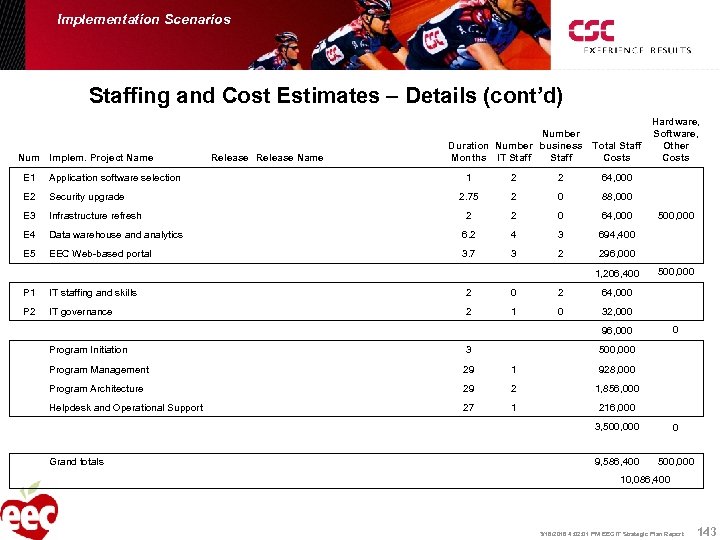 Implementation Scenarios Staffing and Cost Estimates – Details (cont’d) Num Implem. Project Name E 1 Application software selection E 2 Security upgrade E 3 Infrastructure refresh E 4 Data warehouse and analytics E 5 EEC Web-based portal Release Name 2 2 64, 000 2 0 88, 000 2 2 0 64, 000 6. 2 4 3 694, 400 3. 7 3 2 296, 000 1, 206, 400 1 2. 75 Hardware, Number Software, Duration Number business Total Staff Other Months IT Staff Costs 500, 000 P 1 IT staffing and skills 2 0 2 64, 000 P 2 IT governance 2 1 0 32, 000 96, 000 0 500, 000 3 Program Management 29 1 928, 000 Program Architecture Program Initiation 29 2 1, 856, 000 27 1 Helpdesk and Operational Support 216, 000 3, 500, 000 0 Grand totals 9, 586, 400 500, 000 10, 086, 400 143 3/16/2018 4: 02: 01 PM EEC IT Strategic Plan Report
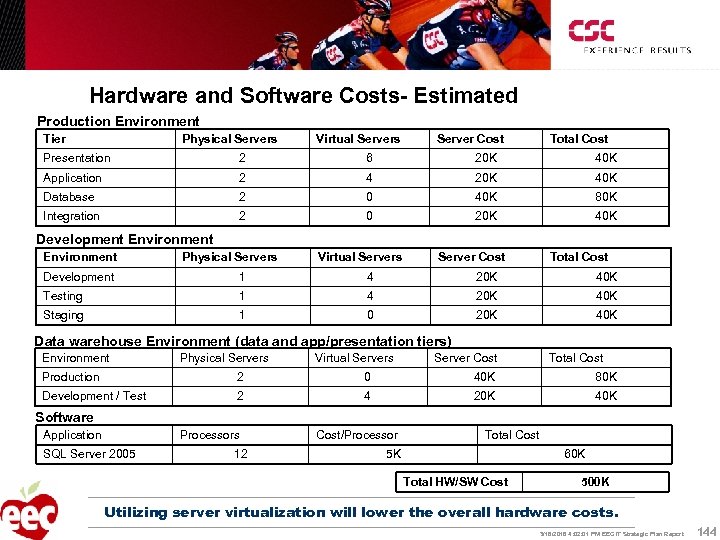 Hardware and Software Costs- Estimated Production Environment Tier Physical Servers Virtual Servers Server Cost Total Cost Presentation 2 6 20 K 40 K Application 2 4 20 K 40 K Database 2 0 40 K 80 K Integration 2 0 20 K 40 K Development Environment Physical Servers Virtual Servers Server Cost Total Cost Development 1 4 20 K 40 K Testing 1 4 20 K 40 K Staging 1 0 20 K 40 K Data warehouse Environment (data and app/presentation tiers) Environment Physical Servers Virtual Servers Server Cost Total Cost Production 2 0 40 K 80 K Development / Test 2 4 20 K 40 K Software Application Processors SQL Server 2005 12 Cost/Processor Total Cost 5 K 60 K Total HW/SW Cost 500 K Utilizing server virtualization will lower the overall hardware costs. 144 3/16/2018 4: 02: 01 PM EEC IT Strategic Plan Report
 Contents Project Approach Strategic Business Requirements and IT Baseline External Drivers Current Business State Current Technology State Fusion Tree – Business Requirements Fusion Tree – IT Requirements IT Vision – Initial Options For Data Integration IT Vision EEC business vision and benefits Vision for future state of EEC IT architecture Applications and data IT infrastructure IT organization and governance IT implementation approach and roadmap Proposed implementation strategy Implementation projects Implementation scenarios Proposed implementation organization 145 3/16/2018 4: 02: 01 PM EEC IT Strategic Plan Report
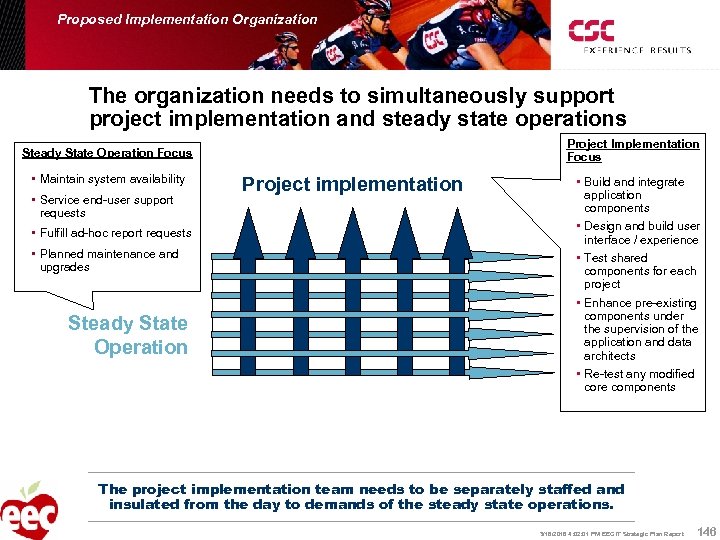 Proposed Implementation Organization The organization needs to simultaneously support project implementation and steady state operations Project Implementation Focus Steady State Operation Focus • Maintain system availability • Service end-user support requests • Fulfill ad-hoc report requests • Planned maintenance and upgrades Steady State Operation Project implementation • Build and integrate application components • Design and build user interface / experience • Test shared components for each project • Enhance pre-existing components under the supervision of the application and data architects • Re-test any modified core components The project implementation team needs to be separately staffed and insulated from the day to demands of the steady state operations. 146 3/16/2018 4: 02: 01 PM EEC IT Strategic Plan Report
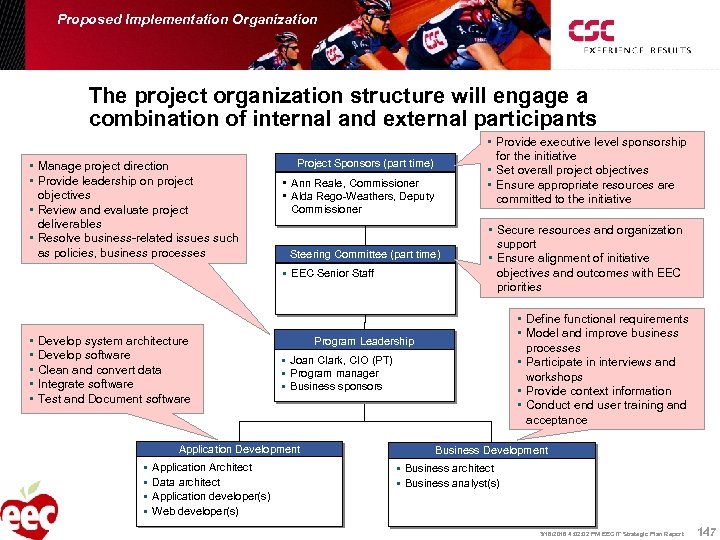 Proposed Implementation Organization The project organization structure will engage a combination of internal and external participants • Manage project direction • Provide leadership on project objectives • Review and evaluate project deliverables • Resolve business-related issues such as policies, business processes Project Sponsors (part time) • Ann Reale, Commissioner • Alda Rego-Weathers, Deputy Commissioner Steering Committee (part time) § EEC Senior Staff • • • Develop system architecture Develop software Clean and convert data Integrate software Test and Document software Application Architect Data architect Application developer(s) Web developer(s) • Secure resources and organization support • Ensure alignment of initiative objectives and outcomes with EEC priorities • Define functional requirements • Model and improve business processes • Participate in interviews and workshops • Provide context information • Conduct end user training and acceptance Program Leadership § Joan Clark, CIO (PT) § Program manager § Business sponsors Application Development § § • Provide executive level sponsorship for the initiative • Set overall project objectives • Ensure appropriate resources are committed to the initiative Business Development § Business architect § Business analyst(s) 147 3/16/2018 4: 02 PM EEC IT Strategic Plan Report
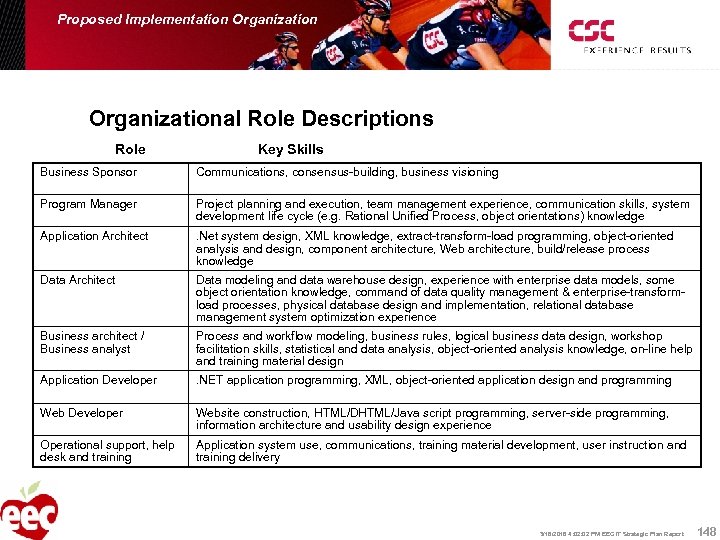 Proposed Implementation Organizational Role Descriptions Role Key Skills Business Sponsor Communications, consensus-building, business visioning Program Manager Project planning and execution, team management experience, communication skills, system development life cycle (e. g. Rational Unified Process, object orientations) knowledge Application Architect . Net system design, XML knowledge, extract-transform-load programming, object-oriented analysis and design, component architecture, Web architecture, build/release process knowledge Data Architect Data modeling and data warehouse design, experience with enterprise data models, some object orientation knowledge, command of data quality management & enterprise-transformload processes, physical database design and implementation, relational database management system optimization experience Business architect / Business analyst Process and workflow modeling, business rules, logical business data design, workshop facilitation skills, statistical and data analysis, object-oriented analysis knowledge, on-line help and training material design Application Developer . NET application programming, XML, object-oriented application design and programming Web Developer Website construction, HTML/DHTML/Java script programming, server-side programming, information architecture and usability design experience Operational support, help desk and training Application system use, communications, training material development, user instruction and training delivery 148 3/16/2018 4: 02 PM EEC IT Strategic Plan Report